Hello everybody. Welcome to our Agentic Masterclass. Today we're talking about from prompt to performance, the five steps of Agentic merchandising. I'm Anthony. I'm Jason. And we're so excited to have you here today. Before we jump into the master class and all the fun content, a few housekeeping notes. We've got moderators in the chat, so if you have any questions throughout the session, please ask them. We're very happy to to answer them. As well, the recording will be distributed with a nice handy link at the end. So whether you loved it so much that you want to watch it again or you want to share it with someone because you found something interesting, you'll have access to the recording. So no need to to record your screen. So let's jump into the fun. So everyone here knows and uses merchandising tooling today. Alright. Filters, boosting, campaign based listing pages, recommendations, facets, you name it. Everyone knows this stuff today. And everyone knows as well that a lot of the ways that people have used this software over time, yourselves included, is tactical. Right? There's always this mix of strategic and tactical work but a lot of small details whether it's you know, we work in multiple regions and we have to copy across all of our regions to make sure and and and mutate the language slightly each time. These are stories we hear day to day when we talk to our customers. But everyone wants to kind of move towards more strategic. This is a recurring conversation I have with all of our customers. All of our merchandising teams would like to spend more time thinking strategically, doing higher leverage things for the business instead of doing tactical work that's responsive. Right? Agents change what this mix can be, alright? So this is something that is a revolutionary technology, we think it's going to change how merchandising works but it doesn't happen overnight, it happens in stages, right? You might start by asking questions. At some point you might review a change and ask and and kind of gate things. At some point you might kind of equip it with a bit more context and and make it better. You might get to stages where you start really having the agents draft changes for you and automate away. And eventually you can get to a stage where agents with proper guardrails can take on a share of work for you and really kind of delegate and give you that space to work more strategically. But this doesn't happen one go, we earn each step one at a time. So this order is the subject of this session. Five steps from asking a question to trust a delegation. Jason, you have spent the last few months watching teams work through this kind of order. Take it away. Yeah. Let's dive into a bit more detail on those five steps that you introduced very nicely there. So as you said, most teams start with ask. And if we think about how we use, AI assistance today, think about ChatGPT, where you go on there and you ask a question and you get an answer back. So think of this about asking for insights. In natural language, you don't need to understand the terminology of how data tables and schemas are structured to speak how you would normally speak to a friend or a colleague. And as you start to graduate past that, we started to recognize with these AI assistants, you can get a lot more value than just an answer. Imagine you could start to actually approve and let this AI assistants go ahead and take action on your behalf. And at this approve stage, you're still really in control as the operator. The AI system works with you, proposes plans. You can tweak those plans, give some feedback, and ultimately, when you're happy with it, click approve, and work is actually done for you. Now, if you want to start handling your more challenging work, the agent needs a lot more context. It needs a lot more instructions on how to do things. This is where we're describing this third step as equipping your agent. So think here where you're providing more data to your agent, maybe external data that doesn't exist within your current system but exists in other systems that you want to connect. We'll think about providing more context to your agent. So, when I ask my agent, hey, AD, can you help me out with this thing? They know exactly that AD is not an acronym for audio description, but it's actually my colleague here, AD. And you're providing more context about your team, the business that you work in. Now, once your agent has all this context, it has instructions on how to get work done, and you've given it the data that's necessary, then you start to move to this new role where the agent will actually start drafting and presenting more proposals to you. But rather than this being one by one proposals that you're approving, you more kind of turn up to work, and you're given a batch of things to review, at one stage. And this is really powerful, right, because I don't know if you've ever had the writer's block when you start in a new document and you're thinking about how to actually start and you can stay and be frozen like that for ages. It's much more easier when you're given a draft for you to be able to move quickly, tweak some things, and get... Be more productive and efficient with your work. Absolutely. And the final step right up here, this is the act phase. So this is where you're clearly defining a boundary, where the agent can act within here. You're giving it very specific scope of what it can and what it can't do, and you let it act autonomously. Instead of drafting things for you, it will instead give you a report of what it did and the changes that it made working within the guardrails that you've defined. There we go. And I guess the other thing that I would say here is that a lot of customers looking at these five steps, you might be mapping where you are. Maybe you're just at the ask step here. And you're... What I've just described in act sounds magical, and you wanna get there straight away. But what we're going to take you through here is really graduating and moving your way through these five steps. No one goes from ask to act in one jump. You kind of have to work your way, build the discipline, the belief, and the trust in the system that you can get to that act phase. And I think another thing is this isn't five features, right? This isn't five products. This is the same kind of relationship with the agent evolving over time. That's what gets you to this final state. We want to get there with people. Yeah. So why don't we show them what it looks like to move from ask, what ask looks like, and what it looks like when you go from there to approve, and approving the product. Let's do it. So we're going to jump into a demo and show you what this ask and approve step looks like within our product with the merchandising agent. Hopefully, screen looks familiar to all of you. It's our merchandising hub. We're over here on the home page right now. And what we're gonna do is start the experience with the merchandising agent, and we're gonna go ahead and ask some questions. And asking is a really good place to get started. It's something to help you start to build a habit of working with agents. Asking things is something that's completely free to do. And what's the worst thing that can happen is you get an answer that you might not agree with, but you haven't made any changes to your storefront. It's all very local, and you getting a view into your data in an interesting way. Question I always get actually, why would I ask this agent here as opposed to ChatGPT, Claude, Copilot, the tools I use every day? Yeah. It's a good question. And the answer you're gonna get really depends on the context that those tools have available to you. So if you go ahead and you ask ChatGPT or Claude, a question about your performance on a listing page, it's only gonna have available the information that can maybe see publicly. Maybe you can see that listing page on your website that has no visibility into the views, the revenue that's driving, or the behind the scenes work to make that listings page work. Your... All your merchandising rules that you have then, the catalog data that's powering that listing page. Color making, Answer. So let's start within here. Let's have a look at queries related to drive systems that had high views but low conversion over the last thirty days. Futuristic talking to your computer like that. Yeah. Who types nowadays? You can see Not us. Way faster. Not us. So what you can see here is something really interesting. Our agent is starting to reason about the request that we've put within here, and it has access to tools where it can actually get information. And these tools are capabilities that are available within the Merchandising Hub. So we've asked here a question about our views and conversion data. And in the same way that you can see this information, if you go to your search manager, and within the product, you have all the data available within here. And all the data that's powering this screen is available as a tool to the agent that can query and reason about that data and the request that we've had here. So we can see within here, we've got a really nice response here from our agent that's had a look over the last thirty days and given us a prioritized list of queries to dive in into a bit more detail. Talking about tools here, how do we... How should we be thinking about which tools in the Merchandising Hub become available? How do they... How do you know, how how do we think of the the the the collision here between the agent and what it has access to versus the rest of the product? Are they the same? Are they different? What's it like? Yeah. So the the tools that an agent has access to is the... Based on the permissions that you have as a user. So me as a user, if I only had view access into this property within the Merchandising Hub, the agent would inherit those permissions. So it could query and view your data, but it couldn't do much else past that. But if you had a bit more elevated permissions where you could actually take action and maybe create rules, the agent has access to those tools as well. So just think like the agent is your body that has the same skills and tools that you have. Yeah. And one of the ways we kind of think of this is you know, when we were building new features in the Merchandising Hub, visual features that allow you to kind of traditionally kind of analyze data, go through flows. These are absolutely important things. This is gonna remain a big part of merchandising. But we wanna make sure that if that's possible kind of manually or kind of visually if it's if it's more of a a view thing, we wanna make sure the agent has access to it. So there's no there's no asymmetry between the two. Yeah. So another thing that I really encourage people when they're asking is to try and talk about the job of what you're trying to do. And this is a a real big change from how we've worked with technology, up until now. Before, you could only interact with technology and computers through the UI that's available to you. So if you had a job like, I've got this new product, and I'm trying to boost views to it, and there is no button or CTA here that says, press here to boost views to your new product. You have to translate into your head, well, I need to boost this new product. I know in this UI that I can go find this product and do x, y, and zed to perform the action. But now with working with agents, describe your intent, the job that you're trying to do. And although you might be preconditioned with I know exactly how to do this work, you might be surprised with the suggestions that you get back and inspiration of things that you wouldn't have thought of, initially. So should we give that a go? Let's try it. Okay. So let's have a follow-up question here where we're gonna say, okay. That's great. Our newly launched n d one three two dash zero zero one multi axis server drive isn't getting seen. Help drive more views to it. And let's send that prompt there, and let's see what suggestions we get back of what we could do with boosting the visibility of this product. I think it's a fantastic example too. Right? Like, this this is this is what merchandising is essentially. Right? It's it's understanding the business. It's doing, you know, it it it's kind of thinking of how we can drive outcomes and the strategy of our company. When we think about intent, it it changes how we work and we can go so much further. Yeah. Exactly. And you can start to see here the agent figuring out how to identify this product. Note that what I said and in my prompt, I didn't say we wanna do it on this specific listings page or that we wanna do something in search or something in recommendations. The agent is gonna go, and have a look and figure out, a lot of that thing. And we can see here that we've got some follow-up questions within here, where it's asking for, different ways to potentially, identify this product. So we're gonna do this based off of... This is based on our product ID. Give that information over here, the product. And when I work with an agent like this, I love when it asks me questions when it doesn't understand. Right? That's what makes me feel safe. It's not running off and trying to figure out something random. Yeah. It's like, you know what? We didn't know enough. So... Yeah. And this is what's really great, the fact that the agent has access to my catalog and all my data. I gave it a partial code for the product that we're boosting here. And it's recognized this and has actually found that. It found the full product daily. And as a merchandise, I'm probably not gonna include that initial part here because all my servo drive motors start with that. So let's say, yes, it's this one. Wanna make a quicker talk. Yeah. That's... See I'm even getting used to talking versus typing. And you can see here it's been able to validate and find our product in the catalog as well. Yeah. And this is this... I think it's a good example of tool equipping. And know media as a merchandiser a lot of times, if I was trying to do this through a manual rule, if I hadn't remembered that prefix this might have been a five minute job to go off into my PIM to find the right code to get this whole thing to work together. And those are the minutiae that just kind of kill your day. Right? You go off, you get into the PIM. The PIM system that's trying to do their best job has an alert that says you've got some problem here, you get distracted. And your rule that you really wanted to get out today, it gets out tomorrow. The more we can use context, the more we can keep you focused on intent and we can get you there fast. That's how agents I think are are changing so much and merchandise included. Yeah. So as we've seen there, we started with asking some questions, going a bit deeper. And the answer that we got back was a suggestion of a plan. And you can see within here, we proposed this plan to you as a user. And this is you graduating from that R step to that second step, which is about approval. And this is one of our core principles of building this merchandising agent is that the agent will not create anything without you giving your stamp of approval. So you can see here the plan is presented, we're given three options here. You might not agree with this change, and you can reject it. Maybe you kind of like the path the path that's going down, but you wanna change things a little bit, so you can click change and have that back and forth conversation. But if you're confident and this looks great, you can go ahead and click apply. And this is now... We've graduated to that second step. We're approving. Up the staircase. So we'll let our merchandising agent hear. It's been approved, and it's working through. I'm not sure if you saw within the within the screen here. It's gonna apply a boost rule, and it's targeting specific search queries where shoppers may find this particular product. It's looking at survey search queries and things like that. And we've got this confirmation message to say that the rule has been created and approved. And if you're gonna have approval, one thing that's really important is governance and being able to see what the agent has done, when it's done it, and who approved that change. And in the same UI where you see all of the rules and changes that you do, if we head over to our ranking rules here and we look at the most recent created rule, we can see here an agent created action boosting at a specific product, and it was approved by myself here as well. So you have all of that governance alongside all the other roles you created here earlier. That's right. It's not a side channel. It's it's it's the same it's the same kind of flow and concept. Great. So this was more kind of a a B2B environment and a B2B use case Yep. Where you're maybe working with more complex part numbers. But what does it look like for some of our listeners here who might not be working in B2B, but maybe more of a B2C environment. And let's switch over to an example here. So let's say that I am a category manager at Barca, and Barca sells water sports goods and to help you have all that fun when you go out in the water. If you know the Merchandising Hub, you probably know Barca Sports. Yeah. And you've probably had AD cheer your era of about Barca Sports. Absolutely. Lucky you. And let's say that I'm a category manager for wet suits. Yeah. And so I'm logging in, doing my normal work, where I might be analyzing the performance, of this listings page. Now I could come here, try and reason about and go through all of this data. And then from this data think about, okay, what can I actually do? What sort of actions can I take off the back of this data that's presented to me? Or let's see what how the agent could help. Exactly. While you pull that up, I think one of the biggest challenges sometimes with merchandising is where do I start? And you know, the data doesn't always point a nice clean direction. Right? We all know that. There's a bit of good here, there's a bit of down lift there. It's you know, and part of moving from tactical to strategic is okay, the tactical stuff is a lot of times just the broken stuff or fixing broken stuff. But as you kind of go up and as you graduate towards more strategic merchandising, you have to start playing in the gray area of you know, the nuance. That's where we can really have a lot of lift. There's so much more of the product discovery journey that is good but could be better than there is that is fundamentally purely broken. We want we want merchandising to be much more than unbreaking your search. Yeah. Exactly that. And let's give some tips out here as well working with merchandising agent. As you can see on the screen here, you can see a very chunky prompt here and I really wouldn't expect anyone to just open up a blank prompt and type something like this. This was actually the result of me having a back and forth conversation with the agent. I think what we've learned with agents and interacting with it is that agents are very good at writing prompts, way better than human beings are Absolutely. Formulating instructions and making sure all steps are captured. And this is a result of it. Honestly, when you open up the merchandising agent, give it a task that you're trying to do and ask the agent, write me a reusable prompt that I can use again, that I can paste, whenever I come back to do work, and just hit straight away, and see some results. So we've got a complex prompt here. We're gonna break this down a bit. And speaking of that reuse, have you already seen our customers doing that? So this is a behavior that I haven't... What... We've kind of seen a little bit of that. I don't know if you've noticed that when you're using the merchandising agent and you start it on a new chat within here, you'll see these suggested prompts that appear. Yep. And we're seeing a lot of usage of these suggested prompts, which is the same behavior. Right? It's a reusable prompt that you can run again. So people are starting to see values of this. You can expand this and start to write your own reusable prompts, save it locally. If you are a team and you work in Google Drive or you work in SharePoint, why don't you create a folder of your, like, golden prompt library where people have seen really successful results and save it on there so someone else in your team can also take advantage of it? Sounds like the kind of feature we should we should start working. I think so. More to come on that one. But, yeah, let's go back to our chat history. Go back to our prompt that we've got here. And what we're really doing here is this is a a facet optimization prompt that we've got here. What it's looking at is analyzing the performance of my wet suits listings page, and it's go breaking this down in steps here to see about how could we improve facets on our wet suits page to ultimately help our shoppers find the right products for them. And this is where agents scale so well. Right? This is all analysis that everyone here can do. I promise you it's gonna take you half an hour to do it to get to the actions. You can't do this for many of your listing pages, but when you can work with an agent this becomes viable and like I said before, the floor the floor goes up. You can have a great experience. Yeah. Exactly. So you can see here, the second step is reviewing what our facet configuration looks like on this listings page. It's told us about configurations that we've set here. It's reading what's live in your property, the brand and price facets that are pinned, but it also has access to your product catalog data. So it's had a look in your product catalog and found some really interesting attributes that your shoppers might want to be using when they are looking for wet suits product. We're not gonna end there. This isn't just telling you about what's available, but it's also providing you recommendations and giving you a recommended facet configuration and prioritizing which facets to rank in your configuration wet suits listings pages and the order to do that in. And like we saw before, it's not gonna go ahead and do this without your approval. You stay in control. You're the operator. At the end of the day, you're the person responsible for the performance of this category, so you should have the say of whether to approve such a plan. I think this is so interesting because from a facets perspective, we've invested heavily in things like relevance selection. And this is a great tool for search. Right? For search, you have your your default facet collection. You might pin a few category, brand, price facets, but on every query we pick the long tail and that's fantastic for search. I think listings live in a bit of a liminal space where what you can... There are enough listings that you can actually merchandise them a bit more locally and curate the facets. And what we're getting to here is really this this term curation. Right? Relevance selection is fantastic. It scales super well. It allows you to have this really seamless rex experience or sorry, search experience with facets. But one of the things that Relevance Selection might not understand is like taste, right? Do you understand that the height and width facet go next to each other because they're both together? When you're working with the agent here you're really kinda capitalizing on those tools we have and you can really kinda impart that that level of taste but still in a way that you know, we we delegate some stuff to automation and scaling and and other things more to better curation. You get to kinda gauge here where you wanna invest your time. You just get more... Much more out of it. Alright. So that was the demo. But let's talk about how do you actually move up this this step framework that we presented. Absolutely. So from each step to the next, we think that there's kind of a recurring set of graduation criteria. And the first thing is that I need to be able to understand any change an agent would make. Yeah. So let's say as an example, you're working with a merchandising agent, we're in the same team and you've gone with the agent and you've published a change to the agent, a new rule. I should be able to come into the system and be able to understand what an agent did, what rule published, what change happened since I was away. Exactly. It's no different than any other action. Second, I can understand the scope of what an agent would do before I approve it. Yeah. Exactly. At the end of the day, who's gonna be responsible for changes? We're gonna be responsible. You're gonna be responsible. You still hold a particular area and that you're the owner of, and you need to be comfortable with any changes before it happens and that it's working towards a goal that's important for you and your team. Absolutely. Third, we want a record of changes. Yeah. What we've actually seen, which is really interesting in our first set of customers who've been working with the merchandising agent, is the amount of work they're able to do and grows and they're able to be more efficient doing more actions. So you have to make sure that you've got a log of everything that's being done over that time period. I think this has always been kind of a piece of of hygiene in any kind of software. Agents just, you know, they they they they make it even more important. Fourth, changes have to be easy to revert. Yeah. Exactly. And I think it would be easy to think that, oh, why don't I just ask an agent to go and delete something. You have to be really careful when you get into that world of giving an agent tools or capabilities to actually delete. As Uncle Ben said to Spider Man, with great power comes great responsibility, and you don't want your agent deleting anything. So the principle that we're really sticking to here is that any changes that are made sit with if an agent did it or if a human being did it, it goes into the same set of rules, and you can go into a UI that's deterministic and have control of deleting something or reverting a change. That really helps our customers feel safe from the conversations that I've had. The fact that the agent just doesn't have access to deletion that you're gonna go through a more manual floater delete, it means that the downside risk, even if you see a big plan and you approve, it it'll never go in and delete stuff. The the the downside risk of using the agent is really mitigated by that. Lastly, when I grad... As we're graduating up here, we need to be able to kinda update our context over time, get smarter, get better. Yeah. And another tip when you're working with agents to give context. You might be wondering, well, what context is useful for me to share? Something that I love doing is asking an agent to interview me. So I'll give it a problem space, and I'll say, ask me questions about what you would want to know to help you do the right thing. And the agent will give you a nice set of one to five questions, something like that, and just work your way through and continue having that conversation. As that context grows, this is really what makes the Agentic experience better. It makes that agent a better teammate for you, someone that you trust. I think we're gonna talk kind of now about that next step, right? And so this next step that we've talked about is this notion of equipping. And it's kind of a bit of a fan out step in the sense that to earn those further steps up the stage, we want to make sure that our agent really kind of is of high quality, we build that trust. And so I'll talk to you about a few ways that an agent can kind of gain that trust. The first thing is skills. Tell me about skills. Yeah. So skills are, you know, when we were going through, we were typing these prompts and we we really nailed down a set of instructions to work exactly how you want it to work. You wanna reuse that over and over again. And those instructions, what how they're kind of referred to in the industry as simply just skills. It's a way to get something done and something that you've approved. That's right. If you think you're gonna do more than once, scale it. Second, what about tools? We talked about a bit earlier. Yeah. Yeah. So think about tools of the agent being able to do things. The tools could be reading your data in your product. It could be going ahead and creating rules. All of these things are tools. If you're more technical, just think of this as being able to access an API make requests to that API. They're all tools at the end of the day. I think this is a fun one too because today a lot of the ways that we built our agent is in giving it the same tools that you have access to as a user and it creates this nice symmetry and kind of reasoning. But one of the things that we think is gonna happen over time is there might be some tools that wouldn't really make sense to a human being, they're not really useful to you but if we gave it to an agent it would really solve some of their problems. So we increasingly see a need to better understand how agents are reasoning, what they're doing and if you come and kind of improve the quality of their tools that's gonna kind of raise their performance as well. Third one here, connectors. Yeah. So what we've gone through in the demo is the agent has access to really valuable data and that's available in Coveo. But you might have other data outside of Coveo that would be really useful to share with the agent. So in the same way that within your index you might want to connect other datas from other systems and have it in Coveo's index, think now of being able to connect your data with Coveo's merchandising agent. Yeah. Imagine a world where I have access to my digital marketing performance, right? And I can attach that and flow that into my product discovery experience. Imagine a world where I know about returns or product lifecycle management. All of these things are implicitly feeders into merchandising strategy. Today a huge amount of kind of what we do as merchandisers is you're taking all this context, you're translating into a strategy. Imagine what a world where an agent can work alongside you with that. Fourth one here, memory. Yeah. If you've shared some really useful piece of context on how to get something done last week, you don't want to repeat yourself again. That's right. Yeah. Yeah. My wife will know about that. So the... So again, what we're talking about here is this kind of equip stage. All of these things they compound on each other. Right? Imagine a world where you have skills to handle your repetitive work and they build off of enhanced tools or connectors. This is a compounding thing. This is something that is really exciting because you might build a little bit here and a little bit there and then suddenly when they come together it's a superpower. This is a really exciting stage and this is something that we care a lot about to kind of earn these next steps. Yeah. And something I'm really looking forward to is Coveo is putting out there for our customers Coveo's Merchandising Agent, but you will soon be able to start personalizing that to be your merchandising agent that has your set of skills, that has your connectors, that works off of things that you've shared and its own memory and that's personalized software. The future is bright. Alright. So we've talked about equipping, what about the next step? What do got here? So talk about drafting, we're actually going to walk through kind of a worked example. So SEO optimized pages are a topic that I've heard about as long as I've kind of talked to merchandisers and it's this idea that you can use your product discovery tooling and strategy to actually pull on one of the most important levers in your business which is organic traffic acquisition. And so you know, one of the ways that kind of digital market or sorry like SEO specialists will talk about this is this notion of a pillar strategy. So imagine you go to a DIY store and there is a barbecue listing page. Well on that barbecue listing page you might have a color facet, you might have a B2Us facet, you might have a another attribute based facet maybe like grill size or something like that. And what you can do is if you can identify the key differentiating facets that identify this listing page, I can fan this out. Right? So I have my pillar page which is barbecues and I generate a listing for black barbecues with two grills that are over 50,000 B2Us. And you can keep going over these and you can fan out into a bunch of listing pages. And what happens with these listing pages is they can capture long tail traffic because sometimes people on Google, they will go in and they will search for these kinds of terms. And if none of your competitors have indexed this kind of data or created this kind of listing page but you do when you have some backlink traffic, you get free traffic. And I've seen the data on these pages when you do this kind of pillar strategy. These long tail pages might get like five views a month, it's small. But on aggregate when you do this strategy you can really pull an important lever and create the kind of more of this value. Well, I've talked about all this, it sounds really good. There are some downsides to this. So one, which kind of keywords are we even trying to go for? Are we just fanning out everything? Are we creating a lot of waste? Are we creating a lot of cruff in our system? Are we making our merchandising harder to scale? These are kind of questions that that are really tough. And then how do I respond, you know, it's one thing to take the pillar page. How do I respond to the fact that Valentine's Day is coming up? That's an important thing to me and I should have some kind of response to that and I should have a curated page for that. These are things an agent can understand that a pure brute force method wouldn't work. So let's talk about how this could be drafted for me. Yeah. So you said first that one of the challenges are which keywords to start targeting and start building pages on. So there's lots of systems out there that you might have data around keywords that your competitors bidding on that you're currently not and you don't have any pages targeted to those words. And you might want to start being more competitive there and starting to get some more of the share of that traffic. Now going through, those list of, terms, it's large. It's time consuming. Absolutely. So why don't we get an agent to kind of go through this? And this is where not only just having a single agent, but what you can also actually create is kind of a council of agents. We love a good council. Each of these having a different perspective of lens on how to look at the data. And you might have one agent and that's focused on checking are these terms even right for my brand and the kinds of things that I want to be marketing out there. Exactly. This kind of team of agents thing is a really interesting concept, right? Because it mimics a lot of what we do inside of our businesses, right? We have teammates who come with different perspectives, where agents can also kind of take on these various perspectives and it leads to a more kind of varied and more intense intelligent result. Great. So at the end of step one, you've had this long list of data of possible keywords you could go for. You've had agents go through, distill all that information, and created a candidate list of keywords to actually start thinking about and creating listing pages for. And so how do you decide which products should go, on those pages? This is where Coveo can really help. You can search for those terms, using a hybrid approach. So you're not just, looking at this exact keyword in your catalog, but what's the meaning or the intent behind that keyword and start to leverage more of a semantic approach here to find other products in your catalog that actually match the intent behind what someone was after. It's such a cool way to reuse the experience you already are curating for your customers. Right? We're working so hard to build great search that that leads the market. This is a great way of purposing it towards this kind of curation, on that long tail. Exactly. And the next stage here is let's bring our team of agents in again. So we've now got a candidate list of keywords. We've got a proposed list of products to put on a listings page to target that keyword. But why don't we get our agents to, again, go through these possible products and then review it from different perspectives. Maybe you could have an agent that comes in here is more critical at looking, does this product really fit the term that someone is looking for? Is it still relevant? I think this is really cool too because there are lots of different ways to do this, right? So one in the literature you'll see things like LLM's as a judge. An LLM as a judge has its strengths and its weaknesses. We can use lots of different tools for Agentic voting. We can use some of our ranking kind of approaches like learning to rank as judges as well. So by equipping these these agents with tools, don't think of them as like a simple prompt. They can be actually quite sophisticated in how they evaluate this this this this kind of match of products to a keyword we wanna we wanna compete on. And so the the the results can be quite surprising and quite sophisticated. Yeah. And, next up here is how about now that we've got our agents have kind of given their seal of approval, on these sets of products. You don't wanna have to go and manually now configure all of these listings... That'll be crazy.... Set that up. That'll crazy. No. But an agent can go ahead and do that for you and do that in a batch and at scale. And what's beautiful in all of this is that before I've even come to my laptop, I land and I see a queue of potential listings pages that have already been configured with products. There's a well thought through strategy about why we're using these products on these specific keywords, why we're even targeting these keywords. And my job now is to now look and approve and publish those listings pages if I'm happy with it. Imagine this world, Today when... Talk to our customers about how they do SEO. They might have this you know brute force pillar type strategy. When they want to do these more intentional deep dives on SEO, this is something you do every three months, every six months, once a year, is extremely expensive. This is a very very deep process and SEO specialists aren't cheap, alright. These are these are these are people who kind of understand Google's algorithm, they're they're trying to to be adaptive here. An agent that can keep up here is gonna do this work every week. Every Monday you land on your desk and you just see the things that might change. You're you're not, you know, getting a boost every year on your SEO and letting it lag throughout the rest of the year. You're constantly staying at the frontier. You're constantly optimizing how you can work. This is the potential of a world where an agent can draft. Yeah. And that's the value of Step four, this kind of semi autonomous way of working with agents. That's right. So acting, autonomy within guardrails. This is the... This is this is where we wanna get to. This is nirvana. Tell us about it. Yeah. So acting here, we said one of our core principles is that as an operator, you always have the the seal of approval to kind of say you're happy and you approve that plan. But what about if you could define a boundary that an agent can act within? Let's go back to our category manager example where I'm working at Barca Robotics, that b to b organization. I might be responsible for that server drives and listing pages associated to that. And I might say that and be comfortable with this agent to act on one specific listings page Yeah. Not all of my listings page. And what it can actually do within that listings page is it can review the rules that are there. If they're performing well, great. But if they're underperforming and not driving positive impacts for that page, rather than me having to catch this and delete that rule, the agent can pause, delete that rule and whilst you're away, and making sure that it's optimizing and keeping your business performing. But what's really important here is that you've defined the scope that the agent can act within. It can't just go to every listings page and do this, but just the listings page that you've defined. And the way that you're interacting with our product now is you come into our product and instead of seeing maybe a draft of things that you can approve, you're coming here and you're seeing work that's being done whilst you've been away. And this is, you know, it sounds corny but this is kind of that virtual teammate that we think is going to be essential to competition over the next couple years. The the winners are gonna be the ones who who are able to offload tactical work to these kind of these other channels. And by doing this, think of how much time and mind share and and and and like lesser context switching I have that I can just focus on strategic stuff. I can create more value to the business. But this is earned, We gotta go through these steps. We gotta make sure that every... And every... You know, that people feel so comfortable with the agent. It's almost this world of every morning I show up, I look at the drafts and I just drone on on approve button. If that's where you get to, you're ready to act. Right? You're ready you're ready to let it have some guardrails but work within them. Great. So I'm sure many of our listeners that that hopefully is feeling inspired, excited of where the future can take them. I sure am. But where do they get started, AD? First, ask questions. Yeah. So as we've spoken quite a lot about already, asking is such a great place to get started and to start to change your mindset and how you think about things. Just building that habit of going in and asking the agent and creating that as a reflex, you'll start to see as you ask, you'll get more recommendations, more suggestions, and it's starting to let you trust the system and the sort of suggestions that you're getting to help you move along that step. Talking to our customers, I've been so surprised about this. They'll ask these questions and they'll constantly tell us these stories of you know, I didn't really think that I was going to get a useful response but I kind of like just asked some random question and it made me think of something different and I wouldn't have really thought of doing this this way. Sometimes the way we use software we get so used to well if this is the business problem you solve, I always do this. Right? I always use a pin rule. I always change the facet collection. We all get kind of a bit stuck in our habits and so having someone to check us there, just starting with those questions can already make us better before we even kind of get to some of the more advanced steps. Great. And the second one that we've got here? Action at scale. Yeah. Exactly. So this is where as you start to be more comfortable, in asking the agent and you're ready to kind of start approving, you can really start to be much more effective at your job. And with that busy work that used to take hours to kind of comb through the data, figure out the actions to take, you can really reduce that now down to minutes. And that means you can take more action on some of those areas that you haven't been able to spend time on. Yeah. I constantly hear of our customers who are kind of global multi region. You know, I am pushing for you know the color blue in this market or this specific kind of term. But you know the catalog is translated and so it takes me a while to go reproduce the rule with maybe a little bit of translation in Spanish and English and French and German and Italian and on and on and on. LLMs are so good at this, right? And so just kind of batching that out, starting simple and fanning it out, it's a complete change. And so a lot of times the organizations that struggle the most with tactical merchandising are the ones that can really benefit the most from this. It's a big game changer. Yeah. And last one, notes and tasks for delegation. Yeah. So for this one, and this is where... Think about the work that you do every day and and start thinking about that work that's very time consuming, busy for you. Start to think about where an agent can really help you be productive and start delegating some of that busy work so you can focus on the more strategic work where you really bring value to your business. This is... And this is fantastic because you know before kind of agents were a reality, this friction in your day to day was just kind of bad. It was just annoying, right? It was just a down party job and now when I have this friction in my day to day I'm like, oh, this is an opportunity to do something cool to make this to to actually like turn this into something that I can delegate and and I can make this better. I can turn this into something fun. So you know, the goal here is not obviously just to have fun, our goal is to drive great business outcomes. But there's something really exciting about how fun it is to work with these systems. It brings a big fresh breath of fresh air to day to day stuff that could have been kind of stale before. Alright. So questions that you should be asking before adopting an Agentic solution. First one I want to ask, can I see the plan before it acts? Yeah. So you've seen that within our product here. So an example of before it takes any action, it's gonna give you the plan step by step of what it's gonna do so you're in full knowledge of whether it's the right thing for your business. Number two. Can you see the scope of what's gonna be done? Is that... Is this gonna be a permanent rule? Is it gonna be a rule that's gonna be scheduled? How many listings pages is it gonna target? Is it just gonna target your listings pages or also your recommendation slots? Gotta feel comfortable. Number three, is it on record? Exactly. So this is where we're talking about as you start using the agents to take more actions, you wanna make sure that those actions done by the agent, at the end of the day, is gonna impact your storefront in the same way that if you were to go in and take these actions. You want all of these things being in the same place and seeing all of these actions there. Absolutely. I've never met an enterprise company that doesn't care about governance. Number four, can I undo it? Yeah. Really important. Maybe something that might be right in the moment is no longer right in next week. And as we start to collect new information, we need to be able to adapt and you have to make sure that you can undo those actions. That's right. You gotta feel comfortable. If you do press the button, you can always flip it back. Number five, how do I know the agent isn't getting worse? Yeah. So this is where over time as you start delegating this work, you wanna make sure that you keep seeing the output that you expect and you're still getting good results. And this is where what you might hear a lot about in the industry, the term evals. So this is where as you start working this world where agents are probabilistic in nature. So you can't really have your test case scenario that when someone clicks on this button, they should see this specific page next. Because what we're doing now is you're you're describing a natural language, and the answer that you're gonna get is gonna change with the data. So instead, what you need to do here is think about those scenarios, but instead of being very deterministic of this button leads to this, what are the sorts of outcomes that needs to happen? If somewhat... If you ask an agent about a listings page that doesn't exist on your website, you don't want the agent to hallucinate. You want the agent to be confident and tell you that listings page is not available. Does the merchandising agent have evals? It does. Sure does. So we're obviously gonna keep doing. That's right. So thank you so much. We appreciate you being with us today. I hope you had a good time and learned a few things. We'd love to hear from you. So if there are kind of things that came to mind, don't hesitate to reach out to to me and Jason. We'd love to have these conversations with you guys and ultimately build a great merchandising experience and the merchandising of the future with you. Thanks,
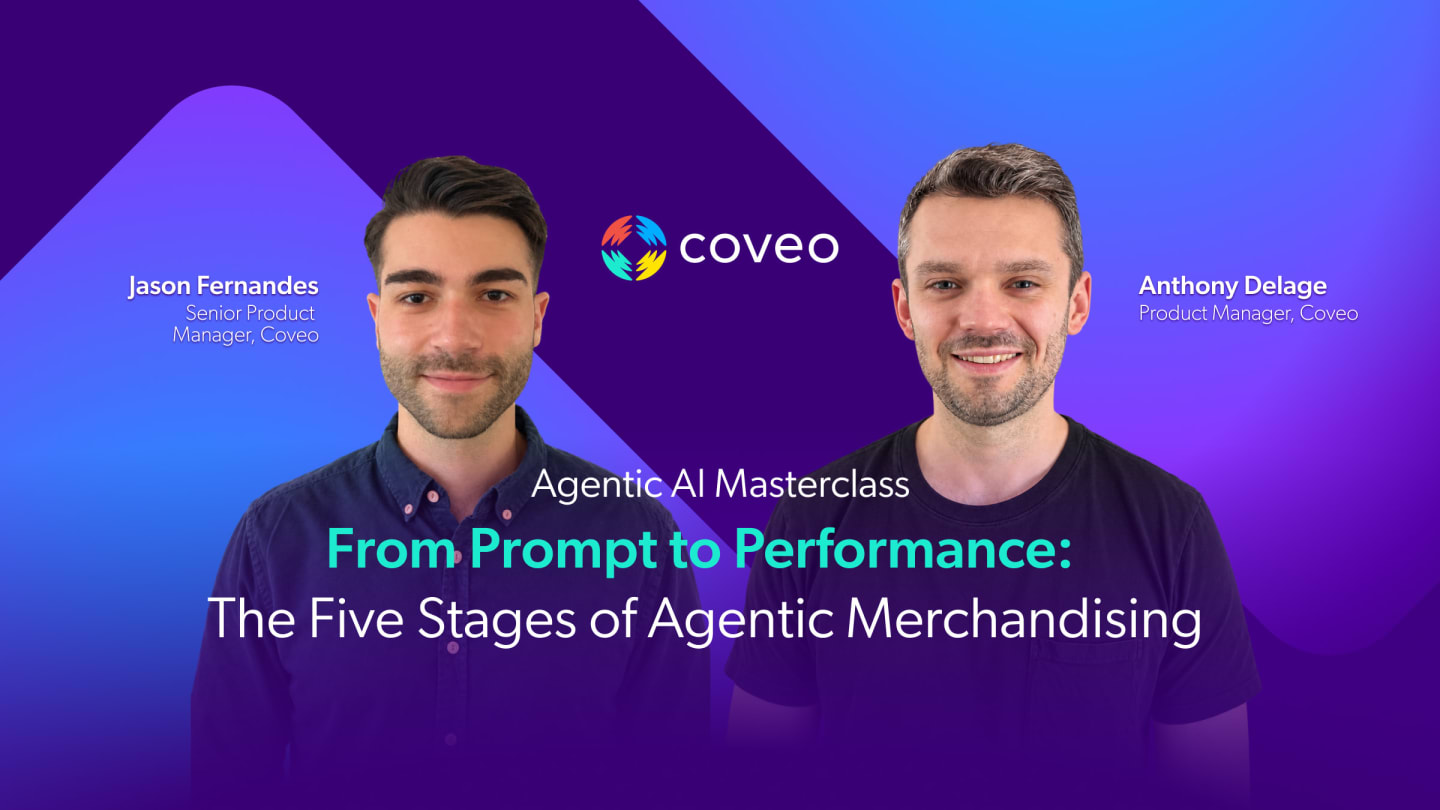
From Prompt to Performance: The Five Steps of Agentic Merchandising
Gartner predicts that by 2028, AI agents will automate 20% of the interactions across the buying journey. As agentic AI moves from the storefront into the back office, most merchandising teams stall at the same point: they’ll let an agent suggest, but not act. Autonomy isn't something you switch on. You earn it. In this masterclass, Coveo's product leaders walk through the five stages from one-off prompts to trusted delegation, with a real demo and a clear framework for what to delegate, and when.
How much of your merchandising team's Monday-morning cleanup would you hand to an agent today?
Merchandising teams already know how much of their time goes to tactical work: copying rules across storefronts, patching one query, adding another boost because the last one stopped working. An agent can take that work on, but only with the right context. As Gartner puts it, “[agent] quality will depend on the underlying catalog and RAG architecture.” In merchandising, that means your catalog, your rules, and how your best merchandisers make decisions.
What it takes to get agentic merchandising right
What you’ll learn from our experts:
- Move from asking questions to approving actions, with a person making the final call
- Spot which repeated requests are ready to become governed skills your whole team can reuse
- Know what to check (plan, scope, record, reversibility) before delegating more
- Understand why your team's context, not the model, makes the difference between an average answer and a good one
- Assess where your team sits today, and what the next stage requires


Make every experience relevant with Coveo