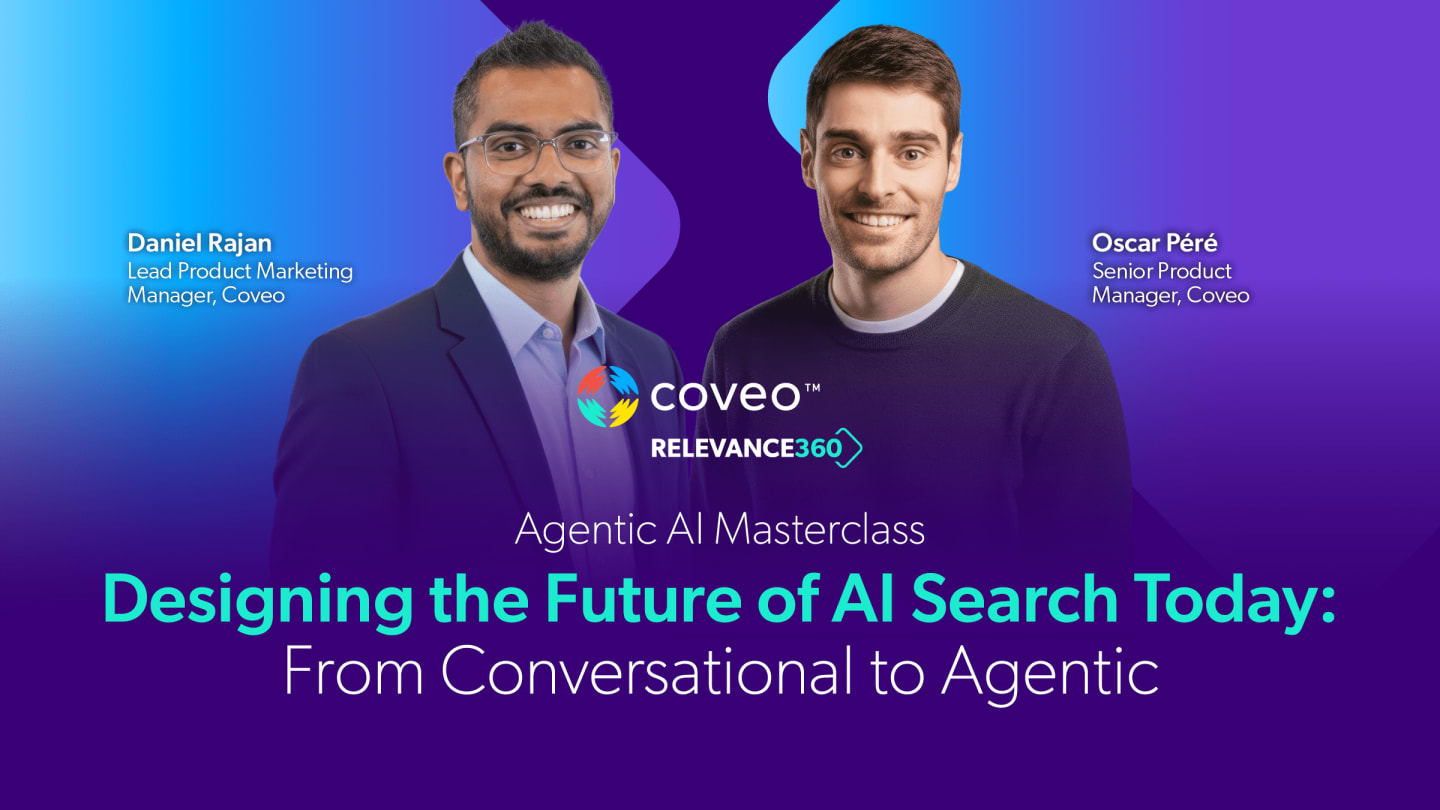

Hi there. Welcome back to the Coveo AI Masterclass series. Over the last year, we've been with you along this journey exploring Agentic AI, what it is, how do we use it, what the use cases are. But this time around, we're gonna explore a new facet of Agentic AI, and that is to design the future of AI search today and how to go from conversational to agentic. So it's gonna be an exciting session. We're glad that you're with us. I'm Daniel Rajan. I'm the Lead Product Marketing Manager at Coveo. And I'm Oscar, I'm a Senior Product Manager here at Coveo. We do have a couple of housekeeping items that we want to get out of the way. First things first, you are in listen only mode, so please participate with us in the Q and A chat. Will be engaging with you over there. And secondly, this you will actually see a brief survey at the end of the session. We'd love for feedback, so please respond to that survey. We would love to hear from you. And lastly, this session is being recorded, so you will get an on demand version after. With that out of the way I want to jump right in into the agenda. Firstly we will give you our read of the state of the market in conversational agentic where it is today. What we are seeing is in twenty twenty five it was a great year for Agentic. A lot of hype, lot of excitement around technologies, new models, new frameworks, all of that is great, but what we're noticing is use cases has hit roadblocks, it's kind of stalled, so we're going to dive into why those things happen, why AI agents actually fail in production environments And how to fix it, we figure it's search and retrieval. And search and retrieval is our heritage in Coveo, so we're going to be talking about how that search and retrieval framework evolves and really needs to adapt for agentic systems. Next part, I'm really excited about. Oscar, what do you have for us? Yeah, we have a few demos to show what Coveo can bring to the table and see it in action, really. Awesome. So this is our read of the market. The wow is now expected everywhere. Largely what we are seeing is you and I have had like wow amazing experiences with ChatGPT, with Gemini, you pick your vendor of choice. It's amazing, it's become a big part of our daily life experiences. But here's the thing, I want you to take a second to kind of see the visuals that you are seeing on your screen right now. It's a big contrast between the consumer experience and traditional enterprise search experiences. The truth is consumer experience is now the standard, and enterprise experiences really needs to catch up. And what you're seeing over here is broken, And just because the enterprise experience needs to catch up, the user is really not going to lower their expectations. Hey, it's enterprise, you know, that's how it is. This is going to escalate or worse, they might just walk away and disengage with your brand. So we don't want that to happen. What we are seeing is experiences now needs to be personal, it needs to be conversational, it has to happen fast. So Oscar, I'm curious about what you are seeing with customers out there. I know Gartner has put out the statement by saying by twenty twenty eight conversational and agentic AI will become the intelligent front door to self-service experiences. So is that what you're seeing out there with customers? Yeah, it's really interesting. We hear that intelligent front door being also a code name for a lot of our customers' projects or discovery projects with Agentic, but across the board, we are hearing is really a simple experience, I'll summarize it this. I want my employee, let's say, looking to have another kid and trying to find information about parental leave. So they want to go onto an enterprise portal or an enterprise surface and ask those questions. They want to get accurate information about what policy is and ask a few follow ups. But in those follow ups, the enterprise also want to deliver personalization. So the person can ask, how does I qualify for it? How will it be based on my contract and the vacation I already took? So they want the surface and the interaction to be personalized. And lastly, they want that employee to be able to submit a form or request for that parent to leave right away on that surface as well. So that's really the one, three we are hearing from various customers around various industries: accuracy, personalization, and ability to take action right from one single place. Yeah, we're starting to see the paradigm of conversational and Agentic to really start to merge. Conversational, yes, it has to detect intent, have a natural language engagement with your end user, but it's also about then Agentic takes autonomous actions on multi steps in solving complex queries for self-service and that's what we're seeing out there. So today I don't think any more customers are asking about what is Agentic AI. They've now shifted into asking how do I make Agentic AI work? And largely, I mean you are in the trenches with customers every day. What are the complexities in their journey? Yeah. Is many of you might be in that journey. And regardless of the vertical you're in, the industry, it's really about political organisational challenges along with hitting the road and seeing it through the lens of, okay, it's production ready. So the first thing we see is really having many projects going on at the same time. And we see it all a bit as architecture chaos. We've heard customers with over seventy chatbot agentic project active ones going on at the same time and trying to reconcile how they are not stepping on each other's toes, how there's awareness, whether it's co pilots and broadly available LLM's or if it's like your existing vendor that's upgrading its capabilities for agentic support like Salesforce is doing with Agentforce, we see different path and multiple paths at the same time. The other element is really delivering ROI. So if you continue, and we see our support leaders being a bit squeezed between thumb down mandates where the company wants to broadly adopt a technology or vendor while seeing also the bottom up reality and the friction that causes because you might have already existing system, a system of choices with which you are comfortable delivering ROI. Support leaders are in that grind where they have to reconcile different vendors, different technology while reducing cost and delivering ROI. So that's a really complicated problem. Yeah, it's almost political. You have to navigate through all of those things. Line of business leaders experience all this. Then there's also build and buy. What are you seeing with that? Paralysis analysis, right? There's so many options out there. Do we build? Do we buy? What's your It's a never ending question, really, build or buy. You always have pros to start building, but you also have pros to buy an existing solution like keeping up with innovation and don't have as high a cost of ownership. So this dichotomy really slowed down some decisions or some choices, and that's true with Agentic, so that's not going We're curious, what are the challenges that you are going through? We'd love to hear in the chat, so post those right away. And for the ones who actually make it through all of these obstacles, here's a reality check-in production, things aren't really looking pretty. Yeah, because we've seen customers get to pass the demo, the political, and launch at small scale their Agentic solution, and all the reality check comes in, like, well, the accuracy is not as great as they add in their demo or in their labs. Latency at a high volume and under that complexity really is suffering. We also see how the pilots can't really scale sometimes just from an infrastructure perspective, or it could be cost. The cost at scale becomes too big to really create ROI, the ROI you are looking for, and it's not mentioning the compliance that can break or that could be at stake with production, reality, and those real world queries. Yeah. So we are really broadly seeing you are not alone in this journey. If you look at recent headlines, everybody is going through this. Largely speaking, it's safe to say that AI ambition today is outpacing its readiness in production. This is where you know things start to break in real world enterprise complexity and if you look at those headlines you know trust is declining, there's guardrail gaps in the systems, Things are not really progressing beyond pilots. So it's not looking very pretty and agentic after the hype cycle that we've been through in twenty twenty five. And when things break, what really ends up happening is trust gets broken, it damages credibility and reputation, and that's pretty expensive to come back out of. So what you're going through is not something you're not doing this through isolation it's like that's what we're seeing out there and this is really creating a wow trust gap and that's what we are that's our state of the market today. There is a big gap that is emerging between AI promises and AI in production. If you think about it, trust in enterprise has traditionally been about customer data, privacy, security, compliance. All of that is true, but today it's going beyond just protecting customer data. It's about protecting customer experience. That's what trust is becoming today. It's about how do we reduce uncertainty in the output and the outcomes that AI drives for your business. How do we increase confidence and reliability and predictability? Right, it's about the definition of trust is expanded. And what we're seeing is this wow trust gap starts to emerge when your AI is not grounded in enterprise truth. Really taking it back to fundamentals, it's good reminder about garbage in garbage out and that your AI is only as effective as the data that you feed it. And so how do we fix this wild trust gap? How do we bridge that gap, right? So I want you to pause, take a deep breath, say it with me. You cannot prompt engineer your way out of a retrieval problem. We have to start I mean if we had more time I would ask all of us to say it five more times because it's that important. But we have to start getting away from this instinctive mindset that when things break, hey let's get a new model, let's tweak the prompt, let's add more instructions, let's be more specific. But the reality is prompts only control responses and not what model actually knows, not the knowledge part. LLMs don't know your enterprise. Retrieval is how they actually learn at runtime. I do want to stop and pass it back to Oscar. There is a caveat. I want you to talk about fine tuning. Yeah. Because as as you say, most LLM don't don't understand your company knowledge. Although you could really, like, fine tune whether it's a semantic encoder, whether it's a large language model, but those are very mature steps in the agentic and technology journey that you're taking on. So there are benefits, although if you don't have the basics, they're kind of useless and will waste a lot of resources and time, while there are other most cost effective and ROI effective solutions in the basics of retrieval to ground those agents. And the knowledge and the data that you need to ground your AI agents in the enterprise context is dirty, it's messy, it's large, it's complex, think of all of the synonyms that can I can use, I can go on? It's scattered, it's dynamic in nature, it's permissioned behind security walls, so to ground all of that is hard. And so if your AI agents and your systems don't have the right context and that right context isn't retrieved, your models really don't have something reliable to reason over. And so you cannot prompt your way into accuracy, you can't prompt your way into relevance, and certainly you can't prompt around permissions and make things work. So it's without a strong search and retrieval foundation that's grounded in your trusted enterprise knowledge, this wow trust gap starts to become inevitable in production. That's what we're seeing. Want to, Oscar, I want you to explain to our audience what does retrieval mean? Analysts that we have been speaking to start to interchangeably use the terms retrieval and search. What is your take on search and retrieval? What is the role of search and retrieval in Agentic AI and what can you accomplish with it? Let's dive a little bit into that. Once you've really acknowledged that there is this gap and that retrieval is one of the key elements to solve it, you would realize that search is more than just the UI that you are used to see. It's really that intelligence layer that goes from getting the data in, potentially transforming that data, whether it's like a knowledge graph, whether you transform a text to markdown, to prepare it for, retrieval and, models that would be downstream of it. You you have all the search techniques, and there are many out there today that you can apply different signals for the retrieval engine to pick up and and really create that relevance, and and also all the permission and the grounding. So the the search engine is really or the retrieval engine, I could say Yeah. Is really a a fundamental element you need in your stack. So it goes beyond UI. Also, the agent, what they need the most, although they are almost intelligent entities on their own, to work in the enterprise, they need the right signal. So whether it's passages, the full documents, they might need extra metadata to make sense of which answer or which document to pick. You you need a lot of tools for those agents to be able to reason properly. It's like giving your new employee a stack of, like, paper and documents or you give them a very clearly organized binder, that's the difference that retrieval will make in your process, in your Agentic process. So by really giving the right context at the right time through the right tools, retrieval enables that situational awareness and then you make the most out of the agent and the agentic solution you are trying to adopt and bring to your employees or consumers. So that's a bit how we should see search evolving and being retrieval as a more fundamental capability that could be applied and delivered across many use cases, many surfaces, and yeah, just go beyond the UI, really. Yeah. But hold on, you know, everything that you're saying is making sense to me, but it also sounds like my team might already be doing search and retrieval. What is your take on how search and retrieval needs to evolve for Agentic? Yeah, that's a good question. You might have a search engine, might have a retrieval engine, you might even be doing RAG already, which is great. But all those systems have been designed for human first retrieval, optimized for people, you and me searching through short queries, one query after another, no memory or states. And those search engines have been also been optimized for very fast latency, so milliseconds to get blue links and answers because that's what us human, impatient humans, are after. Now we see that there's a shift and not that this persona needs to disappear and the the retrieval engine still need to serve those users, but it now needs also to support the agent user and and keep up with them because they are using the system differently. They have longer queries, more structured queries that they use for their reasoning loops. They will also create or generate more queries than we can because they're machines, so they go faster and can really create spikes of traffic. They will use their memory to store that information and they will go after a wide amount, a large amount of information because the memories and the context windows opened up so much that they can, so why not? And they can absorb full documents and parse them and pick up the right signals. So it's it's a different user. It has different needs. It's it needs a different architecture, I think the the your retrieval engine needs to become, like, future proof to support the two persona at the same time. So Yeah. Really, it's it's it's raising the bar, the retrieval you have today needs to evolve to support those two users. Yeah, it doesn't remove the need for retrieval, but like you said, it raises the bar for what good retrieval needs to look like to support Agentic systems. So, so far we have seen why trust breaks, the emergence of the Wow trust gap, and how you need to fix it through search and retrieval. But next I want to show you what Coveo is doing about it and what our approach is in deploying conversational agentic experiences through three distinctive but relevant related applications of it. So I'm excited for this section where Oscar you're going to showcase to our audience how this is going to work in practice. So I want to share our posture of Coveo for conversational and agentic experiences. At the core, you have a Coveo AI relevance platform. This is your grounding and retrieval layer that indexes all of your scattered large complex enterprise knowledge and context. So regardless of where this data lives, you index it securely, respecting permissions, and this layer really serves as the trusted context for your agents to operate from. One, we have a Coveo agents. It's they are our suite of agents that are fully managed, agentic RAG solutions. We also have personal assistants and custom gen AI, and agentic applications. What ties all of these experiences together is the same foundation. Unified index, permission aware retrieval, hybrid relevance, and behavioral signals that makes all of these agentic experiences work at production. Oscar, I want you to take us through, I'd love for you to take us through what Search Agent particularly looks like. Yeah, no problem. So you should be able to see my screen. The Search Agent is really an out of the box managed experience that sits on top of the Coveo AI platform. So it's a prepackaged solution that you can really use to help with self-service support, agent resolution, etc. So I'll just do a quick demo, and you might be aware of our Gen AI feature called RGA. So let's imagine I'm a customer and I want to understand what it is and I want to add it to a pipeline. Just throwing all that to the search agent, and it's going to be analyzing a little bit the query and looking at various search results and search tools to get me an answer as expected. I can see the procedure, I can see the grounded content, and I'm able to continue the conversation. Let's say now I want to get a little bit deeper into the setup of my r g RGA model. I really wanna give it like exclude some queries and so it works only in certain use cases. So I'm gonna ask it to help me create the model association condition with a regex that exclude one word queries. So the search agent here acts even more as an assistant, guiding me through the knowledge base and doing some of the reasoning, for me. So here it's still using, some of the the documents, and giving me regex explaining what it what it's doing. I'm gonna point out a bit in the execution what it's doing so we could see here that there is the reasoning layer and the orchestrator between query document search, query optimization, and passage retrieval. This is where the agency happened really. Given the instruction, that are provided to the search agent, it has different choices and here in that specific instance, it reformulated my query and used some passages to build up the answer, evaluated it and gave me some follow ups. Okay. So, this is great. But I'm wondering if you're able to handle more complex queries. What if I want to exclude a certain product ID? Can you make that happen? Yeah, we can try it out and make the regex a little bit more complicated. So, let's say we exclude product IDs with specific patterns because you know that they are not relevant or it's a different line of business. So let's, let's see how that, unfolds. Again, there will be, the thinking and the reasoning, based on all the previous context we've had in this conversation. And so here it's telling me, here's the updated regex that you should be using in your model association condition. If I switch again to the Orchestrator tab, we could see did something similar. I didn't have to do a full document search here. It's using the memory, its own capabilities to build RegEx based on the passages that we have in our documentation. Lastly, I think what we see a lot is using AI to be an assistant in helping you complete tasks and steps. So let's say that now you did all this, but you're not the implementer, Danny. I know you're not. I hang out with you all the time. I'm supposed to be a little bit more of a nerd at this You should, but let's give the implementer the credit they deserve and they will probably be the one doing that regex and putting into the system. So I wanna summarize what we discussed and keep track of the the regex in an email. So that's just more convenient. I could just, like, ship it off to, the person that's responsible for it down the line. So search agent is working through, his hoops, giving me a preformatted email. I can I can tweak this? And here in the execution, we can see it didn't have to use any of the the search tools, really. It just reformatted and and used its own agency to to repurpose and follow my instructions. So, this is the search agent. It's a conversational experience that's grounded into the knowledge and that as that agency to use the various search tools or not, as we saw in the last query, to help self-service and customers. That's awesome. I love this whole UI interface that is really conversational. I would say that Search Agent, the main use case, is driving self-service success through a lot more conversational format that we are starting to see out there with the likes of GPT, Gemini, etc. And this is really amazing especially for enterprises to have this sort of an experience within the nine to five world. You deploy this in your employee portal, you could deploy this on your self-service support like public site. So even if customers might not be as used to it, see how queries are evolving and how the adoption of those tools is really great. So, yeah, we're excited to release it in the open. Awesome. But it's not the only product that we have, so maybe you want to show us. Yeah. So the next part is personal assistance from hyperscalers. Coveo has a way to ground your personal assistance on your enterprise data. It's more of a workplace scenario, I would imagine. We recently put out a ChatGPT integration. What do you have, Answer? Yeah. Let explain a bit further. So we do use ChatGPT internally, and initially it was only for just no. Would say modern task, but it was just help me summarize this email, do some research, but it wasn't connected to Coveo. With the platform capabilities and an MCP server that we released recently, we are able to connect ChatGPT to specific search pipeline that we know what's in it, so that GPT can be grounded on that data and use our search and retrieval tools. It's just a shortcut to getting this deployed to another use case really. So let me get a query. It's on our own data. So I want to understand, I wanna see the latest product roadmap, and I wanna understand I'm a salesperson, let's say, and I wanna understand if it's the Morgan feature is coming up, because I need the status for a customer. So I'm going to be using the company knowledge. There are some sources that are available. So here I'm looking at our internal docs and some Slack. So you could see it's searching through what I allow it to search for. You can see that it's doing multiple queries at the same time. It's reasoning over what it's it's finding. It's a little bit slower than or out of the box, maybe more optimized search agent, But nonetheless, it will get the documentation and the answer to my query. So we'll let him search the internal apps. Hey. It's doing a thorough job. So we can see it found the roadmap document. So it's not just us struggling to find what the product is releasing. Even ChatGPT is struggling. But hey, there you go. So it found the knowledge roadmap, gives me where the roadmap is referenced, it's answering my question. Yes, talks about markdown, here are some timelines that it pulls from various Slack channels, etcetera, etcetera. So it's able to give me a consolidated answer. Now I want to understand who owns this feature. Stop. Because let's say I am in sales or I'm in customer support and I kind of like need to ask a question to the product manager and get more details. So again, it's going to go through various various hoops of knowledge knowledge grounded knowledge and get back to to me with an answer. Oh, I I know who it is. You should know probably who it is too. You're exposing him. So you could see we have a technical person here, but you also have the product manager. So it's giving me a little extract and snippet to answer what I asked. So it's really interesting for an employee context to ground existing personal assistant onto Coveo. Awesome. Lastly, we also have Coveo augmenting or enhancing your custom Gen AI and Agentic applications. Talk us through what that looks like. Yeah. So, an example that we've released last year already is our integration with Agentforce, which is the assistant from Salesforce. So here I'm in Salesforce Console, usually what a support agent would see on this day to day. We have some traditional Coveo capabilities to the right, but when I click onto Agentforce, it's giving me kind of like the ability to chat as as an assistant. So I'm just going to ask it to solve the case for me. The case that we're seeing on screen here and what it's doing behind the scene is really leveraging our passage retrieval API to get the right information about the case and feed Agentforce and the LLM that's associated to it to answer, the support agent here. So here is the here's the solution based on the documentation that that is provided in the pipeline. It has the sources, the reference, and it's guiding me also through a resolution step. So maybe I want to classify it, maybe I want to create a knowledge base article for it. And again, it will use the Coveo search tools to grab the right information, reformat it into the instruction it has for how a knowledge based article should be structured for this specific customer and do the final generation for us. I mean, are really powerful use cases. Yeah. It helps improve productivity. In that case, it's like an agent productivity and I could see my knowledge article right here that I can then review, modify, edit, but most of the work of solving and updating the knowledge base has been done using Coveo under the hood. Surface is still Agentforce, but we really give the intelligence and the grounding to that system. Yeah, and I also see this is a really nice way to bypass some of the blockers that customers have with moving all of their knowledge and data into the native clouds of these ecosystems like Data Cloud has challenges And this is a really nice way for the customer to index all of the data without any migration, respecting security, and serves as that trusted context for Agentforce in the context of Salesforce to operate. So that's really neat. So, really what we were showing were a few application through direct integration, MCP or own best of breed application of the Coveo platform for support use case using the same relevance and retrieval platform underneath. Yeah. So to bring us back to the platform view, you have the same foundation that powers Coveo agents. You have fully managed Rag based agentic solutions and these agents can operate for specific use cases like search agent is to increase self-service success through a conversational format that can be deployed on your website, your customer portal, in your own properties. And then you have personal assistance where Coveo enhances experiences for a workplace scenario that you demoed and then you also have the custom gen AI and agentic applications where those experiences happen within those tech ecosystems or within those specific workflows that you are operating under. Correct. The goal is really to make you maximize the reach of the content and knowledge you have through that retrieval layer, and you can distribute that knowledge in any surface shape or form that you want. So, that's really a lot of options out there. Perfect. That was awesome, Oscar. So thank you for showing us what that looks like in practice. Before we wrap things up, I want to leave you with a couple of more slides. To zoom out and tell you that not everybody is in the same stage in their AI journey today. Some of you are in AI search, starting things out. Some of you are implementing generative experiences, which is great, it works. Others have graduated on into bringing those experiences, making it more conversational, and a few of you are really on the right hand side of the spectrum exploring Agentic AI. We spoke about the challenges and how we are addressing it. But this Wow Trust gap has a way to show itself up in every stage. So that is our heritage in Coveo, is search and retrieval. That is how we bridge the Wow Trust gap regardless of where you are. Coveo meets you where you are today and helps you scale along the AI maturity with confidence, along a safe and scalable path. That happens only because all of these experiences available in Coveo is grounded in your trusted enterprise knowledge and context. So we're not asking you to jump the line and graduate faster, that's not what we're saying. It's about helping you scale along your AI maturity journey at your own pace, but you're able to do that with confidence. And Oscar, as a final takeaway, if there were three things, what would you tell our audience to remember? Yeah, evaluation, evaluation, evaluation. We know how Agentic and Agents will confound a mistake through different systems, different calls, so you really wanna test this out. Human SME tests are great. You also wanna have, like, the proper evaluation frameworks in place to make to make sure you control the trajectory and and you can you have control mechanism in place. Also, make sure you are investing in a system, in a retrieval system and and architecture that can be shared across use cases. We know the scale of our enterprise customers, and being able to reuse a tool is fundamental. It will deliver ROI faster. So try to find the efficiency at scale. Lastly, don't just be wowed by a single demo. Make sure you see the benefits and you have metrics to qualify the outcomes at scale when you deploy live. So those will be like three takeaways, Danny. Yeah, that sums it up perfectly. So we are at the end of our session. At this point, thank you for listening in. Thank you for participating with us. We do have a couple of questions that we are seeing in the chat that we would love to take. One of the questions that I would love to take over here is, Coveo Search Agent and Agentic capabilities looks great. Is it live yet? When is it coming? Alright, so I have a two fold answer for this. First answer is that you can already leverage Coveo for Agentic solutions. So we've released an MCP server that could be connected to many tools. There is also an integration with GPT Enterprise, as we showed it in the demo, and you can integrate it into your own MCP server or your LLM of choice. You could already benefit from this. Now to your question or out of the box managed solution that we call Search Agent, will be available in beta starting March thirty first. So we're ramping up to this date, and we're really excited to bring those new capabilities to our Generative Answering capability. Yeah, can't wait for March for two things. One is spring, obviously. Secondly, it's the Coveo Search Agent coming out, so really exciting times to look forward to. Coming soon, stay tuned. The second question, probably the last in the interest of time, is do you envision Coveo search agent take action? I guess what they're trying to clarify is we've seen the agent summarize an email, but can the agent actually send that email, take further action? So we do see the need to expand beyond just answering and really being able to expand to other systems and workflows. Want to be Coveo wants to be that universal inbox that receives the customer query and can route it to other system if need be. So we're working towards this outcome, which means extending some of the Coveo capability to connect in real time to other workflow system. Coveo is not a workflow design system, it's rather like a retrieval system as we explained, But we see how the intelligence that we gather in our answer could lead to taking action in other systems. So we're working towards this, I can't give you a date just yet, but we have several great minds working on this. Awesome. Couple of other things, folks. Exciting news, the twenty twenty six Coveo Relevance Awards registrations are now open. So if you are a Coveo customer and are seeing measurable impact and ROI outcomes, love for you to sign up and register, showcase your team, give them the recognition that they deserve, we would love for you to sign up. Registrations are closing on Feb thirteen, so it's happening fast. It's Valentine's Day eve, that's one way to remember it. Maybe before we end this up, I also want to point out we have the Knowledge Relevance three sixty happening on March twenty fourth. So we're going to be unveiling a lot more around the search agent at that time, so we invite you also to tune in for that. Yeah, so scan the QR code or sign up at coveo dot com. We'll see you there.
Designing the Future of AI Search Today: From Conversational to Agentic
95% of generative AI pilots are failing to scale. Why? Because there is a growing "Wow-Trust Gap" between what AI looks like in a demo and how it actually behaves in a complex enterprise environment.
Coveo AI experts, Daniel Rajan and Oscar Péré highlight the fact that, “You cannot prompt-engineer your way out of a retrieval problem”.
Without a foundation of secure, permission-aware retrieval, even the smartest agents will hallucinate or fail to act. They also cover:
- Why LLMs alone fall short
- What grounded, trustworthy AI looks like
- How conversational search actually works under the hood
- The scalable path forward for your organization