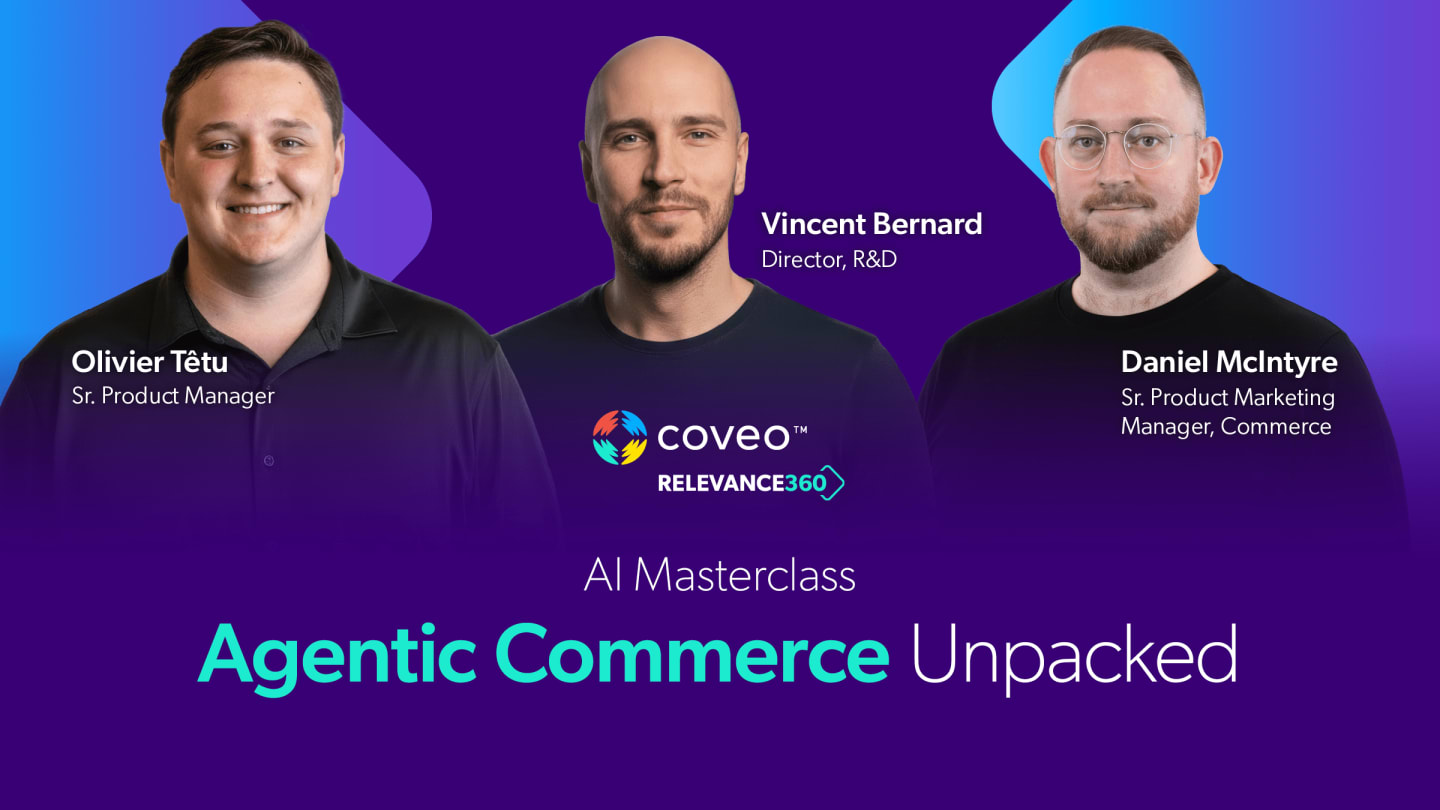
Hi, everyone. Thanks for joining us today in our AI Masterclass, Agentic Commerce Impact. I'm Daniel McIntyre, and I'm a senior product marketing manager at Coveo. I'm thrilled as well to introduce two of my colleagues, Vincent Bernard, director of r and d, and Olivier Tatou, one of our senior product managers as well. I've got a couple housekeeping items to talk about just before we get started. So first, everyone is in listen only mode. We do want to hear from you throughout their presentation, so you're going to be able to ask questions and we're gonna answer them in the chat, so please make use of that feature at any point. At the end of today's session, you're gonna see a brief survey on screen. We really appreciate feedback because it helps us to make sure that we've got programming that is relevant and of interest and also helps you in your business. And also at the end of today's master class, you're gonna get a link to watch this on demand, which will happen right at the conclusion of the event. So, with that in mind, let's get started. Today we'll be covering a few different subjects. So first, I think we'll give some perspective on what Agentic Commerce actually is, how it's changing buyer and shopper behaviors and experiences, and then how Coveo is actually implementing agentic technology into our commerce products. I think it's important as well to talk about what to consider to prepare to actually make use of this new technology so we'll wanna leave you with some takeaways as well. So to start, let's ask a simple question. What is Agentic Commerce? Well, it depends on who you ask. There's a lot of different opinions on what it actually is, what can be, what it means for customers and businesses and experiences, and really they all boil down to some really really big promises and big claims. The biggest one that I see is it's gonna change everything forever. I'd argue the reality is not so drastic, but there's a lot of opportunity and value to actually get to once you really understand what it is. So to repeat the question, what is Agentic commerce? Well, I think it's best to start at the actual idea of commerce itself. So how do people shop and what makes them actually buy things? Commerce used to be a mobile practice where it was mostly trade based and over time it evolved into a static experience like a market which then also evolved into the stores that we see today. For in person commerce today, we see a few different ways that people typically engage. So customers are shopping on location. They're browsing for products, you know, getting to actually touch them. In store experiences or merchandising tend to be able to drive behavior or get people to engage a little bit more like an activation. Most importantly, salespeople are there to actually engage. They can give advice. They can recommend products. They can ask questions and they're there to enrich the experience. In the actual experience of commerce, whether it be in person or online, people usually come with a range of intents. So there's a couple that you can't do a lot about. So the first one being no intent visits. In a real world context, this could be like maybe a delivery. This could be somebody coming just to browse that doesn't have any intent purchase and you know that. There's not a lot you can do in that situation. You can try but not always worth the effort. Another one is strong intent visits. Once somebody knows what they want, if they're coming in with that intent, they are there to actually perform a transaction. You know they're there for a reason. You can try to add on to that but you can't really do much to move the needle in a good circumstance. However, for visits with unclear intent, that's where the opportunity typically lies. Shoppers are actually more interested in exploring or discovering rather than knowing exactly what they want. This is where you can turn that exploration into purchase intent. So this is where a salesperson typically would be your greatest resource. A really good salesperson will do a few things kind of reliably. One, they'll listen for intent and preferences. They'll ask some answer or they'll ask some questions and get some answers if they need it. They'll use that context to actually make decisions and buy trust or build trust with the buyer or the shopper. They'll factor in constraints inventory availability or say I've mentioned a price range I'm willing to pay, they'll factor that in as well. They know when to act or they need to ask questions to get some more information and they'll follow the rules and the policies set by the store. Maybe you're trying to push a specific item or a brand or something. That salesperson's knowledge is multifactorial. It relies on input and output and that kind of cascades into an actual sale or a purchase. So in a digital context, it's not terribly different but it's a little bit more self serve by nature. Shoppers will come in and they will be shopping and browsing but they'll be using, you know, the search. Sometimes they'll be using, actual product listing pages. It will be on a storefront or a portal. They'll be engaging with recommendations that you might have implemented across the site. They'll be using content if you have it to inform purchases because they're gonna want some additional information. And then evolving right now and recently has been AI tools that actually help guide shoppers into a purchase decision. And there's also a lot of other factors that contribute to bringing people in and getting traffic in. Some can be, say, brand loyalty. They can be domain authority. They can be contracts for B2B, you've got a list of items that they know are gonna be available on this this particular portal. That can help bring customers in. But once they're there, the same things tend to apply. So we have often a range of intents that is very similar. Once somebody's there with no intent or it's a bounce or say it's bot traffic, you don't wanna use that that information to make decisions. Strong intent visits, you don't wanna get in the way. You wanna make sure that people can actually get to the products they're looking for as quickly as possible without as much, without without wasting time, without any impediment. And then in the middle is where you have your unclear intent visits. This is where guiding the experience actually turns that exploration into purchase intent. So just like in person, an e commerce experience that is at its best is going to do the same sort of things. It'll listen for intent and preferences. It'll ask questions and answers if it needs to. It'll use gathered context to actually make decisions, build some buyer trust. It will factor in constraints like inventory availability, location. It will then know when to act or when to get some more information and it will follow the rules that you actually set behind the scenes. In a digital context, it's even more important to think about how easy it is to find products, how to guide shoppers down where you wanna guide them, and how to drive purchase intent. But without a physical salesperson involved, what can you do? So at Coveo, we know that AI is the foundation to how we approach commerce. B2C shoppers and B2B buyers all expect a modern interface and a modern experience. They want relevant search results. They want recommendations that make sense and they wanna make sure that products are easy to find. This is actually backed up by our own research. This is something that we see in research that we encounter but every year we publish a relevance report. So upcoming, we have some new figures that I'm previewing it right now. We know that ninety percent of shoppers expect experiences to be as good as or better than an in store experience. We also know that shoppers are expecting conversational to be the next evolution of how they shop. We know that fifty nine percent of customers would use AI if it can answer them in real time and we know forty percent of customers are more likely to purchase when supported by AI. So until now, there's been two main ways that AI has shaped experiences that, that have driven commerce. So the first one being AI search. This uses machine learning to predict intent and then optimize results based on shopper intent. It results in relevant search results, ranked products that are easy to find, recommendations that make sense, so on. Then we've had generative AI. This generates answers to questions. It can also generate product content. It helps guide the shopper, it helps increase confidence to buy and it contributes to the authority of a brand. Behind the scenes, merchandisers can actually, manage this AI and make sure that they have full control over the experience and they use AI insights to make better decisions for the business and drive KPIs that matter to them. But things are changing, so it brings us back to the question, what is Agentic Commerce? So I'd argue it's not really a feature. It is a, in simple terms, a change in how experiences are delivered both to shoppers and to merchandisers. Agentic Commerce is a system. It interprets intent. It can decide on best next actions and works within business constraints to deliver results. Some key components that make it up are the agents themselves. This is little pieces of autonomous software and our GM calls it agents are little software robots which I quite like. They can actually perform tasks, they can reason and they can act. They work in a system and they communicate and establish protocols. You might have heard of MCP servers or MCP. More recently, there's UCP which is universal commerce protocol. And then to do this, they also use data and they can call APIs to fill in data to actually perform specific tasks. So if you put it in another way, Agentic Tech has evolved and it's a major step forward. It brings the power of an in person experience to digital commerce. It powers the conversations that adapt and deliver product results and answers and compares products and the impacts can span from B2C to B2B. They span from, you know, the front of an actual e commerce website or portal to the merchandising behind the scenes. So it updates generative experiences and makes them conversational. They, actually understand and engage with shoppers in natural language and adapts in session to respond to that input. And then adding to that, Agentic can actually, reason, it can decide and act to perform multi step tasks that shoppers and merchandisers might wanna perform. The promise of Agentic technology for enterprises is pretty tangible. Shoppers get an intent led dynamically tailored experience that's just as compelling as an in person or sales assisted. It's trustworthy and due to real time catalog data and constraints like availability, location, entitlements and pricing, it's always up to date. And when powered by Coveo, it actually unifies all of your scattered data and makes it a composable implementation. And with that in mind, I'm pretty excited that we can talk about two new commerce features that we've recently launched. The first of which is for shoppers. So this is conversational product discovery. It's evolving the search box into into an intent box and it's our first milestone towards that goal. It's a conversational interface that gives an expert like experience that answers questions and guide shoppers. It delivers relevant product suggestions and compares products. It's supported by a dynamic UI and an interface that actually adapts to user intent as it goes. And then for merchandisers, we have our Agentic Merchandising Copilot. This is a merchandising assistant that interprets natural language commands, it analyzes data, it can make changes, it delivers insights and previews suggested actions. But most importantly, it gives merchandisers complete control to validate before any changes are made. And now I'll hand it over to Vincent and Olivier to walk you through these two new features and tell you all you need to know. Thanks, Daniel, that context. Really helpful to understand where we are in the market right now. I'm Vincent Bernard, director of R and D. And I'm Olivier Thesaurus, senior product manager for commerce. Let's jump right away in the conversational commerce demo. This is Barca, our B2C implementation. It has all the best feature we have to offer. So if we hit the search box here, you're gonna find right off the bat some product suggestion, query suggestions. This is packed with feature like personalization as you go and filled with ML ranking options. If you type something like kayak and you fire it up, you're gonna reach a classical commerce search interfaces with filters, with beautiful product tiles here, prices, swatches. So really a classical experience. What happened if we just tried to hit the search box again, but with a much more complex or more human like query, like breakdown for me the different tiers of kayak? You can see here that we have the little sparkle icon, which is kind of a new standard for, everything that is generative. And then if we fire it up, we're gonna enter on the search page with a very different UI. First off, why did we decided to not have for instance a chatbot and a search experience? Why are we merging them together? Yeah. Good question because we keep getting asked about chatbots all the time. However, what customers truly want is a unified experience. Right? They see chatbots as a way to deliver, you know, conversational capabilities to their front ends, But it's not the only way, and we believe there's a better way. Right? So, Vince, to your point, you know, we want a single search box to handle multiple intents and queries. Right? Indeed. Indeed. And and you see that you can flick it on or off, but right now, we're able to route it automatically. Fire it away and the first thing you notice is that it's a little bit different for sure. The first step we have here is that box that says thinking with an incremental step counts. What's happening there? What's happening there is that you're seeing our new discovery agent. Right? And then the in this use case, it's really made for conversational product discovery. But under the hood, what we we what we've built is essentially a very smart agent that's able to reason based on the user input and not only display the right content, but decide what to query and which tools to call to actually display the right content. And then, you know, we'll get into it a bit later, but it also decides how best to render it and how to dynamically handle, right, all this content that's coming back. You said tools. What what kind of tools is under the hood available for for that orchestrator to pick? In this case, right, today, it's really based on our commerce search for catalog search as well as our search API. But we can see here any tool that's made for a retrieving a retrieval in a specific task. Right? So you can think about in this case, wanna break down the tiers of kayak. You need to first understand, you know, what types of tiers of kayaks are useful. So you need to understand what corpus of kayaks are available to this agent in the cell in itself. And then, you know, if you have an an an any additional rich content to support this, right, you can also use it to further ground the kayaks, if you will, and that answer, here. The cool place the cool spot here is that we didn't instruct the bot that there is different tiers of kayak. It's basically it's not even reading from the documentations. It is just querying and understanding the kind of results set that is available. And what's really critical here is what you said, Vince. Right? Because in this case, it's a very simplistic demo internally for Barca. But we we work with all kinds of enterprises that have all kinds of requirements. Right? So it's really critical that the agent is able to really think on its own. And in this case, it's five steps. It could be five steps. It could be one step. It could be two hundred steps. Right? If we were to prep like, ground it upfront, we would prevent it from answering in some cases. So there's no limit in terms of step depending on the complexity of what I'm asking. It's just gonna try to dissect. The goal is not to limit the steps. It's really to hone in on the right level of precision based on the quantity of compute you're consuming here. Right? So, like, the goal here is, of course, not to over bloat the number of steps, to not make the experience bloated, slow, and expensive. Rather use the right amount. Right? And I think that's the intelligence behind this. And at one point, if I'm asking a bloated question, it's a little bit my fault. Exactly. Let's jump a little bit on the results set below. So, the interesting part here from what I can see is the rendering which is drastically different from a classic search experience. What you see is first off some some text that explain the different tiers of kayak. You can see budget, mid tier, and premium with different price points. And then just a little bit lower here, you have that that cool carousel that show a kind of a a an event tie of of all these different kayaks. So what's the how did you build it? Why is it like that? Yeah. For sure. And right now, this is just an example of how it could look. Right? But what what we're introducing here is really what we call an a to UI framework. Right? So really an agent to UI framework. And what's happening here is that the agent is not only deciding what content to orchestrate or fetch, but also how to render it in the UI and how to present it to the end user. So in this case, this fictional Barca shop has set up different types of layouts such as this one. Right? Where they say, oh, well, if a broad intent is detected, right, and we see a slew of products answer that question, we first wanna give an answer and then show an assortment of these products in a carousel below. Alright? So that's really how it came to be but it could look any way you would like. Right? Because this is all based on the styling guide and design system of this website. Yeah. Of course. We'll see more example of renderings later. But this one's cool because it's kind of an overview. At the bottom, we see a conclusion. So thanks Generative AI to help me understand what are the different tiers. And more importantly, we see completely near the footer a an empty box where I can do follow ups, but also some suggestions here, some blue ones and some, gray ones, which are mostly follow ups. And what's the difference? Yeah. In the end here, right, we did start from the search box. So it's important to remember that we're still in product discovery in this case. Right? So we're really trying to discover the right product for our use case. In which case here, we've instructed the agent to say, okay. What in your follow ups, right, we always want to give a search recommendation at first because we wanna allow users to actually be able to broaden the results that that they see. Of course, this being a carousel, it's a limited space, right, for us to be able to show the full assortment. And also search comes with, you know, facets, filters, everything, which this type of layout doesn't. However, if you look at the rest, it's really about follow-up questions because with conversational agent taking everything, we really have the opportunity to have no dead ends to these user experiences, which is always a huge pain. Right? You can think about no results in search or even bounce visits, right, in general in commerce. It's really what you wanna avoid. This gives you, like, investigation path to continue your journey. And I I I don't dislike a carousel because right now, I'm just looking to understand the kind of sections of your products or or or what fits me. So I'm I'm fine with that. Exactly. But you understand here it's displaying a carousel. It could be a two by six grid. It could be a two by eight grid, whatever. It's all based on the instructions we give the agent in the end. Right? So that's the beauty of this. And also think about these next actions. They could also be around, like, you know, handoffs to other systems or CTAs around add to carts or even say, you know, check order status or something like that if it if it applied, right, and calling an external system that's not even within Coveo's remit. Right? That's something the agent could do as well for you. We'll talk a little bit more about how do we, interact with other systems. Obviously, this is the basic b to c experience. The more we go, the more deeper we'll get in how do we connect to more complex b to c b to b experience for instance. I'd like to follow-up here with, I like red ones. You know, when you are opening up to the public within a Gentic system, you can expect some queries that are sometimes very complicated, sometimes very basic. So at this point, I'm trying to find an attribute. How do you filter or interact with that? I find it funny that you say, oh, this is like a basic one. Right? Because if you threw this in a search box, right, what would you return? Red ones. What are red ones? Right? Search boxes aren't contextualized to your session. Right? But this is. Right? So because it knows what it's returned before, then you're able to say, okay, like we're looking for a red filter. And in this case, right, because we're using all the Coveo tools, right, such as search, you know, for commerce as well as products and content and etcetera. Well, all that information is available in search. So as long as the attributes and information are available within the the customer's catalog and what the user is allowed to see, of course. Right? Because the agent is in the end impersonating you Vince Bernard in this case. It's gonna be able to filter down. And and and this has actually applied a filter on the search query itself. Right? So this is purely deterministic. A very relevant agent. So if we continue here, you'll see that the red options have again he's trying still to, get back to tiers which is what I was asking initially. So you see you have different red k x in different tiers. At this point, you see we still have options, but I want to continue here and just say under fifteen hundred. How do you parse this? How how can you make sense of it? Is it is it pounds? Is it is it dollar? Like, exactly. Well, you know, the agent is given a personality and a tone and an objective. Right? In this case, it's an agent that's meant to be a shopping assistant and to discover products for end users, in which case it knows that, you know, when it talks about an amount like this, right, in that setting, it's gonna understand in context that you're actually talking about price. Right? And you see here in the current inventory that's on Barca, we don't have kayaks under fifteen hundred dollars. Right? And that's a key point here. We don't want this agent to just hallucinate answers. We want it to be truthful and scalable across all customers. And I said under, so he says, I found some that are exactly fifteen hundred, but I'm too shy. I'm asking you. Sure. Show me. Show me. It's fine. Exactly. It's part of my budget. But it's a bit like a human. Right? Like, you know, that's how a natural store, you know, interaction would probably occur. And of course, this is configurable. You can make it off the bat, softer, if you will, and less strict, right, in its requirements. However, that's not what we see most of our customers wanna What we want what we see, however, is that businesses want control. That's that's one thing. So they they wanna have an experience that is built in, something that is easy to deploy, easy to to manipulate, and and value out of it quickly. But they also wanna have control over that experience. So what tool do we offer to gain control as an implementer or not as an implementer, as a business owner? What tool do I have? It's a good question and we'll cover a bit more of that in the road map. Right? Right now, this is all new. So, of course, user tooling is limited in terms of business user tooling. But because we're using the agent let me just take a step back here. Right? Because we're using the agent to actually not only orchestrate the content, but also the UI, we're then able to instruct the UI to render however we like as long as the components and style is available essentially to the agent. Right? So you can see this as if the agent was a human. You give it a list of components. So you can see like a carousel, a block of text, a search part, a search page, search result display, next best actions. You can pick and choose You can pick and choose whatever you want. You style it to your needs. But then once you get into the Merchandising Hub on your side, as long as you're within these preset constraints of components that you already have, you're just gonna be able to create a new layout and let the agent actually orchestrate that for you. So this to me is really a new revolution because overall, over time, when merchandisers wanted to deploy net new experiences and net new use cases even to their main search boxes, even when they're able to develop it and everything. They have to go through full deploy cycles and everything. And in this case, because it's config, it's even gonna be able to be a b tested like the rest of Coveo. Right? So all of these things that we're thinking about around bringing a lot more back control server side is critical in this case. And I think that's what's gonna be critical to be able to launch this type of solution because it's so free form. Right? You have to let it go sort of wild, if you will. And it's multi devices. You can have it on your cell phone. You can have it on your website, on your tablet. You don't want to have, like, deployments of reactor type script or or built in app on on these mobile device like Android or iPhone. You wanna control it on your end. Yeah. Yeah. One hundred percent. Right? And in the end, you know, we believe that giving strong user control, but while letting it run free is gonna allow us to really find the right balance with our customers because the reality is it's gonna depend. Yeah. Right? So let's try a more complex query. The first thing we tried was a single product exploration. Now I think we can try different options because this UI is very flexible actually. You're gonna be able to compare, to assemble, to question. So a lot of different options here. Let's try something like this. I built me a kit for paddle boarding. I'm a beginner, which is entirely true. I don't know paddle boarding at all. But Barca is very paddle boarding centric. Right? So I think that's key to to, you know, look into here. Right? I love Barca. I was the CTO of Barca before joining Coveo. It's a company I know very well. Yeah. There you go. Yeah. So here you see that we got a lot of different steps that are happening. It's still going on. Why is there more step in that query than the previous ones? Because in this case, when it looks for something as vague as paddleboard on a paddleboarding site, right, it needs to find more options and more, information to be able to disambiguate between all the results. How do you know what's a beginner paddleboard? Right? To know that and to know and be able to compare and select the right ones, in this case, one, right, out of a slew of, like, probably over a hundred paddleboards, you need to then look up a lot of information to be able to be sure about the results. So here, this is a good point about earlier around saying, you know, sometimes it takes one, sometimes it takes a hundred steps. Right? If you had grounded this more and safeguarded it more to retain less the same quality. You wouldn't have the same quality. Right? And in this case, don't forget. It's also looked at multiple other intents. If you expand it here, you'll see at the bottom there, like, you know, in the products, you have a life jacket, you have a bag, you have a paddle board. Right? So it's been able to actually look for many types of queries and intents and to really select out of all of these what were the most relevant results. Okay. So it it brought in my query because that was my intent, to look at different products that are related to that. And then after it for each one of these queries, it kind of went through pagination to find the right products that Exactly. And what's crazy is that people always assume, oh, you need Agentic for very complex things. But you can we can also show that it can be used for very ambiguous and broad things where before those queries actually don't lead to conversion, don't lead to any outcomes. And here, if you're able to disambiguate the user intent early on upfront, you can actually maybe point them towards the right section of the catalog. If we scroll a little bit below, you see a different rendering that we haven't seen yet, which is a table. So it's kind of doing the sum of all the different products here with the total amount giving me some benefits and and I I really like that view. How is this how is this thing basically? Yeah. This is another layout. So in this case, right, we have another layout that's called a kit or bundle layout. And what this one is made for is essentially to build a bundle. Right? So if it detects that a user is not just looking for one thing, but is also not looking for many things, they're just looking for a concept, right, together, and they don't really know where to go, Well, we can assemble it for them. And in this case, for instance, the merchandiser would have configured to say, I wanna show the important information that we believe for that end user in a table. In which case, of course, price seems kind of relevant. But you see here the benefit field in the table doesn't actually exist on these items. Right? This is a field that was made dynamically based on the research that the agent was able to do early on. Yeah. That that that's rad to be honest. I I kinda wanna buy it. And then it it gives you like everything you need to start freely. So you're have safety, you're gonna have some some some travel help and then you're you're bored. So very cool. Yeah. Let's continue here with something a little bit different. So my next query is to try to disambiguate. So this one here was mostly like to understand the intent which was broader. If we start a new chat and paste it here, I'm looking to get in shape. What outdoor sport would you recommend? So this is a very different concept because here I'm not asking for product yet. So how does it does it handle the fact that I'm just asking for questions or clarification? You see here actually, it's gonna ask you what you're looking for. Because in this case, right, it has not found that your intent was actually, you know, precise enough to give you an educated response. So instead of trying to answer and this, of course, is is configurable, right, as well. But instead of just trying to answer the users plainly, it's actually gonna try to challenge you and get ask you to prompt more information. Right? So you see, it's not even gone through a lot of steps. From its first reasoning step, it was able to figure out, okay, based on the knowledge that I believe I have available as well as my function, I don't have enough information to help you. It's really cool. And and the suggestions you have here are still contextualized to the catalog and the information I have on Barca. How do you scope that bot? Because right now, it's not grounded on content article. It's straight against the catalog. How does it know the boundaries, of the products in the catalog? Yeah. Right. We train a lot of ML models. And in ML models, right, you have to train the model. Right? So you wait. What's a model? Right? It's an algorithm and a dataset combined together. So you combine your algorithm and your dataset. You output a file. And at that point, you can start serving recommendations, for instance. Right? The same is gonna apply here. Right? For when you set up your initial agent, you're gonna configure it, and then the agent's gonna be able to discover what's available to it. Right? So by letting it by letting an agent know, okay, this is your product catalog and this is your function, it's then gonna be able to transpose its function on the product catalog, if you will, and extract some insights and information that it can keep in memory so that every time it answers, it's actually able to dynamically and, you know, enhance and enrich the answer towards that. So the training phase is mostly the LLM or the model going in the catalog, learning boundaries, and then scope it down so when it serve, it's it knows what it's talking about. It's funny. Developers are calling it almost the index of the index. Right? Where you wanna create an index of the metadata of your index essentially. Right? Very interesting. Last thing on this demo before jumping on the the slides because we have a set of slide just really to showcase a little bit more how does it work. There is a function here where we can see historical conversation. Is this plan for a standard B2C? What's the what's the scope here? I mean, in B2C, most users, over ninety eight percent of visits we see are really anonymous. Right? So having a logged in experience like this doesn't hold much value. We plan to have in session memory offered at the base. However, if you want more retained memory, if you will, of this across time, it's gonna be at an added fee, of course, for customers. That being said, we see this as being highly relevant in B2B, where most vendors actually have buyers that come back over and over again to repurchase things. They're always almost logged in because they're behind gated content, in which case, you know, it's gonna become a question of implementation, whether they want to actually have a history panel or not Right. Alongside their experience. And being in Coveo Labs, I always cross the border between commerce and and and service as we call it or knowledge. I can see this as very important if you're troubleshooting something or, like, down other use cases, it's gonna be very useful in my opinion. Exactly. And keep in mind, this is the first use case of conversational product discovery, but the discovery agent underneath will end up powering, you know, all use cases. Yeah. That's what I can see as well. Yeah. So now let's jump into a little bit more detail or something, I'd say, not more visual, but we wanna dig and show you with slides so you can have a clean takeaway of what we're talking about. Alright. So now let's dig a little bit deeper in each one of the feature we saw in the demo. You're gonna put labels on these features and then we're gonna be able to map them on a timeline afterward in the road map. The first one we see here is conversational product discovery. What is it? This is really the overarching principle and concept of the first delivery we're doing now of the discovery agent. Right? So the first use case we're tackling is really around conversational product discovery. And as you said, Vince, right, we're gonna show you the different features that make it up. But essentially, this is really more the type of experience that we wanna deliver within the main search. So the search box that morph into that intent box, the intent detection with the wrappers for the UI. Exactly. But the important thing here is that the conversation happens from the main search box. There's no side or separate experience here, right, that's required to power this. What we see next is the discovery layouts. One of my favorite part because we're gonna have each layout is tied basically to a use case or a customer behavior. So here, we see product education which is mostly the first thing that we've we've done. So basically, teach me more about a set product. Yep. Exactly. And and, you know, if you hit the next slide actually, Vince, we can just cycle through them if you want, one by one. But just before we go through that that whole thing, the important thing to notice here is that we work with businesses. Right? And these agents are very free form, but businesses want deterministic experiences. So in the end, we can't just let it go wild on, you know, all of our customers' websites and experiences. Our customers wouldn't buy into that. They want to be wild in a frame. Exactly. Right? And they wanna be able to decide what goes into that frame or what at least concept should be part of that frame to make it meaningful and what types of frames their customers could see. Right? So that's where the discovery layouts really come in, is that they give the right axe, access, if you will, of interaction between the solution and the business user where the business user can specify, here are the layouts I wanna be able to serve to my customers. And those layouts will then tell the agent what tools it's gonna need to use, how to render the content, and how to dynamically render the UI. So I imagine you have a music shop online selling instruments. You probably wanna have really detailed and beautiful pictures, close-up of these beautiful guitar finish and and all these different things. While as if you're selling coffee beans, probably wanna have comparison. Or if if you're in complex B2B and you wanna have, for instance, dynamic pricing and inventory, would that be a layout? That that would be part of a layout. Right? But it depends on on let let's bring that down for a second. Right? Like, for instance, something like comparison or education, like you mentioned, hundred percent a layout. And within those layouts, also in B2B or versus another, maybe there's different fields you wanna force in a comparison. Maybe not. Right? Maybe you wanna force some dynamic fields or not. Those are all gonna be types of configuration you can see. Then you mentioned also, like, additional order information and everything, everything, and we'll see that a bit later on the timeline. But that's really when you start to contextualize your agent, right, to additional information. And that information can then be brought into layouts, of course. Right? So, of course, everything would be intertwined, and and we'll make more sense of it with a diagram a bit later on. But, yeah, essentially, that's it. It's very interesting. And and and the fact that you can select these layouts because they are basically they apply or not to your business. Because you can see here for instance, conversation to product. So we are just asking a general question and at this point it's answering with three tiles of a product, giving you follow ups at the bottom. So similar to the first one but more into a, I'd say an ice breaker from the customer instead of having something directly like I'm looking for a product. Exactly. And you can leave like, right now, it's a demo. We're leaving all these layouts to be fully responsive, but you could also have a layout for mobile, desktop, tablet, etcetera. Right? So we're gonna give the flexibility to configure these things. Next one on the list is the conversational refinement. So this is where, like we said earlier, I like the red ones. So this is really to manipulate, I'd say, the catalog using words. Yeah. And the important thing is, like, we're moving to dynamic UI state. So you could see these manipulations are happening in the agent now, but we're also gonna be able to reflect it to the user. Right? So that the end user sees now that a filter is applied and and they can actually understand the search query that's going on underneath. Always a big fan of, seeing the applied filter because I feel I have control and I feel I understand what's happening in the behavior of the host. And most important, you can remove it. You can remove it. If there's a problem, you can remove Right? So it's not a dead end once again, right, that we wanna prevent. Very interesting here for refinement. The next one is multi intent product search. This is where you for instance, here, can you show me different types of wet suits or earlier when I said different tiers of kayak. So really have multiple carousels. Is there a reason why we're using carousels? In this case, it was just a rendering choice from the designer who designed the website. Right? As I said, the carousel is just a configuration, and the way it's rendered is a component at this stage. Right? It really depends on what you make available to the agent. The multi intent thing though, here, of course, it's Barca once again, so simplistic use case. But if you think about like a B2B supplier of parts, right, you could say here, oh, I'm looking for a five eighths bolt with a shaft alongside a a belt to go with my Tacoma engine. Right? And this is gonna be able to dissect each of these three intents, essentially, match it to the Tacoma engine and return the right parts. But by separating them, it gives users the freedom of choice. So once again, configuration options, layout options, but the important thing is here, as you can see, you can choose however you wanna present this to the user. And the beauty is changing that is a configuration, once again, not a code change. So that's a big paradigm shift as well. Where You decide which, which layout it is. We are suggesting some of them, but you can add or remove. Yeah. Ours are recipes, right, in the end. And we're gonna give you freedom to be able to modify your recipes, if you will. Of course, we're gonna have some strong recommendations, right, because we know that certain recipes work better than others. If you try to make pancakes with concrete, probably not gonna wanna eat them. Right? But, in the end, you know, we just wanna make sure our customers are are serving great experience. And what I really like about it is that we're avoiding paralysis here because there the options are infinite. So at one point, how do you start with a blank page? My mom was an art teacher. She always said the worst project was the blank page because people were not they they weren't they weren't having any constraints. So by scoping the behavior of the bot depending on what the user is doing, it it just unlocks so much potential. But what's critical here is that filling and fulfilling the layout becomes the bot's goal. Right? So we're not constraining its tools and we're not constraining its method, but we're constraining the goal it's trying to hit. Yeah. And I think that's where by setting a clear goal post that's deterministic, it can bring clarity to users. But also then we can start offering reporting on your layouts. We can start giving you insights on usage of layouts. Which one works. You can actually AB test layouts eventually, right, which is gonna become critical. It's pretty cool. Product comparison, one of the thing I haven't showcased earlier, but you can imagine the drill here, compare with suit a with suit b. How does it decide which attributes to compare? It can be influence, of course. Right? But as with everything else, again, these are the attributes that based on the items you gave it and the context of the discussion, it believes are most relevant to that user. In this case, the configuration for the user is really, do you wanna have it return deterministic attributes or not? So do you wanna let it essentially assemble attributes as this? And how many, you know, columns and rows do you wanna allow the bot to fill? Although in this case, we haven't made a big deal about the number it has to fill, if you will. So when remember when I talked about that goal versus an objective, etcetera? That's really what we're seeing here. Last page we see here is basically in the hybrid between conversational conversational and the search page. What is this? This to us is really the logical next step. Right? Right now, we have on one hand a search page. Right? And on the other, we have a conversational experience. And from the main search box, we can route users to one or the other. However, that routing becomes unnecessary in a a two UI framework. Because in the end here, the UI is fully dynamic. It's waiting for the API to tell it how to render and what to display. So in the end, why not bring search as a layout? Right? And and here when we started doing this, that's when it really unlocked all the possibilities because search in the end is just another discovery layout. Yeah. It's probably the main one and will remain the main one. It's super powerful, feature rich, has been also refined and fine tuned by players like ourselves, Coveo for years. However, you know, users now want the option to decide. Right? And by bringing search as a layout amongst others, it's gonna allow us to truly drive a fully dynamic experience. And also remember, service like control. Right? If you can bring search in the same UI, you can then also control search. And if you look at the top of the search interface here, you see that intent recommendation block. Right? Well, we're gonna be able to extend and improve search over time as well by not only routing users to conversations and everything, but also enhancing it, you know, with asynchronous AI features. And it's also a good, I'd say transition because some of our customers are more traditional or more, I'd say not afraid but today we'll take that change more slowly, which is fine. I mean, if you're a very, serious pharmaceutical business, you may not just want to to jeopardize your sale and make the UI jump all over the place. That's fine. So I think this is a good transition that is, possible for them. Yeah. And it's gonna allow us to maintain performance in search. Remember, search has to be fast Yep. Right, and everything, while being able to dynamically determining how much time we can take for all the other use cases. Because, of course, if I ask a very complex paragraph long question, right, I probably don't expect an answer at the same time that I if I ask for to see kayaks. Right? If I go to Vince and say, you know, you know, what's, the square root of, seven thousand three hundred and sixty? Probably gonna take him a bit longer than two times two. Right? So this we we we see the same thing apply to agents where people are more tolerant when they perceive the complexity being higher. I mean, this this is great. Where do I sign up? How do I get this? What are the requirements for me as a customer to get this on my website? The beauty of this from a content perspective is that the requirements are actually not that strict. Right? Like, of course, you need a product catalog. You need to be relevant. As we always say in ML and AI, right, garbage in garbage out. Meaning, of course, if you give us false information, all I'll be able to do is answer false responses. Yep. Right? So, of course, you're really dependent on the exact and truthfulness of your content, I would say. But in this case, contrary to product search and traditional search, if you don't have enough content, the agent, since it can reason on its own, it can run multiple queries, it's always able to expand the intent and rewrite the query, which means that it can actually be quite flexible semantically speaking, in terms of understanding the user intent and returning the right results. Right? That being said, it will end up costing you more if your content is poorly structured. So gonna need to refine. Exactly. Because it's gonna be more process you're just shifting the responsibility to the agent to process more. In which case, of course, if I can give a few recommendations, of course, as with any search or any implementation in general, have your catalog data clean, ideally structured. Right? It's a good title, clean descriptions, a taxonomy that makes sense. I know this one is hard, but it's it's the main it's the main, decision tree for that bot that's gonna crawl your website and try to figure something out. Exactly. And the more attributes you have, the more of these types of conversational filters you can support or types of complex questions. Right? Of course, if you just ask a question like, you know, on Barca, can I see some yellow kayaks? You don't need a very sophisticated catalog for that. Right? But if you wanna get into the nitty gritty like our customers want their customers to be able to, you really need to supply that. And of course, also, you know, preparing your rich content. The beauty of Coveo is it's very easy for us to go and fetch content anywhere in an unstructured manner or a structured manner. That being said, of course, knowing where it resides and where your relevant content resides also is important. And in this case, I think before we used to see a separation between support commerce where we'd say, oh, we have product related content and products on one side and cases and resolutions on another. I would say in this case, with the direction we're heading in and everything as you'll see in a second, having everything together is definitely a big, big important point. So that was the detail of these features and we have more actually. So it's not just about the end user, we also have some agentic capabilities directly for merchandisers. So let me jump in the Administration Console. So now in the Merchandising Hub, this is where merchandisers go obviously to see the performance of their website, but also take action, some some business actions. Do you have any, any examples of what the is the daily life of someone Yeah. For sure. Like, you're managing search, recommendations, badging, facets, etcetera. Right? So let's say you head to the listing, manager, and view a product listing page once. Going on the listing page manager, you'll see it is a overwhelmingly full of data, which is good. This UI is data driven. Every action you take is based on data. But what if you have a question? You know, like, what if your manager comes to you and says, how are all our pages featuring kayaks doing? It's a good one. I mean, I I'm kinda I need to enter each one of them. At this point, there is the it's not often you complain you have too much data in management, but then at this point, I'm I don't know how to respond to that question easily. And you see, like, most most platforms build a dashboard. Right? So you'll have, you know, use case specific dashboards for all the aggregations you need. But if you need a new one? Yeah. What if you come up with a new idea of aggregation? Right? And they just they just they just get all these lists of dashboards that were for specific purposes. At this point, what you can do is basically spawn this guy here. This is our AI Copilot for Merchandising. When you open the panel, you just get a new session here and you see it's contextualized to where I am here. So if you hit that first suggestion here, give me an insight into the current listing pages metric. It's just gonna start thinking. And what kind of action can it does here? Here, it's first gonna plan, of course. Right? And then it's gonna be able to essentially see even when as you see here. Right? Well, okay. I can't believe it did that in when I was saying it. But even as you see here, when it's failing as a step that that it's undertaking, it's actually self correcting itself, right, and finding the right information there and everything. So it's first gonna come up with a plan. Right? If the plan doesn't require any concrete changes, it's gonna go ahead with this plan and prepare something for you. Of course, always prompting users to ask them before doing anything or making any changes. We're on production after all, right, like here, so, you gotta be careful. I really like the conclusion because, I mean it made ten very compelling points. So if I'm on the next business meeting, I'm gonna look bright because I know all the different cool I'm gonna look smart, know. I have all the different cool points to talk about. But then at the bottom here, you have that kind of that kind of summary of everything happened, on my website. All pages together. And you see here, you got recommendations. And it's not out yet in this version, but in future iterations, course. These are gonna be packaged. They're a bit like a conversational assistant, right, as an as next best actions. So here in this case, it's recommending that you create a few pages and stuff. We're actually gonna offer to do that for you in the future as well. The final demo here before we jump on the road map to explain, when is this gonna be rolled out is something a little bit more complex here. So I'll go and type create a boosting rule for red kayak when users are searching for kayaks. This one is a tough one because it has to create a rule under a specific condition for a value of a specific field, basically. So you see here, there's the plan. I'm gonna I'm gonna validate that red is a valid value for your color related field. I'm gonna get the, information to see if I can fetch product that matches that, and then I'm gonna create the rule. Again Each step is critical here, Vince. Right? Because here you entered the red. It seems pretty self explanatory. But you could have said, you know, I want to boost all potato paddleboards. Right? Yeah. And it needs to be able to tell you, hey. There's no potato paddleboards. What what do you That that rule is gonna fail. So Right. Not even go until the creation of the rule. At this point, if you apply plan, it's just gonna start executing the plan step by step. Again, you see here, this is a very open ended. You can ask any kind of behavior. So obviously, it will not nail it first time all the time, but it has that self loop, self optimization that's gonna it's even gonna give me a preview here of what I wanna see. And then you can choose to apply your plan. Right? And to point, the bot knows which fields are available, but it doesn't know which attributes reside in which fields. Yeah. Right? So here it's trying, but that's okay because it's not gonna let a field that's that yields invalid values go through. And if multiple fields match, it's actually gonna select the ones with the most relevant, know, iterations of, of that attribute. At the end, it just says that it has been been created successfully. And if you check the rule that has been created, at this point, you're gonna see the different k x. Here, we already have some merchandising options that are available. So if you hit view details, can actually see them, Vince. Right? Like, in terms of Yeah. You know, what's boosting this. And you see here, you got a huge behavioral AI boost because, of course, the Barca websites are being used by our bots. Right? And you also have a huge merchandising boost. So if you put this to the max, man, like, all the way to the top, then we may start to see some red kayaks. But if you if you hit view details on the blue ones It starts to show up on the top. The other merchandising rules today are so strong, they're not superseded. That's not the critical thing here, though. The critical thing here is that Vince, through a copilot, was able to simply say, ask in plain English, right, that, you know, they wanna target quarry's containing kayaks and boost all red kayaks. Right? And it's being able to be applied here. It just shows up, and the rule is prepared for you. And you can then choose to tweak it and everything. Yeah. I can still go there, modify all the values. It's still and imagine the shortcut for learning for new employees, for instance, or or even if you have new products or new catalogs. And we see a lot of these new agentic systems also be very black box. Right? You send a do this, it says, okay, I did it. How can you validate? How can you visually see? By giving you a preview here before you publish, it allows you to actually preview your site and see what will happen once I apply this change. Right? And understand it, like, you know, feel it. Right? Touch it. Smell it. So lastly, let's jump on the final part of this webinar which is the roadmap. So let's go ahead. So let's now dig a little bit deeper in the timeline. So there's a lot of work. Obviously, a lot of features. Good luck building all of that. But please explain, what's the, what's the plan here with conversational product discovery milestone one? No. For sure. And a lot to unpack. And, of course, we'll hold separate sessions to dive deep into this. But the important thing to understand here, like, at first, if you look on the right, we brought up the concept of layouts. Right? So the layouts are really the discovery layouts that you can actually front to your users. The first ones we're gonna ship are really everything but search and what we showed you today. Right? So conversation to products, multi intent product search, comparison, product education, product bundle, and conversational refinement. Right? To ship these things, we then need to ship, you know, our agent our our discovery agent, the orchestrator, the the brains behind the operation, if you will, as well as the whole delivery mechanism to allow us to leverage all Coveo tools and services within that agent. If you hit the next slide, Vince, in the next iteration, which is following up by the way, this first milestone is coming up in April. Right? So we're we're talking very short term. This next iteration, which will happen more towards this summer, is really about incorporating product search into it. And this is really to achieve the intent box state, if you will, as I like to say, where you have a single search box powering all your discovery interfaces and all your control is brought back server side. In this case, this is where we plan to start adding new component libraries, headless libraries, as well as some observability, dynamic preview, and merchandising control that goes alongside the agent. Once the groundwork is done, it's kind of easier to take speed on it. So we're have that whole foundation ready and start building on it. And also breadth. Right? As soon as you start including new tools and everything, after that, you know, we we can start thinking of new layouts that have become very easy to deploy. And if you hit next, Vince, this is really where we get into the future of this Discovery Agent where, you know, we're no longer only looking at product discovery. We're looking at discovery in general. Right? So let's say a big B2B or B2C company Complex PDFs. Has complex PDFs to go alongside their products, but also support cases. Warranty. We wanna start doing, like, we listed on the right here, some support to products, right, or, you know, more educational journeys, some, you know, listing recommendations that are more tailored to end users and such. You start needing rich content. You start needing to ground that into your content. Right? And to be able to do, let's say, a case where let's say get a question like, how do I fix my Tacoma pickup truck belt? I need to first look up, you know, how you previous users have done so Yeah. And then recommend which product clarification as well. What's the model? What's the the part? And milestone future, basically. And this is really about extensibility. Right? So this is when we'll start looking at, you know, external contextualization. So in commerce, you can think about our order history or supply chain API to answer questions like, where's my order? Or, you know, how long ago did I order this product, etcetera? And as well as, you know, custom tools even. So we have a lot of customers that work on their own tailored custom MCPs. Right? Let's say we have a customer that sells concrete. Right? They have an MCP that can help a customer scope the amount of concrete to use in a given project. Very specific niche. So we wanna give our agent the ability to interact and to hand off and and use that MCP's response to enrich its experience. Right? We see a lot of customers building their custom agents as well. And we, of course, as Coveo, plan to be super flexible and support all of these. But what we see is that most of these cons customers are building their own agent because there's no real offering out there that allows them to scaffold the experiences they want. We strongly believe that this type of framework with these abstractions that we've created here are gonna empower customers to do that. A lot to unpack. So, Daniel, back to you. Thanks. Thanks, guys. That was a really great walkthrough, and I'm excited to see where these products land with To conclude today, I'd like to leave you with some takeaways that you can actually use to prepare your business. The first of which is to think about the basics. It's really important to get your product data right. The better your product data is, the better it will go in the short term but it will pay off huge in the long term. The next thing that's important to consider is the experience. What do you want to deliver to customers? You wanna make sure that you're giving a consistent experience and you don't wanna get in the way of delivering what a shopper actually wants. It's important to understand what makes customers actually buy things and then focus on that to lead your strategy, whatever it is. And you want to maybe examine the way that you're operating right now because you might be able to offload some things to Agentic technology. So it's worth really critically thinking about that. Like any major shift in commerce, there's a lot of speculation about the latest and greatest being the technology that kills off brick and mortar. I think we've all heard that one hundred times. I hope today has helped you gain some concrete insight into Agentic Commerce and how it's a strategy that can actually make digital experiences as compelling as they feel in store. And hopefully in time, we'll actually see in person and digital experiences converge and they'll start influencing each other and making each other better over time. Get in touch with us today to start leveraging this technology for your business and check out our upcoming Relevance three sixty Commerce event using the QR code that will appear on screen at the end. And most importantly, thanks for joining us today.
Agentic Commerce Unpacked
In this masterclass, we unpack how agentic experiences are redefining search and merchandising. We dive into conversational experiences that educate and guide shoppers like a sales assistant, autonomous agents that optimize merchandising, and AI copilots that deliver insights through natural language. Join our AI experts to see these capabilities in action and learn what your organization needs to get started.
You'll see live demonstrations of agentic AI and leave with a clear framework for implementation
- What makes commerce "agentic" — the key components and how they're reshaping digital commerce strategy
- Conversational Product Discovery — multi-turn conversational experiences that guide shoppers through complex decisions naturally
- Agentic Merchandising — agents that act as virtual teammates and copilots that help merchandisers execute more efficiently
- Enterprise readiness — the infrastructure, data quality, and organizational capabilities needed to implement successfully