How Plex Saved Half a Million Dollars by Deflecting Cases With Unified AI Search

Scaling Self-Service and Cutting Costs With AI Search


Born on the shop floor, Plex was created to make industrial plants run better. The multi-tenant SaaS ERP manages the manufacturing process and supports the functions of production, inventory, shipping, supply-chain management, quality, accounting, sales, and human resource departments, in addition to the traditional ERP roles of finance/accounting, procurement, human capital management, and more.
Plex Manufacturing Cloud is highly configurable, meaning manufacturers can set it up to address how they run their business. This flexibility is wonderful for customers, but adds a layer of complexity when diagnosing customer support issues. As the company scaled, case volumes also rose — a challenge that was compounded by scattered knowledge and brain drain.
“We had so many sources of knowledge in our company. People would have to go to multiple places to find an answer,” said Jeff Bugayong, Global Delivery Leader, Plex by Rockwell Automation. “This was tedious not only for our customers but internally as well. So we decided to create a one-stop shop.”
Ultimately, Plex wanted to deliver a Google-like B2C experience, where searchers could ask once regardless of channel and get a self-served answer. In addition to starting an enterprise-wide knowledge management process, they also sought an intelligent search platform to underpin their efforts.
To ensure relevant knowledge delivery through AI Search, they chose the Coveo AI-Relevance™ Platform.

Knowledge can live anywhere, but
we need to be able to search everywhere.”
High Cost of Hidden Knowledge

Different teams own different parts of the Plex customer experience, and manage content relevant to that touchpoint. As a result, knowledge lives in various systems and solutions without a central way to access everything. This increased the time and effort required for both employees and customers to find relevant content and answers.
“Product documentation, training materials, knowledge base articles, support cases: our knowledge is under so many umbrellas,” said Bugayong. “We realized we weren’t going to get everything in one tool. Every department picked a tool to put their knowledge in for a reason, but we needed to be able to search across everything.”
Another layer to this challenge was knowledge leaving when experienced staff departed the company. Plex wanted to ensure tacit knowledge capture, especially in light of new staff needing at least a year to become familiar with the product, let alone start developing new knowledge.
Unifying Search Without Changing How Users Work

Plex’s customer support team started by building a knowledge management process to document tacit knowledge. But that was only the first step — they knew they also needed a way to surface that knowledge when and where it was needed.
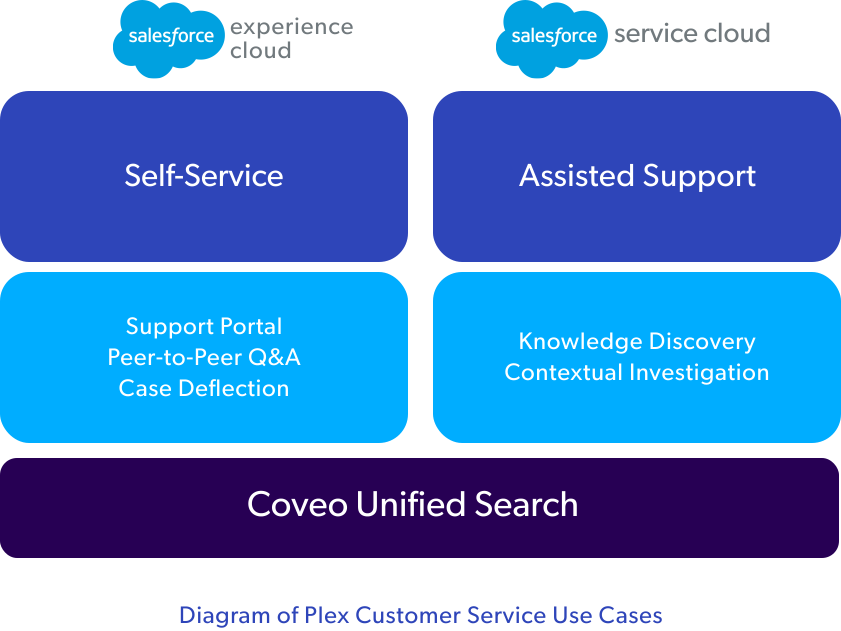
After evaluating multiple vendors, Plex chose Coveo to be the unified search engine behind their community portal, as well as within internal employee systems. Users still search within the same familiar interfaces, but with an improved experience.
“What really made Coveo stand out was the ease of use, ease of implementation,” said Bugayong, highlighting Coveo’s ability to layer within existing systems and create a unified index for content access. “The hardest part was figuring out which sources of knowledge to tap into, what silos of information to open up.”

Finding the Best Answer Shouldn’t Be This Hard

Thanks to a skilled manager, Plex’s support team boasts a strong Salesforce Experience Cloud-hosted customer community where 90% of questions are answered peer to peer. But even if the answer already existed, traditional keyword search was not meeting customer expectations. And that existing search engine did not extend to platforms containing other helpful materials like product or training documentation. Customers and employees alike had to log into multiple systems to search for what they needed.
“In unifying these sources, it was key to deliver the best answer,” said Bugayong. “When you have to go all over the place, you don’t know what’s the best answer out of all of those sources. We wanted to make it easier for customers to self-serve.”
Not only did Plex need search, they knew they needed intelligent unified search that leveraged machine learning to surface the right information to the right people at the right time.
Relevant Results, No Matter How You Ask
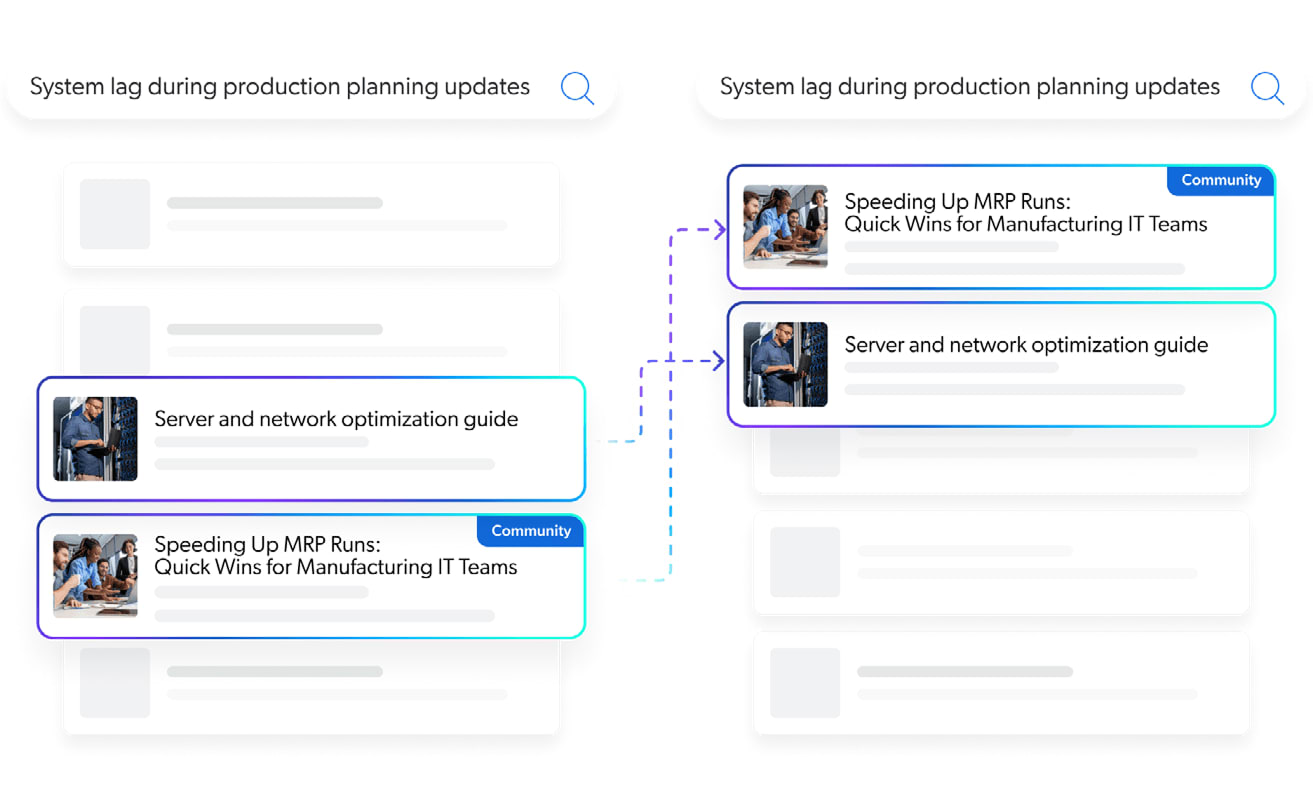
Coveo is the search engine behind Plex’s customer community, improving and enhancing self-service with capabilities like hybrid retrieval and machine learning models such as natural language processing (NLP). Because of NLP, users can ask a question to the search platform in the same way they might ask a coworker or friend, and get the right response in their search results.
Hybrid retrieval combines lexical and semantic search, balancing precision and recall. Even if a document doesn’t contain the exact query searched, the platform knows it is still relevant due to other signals. Users then get a rich set of results spanning the wealth of information available via the unified index. And to further amplify the experience, Coveo’s Automatic Relevance Tuning (ART) machine learning model learns from user interactions (clicks, engagement, and more) to re-rank retrieved documents so the most useful content rises to the top. For Plex, ART delivers a +6.9 improvement in click rank vs. standard queries.

Lastly, Coveo’s built-in analytics gives Plex’s customer support team a direct view into what customers are finding, what searches come up empty, and deflection-driving content. While machine learning continuously improves the customer experience, Plex’s support team can also make adjustments with tools like a thesaurus, easily adding business rules, and more.
It also helps new tech support engineers accrue knowledge about the product faster, contributing to a shorter time to resolution for the 10% of difficult questions submitted as cases.
Global Support, Growing Pressure
Plex’s customer service team is composed of 50 tech support engineers who serve a global audience of 700+ customers across North America, APAC, and EMEA. As the customer base scaled, case volumes rose by a thousand every year. Plex wanted to address this without adding headcount.
“We were on our way to 23,000 cases a year,” said Bugayong. “We knew we needed to increase case deflection by enabling customers to find what they needed on their own.”
Plex also wanted to upscale their customer support team’s proficiency. With a majority of customer questions resolved via peer-to-peer resolution in the customer community, their tech support engineers received the most difficult questions. Engineers work in a single tier model via case swarming.
“We have groups of tech support representatives who have specialized skills,” said Bugayong. “But they handle all of the break-fix scenarios that come in — so they need access to information.”

3,000 Fewer Cases Every Year
To enhance case deflection, Plex plugged Coveo directly into its case submission form. Coveo recommends relevant articles, posts, and more at the last possible juncture before a user submits a case — especially useful for those who may have bypassed self-service entirely. Adding Coveo to the Plex case submission form resulted in a 5% improvement in case deflection, culminating in $500,000 cost‑savings over three years solely from explicit case deflection. Plex estimates that the full scope of Coveo’s impact is triple that of their explicit deflection metric.
“We’ve achieved a lot of savings in people who never even had to open a case,” said Bugayong. “Since we implemented Coveo, we have been consistently down at least 3,000 cases a year.”
On the assisted support side, tech support engineers also have access to Coveo. An insight panel embedded directly into the Salesforce Service Cloud agent console surfaces relevant case information, articles, and more, to help support engineers quickly and efficiently deliver resolutions.
“The more they search, the more the machine learning makes their answers more and more relevant,” said Bugayong. By combining Knowledge-Centered Service and unified search, Plex reduced their time to resolution numbers significantly.
Future Roadmap

Plex’s customer base continues to grow, but case volumes are shrinking. Bugayong said they’re exploring new metrics like self-service resolution, which will let them quantitatively measure how their community impacts their customer service journey.
“We want to continue to flatten the curve, even as we continue to take on more clients and gain more revenue,” he said. “Overall, we want to be more efficient because of smart technology.”
To that end, Plex is deploying Coveo’s generative answering solution for internal employees. Pending that initiative’s success, they’re hopeful that they’ll flip the switch on GenAI for their customer community, too.
“We wanted to deliver a Google-like experience, where the more you use the search engine, the better it knows you and what you’re trying to ask,” said Bugayong. “That’s the same experience that our tech support engineers and our customers are now having.”

Achieve customer self-service excellence with Atomatic Relevancy Tuning (ART)

Hey 👋! Any questions? I can have a teammate jump in on chat right now!