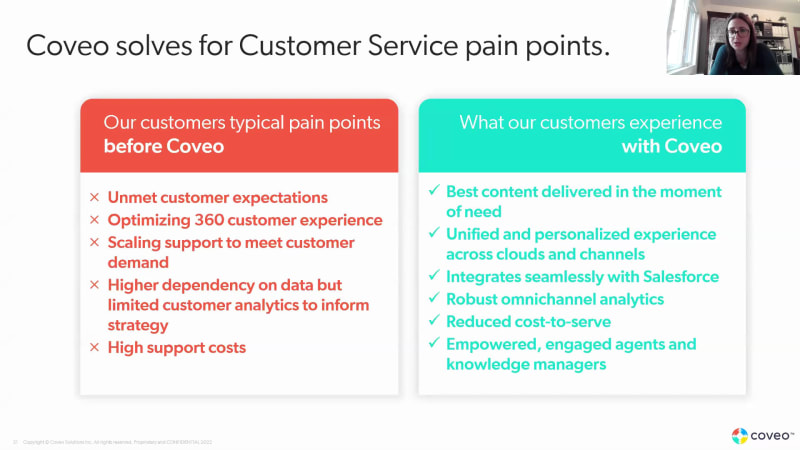
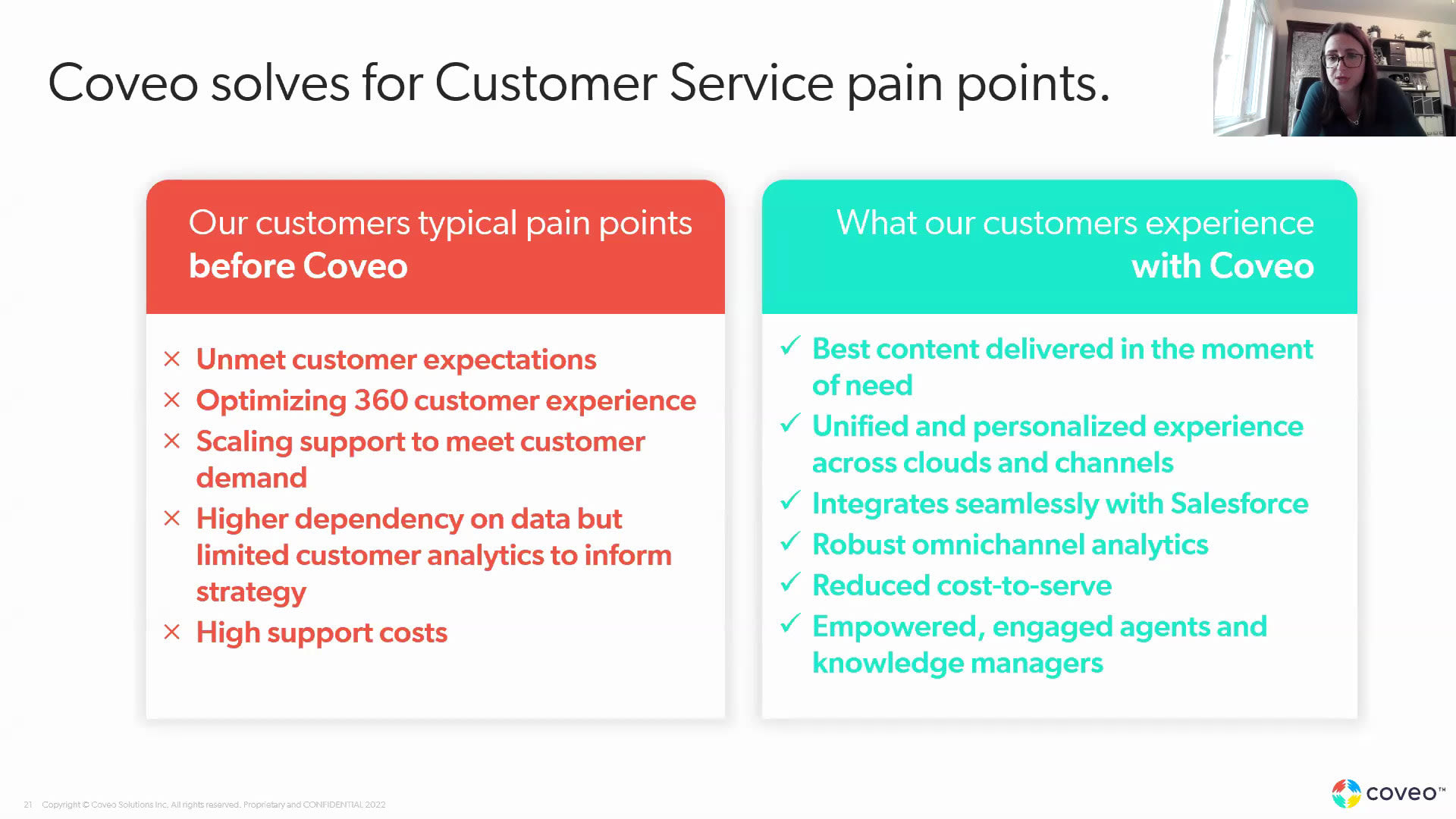
Hello, and welcome, everyone. And if you've been with us for the last couple of series, welcome back, and thanks for joining. My name is Mark Handrin, and I lead the global channel and alliances team here at Coveo. I think last week, I came to you from a hotel. This week, I'm coming to you from a hotel as well. So, pardon the background. This is our final series of our three part summer series. So if you've joined us, thanks for thanks for joining us over the time, and we will be doing another one of these series in the fall. So if you have some feedback for us as to what content you might be looking for, didn't get this time, or would like us to go deeper on some of the content you heard, please give us that feedback. We'd be delighted to hear it. We'll certainly incorporate that into the fall session. So this session today is focused on our business value engagement, consulting engagement, and framework. And I'm delighted to have with me my colleague, and, you know, the the subject matter expert, on the topic, Alex Dassa. Hi, Alex. Hi, everyone. Pleasure to be here. Great. It's great to have you. Thank you. Hey. You know, before we get into the great content that you've prepared, talk to us a little bit about the work that your team does, if you would. Sure. So our strategy and business value team here at Coveo, we work with prospective customers, to help them quantify the projected business results that would be associated with their Coveo deployment. And we work in a collaborative fashion, right, in an iterative way to make sure that our assessments are data driven, and are really grounded in their business reality. We delivered hundreds of these assessments, and they include kind of an executive level overview snapshot that we're showing here, and the deep dive into the Coveo, business case and the assumptions behind them. We also work closely with our install base, to assess the value that's realized, by our customers, and that's driven by Coppell. You know? So just context. At Coppell, this is probably one of the most critical steps in engaging with our customers, in accelerating our sales cycles, in improving the the level of conversation that we have with our customers and their executives. And as I was talking to partners over the last many months, they were looking for tools to do exactly that, to improve their own conversation, whether we're at the table with the partner or not. And we thought that, you know, this would be a a great framework to share and extend to the partner ecosystem. So I hope you get a lot of value out of it. There's a lot of content here today that Alex is gonna get into. We will take questions at the end, and I believe we will have some time at the end. So with that, Alex, I'll turn it over to you. Okay. Great. Thanks, Mark. So before we start, just a disclaimer to mention that any of the financial information or, potential value that we talk about in this webinar is really a potential illustration of the value that probate can drive. And with that out of the way, what will we cover in this webinar? Right? So based on, the hundreds of business value assessments that we've conducted for our customers and the recent conversations that we've had, with partners, like the organizations that you work for on how to, establish the joint business case, for prospects, we wanted to share in a brief session, an introduction, to our enterprise wide and ecommerce and, service use case specific value propositions. The main customer pain points that we look to resolve and, the value, that Coveo can drive for our joint customers, and then how we can work together, to really define this value. So, let's talk about what we see happening, with our customers at the enterprise level. We're seeing companies that are now at the level of maturity in their digital transformation agendas that they're focusing on the experience that they're providing to customers, to employees, to partners, to all their stakeholders. And more specifically on how to make those experiences tailored to the individual in a way that is completely personalized and relevant to each individual, where every single touch point along their journey is responsive to their needs and and can accurately prescribe what information, what products, or services can help fulfill those needs. But, companies are struggling, right, to deliver these competitive personalized experiences that meet or surpass rising expectations in a way that really makes sense from a business perspective, right, without, the intelligence of an AI powered relevance platform like Coveo. So how does Coveo balance that equation? How does Coveo, the leading platform, balance personalization on one hand with, the business outcomes such as, know, the financial profits and loss imperative, the cost serve focus, and, achieving that stakeholder engagement, those advocacy objectives. Well, we do so by delivering, again, you know, personalized and prescriptive experiences that convert, on the ecommerce channel while maximizing, on the other hand, margins and, customer lifetime value. Increase net promoter score or that advocacy, for customer service users while minimizing costs and increasing revenue. And then from a platform perspective, increasing employee proficiency, website user, net promoter scores, or advocacy while reducing costs and increasing revenue. And we do so across the customer journey and our customers' businesses with our AI learning from each interaction to serve relevance within the next interaction and activate that virtuous cycle, fed by three hundred and sixty degrees of data, and all the signals that are coming from, all forms of additional interactions. So not only does kind of the wide ranging applicability of the Coveo use cases enable companies, to easily scale across their business, across their value chain as they grow. But the more Coveo is present, across that value chain, and across our our customers' businesses, the more performant their business to caps with every interaction really, being informed by the intelligence gains by the previous one. Right? That that virtuous cycle, if you will. So let's dive into the, commerce, value proposition. In a nutshell, Coveo for ecommerce provides smart personalization strategies that delight shoppers and profit optimization capabilities that delight the business. And so before we dive into kind of the the value drivers, and our value driver map, let's review the pinpoints, that we hear from our joint customers that they experienced and how Coveo solves for these. Because that's really what informs, how we, position our business cases. So our customers on both the b to b and b to c, side, often share with us how challenging it is for their ecommerce users to discover and find products that are relevant to them and, that the experience on the site doesn't necessarily meet these rising user expectations to really know me and tailor to my needs. And so this is where Coveo provides that friction free, personalized customer experience with a consultative online sales approach that's scalable, with increasing customer expectations and the growth of the business. So even for large and complex catalogs, Koveos smart indexing and ML machine learning for query suggestions and relevance ranking ensures that product findability. And we also enable friction pre search by SKU, by part number, by brand, by generic attribute, what have you. Our machine learning combines catalog vector mapping, buyer behavior to fuel AI and deliver personalization even for non logged in shoppers. And then there is that continuous improvement aspect, with our large group of, data scientists that are continuously innovating, our our native cloud AI platform to improve those commerce outcomes for customers. So that's all contributing to that personalized friction free, you know, scalable customer experience. Another pinpoint that we often hear our customers talk about is lagging return on costly customer acquisition. Right? And this is where Coveo helps our customers to provide efficient customer conversion, improve profitability, customer stickiness, and lifetime value. And we're gonna dive into the specifics of this in a little bit because that features heavily in our business cases, of course. And then there's manual merchandising, you know, where manual processes, rule coding, tweaking to maintain relevance can be really heavy on the merchandising team. With Coveo's automation of tactical merchandising activities, like automating the reduction of no result searches, for instance, and then Coveo AI automatically delivering relevant results and recommendations based on context and and based on intent. The merchandising team is freed up, to focus on more strategic, revenue generating and ultimately profit boosting activities. There's there's also a couple of other levels that, levers that act on the the merchandising side. So as Koveo is easily configured for tuning the experience, so we could boost and vary capabilities, feature promotions, time based campaigns. The merchandising team's reliance on a t IT is reduced, and that allows them to have more control, to be more nimble, in the, strategic activities that they undertake. Also, the team is further empowered, really, to be more strategic and effective because of the access to, the analytics driven insight and the control that they get, with Proveo, particularly, you know, AB testing capability. So that's for the automation of tactical merchandising and, you know, what enables them to be more empowered and conduct more strategic merchandising. Another pain point, that we hear a lot of is lack of transparency on local stock inventory. And with Coveo's, real time inventory matching, this is a real driver, to buy online and purchase in store models. Another pinpoint that this is a lot of pain points, and I've tried to resume them. But another pinpoint that is something we hear a lot and that we handle quite well for our joint customers across all use cases is the difficulty in, unifying and making sense of disparate sources of information. Coveo can connect, to and index any content, whether it's structured or unstructured to create that unified experience. And so, really, data integrity is a foundational capability, that we can provide together to our customers. For our b to b customers, specifically, we find they often have difficulty managing all the complexity that their business requires. You know, managing complex catalogs, multitude of facets, being able to handle customer specific pricing entitlements on their ecommerce channel. And we love these problems because Corveo eats complexity for breakfast. You know? It it even opens the door to promote a push from offline ordering to online. Because with Proveo, our b to b customers can now allow their clients and empower them to order online with real time pricing, inventory updates that respect customer entitlements even if they're complicated levels at search time. So from a value perspective, we see costly labor intensive offline ordering drop and move towards the less costly, and less labor intensive, online ordering self serve mode. We also see, as a result of this, the rate of first time rate orders increasing. So there's a downstream, value lift, kind of a ricochet effect that occurs as well. And so, essentially, you know, our customers turn to Coveo to deliver experiences that are personalized to their customers' individual needs while supercharging their business performance with improved profitability and empowering merchandisers to align efforts, with strategic business objectives. And in doing so, Coveo has driven real business outcomes for its customers, delivering incremental revenue, for the online ecommerce channel and beyond, incremental gross profits, cost savings, enhanced sustainability performance, all while driving customer satisfaction and advocacy. So from a revenue perspective, Coveo drives an increase in online orders through improved conversion rate for sessions with search, an increase in AOB, average order value, per sessions with recommendations. An increase in overall revenue per visitor, RPV, per content services, social proofing, badging, abandonment recovery. There's a whole menu of of those services. An increase in overall revenue from empowering merchandisers, and we're talking about that, to be more strategic, and an increase in revenue for offline channels from the improved relevance of online research. So we actually find that a good proportion of our customers' clients will research their in store, purchases on the b to c side or EDI or offline, purchases on the b to b side online prior to purchasing in the offline channel. So Coveo has this kind of wide reaching impact beyond just the online channel. And from a gross profit, perspective, Coveo enables a shift in revenue from the lower margin to the higher margin brands or products while still improving the relevance experience. We also see, you know, improved retention of customers through an enhanced experience. So this drives customer lifetime value up, and that improves the overall return, that organizations have on their customer acquisition costs. From a cost avoidance or takeout perspective, Coveo really improves the productivity and efficiency of the merchandising team. Right? So we talked about automating manual or tactical search management activities like no result searches. We also reduce the need for online order support, particularly, you know, folks that are calling in to our customers, support organization because of product findability issues. And we have a few customers that actually, one of their their biggest cases, case types is product findability's, support, particularly on the b two b side. There's also a reduced need for offline ordering, support or processing because, you know, that customer experience online is now improved. And so customers are less likely to go and order offline. Or in the case of b two b, they're now able to actually place their orders online. And so that labor intensive offline ordering, processing, reduces significantly. Coveo also has an impact on reducing the cost associated with return goods processing. Because customers have a more relevant experience, they end up with a better outcome, and they're less likely to return an an item at the end of the day. And that that is very costly for organizations. We're seeing a lot of ecommerce organizations starting to charge, now for returns. But reducing return of goods also improves a company's sustainability performance because, we have to reduce the need to have return goods shift back. And so the need for energy intensive transportation reduces as well. And that's a big, metric that's looked at from, the sustainability performance profiles of our customers. There's also another way that Coveo acts to help our customers improve their sustainability and performance. Because Coveo can boost and surface information that's most relevant to the user in line with company's strategic objectives, it it helps our customers to highlight things like the eco sustainability profile of their catalog, for instance. And that really allows them to further their sustainability focus and and achieve their sustainability mission. And then all of this is achieved, you know, while improving users' overall experience, and satisfaction at the end of the day. So this basically summarizes our value driver map in a way that it can be easily absorbed because this is our value driver map. It's a little bit of an eye test. But when you deliver so much value, it it kind of is hard to fit on one page. So to give a sense of the magnitude that Coveo delivers, we created a kind of typical value profile. And this is illustrated here for a company with a billion dollars in ecommerce revenue. So just a disclaimer to say that, you know, the magnitude of the outcome that we can drive for our customers varies, right, according to the scope of services they deploy, their baseline performance, the growth of visits or visitors that they're projecting for their site, the quality of their UX, and so on and so forth. But a range of uplifts that's shown here for each value driver, you know, can vary. Also, depending on the baseline relevance, maturity level of the company in question, this is kind of what we generally work within even for that kind of wide spectrum of, of factors that would influence that maximum benefit potential. The high end of the uplift range that you see associated with these value drivers is not necessarily our best case scenario. So we have, for certain value drivers, seen higher lifts with our install base, but we try to be conservative, in how we predict value profiles. So, usually, the max that you see here is the max that we will position as part of a predictive value assessment. So for a typical company, you know, we're talking four percent conversion rate baseline, five hundred dollars in AOV, fifty million, you know, unique visitors a year, ten percent unique visitors growth rate, and so on and so forth. Coveo can create up to sixty seven million dollars in incremental profit annually. It it the the impact is is quite immense. And so while this is kind of an example, right, of what could be predictive value assessment, it's based on the customer value that we've driven, with our install base. So for instance, a couple of examples here. Calares, so global retail footwear company with over two point five billion dollars in revenue. They worked with Coveo to transform, their, the experience of their portfolio of branded sites like, Famous Footwear, for instance. And they experienced a twenty four percent increase in conversion rate associated with, sessions on search. Hearts on Fire, which is a jewelry retailer and manufacturer that, worked with Coveo to transform their b to b and b to c ecommerce experience. They experienced the tremendous results, including a forty nine percent lift in their average order value. Oopsies. River Island, which is a clothing retailer, saw nearly a six percent improvement in RPD from abandonment recovery. So this is where you deploy warnings at the shopping cart stage across desktop and mobile and informs abandoning visitors that their items in their basket are selling fast. So it it kind of effectively persuades more people to finalize their transaction sooner rather than later. And that's just one of the the services that they deployed, and this is specific to that service. Acuity Brands, a, a lighting and and building management firm, they saw an eighty percent, reduction in no result searches, which really allowed them to repurpose, their tactical merchandising time into more strategic, profit generating activities. So one example I I also want to highlight in-depth was a b to b example, FleetPride. And, they are the largest, independent heavy duty distributor of truck parts in the US, so an industrial company. And since Coveo thrives on complexity, FleetPride's complex catalog, like, we're talking a million SKUs, four thousand attributes, this didn't stop Coveo from having a big impact in contributing to a major increase in revenue nearly forty percent. And this was with search, navigation, recommendations, and personalization. So now that we've provided a very high level, overview of ecommerce, let's, move into service. And just as delighting both customers and the business is part of our ecommerce value proposition, for customer service, we focus on solving and delighting with Coveo as well. So before we go into, the value drivers and the value driver map, we're gonna review again those pain points that we hear, from our our joint customers and what they, you know, typically experience and how we can together solve for these from a service perspective. So similar to the the pain points, that our ecommerce, customers experience, often we hear our customers talk about the difficulty in meeting customer expectations and optimizing their experience across digital channels and Salesforce clouds while scaling support to meet customer demand. So here, this is where, you know, Coveo cuts through the noise, really, to deliver the best content in the moment of need. Right? Unified, personalized experience across all channels from the contact center, where we empower agents to deliver best in class and efficient service to the delivery of web self-service where, you know, we empower our customers to delight their customers quickly and seamlessly solve for their own problems, and their own needs. Another pinpoint that comes back frequently is the high dependency on data, but limited customer analytics to inform business strategy. And with Coveo's robust omnichannel analytics that really offer that three hundred and sixty degree view of the customer, it makes it much easier for our customers to measure success and optimize the content experience across clouds and external channels. It also provides insights that allow the service organization, to empower knowledge managers to identify and solve for gaps while defining opportunities for the service organization to be more than just the cost center, right, and identify revenue generating opportunities. Finally, you know, our our joint customers are looking to reduce their support costs caused by high case volume, high call times, and agent nutrition. And we're gonna go into more detail, on this next, because, Coveo acts to reduce the cost to serve, across a couple of different ways. Caseload reduction, reduced case handling time, improved employee engagement and retention, and a few other areas. So, essentially, to kinda summarize all of this, you know, our customers, again, turn to Coveo to deliver experiences that are personalized to their customers' individual needs while supercharging their business performance with improved profitability, empowering agents and knowledge managers to align efforts with strategic business objectives while driving that customer satisfaction and that advocacy. So it's the, you know, two sides of that equation once again. So that as companies' customer base and revenue grows, the organization can build profitable customer relationships while keeping the support cost curve as flat as possible. Right? They don't want it to grow as quickly as their customer base and their revenue base. And so they wanna keep it flat, but they need Coveo to do that while increasing their net promoter scores and continuing to delight and meet rising expectations from their customer base. Okay. So how does Coveo optimize the customer journey in a way that both drives customer satisfaction, customer advocacy, right, and is optimized on one side of of that balance while the service organization's p and l is optimized on the other? Let's start, with self-service success. This is where Herveo delivers prescriptive answers that help customers solve their own issues. This not only allows companies to reach a lot of customers at a very low cost, but also research shows that customers wanna self serve. And the ability to do so well drives satisfaction, drives advocacy up. They would rather self serve than interact with the human or or even a chatbot. Cobain is also excellent at helping companies intercept and avoid case submission. And that's a you know, case caseload is a big drain on service organization. So with Coveo helping companies to intercept that and avoid that case before it reaches an agent, where Coveo proactively suggest solutions before that case is submitted, then together with Coveo's impact on self-service success, organizations with Coveo will see their caseload reduced, which, again, big driver of support organization costs. But for situations where the customer does still submit a case and there are situations where organizations actually want customers to do so, then Coveo works to make agents more productive and efficient in how they resolve customer queries, reducing the average handle time and resolution time, reducing case escalations, increasing first contact resolution, and even shortening the length of time it takes to get new agents fully proficient in their roles, which if you consider how high the turnover rate is for some support organizations, sometimes reaching even twenty percent annually, this can be a big driver of support organization productivity. Because Coveo can act to upscale agents in the course of their responding to customer inquiries and issues by providing agents with the contextually relevant information they need to rapidly resolve these issues. Coveo also, acts to equip field workers to provide efficient service and empower them to suggest complimentary products and services, in line with customers' needs to contribute to the revenue generating potential of the service organization, which is also something that we see happening with agents. For those organizations that want to empower agents to get involved, you know, in cross selling and upselling. So in addition to all this, Coveo enables companies to, avoid the customer experiencing an issue altogether through our IPS, or in product experience solution within the product in context. Given that most products and and services are delivered digitally to customers, there is some sort of, you know, digital channel to engage customers and and push content. So with Coveo, organizations are able to avoid the issue of the need for a customer to self serve or submit a case by providing that solution immediately within the product. And this becomes, really interesting from a p and l perspective because the cost to serve, of each of these stages increases, right, as you go further to the right. So the more you can solve upstream and avoid any downstream activity, the more efficient you're actually making, service organization operations. Coveo also allows our customers to go even further. Right? So within service data, Coveo customers are able to, find opportunities to predict potential customer problems before they even occur and rectify the issue or inform customers proactively. And finally, and this is, you know, my favorite part, Coveo customers leverage insights, right, to identify revenue generating opportunities within service data so that the service organization doesn't stay only a cost center, but can also be a revenue generating business. So now that we've gone through how Coveo drives value, let's go into what those value drivers are. And, let's start with cost savings. So, you know, caseload reduction, agent and knowledge, manager productivity. We just discussed how improved self-service success, case deflection, issue anticipation, issue avoidance contribute to caseload reduction, which is a big driver of labor intensive costs on the support side. There's also case escalation reduction. So as Coveo empowers lower level agents to handle increasingly complex cases, they're better equipped to easily, locate and address customer issues, and the knowledge articles, to resolve those. And knowledge managers can derive better insights, right, on issues to equip those agents with that necessary documentation. There is a drop that we see, in how often level one agents have to escalate, to level two agents. So we see a drop in the cost per case occur, because that's increasingly being handled by a level of agent that it has a, you know, lower hourly rate. From an agent productivity perspective, Coveo really reduces the length of time required for new agents to become proficient at their roles. And this reduces the amount of time where they're operating at suboptimal or low lower levels of productivity, because they can easily find the information that they need to do their job when they first come on. And by the same token, Coveo also allows agents to resolve cases faster. They're they're spending less time trying to understand how to resolve a customer's issue or communicate those resolutions. And that has a material impact on case handle time, which drives down mean time to resolution, a big focus of support organization and a big driver of of customer satisfaction with support. So that combined with reducing escalation rates also, contributes to an increase in first contact resolution. And this really, you know, is a big factor in, delighting customers. But it can also be tied to service level agreement fee reductions for those organizations that offer SLAs that are tied to FCR. So, you know, as we've been mentioning, Coveo also acts to improve the service organization's ability to generate revenue, and it does so in a couple of ways. One, by empowering agents and field workers to access contextually relevant information to not only resolve, you know, issues faster and better, but also to understand which services and products to recommend that would be most relevant to customers. So driving up, upselling, cross selling. And, also, secondly, by providing insights, and analytics to support the identification of revenue generating opportunities for the service organization to initiate. So so far, we've kinda talked about, you know, the p and l side of the equation. Quoveo also, works to enhance, employee, engagement and satisfaction and, therefore, customer satisfaction. Because employees are better equipped, have the have more better tools to be able to conduct their work in a more seamless way, they're more engaged, and they're more satisfied at their jobs, which we often see translate into improved customer satisfaction. Now customers are dealing with agents, that are happier at work. And that can have a big impact on driving down unwanted attrition, which carries its own burdensome costs in terms of lost productivity, in terms of recruitment costs, onboarding costs, and so on. But, you know, as mentioned, as employees are more satisfied at work, they deliver better customer service. And so that effect plus all the other ways that Coveo contributes to an enhanced customer experience really drives CSAT and NPS scores up and drives customer effort scores down. So this is how it all fits on the value driver map. Another eye test, unfortunately. To give a sense of the magnitude of value that Coveo delivers, we prepared kind of a a typical value profile. So this is illustrated here for a company with one point five billion dollars in revenue. Typical company, let's say a tech company, around three hundred and fifty agents, over a hundred and fifty thousand cases per year, case growth of five percent, so on and so forth. Right? And Coveo, in in this hypothetical situation, can create up to seven million dollars in cost savings annually and a million dollars in incremental revenue per year. This is, again, just an indication of the magnitude of value that our joint customers can capture. And this range depends not only on the scope of services that are being deployed, and customer's baseline performances, you know, the level of maturity that they're starting from and how performant and how much growth is assumed their business will generate. But also on factors like, do they have strong knowledge management, strong knowledge management strategies, KCS metrics? What does their UX look like? Are they putting in place the right elements to promote employee engagement and adoption of Coveo for assistant service and client education to encourage self-service? But by and large, though, I mean, we do drive significant value for our joint customers even if they are, on a wide spectrum with regards to the factors that I just mentioned. So the uplift ranges, that that we work with, the low highs that we usually consult when we position these business cases, those are based on the customer value that we've driven for our install base. So some examples include Tableau, that saved the equivalent of eighteen million dollars in support, annual support organization costs from case, deflection improvement alone. And it achieved this while also reducing technical support, agent hiring by fifty percent. So that's really great. They they needed sorry. I'll go back. They needed a a scalable support system to, provide excellent customer service, of course, but they did so while flattening support costs while growing at a rapid rate. So, again, it's that that balancing of that equation that Coveo really helps our customers to do. Another example is, OziSoft, a manufacturer of application software, for real time data management. They drove down case resolution time by fifty six percent, which is massive. And Xero, a technology company, that, they they provide cloud based accounting software. That's a great example of a company that leveraged Proveo to drive down its cost to serve by nearly forty percent while growing its business at a rate of a hundred and twenty four percent and driving NPS scores up by twenty points. So you you really see how, you know, Coveo helps these companies to kinda keep these balls juggled up in the air and really drive, incremental value overall. Another, customer, to highlight is also a partner of ours, Salesforce. In fact, we're a Summit partner of, Salesforce, which is the highest tier of partnership, and we've been partners since, twenty thirteen. A year later in twenty fourteen, they became a customer of Coveo's, and they've deployed Coveo across, you know, commerce, service website, workplace, what have you. They've achieved, just on the service side, a fifty percent improvement in case deflection among other great results, and and we continue to find new ways, to work together to drive value. So that kind of, wraps up our overview, our high level overview of the value that we can drive together for our customers. Before we talk about how we can work together, there's a a few topics, that I'd like to touch on. And those are time to value, success factors, total cost of ownership. So time to value. Coveo helps to personalize experiences from day one on, through our ML models that are built for relevance. But to reach max benefit attainment, it takes a few weeks for our ML models to be fully optimized, based on on usage. And so when we model our business cases, we usually model a progressive, benefit ramp up or deployment. And the rate of this ramp up to max benefit attainment and also the the magnitude of the max uplift that we position, it varies. Right? It it varies based on our customer starting points and their level of maturity, the change management efforts that they're gonna put in place to drive adoption, the quality of their UX, and, you know, other factors like KCS on the service side, visitor growth rate anticipated on the ecommerce side. So we make a point to kinda discuss this with our customers. This largely, you know, falls outside of of Kubero's, purview, but, we try to be mindful of that in terms of the uplifts that we position and and how that max benefit attainment will be reached, the the speed at which it'll be reached. Total cost of ownership, this is this is, you know, another element we haven't gone over, but that that does feature in some of the discussions we have with our customers around business cases. And and usually, this, comes up when we talk about the buy versus bill story of Coveo. Right? And how TCO, really works its way, into the the business case, for Cobayo. So here we often talk about the massive investment that Cobayo has made in r and d, the nearly fifteen years of, like, focus on these, you know, issues are regular releases and upgrades, you know, the ease of management and maintenance, which is less costly from a Coveo perspective than for an in house build, and, you know, so on and so forth. And there's a lot more detail that we take into account than we consider when we position our business cases. But I think the last, you know, thirty, forty minutes together kinda give you a high level overview of what we look at, what we consider, when we're helping our customers to understand what is the business case associated, with the Coveo deployment. So Mark is is, next gonna talk a little bit more in-depth about how we can work together. But first, just to mention, that we do have ROI calculators up on our website, and and these provide an indication of the type of value that our customers can expect by working with us. It is it is gated. So, you know, I have to put in your email address and we'll get an email from. But, it does provide kind of a a high level overview. Just to note, these are currently being revised, for value driver completeness and to reflect all of our use cases, but we wanted to show that, that is available to you. So how how can we work together? Well, you know, after this webinar, you'll receive this material. Hopefully, it'll be helpful to you. Do reach out if you have questions, and then let us know if you require further enablement. You know, we've worked with our partners to kind of help them understand how Coveo's value map fits in with their existing value map and what that joint value map really looks like and, how they can, you know, assess the incremental value that together we can we can bring to our customers. Yeah. And I think, Mark, you had a couple of things to add. Well, first, just this was this was a great session. I hope, those that are on the call did find value. I mean, it's it's good timing. Right? You know, last year and the few years prior, we were in the era of growth and coming into this year. It's all about profitability, particularly in large enterprise space. So, so, hopefully, timing was good. Hopefully, you got some good nuggets, you know, either uncovering that new pain points or, you know, value drivers to deepen the ROI conversation because that's what it's all about. As as Alex said, we've pulled her into partner conversations about individual either individual customers or more generically. So reach out, and we're happy to have, you know, one on one conversations to get you started, and to start to consume this content and apply it to your conversations either with your customer or with Kaveo Plus you and your customer. So so, so thank you, Alex. We do have a couple of questions. I let me just check. Yeah. We've got some time. First question, you mentioned how Kaveo can have an impact on first time right rates. Yes. Can you elaborate on that? Yes. So, this, this often happens, with our b to b customers. And, you know, we talked about how with Coveo, we can handle the complexity of different layers of pricing entitlements and so on. And so this, promotes a push from, you know, the old school offline ordering of fax and email and phoning in, orders to, you know, representatives of company to empowering customers to go online and place orders. What we see happening is really interesting. One of our big b two b customers, fifty billion dollar manufacturer and distributor, explained to us that their their rate of first time right orders, which is the rate at which when an order is placed, it doesn't need a manual human intervention to be corrected for their business rules. So for instance, you know, someone ordered two pallets of, you know, a particular product from a a distributed brand, but they need to order three pallets as the minimum. Right? And so this rate of first time right was pretty low when it came to offline orders because they there is nothing to kind of correct the customer as they're filling in those orders. And so a representative from this company had to call that customer and say, hello. I'm sorry. You know, your ordered, doesn't meet the minimum requirement. We're gonna need to change it. And this was really lengthy and really costly and not so great from a customer experience perspective. But with online ordering, particularly with Coveo, their first time right rate was, like, eighty percent. Offline, it was twenty percent. And so when we enable complex pricing entitlements to be handled online, what we actually see is, you know, yes, that's that's less labor intensive to begin with, but there's also that ricochet effect, which is your first time right, rate goes up. So customer satisfaction goes up, and the processing associated with correcting those orders goes down. Got it. Thank you. Hopefully, that helped. So the second question, it's around the uplift associated with the conversion rates. Yes. Impressive numbers. Can you talk a little bit about how you calculate the incremental revenue associated with the conversion lift? Yes. So, it it's, the the conversion rate uplift that we drive is is quite large. Right? One thing to keep in mind is that, this is associated with sessions with search. Right? This is not something that's applied to a hundred percent of traffic. It's really the proportion of traffic in which users will engage with search. And so that uplift is is pretty high. It's on a subset of the traffic. However, what we see is that, the baseline conversion rate for sessions with search is at minimum two x the overall conversion rate. Right? Someone's intent to buy is much stronger if they're actually putting in the effort to put in a term in a search box. And so those you know, that uplift of, you know, up to twenty five percent increase in conversion rate per sessions with search, it actually is applied to typically, when we model our predictive value assessments, we use the overall conversion rate. But what ends up happening with our install base is we see this as a multiplier effect because, let's say, a company has an overall conversion rate of four percent. Typically, their conversion rate for sessions with search can be as high as, you know, three x that, four x that. It's pretty insane. So it it it ends up being, quite impressive, the the impact on incremental revenue at the end of the day. Well and I was smiling at the question because as we were preparing for this session, Alex, I know you were very conservative and cautious about the numbers you were putting out there on the screen to be conservative. So, so I just I I chuckled to myself. But, yes, they are impressive numbers and and, like to go much higher than what you're seeing on the screen here. So those are the I think those are the questions. If there's no other ones a couple of things I just wanna remind you. This content will be on the partner community, as will the recording. If you're gonna be at Dreamforce, please look us up. We will have a small army at Dreamforce, and we'd love to meet. We can start this conversation or certainly engage in other conversations. So, with that, I think we'll give you just a few minutes, back. But, Alex, thank you again. I know you put a lot of time in this, and it's great content. So thanks a lot. My pleasure. I hope it was helpful. Thanks for joining everybody, and have a good rest of the day. Bye bye.
Positioning Our Joint Value with a Business Value Assessment
Make every experience relevant with Coveo