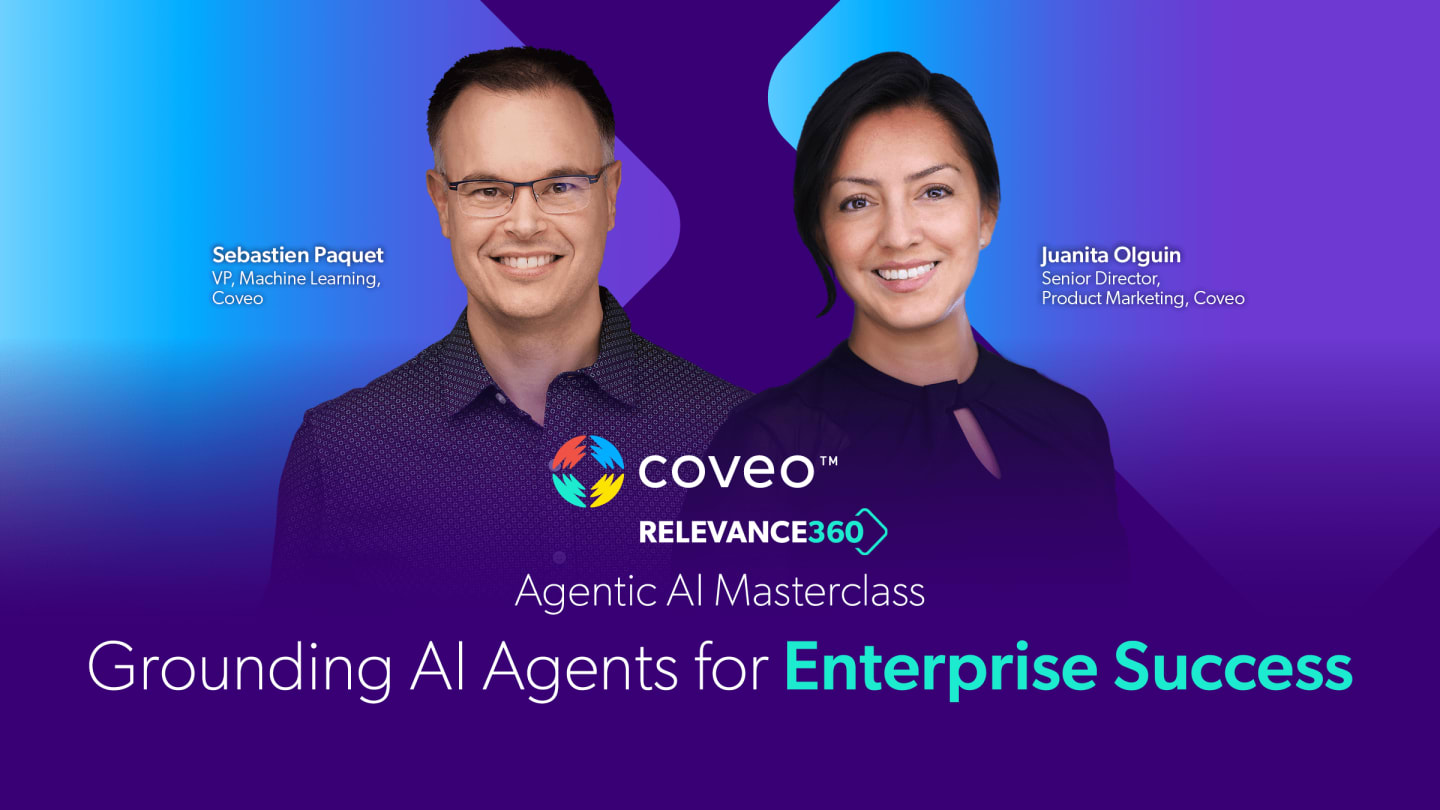
Welcome. Thank you to those of us that are joining us today for our Agentic AI Strategy Masterclass. My name is Juanita Oguin. I run Product Marketing here at Coveo. Today, we have about one hour to unpack the most popular topic out there in the world of tech today. We will do our best to give you use cases, talk about the challenges and solutions. And we always try to keep it a little, you know, keep it real, keep it conservative on on what we actually project to happen. So that's what you can expect from us today. I'm very excited to be joined by our VP of Machine Learning, Sébastien Paquet, who you will hear from shortly. Seb, thank you so much for being here and offering your expertise today. Hi, thanks, my pleasure. I also wanna give thanks to our team on the back end who you will hear from and see in the chat. We have Ahmed, Algy, Ash, and Gavin who are monitoring our chat and our Q&A. And so please feel free to engage in today's, conversation by chatting or submitting your questions ahead of time. We will reserve time to run through some of those questions towards the end of today's presentation. Now with that, we wanna jump right in to give you the most out of today's session. And the fact of the matter is we are talking about something that is a true breakthrough capability, Agentic AI, and analysts are predicting this is going to become a competitive necessity, which is why so many of you are referring about this everywhere, and it's why you're joining us today to unpack this a little bit further. We always like to start by looking at the headlines, what's going out there, what's going on out there in the news today. So I'll show you some of these from the last week or so, and I'm sure there are new ones today. We see things like acquisitions happening in high valuations. We see, challenges new challenges starting to emerge where it's not about scale, it's about control. We see Sam Altman predicting Agentic AI is gonna "click around the Internet", and be able to do things you might not want it to do. We see articles around, upskilling the workforce, sorting through hype versus reality, considering API management as a way to really make these things make this technology useful. Of course, there is a topic of security and new tech MCP and how it's going to supercharge Agentic AI. If I were to give you a word bubble, these are the words that would come to mind to just synthesize this information. Valuations, control, trust, skills, vendor credibility, API security, and new tech, new standard. Seb, I know you're working in the space much more deeply than I am. What do you think about these headlines and anything you wanna call out here? It goes so fast. There's so many things, announced every day. Even for us in the field, it's hard to keep up sometimes. So even for customers, it's hard to see the, the truth from what is actually applicable within the enterprise, and we'll try to to make it clearer during this presentation. Amazing. Thank you. Yes we will. Because we also see there's a lot of predictions out there. For example, here's one from Gartner that is projecting that Agentic AI will autonomously resolve eighty percent of common service issues without human intervention by twenty twenty nine, which is just a few years away. If you're wondering where people are on their, exploration journey, you can see here that while there's many that are dabbling and exploring, really only twelve percent have deployed. But, of course, we wanna hear from you on where you are on your journey today. So I wanna ask, Ahmed if he can run our first poll of the day, which is where are you or where is your organization on the Agentic AI journey? Are you just exploring? Are you identifying potential use cases? Maybe you're already running some early PLCs. Perhaps you're in that smaller group of scaling successful implementations, or perhaps you already have it fully integrated running into your daily operations. We'll give you a moment to decide and to select one that just shares with us, you know, and shared among one another where you're at today. Sam, do you what is what is your expectation here? What do you think we'll see? We just saw with the statistics that only twelve percent of the companies have actually, put system into productions. So I expect, most people to be in the first steps, of exploring Agentic AI, systems. Absolutely. I think that's what we'll get on that one. Do we have the results to display to see where we're at? Okay. As projected, we can see a lot are on the earlier AI. So either exploring or trying to understand what use cases to consider. We see some POCs underway, and seven percent that are saying they're scaling successful implementation. So it's as expected. Thank you for sharing. So so we'll dive in a little deeper here. As Seb said, things are moving so fast. And what I wanted to share was, there's an entirely new book. I'm not sure if you guys have seen this. It's Agentic Artificial Intelligence. Five hundred pages of information insights, a couple of which you see here on the slide. This was released in mid March, and we wanted to just highlight again some of the different use cases and industries that are currently implementing Agentic AI. As we can see, there's some usual suspects on the board. So you can see the top use case area is customer service and support at thirty five percent. And then from an industry perspective, we see that technology and software companies are, the highest, ones implementing because it's typically a much more progressive, you know, industry. Seb, any thoughts on this slide? Anything you'd call out here? The important part is that they are implementing it. So it doesn't mean that they are actually using this system in productions. But it's still really low percentages. If you look at even software companies, only at one quarter of them using, or implementing Agentic AI. You see, it's a really new technology. People are trying to understand what it can do. So, still early stage for Agentic AI. Awesome. Thank you. And for those of you that are joining us today, I mean, take a moment to assess. Does this align with your industry? Do these percentages represent where you're at today as well as the use cases? It's just a good, sense check or pulse check to see where you're at as compared to others. Now we're just starting to skim the surface, but I think we need to talk about this multi-agent future Seb, so I'll pass it over to you to take us through that a little bit more deeply. So, you're seeing that it's really a big hype, a lot of people are telling that you can do agents for almost anything, and I think it's a really transformative technology. So what it will look like in a near future is that you might end up with multiple agents, either cutting agents, research agents, generating reports, customer support agents, helping your end customers or your support agents. And the list go on and on, you can have tons or even hundreds of agents, maybe at some point. But if you start by trying to build them all at once without looking a little bit further and and trying to see what actually they require to be successful within an enterprise. I think you can spend a lot of cycles, you're gonna hit a lot of walls like what we're we're gonna explain a little bit more in details in this presentation. But to be really successful, most agents within an enterprise actually require access to the enterprise knowledge. And it could be easier within a POC to copy data from one system and just copy it in a simple bucket and do your experimentations with. But when you try to really implement these agents at scale within your enterprise, you really need an enterprise grade architecture, you need something that is secured, you need something that can scale, and this is where it becomes really more complicated. So what is a Agentic AI? We'll define it a little bit, more precisely so that we talk about the same thing. So first of all, what is not? So because people are are saying these days that everything is agents, and you can build agents for almost anything. But it's not really the case. If you simply have workflows, automations, you have ML models doing predictive analytics, simple role based systems, or you generally have a standalone LLM or a standalone, retrieval augmented generation system. These are not really agents. To be called agents, I think you really need some kind of free zoning models. You need something that will actually be autonomous in deciding which steps should be done to achieve a goal. If you look if we look a little bit more closely at what is required, AI agents are systems that need to perceive the environment, either textual, video, images, they need a way to be able to perceive the world. They need to be able to reason about it, and I think it's the main, component of an agent. It needs to be able to understand its input and reason about what it needs to do to achieve the user tasks. In order to achieve the task, it needs to be able to act. So it needs some kind of tools, function calls or anything to actually act. And we expect them to learn. So to, from one interaction to another, to learn about the user, and also from one to use to another to learn about what's out there and to adjust the plan, that being clear moving forward. So it needs to to have some kind of learning happening in this for it to be called an agent. And a little bit more technically, what are the main components of an agent? First of all, you need an LLM model, and most probably a reasoning model, that will be used to understand the task, understand the input, decomposing it in multiple subtasks to achieve the goal. And then you will need some kind of tools, so external functions, APIs, or even other agents to execute some actions. And when these agents do, interact with the world, you want them to actually follow some guidelines or guardrails. So the other hand model itself out of the box is not enough, you need to put in what you want and how you want the agent to behave. Sorry. And in most applications within enterprises, you also want guardrails. So you want to be able to control what it's gonna do and and how it's gonna react depending on different outputs or answers that it gets. Then you need, we said it's not a a simple workflow, it's as a a simple path. So you kinda need, you need some kind of control loop going through the different tasks, getting the answers back, adapting the plan based on the answers it gets from the different tools, you know, to achieve the goal. So you need a control loop that will loop over, the different tools or reasoning it can do, until it achieved the goal or decides that it cannot achieve the goal, which is also really important within an within an enterprise. You don't necessarily want your agent to always answer. It's where it will start to hallucinate more if you force it to always answer something. And, we said that it should learn, so it needs some kind of memory. It needs to know what was done before, what were the answer, what were the past interactions with the user, so that it can improve over time. So all these components are important to build an agent. And you see here that multiple of these components need to work well together in order to achieve or to to have a good agent. Thanks for that. And so, what's the difference between generative AI and Agentic AI? So standard generative AI, and it's strange to talk about standard generative AI, it's so new also, but it's more about reactive systems. So, you have applications that have a static execution plan, you have predefined steps that needs to be done. Most of the time, you have limited adaptability, even if you have generation of the answer, sometimes, most of the time, you control it way more. So you have more control, more predictable outputs, which is actually good within an enterprise. So if you don't need enough fully autonomous systems, maybe a a more reactive one is preferable. But if you want to go full Agentic take and have a autonomous system, then it's more intent driven. So you don't have to specify exactly what you wanted to do, you just specify what you want to achieve, and the agent will figure out the plan to to get there. This could be really powerful to achieve the goal, and it requires most of the time multiple steps to, for resolution. But at the same time, you're you have less control or really, it's more complex to keep control over the system and it's less predictable. So any agent will have multiple prompts, will have multiple calls to LLMs, so multiple occasions to hallucinate. So, it's just a compounding effect. So if you think one LLM call could hallucinate, if you have ten calls to achieve a goal and you ask it also to be imaginative and figure out the right task to do, then it's really hard to keep the control and to evaluate the quality of your system over time. I really like that the slide is set as a summary because, as you said, there's a there's a lot of maybe even vendors out there that are claiming to be a Agentic, and they're not. So I really like this slide on the what it's not just to, again, help ground us on how to think about this. And I think a key point you mentioned here is that, you know, both of these are useful and should be considered in your organization, it's not one or the other, rather both in understanding which one you wanna leverage for different use cases, right? Exactly. So now let's talk about what do we require to actually do Agentic AI in the enterprise. But I will start with some story. So we have multiple organizations, and they've been told by suppliers that agents can do it all or they've seen all the hype and the different articles about successful Agentic. And it always goes well when when you look at the the marketing material. But, then, most companies will start to do one prototype. It actually, it can go fast. We can do simple prompts, one liner prompts. You get a good Agentic AI prototype. You just set out on a really small subset of data, or maybe you just copy data to a bucket and you say, "okay, let's let's build a prototype out of this." You will get positive feedback. It's a controlled environment, smaller one. Most of the time, you do few examples. So you see, "okay, it it it looks like it works." And then, you try to scale it to your enterprise. So then you need to, you cannot simply copy the data from the data source, you need to actually connect to the data source so that you can add the updates for the new content, and you can also keep the security of the documents in check. So it becomes way more complex to integrate with the different systems within the enterprise. And then your security and compliance team will start to ask questions. "Is your calls encrypted? Your data encrypted?" "How do you authenticate your agent, how do you make sure that it's actually, it's making actions on behalf of the user, but how do you control which actions it's doing?" And you have way more constraints and as I said before, it can hallucinate more. So if you have more users using it, more diversity of queries, diversity of inputs, it can hallucinate more. And as I said, it can be hard to control if you have autonomous agents going on. So what we've seen a lot is that the prototypes just are, archived. It's, like, becomes really costly, too long, and at the end of the day, people feel, "oh, it's not that good." It's still not enterprise or prime time ready. And you might have done more than one in parallel, trying different things in different departments, trying to use these Agentic platforms. And some IOP manager may say, "okay, just wait and see." So these things don't seem to be enterprise ready, so just wait. But I think this would be a mistake actually because if you look at these, most prototypes will require the same kind of things, and if you don't plan for the future at the speed at which these technologies are evolving, it will be hard to catch up if you don't prepare your enterprise for this this new Agentic era. So I think there's things you can do, without rushing into developing multiple of these Agentic systems. So what's the reality of an enterprise complexity? You often have hundreds of siloed systems to which you need to connect to, so your data is scattered all over the place. And it will stay that way. So big enterprises are using multiple softwares and users want to use the best software for their own task they have to do, so the the data is generated in multiple systems. And you want to connect them, but you want to connect them in a way that you keep the security of these systems up. Then you have terabytes of structure and unstructured information everywhere, as I just said. And you want to when you connect to these systems, you don't want to lose the access rights that these systems have enforced. So it would be way easier to just copy the data somewhere but you need to keep the access control so that enterprises can do Agentic software on top of proprietary information and not only on public datasets. So it's pretty easy to do it on public datasets, but it has less value for big enterprises. If you want to get the most value out of it, you need to be able to connect securely to your data sources. And that can can take a lot of time and be hard to implement. The pace of change in Agentic AI, it goes so fast that it's really hard, and it's almost unsustainable from a development perspective. Models are coming out every week. New Agentic protocols are coming out every month and you have new capabilities, new AI demos, and everything. So it can be very hard to keep up with the all these changes. And if every time a new software comes out, a new model, a new agentic platform, you want to try it out, then you will always be in a in an infinite loop of prototyping. Also one thing that is often not thought about is that prompting is actually hard for enterprise grade applications. So you can do really nice prototypes with one liner prompts, but when you want your system to have more control, when you want to add guardrails, when you want to make sure that it doesn't answer if it's nota well, if it's not a good question or if it's not a good task that has been asked of it, it's really hard to manage a good prompt that actually have a good answer rate, but only answers what it should answer. So in here, if you multiply the prompts and you're using Agentic platforms that have ten prompts, so one after the other, it can become really hard to make sure that all the prompts are well, crafted and that it's not easy to actually create them. Because make no mistake, your end users will try to break it. So it's really hard to make it good. And at the end of the day, you will want the AI and Agentic AI solutions to be deployed everywhere. So you have the dream of having autonomous agents and having AI applications everywhere in all your touch points and all the applications your end users are using or your employees are using. So you need to think about scalability of your solutions from the get go because it's really harder to try to scale something that is already built than to build on something that can actually scale. Thanks for that, Sam. Does it makes sense? Is there something to add here? Yeah, I mean, I know we're spending some good time on talking about these enterprise challenges, but it's important because if these are not addressed I think it's fair to say any AI or Agentic AI is not gonna be successful. So I just wanted to double click a little more on what you're covering, Seb, again, to bring this back to our own lives and realities and at the companies we work for. And that reality is that we have a little bit of an acronym soup going on at organizations. Hopefully, these acronyms are familiar to you. We're not testing you. But everyone has an ERP, a CMS system, CRMs. And sometimes maybe you have multiple of these systems running your core operations. As Seb said, these things are typically siloed, it's different teams that are making those buying decisions and different departments that are managing the system. But at the end of the day, your end users don't care what system you're using or what application. They just wanna find what they're looking for easily, seamlessly, and as low effort as possible. And, also, on the back end, because we can't forget about our IT and end development and service delivery professionals, they wanna work with the best technology that's out there that's modern, that's fast, that's, you know, best to breed. And so when we think about the experiences that you're delivering, we really wanna consider how you're bringing it together, how you're modernizing these systems to make it work, not just for your end users these days, but also for the AI that you're feeding information to. That's really what we're talking about today. We wanna run our second poll actually to hear from you on as you're thinking about the potential of applying Agentic AI across your different departments or applications, which ones are top of mind to you? We saw earlier, you know, customer service and support is typically the most popular just because I think it's also a little bit easier to measure the success of of those types of initiatives. But there's also sales and marketing applications, perhaps internal operation of the round, you know, employee productivity, or maybe there's something else we haven't listed here. We'd love to hear what you're considering and what you're thinking about as it relates to use cases. Seb, any thoughts on what we'll see here? We often see customer service, we often see internal systems also, so curious to see to see the answers. And, also, perhaps there's other ones, I see self-service in the chat. Thanks for submitting that, Dwayne. We can probably go ahead and, show them the results. As predicted, sixty percent are thinking customer service and support followed by internal ops at twenty four percent and sales and marketing at fifteen percent. So thank you for sharing that just to ground us on where we're all at today. So I'm gonna pass it over to you to talk a little bit more about the challenges that will be compounded, which is a keyword we're using today, compounded challenges, if some of these fundamentals aren't addressed. Yeah. And we're almost done with the challenges, we're gonna go into solutions soon. But to look at these challenges, people often think that the agents will correct everything, will solve everything. But at the end of the day, if you have bad data quality it's gonna be really hard to to have good results. But you need a way to identify and find the information that is really relevant for your systems and that should be, that's is really important. Also, we already said it, but most organizations are fragmented systems and applications. So connecting all of them is not that easy and it could be time consuming. And especially if you do it in silos and and redo it for all, your Agentic AI applications one by one, you will see that you will lose a lot of time in just integrating with the systems you already have, and you will spend less time actually just building your agentic system. And at the end of the day with an enterprise, you cannot forever forget about security, transparency, control. This is not the most sexy things out there but you need them to work well. If you have agents that are autonomous and can decide what to do and can make autonomous actions, how are you gonna evaluate it? How are you gonna monitor it? Are you gonna make sure that you keep control on the system? It will actually require full new role and full new jobs actually as AI engineers just to design and control and evaluate these kind of systems. The more autonomy you give to a system, harder it is to actually control and evaluate it. So if we look at the reality for AI agents and, don't want to break the dreams of some, but it's not a silver bullet. It still has a lot of limitations. It's improving really fast as you you all seen, but real Agentic systems have less than a year. So, it's, it's still a really new technology, so you need to expect changes. You will see new systems come out. The best solution of today might not be the the best one in two months. So, you need to make sure that with the way you plan for your enterprise, you're not locked in with with a specific agentic platform and and you can, follow the changes a little bit. And, also, maybe you don't need to change. So if something works well enough, then maybe the AI the the new shiny thing is not necessary. The system are nondeterministic. We know that all these other items that are used within agentic system are probabilistic. I'm, sorry. They use probabilities, to generate what they are generating, meaning that they can hallucinate. And the longer they think, the long, the more complex task they get you give them, the more they can hallucinate, actually. So, it's often easier to build more simpler agents than trying to build a really complex one. Rapid development is possible. You can use AI tools to help you develop faster, but at the same time you need to make sure that it's enterprise grade. And this is really can take a lot more time. You will need more evaluation, you need to make sure that you have the good evaluation in place, good monitoring. So, yes, as I said, you will make significant effort just to maintain the control over these systems. And the success will depend on the integration with all your infrastructure that you have. So the Agentic system will be useful if it actually has access to your enterprise applications. And to make sure that they have access to your enterprise applications, you need to make sure that you respect the security constraints that are enforced within your enterprise. So at the end of the day, any meaningful agent within an enterprise will need access to your enterprise knowledge. And if you develop multiple of these agents, you need a way to make sure that this doesn't become the bottleneck, but actually becomes an enabler for your agents, an enabler for to develop more agents. So Juanita, now that we've talked about how all the things that make it hard, let's change some change direction and look at the solutions. Yes. Let's. But to do that, let's start by looking at the endgame. Let's consider, the existing touch points that are out there today. We saw that the top use case that most of you are thinking about is customer service and support. So it's those customer facing interfacest that your customers have to interact with. And the reality is, as we can see here, there are many of them, whether that's in app in your SaaS based applications, those self-service portals, the case or ticket submission form that your customers are interacting with. Perhaps it's on the agent assist side, so helping agents being more successful while they're trying to resolve, issues. Or maybe it's those chatbots or conversational AI. So we gotta think about the endgame and what we're really trying to solve for and improve while we consider this technology. And, ideally, we want these different touch points to be connected, to deliver consistent information, to have a level of coherency. And as Seb discussed, like, to do that requires some key capabilities that can create that type of experience that, again, this all of this tech is meant to help improve and augment. So to talk about some of those capabilities, we'll talk about, first and foremost, having agnostic search and retrieval that's able to find that relevant information to produce the relevant results, outcomes, or answers. And we see a lot of, you see a lot of, you know, companies talking about doing full migrations of your data and your information. You don't actually need to do that with today's technology. There are things like indexes that exist so that, again, you are making the most of the information you have today. And this first point, what we're really trying to get across there is we all know that saying "garbage in, garbage out." So being able to find and filter and rank the best information for these AI models will become extremely important so that, again, these agents are acting on good information. The second capability, and it's kind of one of my favorite right now, I'm gonna say, just because I see, again, so many companies out there talking about vector databases, old vector search, but there's more than just vector databases or more than vector search that is required, again, to find and identify information in a precise and efficient way. So you need the ability to go beyond just vectoring, you need the ability to do keyword search, you need that ability to learn from user behavior, and have that closed speech system that Seb talked about. And last but not least, you need the ability to apply complex ranking and filtering, which, again, these systems out there, when thought about in kind of a siloed way, aren't able to do effectively. And the third capability we'll cover is, no surprise, interoperability. Big word there. But, essentially, it's that integration and connectivity and "desiloing" those existing platforms that are out there today. The reality is, you know, these big platforms you're working with, they are very focused on themselves, right? And knowledge doesn't exist in one platform. It exists across the enterprise. So you need a way to bring all of this information together in a way that is easy without migrating, that's not costly, and that offers diverse ways of finding information beyond a vector database. That's really what we're talking about here is what you need to build a a truly, coherent and cohesive system. Now, Seb, I think you have some further capabilities for the audience here to digest. You're on mute, by the way. So if we look at, what you need to iterate fast, so we see that, multi-agent systems are really complex. So if you start at the top, you will find it really hard to productize them. So at the same as you explore the different possibilities with agents, I think you you need to make sure that you have addressed the foundations that are required to iterate fast on these systems. The first one being that, an enterprise data connectivity. Do you have access to your enterprise data in an easy way? Is your audio system connected together? Do you have an enterprise search solution that can actually, easily give you access to the information and being able to, define multiple, query pipelines or multiple segregation of your data so that you can, easily use your data to power different AI applications? Once you have access to your data within the enterprise, then you can start to iterate on maybe generative AI systems. So these are more reactive, more easily controllable, but you can already get value out of it. So with the enterprise search, you already get value because people can access your data everywhere. If you go to generative AI, again, you can add even more value. If you've seen on our previous presentations customers see between twenty to thirty percent in case deflection improvements. So, you already get value which can, be reinvested in developing more complex agent systems afterwards. But if you already played with LLMs, you already know the limitations, you already, know what you can do with it, you have a good sense of what you can do with it, and you have a good system to access your data. Iterating on agents is actually quite fast. So building your first agent to calling, using your data and and using any of the platforms can be done in in a few days. So but if you don't have the foundations, these prototypes will take a lot of time to work or will work only on sample datasets that you have have extracted from your system. So, yes, you you need to build the foundations that may take you a little bit more time and I think you should do it while you're exploring the different possibilities of agents. But at the same time, you should crawl, not run. So you should make sure that you have the right right foundations, that you have all really generative AI applications out there, that you build simple AI agents at first to really understand what it is, to add an agent that can plan tasks and maybe don't go all overboard with a really complex Agentic system at first. But this is a way for for me, I think, to build on the foundation and have a successful system afterwards. Thank you Seb. So, Juanita, I'll pass it to you right now. Yeah. By now, you can see we like to show you different ways to think about this in your world and how to break it down. So we, you know, take a step back and think about the realities of an enterprise. We have that front top end where we wanna give the best experiences, e want information to not be irrelevant and disjointed. Then you have the back end, the bottom level that most foundational level that Seb just covered, which is your enterprise data and systems and wanting that to be accessible. As we said, information is typically in multiple different repositories. So I know these logos are a little small, but I'm sure you recognize many of them because they are your knowledge base or your repositories and FAQs of where your key information is at. At the top, you also have multiple different touchpoints as I mentioned earlier that your customers and partner, your investors and employees are having to jump through. And this essentially represents their entire buying or learning experience. And those sites are typically also powered by some of the same platforms. For example, Adobe powers, you know, websites or Salesforce powers a CRM and service management application. So there's a lot of different uses for these platforms and the need to be able to leverage them securely and unlock that information securely. I mean, the key question we're here, I think, to address is how can you ground these AI agents in factual, accurate enterprise information securely while providing consistency across these different end users' experiences in an enterprise scalable owner and with control. And that's essentially what we aim to do, at the Coveo AI-Relevance Patform. Those of you that know us know we're on a constant evolution and really trying to unpack these new and different technologies. And in the case of Agentic, we really think that the value is having that unified index and hybrid ranking, having that secure connectivity and integrations, as well as offering APIs or Agentic oriented APIs and package solutions, again, addressing the foundational need so that you're set up to accelerate and build those AI agents and not concerned about the data, not concerned about the security. That's the solution. That's what we provide. And, Seb, I think you wanted to unpack this a little bit further and look at those Agentic platforms that are out there today. Yeah. So to put it a little bit more concrete, if you look currently, you have multiple agent platforms. You can think about Agentforce, Microsoft Copilot, Amazon Bedrock, OpenAI agents, and more. So all big companies out there have their agent platforms, where you can you can use to build your agents. Many of them also have the end user applications. So Salesforce has control over its CRM application, Microsoft the Microsoft 365 applications. And you see that these big companies will actually control which agents are deployed within their own application. So easily within an enterprise, you will end up using many of these platforms because you need to integrate your agents within Salesforce, within Microsoft, within SAP, within the other tools that you're using. And, currently, all of them are using different protocols, different libraries to to connect to them. Yes, there are some standards that are trying to come out, like the Model Context Protocol or MCP. But but all these things are moving really fast. They are changing. Even the protocols are evolving really fast. These Agentic platforms, you will probably have to connect to many or more than one. Currently, all these big players are asking you to copy your data in their system, and most of them don't provide you a a nice way to do it while keeping your access rights and your data where it is currently. And it can become really, really expensive if you copy your data in all the systems that you need to to interact with. One way to shield yourself from all this, speed of innovation and modifications that is happening right now is to make sure that you have a good data access foundation. Because afterwards, when you want to build an Agentforce actions to call, to use your data within Agentforce, then you're talking about one or two days of development to have your data within Agentforce, maybe one or two days to have a plug in Copilot working. So it could accelerate your experimentations and development of your agent applications. And, also, it will guarantee that the user will see the same thing in all the platforms. And more importantly, it will see only the things he has access to. So, and if you don't want your agents to hallucinate, you need to plug them with your enterprise knowledge, making sure that they answer with the information you want them to use to answer. So I think it's a nice way, and Coveo is providing, Agentic APIs, providing really APIs that are useful to built Agentic systems. We even have Agentforce action ready, and we're building other connectors to the different platforms. And as I said, this is quite, can be done quite fast. Good. So, thanks. We're ready to ask for your participation, and let us know. Thanks for covering that, Seb. Let us know what platforms you're exploring to enable these Agentic experiences. There's somewhat of a long list here. Right? Salesforce, AWS, Microsoft, Google, OpenAI, SAP, and others. There's probably, again, different tech that you're considering that we don't have listed out here. I was worried this list got too long, but Seb you had a response for that. Yeah. It's actually, it's out there. All the big players are trying to add the Agentic platforms, to control the agent, to control the agents. So, an enterprise who has to choose will see all of them and will be conducted by all of them. So, yep. Awesome. Yeah. So let us know what you're thinking. Again, it could be, it probably is more than one as Seb said. But, yeah, we'd love to hear it. Again, if you don't see something you're using on the slide, you can let us know on the chat what you're considering there. Alright. We can probably show those results Ahmed. Okay. It looks like we have Copilot in the lead with forty eight percent considering that, followed by Salesforce Agentforce at forty five percent, OpenAI at thirty seven percent, and then the rest. So, I see Adobe in the chat, Vercel also in the chat. Thanks for that, Doug and Mike. Thank you for sharing. You can see that there's a little bit of a mix as projected. So, yeah, we'll continue moving on here. I think, we're gonna get into the final stretch of the presentation before we open it up to, Q&A. So go ahead and get those questions in. And this is really this last section is about assessing Agentic AI readiness. Now there's a lot of text here, but what I really wanted to share with you is I did a webinar last year with, Dan Shapiro from Organon, which is a spinoff from Merck. And he had some great quotes about, search and AI, and he said, you know, "if search is a mirror that can uncover problems with your content, then Gen AI is a fun house mirror that will magnify what you need to fix." And so now if we add a Agentic AI on top of that, that is going to compound those underlying knowledge or data management issues that we might have. So it's extremely important to get that, you know, the fundamental data knowledge and system interoperability in order. And we hope by now, you know, you're you're getting our our pitch here, which is that underlying foundation is key to making these tech work efficiently. But we wanna leave you with some tips on how to not be in solution in search of a problem. Right? It used to be you had a problem. You're finding a solution. Now we want, it's kind of there's solutions out there, and you're trying to find the problem. We want that to be the opposite. So, Seb, take us through what what are some considerations there. Yeah. And as all the development, you first need to identify your business need and what problem you really need to solve. Is it something you already have a good solution for? It's really what is the expected gain you have there? So what are your use cases? What's the pinpoints you want to solve for? Do you want to to, yeah, do you want to have better answers or you want to help your employees work faster or or anything, but it needs to be clear because you need to be able to evaluate it. Make sure that you assess if the solutions are mature and actually enterprise grade, so not all solutions out there. There's so many, applications coming out, so many open source systems, startups, and everything. But when you want to use it within an enterprise, you need to make sure that it can actually scale to the level required for your enterprise. It's also, yeah, the monitoring and evaluation is super important, because you want to be able to to see what's going on. And as you need to ask yourself, is your enterprise that I have knowledge ready for these agents? So where are are they gonna get their information? It needs to be obvious. It needs to be easy, to to have access to. And you need to evaluate what are the advantages compared to the existing solutions. Agents are not necessarily what you need. If you only need a a simpler workflow, if you need something that you it's always the same kind of things you want to do, then maybe you don't need an agent choosing which tasks to do all the time. Do you really need an orchestrator calling multiple systems? Because this is really still, I think, in more research prototyping type of state, having an orchestrator that calls multiple agents. So it's already hard to do one agent, right? If you have multiple agents interacting together, it will become way more complex. So, I don't think it's the first step. So I think you need to get, good with one before you have multiple agents. Change management will be important. So Agentic means that you give away control and you ask an agent to do the tasks for you and people need to be okay with it. So you need to make sure that you identify use cases where, your teams or customers will be good with that. And you need able to measure. It's gonna be expensive. You're gonna make multiple costs, well, and most of them are not cheap. So, you need to make sure that you can measure the impact and actually, have an ROI, a clear ROI so that you can justify the investment. And we gave some kind of ways to to get there. So if you ask yourself, do you have, is your enterprise data securely accessible? Then you can ask yourself, okay, can you find the relevant information easily within your enterprise? Can you generate answers, outputs with good reliability? So have you already tried generative AI? Are you able to, with a simpler system to be able to use LMMs and to generate stuff that is stood up to the standard of your AI? It doesn't hallucinate, it gives good answers and everything. Then maybe we you choose one use case or a few and try to have a more autonomous or flexible system and build a simple agent for it. I think you should start simple, with the agents and make sure that, you control the prompts, make sure that you control the interactions, that you have the right guardrails in place. And then if you're really good at it, you can consider multi Agentic systems without adding multiple agents, autonomous agents interacting together. But this becomes really more complex and risky for an enterprise. So, but if you don't have the foundation in place before you try to do the full fledged maintenance system, then you will never go out of the prototype and pilot step because your enterprise controllers or security compliance, I don't know, you name it, at some point, it will just block you. Thanks for that, Seb. I think, part of being ready at that ready next stage is also knowing what's available today, and you touched on some of that. But I'll, quickly show that you know, we've shown this slide in the past to just show that there are multiple tools and techniques out there. You you know, search may still work for you. Maybe keyword search is just fine, people just want the link to the doc. Maybe you need semantic search. Question answering, right? Getting into that Gen AI space. These are more of the reactive that require a user to initiate a search. On the right hand side, maybe you wanna be proactive and offer those AI recommendations. Again, tech that exists that's out there. And these, what we're showing, are live and production, and enterprises are getting extreme value out of it. And so the point is not everything needs to be Agentic, right? We can think of what you're trying to do and what's out there, what may be better suited. Just to quickly cover this as well. I mean, these are our, suite some of our suite of, products that are out there for consideration. We have so many enterprises using Managed Generative Answering and getting value. This is that easy to deploy, out of the box, low maintenance solution for using generative answering in your enterprise environment. We have Passage Retrieval, which is, again, grounding, those LLMs and, again, enterprise relevant factual information. And then our Coveo for Agentforce actually leverages passage retrieval API to help, again, feed the right information to those LLMs so there's confidence in what those agents are doing. I know we're getting the time and wanna allow for your questions. So I will leave you with this, which is covered so much with you today, but there are, of course, additional resources, including an infographic to assess whether some of the out of the box versus API based solutions are best for you. And then if you are on the Salesforce Agentforce path, we do have our Coveo for AgentForce product and demo video just so you can see a little more of what we're helping to do there. With that, we've covered so much in this hour. Seb, thank you very much. Any parting words before we open it up to a few questions? I think, the main thing you should, take out of it is that if you want to build good agent applications, you need the right foundation in place within your enterprise. And once you have the right foundation in place, it's really where you're gonna get speed, and you can spawn multiple, Agentic AI applications on top of it. But you're gonna do it on a solid ground that respects your enterprise rules and security concerns so that, you will not be stopped before deployment and you can actually bring more of these, applications to life. Thank you for that. I know we're close to time, but we're gonna try and cover some of your questions. So the first one, if I could pass it your way, and I'll try to move quickly, so bear with me, is I think it's an important one, Seb, which is how can you know when a system is truly agentic or not? I I think the main part is the reasoning part. So if the system can choose which actions to do, and doesn't make necessarily the same choices with with different inputs, I think it's where you start to have Agentic systems. So it's less of a direct flow, but more something you need, some kind of reasoning or planning to consider it an agent, I think. Thank you. To follow-up on that and somewhat related but slightly different, how would anyone compare this as a feasible solution versus the existing solution? So why would they even consider something like this? Why would you consider Agentic when there are a lot of good existing solutions out there? I would consider Agentic when you have a more complex tasks that require more than one action. And you really need to figure out which complex task you want it to do. Examples of it are, research agents. So I think it's an easy one to understand, but if you asked for a more comprehensive report and that the agent needs to find information in multiple data sources, need to understand their responses, and needs to do maybe multiple calls again, to get more information and to structure a well formed report. So you see here that, it will generate different reports and will call different systems depending on the question that is being asked. So and this is really hard to do because the information is not in one source because to do a report, you need to ask more than one questions. If you want to compare two systems, for example, you need to ask what are the capabilities, what are the differences, and then, to be able to to have really detailed analysis of what, which one is best for a specific use case. So you need that kind of reasoning going on behind the scenes. But if you have something that just, I don't know, change my vacation days, then this is a really simple flow. It just just needs to understand how vacation days I want and just call an API to do it. So I don't necessarily consider that an Agentic. I don't think you need one. If you add, all the Agentic, machinery on top of it, you're just complexifying the system for nothing. That's fair. Again, a balanced answer and balanced approach. We hope you enjoy today's webinar. Seb, as always, thank you for your expertise, your knowledge, and your insights. Thank you everyone for coming, and have a great day. Have a great day, everyone. Thank you.
Grounding AI Agents for Enterprise Success
Attend the Agentic AI Masterclass to explore the next competitive frontier in enterprise AI.
In this masterclass, you will:
- Understand what Agentic AI is (and what it’s not)
- Navigate the common pitfalls and challenges of scaling AI agents
- Compare generative vs. agentic AI and why intent-driven systems matter
- Identify high-impact use cases across service, commerce, and the digital workplace
- Ground agents using hybrid retrieval, advanced ranking, and enterprise-grade security
- Assess your organization’s readiness and set a roadmap for implementation
- Leverage Coveo’s AI-Relevance Platform™, Agentforce integration, and Passage Retrieval API
Gain practical insights, real-world use cases, and a clear path to deploying agentic systems that drive measurable business outcomes.


Make every experience relevant with Coveo