Hi, everybody, and welcome to the partner power hours GenAI series. So we're today, we're at our third and final installment of this series, and we're really gonna dive into seller enablement, how to sell these solutions, how to position them for our customers, how to really feel confident when we're talking about GenAI with enterprise level customers. So as usual, you will see the disclaimer that says everything we're saying is public information, but, obviously, to be used within discretion. And this is all the information that this is all the information you need to know about what we're sharing. You'll have to pause it if you're listening to the recording. I'm not gonna read through the entire disclaimer sheet. So my name is Liz McConomy, and I'm the head of commercial enablement here at Coveo. And my role today is really to start talking to you about how we are selling these solutions in market, empowering you, your teams, and the people that you work with to really make sure that they feel ready to pitch Coveo, pitch Gen AI, and talk about these solutions to the customers that you really wanna connect with. So as we dive in, we'll look at the agenda. The agenda is pretty straightforward. So we're gonna be recapping our solution, who we sell to, and just really the solution that we have, some objections that we hear, our proof points, and how you can get started on working with Coveo. As usual, if you have any questions, please don't hesitate to pop into the chat, drop in a question. I'll be addressing them as we go. I'd rather address any kind of questions or blocks that we have along the way to make sure that you guys are really feeling confident in what it is that we're talking about. So before we get started, I wanted to share a little bit about Coveo. Now don't worry. I'm not gonna give you the whole pitch intro about Coveo. But if you're here, you already know that. So I wanna talk to you about why Coveo is the best option for Gen AI. And, honestly, it's because we have had a single thread of focus our entire life cycle at Coveo. If you go all the way down to the bottom left hand side of the screen, you see two thousand and six. That's when we started thinking about search solutions. That's when we started thinking about what it is truly that offers the best experience in search for enterprise level customers. And as you start scaling up the entire kind of thread that I spoke about earlier, you can see that in twenty twelve, behavioral machine learning became part of the conversation for us. We were looking at AI powered recommendations in twenty fourteen. We were thinking about LLMs. We were thinking about unified experiences, personalized experiences, one to one search experiences all the way from our inception. And so when we talk about generative answering, we talk about how it's personalized and unique and one to one and we're thinking about security and pulling on LLMs and the models that need to be built, there are a lot of businesses right now that are saying, yeah. Vendors are saying, for sure we can do it. We got this. But they're just starting to build these solutions now. We have been putting the foundation in place for successful generative answering for over a decade at Coveo, and that's why we really believe that we're the winning solution for you and your customers to be thinking about in terms of vendors. So we've been working with leading enterprises for over a decade, and we've been thinking about AllSearch all the time. So that means we've got our seven hundred leading enterprise customers. These are large enterprise customers like Dell, like Xero, like Forcepoint. Those are huge customers that are leveraging our technology for improved and accelerated search search experiences throughout their entire platform. We've got seven hundred applied AI experts. Forty percent of those are in r and d. When I started here at Coveo, full disclosure, I've worked in search AI and technology for over a decade. We're not gonna get into the actual numbers. Thank you. But I've been working in search and AI and tech for the last for over a decade. And when I started at Coveo, one of the things that really surprised me was that we were at an almost fifty percent of our employees were r and d, and I found that really striking. It was such a sign to me for the investment we've made in our products, the investment we've made in our solutions, and really the investment we're making in being the best and bringing cutting edge solutions to our customers and our partners' customers. And so knowing that knowing that that's the lens through which we look at what it is we're bringing to the market, I really wanted to call it out because I thought it was such a great standout marker for what it is that we do at Coveo and where we bring value. So like I said, over ten years working in AI, thinking about AI, and thinking about a great one to one experience, Everything you see below are are accreditations, are shout outs, but on the bottom right hand side, you'll see our compliances. So we've got, SOC compliant, HIPAA compliant, ISO SOC two compliant, nine five nine SLA. We're looking at numbers that are not numbers that you achieve overnight. We've been investing in this deep level security and this deep level of consideration for what are the most important things for our customers. And we know, and there's other, white papers and and webinars about this, but there are five main CIO headaches. And one of the top headaches, if not the top headache, is security. How secure is the information that we are going to be leveraging in our search solutions and in our Gen AI? And how are we ensuring that the parameters of security are being applied to ensure that we are not creating any type of breaches, any type of leaks, any type of risk for that information. So we take the data and the information that our customers entrust us with extremely seriously, and we take that responsibility extremely seriously. And we'll talk a bit later about customers that are working with us and how they're benefiting from us right now on those security levels. So I wanted to shout that out and really just talk about Coveo is a is a company that's committed to not only great search experience, but also we're committed to driving better innovation and technological advances across our in our SaaS community. And, I mean, if you don't wanna take my word for it, we've been so consistent in how we've brought things to market. We're actually considered to be leaders across market analysts as well and reports as well. So we've got IDC, Infotech, Infotech, Gartner, Forrester, couple of the big things you may know about. And you'll see us on that upper right hand side of every one of those reports, which means our single thread of focus on search experience are and our single thread of focus on creating really, really, really great search solutions for enterprise level businesses have paid off. And those efforts are being reflected in the reports that are being released and that are still being released. We just, Gartner just came out with a new release on, a new magic quadrant on search experiences and insight engines. And, again, you can see, Gartner there, but a new release came out a few months ago that we're really proud of that listed Coveo as one of the top solutions for for commercial for search in commerce or retail scenarios. So let's talk a little bit about why GenAI. Obviously, everybody's here because GenAI is the flavor of the day. It is the thing that we're focusing on right now. I don't think I need to talk to you more or sell you on Gen AI. What I will do is I'll contextualize how we talk about Gen AI at Coveo to help you feel empowered when you're presenting us as a vendor to your customers, why Coveo was the right so is the right choice. Coveo's AI models are purpose built, and that means that they solve for specific areas and phases of the user journey. We consider and I'm reinforcing this because Gen AI is not the silver bullet. Gen AI is an additional component to creating a great search experience. So we understand that the entire user journey matters, but the reality is that it's not linear. Right? Stakeholders may jump from one stage to the next. They might be logged in at one point, logged out at another. So we know that you could start maybe in your Internet looking for information about the company that you work for and you're looking through your employee hub, and then you think to yourself, oh, maybe it was marketing materials. You hop back to the website and then you think, oh, maybe it's in our documentation. So you're getting into the customer facing service, kind of self-service portal, and you're starting to jump around. We need whether that starting user is an employee or let's say it's a prospective customer. They start on the website. They wanna browse. They wanna learn. They wanna win they wanna get inspired. And then they fall on some documentation. They fall on some public facing service documentation. So they're starting to ask questions around, how would you support me in this scenario and how does this work out? So think of a bank. Think of situations like that where there's a lot of support material that happened for customers that aren't necessarily behind a portal the whole time. We'll talk about that a bit later, but, obviously, that's part of the security. Right? It's the permissions that are associated to every piece of content. But the picture I'm trying to paint here is a user can start maybe browsing in the shopping cart and then find themselves on the website looking for something else, find themselves in a service portal looking for something else yet again. And so we're bouncing around as users throughout the experience, and it shouldn't matter where your users are along the journey and where they're visiting within your enterprise environment. They should be having a seamless, secure experience across the board, and that's what Coveo's intelligent search and various AI models help deliver. They offer unified, seamless, personalized experiences that help users convert, buy, or get the job done more effectively. And the split here is between customer and employee. We will actually be able to offer a great CX and a great EX depending on the use case that you're invested in. So we've talked a lot about these great experiences. So let's think about what creates or what constitutes a remarkable digital experience. Well, users today so let's take ourselves out of the, I'm at work. I'm trying to understand something. I wanna be able to position Coveo space and just take a step back and think about what do I as a user want when I'm engaged with a company? I wanna adjust for my experience. I want it to be personalized. I want it to feel like it's, a a one to one conversation. You're speaking to me. This isn't just generic content that you're throwing at me. We all know it when we're being thrown generic content. We all know that if we've asked a question about a b c and we get something that answers just a or just b, that we're getting thrown content at us. That's not what we want. We want it relevant and efficient. We don't wanna have our time wasted. We're online looking for it on our own, which is already an indication of interest and willingness to kind of do that be engaged at that level. And the truth is is we don't wanna have our time wasted. I don't want to have to call customer success. I or customer service. I there was a meme I saw recently that turned around and it said, you know, that you that your true self is the voice that you use when you're asking for a representative when you're waiting on hold. And while the first time I say representative may be indicator of my true self, I think the third time you have to say representative starts being even more indicative of who your true self is. And that's where it gets tricky, right, is we don't want to feel like our time is being wasted. We want it to be advisory. We wanna feel like we're being told how we can solve the problem as opposed to, oh, go do these six steps and this is how it's working. You just wanna be told here. This is how you go fix it. I wanna make sure that it's a secure experience. If I've called my bank, if I'm calling an airline, I put in my information around either my PIN number or my my, loyalty number for whatever airline that I'm calling. I wanna make sure it's secure and private. I wanna make sure that I'm having a conversation I can trust, and I wanna make sure the the experience is coherent. If I'm online or if I'm on the phone or if I'm on my mobile, I wanna be able to have the same experience across the board. And businesses and enterprise level businesses wanna be offering those those experiences as well. So that's where Gen AI starts being a bit of the solution to the problem. Right? But there are tons of forms of generative answering. And gen in and of itself is just the larger category under which many different generation solutions exist from content creation, which includes images and text and audio to summarization severance services and translation, as well as generalized simulation generated simulations, excuse me, and predictions. Where Coveo lives, and this is where we're gonna be focused today, is on content discovery. Content discovery is the most approachable and accessible form of Gen AI for enterprises today because it not only leverages something they already have, which is content, but it offers them the possibility to test it internally and work through some of the kinks with their employees within their intranet. They can start with a subset of employees, and they really then can make sure that they understand how it works, leverage its power before they put it in front of their customers or their clients. Twenty twenty four is being dubbed or has been dubbed the year of Gen AI operationalization. Support leaders and service leaders, leaders across enterprises are making decisive action, multiples. They're making decisive actions to integrate this capability into their models. And so they're starting with possibly the Internet. They're expanding it into their service models. There are a lot of places where generative answering can really and content based generative answering can really start being influential and important for business. And I was at NRF at the beginning of last year, and I attended a talk by Canadian Tire. For those of you who may not know, if you're in the States, Canadian Tire is a really large kind of similar to a, I wanna say, like, a home like, a house and home. It's it's not, it's not like a TJ Maxx, but it's like it's got a bit of everything. Right? So it's a it's it's maybe I I don't know. I would like it it to somewhere between a, a Walmart and a hardware store. I know that sounds like a weird mix, but it thrives in Canada. And so the Canadian Tire, it was the VP of AI experience She was talking at NRF about how they're testing generative answering internally first. And they're using it within, you know, kind of the portable systems that the the staff uses to make sure that they can test inventory and they can check, you know, criteria and components around some of the products that they've got throughout their store. And the reason why they were testing it internally was because, of course, it was one of those kind of more safer avenues to be able to test it out, but they are seeking to operationalize generative answering today. And they're looking to try and learn everything they can about that experience. So when you're speaking to your customers in this partner situation, you're talking about vendors. Coveo's solutions are not just generative answering solutions that are applicable to the public first and only. Our generative answering solutions are applicable within a multitude of use cases, whether we're starting on your Internet, your website search experience in and of itself, and then we can expand into getting in front of customers on your in your serve in your self-service portals or getting in front of your agents throughout specific dedicated, generative answerings generative answerings that generative answer gender rated answers, we're gonna be okay. I'm gonna make it. Maybe another cup of coffee at the end of this hour, but I'm gonna make it. Generated answers that show up for our for their customers and for their agents while they're on the phone or trying to answer through chat. So, again, this is all about expediting efficiencies, creating like, creating increases in productivity. And there may have been and some of you on this call may be thinking, yeah. But I've heard, you know, there's this fear that AI is gonna take jobs. I can understand that fear. And, I can understand it because the second I told my family I was working for a company that works in AI, they all looked at me with these big eyes thinking, who what are you what are you gonna do? And I said, all we're doing is striking to try and offer striking trying to find the opportunity to offer your customers and offer internal your customers' efficiencies, but also offer your internal staff and everybody that works for you, your employees, offer them the opportunity to do their job better and faster and more efficiently. And we know that employee experiences go down when they don't feel equipped with the tools to be able to do their job efficiently. AI offers them the tools to do that job efficiently. And that's really what we're looking to position when we're talking to our different businesses and different enterprises, whether it's about creating a better Internet experience, better web search experience, service experience, or even a commerce purchasing experience leveraging AI and generative answering. So GenAI is critical today because it's as techno technology is built up to this moment, it wasn't always interconnected. In fact, there were a lot of sources that were being that were pulling from their own individual siloed databases. And what this was creating was similar, but not exactly the same experiences across the board. So if your Gen AI bot is still pulling from documentation that's a bit outdated, but your chat is more up to date, maybe the Gen AI generated the bot generated solution the bot generated answers weren't totally aligned with what the actual new up to date content is. Maybe the content that's navigable on your website isn't up to date because it hasn't been reloaded, and so it doesn't match the question that you've already asked within a self serve experience or the the question that you've asked when you were speaking face to face to an agent. And so this fractured digital experience is essentially creating a lack of trust with customers. And we know as customers ourselves in the world that if we start having poor experiences within a business, we're gonna start losing trust in the ability for that business to support us meaningfully in the way that we wanna be supported. GenAI at Coveo creates a unified AI experience, and so your intent we don't believe that there's search anymore. We don't believe that enter entering a query in a search box means that all you can do is interpret the words or the partial sentences that were entered in that search box. We believe there's so much more that we can leverage with our AI models to be able to define what was the intent behind that search. So, yes, of course, the semantic and lexical capabilities of search that allow us to, you know, complete a query and be able to predict what the query is gonna be about, think about what else somebody could be looking for based on that query is fundamental. Those those are the core components of great search. We know this. We've known this for a decade, but now we're starting to think of how can I recommend content based on what it is that I'm seeing? How can I ensure that there's even deeper discovery happening based on the query that I've seen come in here? What do I know about this end user? Have they logged in? Do they have a history with us? Have they been performing and searching across our site for a few site for a few cycles right now? What information can I glean about them to be able to define what is their intention rather than just answer a specific black and white question? And that's truly one of the biggest differentiators that Coveo brings to the market when we're selling this solution. So when we think about Jene I Coveo, we're thinking about that unified relevant experience. And at the top, you'll see it. It's one intent box. There are queries, questions, and suggestions that show up there, but how is it that we're actually creating a deeper and much more layered positive unified experience, we'll always have relevant ranked results. Right? What Google built at the beginning of its inception, what Google set as the gold standard in search experiences, we're not gonna deny. Those are great search experiences and we will provide relevant search results. But at the top, if we've got generated answer generative answering, we're going to have an LLM generated answer, and we're going to ensure that within that answer, we're putting the steps, the methodologies, the processes, the ways that we're best providing the information for your end user. We'll provide all the sources and citations. You never have to worry where that information comes from. Whether you're the enterprise or you're the end user, you can always see exactly where it was that we pulled that information from. The dynamic navigation and all the facets and ranking on the side allow you as an end user to actually go in and streamline the sources of information that you wanna pull from, the dates, the subject matter, all of those things are ways that you can even, again, start refining and tune and retuning the experience that you're looking for. As an end as an enterprise, you can also, in the back end in the admin console, start thinking about the dynamic navigation experience. Like, how do you wanna think through the the the the the the facets and the navigation that's happening on that left hand side to create an even more powerful experience? We're gonna have smart snippets. So smart snippets is where you go into the most relevant piece of documentation, and that's based off of not only keywords and associations, but also the volume of clicks it's gotten, how many times it's been the answer to the similar queries or that query itself. And we'll pull a quote, which seems to be the most, appropriate and accurate attached to the query and attached to the question that was asked. We'll also suggest follow ups. Hey. People that were looking for this have also looked for this. So if you're interested in this, you may be interested in this. Not finding what you want, get in touch with us. All those pieces of information can be pushed directly within that search page. So think about that experience that you're getting. I'm looking for something. I have steps that I can take. I can refine on the left hand side. I have the best possible answer to answer my question. I've got suggestions for other searches or even more sources that I can go through. And if truly at the end of it, I'm not finding what I want, I've got the prompt to be able to get in touch with the enterprise right now. It's extremely powerful and extremely important for us to be thinking through those experiences. And last but not least, there's always recommendations. Hey. If you like this, you might like that. So now we're thinking about when we interject generative answering. So, again, at Coveo, you cannot buy generative answering as a stand alone solution. We don't believe that it is a silver bullet solution because generative answering is one component of the search experience that is layered on top of every other search experience that we've been creating for over a decade. We know that at Coveo, it's not always a generated answer that's going to be the right answer. And so even if you have, activated generative answering, we know that in a scenario where there isn't enough information for us to confidently give you an answer, we will not provide generative answering. Instead, we will provide more traditional responses in ranked results, suggestions, or smart snippets. There may be different forms of search responses that show up within those unified experiences because generative answering is not, the one that we've selected, and I say we, but the one that the models have selected based on the way we've configured them and and the way that your customer would have configured them with us at implementation. And so when do we interject generative answering? Well, we'll do it for what we call level one questions. So this is really about quick, easy, clear cut questions. Well, the answer is pretty straightforward. What time is this, bank branch open? These are the dates. This is the address. This is what you got. Go have at it. The next type of question is a level two question where it's a much much more complete sentence, and we're looking for an answer in and of itself as opposed to just a a screenshot or just a a push of the content of your business hours would answer the job. But what's the difference between a personal loan and a commercial loan? So now you're starting to see, okay, there's been a generated generated answer. This is a long form question. There's a layer of complexity to it. We're able to pull into the l in we're able to go into the LLM and pull the answers that we want from that LLM, which means and you see it at the bottom here under learn more. We went to the commercial loans article, a business loans and commercial loans article, personal loans and business loans article, and we were able to pull the answer and pull the content and generate this answer based off of everything that we were fed. Now had nothing existed here that answered this question, we would not have pushed a generated answer. We don't believe that you push a generated answer for the sake of it. It's not a novelty. It needs to be something that is reliable, and it needs to be something that is accurate and creates predictable experiences over and over and over again. So a level two customer question will most often get a generated answer based on complexity, but also only if the content is available to answer the question. And our third example here is just behavioral recommendations. Right? So I've just put in saving up for for college. So this is kind of a general statement. It's just looking for some guidance, possibly just starting as in your in your search journey. So you'll have an article about, you know, saving starting a five two nine, but there's a recommended article based on your behavior that says, hey. Do you wanna set up a home budget? Are you living in an apartment? Do you have a job? Do you need to start thinking about how you save money to be able to go to college? And so we're starting to stagger out information that creates a more unified and relevant experience. So I'll pause here. I know there's a few of us in the group. And if there's any questions in the chat, you feel free to jump in. I'm happy to answer any of them. So I'm just wanted to open up for those of you that joined a little bit after the top of the hour. No pressure. No judgment. I understand how it is to be in a workday. So the Coveo Gen AI pitch, which I think is what we really wanted. I'll jump into this now, but, again, don't hesitate to ask questions. So at Coveo, we believe that the future is business to person. And what this means is we worked in a concept of business to consumer and business to business for a long time. But we believe that no matter whether you're selling b to b or b to c, you're actually going to be selling b to p. I just made that up. We're not saying that at Coveo, but it really is about the business to person. And it's about thinking through the use cases that we have. So I spoke to them earlier before, but I wanna reinforce them. We are one single platform that are that's powering individualized trusted and connected experience across every interaction and the entire digital journey. We believe that this is what companies want and fundamentally what customers want. But whether you're on a website, an ecommerce site, you're a web self agent, or, you know, or or looking for answers within documentation, or even in your workplace hub or Internet, you're the same person and you want to be recognized as that person throughout the entire experience, I am sure everybody here can empathize with the experience of you call the bank because your credit card is stolen. So you call the number, and then you go, my credit and then go, great. I have to send you to the credit card department. So you're freaked out. Right? Your credit card is stolen. It's a very high emotional stress. You're thinking, I don't want anybody buying anything. I don't know about you guys, but I've had this happen to me before. You know, it got weird. There went somebody went and got some ammo, and then they went to the gap. And only one of those two was really applicable for me, and I'll let you guys decipher which one was applicable versus ammo versus the gap. And, this you know, I was stressed, but I called the bank and I had to speak to the first person, then they sent me the thing. I'd repeat my thing to the credit card person, and then they said, okay. Great. I'll send you into the fraud center. I repeat my thing again. So it took a good twenty minutes before somebody said, cool. Your card's been blocked. And I thought to myself, that's ridiculous. And this was, you know, over fifteen years ago, which is insane to think that the experience would be the same today given the fact that and I was just speaking to my colleague who's on the call right now about how we were texting fifteen years ago using t nine. You know? Remember you had to click, like, four times to get to the letter f or whatever it was within your phone? That's insane to me that these some of these experiences are still the same as they were fifteen years ago when technology has advanced so much. And so Coveo was really looking to be part of the advancement of those experiences and thinking about, I wanna have a one to one experience no matter where within your ecosystem I'm interacting. Now, obviously, if I'm a customer, I'm never gonna be in your Internet, but I will be speaking to possibly people that work there that are searching through the Internet for answers or a service agent that's searching through your database for answers. And so I wanna be having a similar and and streamlined experience throughout. And we really believe that enterprises need that kind of centralized ability to be able to create individualized trusted and generated answers at every single interaction to be able to drive not only a happy customer experience but a superior business outcome. And so we believe that one Coveo, one platform, we're creating those composable AI search and generative experiences that are the ones you should be speaking to your customers about and thinking about us as that vendor. So this is the bonkers slide of all of them. So I'm gonna take a minute to unpack them with you. And I think two things to take away when you do end up getting a copy of the slides that you can use from your from your, partner manager. This one will most likely be part of it. Run through it with them, talk to them about it, come back, listen to this listen to the the presentation word about the hold on. What time is it what time is it? I'd say about the thirty minute mark within here. So one of the things that I want you guys to think about is the layers here. Right? So at the bottom of this slide, you can see all the content and data. So one of the things that we've been working on at Coveo is building the ability to connect into all of the most likely contenders of sources of data and information at large enterprises. You can see Salesforce. You can see Adobe. You can see SAP. You can see Google Drive and Dropbox. You see all those big names where your information lives. Well, we're connecting into that data securely through either push APIs or pull APIs. We have a security cache that gets cleared regularly. We index this information. We'll enrich this information as we need to. We're also gonna then create vectorization. I'm not gonna get into that's like a Gen AI one zero two level course. But vectorization is really about where you're taking all the data that you've seen and you're almost, I'm gonna say, putting it into a three d space and everyone's gonna go, what do I what does that even mean? What it really just means is putting it into three d space. It's exactly what I'm doing. Right? A circle is a flat and a sphere is a three d space. It allows for our models and the way that the information is being computed to be turned on its head and rotated completely so we can start seeing the interactions of various data points all across the board and creating what we call vectors, which are we're creating points of similarity. So if somebody on your, let's say, your commerce site has been searching for pink outfits or a pink T shirt, pink blazer, we'll go for pink blazer. Well, alright. Great. You're gonna start putting pink, fuchsia, blush, rose, raspberry, if you're really stretching. But you're gonna start putting all of those together as the as the blazer options. Then you're gonna start saying, okay. Well, what else is close to this? Maybe it's full suits. Maybe it's a pink skirt. Maybe it's a pink top. You're gonna start, you know, thinking about, well, whenever somebody buys a pink blazer, they buy a they buy a white top. Okay. Great. So then I'm gonna start thinking about pair this with. The vector space allows all of that to live in that three d space I was talking about, and that's really how we're able to take all that indexed information and create really quick interconnections to it so that we're not only anticipating the user's next move, but we're accurately answering the first question they've asked in the first place. So the relevance AI models are how we're going to be interpreting all that data that we've just pulled in from those various sources. So from query suggestions, which is one of the fundamental search experiences everyone's looking for, and that means I've typed in b a n b a n. And so somebody is going, okay. Is she looking for a bandana? Is she looking for a banana? Is she looking for a Band Aid? Those are the options based on BAN that you can start thinking about. And so the suggestion starts showing up. Obviously, maybe at a Canadian Tire, you'd have all three of those versus at a, let's say, an Old Navy, you're gonna get maybe the bandana or maybe you're gonna get the the bandage dress or whatever it is. Then as we go through and I won't go through all the models, but these are all the models that we built out. The behavioral machine learning models have been our our true bread and butter and foundation for an extremely long time. The deep learning models are where we're really starting to get into that vector space, but also thinking about the new iterations and the new varieties of generative answering models that we're building at Coveo and and and driving as well. We've got, obviously, our LLM and generative models. This is where we're thinking about relevant generative answering, and we're working with OpenAI and Cohere at the moment amongst others as part of our LLM structure. Our usage analytics. So, obviously, we need to know if we're doing a good job. So we're constantly looking at what did the engagement look like, what did the usage look like, what does that whole cycle look like. So we we've got all of those pieces that are there and available for the customers as well to look at in the dashboards. And then we're looking at the frameworks and the native integrations. So first and foremost, native integrations, most of you would know about this. That that some of those are you. But the other piece that we're looking at with the u the API frameworks is we've built so many different pathways to connect successfully, quickly, and securely into enterprise level information databases and enterprise level workplaces and websites to be able to really confidently go into those spaces talking about security and and talking about privacy and talking about accuracy. So whether it's hybrid or semantic search, those AI based recommendations, generative answering, or unified relevance, Coveo puts all of that together, leveraging their eleven a their twelve now AI models and all the deep connectivity into the content sources we've been looking for. So I told you it was a bit of a whammo of a slide, but the goal of it is to layer in all of that twelve, ten, fourteen years of experience that I was talking about earlier in how we're thinking through the generative answering experience that we're building. So, essentially, if you want the TLDR from that last slide, we're bringing all enterprise level content and data to every point of experience. It's individualized for users, optimized for business outcomes, empowering remarkable AI search and generative experiences. I wanna double click on something in here that's, we haven't really spoken about, but it the optimized for business outcomes. So one of the important things for us to consider here is you're not just at the mercy of wanting to create a great experience for the end user. In the admin console, as you're setting parameters, you can say well, first of all, you can say what information you don't wanna share, but you can also say let's say for a commerce example, you can turn around and go, great. I actually wanna go into my merchandising hub, and I wanna promote all this stuff that I have in Overstock, or I wanna promote my end of season stuff or my brand new seasonal stuff. Right? Your merchandiser will be able to have that ability to think through what are their end goals, what are the targets that they have as a merchandiser and the merchandising targets that they have, and how can we help them achieve those goals, they're able to toggle and personalize those experiences within the merchandiser hub. And even more so, you can think about the self-service or the agent experience. You can also create experiences where you're ensuring that certain pieces of content are the the core sources that are used through the indexation, through the in information push, and also by just setting up the parameters that you want within your pipelines and within your AI within your a sorry. Your Coveo console, your admin console. So to wrap it up, when we're talking about the value of Coveo, and I'm just wrapping up what the pitch would be. We'll get into common objections next. We're thinking about in commerce, it's an increased revenue and profitability, ten percent increase in revenue per visit with twenty five conversion rate increase through search and a ten percent increased average order value. This is not with generative answering alone. This is the Coveo experience, but generative answering is definitely part of how that needle gets moved. In service, we're looking at a fifty five percent increase in average self-service success rate, twenty five percent decrease in case resolution time, and an eighty percent average increase in case deflection. Those are some pretty impressive numbers. Our increase in website engagement goes up. The average time on spike is, the average time spent on-site goes up. No time on spike, just spent on-site. They increased workplace proficiency, so we're looking at an eighty percent decrease in average content gap, seventy percent increase in click through and engagement, such powerful numbers for us to be bringing. So if you ever really wanted some recap slides, I would really position this as one of the ways that you can position the value of, of Coveo married with that kind of more complex side that goes through all the different components. So when we're thinking here about common objections, one of the first things we hear very often is, oh, don't worry about it. We'll build it in house. This one's a tricky one. Right? It's it's a tough one in any type of SaaS situation. It's a tough one in any type of software cell. But with generative answering specifically, look, we've already got the objections that come up on we'll build our own search in house. They get started. They're talking with, you know, different vendors that can offer them those capabilities, but they probably don't have forty percent of their company being dedicated devs to working towards a great search experience. That's not usually the split on an enterprise, and so why not leverage a vendor where almost half of the company is dedicated on building the software that will create those search experiences that you want? So that's, in a nutshell, the objection around, you know, build versus buy, but let's dive into it a bit for CRGA. We know, because Gartner told us, that by twenty twenty eight, more than fifty percent of enterprises that have built RJI models from scratch will abandon their efforts due to costs, complexity, and technical debt. AI models are not easy to build. They are not easy to train. They are not easy to ensure they are run it is not easy to ensure that they are running accurate, successful, and and exact results. And so with that, we're looking at a group of people that we need to be educated on how they think through whether or not they wanna build in house or not. So we're gonna look at the perceptions and considerations that these customers often face when they're deciding to build their AI systems in house. They wanna understand both the advantages and challenges that are key to making informed decisions. So let's let's look at the pros. It's not like there aren't any. So let's look at the pros. Customization. Building AI in house allows for highly tailored solutions. It means your AI can be designed specifically to integrate within your unique business processes, goals, and, like, it ensures a perfect fit for your, like, operational needs. But the control and honor ownership piece, obviously, when you build your own AI, you own it completely. And you can your control is not just about the intellectual property, but it's also about every part of the development process and ensuring the safety is there and all your strategic and competitive interests and things are being considered. But then there's that focused application, which is really about you're focusing intensely on the specific challenges you wanna solve for. But again and I I know I'm getting into the cons, but I just wanna put that that that that the the the the asterisk on this of you only know what you know about your strategic challenges. We've been working with over seven hundred enterprises. We've seen businesses like yours face similar challenges. We actually probably have suggestions or thoughts or ideas about where the challenges are gonna come up that you may not have even perceived, considered, or anticipated. And that doesn't mean that as an enterprise leader, you're not doing a good job. Absolutely not. It's just a question of we've been exposed to these scenarios more throughout our life cycle at Coveo than you have within your your centralized kind of individualized experience. And so we're going to be able to bring that expertise to you. The so let's look at the cons. Cost, resources. This is kind of a given when you think about anything that you're gonna build in house. It's how expensive is it how expensive is it gonna be. Building AI from scratch is expensive, and it's resource heavy. It's expensive because you have to invest in other technology, in other technology to be able to just make the AI work, but it's an investment in talent acquisition, in training, in infrastructure, and it diverts focus away from other parts of the business. Right? There's a longer time to market because you're going to have trial and error. You're going to have people that are doing this for the first time, and that's going to lead to, we gotta go back and fix this. Oh, we gotta do this. Hey. We forgot about this. We didn't know that this would happen when we did this, so now we have to do that. And that's okay. We've been learning those things as we go, and we have a team ready with the best practices in place, and we're also able to pivot quickly when something comes up. There's obviously a longer time to market, like I said, ongoing man maintenance and technical debt. It's where generative answering is an iterative process. AI models, LLM, working at the cutting edge of these search experiences is iterative. Why? Because the technology just keeps advancing, and you'll need to keep up. You'll need to stay up to speed and in interconnected with what's happening in that space right now. So the pros of building in house are obviously compelling and they come with but they come with significant challenges. And we have to emphasize with partnering when when you're partnering with Coveo, we can help you achieve the advantages faster and mitigate for the cons that you're seeing here. And one of the core things that I really wanna talk about is just the limitations of in house builds. Those limitations are so apparent when you start getting into it, but you've gotta get into it to start seeing them. And then at that point, you've already spent, what, three, six months thinking these through. So I won't go through them here because I think we've talked about them, but I really wanted to highlight them. I think they're important for us to consider when we're answering and handling this objection. The issues in integration, the scaling limitations, the intensive resource ask and and pull that's made there, the insufficient security, being SOC two compliant and having HIPAA compliant, even having five nines, if anybody here has worked with devs or anybody here works in SaaS and knows about these, that doesn't happen overnight. The last company that I worked at before Coveo started wanting to started wanting to consider SOC two compliance, I'd say three months before I started. I saw the LinkedIn post last week that they'd accomplished that goal. Now, obviously, they were a handful of devs because they're a tiny they were a tiny startup, but I thought to myself, that's a little bit over a year in the timeline that it took for them to be able to get that compliance. Can you really say confidently that our enterprise level customers have a year and a bit to wait to be able to ensure that they're compliant in the way that they need to be to get their generative answering up running accurate, and secure? We all know the answer to that. Right? Complete ownership comes with responsibility. You have to be responsible, and I'll speak to the third one about the data users and the permission. I'll get into that into a bit. That security, again, that responsibility is a huge one to to take and to take seriously. Testing, accuracy, quality, performance, you've gotta make sure you're testing constantly. You've gotta make sure that you're testing against the queries that came up. Were you providing the right answers? There are cycles of q and a and testing that happened in Coveo that just are difficult to replicate at the enterprise level when you don't have a dedicated team. The compliance, all the misinformation, hallucinations. So hallucinations, I'm sure everybody knows about them. But for those of you that may be like, finally, somebody's gonna explain what a hallucination is to me, it's exactly what it sounds like, you know, where it really is just that the the model misinterpreted information or the it's not even that it misinterpreted it. The model didn't have enough information to intelligently create an answer, and so it created something that just didn't doesn't look or sound right. We've seen this with, hallucinated images more and more. Right? Where you're laughing and you're like, why does this person have six fingers? Or why does this person you know, why does this look like this? Those are hallucinations where there just wasn't enough data that was put in for the model to accurately be able to interpret and create and generate an answer. The security piece, data and user and permissions. K? So I want us to just think about this for a second. Security Coveo does not mean, oh, it's safe. Security acoveo means we take the information you tell us you wanna pull from, we put it in its own kind of standalone siloed space, safe, secured, locked in the way that we built all our security parameters, and then we feed it to the LLM. So there's no chance the LLM can get into anything that hasn't been shared and given a green light. But on top of that layer of security, we also layer in all the permission based securities. So if you're saying, hey. Some employees, if they're talking to credit card customers, I don't want them to see the mortgage rates. I don't want them to see people with existing I don't want existing mortgage, mortgage based customers to see our new rates and vice versa. And so we need to make sure that the service agents are not seeing that information when they're speaking to them online or on the phone and that the self serve experience is the same. User based permissions are also layered in. So if you tell me maybe it's either a customer type level of security or it's an employee type level of security, you think about a workplace, Internet, I don't want everybody on my team to be able to see everybody's personal profile and personal, you know, employee page. I wanna have access to that alone that's permission based. And that's the type of security that we're able to offer, differentiates us in the market in me, immensely. And so let's just take a look at some examples you know about these. Right? Think about Air Canada. We've heard about it. This hallucination cost them in terms of court representation, but also cost cost them in terms of the damages they had to pay out. Just a perception thing. This was I mean, Slack blew up when this happened. Right? We've got the one dollar Chevy Tahoe, which you may not have heard about, but there is an opportune there was an opportunity to buy a Chevy Tahoe for one dollar. This article describes this chatbot as being bullied into giving a response. And while it's kind of funny, when you think about it, it underlines the the information the importance of really, really strong information and rules of engagement to be fed to the LLM. If I do not have the answer, I if the you know, generative answering, if I do not have the answer, I will not answer no matter how strictly or solidly it comes across. The findings of our first generative AI experience. So this was a a re research done by gov dot u k, and this was really about a controlled test where they acknowledge the limitations when it comes to answer act accurately and the complexity, how complex it is to get this right. And so, obviously, when you're looking for information on, let's say, your student loans, you wouldn't wanna know that the chatbot has a tendency to hallucinate and get it wrong. You really wanna speak to a human, and this is the thing we're trying to avoid. Right? Which is saying, oh, I'm starting not to trust these forms of communication with enterprise level businesses, and now I am gonna go talk to a human. And then we see, you know, case case creation goes up, deflection goes like, deflection goes down. It's just all a bit sloppy. That's what we're looking to avoid. And that's the reason why when you go build versus buy, when you're buying with a vendor whose sole focus is on creating these secure and accurate experiences, you're buying into a trusted source that's gonna partner with you meaningfully. So there's another objection that comes up that says, we'll just wait. Gen AI seems pretty kinda up in the air right now, so I think we're just gonna wait and see what happens. Well, okay. But you're going to be losing out on competitors. Competitors that are starting with AI and learning about how AI can impact their business today, they're going to be the ones winning in the long run. They're gonna be the ones that maybe they're tripping up or having some issues now. But in six months, a year, when you're just getting started, they'll have a year a year's worth of intelligence fed into the models. They'll have a year's worth of exploration and understanding the best use cases for these for these scenarios. They're gonna have a year's worth of experience working in this that you just don't have on hand. So when you're partnering with Coveo, you go live faster, you gain momentum, and you actually are able to get things up running and intelligently running even faster. And this this means that if you're building in house and you go live later or you wait and you go live later, you're missing out on all this opportunity to do this thing. Don't wait to see what generative answering can do for you. Partner with a vendor that can meaningfully help you explore those opportunities and dive into the best use cases for generative answering and and gold standard search solutions for your enterprise. Coveo really often speaks about this. So if you've ever heard about Coveo before and you've talked to us, we talk about how Coveo is a subscription to innovation. And we think about it this way. At Coveo, we have three hundred plus minds in r and d working daily on the innovation of not only our relevance generative answering, but of our entire search experience and our foundational platform. And it is key to the way that we're able to deliver results. And if you've got three hundred plus minds solely focused on this versus ten that used to be on other projects, now have to get caught up, now have to do some research, now have to figure out how to do it, or even whether that's in house or a smaller agency, you're not looking meaningfully at the opportunity for that vendor to offer you powerful results just from December twenty third till today. We're not even a full year cycle in, and we've already deeply improved the experience for our generative answering. And you can see it. We've added rich formatting, a chunk inspector, which, again, is part of the one zero two class, but the vector search scaling, all of these things are constantly getting iterated on and innovated to be able to drive better results. We are more than just a vendor. We are a partner in your success. We are partnering your success with the customers that you're working with. We've got the people that know how to do the work. We've got the processes to get the work done. We've got the platform that's been built historically solely with the end goal and the purpose to drive the best results and most unique most uniquely relevant search experiences. We are the we have the partnership that we're willing to put our hands out and put our our money where our mouth is and say, we wanna work with you on making sure that this is the best solution for with you, and we will talk about business value assessments. We will talk about the proof points that we're willing to work through and the POCs that we're willing to talk about to be able to really show you what we can do. And we do all of that because we know we've got the performance. We know we've got the data that's gonna back us up, and it's gonna take us to where we wanna get. So I'm looking at time. I'm gonna get into the proof points, but don't worry. We're gonna I'm not gonna take up more than your hour. So with the proof points, the value of coveo generative answering really comes into play. This is force point and zero and f five. So I've got kind of this as a three for one slide. You'll get access to this. You just have to talk to your partner manager to get the access to the slide where that you want. But an eleven percent improvement in self in self-service success rate, a fourteen percent improvement in the success rate on the community hub at Forcepoint. F five did a twenty eight day AB test and already saw an eleven percent success an eleven percent increase in their success rate. That's crazy. That's twenty in twenty eight days. After three more after three months, Forcepoint saw that improvement in their self-service success rate for by fourteen percent. Xero, after a thousand search search sessions, and for those of you who don't know, Xero is a huge financial company based in Australia and New Zealand, they had a twenty one percent improvement in case submission rate. I don't know about you. I know that I'm biased because I work here, but, like, those are mind blowing statistics. SAP Concur talking about Coveo relevance generate generating, they have a five percent reduction in cases per thousand search sessions, eighty percent reduction in number of searches per visit, and a sixty four percent decrease in content gaps. So what we're looking at here is in four weeks, these are the numbers that we're seeing in terms of improved performance. That's huge. And you'll have access to this information to be able to bring it to your customers when you talk to your, your Coveo, partner manager. They're more than happy to walk you through all of this. And we're gonna talk about business value, which is something specific to Coveo that we offer that I don't think everybody is totally aware of. And it's really, an opportunity for us to build out business value assessments prior to everything being locked in. So this is in the POC. You're going to need to work with us and your partner to provide us some data points and some proof points that are, you know, some some baseline data points that are specific and unique to your customers. We'll need their their data for some of these scenarios. But what we're able to do then is we're able then to actually show what the incremental impact was of launching generative answering or launching Coveo solutions to be able to see where did we move the needle. The generative answering really move all of those needles in a meaningful way, and we're doing it based on existing data, real data. These aren't interpretations. These aren't assumptions. These are fact based studies that allow you to prove the value, make that case, and move that deal forward into where we want, which is signed, closed, and delivered. So the value process, you're here at the beginning. It starts with the evaluation. The BVA is a forward looking assessment that'll project, the the potential value of our solution by leveraging data that's already been delivered by our customers, and then we're able to then apply some of the some of the the formulas that we've seen with our existing customers. The business value realization is when we've actually been able to see, cool. Great. You gave us your baselines. We had an idea of where we thought we would land. Now we've launched it, and now we're taking a look at, okay, this is how much the needle moved here. This is how much it moved here. Here are the situations that may have impacted these results positively or negatively, and this is really the business value assessment. We believe in these wholeheartedly. So your next steps are if you want to activate these, you just get in touch with your Coveo partner manager, talk to them a bit about the use cases. They'll help you formulate a pitch. They'll come with you on the pitch. They'll they'll actually jump into those conversations with you and your customer to be able to really show the value of Coveo if that's what you want. If not, they're more than happy to have the conversation and walk through the pitch with you so that you really feel confident bringing that to the table. And so we've got a three minutes, so I'll leave it up to q and a. But if any of you have further questions, further information that you want, more information that you'd like to have accessible, please reach out to your business partner or manager. They're more than happy to support you in a meaningful way. And I encourage you all to grab your phones, take a copy of this QR code because we're gonna be setting up, Relevance three sixty, which are a real practical example of large enterprises that are thriving through AI and GenAI. And so you can sign up there, and then there's new in Covea, which is our new product releases. So feel free to sign up for these. Feel free to keep learning more. Reach out to your project manager, your partner manager. Apologies. And my name is Liz McConaughey, and I wanna thank you guys so much for having taken the time today to be with me and really just learn more about Coveo's relevance, generative answering solution and what it is that we bring to the table and how we can position this to our customers and position Coveo as the the vendor of choice. So I thank you guys so much. Go have a great rest of your day, and we'll talk soon. Bye, everyone.
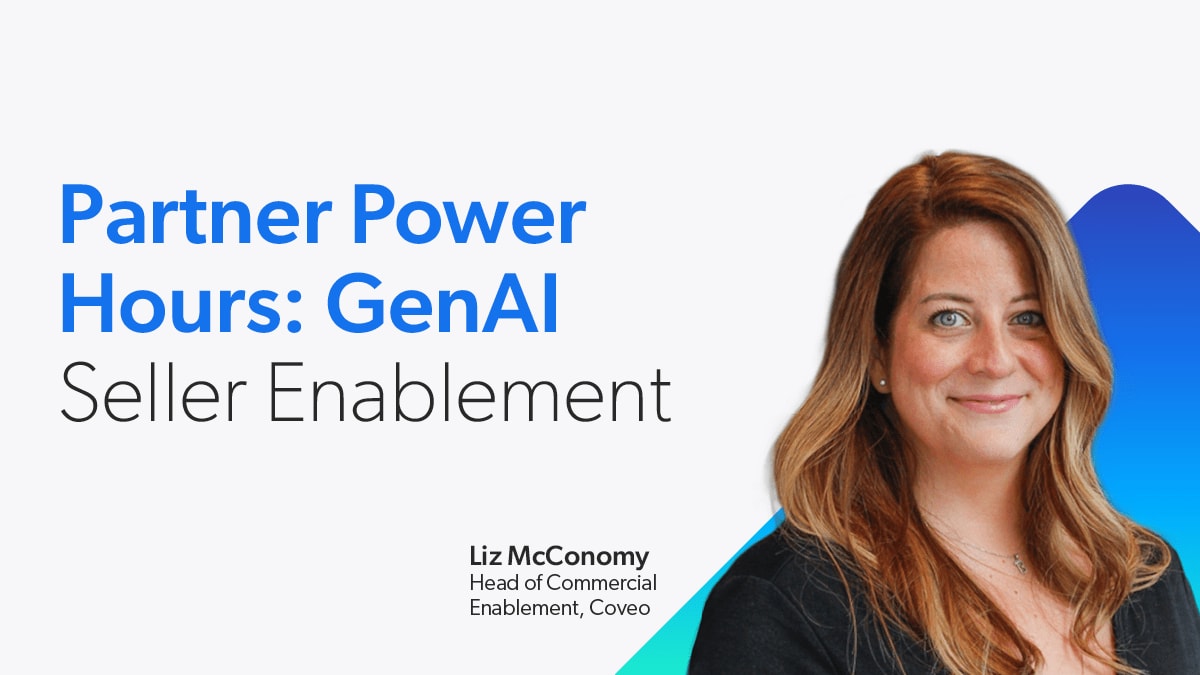
Partner Power Hours: GenAI | Seller Enablement

In our final session, we’ll provide the tools to enable your sales teams to proactively pitch Coveo with confidence.
We dive into:
- How to identify and leverage key use cases, core pitch deck and differentiation strategies
- Buy vs. build decision-making process
- Utilizing Business Value Assessments (BVAs) effectively.
Make every experience relevant with Coveo