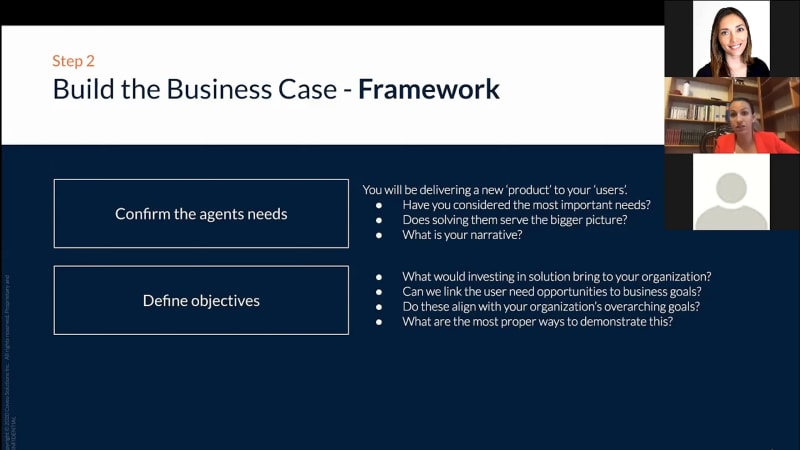
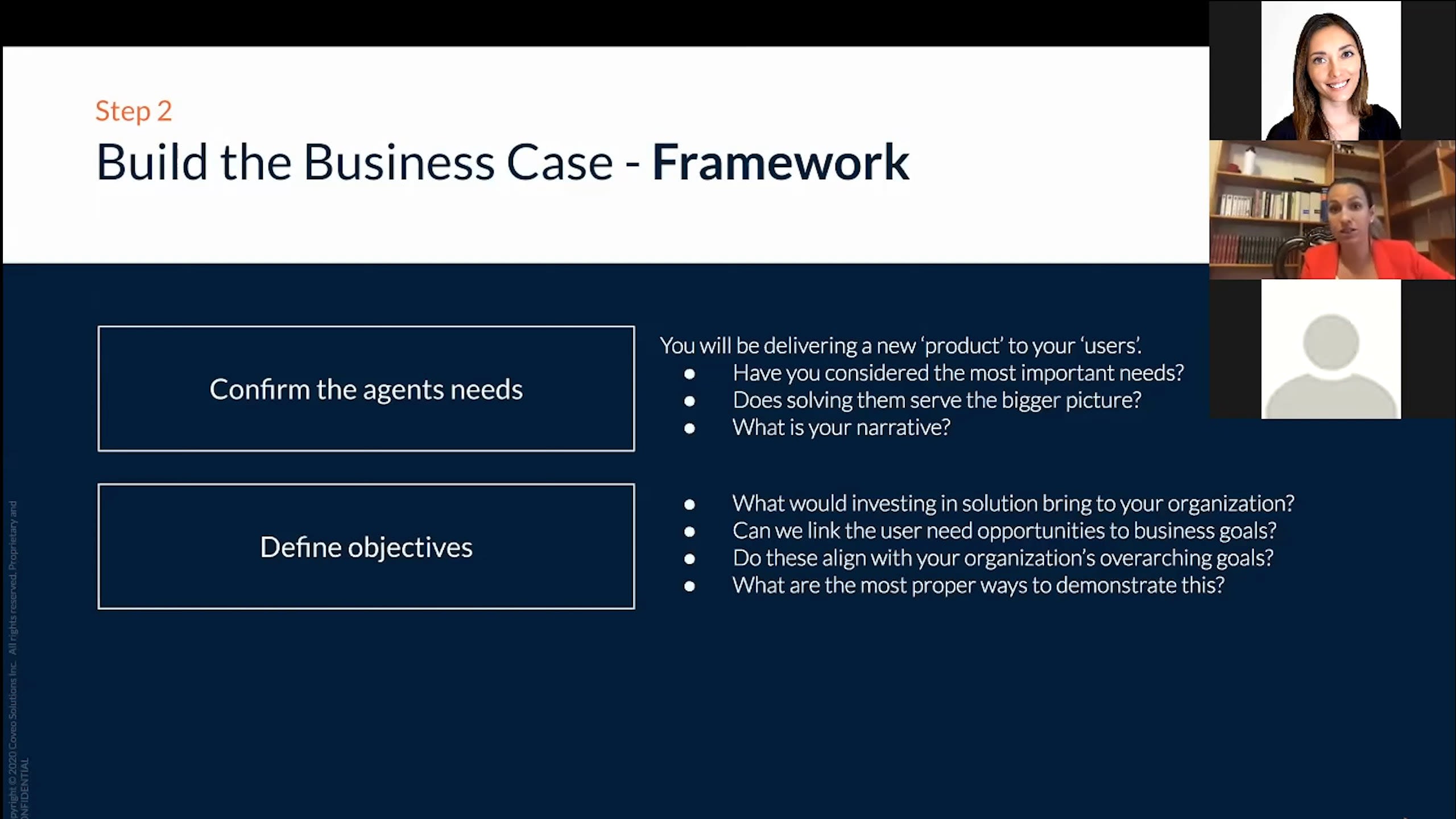
Hello, everyone, and welcome, and thank you for joining us today. My name is Bonnie, and I'll be joined by Rosalie. And today, we're going to give you a different perspective on how you can make a case for investment in the agent experience. In the first part of this presentation, I'll give a different way to really think about the agent experience and share some data points, and then Rosalie will take you through how you can actually build a business case. We're happy to take questions, so feel free to enter any at the bottom of your screen. To get started, what I really want to share is that customer service is not just a standard, but it's a differentiator. It's not enough to provide self-service or customer service on its own. It must be exceptional. One of my favorite quotes is from our our CEO or it's a it's a really a question that he tends to ask at events. And the first question is, you know, how many of you would be willing to wait ten minutes for a taxi, you know, ten years ago? And most people in the room would raise their hands. And then today, how many of you would be willing to wait ten minutes for an Uber or Lyft? And the reality is is that most people aren't willing to wait ten minutes. They will change drivers or switch to a different app. And what this shows is that the expectations of customers have changed tremendously over the last ten years. Our accept our expectations are higher, and, you know, we do expect brands to have a different level of customer service today. And you can see this in in real time as big box stores have been closing. You know, what did Amazon and Netflix provide that Toys R Us and Blockbuster didn't? You know, part of that is the the ease of service, the ease of doing business with them, and really that their ability to provide relevant experiences. And, you know, what we've seen is that it's not just the operation operational costs that contribute the most to customer service costs, but it really is the impact that bad customer service can have on your business, which is why it's so important to empower your team to provide that level of service. So how can service leaders create those relevant experience and become relevant amongst those giants while delivering results for the business? Well, we like to look at, this value erosion model provided by the consortium for service innovation. And what this shows is that when a customer has a problem, it pays to solve it quickly quickly and effortlessly. You know, when you think about your own experience, when a problem arises with a product, your first stop is most likely Google or, you know, the app on your phone, really to just try to to find the information to solve the issue on your own. But if that information isn't there, we have to work a little bit harder. So, you know, whether that's going to the community or, chatting, just trying to find the information. So it really, these these efforts take a tax on your customer, and that that extra effort costs you. Because when you factor in the cost to serve by channel, the picture becomes more clear. And we have data from the TSIA that shows that email or phone support can be a hundred times more expensive than self-service. And the takeaway here is that the easier you make it for your customers, the better it is for you and for them. And so this really helps to by by providing that better experience, you're creating happier customers and more reliable customers, those who will stick around and stay with you for the long run. And, of course, what we've seen is that increasing customer retention rates can actually increase profits, and then your cost center actually becomes a profit center. But what really is keeping us from doing that? And and a lot of it really is, the silos that we've created. You know, for twenty years, we've been filing information away in containers, whether it's point systems, databases, knowledge bases. And so now information is everywhere and spread out. And so in this environment, customers and agents need to hunt for the information if they know where to look. You know, my my first job was in a call center almost twenty years ago, and I just remember the feeling of frustration, when trying to just find the simple solution to help solve a customer issue. And on top of that, with attrition rates being high, in a call center, it's often, the reliance on coworkers that help solve problems as well. But with all of these data silos and with, with our agents being spread across different areas, it can be difficult for us to kind of turn the chair and ask that question and get that assistance and support, which is why it can be a challenge to provide that, service experience in such a disjointed, when we're experiencing a disjointed environment ourselves. And so what what business leaders are doing, what support leaders are doing, is really leveraging data and AI to reshape that experience. And so how this works is really, you know, you're already sitting on a wealth of data that you can activate, who your visitors and customers Barca, and what they've bought. And are you using that to improve the customer experience? And if not, that's that's what you really should be doing, and that's building a foundation for transformative customer service using search data and AI. And so while I wanna kind of give you a high level of what that looks like, it's really building a case to, invest in technologies that help you really capture then reuse that knowledge, unify the access so that no matter where your content resides or where your your support agents, are working, they always have that same access. And then, of course, being able to track those insights and metrics, leverage AI and relevance to personalize those experience and and increase relevance for your agents, and then, learning that behavior to continually improve. And we know that these these are all important and things that will help your your support team operate a lot more efficiently and effectively. Just a few results to show you, you know, the impact that that this can have when you unify knowledge, content, and organizational silos. Companies like Xero and Tableau and RingCentral are seeing great results. They're seeing, you know, decreasing the the cost to serve, increasing self-service success, and really decreasing the burden on their support engineers. And so I really just wanted to share some of these examples, so that you can, you know, really take a look and and you can view these case studies after. But by really making those investments, you can see, success. And so, next, I would like to to pass it over to Rosalie to see how you can actually, take that and turn it into a business case. Thank you so much, Bonnie. So hi, everyone. My name is Rosalie Gerard. I lead the business value group here at Kaveo. I'm here today, to, to walk you guys through, how do we build a business case, for your agent experience. So in this presentation, I'll actually walk you through this, the following framework. So how do we first start with discovery and analysis? Then how do we build a business case framework? How does that look like? How do we articulate the value around this? Third step, how do we assess a project feasibility? How do we factor in all of those costs and make sure that it still makes sense? Fourth step, how do we make sure that we socialize and improve, the business case over time? And the last step, how do we, update the business case and make it a living document over time? So I'll get started with the discovery and analysis. First of all, steps, but a very important one. So this in this step, we wanna make sure that our, business case actually focuses on our users. So on our agents. How do we do that? Well, you know, through interviews, external research, process mapping, pain points through, you know, workshops or or, focus group. Time studies is also something that that that, usually gives us access to pretty good data. And this is actually wanna, what I wanna talk to you guys today, about, you know, time studies. So when at Cavill, we do time studies to build a business case, we use a tool called, dialogue, a a DILO analysis tool. DILO, d I l o, stands for, day in a life of. So we basically pre COVID would, you know, sit next to an agent and, and capture information. Post COVID, we do that through, screen sharing. But the goal of this activity is basically to, to capture every single activity that an agent is doing. So, I'm sure you're you're familiar with that. There's a lot of things going on in an agent's life. It requires a lot of concentration and, and, and discipline to track every single thing that they're doing in a day. And when I say every single thing, it's basically we wanna understand, you know, the agent is going to SharePoint looking for information. Okay. The agent, actually doesn't didn't find anything. The agent's standing up going to his neighbor to ask a question. Okay. The question is over. Agent's coming Barca, actually looking through his email to find a old email that would answer the question. The agent. So it's really item per item. We wanna capture everything that they're doing, in this tool. So the tool that we can definitely share with you guys, after this presentation, it's it's it's been working pretty well for us. So, once everything is captured at the end of the day, what we do is we actually categorize the activities. Was this like a communication and and tracking? Was it, issue identification? Was it resolution and research? Was it escalation? Was it, resolution and testing? Or was it documentation and wrap time? And once this is understood, then we can do the analysis on, you know, what agents are spending their time doing. This is a result of, a recent study we did with, a large financial institution. We can, we can see here in the blue part, the light blue part of my graph, where you see thirty one percent of time doing resolution research. Means almost a third of agents' time is spent looking for information. That's a lot. However, not all research is bad. Right? You don't want your agents to just, you know, be, talking to customer and and and and giving them information. You also, especially if you're, dealing with a more complex and technical, type of tickets, you want them to do some research, but good research. Right? So when we did this analysis, we looked at, waste. We wanted to identify waste. Wanted to identify the time spent searching that could be avoided. And if you I'll drive your attention on the right side of the screen here. What was waste in this context is basically, that the the agents, that we're looking for non index content. As Bonnie mentioned, you know, with all of those silos, there's a lot of opportunities spent to to lose time there. So that was the first type of waste. The second one was tribal knowledge. That's basically, agents asking a question, to their neighbors, slapping, their neighbor without creating knowledge that can do, we we use in the future. Meaning that an agent, in in the Philippines that have the same question two weeks from now we'd actually use, you know, companies time to, to figure out how to solve it all over again even if it was solved in, you know, in India last week. So this is, this is what we looked at to identify waste and we actually realized that two third of the time spent searching could be avoided since it was spent outside of Coveo. So that's huge. But that's also data driven. So this is a very good way to start a business case by, by going in the field, capturing this data if it doesn't already exist or just harvesting it if it already exists, and and make sure that you include it in a business case to make it more more solid and tangible. Building the framework, making sure that it's, that it is aligned with our, our users, our end users needs. Right? Our agents. Make sure that we have considered, their most important needs. Make sure that we are solving, what sort of big picture and, and that is that our narrative is aligned with with what they actually need in the field. Once that's done, we wanna make sure that, our business case start by aligning with our organization's bigger goals. What are we bringing with the to the organization? Making sure that we frame the story before even getting to the numbers and how, and we do we, link the business opportunity with our our organization's business goal. I'll give you an example. If, your organization are, is investing heavily in, you know, developing a contact center in, in a high value center, in another country. Well, this this is the big, you know, the big opportunity that your organization is working on this year. How do you make sure that you frame the conversation on how are you gonna, you know, bring value in this bigger project by investing in in, in certain technologies such as Cabello? So important to link it back to, you know, more strategic opportunities or other opportunities that are going on in the company and making the link between how how do they align together. And once that's done, you can actually get to the value drivers because this is super important. Right? So if I'll, I'll bring your attention to the left of the screen here where I have my list of value drivers. So in a call center, you know, whatever you're measuring is what you wanna have in this in in this, in this business case. And when I say whatever you're measuring is because we wanna make sure that the terms and, the the vocabulary used in a business case resonates with the, all decision makers. So what it whether it is, you know, case and all time, agent time to proficiency, escalation rates, infrastructure costs if you're talking with IT, overall support costs, internal support costs, employee satisfaction, whatever it is that is a KPI that is directly linked to a dollar value is what you wanna include in this business case. So, obviously, you're probably measuring way more than that. Right? You know, maybe a tax rate if you are a KCS, organization, etcetera etcetera. But it is very hard to tie a dollar value to that to attach rate. We wanna make sure that we focus on the KPIs that have a direct dollar value associated to them, such as those that you have here on the screen, on the left part of the screen. Then once that's clear, you wanna, look at baseline. So how can we measure this today? And take you the the right picture. How does your organization look like today, for each of those value drivers. So for the end of time, you know, is it, you know, two days or is it thirty minutes or or whatever the complexity of the cases that you're dealing with, but you wanna make sure that you capture baseline. And then this is where you apply, an improvement hypothesis. So that's typically something that we can definitely help with if you're thinking about, building a business case or Coveo, because we can actually bring you some, some experience from our customers just as Bonnie mentioned, and see if it's realistic or not, to go, you know, as aggressive or as conservative as you're planning to go. But when you have your baseline and you apply your improvement hypothesis, this is actually where you're gonna be able to calculate your annual impact by, business value drivers. So this is kind of what, should be included in a business case. This this slide that you see here, is actually some very important part of the business case. And once you're clear about the value that could that your project would, would bring, you have to look at the the feasibility. Right? So including the upfront cost, project management, data migration, or any additional assessments that are required, to to have this project come through. Deployment cost, implementation configuration, if it's done by an external partner, if it's done in house, how are you gonna organize and how you gonna account for the cost? And also ongoing cost, licenses of a software, upgrades, maintenance, internal cost, whatever it is that is not included in in the, actual, licenses that that that a vendor could, could propose. These are the hard cost. However, it is also important to identify risk risk migrations, in the business case as a in terms of the project feasibility. Another thing that's important to, to measure and include in this business case is actually the key critical success factor, that you'll have to consider to make sure that this project is successful. Now I'll give you an example, change management. Change management is a huge one. Even if you are accounting for, you know, all of the direct costs, from from a software provider, never forget to include your internal cost to make sure that the project is successful. This week, you might, reduce a little bit the the expected ROI that is presented internally, but at least it's something that is realistic, that will, have good credibility and that can live over time with you. So change management is is a good one, you know, time to have business aligned, and and who do we need from different new business units to make sure that this project is successful, etcetera, etcetera. So this is these are all things that are important to consider when you're assessing the project feasibility. Then, for instance, if you're looking at, at a build versus buy, scenario, it's important to make sure that you are, you're including this in your business case as well to make to make sure that you don't get challenged, especially by the IT department. So oops. So you wanna make sure that, you know, you articulate the actual business value that you would get from a, you know, out of the box solution such as Coveo, versus something that you spend time, you know, configurating, building extensions for, and then, you know, investing internal resources and customization over time that would actually increase the risk, in your investments. I'm sorry. I get fascinated about this subject. That would actually increase the risk of your investment, increase the time to value, and, and actually have lower ROI. So it's something that you just wanna make sure that you include in those business cases to to to make it a no brainer. Right? To make sure that, you know, are we targeting the lowest cost solution? Are we making sure that we're accounting for availability of resources, differentiation time to value? These are all things that you wanna make sure that you clarify. Then once you have, you know, the potential value per value driver, you're clear with your project's feasibility. You wanna make sure that you build a business case that's aligned with your organization's or the way that your organization is expecting to see business cases, but also, that that is aligned with what your organization how your organization is used to communicate those, those those value conversation. So do you wanna build a phased approach? If so, you know, these are all assumptions that you have to test in your model. So phased approach, you know, are you going all in at once? Adoption rate over time, this is something that you wanna account for every year in your models. Benefit ramp up schedule probably also be, impacted by your phased approach, and and the adoption rate as well. Difference between diet creation and cost avoidance. Things that you need to factor into your model. Cost and contingency level, growth rate, growth rate of your company. Usually, we use, growth rate of sales and basically, reflected on, the the the actual growth rate in, in headcount, etcetera, etcetera. Discount rate. And from this, you can actually decide, you know, when you're building those models, what type of, financial metrics you wanna reflect in there. NPV, ROI, RRR. And from there, then you can run you can run very sensitivity analysis to make sure that, the assumptions that you're taking, in in the points above are are impacting your ROI in a way, that makes sense to you. Update buy in. I think from everything I said so far, this is probably the most important step. So a business case is needs needs to have, needs to have buy in inside of an organization to make sure that it is it it has credibility and it can actually, bring you to the next level. So, when you build a business case, I was telling you to align it with your user needs, go on the field, capture, capture field information, but also oops. But also, align it with your business, your business goals and and business goals from other department. Tell a story. It'll make your case more preservative and memorable. That's huge. Spell out the business need. As I was mentioning, making sure that it resonates with the audience that is it is linked to what it is the reality of your agents in the field, and have both a short and a longer version ready. So here's an example of a very, very short version, but something that's all that needs to be presented, to to get buy in. Right? What are the value drivers that what's that were considered into the business case? How aggressive or conservative we wanna be, in terms of improvement hypothesis? And it always makes sense to show this because especially if you wanna be as conservative as possible and you still have a positive ROI, I I I just think that it communicates very well and it, it usually is is pretty well received. And then on the right side of the screen, I'm sorry. What is, the actual dollar value that would be delivered in your organization based on each of the value drivers that you see, that that that were used in your, in your business case. So having this on a one slider like this, actual value drivers, improvement hypothesis, and total, potential per value driver and summarizing on the right part, you know, the total investment we're talking about, the actual benefits that are related to it, and in this case, you know, the NPV of the project over three years, and how it translates into our ROI. Something that's that's all they need. Well, actually, that's all that what needs to be communicated in, in in a company, to get buy in. Sometimes we need a longer version and everything I walked you through, to make sure that it actually makes sense and we position it very, very well in an organization. I said the last part was, was the most important. I I think this one is also crucial, to make sure that, that your project actually makes sense and you don't only talk about potential ROI, but you actually report on ROI. So update that business case. Make sure that whatever you built before a project or before a technology, you acquire certain technology actually becomes a, a success plan that you actually update over time. So make sure that your executive business review of the project are are if you're talking about, you know, for instance, build business, building this for the acquiring for instance. Making sure that on each business, executive business review, you are reporting on those business value drivers that you captured, before before the project. Adapt to changing context. Make sure that it's something flexible that can be changed over time, and and even objective can be adjusted based on what is happening in the organizations. And build a value driven roadmap, with six months milestone. So when we build a business case, we typically, you know, build a three year story, make sure that you have actionable items to make sure that you actually see this value in a shorter term as well, so that you can, you know, celebrate that value and then build something, from there. So super important to make it a living document. Socialize it, get everybody's buy in, and then make it a living doc living document. So at Kaville, we can help you build that business case. I mean, if, if this session was, was relevant to you and gives you, you know, an enough tool to go build it, well, that's awesome. But we can also help you, get started on there. We have a business value consulting group that, helps you, you know, identify your, operational efficiencies impacting your business, doing those time studies, you know, focus group, etcetera, etcetera, collecting some, you know, operational and financial data. Then we help, you know, you understand key value drivers, of, of your workplace, you know, for for the agents. Then we help you evaluate, how Cabello can help impact those metrics, and we help, you know, shape that business case. So this is definitely something that we can, we can help you with. We actually offer those services, for free. So don't hesitate to reach out, in chat, at the bottom of the screen. Those engagements are actually, so it's it's not it's not a a big engagement or big time commitment from your side. Usually, you know, forty five minute discussion to make sure that we understand the situation, then, followed by a workshop, a discovery workshop around two hours, more on our side, than your side, in terms of, of homeworks. Then we send you a data request. We help we ask you to, you know, provide us some operational and financial data, and then we can find, finalize a draft that we run by you, make sure it makes sense, do couple iterations, and then, you usually, are in good shape to have, have something ready. So I hope, this session was relevant to you guys, and helps you, get started on building that business case. We we will have a booth available, and we'll be there to, to answer your questions. So please don't hesitate to come and ask us anything. We'll be happy to, think those next steps with you and and help you shape that story so you can get your projects, started. Thank you. Thanks so much.
Making a Case for Investment in the Agent Experience
Customer service isn’t just a standard. It’s a differentiator.
Your self-service and customer service experience needs to be exceptional because 90% of your customers will use that experience as the deciding factor as to whether or not they return.
The is that the expectations of customers have changed over the last 10 years. We expect brands to have a different level of customer service today.
A decade ago, most customers would wait around for customer service chat help. Today, customers wouldn’t wait more than a few minutes to get help.
When a customer has a problem, it pays to solve it quickly and effortlessly. The easier the experience, the easier it is for you and your customers.
Watch our webinar to see how increasing your customer retention by 5% can increase your profits by 25-95%.
Your customer service goes from a cost center to a profit center when you break down the silos where information is hidden away.
Stop the madness of trying to find the solutions to simple customer issues with a process that captures, re-uses, and makes knowledge easy to find.
Data and AI transform the customer experience by learning from the behavior of your customers to continually improve.
In this session, our head of Business Value Consulting Services guides you through how to create a solid business case that justifies investing in more unified and effortless experiences for your agents, and the KPIs you must track to be able to demonstrate the ROI of those investments.
Create an experience that:
- Unifies relevancy for your agents.
- Brings customers back.
- Turns the heads of other business leaders.
Make every experience relevant with Coveo