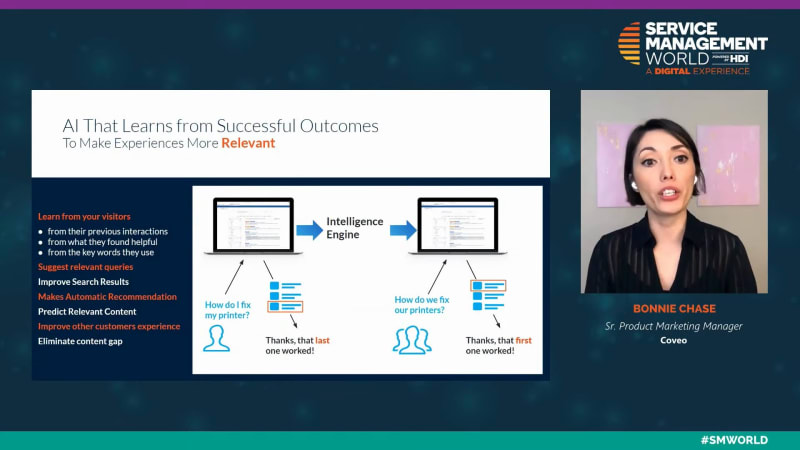
Hello, everyone. Thank you so much for joining us today. My name is Bonnie, and I'm on the product marketing team at Coveo. And I'm joined today by my colleague, Juanita. And today, we're here to talk to you about how digital leaders are transforming customer and employee experiences with AI. Now over the last few months, there's been a shift in the perspective of the employee experience and where that sits against the customer experience. And from our perspective, it doesn't have to be either or. It can be both. And so we'll talk to you more about that today. Thanks, Bonnie. And hi, everyone. Really excited to be here to talk to you and give you a perspective on how to balance these two very important areas, at every company. So, of course, there are many new normals that we're experiencing throughout this year, but the new normal that Bonnie alluded to is the fact that companies now need to be agile as it relates to developing their customer and employee experience. And at the beginning of this year, every company was sort of awakened as to where their investments were being driven because of the pandemic that we're all experiencing. And so today every company knows that they really need to be agile and to take both experiences into serious consideration. So put simply, if at the beginning of this year, you had put a little bit more priority and a little bit more investment on the customer experience side of things, the pandemic was really sort of an away an awakening to many companies and leaders, and it really highlighted the importance of putting the right priorities as well as the right investments in the digital workplace. And so, you know, customer experience is no longer more important than employee experience. They're really both, they really both serve the same purpose and they go hand in hand. And what we saw play out this year were a couple of different sides of the spectrum. Since billions of people were were ordered to work from home earlier this year, we saw those companies that were absolutely prepared to shift to remote work, and then we saw others that necessarily worked. So on one side of this spectrum, we saw companies and employees that had never worked from home before. And so there was a little bit of scramble to get employees set up properly to get the right connectivity, VPN, secure access to the digital workplace. And on the other side of the spectrum, there were companies that had been investing in digital workplace areas over time and for many years. And for those companies who had made steady investments over time, business did not skip a beat for them. And the real difference between, these two sides of the spectrum were those companies that were conscious of the impact that investing in your employees, had on the actual customer experience as well. And so we truly believe that there really is a center of balance and with today's advanced technologies including things like AI, companies can really achieve being able to deliver both a great customer experience and an employee experience. And the reality is that both of these key stakeholders expect that companies give them a great experience because they've been a bit spoiled by the giants of enterprise such as Netflix, Amazon, Google and even Facebook. It's really the consumerization of IT that has driven employees and customers and they're oftentimes one and the same to expect these great experiences. So we believe there's many parallels when it comes to employees and customers, and one of these parallels and similarities is actually, some of the same pains that both stakeholders are experiencing. So as you can see here, IT teams spend up to eighty percent of their time maintaining legacy technologies. And that leaves just twenty percent of their time to be able to develop new solution for internal and external customers. And so if both, both customers and employees are experiencing the same pain points, then really there is a sort of root cause that really can be addressed here. And it's really the technology, in the right sets of smart technologies that can be used to make sure that you're controlling and managing your stakeholders experiences, wherever they're interacting with you and at every moment that they are, looking for information from you online. And so what we see this pain point, this common pain point, impacting is it's really creating this level of dissatisfaction and frustration among employees and customers. So on the employee side, the left hand side here, you know, workers are saying that they're underutilized, they're uninformed, and they spend nearly one month each year just searching for information, searching for knowledge, and searching for expertise. And Bonnie, you might wanna comment on the customer side of the house a little bit. Yeah. Absolutely. And so, you know, we we see similar things on the customer side, and we know that more than half of customers who have a poor experience are are willing to leave a company for that. And this really directly impacts the bottom line because what ends up happening is you're not really competing over the product anymore. It's the product and the experience, and both your employees and your customers expect better. Absolutely. And as I mentioned before, with this whole consumerization I of IT, employees know employees and customers know you can do better. And so if for any reason you're still sort of wondering why this, experience matters, we wanted to put forward a few a few very interesting stats again, both on the employee and the customer side. So on the employee side, really employees are a company's most important asset. If you have the right talent, that really can give you a competitive advantage. And what we see here is that EX leaders or employee experience leaders have forty percent less employee turnover than their competitors. And another interesting stat here is that EX leaders also beat out the average SMP by a hundred and twenty two percent. So if you kinda break that down, it's, you know, if you really do invest in your employees and their daily working experience, you're going to reap less turn turnover than your competitors, and you're also gonna have better overall company and stock market performance. Bonnie, you wanna come in on the customer side? Yeah. Yeah. Absolutely. And, you know, on the on the customer side, we all know customers have a choice in whether they stay with you. We've all gotten used to having subscriptions and being able to jump from Netflix to Hulu, from Amazon to Wayfair, and that's just part of our day to day lives now. And so there's nothing different from us in our homes and the interactions that we expect there and the interactions that we expect, with a company that we are purchasing from or a company that we are employed at. And so, you know, giving that that good experience is key to the stickiness in keeping your your employees, retained and keeping your customers customers for life. Absolutely. So the logical next question would be, how do you keep your employees and your customers from leaving? And, we believe there is a formula that can be followed to help kind of control and make sure that you are giving a great digital experience. And so there's a ton of research around experience and digital experiences, but we wanted to simplify this, so that you can use this as a guide as you're considering, the impact and the perceptions that you're giving your key stakeholders. So just to talk through this formula. So we believe there's a couple of factors, Being able to engage and enable your key stakeholders will lead them to feel empowered. And if they're empowered, they'll then perceive that their overall digital experience was one that was positive and successful. So to break it down even further, when we think of things like engage, we think about being able to meet your visitors where they are, being able to know what they need even before they know what they need, and being able to provide them with information even before they have to search. So that is creating an engaging, engagement level with your visitors. On the enablement side here, what that is all about is making sure that your visitors are able to find and discover information on their own terms and in their own time, enabling them to be able to take action online and enabling them to find, and believe that they are using trusted information. And so those two, create a visitor that feels that they they can trust your sites. They feel that they have what they need to achieve their goals, and that leads to an overall positive experience that will keep them coming Barca, that will create a level of loyalty. And so just consider this as a way to think about how you are driving, and enabling your users on your different sites to be successful in the goals that they have in visiting you because every visitor, has an objective or a goal in mind. And let's talk about what some of those goals and objectives might actually be. So on the employee side, every employee has a set a fixed set of things or a good set of things that they're trying to do, in their daily work life. And so the first one is is very obvious, you know, every employee wants to be able to find and discover the right information that's going to help them be able to, you know, be productive on a daily basis. Every employee, especially as you're onboarding, wants to make sure that they have, their HR and IT resources set up successfully. They wanna make sure their benefits are running, that their computer works, that the key applications they're working with are up and running successfully. Every employee wants to be able to learn ongoing, learn about the company, learn about the products that you're serving your customers, and of course every employee at some point is going to want to resolve an issue, perhaps get access to a new application, and so being able to allow employees to do that is absolutely important. And lastly, every employee will need to connect with colleagues. And not just there's both a general connection to meet other peers in the company, but there's also a need to be able to find the right expertise and the right subject matter expert on key topics and categories. Yeah. And on the on the customer side, it's really, you know, very similar in trying to get information. And some of that information is the same as what employees need to need to have access to. But, on the other hand, you know, customers really they they want to be able to to buy your product or service, information like watching tutorials on on learning about your product, learning how to do something, fixing those issues that they encounter and connecting with their peers. And so as you can see, there are some similarities and parallels between what they're trying to achieve and at the core foundation is knowledge, is the content that they need, to take them to the next step. And so, you know, on on this slide, what I'm showing is really the the support journey your customers are are expecting. And so, you know, customers expect that in just a couple minutes, they can go from the problem that they have or or the the thing that they're trying to do to a solution. And as soon as they have an issue, you know, the the first step is really to Google it, and they expect to find their solution right away. And if you're not able to find your answer in Google, then it goes into a self-service journey. And so this can be any number of channels that your customer may try to access information from, whether it's your knowledge base, your community, a chatbot, any of those areas. And so from here, your customers are are then going to start exploring, your digital channels to try to find the information that you need. And so it's really key to giving them that experience that they expect. And it's not that different from the employee experience. Right, Juanita? Yeah. Exactly right. The only difference here is that, as you can see, we're taking all the different information, channels, and resources that every company has, and we're sort of pushing them to the employee. And that's because, you know, we operate under a premise that employees don't wanna search. They want to know, and so employees expect that proactive guidance, that proactive recommendations of company, knowledge as well as role specific knowledge that's gonna help them be productive, that's gonna help them make the right connections. And so employees do want an easy and simplified way to access trusted information, and companies need to be able to provide that. And the only difference I would say here is, I mean, you said a couple of minutes on the customer side, but I think really on both is, you know, they the the expectation is almost near instant. Both stakeholders want, you know, instant access to the right information, and companies need to be able to deliver that. Yeah. And then well, it sounds, it sounds like it makes sense, sounds easy to understand. This is the reality that most, companies are offering. This is the type of experience is, you know, obviously nonlinear, but jumping around from multiple channels. These channels are often disjointed. The experiences feel very different depending on where you are and what tool you're using. And, really, we sort of highlighted this a little bit before, but the real core and the parallels between employee and customer experience is that, knowledge is at the core for both of them. Both are looking for specific knowledge, albeit employees are looking for knowledge to do their jobs. Customers are looking for knowledge on the right products and perhaps the right service needs for the product they purchased from you. Both stakeholders want and need to be able to self-service on their own. This we can't stress enough. Employees want to be self sufficient and so do customers, and so being able to offer this self-service ability is very important. Both also have a break fix need. Technology breaks, product sometimes break, and so this is another similarity that we see across both key stakeholders. And it's really the digital experience leaders and the sort of forward thinking companies that are gonna be able to help these stakeholders find answers faster, to increase the self-service capabilities, and lastly, to reduce repeat volume or repeat tickets to the help desk, and hopefully shift left, which is being able to address some of the core problems at the beginning of the problem so that you don't have these repeat, issues coming into the help desk. Yeah. So how do we resolve these similar problems? Well, the answer is relevance. And we all know what a relevant experience looks like and we know what it feels like because we we have them every day. And so a relevant experience is one that's driven by technology that can really understand the context of what people want. And this is done by analyzing data and actually picking up what their true intent is through AI. And so this is everything from powering a simple search to helping you find what you want, to then understanding more about who you are and what you like, even comparing you to other people like you and anticipating what they're likely to need next based on those similar patterns. And so this type of technology is typically, you know, what you would see from the Amazons of the world and what those giants have harnessed. But, this has actually been democratized recently. And so now this type of technology is is really available to everyone, both from a workplace and a, customer experience perspective. And so, you know, the the the question then becomes, you know, how can workplace service and support leaders create those relevant experiences? And so I wanna take you through kind of three key steps that will, lead you to creating that relevant experience. And the first one is really about unifying data. And so when I say unifying data, this really means stitching together the data, meaning the customer data and the content, across silos. So imagine the disjointed experiences that we've talked about so far where the employee has to jump from, site to site to try to find information. The customer is moving from chatbot to community to knowledge base to find information. And when you think about where that content is coming from, right now, it's very fragmented because knowledge lives in multiple locations. Right? And so it's kind of impossible to have all of your content being sourced from one area. And so unifying is really what brings the content together so that you can provide that consistent experience across all of your channels and give your customers and employees access to the information they need the most. And really just to kind of give you an example of what that looks like here, in in this screenshot, you know, typically, when we think about search, you know, we a lot of people like to, purchase a federated search that allows them to, really search all of the content. But the problem with that is that it still remains siloed. And so a unified search, on the other hand, actually brings all of those sources together. So, Juanita, if you do one more click, just to show that from a results perspective, if you have your content unified, not only are you surfacing all of the content from one area, but you're really able to apply, machine learning on on top of all of that content. So on this screen here, you can see that, content's indexed from over fifty sources. So that means if it's a tutorial, if it's in a YouTube video, a PDF, or a knowledge base, you still have access to that content. You can still search for it in one interface. Or if you move to a different interface, you still have access to that same content. And, with the content being unified into one index, it really allows you to surface the most relevant results because you're able to apply AI on top of that, which leads me really to, to another example, which shows it from the agent perspective. And and the agent perspective is unique because it is you know, they are an employee, and they are directly interacting with that customer as well. And so for the for the agent, having that unified, unified content enables them to have access to the information they need to help the customer. So step one is really about unifying. The second step is really about being relevant. And so when we talk about relevance, that's when we're talking about adding AI to going beyond digital. So, you know, obviously, we all need a digital experience, but how can you make that digital better? Well, you make it more effortless and pleasant for the customer by leveraging things like recommendations, suggestions, narrowing the results to exactly what's needed. And really this is where machine learning can do the work to help understand what you will find useful and what people like you will find useful. And so in this example, we can really see that, machine learning can learn from your previous interactions. It can learn from what you've searched, what you've viewed, the keywords you've used, what results you've clicked on, what you've said, you know, helped solve a problem. These are all things that, machine learning can pick up for you. And, on the next slide, you can see an example of what a relevant experience looks like. You know, it's providing those content recommendations that you're used to seeing in Netflix or Hulu, but this time it applies it to content in your service experience. And not just for the customer, but, as Juanita can show it, it you can do this for your employees as well. Yeah. Absolutely. Here, what you can see is a relevant employee experience and how it's very proactive and that it's recommending content and people to you as an employee based off of who you are, based off of your department, and even based off of your preferences. So maybe you are in the marketing department but you frequently collaborate with someone in product management on on a particular topic Barca. And so with smart technologies including AI and analytics, you can actually receive this sort of personalized and tailored experience so that you feel you have everything you need to do your job on a regular basis without having to spend so much time searching and so much time going through many different sites to find what you need. And I have to say this, this hub is something that that we have ourselves, and it really does make a difference to have something like this where you can actually see what's going on with your team and what different projects you're all working on, which customers you're working with, and have that kind of, that internal collaboration and that teamwork that helps drive the business forward. Absolutely. So you no longer need to ping someone to know what they're working on. Yeah. Actually, just take a look and and see your team's activity. Exactly. And so, you know, the third the third step in in driving these good experience is really, driving value. And when we say drive value, we mean, measuring and optimizing that experience. And so, you know, when we think through the steps, step one is unify. Step two is adding in that AI. Step three is really, you know, reviewing everything that you've done, looking at your goals, what you're trying to achieve as a business, and then reviewing how your experience is meeting those goals. And so from this perspective, there are a few different, you know, types of analytics and dashboards that you can leverage to create that good experience. The first one being, you know, obviously, identifying and resolving content gaps. So if you have analytics that can give you the trends in search and visitor, behavior. This can really help you narrow in on what content is needed on both the the employee and the the customer side. Secondarily, self-service success is another key measure. Again, this is something that can be measured on the employee or the customer side. When we talk about self-service success, this is really, you know, broader than just, just case deflections. Right? We're looking at how much engagement the the customer or employees having, how many searches, what content are they looking at, have they been able to resolve their issues that they've had with that content that you've provided? So this is just another type of of, report that can really help you measure how well your content is, achieving the goals that you have set forward. And the other example is case deflection. So, you know, measuring case deflection can really help you get a grip of how many cases are you, are really coming into your your support or service center and then how many you're able to prevent with content content. So this is another common report that we see. So these three reports are just examples of the types of analytics that you can use to improve that experience. But really what's key is making sure that you're able to map your KPIs of your business to the activities of your site. And so to summarize just that piece of really, you know, how we're creating those relevant experiences is really these three stages. So the first one being unifying the data, because this is how you help users find information that they need, and and using all of the content that you have. The second step is being relevant to leveraging AI to connect them with answers using the lowest cost channel. So wherever your users are, whether they're in a community, chatbot, or an internal, intranet, being able to connect them with the answers. And then finally, driving value through a culture of knowledge sharing and continuous improvement. So continuing to put out, the most relevant content that can help solve problems and then improving, you know, and adjusting based on what you're actually seeing through the data. So these these are really the strategies that we've seen working with, with the customers that we work with. And I think, you know, sometimes when we when we look at these, these three kind of steps, it can be a little daunting. Right? You know, to have to think about all of these things that you need to take down. But like to to take and and what really helps us with our customers is really following a maturity model, which Juanita will talk through now. Yeah. So thanks for that, Bonnie. Let me just spell out the slide here. So, you know, we we recognize and realize to Bonnie's point that every company is really at a different stage in their digital maturity. We saw that this year with the pandemic playing playing out and and the rush to work from home and those that, you know, executed flawlessly, and then there were those that didn't. And so with everything, it's about a plan and taking a phased approach. And so what you're seeing here is our relevance maturity model, and it's really a goal and a phased approach for how you can, get to sort of that nirvana of delivering a truly personalized and a truly relevant full experience for your key stakeholders, no matter who they are and no matter which channels they're using to interact with you. So just to describe this sort of four, columns or four, the four columns that you're looking at. The first is your reactive sort of phase, and this is obviously a place that no one wants to be at. And the reactive phase is one where, you aren't giving your key stakeholders a great, search experience. This is something that hopefully isn't too common for everyone, but everyone, has experience not being able to find something. You don't know what key terms to use. You're trying many different, keyword combinations and yet you still can't find, content, which is again the place that no one wants to be. And so where we we really come in is, on the responsive column here, which is where that, step one, unify, comes in. And so we really do come in to help companies, basically unify their content and by that we mean we bring all of this enterprise wide data into our index and that allows employees to be able to search across multiple repositories rather than having to go system by system to find what they need. So responsive means that, you know, I as an as an employer, as a customer, I'm hitting that enter button to search and the system is responding, to what I input into the system. And so we can use a little bit of AI here to help with a keyword suggestions. But really where the next stage that, you know, companies wanna get to is to be more prescriptive. So rather than waiting for me to enter a search term or query into a search bar, we can really start to get a little bit smarter and, use the behaviors and the actions of many previous users to to get an idea of, you know, based off of the things that you're looking at. We know you might be searching for a particular term next. So prescriptive is about, it's kind of getting away from requiring employees to search and hit that enter button to now giving you more recommendations. So based off of maybe your geography, based off of, your previous search history, We can start to understand who you are to start making recommendations to you. So it's no longer just based off of your input. We now have some data, you know, based off of many other users so we can kinda guide you down a journey. And then the last kind of stage, the predictive stage, again this is sort of like the ultimate goal and stage that we want to take all companies to, for again not just their employees but their customers. And the idea here is that you're bringing in not only, a user's behavior, but then you're also bringing in personalization, actual things about that per that person or persona, that you might be able to gather from your CRM system, or again through, online, activities to be to to be predictive, prescriptive, and really just how help them feel like they really are receiving a personal personalized journey, no matter where they're interacting with you, within your organization. And really the a great thing about this relevance maturity model is that, again, there are stages and phases that every company goes through. But at the end of the day, it's all about being able to have consistent experiences for both your customers and your employees. So it's not just targeting one site, but rather if done correctly and if kind of taking a holistic approach, you're able to give this great experience, and apply it across the company so that you're you're reaching, employees and customers where they are, and you're sort of controlling the overall brand and service experience. Did you wanna make any comments on this one, Bonnie? Just, you know, just to the screenshots that we shared kind of give examples of of each stage along this journey. And so, yeah. I think that you did a good job covering it. One thing I will add is that, you know, it sometimes it's it's a little tricky to figure out where you are on this maturity model, and so we do offer, a free assessment to help with that. So I think, on the next slide, if you, move to the next one, I can talk more about that. But before we get to that, you know, we did have that quote to share, which is that, sorry. I kinda jumped ahead, but really to win in the Barca. You must first win in the workplace. And this is a quote that we found, you know, from the former CEO of Kimball Soup, but I really like this one because I've been, talking to a lot of service leaders lately. And one thing that I keep hearing that's recurring is we have to take care of our people, and we need to take care of our employee experience because having a good employee experience will lead to a good customer experience as well. And so, so, yeah, so to to bring up that assessment that I mentioned, we do have a team of service and support gurus who can take a look at your support site or community and, really assess where you are in that maturity model and and provide recommendations for, you know, what steps you need to take to help get you to a more relevant experience. That's great. And along the same lines, we also do have, a workplace assessment which is a little different where, Bonnie and the support team is focused on analyzing your existing support sites. What the workplace assessment, really does, is help digital workplace leaders provide an ROI based approach and justification for investing in the workplace. And so I think for many people, there's sort of this understanding that workplace investments usually are, a softer investment and it's hard to show the ROI. However, we we see it a little bit differently. The way we approach workplaces that, yes, we do help with knowledge discovery, but we also help in very concrete areas such as, sales enablement and helping sales be proactive and productive so that they can close business quicker. We also help on the agent and support side. Obviously, agents are, employees, but they service internal employees as well. And so there are real cost savings there as well as cost avoidance measures that we help with. And so our workplace assessment is really all around helping you to sort of identify problem areas and and savings opportunities so that you can confidently, you know, go to management and build a case for why investment in key workplace areas keyword placed areas will represent a great investment and a great, ROI. And so, similar to the, service assessment, it's a simple step of reaching out, and we have a couple of links here that you can access. Reaching out to our team who will follow-up with the call to walk you through the process. And the whole idea is that we really are helping you to, create a great experience for both of your key stakeholders. Yeah. With that. I think we're, ready for questions. Yes. Absolutely.

How Digital Leaders are Transforming Customers and Employees Experiences with AI
Knowledge workers and agents are now working remotely when customers’ expectations for personalization are at an all-time high.
Customers have come to expect real-time communication.
Real-time information.
Real-time suggestions and recommendations.
Real-time help.
Customer support teams that are operating with limited resources in an old-school way, will find that they can’t scale up to provide customers with seamless and predictable interactions with your business.
AI has evolved to assist individuals with increasing speed, accuracy, and intelligence.
Businesses that adopt an AI-powered platform for their customer support will be leaps ahead of the competition.
AI can solve problems faster, more consistently, 24/7, 365 days a year.
Think about how your customer support team can work smarter, not harder, with an AI platform.
Watch our webinar to see how our AI solution will be able to scale along and eliminate your growing pains.
In this session, Coveo’s Workplace and Service experts:
- Share why a holistic view of customer and employee experience is necessary
- Review some of the top trends and challenges for employee and customer experience
- Provide tools to evaluate your digital maturity in both
Today, we will show you how our AI platform can help you automate the influx of new customers.
Make every experience relevant with Coveo