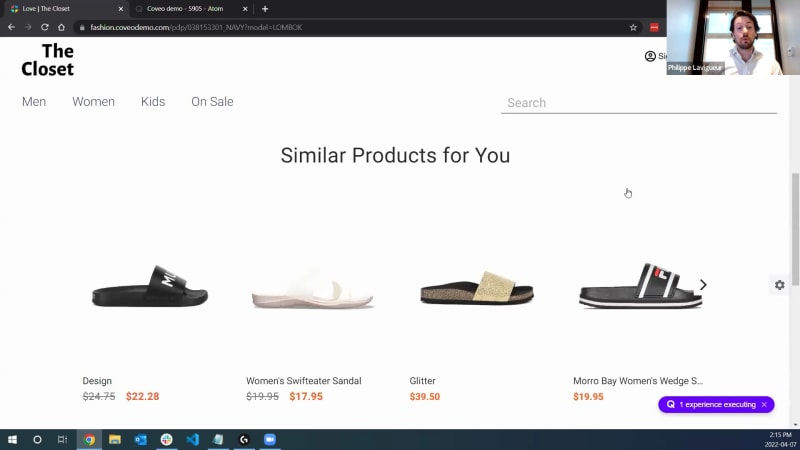
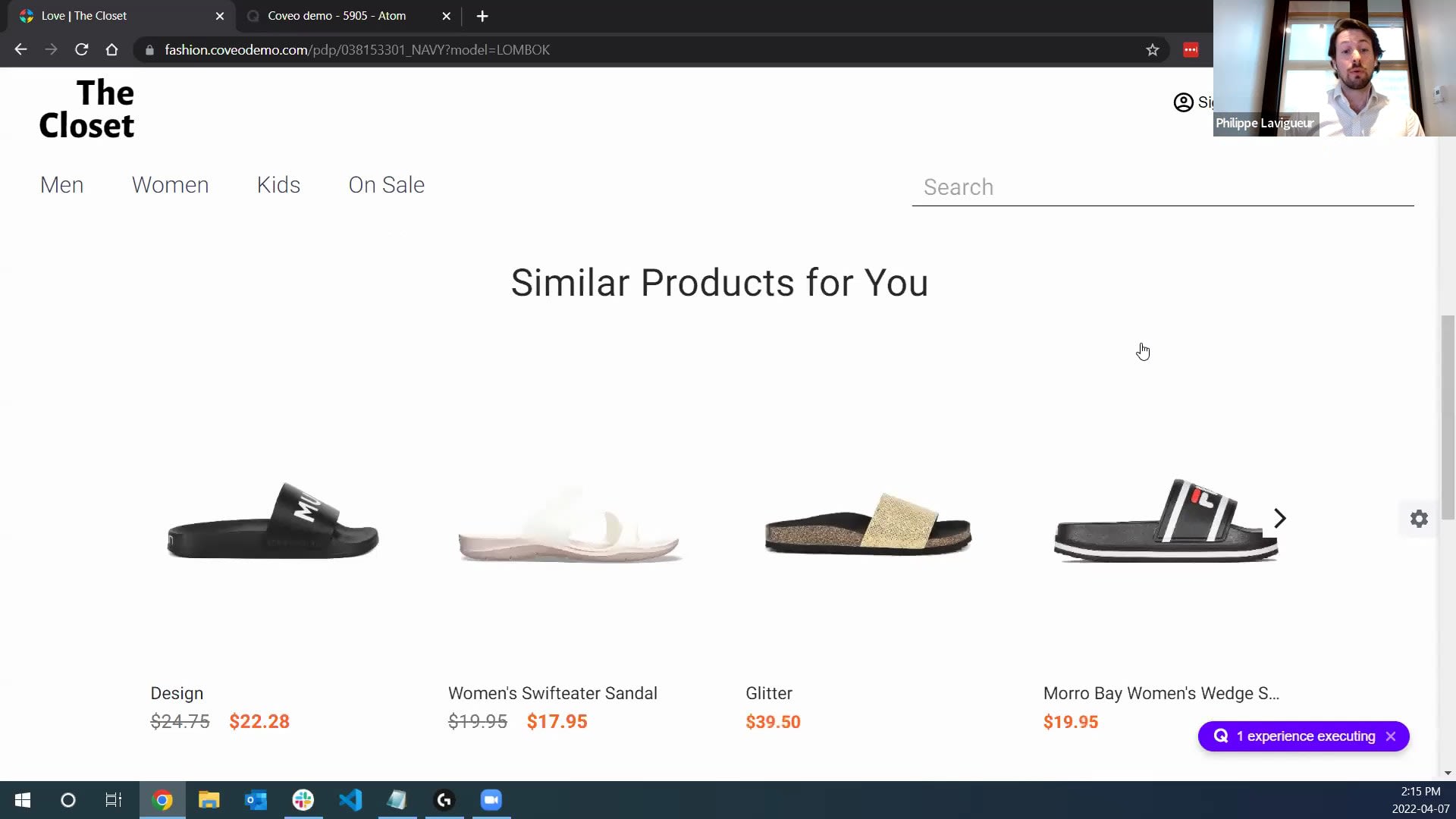
Hello, everyone, and thanks for joining our webinar, demo webinar today on AI powered search personalization and recommendations for ecommerce. So my name is Shereen Reid. I work on the product marketing team here at Coveo, and I'm also joined by my colleague, Philippe LaViguer, who is in our solution engineering team, and he's going to be leading the demo today. So first off, I have just a couple of brief housekeeping items to cover with you quickly before we get started. Everyone is in, listen only mode. However, we do wanna hear from you during today's presentation, so please feel free to send your questions along using the q and a section on your screen. And I will go ahead and answer a popular question that usually comes in, and the session will be recorded. And you should receive, the the presentation with that in about twenty four hours of the conclusion of the event. Alright. With that out of the way, let's get started. So, before I hand over to Phil, I just wanted to take a moment or two to kind of set some context, for the discussion today and the demo. So Coveo commissions a survey every year, and we publish our findings in what we call the ecommerce relevance report. So this year, like last, we asked about four thousand consumers to share their thoughts about their online shopping experiences. And what you see here on the slide is that ninety three percent of those that we surveyed said that they expected their online shopping experience to be equal to or better than in store experience, so quite a high bar. But I think what's more interesting about this is that it actually represents an increase over last year. So when we did the survey last year, they said ninety percent has actually gone up, so the bar is getting higher. And the reality is that we know it's tough out there, right? So over fifty percent of shoppers start their journey on Amazon. And if you factor in Google into that as well, if you combine Google and Amazon, you get sixty, sixty five percent of people. That's where they start their shopping journey. And conversions typically on, retail sites are around three percent only, so it hasn't gone up that much over the last few years. And when people do land on your site, you need to show them something quickly that's relevant and compelling. You have one or two page views, that's all you have, or they bounce. And that's also a known, stat that we've, seen when we've done some research. So with that in mind, when we think about these ecommerce experiences and making them relevant, we also have to think of every type of shopper, right, and about the entire, buying or purchase journey that they're going on. So you have to think of that whole spectrum of shoppers out there. And people discover or want to discover products in different ways. So you have shoppers that know exactly what they want. Right? They want to be able to go to your site, have fast responsive accurate search that gets them to the products that they want as quickly as possible so they can just add to cart and go. But then at the other end of the spectrum, there are shoppers that are browsing, and they might need guidance or more personalized recommendations. They might need to see special offers that's right for them. Then you also have those that want to maybe understand better how to use a product post purchase. So thinking of more complex items maybe like an electronic equipment like a new router or even a small new appliance new small appliance that you've recently purchased. And finally there are those that might be returning customers and they might want to repurchase items that they've ordered before so you need to to facilitate that as quickly as possible. So the question is how do you cater to all of these different permutations and combinations at these different stages of the journey and at the same time make them relevant? So it it really has to be scalable. And, frankly, from our point of view, you also need an AI platform that can underpin all of these different shopping journeys. So Coveo is able to support that each type of buyer journey and different buying scenarios. So there's a whole lot on the screen. I'm not obviously going to go through this today and Phil will be touching on a subset of these. Just a couple of quick examples, elements, you know, like during the discovery phase, if you need predictive query suggestions, you need relevance powered listing pages that Coveo provides, and remove some of that friction from product findability. And when you think about it, customers often will land directly on a listing page from Google. They won't navigate through your home page, so having plp pages as personalized and as engaging as possible is really, really important. In the aware phase, Coveo was able to power personalized welcome messages. So typically, everybody fights over that home page real estate. Right? You wanna it ends up becoming a catch all for every type of customer but really instead it should be more give you the opportunity to personalize it. You want to be able to welcome new customers or welcome back a VIP for example. And then during the selection phase, Koveo has the ability to index a wide variety of information including inventory and even pricing. If you have localized pricing like some of our customers do, that's important. And so this is ideal to support things like real time inventory, availability for BOPIS, and Phil will show you some of merchandisers out there, Coveo also has social proof badging which allows shoppers to build confidence. So it's human nature, I know like myself, we like to know what others are doing and if we're within the trend. So this can be a super powerful way to programmatically deliver that. And then finally, if you're looking at the during the purchase phase, so at the end of the road, you wanna be able to power those recommendations based on maybe items that are in a shopper's cart or even additionally personalized session based recommendations depending on the behavior that they've been showing throughout, their in session. Once they click on the confirm button, you also have an opportunity there to, position other products for maybe their next visit. So with that in mind, I'm going to stop sharing my slides, and I will hand over to Phil to walk you through some of these elements, live. Alright. Thank you, Shereen. Alright. So let's get into it. So this is our our the closet. It's a fashion. It's a brand retailer that we we've built for demo purposes. We do have a lot of Coveo touch point throughout the website, and that's what I'm going to go over. Our persona today is going to be Tracy, travel traveler Tracy. She's based in New York, and she's tired of the snow of the the the winter. So she's she wants to go on a suncation. And today, she's going to shop for sandals, shorts, skirts, anything that could really get her flashing in her upcoming trip. So how are we going to be able to personalize the full experience of Tracy? It's with events. It's with rack tracking. So here, we do have a small demo widget where we essentially put web paint underneath Tracy's feet. And as she starts performing clicks on on the website or or searches, we're all gonna track this information, and we can even drill down in these, kind of events and see, is is Tracy a returning customer? How long is he has she been on the website? So this is all information that we're able to track, and we're even able to have some Google Analytics IDs so you can get that information streaming in your own system. So that's just a bit of a side note on the events. So let's start as Tracy. So Tracy comes on the closet, the website, and our merchandising, choice right now is for Sweater Weather. We're coming out of of winter, so this is gonna change, but they've been lazy. They kept on on sweater weather, and that's not what Tracy's looking for. Right? So everything here is chosen by the merchandiser, and I wanna put specific attention here on that that placement genes for everyone because we will see this completely change based on Tracy's behavior on our website. We also do have some recommendations at the bottom of the screen. So this is great for product discovery, and this is all dynamically fed by Coveo's AI, Right? So you don't have to have a dedicated merchandising person that is gonna select these products. This is all done based on user clicks, user searches, and we're gonna promote the most relevant content and the most popular content for our user today. Right now, we're we're quite kind of a vanilla session because we have not performed any clicks. We've done a single page view on the home page, and that's why what we're recommending here is only the most popular, selection of hats. But, as we start clicking, it's gonna change. Right? So I'm gonna Tracy's gonna start on her journey. Once again, here we do have predictive query suggestions right now. Once again, based on really warm weather close. That because that's what users were searching from for this winter, but this is not our purpose today. We wanna go for sandals. So as I start typing, we definitely will see the query suggestions being, automatically kind of changed, and it also supports query kind of, auto correction. So here, I I misspelled women, but it's their engine is still able to understand. We're searching for women, so we do have some great recommendations for queries here. And even if I hover on on some of these queries, we do have a small pre product preview. So it it it indicates what type of content I should be looking for if I run this query. So Tracy's looking for sandals. We're gonna run that query, and here we go. We fall onto the main Coveo search page. And note here, everything that you've seen, all the content, the information is dynamically is fetched from Coveo. So everything from the results, how they're they're built, the breadcrumb here, and even the facets and the values within the facets. So what do we have right here? We have, the breadcrumbs that are automatically going to filter down for the category and also the gender. This is based on my query and understanding who my user is. And this is this is crucial because eighty eight percent of consumers say that when they fall on a on a website on a retail website, they're just simply presented with too many information. There's too much content. So using these these smart filtering, we're able really to understand what our users is looking for and and kind of filter out some of the noises that might confuse them and render their online interaction kind of poor. So it's all about really customer satisfaction and getting them to to use your website more and to buy more, and that's one crucial part is really to to help them find their product and also remove a bit of the noise. Of course, we can clear this to see all of the the full catalog. That's completely doable, but this selection was premade for us. Now this has not we we didn't have, as a merchandiser, have to kind of map this query to to this selection. It's all done based on previous user clicks being fed to our Covell machine learning models. For this specific case, it's our dynamic navigation experience ML model, which is going to make that auto selection, completely dynamically and automatically. So you don't have as a merchandiser to really put a lot of effort at, getting that feature out. It's all done for you using Coveo ML. Now one other functionality of this ML model is to re rank the facets. So the filters on here on the left, right now, we do have six filter filtering options. It's not a lot, but sometimes you can have up to hundred or even thousands of filtering, options. And that can really can really, be hard for your users to to be able to select their filters. So the Covell ML model will start reordering the facets and the values within the facets to really present the most relevant, filtering options for for the users. On a desktop, it's it's useful when you have a lot of, a lot of facets, but it's especially useful for mobile device users, where the real estate on on the mobile device is is very, restricted. So that's why you really want the most relevant facets to be shown at the top of the list and even the the values within the facets because you can have, up to thousands of colors. So you want the most popular colors to be surfaced as the first facet values. Once again, all of this is done automatically by Cobayo's ML. You don't have to put any more any time on it. It's all based on your user behavior. So it's also even gonna kind of follow the trend the trend of your users and and be really dynamic, throughout the time. One particular one thing I wanna note here on the facets as well is here, the store facets. So Coveo is able to power some real time near real time inventory management. So here, if I were to select the San Diego store, for instance, when I click on this one, we're gonna filter out any results, any products that are not available in that specific store. Now in twenty twenty two, this is absolutely mandatory to have this information directly on the search results page. Right? Not on the on the product details page because you get your your user excited on a specific specific product, and then they they go to check out the product. It's not available in their preferred store. This is terrible user experience, and it gets your your users to kind of leave your website and go see, Amazon, for instance, and you'll lose your customer forever. So this facet and having this information being directly, given to the user in the search results page through Coveo is is very crucial and and, brings a lot of value for your users. The last thing I wanna note here is definitely the social proofing badging. So I personally do not have any fashion sense. So these badges will help me choose and select some products based on what other people have done. So here, we do have badges like, hey. This has been viewed sixty times today and also bought forty eight times in the last two days. Now this is completely configurable, so you can really tell your users what you want them to tell. So as a merchandiser, you do have Coveo as a powerful tool to to put badges, of metrics that you want your users to see. So Tracy's gonna go over the the the search results page. She quite likes this kind of specific model, the log model, and we can select the color directly here from the search results page. And we're going to launch and click on it and get to that search, product details page. It's right here. You're gonna select the size. Gonna scroll down a bit and see these similar products for you carousel. So product recommendations carousel. Like I mentioned before, this is completely automatic. So it's using the page's context. So the sandal, which I clicked on, and using that information being fed to the Coveo ML model, and then the ML model is gonna give you back the most relevant, sandals and the most popular sandals. Now this is great for merchandiser because they don't have to manually kinda create the list. However, we do understand merchandisers, and we know that sometimes well, you do wanna manually have an input in these, recommendations carousel. You have your specific business needs, or you wanna try out some, some sales or some some, some campaigns. So you do have the option to do this with Coveo. You can either promote a product and say, I always want this product to be the first when I click on a sandal, for instance, or things like, hey. I want the first two, but the rest of the list is going to be fed by Coveo ML. So here we don't have a conflict. You can have your own business rules as a merchandiser, but you can also let the ML do its job for the subsequent products. So it's a it's a great mix between both and allows you to not have a kind of a on and off feature. Both can play well together. So you can really achieve more product discovery and better product discovery with with the these, Coveo features. So Tracy quite likes this, sandal. Gonna go over and click and add to bag. Now if you remember, when I started to search for, for sandals here, I had a lot of information on kind of suede warm weather clothes. But now we're starting to understand our user here, which is Tracy, and she's looking for kind of more more more weather clothes, more more, warm weather clothes and for women. So here, I even if I type shorts, we're not gonna recommend shorts for men because we know Tracy is a woman. We know her visit, and that's why we're gonna kinda predict the query that she wants to do. And that's exactly, what we're doing here, and that's why Tracy's gonna click on women's short. So we're really understanding the user and getting them the information they're looking for as easy as possible. So Tracy is gonna go over here on women's short. Once again, we're doing some dynamic filtering to kinda remove a lot of the noise, and Tracy is gonna start scrolling down the list. Now she wants a pair of denim denim shorts. So we do have a couple here. I'm gonna choose this one because it has been viewed more time. So we can kind of start seeing these, this social proofing badges that can work, great with people that are kind of well, everyone, everyone likes these badges. Once again, we do have our similar products, and we're gonna add to that. Now Tracy is looking for a specific skirt now, so she's gonna go over here in the product listings page underneath women's skirts and dresses. Here, what we see is a product placement. So instead of having only results, we have, as a merchandiser, the option to push some some specific content to our user and start merchandising or marketing campaigns directly on our product's listing page. But sometimes what you wanna do is not have something super generic in the PLPs. You want, for instance, to send your user a link in a on on an advertisement on on Facebook or in an email, and you want them to see some specific content. And we can do this using Kobo's context. So here, for instance, if I were to land on this page, I could really be able to tell her my message based on my audience. So if I were to fall on this page with a specific kind of value in the URL, maybe that would be, something like Old Navy as a brand. I'm trying to push all Old Navy content. I can do this is in the URL, send that context to Coveo, and the user is gonna fall here on the PLP with a specific spin on on Old Navy. In that way, using Coveo in the context, you can have these merchandising, campaign work seamlessly in your kind of already developed product listing space. You don't have to to rebuild the site. You don't have to invest any development dollars into your website. You just have to kind of have a different value in the URL, and the full search results list is gonna be updated for your needs and your customer needs. So you can really you you can you can really target some specific customers. Note on this, we're not filtering out the content. We're just kind of reordering the list using, Coveo ML. And so that's why we still do have the other brands, but Old Navy is definitely the first, eleven items in that list. So Tracy quite likes this, this dress it's floral. It's kind of very popular as well. We're gonna click on this one. Once again, we do have similar product recommendations and we're going to add to the bag. Going on on our baskets, we will see a different kind of ML strategy. So we've only seen kind of, oh, these are products similar to the one you were looking at. Right now at the bottom of the screen here, we have products that can complement your cart and really get that, average order size to to be boosted with these with these recommendations because we have, promotions like, hey. You're only twelve fifty away from free delivery, so check out the recommendations. The part the the great thing about these recommendations is they are based out of your cart's content. So we've seen, a, we have a sandal, we have a bottom, and a bottom once again. Maybe you're looking for a top to to really complement your full visit, and so that's what Covello ML is gonna do. It's gonna understand that you might be looking for this. It would be paired quite nicely with your your your cart's content, and we're recommending some content here. So Tracy wants to profit out of that, free delivery. We're gonna go here and select that top. So then we can go back here on our cart. We've now qualified for free delivery, and we're gonna check out our visit. Like Sharyn mentioned, we do have some for your next visits and most strategies as well. So these are session recommendations, which you're going to use your whole visit browser, your full visit history to promote, products that might interest you for a next visit. Coming back on the home page, I wanted you to remember the the jeans placement that we had. Now since we now know Tracy and as a merchandiser, I wanna promote kind of jeans for her for, not jeans, but shorts for her, specific audience, and that's automatically done using the Coveo platform. And I'm gonna show you how we can actually achieve this. So this is the Coveo merchandising platform where you can can completely configure, your personalized content, the product recommendations, and even the social proofing badges. So if I go in my campaign and I find my shorts campaign once it loads, And I think my Internet is quite spotty today, so this might take a while. Hopefully, not too long. Right. Okay. I'm gonna come back to this once it's it loads. But here, what we're essentially going to do is since this is a placement already done by our del our our developers, what we're going to do is we're gonna be dynamically able to sub kind of switch the title, the subtitle, the images, and where this button points based on specific audiences. So this should load faster. Let me go here instead. Right. Live demos can always be a tricky thing with placements not loading. Maybe I have it here at some point. Right. Okay. So I managed to load here. So I'm gonna go onto my shorts campaign here so we can see a lot of information on that specific campaign, seeing the conversion rate that that campaign has provided. But what I'm interested in here is in the experiences, which is what where what content I'm trying to push. So here we can see that we have an audience for loyal customers. This is the audience I fell onto when I I kind of checked out Tracy's visit. So that's why the jeans for everyone changed to shorts for everyone, and that's how you can, as a merchandiser, really target some specific audiences. And I'm gonna create a different one just for demo purposes. So we're still gonna target the same, audience just for it to be faster. I'm gonna go here, and you'll see that in a matter of kind of couple of clicks, I'm able to completely change the look and feel of my, my website. And not only the look and feel, but I'm I'm able to really personalize some content and Barca users based on on audiences. So here, I'm just entering a lot of, some of the kind of the content that will be in my placement. I can put in some, some photos here for my my placement and here I am done. So you see it's very easy to do. And now as a kind of a business user, I can drag and drop some experiences to reorder the, the priorities of these these placement that I wanna push out to my customer. So here, click on apply changes and directly live on my website. So without having to involve any developer, if I just reload the page right here, there we have it. Bathing suits up. Bathing suit up. We do have a different placement. And now with the power of Coveo and the merchandising capacities that we have directly on the platform, we're able to push content, targeted content to users, and have that reactive to any audiences so you can really tailor the, audiences like you want. You have you can have stuff like, loyal customers for for three conversions, people that have spent more than thirty minutes on the website, people that have seen, seven pages. So you can have, campaigns like, hey. You've you've, created a lot of traffic on the website. You're not looking for what you're you're you're not finding what you're looking for. Here is this type of content or this type of content recommending stuff that they might not have seen. So it's a great tool and a powerful tool to really get you, get your users content that you want them to see. So I'm gonna wrap this up right here. Do we have any questions, Shireen, on the q and a platform? Thanks, Phil, and thanks for thinking quick on your feet there and flipping around to, you know, incognito mode. It worked. So great stuff. Do you wanna stop your share? I will reshare my screen. Yes. Sorry. Okay. Alright. And, of course, I don't have the there we go. So I just want to highlight one more thing before we go into a couple of questions that came in. So, the questions we actually get quite often is in case you're wondering, yes, Coveo is platform agnostic. So we do have some native integrations like into Salesforce commerce, but we also have an extensive set of out of the box connectors, APIs, headless controllers available so that you can embed really Cobeo in any site, app, or mobile experience that you need to. So with that being said, one of the questions that we often get, and I'll see somebody asked it again, is how much data do you need for machine learning to really, you know, be effective to work properly? I it it always depends on the traffic of your website. If it's a small scale website, it can take maybe up to to a week for the model to really be mature and start recommending some great content. But for for high traffic, websites with more than, let's say, one million clicks or or the models can be built very quickly. So, we've seen we've seen some deployments where in one or two days, the models were completely mature enough to to recommend some great content and, even customers where we're kinda worried that the day zero, ML would not be great. And they've been very surprised as the the the fast deployment of the ML models, what they can achieve in in one or two days. Yeah. And we can also, enable a tracker, right, while while we're looking at deploying so that we're collecting the the those ML events in advance. So when you go live, it's already up and running quickly. Yep. Yep. Okay. Great. So another related question, I guess, on the platform agnostic aspect, could you connect, Coveo, so your solution to a CDP to feed the AI with existing customer profile data? So that's an amazing question, and I'll let you answer it. So there are ways to kind of pretrain the models, and get customer data into to for for the models to understand kind of their their context. So that's basically how we do it. We we gather the context of the current user, and we then feed that to the ML, and it spits back the results. So we can connect to a CDP, kind of get a a bot to feed that information back to the ML models before well, prior to the deployment. So we can use this information to kind of pretrain the ML to, to get great great recommendations out of the bat. Yeah. And we could also use it to power, for example, buy again recommendations, which using, you know, what they've purchased in the past so that, when somebody comes back, you can easily just click on on the what they purchased before and depending on what what the context is. Right? I know that's used a lot in b two b, but it also has its purpose in b two c, like things like cosmetics and such where you purchase some things often. Yeah. Yeah. We can we I've I've seen I've deployed, Coveo into Salesforce b two b, for instance, where we would use all of the the customer's previous order as context to Coveo and, and use that for for DML and to kinda kick start DML. So the same applies for I'm I'm seeing the question right now for data You say the weather? The weather, the, the locally of your browsers. So depending on whether you're, kind of French based, English in Europe, or there's a lot of different languages, we can have this information, and it's gonna completely change the experience and the ML, model kind of results back and also kind of the browser and even your location. Yes. And I know there is one of our customers that is actually using a weather API to influence what comes out in terms of what's recommended for this weekend if you're shopping on a on a Thursday or a Wednesday and the upcoming weather forecast is factored into some of the products that they'll be showing you. Yeah. Alright. And with that, I know we are at the bottom of the hour. Thanks a lot, Phil. And once again, thank you for everybody, for joining us today. Just before we sign off, I did wanna highlight that we do have the survey report that I mentioned at the introduction, and it has some great insights in there. So if you're interested, you have the link to download, or you can just head on over to our website and download directly from there. So thank you again, and have a good rest of your day. Alright. Thank you, everyone. Have a good day. Bye.
Every Interaction Matters With AI-Powered Search in B2C Ecommerce
Irrelevance fatigue is not just a buzzword.
People don’t appreciate irrelevant results. They will abandon their cart without hesitation when they can’t find what they need.
Customers today aren’t the same as they always were. They have less time and more options in terms of shopping destinations and purchase channels.
Coveo’s AI-powered technology enables your ecomm business to deliver personalized search and recommendations, so customers enjoy making relevant purchases and have no reason to bounce off elsewhere.
Watch to learn how you can leverage Coveo's AI-powered search &recommendations to elevate your Ecommerce strategy:
We’ll help you:
- Understand exactly how Coveo supports you in boosting conversion rates and AOV by facilitating product discovery on your site.
- Explore the brand-new capabilities for in-session personalization at your fingertips.
- Learn how our recent acquisition of Qubit (the next-generation personalization tool) empowers your merchandisers to influence each touchpoint of the shopper's journey.
AI-powered search and data deliver relevancy that attracts new visitors, satisfies your customers, and delivers a personalized experience they’d love coming back to.
It’s possible… with machine learning.

Make every experience relevant with Coveo