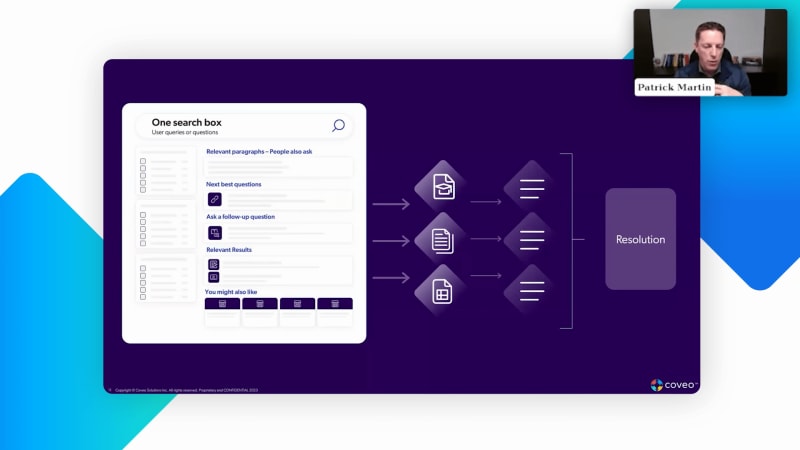
So Patrick is joining just now, and I'd like to give you a bit of an introduction, before I hand over to Patrick. So Patrick's been in the tech industry for over twenty five years, and he's worked in various, industries such as telecoms, human capital management, and relevance platforms. His journey in support services, started back in nineteen ninety nine, as a support analyst, and he hasn't left support since. So we're really with a heavy weight right now. And just before I do hand over to Patrick and his presentation, a couple of housekeeping points just to remind you of. So first of all, in our resources box, you will find some free content from Covio, including some case studies, and AI paper. I really would recommend checking those out. Secondly, all of our sessions I'm seeing some questions about this. All of our sessions are being recorded. You will be receiving an email from CX network with information on how to access those on demand following the session. You can also access these directly via the Zoom lobby, once the day has closed. And I'd also like to remind you all that if you have any questions for Patrick, please do go ahead, put those in the chat and in the q and a box, and I'll be, going through those with Patrick towards the end of the session. But for now, welcome, Patrick. Thanks so much for joining us. Thanks, Louie. Every time I hear the dates and the time, I I feel older every day. Sorry for reminding you. No. That's fine. That's fine. I I just don't know where the last twenty five years will just they just flew by. So but it's been Not AI been a fun it's been a fun ride, and, hopefully, it's gonna continue. So Fantastic. Okay. Well, thanks thanks so much. Thanks for giving me the time. Thanks for, allowing us to kinda share some of the things that, you know, we're we're seeing here and, some of the things that I strongly believe in as we enter this world that, has been transforming throughout the last few years with, you know, the AI tools and everything. And one of the things that I'm I'm really passionate about when we talk about the customer experience is about really thinking about the the the AI strategy. And that's what we're gonna talk about today. And before we go into our content, I do wanna throw these questions out there just to get the thought process going around some of the things that we're gonna talk about. So if I were to ask, you know, the audience around how many of you actually consider that your your company is, you know, customer centric or, you know, customer first? Excuse me. You know, I'd be curious to see what that looks like. Also, all the concepts around customer satisfaction, NPS, how many you guy how many of you think that, you know, this is the most important metric or KPI that you have? Also, a lot of companies out there are implementing AI as part of their customer journey, but how many actually believe that this is a critical capability that will allow your company to be successful? And how many of you finally think that CX is a differentiator for your company today? And I'm asking these questions, you know, just to as I mentioned, get the thought process going because the reality is that CX is a competitive differentiator, and it's not me or Coveo saying so. It's it's actually, you know, Gartner. And if you really think about it, you know, what really differentiates you from, you know, companies that do the same type of products that you do or the same type of service that you do? It's the actual experience. Right? And if we if we put our our customer hats on and we we just reflect on our own experiences right? If, if I go to a car dealer and let's say I wanna buy a a Honda Civic for the sake of just the example, and I walk into a dealership and I've been there for, I don't know, five, ten minutes. No one has come to see me. No one's asking me questions. Finally, I go to the reception desk and say, hey. I'd like to talk to someone. And AI, they tell me, yeah, we'll get you someone. Someone comes to see you and they say, well, they bring you to a computer. They put the Honda site up on the computer and say, just read the information and let me know if you have any questions. Not a real good experience versus if you go into dealer number two. You're greeted by the person at the reception desk asking you, you know, what are you here for to connect you with the right person. The salesperson takes time to understand your needs, look at different models for you, either with Honda or someone else. Really, they're as, you know, positioning themselves as a trusted AI. The reality is that you're probably gonna buy from dealer number two even though, you know, you're still looking for a Honda Civic, but the experience is really becoming a key differentiator. And when we think about, you know, why is it important to act now, why is it important for us to think about this AI experience strategy, is that there is a significant amount of money on the table. Right? This Qualtrics study that I stumbled on last year says that there's three point seven trillion dollars of revenue at risk globally on an annual basis that is due to bad customer experiences. And this money is not necessarily lost. It's just taken elsewhere. So if you don't make this a priority for you, the reality is that your customers are gonna take their money elsewhere. And the data on that is is pretty clear. There's a PwC report that says that thirty two percent of people are gonna stop doing business with a brand after just one bad experience, and that number just goes up substantially after two negative experiences. So it's definitely something that should be on the top priority. And the reality is that we've been working on customer experiences for a very long time. I mean, you know, Chloe said it. I've been around for twenty five years. And when I started doing support, it was easy. There was basically just the phone. But as email and the Internet picked up, we started building these digital channels for customers to interact with us. And the reality is we AI of built them in linear fashion, tied to the customer journey and saying, okay. The customer's gonna start finding information on the AI, so they need to know about our product. They need to know about our our company. And then they're gonna buy our product, and they're gonna need to be trained, so we need an LMS portal. And then they're gonna look for help, and we're gonna do an online help, or we're gonna bring guidance into the product. We need a technical documentation site for them to find product documentation. And when they need to, when they need assistance, we're gonna send them to the support portal. And, now we're gonna have a customer community, and the customer's just gonna go through these step by step. And if they can't figure out or resolve their issue, only then will they contact support. That is nice in theory, but the reality is that when customers are faced with an issue or an inquiry or something, they're not gonna follow that design path. Right? They're just gonna go to the path of least resistance. And that, if you've been in support as long as I have, that that holds ninety AI, and this is a nonscientific number, but ninety five percent of the time, customers will go to the path of least resistance. And the reality is that they have the choice to decide on how they're gonna engage with you and where they're gonna start their journey and when they're gonna stop their journey. And you basically have no control over that. And when we look at the actual, you know, path of resolution or the customer experience today, this is probably something closer to what it actually looks like. And we can take the the analogy of, you know, a car on a highway, and they can basically be on that resolution path and decide to take an exit and go straight to the support portal. And that's where they're gonna, you know, decide to engage with you, and that's it. And if they don't find what they're looking for, they're gonna contact your support organization. Or they could come back and try something else in the documentation site, let's say, or they might go to the community, or they might decide go straight to live chat without even looking at your digital, your digital channels. So, you know, how do you think about designing a customer experience that doesn't create silos, that doesn't create gaps? Right? Because the reality is customers should be able to find their answers and resolve their issues regardless of the path that they take. Right? It shouldn't be one digital property with a specific, you know, objective or mission or whatnot. And when we look at, how customer expectations are shifting in this AI world, there's clear signals that tell us that this is important. Right? The first one is that customers wanna self serve. You know, this is this has been a trend for a very long time, but the reality is that even though they want to self serve, there's still room for improvement around our capability of enabling them to self serve via our digital channels. And a lot of that has to do with the way we designed the experience. The other aspect is that, customers expect you to know them, and they're willing to give you data for you to personalize the experience for them. Right? So they expect you to to know them. So if they go to your site and they're authenticated, they expect that personalized experience for sure. We talk a lot about, you know, effortless experiences, and this is a common theme that is starting to pick up around removing friction in the experience. And when I stumbled on this data point, I I was flabbergasted. And and to me to see that fifty two percent of consumers state that they actually feel exhausted after interacting with support, whether it's through self-service or assisted, that that's quite an, you know, definite signal that there's friction in in how we design the experiences. And the last point here is that this really matters. It it's it's critically important for us, as companies to focus on the customer experience because that is where customers actually, you know, develop, sorry, loyalty towards your brand. Right? So, you see that eighty percent of them actually believe that the experience is as important, if not more, than the products and services that you offer. So why is this difficult? Why is it so hard? Well, the reality is that we've built this in silos. And when you look at this, you know, this picture here, is that we have so many digital channels that have come up through time because, you know, there was a need, there was new technology, new digital channel. We wanted to fill a gap in our experience. But the reality is that each of these different channels is probably owned by a different team. Right? So in product or in app is probably your product management team. Your websites is marketing. Support portal is probably your support organization or your digital customer experience. Community portals could be marketing support. The LMS could be your education services, and so on and so forth. So the reality is that if you try to bring it all together with this structure, it will be extremely challenging. And when we look at the solution diversity that is required to render this experience, chances are all these channels are gonna be using their own content repositories. They're probably gonna be using their native search technology. So this is really what contributes to, the friction in the experience is that customers need to navigate through this and jump through self-service hoops to try and find information. And that is really far from being an effortless experience. Excuse me. So if we take a look at the traditional search experience and how that was designed back in in the day is you had the search box and, you know, a a customer would or a user would go to a digital property, search, navigate through the different content or documents that were brought up that were relevant, and the user would identify the different, important bits of information that they needed to resolve their issue. And excuse me. That could take, you know, several, you know, search queries. They could have gone to different digital properties. But the reality is that the the technology was there to render relevant documents, but the onus of finding the resolution and finding the right information was actually on the user itself. In today's world with AI, this gets totally flipped on its head. Right? So now, users are actually expecting the technology to give them the answer all all baked. So it's now on the technology to be able to identify the relevant documents and identify the right snippets based on the intent of the user, based on who the user is, and render the answer and everything else in terms of the unification of the experience. And you have to be able to do this across your entire your entire experience and your digital channels. Excuse me. So this is a very it's a huge paradigm shift from where we were before. I really apologize. My voice is leading you right now. Really bad time. Okay. Hopefully, that will do. So when we think about the approach of an AI experience strategy, the reality is that we have to bring everybody to the table. You can't look at this, in a siloed way like how we've managed it before, or else you won't get to that level of frictionless experience. You won't be able to unify the experience across the entire journey, which means you're not gonna be able to remove that friction. And that is key. Right? You wanna connect the journey. You wanna remove the silos. You know, the customers should be able to navigate from one channel to another without having to start over. You know, the context should follow through. And the only way to do that is by leveraging AI and ML models. And this also allows you to bring some per a level of personalization to the journey and really deliver this unified experience across the board and and deliver that connected experience. And without going too much into what Coveo does, this is pretty much what we do. Right? So the Coveo AI relevance platform is actually the liaison between your content layer and your digital experience layer. And this is how, going into the next few slides, I'll show you how we're able to really deliver this unified experience regardless of, you know, the excuse me, the application layer. And it starts with the plumbing. Right? So it starts with being able to connect everything, together, bring it all in one index in a very secured way. The next step is actually to, deliver this concept of hybrid relevance. And what we mean by that is leveraging our AI models to really optimize the search experience when we think about traditional search, right, bringing semantic and lexical search together so that we can drive this level of hybrid relevance. The next piece is actually delivering this user experience relevance. So bring it all together within one page. So it's not just about a generative answer. It's not just about recommendations. It's not just about navigating through facets and all of that and really disintergulating, you know, the results. It's bringing it all together. So one results page where you have the generated answer, the citations, the recommendations, the results, you know, everything that the user would expect so that they would be able to resolve their issue on their own within one page. And AI, it's the unification of the journey, And that is really being able to deliver this unified UX experience across all channels, which means whether I go to the support channel or whether I go to the in product experience, if I ask the same question, I should get the exact same experience without having to navigate from one channel to another. And this is not something that, excuse me, is easy. But as I mentioned, it does start with bringing all of your content and context data within a hybrid index. And this is what allows this, you know, hybrid search and relevance, that we're able to to deliver, and that's kind of a starting point. So as you're thinking about this AI experience strategy, that's AI you should start striving for. And once you've got that down, then you can start thinking about bringing in the generative piece. And a lot of companies are going about it very differently, where they're bringing the the, generative component at the application layer, which means you're gonna be bringing, you know, generative, experiences throughout your your different applications that you see here. So whether it's SAP, Adobe, Genesys, excuse me, Agentic, ServiceNow, or whatnot, they're bringing the generative component there. What happens when you do that is that your experience remains siloed. Right? So your your AI agent or your generative experience on SCP will just work on SCP content. If you do agent force, it's gonna work on agent force and so on and so forth. So by bringing the generative piece at the foundational layer, now you're able to deliver that unified generative experience across the application layer. Whether you use, you know, native components to the Kubernetes platform or your own AI layer, doesn't really matter because what's important here is the retrieval and having relevant retrieval. And that is what allows, you know, you to really deliver this unified AI relevance across the entire journey and then have that closed loop where the behavioral analytics actually feed the ML models to continue driving this level of personalization and relevance along the way. As Agentic takes over, because that is definitely something that will will happen, at least if you read the news, everybody's talking about it, and it's definitely something that is gonna transform the customer experience. Agentic on its own is is, you know, gonna do wonders, but you can definitely augment it by bringing the right content, to the right user at the right time. So our platform has the capabilities of integrating with any agentic platform that's gonna manage the orchestration, and we can manage the relevant content piece. So when we look at what is required to deliver these AI experiences that customers expect, it's not something that is as simple as implementing a large language model because you see here that the large language model is just a small component of what is actually required to deliver these experiences. So definitely food for thought as you're thinking through this. So when we look at, you know, the outcomes of having an AI experience strategy, number one is about the unification of your enterprise knowledge and bringing this into, you know, one single robust and secure index. And and that's AI of the building the foundation of your strategy. So when we talked about bringing everybody to the table, that's where it starts. You know, you can't have, you know, the website team just doing their thing because you're missing out on that content, and they are missing out on the unification of the experience. Number two is the ability to deliver solutions, answers, you know, whatever the user is looking for exactly when and where they're needed. And this across your entire application layer, so across the entire journey. So regardless of which channel the customer decides to interact with you on whether it's self-service or assisted, the experience will be consistent and the same. I'm really sorry about that. So that brings us to having this this very powerful omnichannel experience that companies have been striving for for a long AI, and trying to build the integrations between these channels is challenging. So by building this AI experience strategy and thinking about it, how we we presented it, definitely allows you to build that. And AI, we haven't talked a lot about the agents. A lot of it has been around the self-service. But equipping your agents with the right knowledge, the right insights into the customer journey, and connecting the self-service journey with the assisted journey will allow them to resolve issues more efficiently. So your agents need to have visibility into what happened on the self-service side of the house so that they can continue and pick up the conversation where it left off. And that is that is key. And a lot of and a lot of companies, lose sight of that, but that is definitely key when we're thinking about these AI experience strategies. So for the next few minutes, I'll walk you through what that looks like and what results can you expect from taking that approach, and I'll use a few of our customers to do through to go through that. So, I won't go through all this in in detail, but a company in a and z called Xero, by taking this approach was able to improve, case deflection by twenty one percent and actually have users search less. So you see here reduction in search sessions, reduction in certain time spent on page. So they're deflecting more, and people are finding information and resolving their issues faster than before. F five, along similar lines, eleven percent improvement in self-service self, self-service success rates, around bringing these experiences, unified experiences to their customers. CoursePoint progress. Along the same lines along the same lines, fourteen percent improvement in self-service, success rate. Zoom, which is a case study that just came out, nineteen percent, in their case submission rate and twenty percent in self-service success. This one is always always very, telling for me when you look at, SCP concur, and they have reduced their cost to serve on an annual basis of eight million euros. And it's thirty percent reduction in, cases, by using this this approach and this strategy. So I'll leave you with these with these takeaways, when we when you're looking at improving or rethinking your customer experience is that delivering these connected and unified end to end experiences is not something that is easy. And the only way to actually get there is through AI and AI relevance. Don't underestimate the importance of the relevance factor here. So the retrieval layer is extremely important. Fragmented AI is not gonna solve your siloed experience, which means if you're looking at your application layer and your your providers and you implement their AI solutions, the experience will remain siloed. It's it's not gonna be unified. It's not gonna be connected. You will have to try to integrate that or build the integrations between the systems, and that can become a mess. And finally, having an AI experience strategy and and bringing everybody to the table and thinking about this broadly is definitely gonna help you reduce your cost to serve, increase your CSAT, increase your NPS score. And if you're tracking customer effort score, that's also something that's gonna help you in improving that as well because you're gonna be removing a lot of friction from the experience. And with that, I think we're right on time, but we might have a little bit of time for questions. Patrick, thank you so much. That was a really interesting presentation.

Building End-to-Endless CX: An AI-experience strategy
As AI continues to reshape the customer experience landscape, organizations are challenged to move beyond the hype and focus on what truly drives impact: real ROI and lasting customer relationships. Success lies in using AI not just for automation—but for creating meaningful, seamless experiences across every touchpoint.
In this expert-led session, Patrick Martin, Coveo’s EVP of Global Customer Experience, shares the proven strategies leading enterprises use to power end-to-endless customer journeys with AI. This session explores:
- How 30+ enterprises achieved measurable AI-driven results in just 90 days.
- Best practices for embedding NLP, ML models, and LLMs into CX workflows.
- Why seamless customer journeys are critical to long-term loyalty and differentiation.
You’ll see how forward-thinking brands are transforming customer experience through personalized, AI-powered interactions—while staying grounded in ROI and operational excellence.
Learn how to align your AI strategy with what actually works—and what’s next in customer experience.

Make every experience relevant with Coveo