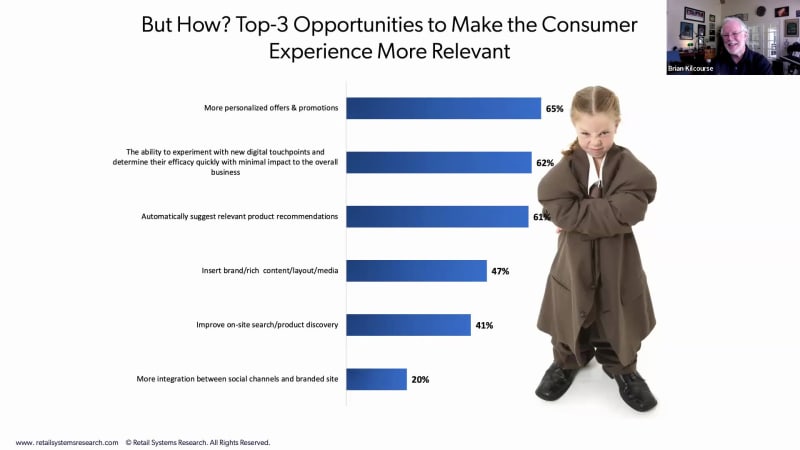
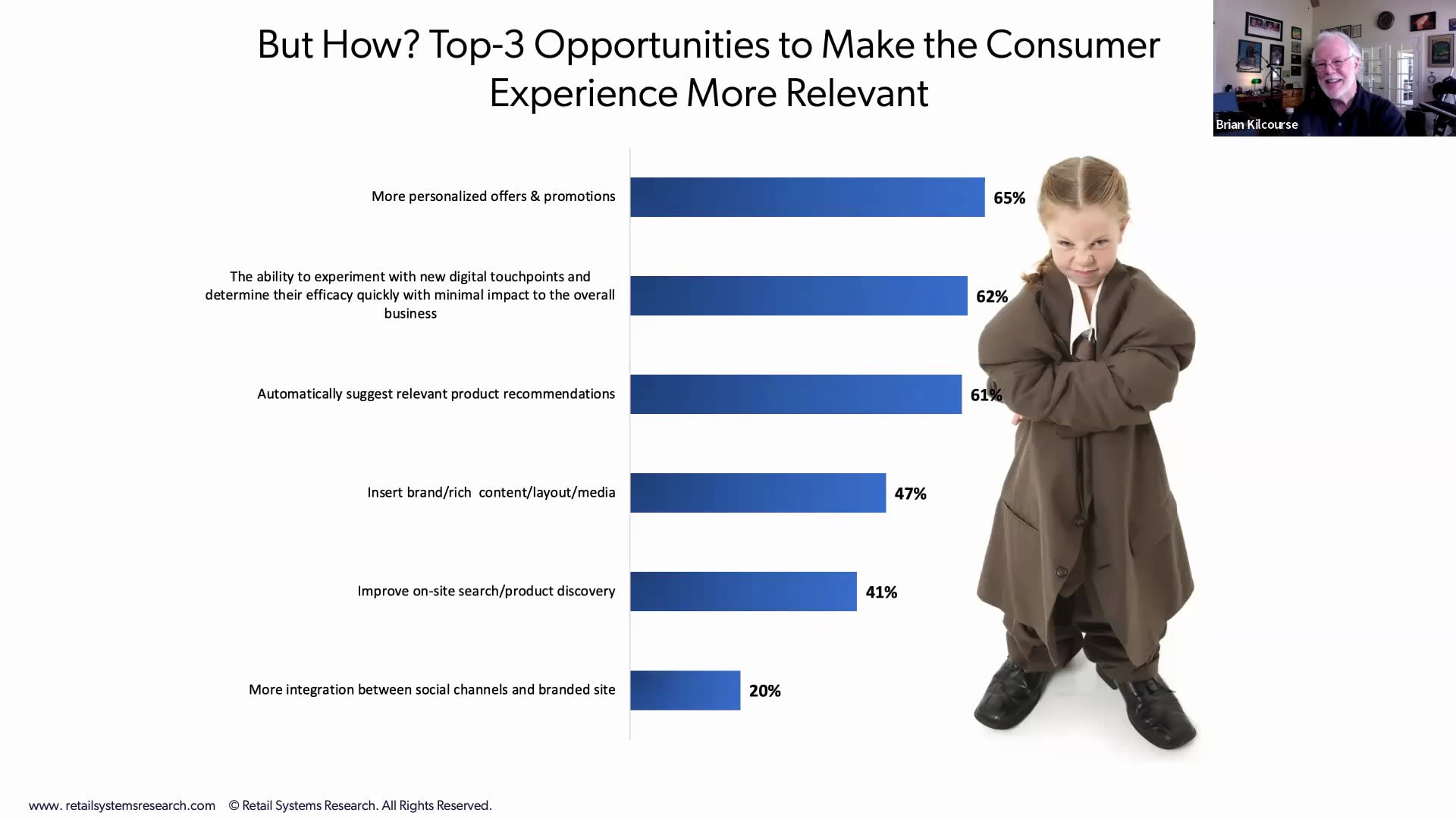
Hello, and welcome to our webinar, winning at customer acquisition in the digital shopping age. Well, retailers are in a perpetual race to woo shoppers and retain them. And in December, Coveo commissioned RSR Research to help us find out where retailers are putting their focus. Brian Kilcours, principal at RSR, is here with me today to share some fascinating findings. But first, some housekeeping. Lines are muted, but we do want you to engage with us, us. So feel free to ask questions of Brian and me at any time. Also, this webinar is being recorded and will be sent out to you via email as soon as our gremlins are able to put it together. Should be just a couple days. I'm Diane Burley, your host and head of content for Coveo, and I'm thrilled to bring back Brian Kilcours from RSI. Brian, before you were a data nerd, you were a long time CTO in technology and commerce, businesses. Having to do what a lot of our listeners are doing now having to make that determination of which tech vendors to bet on. Are you glad you're on this side of the divide now? Great question. Well, there's no there's no doubt about it that vendor management, as we used to call it, kinda euphemistically, was one of the most difficult parts of the job. You have to choose your partners very, very carefully. And, I valued my partners tremendously. I I was very careful about who we work with, but, what I was trying to do is create a partnership to to help our company to excel in its marketplace. So it's a big deal. You can't take it lightly, and you really when you think about what's going on there, you're outsourcing your future to somebody who is not in your company. And you need to be very, very smart about that. I enjoyed that part of the the job, but it was very difficult. Well, and I'm sure you bring all those insights into this as well. And it's gonna bubble up as we we talk today. So let's dig into the data and see if we can give these folks some great insights. Tell us a little bit about what you were hoping to achieve with with the the, research you did and, who was, interviewed? Sure. Well, first of all, a little bit about our methodology. We we study the business use cases that drive the adoption of technology, and we take it from four angles. We first focus on what we call the business challenge, which is always some external pressure that's triggering retailers to think about that subject. So for example, in this case, it's about how to win at ecommerce. Why do why are retailers so concerned about it? And we've we try to uncover those external pressures that are causing them to to act. Then we focus on what we call the business opportunity, the o. And, the it's really about how to flip that challenge into an opportunity. And over performers that we call retail winners are very adept at flipping an opportunity of of challenge into an opportunity to creating summit some competitive advantage based on the challenge that the entire industry is facing. They're very good at it. And one of the things that you'll see as we go through the research is that that the retail winners don't just do everything else that other people do better. They actually do different things as well. And it's so consistent that at our side, we we tend to take it a little bit for granted. But it's always revealing, and it always results in our in our recommendations to the industry. How do you how do you determine a winner or sometimes you call them over performers, sometimes you call them winners. How do you determine them? Based on their numbers. We do the same thing that Wall Street does. We look for for year over year growth in in sales and profitability compared to the industry. So we we use an industry average that is usually published by the NRF in in the United States as kind of our baseline. And if you're above the baseline, you're a winner. If you're at the baseline or below your average, you're a laggard. We group the the average and the performers together because they tend to do they tend to see things the same way, which is not how winners see them. Now in terms of the spread, we like to we like to to look at retailers across the revenue spectrum, and we use the equivalent of US dollars. But you can see here that our focus, it tends to be on two hundred and fifty million dollars and up. There's a challenge, of course, and that's that, for example, a two hundred and fifty million dollar fast, fashion apparel and accessories retail is a pretty big retailer. But a grocery store, two hundred and fifty million dollars, that's a pretty small grocer. So we have to we have to keep those differences in mind when we're talking about the verticals. You can see by the verticals, this is how we group them. These are grouped many different ways by many different organizations, but this was the closest we come. Fast moving consumer goods is grocery, drugstore, convenience store. Apparel, footwear, and accessories are what you think they are. Hard goods, of course, you think of this as the Home Depot, the Ace Hardware, those kinds of folks, the Lowe's stores. General merchandise has morphed over time. It tends to be the the, com companies such as Target, a good example. Canadian Tire, another good example. Hospitality, retail services, and entertainment, we don't look very hard at that. In terms of headquarters, this time, we wanted to look at North America, which is primarily the United States in terms of where they their home headquarters are. The point of this is we we we anonymize the data so that you can't get back to who answered a specific response, but we can glean from these these cuts, if you will, the differences in behaviors that turn out to be pretty important. Now the next two sections of our methodology are inhibitors, internal inhibitors, and those are the things that prevent retailers from moving forward quickly. And then finally, technology enablers. And we don't talk about specific solution. So for example, we don't talk about Coveo, but we talk about the need to identify, the consumers, the consumers need very quickly at the start of the transaction and the technologies that go behind that, like AI and things like that. Terrific. So why don't we get into some of the key findings when you when you did this, the the survey? Well, the we had fun with this one. We asked general questions, and we said, one of the questions we asked to when you think about, search on Google, we all know that how how search is focused, based on who spends to get their name at the top of the list. We said, is that working for you? And, retailers said, well, we're spending an awful lot, probably too much, and we're not particularly happy with it. So, then we asked them the second question. Are are you planning to spend less? And every one of them said no. We're actually gonna maintain our spend. So from that, we learned something fascinating. That's that that SEM and SEM are going to continue to be important. But what really comes out of that is what are you gonna do after that? What are you gonna do after the customer touches the brand? And this gets to a whole issue of site stickiness. We know we we noticed that consumers continue to demand more personalization and relevance. I actually am not a big fan of the term personalization, but I am about relevance. Relevance makes sense to me. And that's that the ability for the service provider, in this case, the retailer, to to glean as quickly as possible what the consumer is trying to do, what lifestyle problem they're trying to solve. And, and retailers see an opportunity to do this better. So they wanna be able to streamline the the digital shopping experience to get shoppers to the solutions faster. So, basically, we can come down to the fact that there's these three retailer wants. They want more traffic. They want more traffic that converts, and they want shoppers that return. Is that is that about right? That's right. It's a good way to say it. First of all, they want they want more people to come to the site. And you can see that this is our first data, data point where we see winners. Winners are stronger about this. But generally speaking, retailers want consumers to get to the site. Well, good for them. Can it's like saying I open my the door of my store, and I want you to come in. Well, of course, you do that. That they want them to stay. They want they want them to identify themselves. They want them to stay, and they want them to come back again. So these are very tactical type of things. They wanna increase re repeat purchases and customer retention, and they wanna decrease, cart abandonment. These are all important to dos for retailers. Retail winners feel more strongly about these things than others. So that blue bar is the retail winners, and the, orangey red bar is the, the rest of the world. Right? There it is. Yep. Winners versus everybody else. Yep. Alright. So in this webinar today, we're gonna be discussing this at what they want versus the reality, why they're struggling, whatever performers are doing, what's holding them back and and what they need to do. And you're gonna be taking your c CTO hat and putting it on and off, and I'm gonna be bringing in my my business background of having been a retail brat and having run on online site, for, high end design. So acquisition, let's start there. Right. Where do the I I love this. This was one of my, was this one of the things that, surprised you? This was a huge surprise. Now we have two bits of, data to share with you on this one, but this is from this particular study. We asked retailers, where do you think your customer starts their study? I mean, excuse me, their their shopping journey. And to no great surprise, they Barca obsessed about Amazon. Thirty four percent of them said, oh, the consumer starts on Amazon, and then they go to our branded website, and then they go to Google, or sometimes they go to the manufacturer's site. So this is retailer's impression of what is going on. It turns out that we knew that that wasn't right because we asked consumers, where do you start? Where do you start your journey? And they started on Google full fifty percent of the time. And we even think that's understated. Google themselves says that consumers start their digital journey sixty four percent of their time at the search bar. So, now that might be overstating it because it's Google, crowing about themselves. But you can see how much more consumers, start at Google than at Amazon. So retailers are over concerned about, Amazon, and they're not concerned enough about Google. But the big loser in every single case is their own branded website. Well, I can't wait to see your numbers from this summer when you repeat it. We just did a four thousand person survey, and we came up with what you did except for the fact when we broke it out by age group, the millennials and gen z's are shunning Amazon, and they would prefer to go with the brand, but they're only coming in at about sixteen percent right now. So there's opportunity. I also wanna ask you why why this is happening. You know? But we know that acquisition costs are soaring. You said that upfront. They're spending more on SEO and SEM. They said that they don't want to stop doing that. But this was what surprised me when you pulled the numbers. Ninety five percent say traffic is bouncing. Right. Right. That's really shocking to me. I, this actually turns out to be the important and it's called the kickoff to the entire study because the problem that retailers are dealing with is that that ecommerce sites have reached the point of ubiquity. The experience in one site is very much like another site, and they're all good. None of them are standout great. And this is part and parcel of what ends up driving somebody to Amazon because the value proposition is reduced to a couple of simple value propositions, availability and price. Okay. And I know this from my days of competing with Walmart, that if you wanna compete on availability and price, they're gonna kill you. You've got to make it more complicated and more interesting and more relevant. And then and the same is true in the digital age of Amazon. If if the value proposition is price and availability, they can beat you. And by the way, let's not forget that Walmart themselves are really, really good at this. They've they've just carried their their goodness forward, and they're a very, very, very, dangerous competitor. So we're we're in we're going to the end of, what we, propose here, but it's retailers need to make it a more complex value proposition. It has to be more than availability of price. And what's the very best thing that you can you can add to that? Well, you can add trust. And trust is all about being relevant and being able to service the the the consumer in a way that she wants to be serviced. And that's really, really important. And so that's first of all, it gets to, do you know who you're talking to? Is it just, somebody who's clicked on your site, or is it somebody you know or somebody you couldn't recognize very quickly? So I would imagine too if you've spent the time to navigate to someone's site and you can't find what you're looking for. I mean, it's it's just completely irrelevant. You're going to bounce, and you've, pretty much lost that person because your brand is now tarnished. They remember that it's an awful sight. So Well, yeah. I mean, I I I use my own family as a as test cases. I ask them all the time. I ask I have kids and grandkids, and I say, what happens if you don't immediately find what you're looking for? They say go back to Google line. They just go to the next retailer. That's not what you want. You want them to stick around for a while. So why are they struggling so much? Well, we started off talking about that really, and that's that in the the digital experience has become increasingly important. And I think at this point in a post COVID age, we can probably accept the fact that we live in an environment where even if we intend to go to a store, we're probably gonna start the shopping journey in the digital space. So that that is the first thing. It's become a, a really the front door to the retail experience. But the flip side of that is that the front door looks just like everybody else's front door, and that's not good enough. So, the retailers have a have a nagging sense that their competition is doing better at this than they are. At the same time, consumer expectations keep going up. Consumers are very fast moving. They adopt new touch points and new methodologies very, very quickly as it suits their their, their lifestyles. So consumers and the competition are forcing retailers to innovate rapidly. I used to joke when I'd give a speech that the one line you'd never see in any retailer's p and l is a line that says r and d. And yet retailers are being asked to to innovate and innovate very rapidly at the pace of the customer. Think about it. And, Diane, think in your own life, when a new piece of technology comes out, how fast you either adopt it or you reject it. And it happens extremely fast. And retailers need to be able to keep up with that speed of adoption. So the other thing, of course, is that there are disruptions in the marketplace, and that's causing, retailers to have to emphasize digital faster. Of course, we're talking about COVID there. We're talking about what's happened there. And the number of digital touch points is also growing rapidly, and that ties back to consumer expectations. So retailers are pressured in all of these interesting ways. So I'm curious if the people that are listening, and, interestingly, it's not just, retail brands. We also have, retail insurance and banking folks on. So it's a little bit of a nontraditional, transactional type company that's that's, companies that are on as well. But I'm curious as to where they are in on this. This is this is what the retailers were reporting was where they felt they were falling short, and and how the competition they were faring against the competition. So sort of interested in, seeing that. The how do you think they're going to get around it? What is are these I saw these answers. So is this what they came up with, or is this what you're telling them? No. No. This is what they voted on. This is what Now it's important in an RSR study when we say a top three. We don't let them vote for two or four. They have to choose three. So we're playing lifeboat with the question. And that what what's interesting about that is if it's above thirty three percent, you know it's pretty important. But we saw some numbers that are truly compelling. First of all, retailers see the opportunity to to offer more personalized offers and promotions. They wanna be able to experiment with new digital touch points. They know they need to do that. And they wanna be able to automatically suggest relevant products, to the consumer once they recognize the the the lifestyle need that is being serviced, and they wanna be able to insert, rich, content to the to the to the consumer so they can make the experience more interesting. So this is all important stuff to a lot of retailers, but it all boils down to something interesting. And that's that you wanna be highly relevant to the consumer and converse with the consumer the way they wanna be conversed with. So it might be a website or it might be a mobile site or it might be a, a live stream on Instacart or it might be VR. Who knows? It could be any of these things, and you wanna be able to communicate with them in a way that enhances your brand and builds loyalty. You mentioned before that you don't like the word personalization. Why is that? Well, first, this is my CIO hat coming out. I happen to be a CIO of, of a large, American West Coast drugstore chain, and privacy is very, very important. So, we used to use a word, ickiness, I think, was the phrase we used, where if somebody's getting kinda creepy, you know, they're intruding too much on who you are and what your needs are and those kinds of things. And by the way, creepiness shows up all the time on Facebook. It's quite annoying. So I'm sure you're just like most people. And when you get on Facebook, you start turning off of those, personalization choices because it it it veers on creepiness. Retailers have to be very concerned about this because remember what I said, the value proposition that goes above price and availability is trust. Mhmm. And not everybody wants to share personal information about who they are, how old they are, what their income is, what their nationality is, what their sexual orientation is, all those kinds of things. Not interested in sharing that. What they're interested in is solving a lifestyle problem. And, so the difference between relevance and personalization is that I need to be able to glean your lifestyle the lifestyle problem that you're trying to solve without getting creepy or icky. We don't wanna do that. We don't wanna go too far. Well, it's funny. I hate that term for different reason, but that's me putting on the other hat. Right? When you go to a trade show and you're looking around and everybody says personalization personalization, it could be putting your name on a mug. I mean, the word to me is a nondescript word. So it's, one of those one of those words that drives me crazy and all the marketers love using it. So there or even for different reasons. Well, you know, you mentioned other industries. Other industries And, you mentioned banks, financial institutions. They've had to deal with a lot of these issues earlier than retailers have because, essentially, money is easily digitized. But remember what a bank does. It has four or five skews. Right? It has it has checking. It has savings. It has loans. It has something else. Very you know? And they're more or less the same. They're semi regulated. So the question then is how does a bank increase your trust in it? And one of them is to be relevant to the consumer. Now in a bank's case, it gets very personal and very fast because one of the easiest ways to understand a consumer is what they spend their money on. But they have to be very careful and not get creepy really fast. Well, that's also different too, because a lot of times, you're logging into your account, you don't have to log into to shop. In fact, I've gotten to the point where I don't even like doing that anymore because I just know it's inviting a lot of email. So I I'm one of those that, retailers are probably starting to hate. Let's look a little more at what is holding them back. They they know what they want. They know what they need to do, but they're still not getting there. So so what what was your findings here? This is one of my favorite parts of our studies And with retailers tell us they recognize the challenge, the external pressure that's being put on them typically by competition or consumers. And they understand what the opportunities are. We've identified those things to get more personalized and relevant and all those kinds of things. Then the question becomes, okay. You know that. So why aren't you doing something about it? And, they typically fall into two or three categories broad categories. The first one is they they're not spending enough money. The second one is their leadership lacks vision. They're lacking the ability to see the opportunities. And then it breaks down into things like the IT group doesn't have enough, expertise on certain type of a technology and those kinds of things. In this case, we see a really, really good example of early adopter syndrome. We see in in the study, if you look at the full study, that retail winners have had their ecommerce sites up longer than average and under per performers have. In fact, I think we're we're just starting the third generation of ecommerce. We can explain that later. But retail winners have been at it, with their current, ecommerce site the longest, and it has created some some inhibitors or some roadblocks that prevent them from, getting getting what they want. The first one, and I was a little surprised at this, I have to say, is that retail winners are lacking a single view of the customer. This has been a hot issue for retailers for the better part of the last twelve years since, consumers adopted, smart mobile phones to to begin their transactions. And retailers know that they need not just to have a good CRM system, but they have to track the experience. They have to track all the non transactional activities that the consumer is engaging in so they can understand how the consumer likes to shop and what the consumer tends to look at. So I think of these as digital bread crumbs, and they need to be associated with the entire, profile of the consumer. And that profile needs to be available to all the facets of the selling environment, not just the ecommerce site or the mobile site or the store, but a combination of all of them and the call center. Don't forget those folks. Winners, have been at this longer than average underperformers, and yet they find themselves to be, more pressured by it. My interpretation of that is that they're just more aware of the problem, that they're they're they're understanding more than average on other performers do, that they need to track every single aspect of the engagement so that they can respond more appropriately. That's number one. The number two was was just wonderful is that marketing doesn't understand the digital strategies we needed to support ecommerce. This is an age old problem, and that's that, marketing is very, very innovative. I used to joke about our marketing VP, would adopt some new trick, usually a digital trick, and and, you know, lo and behold, or lo and behold, the consumers would love it. And then the marketing person would come to me as the CIO and said, I need you to support this because it turns out it's popular. And I'd say, well, get in line. I've got eighteen months of backlog. I don't have time for you. Barca does that all the time. They're very innovative. They're very aggressive in the use of digital capability. I'm gonna back I'm gonna support them here. They've got the, you know, gun at their head saying they better produce leads immediately. So No kidding. Well, there's another issue. Yeah. I I have a lot of sympathy for marketing folks because they are under a lot of pressure. And, but, anyway, here you have a problem is that they're forging ahead with whatever innovative idea they have and spending money like it's not like, there's no tomorrow to get new, eyes and feet into the into the brand, and then they need support. But they asked for it after the fact. The the next one is the one I really wanna get to, though, and that's the ecommerce platform cannot be quickly updated to meet changing needs. That is true. If whether you're on gen one ecommerce or gen two, this is a real issue and has a lot to do with the the technical architectures that were used to build those ecommerce sites in the first place. And finally, you can see the winners are more aware that they need to go to too many places to get the content that they need. So these are big ones. Now you you're teeing this up for me. This is perfect. Here you see that winners, over performers have been using their current platform longer than average and underperformers Barca. And you can see the curve. It's pretty pretty obvious. This turns out to be really important because ecommerce platforms and the technologies that underlie them have changed dramatically in the last five years. So five years ago, we weren't talking about microservices. We weren't talking about software as a service necessarily. We weren't talking about headless, applications and those kinds of things. AI was the glint in in some guy from Stanford die. It just wasn't being generally discussed or or applied in a practical way. In the ensuing five years, and certainly since, yeah, twenty seventeen, these things have gained a tremendous amount of momentum. And the new technologies are much, much more capable of being adaptable than the older ones. And that's just the truth of it. I was sitting at a dinner, with, some CEOs, and this guy says, like, I was, I can't believe it. And he said, my team comes up to me and says that I have to sign another multimillion dollar purchase order after signing one last year. He's been said, oh, no. It's all obsolete. Well, that's a problem for retailers, you know, because they want, you know, the the joke we used to tell at my company was that most of our technologies were old enough to drink legally. And, they get amortized over seven years, and then we run them, in a, you know, post amortization mode for as long as we humanly could. We are gonna have to move up a little faster because we've we've got a lot left and very little time left. So Yes. So much the most important thing on this page. Yeah. So this is what they talk about, the functionality that they want to be able to to do. And some of them, you would think, well, yeah, of course. Product recommendations, personalized, product suggestions and offers, Enable community interaction. That turns out to be really important. Dynamic listing pages, you can read down the list. But these are all really, really important. I would put at the top that personalization of the product suggestions and product recommendations and the ability for shoppers to communicate with each other about, about the things they're buying and why they're buying it. Turns out to be really important. What's the top thing that winners are doing that you're not seeing from the rest? Well, this is an interesting list. Right? Offering rich com content and expert guidance, pro tips, and stuff like that. I was surprised that that isn't more popular with average and underperformance. And then look at the next one right underneath it, replenishment offers. I always think of Ulta Beauty when I think of this. Ulta Beauty, big chunk of their business is made up of replenishment of their products to their loyal customers. And retailers who aren't looking at this are really missing an opportunity. And then finally, of course, guiding offers. The the things at the lower end of this of this list. I think every retailer knows that they should do product recommendations. It's just a standard part of what Amazon does. They need to do it too. The next thing was was disheartening, I have to say, and that's that, retailers understand that very, very few of their customers identify themselves until they get right before the pay button. And that is that's just kind of heartbreaking because retailers work really hard to, get consumers to identify themselves early. But they're kinda hand handed about it. Right? They throw a sign on screen right in front of you right away to get a ten percent discount on something. And if you don't do it, it makes it very difficult to use the website. And you get forced onto a very standardized experience where you climb through the merchandise hierarchy. Bring my home, and that you just named exactly what I've been going through. You know, you want a ten percent off, or do you wanna see if they actually have what you need first, you know, and and risk giving your name over to somebody that you really don't wanna hear from ever again? Yes. People people are offended by that. And, in in another study we did last year, it was very clear that consumers do not like being handled that way. Well, if you guys I know we're running a little bit long, but if you can hang on another five minutes, we are gonna talk about how we can solve this cold start shopper dilemma just briefly, but nonetheless, give you some hope there. Machine learning adoption, how's that going? Machine learning adoption is, unfortunately, right now, something that is a winner's game. And we see this over and over again in studies that retail winners are much, much more aware of the capabilities of being able to model behaviors based on the non transactional signals that they get from consumers. Average and underperformers are very interested in this, but they're not doing it. And so this right now is part of the winner's tool chest. Technology enablers. There's a lot here. We will let everybody read read about it later. I think the important point to take home here is that in the last five years, there have been significant improvements in ecommerce capabilities. Any well, not just ecommerce, but application development capabilities. So the things that we were talking about is future tens, five years ago, in fact, are here now. Whole new ways of of, developing code that is loosely coupled and can be applied to business problems very quickly to increase agility. The use of AI as a practical tool to help model, data based on, behavioral characteristics you've been able to trap. All of those things are really important, software as a service. And I unless and I don't like the phrase headless because it's a marketing term, but it's essentially the the ability to apply a business rule or piece of data to to a business problem or a consumer's challenge regardless of what it looks like, regardless of what the UI is. This is all stuff that's real today. It wasn't real just a few years ago. Retailers need to pay close attention to it because consumers are adopting. So I wanna thank everybody for for being on and tell you a little bit about Coveo really, really quickly. Brian has, spoken about relevance a number of times and and was one of the things having been in the search market for since the early two thousands that we recognized that we weren't just a search and recommendations platform. It was really a relevance platform. And, to be relevant today and in the future, retailers must embrace AI and machine learning to offer these personalized experiences that are relevant. We mentioned the cold start shopper really quickly, and and one of the things that we've been really focusing on and and if you take some time, come to our site and look at the AI labs. This is where our research team has been spending a lot of time looking at shopping data of not the Amazon and Walmart sized companies, but those of you who are on today, your size companies. And and it's a a totally different type of dataset. First of all, you're only seeing your customers a couple of times a year in comparison to an Amazon or Walmart or grocery store where you're much, more likely to be frequently shopping. As a result of that, we call this a cold start shopper. You're they're coming to your site. The cookie's probably expired. Maybe they don't wanna log in. Maybe as Brian found out that they they want to shop without logging in, and and do a guest checkout, which was seen countless number of times. I think it was ninety five percent of the time and fifty percent of the cases. So, this cold start shopper is a real problem. So what we do is looking at the session, session based analysis, session based capabilities, and which is very similar to when you go into a physical store and the sales associate sizes you up. And are you shopping for yourself or someone else? And if you're shopping for you, they're immediately seeing approximate size and where you might wanna be in the store, or they're watching you handle merchandise and saying, hey, this would go with that. And that's exactly what, the type of, machine learning models that we're employing to help people find what's relevant really quickly. I think I'm gonna try and take time for one or two questions. We also have for you the entire report, that Brian was discussing, and you can get it here. And as I said, we'll be sending you an email shortly, with the webinar recording as well as the link to the, the book. But, Brian, give people takeaways. I'm giving we'll give them a chance to ask us a question or two. But in the meantime, why don't you, what are the three takeaways for you? Three take takeaways. Well, the first one is one that doesn't have anything to do with technology. It's sit down and describe what your brand's differentiating values are, number one. And number two, associated with that is is what are you doing to accentuate those those differentiating qualities? And the third one, finally, to technology is how is technology supporting that? This is really key, and you'd be surprised how many retailers never actually do this exercise. But what what makes you different than your than your competitor is a really important question. One of the problems we find when we we advise retailers is they kind of lie to themselves about what's about what makes them so special. And they need to be they need to be honest with themselves about why do consumers shop with us compared to our competition. And then what do you do? What do you spend to to make that more interesting to accentuate your positives? And then finally, how is technology supporting that? Sounds great. Brian, I wanna thank you. We didn't get any questions. I'm sure we've just gone too fast here. If you're not familiar with RSR, consulting, please, in RSR research, please go to the site. You're gonna find a ton of really, really relevant, research. And if there's one other lesson, I think if you're gonna take away from today, this his study, and what we're talking about, it's that relevance matters at every single customer touch point, no matter where they are in the journey. Brian, thank you again for, coming on with me. It's always a joy to talk with chat with you. It's a real pleasure to talk with you, and this is such an exciting topic. So, thank you for asking me to do this. Thank you all for listening. Bye now. Bye bye.
Winning at Customer Acquisition in the Digital Shopping Age
Acquisition. Conversions. Stickiness. These are the top concerns all retailers have to compete with giants. But, what are the winners really focusing on?
In this webinar, Brian Kilcourse, RSR Research's Principal, joins Diane Burley, Coveo's Head of content, to discuss his findings from a new RSR report. We’ll pull back the curtain so you can see the optimal strategies retail over-performers are using.
You'll learn why:
- Winners are leaning in on artificial intelligence
- Relevance is the pillar of a differentiated brand experience
- Determining shoppers' intent must be done as early as possible
- How every page is a home page - and must be optimized
In less than 40 minutes, you’ll gain exclusive insights on what the best retailers are doing to close the experience gap.
Start winning at customer acquisition