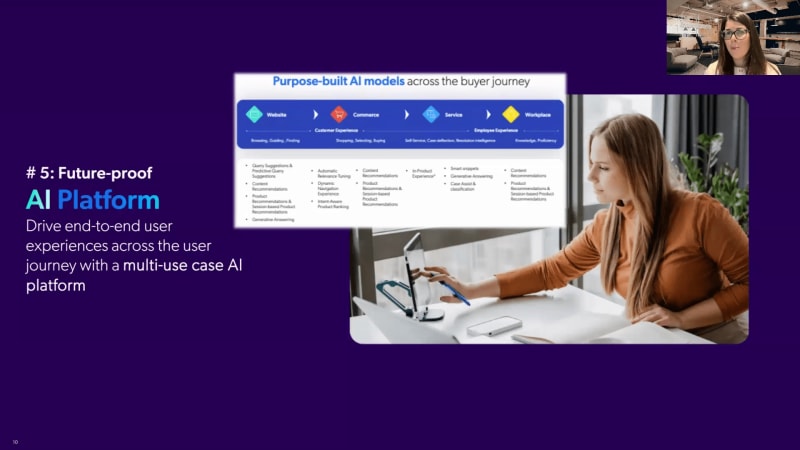
Hi, everyone. Welcome to today's webinar, five must have search capabilities for revenue growth. Today's a demo webinar, so you will in fact be getting a Coveo for websites demo at the end. My name is Carrie Anne Beach. I'm a senior product marketing manager here at Coveo, and I am joined by my esteemed colleague, Paul Sheridan, if you wanna introduce yourself. Sure. Gladly. Nice to be esteemed. Thank you, Carrie Anne. Paul Sheridan. I'm a solution engineer with Coveo. Great to talk to you all. Looking forward to our session. Carrie Anne. Awesome. So let's jump right into our slides right here. Here they go. Okay. So, on our next slide, I will start off with a statistic. Eighty nine percent of companies compete primarily on the basis of the customer experience. This truly is today's competitive advantage, and the invention of chat GPT has not only increased customer expectations, it's really lowered their tolerance to bad experiences. And because of this, a lot of organizations are actually looking to reevaluate not only their website, but really the entire end to end digital customer experience. And search should absolutely be at the top of this list, and I will tell you why. Of course, we understand that search helps customers find and discover your content, but it's really so much more than that. It's truly the foundation of your website and your digital transformation strategy off of which all other features are going to be built, including cutting edge technology like generative answering, which, of course, is going to, you know, shockingly show up on our list here. So it's really important that you nail that first search experience. It's also a window customer. Right? They are signaling to you what it is that they're looking for. And what's interesting is this represents an opportunity to capture very high intent inbound leads by delivering what it is that they want when they want it. It's truly a conversate a one to one conversation at scale. And then finally, it's the glue that connects your entire site to drive that end to end digital customer experience. And this is especially true if you're able to surface data that lives outside of your CMS or your DXP. But the truth is a lot of, these experiences are still lacking with findability and relevance being at the top of this list, and this is gonna have a huge impact on brand perception. But with challenge comes opportunity. There's really this huge potential to reimagine the digital experience and raise the search bar, if you will. You see what you did there. Thank you, Paul. I'm glad. So we'll see on the next slide here, upgrading search is really not an easy feat. Right? Right? So we wanna talk about what it is that you should be looking for so that you can start to reimagine this experience. This is just an example of, you know, all of the different machine learning models that can be applied and all the different kind of UI and UX facets that come into play. So when you're making a decision like this, it's going to impact your team's ability to engage and convert customers in the future. So it is an important one. But the next five capabilities that we're gonna talk to is not only for those that are looking to, you know, reimagine their search solution or going through website transformation. You can also leverage them just to supercharge your search experience if you just wanna amplify it and make sure that you're really getting the most out of your solutions. So let's jump right in. The first thing that you need to consider is, well, search. How easily can users find your content? But it's not just about how quickly you can deliver results. It's also really about how relevant they are to the user's intent. And this is gonna become more difficult the more content that you have, especially if that content is siloed across different systems, but we're going to touch on this later. So some of the things that you're gonna wanna consider here are are your search results dynamic? Are they personalized? Do they vary depending on the user's context and history? Can you proactively suggest recommendations based on similar use cases? It's really so much more than just quick search results. Paul, do you have anything to add? Yeah. I think the, actually, the the image that's on the screen right now where someone is starting to, you know, look for information about saving, starting to both, predict the user's intent and also suggest intents to the user at this point is really useful. Seems simple. I think we're all used to it from, you know, commercial search technologies, commercial, you know, Google dot com Barca when it used to work well. Being able to say, oh, I'm kept in saving. Well, what are the options for me? What, you know, what could I be searching for about saving? I think that's really important. It's, the intent based aspect that you're talking about, Carrie. For sure. People don't know what they don't know. So, of course, they're gonna be coming there looking for one thing, but maybe you actually have something better that would be relevant to them. So it's, we we say to search. We're starting with search, but, of course, you go into recommendations and generative, which we're gonna talk about a little bit later. Yep. So, number two capability. The reality is creating personalized interactions at scale is hard, and it only gets harder if you have content that is in all these different repositories and so many different user journeys that you need to support. That sounds like a lot of manual rules, a lot of manual tuning. And that's where AI comes in. Right? Specifically, machine learning models that learn from user interactions and create this feedback loop to drive this one to one personalization at scale. And some of the things that you wanna consider here is, you know, are you able to layer the machine learning models together to improve relevance, or are you only searching based on one criteria, which may be quick, but is may may not be the most relevant results? So the more that you're able to layer in, the more that you're able to use and learn, is going to enhance the relevance results, but it's also gonna make your teams more efficient by helping them scale their content output. Right? And that's gonna lower your cost to serve because they don't need to imagine every single possible different type of, you know, user at every single stage that they're interacting with you. If you think about an industry like financial services, not only are there users, there's customers, there's prospects, but then they're also in different parts of their buying journey, their financial journey. So there's so many different things that you need to consider, and different types of content are gonna resonate differently with them at different moments in time. Absolutely. I couldn't agree more. I mean, marketing organizations, among others, have struggled for years with the the concept of personalization, you know, defining personas, defining rules around personas, how do we want to show information, whether we're talking search or content management itself, to different types of personas. There's been technology out there to do this sort of thing for a long time, but the actual process of of figuring out what personas do we want to deal with and what do we want to show them, what do we want to do next is hard. It's really hard. So a combination here of rules and leveraging machine learning AI, to to personalize based on, I almost hate to use the phrase, the wisdom of the crowd, is a really powerful tool, and I think essential for scaling as you say, Carrie. For sure. Scale is definitely the word that I would hit on there. Right? It just allows you to do all of this at a much larger scale and just be a lot more efficient, as a team as well. So moving on to number three, a really important piece to consider here is connectivity, and your index. And this is truly at the heart of your search experience. Like many organizations, content is likely created and also stored in a variety of different content repositories. So without an easy way to search and surface information across, you know, all of these content repositories, you're gonna be left with a disjointed customer or user journey on the front end where users are gonna need to bounce around different types of sites trying to find the information that they need. Maybe they're never gonna find the information that they need because they're just in the wrong place and they're not aware of it. So the answer here is a unified hybrid index that's gonna connect all of your content no matter where it lives, and you're not gonna need to do a costly content migration. Yeah. I mean, there's there's so many examples, out there, you know, thinking of a a website that includes, a product catalog, a content management system, perhaps a blog that's hosted elsewhere, you know, videos that are posted on YouTube or some other platform, and then maybe frequently asked questions that might be surfaced, you know, through a chatbot as an example. You you have important useful information that's, that's being managed for, honestly, good reasons in a variety of different, platforms as approval processes. There's, you know, keeping your catalog and availability up to date on a on a a a PIM system, for example. There's good reasons for keeping your content sometimes in a in a variety of platforms, but you need that relevance layer, that, that that findability layer on top of that information to be able to both respect the security of these repositories. Not all content should be visible by everybody, but also to find the most relevant content, you know, depending on where the person is on their journey on your site, be this a commerce site, a support site, a internal, intranet, and so on. So, you know, that that connectivity, that ability to index content, index permissions, respect those permissions, and surface the the best information, you know, when and where it's needed. Absolutely, essential. It's a great point. It's the reality is also that different teams are going to be creating different types of content, as you said, and not storing it in the same place and working off of the same place. We know that organizations do have a lot of different, you know, solutions that they're working with. So being able to, all be having unified access to this, but like you mentioned, having that document level permissions as well, so it's not a free for all, is going to be really important. So some of the things that you wanna consider that we briefly discussed here is, are you able to search across any CMS? So does it matter if you're on Adobe, on Optimizely, on-site core? But beyond that, can you also surface knowledge that lives outside of your CMS or your digital experience platform, like your CRM, like SharePoint, even your intranet for employees because employees are customers too. You have so much data that you want to just have a richer experience and be able to leverage all of those different components. Sorry. Go ahead. Oh, I was gonna say that's what's gonna create that end to end experience across all of us. And I I think the the keyword that we use a lot as well and that's very popular is is composable. You know, composability of a solution. Right? You've got these platforms in which you create and manage content. You've got a a variety of user interfaces for different purposes. You know, the the self-service platform, case creation for for a self-service platform, shopping in a in a commerce, kind of world. So building these composable interfaces to interface, if you will, with the the the composable content creation and management platforms and having that, in between layer, that intelligence well, perhaps not intelligence, but findability at the very least, layer in between, really plays well into the, the composable strategies that we can make so popular these days. For sure. People wanna invest in best of class. Right? So composable definitely makes a lot of sense. So we'll move on to number four. Of course, a key capability that you're gonna wanna consider whether you are looking to implement that now or in the future is Gen AI. And this is because it's truly raised the bar for personalized, contextual, and almost conversational type digital experiences. Now in this instance, I am talking about generative answering. I know there's, like, a lot of different types of Gen AI. Here, we're talking about being able to generate answers to long form, complex questions and return an answer that, is similar, in response and is also natural language. So it sounds like a human wrote it. This is really a game changer in this space, right, especially when it comes to helping users self serve, allowing them to quickly find the information that they need, especially if you have so much different content that you have, allowing them to really get an answer to it, format it in different ways, receive that information in the way that they want it to be received, and in the tone and the format that they're asking the question is really interesting. There's also a big service scenario as well where you can help with case deflection where users are able to answer their own questions so they don't need to go in, and create a case, but also for the agent and helping them resolve the case factor faster by having all the information on their own end. So, really, there's so many amazing, applications and use cases here. It can also help make your own teams more efficient, which as a marketer, I find really exciting, as you can take the most relevant parts of different content pieces and summarize them in a new way and creating something different still being based on your own content. We have seen that many organizations have spent the past two years really racing to understand how and where this can be applied across sites, how it impacts their business. We're really beyond the hype phase now, and we are looking for results. We're in the show me phase. So when you are evaluating this type of capability, you're gonna want to see real life use cases, real life results, like not just a POC, but what does this actually look like in the wild? Another thing that you wanna consider that's super important is where the information is coming from. Are you grounding it in your own content, or are you kind of scraping the Internet, you know, of which you can you can get some pretty crazy things. Yes. We've all we've all seen examples of, various, generative AI solutions, returning information that, is somewhere between just simply misleading to horrendously wrong. So absolutely. I agree. Being able to ground being the key word, I guess, here, any generated responses on really your correct contact, your your your, you know, source of truth is a phrase that's often used as well. But, you know, a subset of your information that it is the kind of fuel that you want to feed a generative model with, you know, that's gonna provide appropriate answers that can correspond to any compliance, rules you might have about what kinds of things you you want to answer. People tend to trust that, you know, that big, box of information, that that thing that looks like an answer that someone's just typed, for they tend to trust that a lot. So you do really wanna make sure that what you're putting there, very useful. Absolutely. It's useful. It helps people to get an answer to their question rather than just a a list of search results or in addition to a list of search results. You wanna make sure that if if there's an answer generated, that it's something trustworthy or at at the very least useful and interesting. Exactly. So your own content, is is really it's shining a light on kind of what we call content hygiene a little bit. You wanna make sure that your content is up to date, that it is accurate, and it's a it's a good exercise to be going through too. Right? I think it's a it's a good reminder. But But you definitely you wanna look at all these different types of, parameters. And we will, of course, be showing a a Gen AI, example when we move into the demo phase. And that leads us to our capability number five. One of the most important components in really any investment that you're going to make for your organization, for yourself, is going to be its ability to grow with you. So in this particular instance, you wanna think about an AI platform that's going to support the ever changing needs of customers. Right? We're seeing that their expectations are getting higher, but we also see that the way that they're searching is literally changing with GenAI. Right? We're seeing them type, and write questions more in natural language, longer form, and you really need that flexibility and that adaptability to be able to meet them where they're at. This actually becomes even more important with the so many different types of people who are searching, so many different generations who are searching in different ways. Right? So I think that just that ability to to adapt to what is being asked and meet those needs is gonna be important. But it's also about, where you're applying it. So AI search and generative answering really should not be applied in a silo. It should be applied across the entire user journey. Right? Even if you yourself are looking at just your dot com part of the website, that's what you have ownership over. If your business has different facets, like a service component, a commerce component, a user could be interacting with all of these different facets that you offer, and it should be a seamless and consistent experience both in brand, and in search and in the results that are coming back to them. So you definitely want something that's going to be multi use case that can be used within the entire organization. Much like adding on those machine learning models, it's only gonna get richer and the experience is only going to be enhanced, the more that you're able to use it. That really rings true for me, Carrie. And, like, when when I go to a website in my daily life, you know, there's there's a search box. There's navigation. There's a a chatbot that I never use. But as you said, I think different generations and and cohorts of people approach your site your sites, you know, the interaction with your organization in different ways and having that consistency across the the multimodal, types of experiences that people interact with you, whether they're finding information about what it is you offer, whether they're purchasing something, whether they're they have a a problem or a question, but they wanna ask you that they'll they'll go to different places. So I think that level of consistency, a consistent platform to deliver appropriate, results, recommendations, generated answers, I I think is is obviously a key thing. And being able to to grow, the word or the phrase future proof in this slide, I think that that's important as well, continuing to think about what's next, if you will. Exactly. And we're in such a a fast changing kind of industry. This is, I think, it's it's almost a trope, but it's really more appropriate than ever. Like, you you truly do need something that's gonna grow with you, and it's gonna be able, to handle whatever it is that may come. So you don't have to rip and replace, you know, when the next thing happens. Yeah. So, coming up for websites can help you check all of these boxes that I'll share right here. And this is no matter where you are in your search journey, in your digital experience journey. Maybe you are starting with your AI powered site search or, you know, converting those high intent inbound leads. Maybe you're going into content discovery. You're helping people, be recommended additional content that you might wanna show them. You wanna service to them in an easy way. Maybe you are evaluating and implementing generative answering, or you're really looking your end to end digital customer experience and applying all of these things to it. We are are there at all of these aspects. We bring AI to every of experience. So with that, how about we dive right into a demo? Sure. Gladly. We've been talking in in, I think, a general sense about what it is that, you know, we think that our our customers need that you might need on on on your various sites as well. So we're gonna now go in and show you a little bit of, of how Coveo as a as a platform, specifically can, can help with some of these, some of these things. Right? And we're gonna do it in kind of a fun way actually today. We have an environment that we use, for demos that, represents a fictitious company named Barca, and they are in the boating industry. They sell boating accessories and sports things for, like, sports on the water and so on. And And we've been using this for quite a while. It's a nice way to demonstrate various capabilities of the Coveo platform, and we use this in our demos all the time. But we also recently, to to show what, you know, what excellent search and generative answering can look like. We've also, though, built an example of really bad search, I guess, I would say. And this is kind of fun as well because it's a it's an interesting way to, to talk to people about, you know, what are the impacts of poor, a poor search experience. And so we've created this fictitious competitor to Barca called Meranox. Interestingly, they're using exactly the same content, that is to say the same pages, the same, yeah, the same the same searchable content, but, they're providing access to it in in kind of a poor way. So we'll kinda compare and going through, you know, each of the the items that Carrie Anne and I were talking about, you know, what good search versus bad search can look like. So on, say, for example, I can start to go in and and type, you know, I'm looking for for information about a global positioning system. I bought a fancy new boat, and I wanna be able to figure out where I'm going. In this example here, what you're seeing is type ahead query suggestion happening. I've got got GPS, but there's a lot of different things I can search for around GPS. Maybe I didn't even think about, oh, I'm discovering new information about GPS's, so I'm, I'm interested in what types of GPS system are ideal for boating. And, you know, in in a good implementation, what you're getting back is quite a rich, list of search results. You've got, you know, information and recommendations here. It's not the exact match for the the that the title, that I'm that I'm searching for, but these are these look like, you know, pretty good documents for me to look at here. We've got good information telling me what these are about, when it was published, you know, a nice intriguing image here, encouraging me to kind of interact with, with Barca content, some informational metadata. I can I can scope my, my my search down, you know, maybe I'm looking for an event about GPS systems, so that's cool? You know, I'll go and talk to somebody about it, or maybe I, you know, I know who is an expert on this subject. I can filter my results accordingly. In a poorer example, and and we'll look at, we'll look at Meranox here. If I start to type in GPS, I'm not getting any guidance, any suggestions, any, you know, attempt to influence my intent. Well, I can I can still search for GPS information, and my results here, you know, are not that rich? It's, you know, okay. There's a couple of events happening around yacht clubs and industry conferences. There's a little bit of information. It doesn't tell me about when this was published, what the nature of this content is. So this, to me, you know, would be a a poor example of of findability. We just like to sort of show that as kind of a, you know, a thing to get you thinking perhaps about, how people might interact with your site or sites. I love Going back to Paul. Sorry. Go ahead. Go ahead. Go ahead. Example, Paul, too, because one of the things that maybe you don't think about as much when you're talking about poor search is, essentially, when someone's searching on your site, they are kind of putting their trust in you. Right? It's a little bit of an exercise in trust. They wanna see if you understand them. And when you, you know, show results that have nothing to do with what it is that they're looking for, you may consume people. You've essentially broken that trust, and they're going to go elsewhere. So I think there's a lot more impacts than you might initially consider, to something like a bad search, besides Absolutely. Poor experience. Yeah. Absolutely. I mean, we often think about, or we often talk about how, you know, people will leave your site if they don't see something on the first page that really intrigues them or makes them wanna interact further. They're gone. They're they're going from Meranox's site. They're probably going over to Barca right now and looking for information. They're already in the Barca. So, you know, while we're here talking about, scalability and machine learning and defining rules, potentially or leveraging machine learning models to influence relevance, an interesting thing, you know, even I've done this search about GPS, GPS systems and what GPS are ideal for boating. We're seeing a couple of highlighted results at the top. These are recommended. And because I know how Berta's marketing team works, I know that these are being recommended by a machine learning model, that we call, automatic relevance tuning. Effectively, what's happening is we're learning that people who perform similar queries, they more frequently click on these documents here. And so Barka's marking Barca marketing team has taken the decision to say, hey. Maybe in addition to any rules that we might create, maybe we've got a campaign going on. We wanna promote a particular event. But we also wanna learn from user, behavior in order to help scale, help deal with all of the different kinds of, unexpected queries perhaps that that people are performing. You know, maybe we haven't predicted the GPS systems were hot this year, but we can we can still take advantage of this machine learning model to automatically promote that good content. Not only that, dig in a little bit deeper. Let's say, this article looks terrific. I wanna read this. You know, I know Julia is an expert on the subject. Hey. This is fascinating. Oh, hey. Look. I've got recommendations for other articles I might be interested in. Now, of course, you know, this is a very common, sort of thing you'll see on almost any website, but how do we scale this? How do we make these recommendations? Again, this is an opportunity to take advantage potentially of machine learning recommendations models. Other people who've read this article have also read these articles. So we're, you know, potentially increasing engagement. You could also think about, you know, recommending not just other articles, but maybe products. If you are trying to sell something, start using machine learning model to promote popular GPS systems, perhaps popular, products that have been added to the cart frequently by by people who've read this article. So bringing together these different kinds of sites, this kind of overlaps between the scalability question and the unified index question, Because you're using the same platform to index your product catalog and your blog, for example, you can kinda make these, these, recommendations across platform. Certainly, yeah, talking about unified index and so on, you may or may not have noticed there's a lot of different kinds of content on Barka's site here. They do sell things. They do have articles and so on. They have events. But this ability to have in a single interface, if you'd like, you know, access to, you know, people who are experts on GPS's events about GPS systems, videos, perhaps. So having that unified index, meaning that people don't have to go to different sort of Barca domains or subsites to find that information, it's all it's all there for them. And, Paul, how easy is it for you to connect, you know, the content that you have into Kaveo? Generally speaking, I'd say it's very easy. The so there's a a variety of connectors, that we provide, that, sort of natively connect to different applications. You know, we think of, certain content management systems. You think of your your PIM system. In some cases, you might be using our indexing APIs to pull that information into the, into the Caveo platform. Happy to talk with you in great detail about exactly how those sort of things work, but depending on the there's almost no kind of content that we can't, index and, you know, make findable. Awesome. Thank you. I'm sure that's a question that we get asked quite frequently. Absolutely. Yeah. Yeah. And, you know, we're always happy to to talk about, the experiences we've had our customers have had and what we can do to to to help with your your situation as well. Then we, of course, we were talking about generative AI and giving an answer as well as a set of search results. An example of that on on Barca site here, I've I've gone back and asked that same question about what types of GPS are ideal for boating. And as you saw, there are some pretty relevant looking articles there. Although they don't, you know, they don't have a a title that that really indicates, hey. Here, we're going to describe what are the best kinds of GPS system for for boating and so on. But here, what you can see is that ability to take advantage of that most relevant content, relevant semantic snippets or passages within those, those documents to return those and format them via a generative large language model into something more like an answer. And I think this is a a pretty interesting example here. We can see citations. You know, where did this generated generated, answer came come from? Well, it came from these these documents here. Oh, cool. I can go and check those. I can go and read those and and get a little more detail if I really wanna dig in and research perhaps. But we've got a pretty nice generated answer here. There's a table being generated. There's a little bit of a summary. There's you know, I think this is important from a transparency point of view. But if a disclaimer, hey. This is generated content. Possible it may contain errors, a generative large language model or, you know, large language models in general. Well, they're super useful. They're they may contain, mistakes. Go and look at that at that original document if you feel you need to, if you wanted a little more detail. You You also have the opportunity here for the user to give feedback, which is, of course, logged to our analytic system along with, what people search for, what they click on, and so on. Sorry, Carrie Anne. You were about to Oh, I was just gonna say exactly. So it's great to have, you know, the links of where it's coming for from in case they wanna go and you, read a little bit more on it. But Mhmm. What's really interesting is that this was taken from those different types of pieces to create what you're seeing here that's very tailored to the question that was asked. Even though you might not have an exact question that matches it one for one, it's able to put those together, of course, with the parameters that you're able to give it so that it's not Mhmm. Getting, you know, too creative with the results. Exactly. Exactly. I think that's super important. Yeah. So it's you clearly the answer is grounded on is coming from Barca own marketing information and probably a subset of that, as well. So that's absolutely important. Getting close to the, the the the end of the the time that we have scheduled. I just I I did we did have one more topic that we were talking about, and that was the AI platform and a variety of use cases. We've kind of dug into what, Coveo provides for Barca on on on their, you know, mostly marketing oriented site. But, Barca naturally has a variety of other kinds of sites. They have a a support site here. And if I was to go in and look for information about, you know, what does an error twenty two message, indicate, you can see an example here of, a different use case for the the Coveo platform from a support point of view. I'm I'm a I'm a customer. I've got a question about an error that my GPS system is returning. I'm getting content from different sources, possibly even secured sources like support cases that I've created. We're, you know, we're limiting this this result, this generated answer, and the search results suggest cases that, in fact, I have access to. Documentation that may or may not be secured. Discussion boards, again, that may be secured as well. And then, of course, you know, Barca also uses uses us on their, on their, you know, more sales oriented site. They're selling kayaks and surfboards and things like that. And, you know, we understand that there are some different nuances to, commercial search. Let's say, you know, I type in life. I wanna get life jackets and, you know, lime surfboards. Maybe I've misspelled lime here. So you can see how you can see how that same platform potentially can be used for some very different use cases in, you know, a really composable kind of way like this. And that's you know, I should probably, I should probably wrap on that and, and stop sharing and ask if there are any questions in the limited amount of time we have. I mean, thank you, Paul. It's a that's a great demo. One thing I was gonna say right there is also you you brought us through a little bit of the different use cases that you have. You saw there was a consistent look and feel. It's also, you know, the same machine learning models that are applied to figure out, ones like, you know, query suggestions, the AI recommendations, but you also mentioned there are some that are purpose built for service, purpose built for commerce. So it allows you to kinda have that flexibility and use it in the ways, that are necessary. So that is all for our demo. I see that we are up at time. If you have questions, please feel free to email us. We'd be more than happy to chat through any of this with you. We do have some additional resources that we'll be sending out as well. We have an industry report. Some things I was talking about, you know, trust is, something that we picked up from this report, and poor search having a really big impact on brand. Or, of course, book a discovery call. We're happy to chat through your specific use case. Thank you so much for joining, and have a great day. Thanks.

5 Must-Have Search Capabilities for Revenue Growth
Customers and prospects demand seamless, personalized experiences -- every time. Is your search platform keeping up? Whether you're redesigning your website or selecting a new search platform, the choices you make today will shape your ability to engage and convert users —ultimately impacting your bottom line.
Watch our demo webinar to discover exactly what you need for a high-performing search platform that supports revenue growth and grows with you. Learn how to use connectivity, intent-based search, and generative AI to create powerful, user-centric experiences.
What You'll Gain:
- Key Features to Look For:
Learn the must-have capabilities of a revenue driving search platform. -
AI-Powered Insights:
See how AI can drive relevance and personalization at scale. -
Live Demo:
Experience Coveo for Websites in action, with out-of-the-box ML models and generative answering capabilities.


Make every experience relevant with Coveo