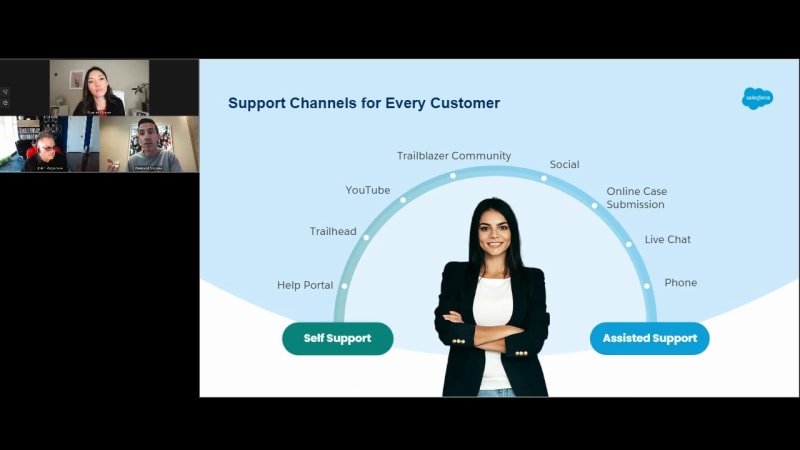
Hello, everyone, and welcome to today's webinar, Salesforce Insight, Key Elements of their Digital First Support Strategy, brought to you by Technology and Services Industry Association and sponsored by Coveo. My name is Vanessa Lucero, and I'll be your moderator for today. Before we get started, I'd like to go over a few housekeeping items. Today's webinar will be recorded. A link to the recording of today's presentation will be sent to you within twenty four hours via email. Audio will be delivered via streaming. All attendees will be in a listen only mode and your webinar controls including volume are found in the toolbar at the bottom of the webinar player. We encourage your comments and questions. If you think of a question for the presenters at any point, please submit to the Ask a Question box on the top left corner of the webinar player, and we will open it up for a verbal Q and A portion at the end of today's session. Lastly, feel free to enlarge the slides to full screen at any time by selecting one of the full screen button options, which are located on the top right corner of the slide there. I would now like to introduce our presenters today, John Ragdale, Distinguished Researcher and Vice President of Technology Ecosystems for TSIA Bonnie Chase, Director of Product Barca, Service and Support for Coveo and Bernard Flowey, Vice President of Digital Customer Support for Salesforce. As with all of our TSAA webinars, we do have a lot of exciting content to cover in the next forty five minutes. So let's jump right in and get started. John, over to you. Well, thank you, Vanessa. Hello, everyone, and welcome to today's webinar. I'm very excited to have Bonnie and Bernard with me today. We're all gonna be together in just a few days in Orlando. And Bernard is doing a a breakout session in Orlando about digital self support and Salesforce's transformation. So he's gonna be giving a sort of a preview of that today. Bonnie, I know that Caveo is also doing a a session in Orlando. Patrick Martin, your VP of tech support, is talking about swarming at Salesforce and Slack. So a lot of great content coming up. But, you know, today, we're talking about a digital first support strategy and in specific, you know, looking at customer expectations for self-service. And I think everybody understands that customer expectations are a lot higher today for digital capabilities than they were in the past. Now I know this is quite an eye chart, but we will have a a link in our resources list for a report that goes into detail about this data. But every year, we do a survey of, ten different countries and four different age demographics asking when they need support for a product, what are the channels that they prefer to use to get information. And, you know, the the answers are very different by age, by country, but we are definitely seeing every year that the preference toward these digital channels, is continuing to grow. And in fact, one of the interesting findings of the twenty twenty one survey is that if you look at, the channels that baby boomers fifty percent or more of baby boomers say they prefer or occasionally use six different channels. But Gen z, the youngest demographic in the survey, fifty percent or more of them say they, really prefer or occasionally use fifteen channels. So my point is customers don't pick one channel and stick to it. It's very situational, and I think it it's sort of by complexity. If they've just got a how do I question, they may watch a YouTube video. If they're on your web site and they have a quick question, they may do a web chat, moving up to digital chat. When we start getting into more complex issues, that's when they may start getting into email and phone when they know there's way too much typing or details involved, to do that with, you know, maybe a a a SMS text or a WhatsApp, for example. So we keep rolling out these channels, and customers are continuing to use them. And the other thing I wanted to mention is the devices are changing as well, and more than half of customers say when they're leveraging these digital support channels, they're doing it on their smartphone. So even in b to b support, you can't assume that they're sitting in front of a desktop or a laptop. And every time I do a a workshop with a company on overhauling their self-service site, I always find some features that either And the final thing I'll mention is though we are seeing huge investment in digital capabilities and self-service, at the end of the day, I don't think we're meeting our expectations of customers. And a couple of data points for you. You know, the average customer satisfaction with assistant support is around four point five, four point six. But for self-service, it's only a three point five, which is a low b. So we're not doing very well in satisfying satisfying this, and customers tend to prefer self-service over assisted service, so we're not giving them the experience they expect. And I would also note that self self-service success is averaging just over fifty percent, which means about half of the time when the customer attempts self-service, they're not even finding what they need, which is a a very frustrating experience for them as well. So to delve in how do we improve these numbers and, showcase some really good examples of success. Thrilled again to have Bonnie and Bernard with us today. And for now, I'll turn things over to, Bonnie. Chase is the director of product marketing for service support at Coveo. Bonnie, take it away. Thanks, John, and and thanks for that that great overview and and introduction. Very excited to be here today to discuss the key elements of digital support with Bernard. Before we dig into a fireside chat with Bernard, I wanted to to kind of highlight a couple of things that that you shared, and then set a little bit of context about who we are at Coveo. So, you know, a couple of key things that that you were talking about, John, is really, you know, there's there's two sides of this coin. It's the customer expectations and the customer preference. Right? So we know customer expectations are high. We know people want, a seamless experience, an effortless experience, and an experience that's personalized to them. On the preference side though, it can differ. So as you've shared depending on the demographic, they may have different preferences. And this can even be, you know, depending on the product as well. So a lot of pieces to take into when you're creating a digital support strategy. So here we are, Coveo and Salesforce. Just to give a little bit of context about why we're having this discussion now. You know, sale, Coveo is an AI platform that sits behind your existing systems to help create those personalized service experiences through intelligent search recommendations and omnichannel analytics. And we work with large enterprise organizations like Salesforce to help them transform their And they, you and they, you know, they bring together businesses and customers. And what really sets Salesforce apart is their ability to provide excellent digital experiences. Right? So from Trailhead to Salesforce help to AppExchange, there's a variety of ways that customers can engage with Salesforce digitally. And when you think about the engagement that these digital touchpoints support, it's pretty astounding because Salesforce supports over a hundred and fifty thousand customers, for example, and ninety five out of the one hundred Fortune one hundred, companies have at least one app on the AppExchange. So, you know, not only is it reaching a lot of a lot of people, but, you know, very, very big, companies as well. So what does it take to ensure a seamless and effortless experience across all of these digital channels? Well, one approach is, you know, thinking digital first. And with that, I wanna introduce you to Bernard Sloey who, as as John and Vanessa shared, VP of digital customer support at Salesforce. So, Bernard, thanks so much for joining us today. Why don't you give us a quick intro about who you are and what's, what your role is at Salesforce? Sure. Thank you, Bonnie. Thank you, John. A lot of gratitude to be here today, and thank you for the people that are listening in. Excited to be part of this conversation. I just recently passed my one year anniversary at Salesforce, so a very big milestone. I'm very, very happy to be here. As you mentioned, I lead our digital customer support team, and I'm I will explain explain by the end of this what all that means, I'm sure. Before that, I spent a year at GitHub where I led our digital customer success and support. And before that, I spent fourteen years at Microsoft. So all in support. I led Windows support from Microsoft. But I've always had a huge passion for digital. I don't think that anybody wakes up in the morning and says I wanna contact support. You know, they're gonna go to Google. They're gonna search. They're gonna try and find a relevant answer. They're gonna what they need. And if that doesn't work, then they'll go to assist and support, and that should be a great experience. But, you know, to the data point John raised earlier on, unfortunately, you know, over half the time, that doesn't work. And that's what our focus is at Salesforce is we really wanna drive that world class digital experience that enables customers to self serve, and that's what my job is all about. That's amazing. And and, you know, when we when we talk about a digital approach or what digital first means, can you share a little bit about, you know, what's the difference between, you know, our our normal approach to to customer service versus a a digital first approach? I I think historically, support organizations have been traditionally always focused on the assisted support contact channels. And and this this graph or this view, sorry, is a great way to look at how we think about it at Salesforce. So if you look at this, we look at self support on the left all the way over to assist assist support on the right hand side. And what this shows you is the channels that we enable our customers to get support with. So you can see we have our help portal, where customers can go and get documentation, etcetera, to self serve. We have Trailhead where customers can go and learn and become experts in our product. We have YouTube where if customers wanna get short form videos, they can go to our YouTube Salesforce channel, which is the second fastest growing channel at Salesforce, which kind of amazes me. Right? It's a support channel, and it's the second fastest growing channel at Salesforce. It hit, like, one point five million views recently, which shows you that the customers want to want to get this content. They want short form videos. Then you start to move into our Trailblazer community, and we think about this as this kind of crossover between assisted and digital. You know, customer posts a question, another customer might respond, so it's kind of direct one to one with a human. But if that response is really good, then it's gonna do great on Google SEO, and more customers are gonna find it through Google as they search for that problem. And then we move into more into the blue. We think we have social. We do support over LinkedIn. We do support over Twitter. You know, we proactively reach out to customers that might be having issues. We also broadcast content. We share our YouTube videos, etcetera. And then you start to get into this one to one assisted support or online case submission where about eighty percent of our volume comes through there. You have live chat and you have phone. And the reason I'm showing you this is I as I mentioned at the start, I think com companies have historically been very focused on the right hand side. Phone, chat, a lot of operational metrics around it. And I think digital has sometimes been an afterthought. Yes. We need to do something. You know, we need to have a website. We need to have some content, but they don't manage it with the same operational rigor that they manage assisted support. And that's what my role does. That's what my team is about. We bring an operational rigor to digital, so we're managing the performance of them digital channels just like we would assist the channels. Does that make sense, Bonnie? Yeah. I mean, that that's an interesting approach, you know, instead of thinking about the the digital touchpoints as as just a piece of the pie or, an afterthought, it's really, you know, how can we how can we organize around this to make sure that we're we're delivering the best experience possible. It seems like, you know, I think you had mentioned, before in our conversations that you actually have, built out a new team to focus on on this. What does that what does that team look like? A a digital support team look like? Yeah. Yeah. Great question. So I the the where I'll start is my role didn't exist a year ago. You know? So it's the perfect example of, you know, we're investing in digital support. We're investing in an organization in support that's one hundred percent focused on digital. And so I've built out my team. You know, over the last year, we've had a fifty percent headcount growth in our team. And with that, we have a number of roles, which I'll kinda talk to you a little bit about. But what we have is we have a team of what we call experienced managers. And what they do is they are responsible for each of our digital channels. So we have an experience manager who manages our help portal, an experience manager who looks at our Trailblazer community, an experience manager who looks at YouTube. They're managing the operational performance of them channels. How many customers are landing on it? How many customers have been successful? How much new content are we pushing out there? So they're bringing an operational rigor to them channels as well as driving with our technology team the road map for them channels. What do we need to enable in the future to help customers serve bet better on digital? So that's one team in my organization is our experienced program managers. Then we also have a digital content team. So we use something called KCS, which is knowledge center support, to get content from our support engineers that we then publish onto our portal. But we use our content team to modernize that content, to beautify it. Right? They take what the support engineers have written. They put it in a format that's snackable, digest digestible, post it onto our sites. They also produce our YouTube videos. So we have a content team that's focused on that support content that we're serving to our customers. Another function we have is we have what we call digital program managers. And what they do is they're actually aligned to our support delivery team. So they're aligned by our products, and they work with our support delivery teams to understand what are the top case drivers. And then what they do is they take them top case drivers, and they journey map them all the way from Google. They look at in app. They look at our portal, and they're looking at ways to improve that journey to ultimately drive down case rates. So if they do their job really well, we start to see our case rate go down, which means more customers are getting served digitally. We also have a BI function that's one hundred percent dedicated to our digital support. They're looking at, you know, using Tableau to monitor some of this data, provide us with lots of information, insights so we know what we need to go after. And then finally, and and probably most important, I would say, is we have a software engineering team. We have a team that builds on top of our Salesforce products on functionality we wanna enable. So we launched Einstein Chatbot as an example. Our software engineering team enabled that. They built some functionality on top of it, and we kinda drive requirements into that team. And so this is a whole focus in our support organization. This whole team exists under me that's focused on driving on that digital experience. I mean, that that's amazing. And and it really seems like you have this holistic approach, you know, got kind of all of your bases covered, whether it's the back end, the function excuse me. The functionality that that you're implementing all the way to that that whole experience side of things. As you were describing the the experience manager's role, it's almost like almost like a UX experience for for customer support, where you're you're wanting to make sure that that as they're as they're engaging with you digitally, you know, that that experience flows through well. Would you would you agree with that statement, or would you describe it a different way? No. No. I would totally agree with it. And and just one example, I build on what you said. Like, one of the roles we have on that team is an SEO experience manager. And her role is she's focused on search from Google. Right? We know customers majority of customers start in Google. Right? We know that. And so we start our experience manager work there. It's like, hey. When customers are searching for certain Salesforce keywords related to support, what is that experience? And we know when we get them over to the help portal, we have a great search experience in the help portal, thanks to Caveo, an incredible experience. But we know the customers are starting in Google, so that experience manager is starting right there, Bonnie. How are we making sure the results they're getting in Google is landing them on the right page first time. You know, that's that's what the focus is there. So yeah. And then when we get to the portal, to your point, the experience manager who owns the portal is looking at that experience, the UX, etcetera, of what that is for our customers. Yeah. That's great. And and, you know, adding on to that and talking about the content team. So you have so as you said, you you follow knowledge centered service. And I'm, you know, just kind of talking through what that looks like. You know, the the agents are then creating content as they're solving cases. But you actually have another team of of content managers who who are taking that content and making it, you know, easy to digest by your customers. I think that's a really interesting concept. One that I haven't really seen before. But they're also also doing, like, the YouTube videos as well. Yes. I mean, that that's that's a really great approach. Has has that has that been able to, have you have they been able to turn around content quickly based on the the content that the support team is creating? So Is that a fine question. Yeah. Yeah. It's it's a really good question. So, traditionally, we use pure KCS where our support engineers will create content, and that will kinda go through the different tiers of the KCS process and then get published on our portal. And a lot of the times, that content is really good, but sometimes it's very long form. Right? And so what what we're using the content managers to do is sometimes they're actually going back reactively and looking at some of our content that has our most visits, and they're trying to make that content more consumable. Right? And so it's snackable content, putting videos within the content, right, because we know sometimes customers prefer video than text. So we still have the ability for our engineers to publish directly to our portal. They can still do that. We're kinda using our content managers more in a reactive. New launch, but reactive on some of our content that's getting the most visits that maybe isn't performing the way we want it to perform. So we wanna go and change the view of that content and modernize it. No. That's great. And and I like the fact that, you know, as as you said, you're you're more focused on that that digital kind of self-service experience, but you're working closely with, with the assisted service side to make sure I mean, there's there's channels flowing through both directions. Totally. Can and Totally. The the YouTube piece is is interesting. I mean, is that something that's new for Salesforce where where you're kind of, pushing that out more and suddenly you're getting a ton of views? We've actually had the channel for a while. I think it it was here before me. So so but we've really focused on it over the last year. So similar to how we're using, you know, our support engineers to create physical content, we're actually using our support engineers to create our videos. And then we have a production team. It's a small team, but they take that. They produce it into kind of, you know, more of a streamlined view that we can post on YouTube. What's been super interesting is over the last few months, we've actually started using our own community to create videos. And what I mean by that is if you look at our Trailblazer community, we have an incredible community at Salesforce, amazing Trailblazers, who are going in and answering questions for other customers. And what we have in our trailblazer community is an answer leaderboard, right, the people that are answering the most questions for customers. And we started to use them answer leaders to actually create video content. So they're producing the content that we're now putting on our YouTube channel. So, you know, they're getting the recognition of Salesforce and, you know, their videos have been put put, put up on our site. Excuse me. So so that's been a real game changer for us. I'm very interested to see where this is gonna go, this user generated content, UGC, because it's not just about our for engineers anymore. We're using the entire Salesforce ecosystem to help support some of our other customers. Yeah. And and it sounds like it there's potential there for for, you know, not just resolving issues, but maybe, you know, coming up with ideas are the possible, you know, creating content for for various intents? Totally. Totally. What what they do is we look at, for example, like, what's the, you know, question on on a certain product that has the most views in our community that an answer leader has answered. That answer leader takes his or her answer then and actually puts it into a video. So we know it's a we know it's a scenario that's driving a lot of traffic. We have a strong answer on the community about it. Now we're putting it into YouTube as well, so we have a video for it. Then we also can embed that video into our knowledge article. So we're we're giving customers choice. You know? Whatever it is the best way that they wanna serve, the best way that they learn, we wanna give them that choice. Yeah. That's amazing. And it and it it ties back to that customer preference. Right? We wanna make sure that whatever their choice is, we we provide them with that good experience. Exactly. Exactly. So, you know, with this new digital team, you're really focused on this end to end integrated service experience. Can you talk a little bit more about what that looks like and and how Coveo plays a part in that? Sure. Coveo we use Coveo in multiple places, but I'll I'll give a couple of examples. So as I mentioned earlier on, Caveo is our search across Salesforce. So if you land on our help portal, we provide a search first experience, right, where you can go and search for whatever you're looking for. And we use the power of Caveo in that. We have all of the data through Caveo where we can see how many times people are finding the relevant answer when they search, etcetera. So that's kind of the entry point. But we're also starting to do some really interesting things with Coveo and other places. So we spent a lot of time on that online case submission that you can see in in the view in front of you of simplifying that for our customers. It was quite complicated. There was drop down menus. They had to select different things. And we've now brought it down to really it's just three things they need to tell us. What's the product? What's the topic, and then a description of the problem. But we actually wanna get it to a point that they don't have to tell tell us what the product is or the topic. They can just tell us a description, type in what your issue is. And we're using Kaveo, and Kaveo's AI is a classification model in the back end. So you type in your problem, and through the power of Kaveo, we can classify that description. Then we can provide you with potentially some search results related to that as well as using that Caveo model to make sure we route you to the right support engineer. So so really powerful using that Caveo classification model to make it easier for our customers because they won't need to select as many things. They just need to type in their problem, and we let the Caveo model figure out what the product is, what the topic is, and who is the right support engineer to get them to. The other area I call out, which is really important to us, is the engineer experience. So we use Caveo inside the engineer's console. So when the engineer you know, coming back to that KCS process, you know, the engineer searches for content for them to help them troubleshoot the issue. That's, again, Kaveo in that experience. So using Kaveo in a lot of places, Bonnie, like, you know, they've been an incredible partner for us. And we're gonna continue to build on that more and more in the future. Yeah. That that's great. And and, you know, and and thinking about that that case classification piece, you know, one of the things that that, you know, I've been I've been talking about a lot lately and even, you know, John and I have have talked about this on previous webinars is, you know, kind of moving away from not moving away from focusing on case deflection, but looking at it as as in, you know, case deflection isn't the the only important metric. And sometimes people do need to contact support and speak to somebody in support. So how do you make that that experience effortless and seamless for them whether they whether it's something that should be deflected or something that should be going to, going to assistive support? Yeah. The first thing I'll say, and this is not me having a pop at you, but I I actually hate the word deflection, because I I I think I think it just drives the wrong behaviors. Like, I've seen in companies where, you know, they have deflection targets, and people will do things that makes it hard for a customer to get the support so they can hit their deflection numbers. And and, you know, we've we've all lived them experiences. Right? As a consumer, you know, you try to get support from some company, and it's really hard to get to them. And they're probably ticking a box on a deflection metric. So the the way that we talk about it is similar to kind of what John showed in the slide earlier on is we think about self help success as as the way to think about that metric is, hey. I engage with your self help properties, whether that's an article on your portal, and I didn't go and create a case. It's the highest way to think about it. We also look at you know, they can tell us thumbs up or thumbs down that it solved their issue, and this all feeds into what we measure around self help success. So so that's the big thing. But coming back to your question, we firmly believe in giving customers choice. If if customers wanna go and create a case, we wanna make that as an easy as possible process for them. Right? Coming back to that thing that I mentioned earlier on with our case submission form, we streamlined that case submission form. It was, like, several clicks, and we made it down to three clicks for a customer to submit a case. We we're we're about to launch Einstein Bot within case submission. But how we're gonna launch it is when a customer gets classified as a certain product or topic and we know the bot can solve that issue, the bot will appear on the right hand side in our case submission. We're not gonna force you to go through the bot, which I think, unfortunately, many companies do. We're gonna give you the choice. We're gonna say, hey. You know, eighty percent of the time, this bot can solve for the issue if you wanna engage. So coming back to what you said, Bonnie, you know, it's about giving customers choice, and it's about creating easy experiences, not getting in their way. If they wanna create the case, we want them to go ahead and do that and make it an easy experience. Mhmm. Yeah. Yeah. Let's let's stop getting in their way. Let's stop blocking them from from talking to us. You know, what are what are some other key metrics that that you look at there? Yeah. So the the the big one, as I mentioned, is self help success is kind of we kind of have three KPIs that at the highest level, and then we have operational KPIs for each of our channels. The other one and and again, John kinda touched on this earlier on. We actually launched a a digital CSAT survey on our help portal, in our community, you know, where we're actually asking customers specific questions related to their digital journey. So if, for example, they're on our help portal, they're on a piece of content, we have a microsurveying mechanism that only shows to a certain amount of customers and it'll depend on what you do. So, for example, if they scroll down to the bottom of the page and been on the page long enough, we might pop up and ask them, hey. You know, did we solve your issue? And so and then we would ask them the customer satisfaction question. So we're very, very focused on digital CSAT. We're at about three point eight right now, so we know we have room to grow. Right? We're gonna continuously get better all the time. Right? I wanna get us up around four point five, but enabling that digital CSAT was the first thing that we needed to do because we weren't actually measuring the digital CSAT experience. We were measuring the assisted CSAT experience. Very important. You measure both, and you have separate mechanisms for both. So digital CSAT is the one that we look at as well. The other one, and I kinda touched on this, is this metric that we call problem resolution rate, which is when we give you a piece of content, you've specifically told us, yes. That solved my issue. So we we can then look at, you know, our content and see what's the problem resolution rate on certain articles. Is it performing well enough? Yes or no? And that that shows us where we need to go after. The same with our chatbot chatbot dialogues. When you go through a dialogue with the chatbot, we ask the question, did we solve your issue? Yes or no. That's problem resolution rate. And depending on the percentages of that, we know what dialogues are working well or what aren't and what we need to go after. So they're kind of our three, what I would say, strategic KPIs, self help success, problem resolution rate, and CSAT. Now we've got a lot of ones underneath. I won't go into detail, like operational for our channels, for things like our help portal. We look at, like, our authentication rate. We look at our load times. How fast is the site loading for customers? That's very important to us. You know? So we've lots of operational metrics that we look at for each of these channels that the experienced managers manage, but then all up there are kinda core strategic KPIs that we look at. Does does that help? Yeah. That that that's very helpful. And, you know, I think those operational KPIs are are important too because, you know, even as you're thinking about, you know, you mentioned embedding YouTube videos into your content. I mean, as as you're adding these, you know, multimodal elements, you wanna make sure that the performance is still, good and you're not kind of bogging things down. So it's good that you're you're looking at both ends of it. I think the CSAT piece is really interesting too where, you know, you're you have the assistant support CSAT and this digital CSAT. So you've got these two different ways of measuring customer satisfaction. I think that's that's really interesting. What what is this what would you say is the main difference in how you measure the two? Is it just where those interactions happen and when they get asked those questions? Yeah. Yeah. What what I've what I've seen companies do on the assisted CSAT is they they ask a question like rating your digital experience or something like that. I'm making this up right and and and I'm not gonna pick on any company. And to me, that's broken because if I've engaged with a support engineer, digital has failed for me. Right? I've tried to probably get self help. I'm true to a support engineer, and now you're asking me a question in the support engineer CSAT survey about my digital experience. I'm I'm not gonna be happy probably. So we have a specific survey that relates to the digital experience. We we actually use a company called Sprig that enables us to do micro surveying. That's really important to me. I don't wanna give people survey fatigue. I don't wanna be popping up in people's face all the time when they're trying to do something. Right? So we're we're very strategic about when we pop up, how often we pop up, and the questions that we're asking. So we can do things like AB testing within that survey process as well. But we ask the standard CSAT question, you know, out of five stars, you know, rating this experience so that we can actually measure them digital channels with CSAT as well. Oh, that's great. Now, you know, I I do have another question before we get into an open q and a, and it's really around, you know, you you kind of helped to implement this new strategy at Salesforce, this digital first approach, this new completely new team with new roles focused on, you know, organized around that, digital experience. For other organizations who may be watching and interested in kind of following the same path, what are some tips that you may have for someone getting started with this type of strategy? Start today. No. I'm I'm I'm joking a little. I I do think you have to invest in a team that's focused on it. And hopefully, that's come across a lot in what I said. I'm very passionate about this. Like, as I said, I I ran large support delivery organizations from Microsoft. But even then, I I often felt like digital was an afterthought. And so I I think if you wanna get serious about it, you have to invest in a team that that's their day job. And and the ROI is there. Right? Like, we all know the ROI is there. Like, you can go do the math. Right? And if you drive up that self help success rate, less customers need to contact with assisted support. They're happier. They get a happier digital CSAT. You're driving your case rate down, so you're saving dollars. You know? So it's about making that investment in that team, and it doesn't need to be a massive team. You know? You can start small and build it out. And then the other thing I would say is using companies out there that are doing these things really well. You know, Coveo is a great example, Bonnie. Like, we have a lot of our own things that we use. Like, you know, our help portal is on Salesforce Experience Cloud, but we use Coveo because they are the industry leader on enterprise search. Right? So there's many companies out there that are doing things incredibly well. Leverage them companies. Use them for your your customers to help improve your experience. Now I'm super proud. Our our help portal now has a self help success rate of ninety six percent. You know? So so you think about that. The amount of people that are landing on that portal and getting what they need and not needing to create a case, it's huge. Right? There's a massive ROI there. But most importantly, our customers are getting what they need. Our customers are satisfied with the experience. So start today. Invest in the right resources. Use companies that are out there that do some of these things really, really well. Yeah. Those are those are all great tips. And I know, you know, in a few days when when you're at the TSIA events, you'll be presenting more in-depth about this topic, with some more examples. So, for those of you watching, and and you're attending the the the TSIA events, please please join Bernard's session. Thank you, Bernard, for for answering my questions. Now I wanna turn it over to the audience to see, if there's any questions we can answer there. So, Vanessa, I will pass it back to you. Great. Well, thank you so much, Bonnie. Just as a reminder to everybody, if you would like to submit a question, please enter it in the audience q and a box. It's in the upper left hand corner of your screen, and we're gonna get through as many questions as time allows. I will say that we do already have quite a few questions in queue, but here we go. The first question is from Anthony, and they ask, what other teams do you work with outside of support to make your digital experience better? I'm happy to take that one. So we work with a a lot of teams across Salesforce to to make sure that we're thinking about an end to end experience for our customers. So we actually work with our product teams to see how we can drive in product support experiences. So if the customer's in the product and they want the content, etcetera, that we're using Kaveo, we've got a, you know, help pane within our products so customers can get into our case, etcetera. So that's huge partnership with our engineering teams. We have to work really, really closely with them on road maps, etcetera, to to make sure we're getting that in place. The other partner, and I I don't think I called this out enough earlier on, but our our our delivery teams are absolutely key in everything we do. So all of the knowledge sits with our support engineers. They're the experts in troubleshooting the experts in our products. So although I'm part of the support organization, you know, we're all one team, they're my most important partner because they're the people that we're able to get the knowledge from on how we can solve customers' issues in the digital experience. So engineering, yeah, we partner really closely with them, our product teams. But then the biggest partnership is with our support delivery teams and learning from them about what we need to do digitally. I don't know, Bonnie, anything else you wanna add to that? No. I think I think that's great. And and maybe one one area, and this might be biased for me because it's my team, but I think, you know, partnering with marketing is is also important as well and making sure that, you know, you're you're announcing, you know, whether you're doing a rebrand or you've got new channels available, new touch points available, having that that marketing team be the voice to to echo internally and externally is is helpful as well. Yeah. Very true. My marketing team are probably given out that I didn't mention them right now. So thank you for doing that because we work very, very closely with them with things like our YouTube channel you mentioned earlier on. We work with our marketing team about how we can advertise that more so people know it's there. So, yes, thank you for that call out. Yeah. Yeah. I would also chime in on on that about customer success because, you know, customer success is doing all the onboarding, and sometimes they're not always up to speed on some of the new digital capabilities that support has introduced. So, you know, it's really critical that they always understand everything that's out there so they can include that, when they're introducing, you know, the the platform both on how to use the technology and get support for the technology, to new customers. And I also know we have a lot of members who are struggling with visibility and influence for support, which luckily is not an issue for you at Salesforce. And, you know, there could be some funding from success to help you with some of the initiatives you have that are gonna dramatically improve the customer experience for support because everybody's understanding that satisfaction with support is the primary driver of renewals. So if you're, you know, kind of struggling to get the budget you need, it's worth worth reaching out to support or to the success organization because they may be able to help with some of that funding. Yeah. I it's a really great call out, John. Like like, one of our values in Salesforce is customer success. You know? So everything we do is about that. But, you know, I partner incredibly closely with our customer success team. You know? All exactly as you said, that whole, like, onboarding slash education journey, like, how we're getting customers the right content to help them be successful there. So really, really great call out. Huge, huge partner. Okay. Our next question comes from Emily. And they asked, do you build out customer journeys? And how do you approach that? Yeah. That's a great question, Emily. So I think customer journey mapping is critical. It's absolutely critical in order to drive improvements for the experience. As as I mentioned earlier on, we we have a role in Salesforce under my team called the digital program manager. And what they do is they take the top case drivers from assisted support for certain products. And we have a framework that we use that they take that case driver and they journey map that all the way from Google to, you know, search to finding the right content in product. Like, we have a framework, and I'll actually be going deeper on this framework in Orlando if you happen to be there or you can watch the recording. But that helps us to identify the breakpoints. You know? Like, the simplest example, like, if you're searching for certain keywords in Google and Google's not bringing up the relevant results you want them to, you have a breakpoint there. You need to try and improve that SEO to get them to the right content. You know? So that journey mapping is critical to make sure you're identifying what are the areas that we can improve upon. If you have a knowledge article that's not performing very well, that should flush up in your journey map, And then you should be, as a digital program manager, I'm gonna go and improve that article so that we can have more customers solve at that part of the journey. So it's absolutely critical. You know, we have a framework around it that we use. I'm happy to share more about that in in the session in in a couple of weeks' time. K. Our next question, here is from Jana, which might kind of go along with the last one here for you, Bernard. It says, does your team have a content strategy? And how do you ensure you have the right content? Yeah. So and, actually, just to build on what I said before because I forgot something. One of the important elements with that journey mapping is we have personas. You know, not all customers are the same. Right? You have in our in our world, we generally deal with admins, but we have people that we would call, like, an accidental admin. Someone who's working at a small company has become the admin for Salesforce. Their journey could be very different than someone who's an IT admin at Dell, for example, who's using Salesforce. So so we use them personas when we're doing our journey mapping as well to make sure we're thinking about it the right way for the different personas. And the reason I'm bringing that up on the question that you ask is we have our content strategist and our content manager roles, and we use them as well thinking what's the right content for the different personas. Right? If I'm a very technical IT admin, I probably want content in a certain way versus if I'm someone who's maybe learning Salesforce for the first time, you know, I might want the content to be a little bit easier to consume, etcetera. So that personas is very important both in the journey mapping and in the content that we deliver. And we use our content strategist and our content writers to help with that. Okay. Well, we have come to the conclusion of today's live webinar. Bonnie, any final remarks from you before we close? Yeah. I would just I would just encourage you all if you're going to be in Orlando to attend Bernard's session. And as a reminder, we have one as well to talk about intelligence warming. Great. Okay. So thank you. Well, I know there were quite a few questions that we weren't able to answer here live today, but don't worry. We haven't forgotten about you. We will make sure to follow-up with you. And with that, a few more quick reminders before we sign off for today. There will be an exit survey at the end of today's live webinar. Please take a few minutes to provide your feedback on the content and your experience by filling out that brief survey, and a link to the recorded version of today's webinar will be sent out within the next twenty four hours. I'd now like to take this time to thank our presenters, John, Bonnie, and Bernard for delivering an outstanding session. And thank you to everyone for taking the time out of your busy schedules to join us for today's webinar, Salesforce insight, key elements of their digital first support strategy, brought to you by Technology and Services Industry Association and sponsored by Kaveo. We look forward to seeing you at our next TSIA webinar. Take care, everyone.
Salesforce Insight: Key Elements of a Digital-First Support Strategy
In the new normal, successful self-service requires you to be digital first. But what are the critical components to include in your digital strategy, and what does it take to get there?
In this session, Salesforce’s Bernard Slowley, Vice President, Digital Customer Support, and Coveo’s Bonnie Chase, Director of Product Marketing, will share how Salesforce transformed their support strategy to think beyond the buckets of self-service and assisted service to a more integrated digital experience for both employees and customers.
In this 45-minute webinar, you’ll learn:
- How a better digital strategy improves the assisted service experience, and lowers both employee and customer effort.
- Why you need a digital support strategy team, where they fit in the organization, and what the structure of that team looks like.
- Which key metrics you should track to measure your progress toward a digital experience
Make every experience relevant with Coveo