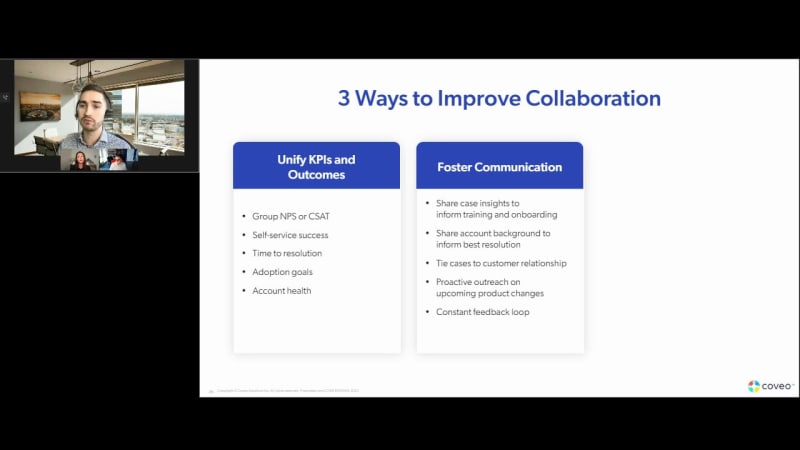
Hello, everyone, and welcome to today's webinar, Trend Alert, How Support and Success Teams are Merging to Increase Customer Value, brought to you by Technology and Services Industry Association and sponsored by Kazeo. My name is Vanessa Lucero, and I'll be your moderator for today. Before we get started, I'd like to go over a few housekeeping items. Today's webinar will be recorded. A link to the recording of today's presentation will be sent to you within twenty four hours via email. Audio will be delivered via streaming. All attendees will be in a listen only mode. Your webinar controls including volume are are found in the toolbar at the bottom of the webinar player. We encourage your comments and questions. If you think of a question for the presenters at any point, please submit through the ask a question box on the top left corner of the webinar player, and we will open it up for a verbal Q and A portion at the end of today's session. Lastly, feel free to enlarge the slides to full screen at any time by clicking one of the full screen button options, which are located in the top right corner of the slide player. I would now like to introduce our presenters today. John Ragsdale, Distinguished Researcher and Vice President of Technology Ecosystems for TSIA Bonnie Chase, Senior Director, Service Marketing for Coveo and Matthew Saburin, customer success Barca, also with Coveo. As with all of our TSIA webinars, we do have a lot of exciting content to cover in the next forty five minutes, so let's jump right in and get started. John, over to you. Thank you, Vanessa. Hello, everyone, and welcome to today's webinar. We recently held our Envision conference in Las Vegas and had an amazing keynote from Microsoft about the importance of digitally scaling customer success. And we're talking today about how you may be able to leverage some of the existing technology that you're already using in support to gain some really interesting insights into your success organization. So we've been talking about this concept of kind of blurring the lines between various services organizations for a couple of years now and our executives have published quite a bit of content around services convergence. And today, we are seeing that more companies are creating this chief customer officer role, and they have oversight across all of the service divisions. And, a lot of companies are finding that there already is existing overlap between these departments. They're trying to find ways that they can start normalizing technology and get more mileage out of technology and break down those silos, that we've typically had between customer support, customer success, professional services, for example. So today we're going to be talking about really the synergies between support and success and some examples of how companies that are working these teams closer together are getting some great advantages. Investing in self-service, so they can answer these how do I or how to questions on your website. But I want to take a slightly different tact today. You know, everybody is trying to understand, you know, what are what are customers struggling with? What can we improve in the the product, to make adoption easier? How can we better train and onboard customers to help them more rapidly adopt technology? And I find that few companies are analyzing this information. And if you look at, the average number of support incidents that a support organization is receiving according to our benchmark, the median, is over four thousand incidents a month. For large companies, it's fourteen thousand a month or more. So if you think that more than a third of those incidents are customers struggling to use a product, analyzing that will give you incredible insight into features and functions that are hard to use, what training on boarding to allow customers to get more access, more value out of the products much more quickly than in the past. And talking about digitally scaling success, if we look at the ratios of how many accounts each CSM is managing, it's quite a few. And you think about their onboarding, they're not just onboarding one person at that account. They could be onboarding dozens or even hundreds of people, depending on what your technology, is. So there's a really big push today in creating more digital content for customer learning, and also, you know, really helping them prioritize what they should be spending time on. And, you know, we we all know that it it's a a challenge to create more support content and knowledge articles. But if you look at it from the education services perspective, one hour of digital learning content costs around ten thousand dollars to create. It's a very sophisticated complex process. So the more information we can get about exactly what customers are struggling with, what content can we be creating to help move that adoption needle, the better. So when we talk about analytics and support and search technology, we usually I talk a lot about these three metrics, which are my favorite. And we've talked a lot about how support organizations can use them. But I want to focus just quickly today on how success organizations can benefit from these very same analytics. And I was just talking about content gap analysis. What are customers searching for and not finding? And this analytic will tell you, you know, which content is either really hard to find or doesn't exist at all. And the same applies for the customer learning. If you've got a customer learning portal and they're going there to to find help, with using products, onboarding for products, that's gonna tell you what your education services team should really prioritize, to create more and more of this content that will be instantly impactful and actually consumed instead of trying to guess what customers want and building a lot of content that may never really get adopted. Usage analysis is understanding not only what customers consume the most and the least, but by demographics, education services group to create personalized learning paths that are very tailored to specific roles, specific industries, specific geographies, that you have a much more, rapid adoption and the renewal rate goes up. And this usage analysis can help you determine, what those customized learning paths would be. So you can start understanding, you know, what are the specific features, process flows, capabilities that an admin versus a research director, a director or a manager or a VP, and you can start getting a much better idea of what is the customized onboarding by title, again by industry, by region, whatever. And this usage analysis automates that so you don't have to try to figure out what would be the most appropriate for these customer segments. And finally, relevancy analysis. You know, this is the technology within search engines that associates search terms with content. So maybe all of your documentation and learning is around, reporting. Maybe you've got a reporting one zero one module, but customers are asking how do I build a dashboard. So relevancy analysis is understanding when a customer is asking for this terminology, they're actually looking for this content even if the words are completely different. So not only is that gonna help your customers find the learning content they need, it's also gonna give you a lot of insight into the actual terminology customers use so you can start embracing that. So instead of always forcing them on what we wanna call things, if you start incorporating the customer terminology, it's going to be much easier for them to really consume that content without having to constantly analytics, but we're gonna do a much deeper dive from our experts today and getting into a lot more information about, success, search analytics, intelligent search, etcetera. So I'd like to turn things over now to our first guest speaker. Bonnie Chase is the senior director for services marketing with Kaveo. Bonnie, over to you. Thanks so much, John, and and that was a great introduction with lots of really good data. And and I think, you know, what what we'll do with this presentation is really take you through, you know, what are those traditional differences between the two teams and and the really the benefits of them working together, to really illustrate the data that that John had provided. And I've been lucky enough to to kind of sit on the outside of this and observe those changes and the shift as these two organizations are working, really toward the same goal and driving the success of the customer. And my colleague Matthew here, you know, deep in the weeds, is ready to, give some some firsthand examples as well. So, Matthew, why don't I hand it off to you to start, explaining some of those differences? Yes. Awesome. Thank you, Bonnie, for this introduction, and thank you, John, as well for all these, these insights. So when we come to think of, you know, traditionally what the roles of customer success and customer support have been, they've often been seen almost as opposites. Right? Where customer success on one side has more of a proactive approach, aimed at making sure, obviously, they can build a relationship with their client, having strategic discussions with them, and making sure that they're contributing to growth. Right? A lot of organizations see success as a growth center. Whereas on the other end, support has has always been more of a reactive organization where they'll react to technical problems. They'll focus on fixing those technical issues. They'll have more tactical and technical discussions with the clients, and they're also seen then just as a cost center, right, as they're reacting to issues, to problems that they need to fix, which is something that obviously, costs money to to organizations. But when we come to take a step back and look at, you know, look at it perhaps from the customer's perspective, they're essentially two sides of the same metal because they both end up working along the same plane, which is the customer journey. So in the customer's eyes, really, all the people they interact with from the different from their vendors is are essentially just one big team, one big organization. So to their eyes, customer success and the so customer support are essentially, again, two pieces, two parts, two, different people they will interact with across that journey that they're usually, that they go through when when using a product. This journey typically starts from a self-service side where they'll be using the product and service. They'll have access to training resources to better understand how to use, the product and services. Of course, they'll have access to support resources as well, which is typically the part of the journey that the customer success team will be a little more focused on, right, being a self-service part. But, of course, the customer success doing a good job at helping, clients, you know, use those different resources will then, of course, reduce the need to open a case and the need to access support with the support team, which is gonna be more the reactive part of that journey where they'll need to use the help of the customer support to resolve case and, you know, potentially see internal escalations where support will have to go to other stakeholders in the organization to solve an issue. But at the end of the day, again, in the customer's perspective, this is just one big plan. This is one big journey, and both teams have a lot to gain in collaborating together to make sure that this experience, this one customer experience, can be as as, as seamless and as as as great as possible. We often say that power comes through, collaboration, collaboration towards the same objective, and both of these teams have the same objective at the end of the day, which is to better that customer experience along that journey. So by collaborating to the together, a lot of key benefits can be attained from improving customer satisfaction to making sure that they're both participating in customer retention. Both teams, of course, will help removing friction and facilitate adoption by, again, solving issues but making sure that clients can, moving forward, self serve and use the product on their own successfully. And lastly, of course, you know, having a seamless and cohesive support experience across this entire journey is gonna, again, be key to, you know, further improving that customer satisfaction, encouraging growth, and and, you know, customer happiness. So back to you, Bonnie. Yeah. And and so in in thinking about that, you know, while while these teams have the same kind of outcomes that they're trying to achieve with their customers, their activities may be a little bit different in in how they achieve that. But really what underlies both teams is content. Right? So it it's the underlying key, for for us and for our customers as well. And this is really that pillar that we we see to reduce costs and facilitate growth. You know, from a, you know, a self-service perspective, if they can find the content, they don't have to submit a ticket, you know, and reducing costs in that way. And then facilitating growth by, you know, helping them learn, helping them onboard, helping them, you know, adopt a product, and and and training and and all of that that can help facilitate growth from their their own, the products that they purchase from you as well as, you know, everything that they're learning as well. So, Matthew, when you're looking at content, you know, and and how success and support are both kind of looking at this, can you talk through some of those benefits? Of course. And the first benefit typically is case reduction. Right? Obviously, content helps clients self serve and learn to use the product on their own. It helps reduce the thirty six percent of of issues that come in, which are usually questions about things that content can actually just help them resolve on their own and help them adopt and use these features without needing to open a support case. So case reduction, of course, you know, is gonna improve self-service, is gonna avoid case for known issues. There's this thirty six percent that John was, presented to us. And, of course, in turn, reduce the support cost so that the support teams can focus on new issues, issues for that are unknown and for which there is no documentation. Reducing cases, of course, will reduce friction. Right? Obviously, no client loves to have to open a case and wait for a support agent to get back to them within a week, try to find a resolution. It creates a lot of friction. It creates a bit of a, of a stoppage in them just adopting and using the product because they have to wait for the resolution to get the full benefits. So reducing that friction will then turn in turn improve the product and feature adoption and will help us also increase CSAT and net promoter scores. Thirdly, you know, having that product available will also help on the other side of the CSMs. Right? I will it will allow them to essentially outsource the training. So they don't need to take a lot of time to do one on one training, one on one enablement. The content essentially can allow the clients to do this on their own. So it creates a bit less dependence on the CSM to be the main driver of training and enablement with, you know, giving the option to clients to do this on their own in their own time. And that in turn reduces friction, right, and allows for account growth as there's then less time spent on, you know, trying to train and onboard and help and and use the features of the product, and more time can be spent on strategy. How do you use the product to get the best outcomes, to get the most business value, which can then in turn, of course, move the discussions toward growth, by, again, reducing the blockers and and, you know, is gonna ultimately be a key part of a land and expand strategy, to have the content, you know, across the entire journey. Now if you go back to that customer journey that we were referring to earlier, content essentially plays a bit of a cyclical, a cyclical role in this journey where, you know, customer support and customer success by knowing this whole journey, by knowing what are the pain points that clients go through along this journey, what the issues that are created are about, but also what issues they face even in trying to self serve are gonna be a key pillar to making sure that we can create new content and insights that are then shared across that journey and made available at every touchpoint, which is essentially a core part of what we do at at Coveo, which is to make sure that this content can then be delivered within the product itself via in product help as we can see here on the bottom lip on the right corner of the screen where content can just be made available and accessible directly in the product, directly where the client might need it before an issue even happens or when an issue does happen, the client doesn't need to leave the product to potentially, as we like to say, to potentially hop off, go to Google, and go to other resources to then find the answer need. They can find it directly within the product. It avoids a leakage, right, and keeps control of the journey. Of course, they might need training enablement as well, which is another key part, you know, a key place where we wanna make sure content is made available to them for them to be able to use the product better and get more value out of it. And, ultimately, of course, they will need support at some point. Some issues do happen. Right? So we wanna make sure that content is created and catered to their needs so that they can find the answers they need within the support properties. Again, avoiding having to create issues. But at the end of the day, we wanna make sure the content is available not just in one place, not just in a support center, but really across our entire journey as early on as possible, as upstream as possible to keep them as further away from opening a case and needing, you know, assistance from a human to, again, keep the conversation about growth and only have them go to support if they really have something broken, which can in turn help improve the product and, you know, fix those, those potential issues. So we've talked a lot about, you know, some of those differences and and the benefits of working together. Now I really wanna dig into how we can actually get started. So some key takeaways that that you can actually do today, going back to your teams. Awesome. So the first one we think of is unifying the KPIs and the outcome. Right? As we mentioned earlier, both teams are working across the same plane, this customer journey. So both teams essentially have a group net promoter score and a group sees that as they're both they're both involved just as much as one another and making sure that the clients are happy and getting the best experience. Right? And some of the metrics that we would typically assign to just CS or just support, self-service success tends to be more of a measure of are the clients able to self serve thanks to the help of of success. Well, you know, just as much as success, support should be involved in making sure that clients are self serving and helping produce the content and making sure that, you know, this is a metric that's as important to them as it is to customer success because users self serving will avoid, of course, avoid, of course, support team getting cases for issues that are known. Just like time to resolution, which is typically seen as a support metric, should be a metric that success, teams are also involved in as, you know, very often in my time as CSMs, a lot of CSMs experience this as Covell where we'll see a ticket come in from one of our clients, and the client is not as sure or as comfortable as to to explain what the issue actually is. And, you know, perhaps the support agent might be lacking a bit of context for the success team to then get involved and work with the support team at at providing that additional context, providing this additional depth of understanding as to where the issue is, where the issue stem from, can definitely help the support agent turn around faster, get a better understanding of what the issue is earlier on, and to be able, of course, to come back with a resolution faster. So, again, this is a metric that can definitely be shared. And, of course, adoption goals in account health as well should be metrics that are shared so that both teams can collaborate in making sure that, you know, our clients are adopting the product and that, at the end of the day, the account health is as as as positive as possible. The second key thing that support and success can start to do to collaborate is to foster communication, whether it be through tooling or just making sure that, both teams are are encouraged and and, you know, understand who's working on what and and how they can communicate with one another. Sharing insights back and forth is gonna be key. From sharing case insights to inform the CSMs on how to train and onboard and enable their clients, what resource to to direct them towards if there's clearly, an issue or a gap in the client's understanding. Just like for CSMs to share account background to the support team to inform the best resolution and make sure they understand where we are at what context, you know, we're we're going through with the client. It's important also to tie the cases to the customer resolution, to the customer relationship. I'm sorry. As, of course, they you know, if the customer relationship is in a bad shape or is in a better shape, the way that the the case would be approached might differ. Right? We wanna might wanna give a bit more priority to cases for clients that are unhappy or not going, you know, through a great time or might have, you know, had multiple cases open, or have shared some some recent concerns with their CSM. Another interesting thing that can be done in terms of communication and collaboration is proactive outreach on upcoming product changes. And this is something that we've experienced first at Coveo where we needed, you know, an an example we went through a few a few months Barca. We needed to reach out to our clients to ensure that they would update something that was within their own environments, which was out of our control. And as the product change and evolve, we needed to run a quick audit and make sure that they were following the best practices. And this truly required both expertise from support as well as expertise from success, to ensure that this could be successful with the success team, making sure to bring the right stakeholders from the business side and the IT side around the table, making sure to launch a meeting, get everyone, rallied up together to discuss the the ongoing issue, the ongoing audit and change, and then using the technical expertise of the support agent on the call to make sure that, you know, the issue would be resolved and that, you know, that technical expertise would be able to run this assessment, this audit that the CSM might not have the technical expertise to do under on. So this collaboration had proven to be very successful successful in our case where, you know, we were able obviously to do the audit, of all of our clients and and resolve this issue that we were experiencing through the audit that was done, you know, in collaboration with success and support. And lastly, having this constant feedback loop. Again, whether it be through tooling, or whether it be just, you know, having, open lines of communication, making sure that there's ongoing feedback so that the way that cases are resolved can be better over time, you know, by feed with feedback that the CSMs might get from their clients, just like support might share feedback to CSMs on where to focus on moving forward. And then my favorite topic would be the third piece here, which is really aligning on that content strategy that we had talked about a few slides back. You know, when thinking about a content strategy and an aligned content strategy, I definitely want to emphasize that it'd be demand based, and hopefully in the flow of work. I know customer support is already, doing this, you know, creating content in the flow of work. But from the customer success side as well, they're capturing really good insights about the customers, as well, you know, projects that they're trying to achieve, things they're trying to do with the product, things that they've attempted to customize, you know, all of all of these different business whys and hows. They they they're capturing that that information in their notes. So, when you're relying on a content strategy, it's important to make sure that it's demand based so that it's content that will actually be used, not thinking through, you know, all of the potential possibilities that we could create. Right? And you do this by identifying and understanding, you know, what John had mentioned before, which is the content gaps and the performance of the content. So if you're able to see, you know, customers are searching for this, they're trying to do this with the product. You know, maybe that's a break fix piece of content. Maybe that's a how to piece of content. And both teams can actually support the creation of that. And that really leads to, broadening the offering of content types so that you're appealing to very various audience and various places within that customer journey. So again, that could be, you know, we often see support as break fix, but again, you know, they're seeing what a lot of customers may be trying to do. Maybe there are ten customers trying to customize a report to find, you know, one particular thing. Well, now that can be a new, you know, guide for, you know, how to create this report. So really thinking through, beyond break fix and how we can support customers in achieving their end goal. And then, finally, you know, when you think about a content strategy, there is a strategic perspective, there's a business perspective and there's a technical perspective. So when we think about that, it's, it's the why and the how. So, you know, yeah, maybe I can customize this part of the product, but why would I do that? And how would that benefit me? And, you know, success can really help guide the customers and what they should and shouldn't do, but having that content available readily available and easy for them to access, will really help them become more successful there. So these are three ways to improve collaboration that you can start today. But you know, we have a little bonus, which is really about unifying the tooling. And so, you know, this is something that is important. It's, you know, obviously tools aren't the magic bullet, but if you're already, you know, in a place where you're ready to collaborate, unifying the tools and insights can make it a lot easier. So for example, you know, I have here side by side on the customer success side, they may not be working in the same CRM as as you are, as the support team is. So bringing those case insights into their view so they can understand, you know, what their customers are struggling with, can really help them tailor their strategy for you know, bringing those customer insights into the support case. So as a support engineer is solving those issues, you know, being able to see that the customer has already looked at all of these articles. They've already searched for this. They've already clicked on these things. You know, everything leading up to that case submission can really give that support agent the context that they need to help solve the case more efficiently. And then of course, we, we've talked about, you know, analytics. And really the the the best recommendation here is making sure that you have that unified journey, the analytics across that unified journey. So, you know, it can become very tedious to piecemeal all the different reports from all the different systems. So if you have a system that can actually aggregate all of that together, so you can look at that holistic journey for the customer, that will really take you a long way. So, with that being said, you know, there's a lot to think about in regards to customer success and customer support working together. It's not just, you know, changing your title to digital customer success that that makes you work together. So it takes a lot of, change management as well. So making sure that, as Matthew said, that the open lines of communication are there. The goals that you're working toward are there. And then, of course, the content and tools to support that in the backgrounds. So that being said, you know, Matthew and I are available. If you have additional questions for this topic, you can find us on LinkedIn as well. But we did wanna leave plenty of time, for your questions. So, Vanessa, I think we're ready to take audience questions. Sounds great, Bonnie. Thank you. And since we do have the time left, just a reminder to everyone, if you would like to submit a question for any of our speakers, please just enter in the ask a question box in the top left corner of the webinar player, and we are going to get through as many questions as possible here. We already have a view, so I'm going to jump right in and get started. And our first question comes from Tom, and they ask, where do you show user journey behavior as seen in your example? Shall I take this one, Bonnie? Sure. Go for it. Yeah. So I think you might be referring to this example here with the, the user journey. This is a tool we have at Coveo called the insight panel that essentially shows relevant content within the context of a case for support agents, and it comes with this additional tool that allows us to see what the user actually did before the case was opened. What resources has the user tried to search? What resources has the user clicked on and reviewed so that the agent can better be informed about essentially what the, user went through before opening that case. And, again, what resources are already, reviewed so that the agent knows obviously not to just repeat and share the same the same content that the user has already seen. Okay. Our next question comes in from Nicole, and they ask, are there some examples of content types that customer success can contribute to? Yeah. I mean, you know, we can look at it from both an internal and an external perspective. So, you know, we shared a little bit about customer success having more context about what the customer is trying to achieve. And and that can really you know, if let's say they created an article about that. Right? They're they have their strategy. They have their goals. You know, we're indexing that content into the system. So when Matthew does a search, you know, and that content shows up, he'll have that context about what the customer is trying to achieve right next to the issue that they're encountering. So, you know, that really goes to show that when they're solving the case, they not they don't just understand what they're trying to achieve, but why they're trying to achieve that. And what that really helps with is, yeah, we can help you on that first call, but what about the next call and the next call? So just solving this issue as it is today, like the issue that you're facing now, maybe fine for now, but if there's a bigger strategy behind this and you're gonna keep encountering issues, having that context there can really help that support agent predict if, you know, actually, if this is what you're trying to achieve, there's a better route to solve this issue. I would say, you know, from an external perspective, customer success, they often see again what customers are trying to do. And if you have the stats of the insights, that show, you know, a number of customers are searching for a specific topic and they're trying to do a specific type of customization, I think I gave the reporting example earlier, you know, we can really start creating that success content that helps them, you know, do more with the product. And, you know, when we think about the needs of content and content creation as a whole, you know, there's technical documentation that explains a lot about, you know, the products and how it works, but customers don't always do things how it works, right? They don't do what they're supposed to do. And so it's really our responsibility to really, you know, provide those guide rails for them. So if a lot of customers are trying to customize this one report, let's give them some guide rails on how to do that and the best way to do that. And again, that's something that success and support can actually work together on, on creating that. And so I think, you know, from an aligned content strategy perspective, those are the types of things that I would be looking for, for success to support in content creation. The other thing I would add, which, you know, may may may not necessarily be a content creation piece, but something that I've been, thinking about. So this is more of a, an exploratory suggestion. And if any of you have done this, we'd love to hear about it. But I know swarming has been pretty popular lately and a lot of support teams are, are swarming and they'll pull in somebody from product or engineering. But consider pulling in success as well. You know, if you're doing a swarm and maybe you don't have an article that shows what the customer's trying to achieve, that customer success manager is pulled into that swarm, maybe they can give you that extra context. So I hope that answers the question. But, you know, there Barca lot of different ways that we can think about, content when it comes to success and support. And to sum it up, I would say, you know, beyond break fix, setting those guide rails, and having, you know, contextual question comes from Christine, and they ask, how do you convince support and success to work together if they are currently working very siloed? Yeah. I think that comes from Yeah. Yeah. I'd say I think that comes from them seeing the bigger picture, right, and understanding how they can benefit one another, how success can help solve cases and bring about additional context with the support agents, just how the support agents can then inform, you know, what the client might need to to learn about, whether client where where the client might have a gap and where success can kinda come in and and bridge this gap. Support might also be a full to inform opportunities for growth based on what the clients are are requesting help about. So there's really just only to to win, right, from having by having these two teams collaborate together. This is where the tooling we feel can help, right, in facilitating and opening those communication channels, but essentially comes from change management and leadership encouraging and allowing those two teams to see the bigger picture and see that ultimately their key objectives are quite common. Right? Both both, again, are focused on the customer satisfaction. Both have, both want to see the clients grow and and and, you know, be happier. So, ultimately, the bigger picture should be kind of the key pillar to, you know, having those two resources to departments understand the benefits of working together, but then they will start to see those additional benefits as they do, by, again, you know, enabling each other to to, to do their job with more ease. Okay. Our next question comes from Peter, and they ask, how do CSMs measure success? Tech support uses CSAT, ATR, MPS, FCR, account managers use sales, revenue, market share. What do what do CNTM views? Well, I can I can take a stab at that? Peter, the answer is more of a four hour workshop than a than a quick response to that. You know, we track in our success benchmark, what CSMs are incented and have MBOs for, and it is a pretty long list. But if you look at the the primary charters of success, adoption, retention and expansion, at a high level, most companies are developing some sort of adoption curve and they're collecting detailed adoption data so they can how rapidly a customer is adopting compared to the desired curve. So there are definitely success metrics about our you onboarding your account so so that they're at or above that curve. And if your CSM and all of your accounts are below that curve, it probably indicates your your onboarding technique may need need some work. The adoption side obviously is about retention, churn, ARR, NRR. So I think those metrics are are pretty well understood. And on the expand side, it's, you know, we just heard, our keynote from JB in Las Vegas that, fifty two percent of success managers today have, an expand selling quota, and he thinks that number is going up. So the expansion percent of the account, is a critical metric there. What percentage of renewals include, and expand some expand selling, and what is the overall increase of the account or the expansion rate? So that's a lot of different metrics, and, you know, that's, I think it's it's getting a little complicated because there are so many charters and there are so many numbers and every company calculates things slightly differently. But, hopefully, that will give you a thousand view look. Thanks, John. Our next question here is from Matt, and they say, what metrics would you recommend to validate success on an aligned content strategy? Well, there are a few that we mentioned, you know, such as the the content gap, the the usage analytics, you know, what are they what are they reading? Are they actually using? Seeing growth in the engagement, in your self-service content, you know, think things like that, lowering the the new issue ratio. Those are some that I can think of. I don't know, John, Matthew, if you wanna add to that. Yeah. I I love the engagement metrics, and that's something that we see both on the support side and the success education side that when you redesign these websites so it's much easier for them to find the content they need, you typically see the amount of time spent in each session gets longer, that they're doing more sessions, they're viewing more content. So they're really engaging a lot more with the web site because it's easy to find what they need. So, you know, I always recommend, companies before you make any changes with your search technology, make sure you're tracking all of this info, so you can see if these numbers are increasing, three to six months, down the line. And I think that engagement metric, you can't really you know, it's hard to put a dollar amount on it. But showing that they're loving, the capabilities, they're spending a lot more time consuming your content is an amazing outcome. And one of the things I'll I'll add, you know, is a lot of times when we track success, sometimes it can be, that things are quiet. So, you know, less noise means it's probably working. When people have an issue, they'll complain. So that's something else to to pay attention to. You know, if you if you overhaul your constant strategy or you start putting out things and people stop asking you like, oh, I can't find this. They're not asking that anymore. They're not saying, oh, you know, this information's missing or this information sucks. You know, they're not complaining and and things get a little bit wider. I think that's a good signal as well. That's, you know, a little bit less hard to track. Can't put a number on that, but just a soft signal. Yeah. It it really comes back to that thirty six percent that John, introduced at the beginning of this presentation. That thirty six percent of incidents are, you know, customers struggling to use product functionality. So functionality. So seeing that percentage go down is a key thing we wanna measure. But as, of course, you know, we were saying the experience and making sure that this content exists, but then this content is properly delivered to a good experience. We're all gonna tie in together to get that number down, which will in turn reduce, support costs. K. Our next question comes from Chris, and they ask, what do you consider the role of professional services in unifying content creation alongside success and support? Well, I have a lot of thoughts on this topic. So I I recently did a technology summit exactly, around this professional role in knowledge management. And, you know, I strongly feel that when companies are, doing these customer journey map projects, which is involving everybody in the organization analyzing the customer journey, that part of that conversations need to be what content is necessary to support the customer at each step in the journey. And that means better sales content, which is a big issue, when you're moving to freemium. Definitely, professional services has a lot of input because they're seeing what people are really wanting to implement, what capabilities they're, they're prioritizing in an implementation. And professional services also, manages training and onboarding for a pretty significant percentage of companies. So they've got a lot of input in onboarding content and what's working and what's not working, especially as we move more to digital. But I also think from a support perspective, there are a lot of support conversations happening because things were poorly implemented or they weren't explained well or they, you know, they're they're missing some customizations that could have made it easier to consume. So, you know, I think PS, because they are in the office virtually or, you know, in reality of these companies and they're having these value conversations and understanding exactly how they're using the tools and the business problems they're solving, you know, they've got a lot of business acumen about, the the technology and how it's being used. So I I think if you're not including them in in that conversation, you're you're probably missing out on some really great input. Yeah. And I'll just add to that. You know, obviously, agree with you, John, there. From a professional services perspective also, they can actually capture some of those repeatable, customizations. So, I worked in professional services for a little bit, and we we found that, you know, customers were requesting certain types of custom implementations, and then we would share results of that with other customers. And what we found is that other customers actually wanted the same type of customization. And so we started documenting, you know, some of these things that that were getting done. And then when customer success would have a conversation with, a customer, who, you know, potentially had a similar need or a similar desire, then we could use that to propose, you know, well, we could do this with you as well. So it actually it helped the customer by giving them those guide rails that we talked about, and then it also kind of fed back into professional services and bringing that, revenue back into the company. Great. Well, unfortunately, we have run out of time today for the live q and a portion. However, I know there are quite a few questions we weren't able to answer. We will make sure to respond to you by reaching out to you personally. That being said, a few more reminders before we sign off for today. There will be an exit survey at the end of today's webinar. If you could take a few minutes to provide your feedback on the content and your experience by filling out that brief survey, A link to the recorded version of today's webinar will be sent out within the next twenty four hours. I'd now like to take this time to thank our presenters, John, Bonnie, and Matthew, for delivering an outstanding session. And thank you to everyone for taking the time out of your busy schedules to join us for today's live webinar, trend alert, how support and success teams are managing to increase customer value, Brought to you by Technology and Services Industry Association and sponsored by Coveo. We look forward to seeing you at our next TSIA webinar. Take care, everyone. Thank you.

Trend Alert How Support and Success Teams Are Merging to Increase Customer Value
- The benefits of collaboration between the customer support organization and the customer success organization.
- How content plays a key role for both teams.
- Three things you can start today to move toward better alignment.


Make every experience relevant with Coveo