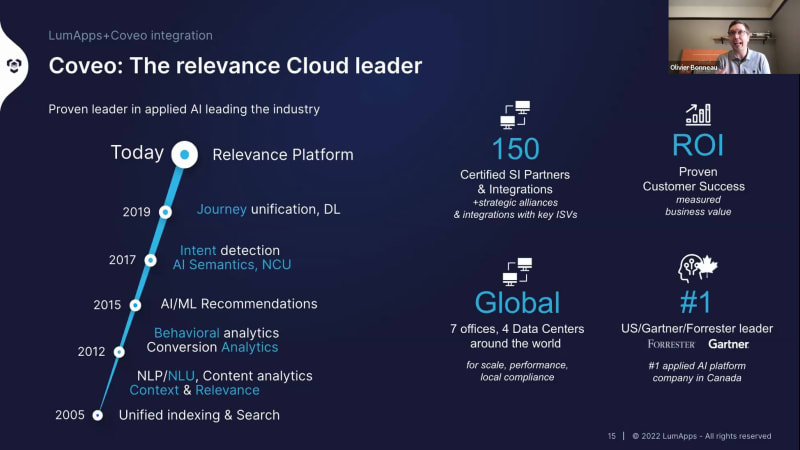
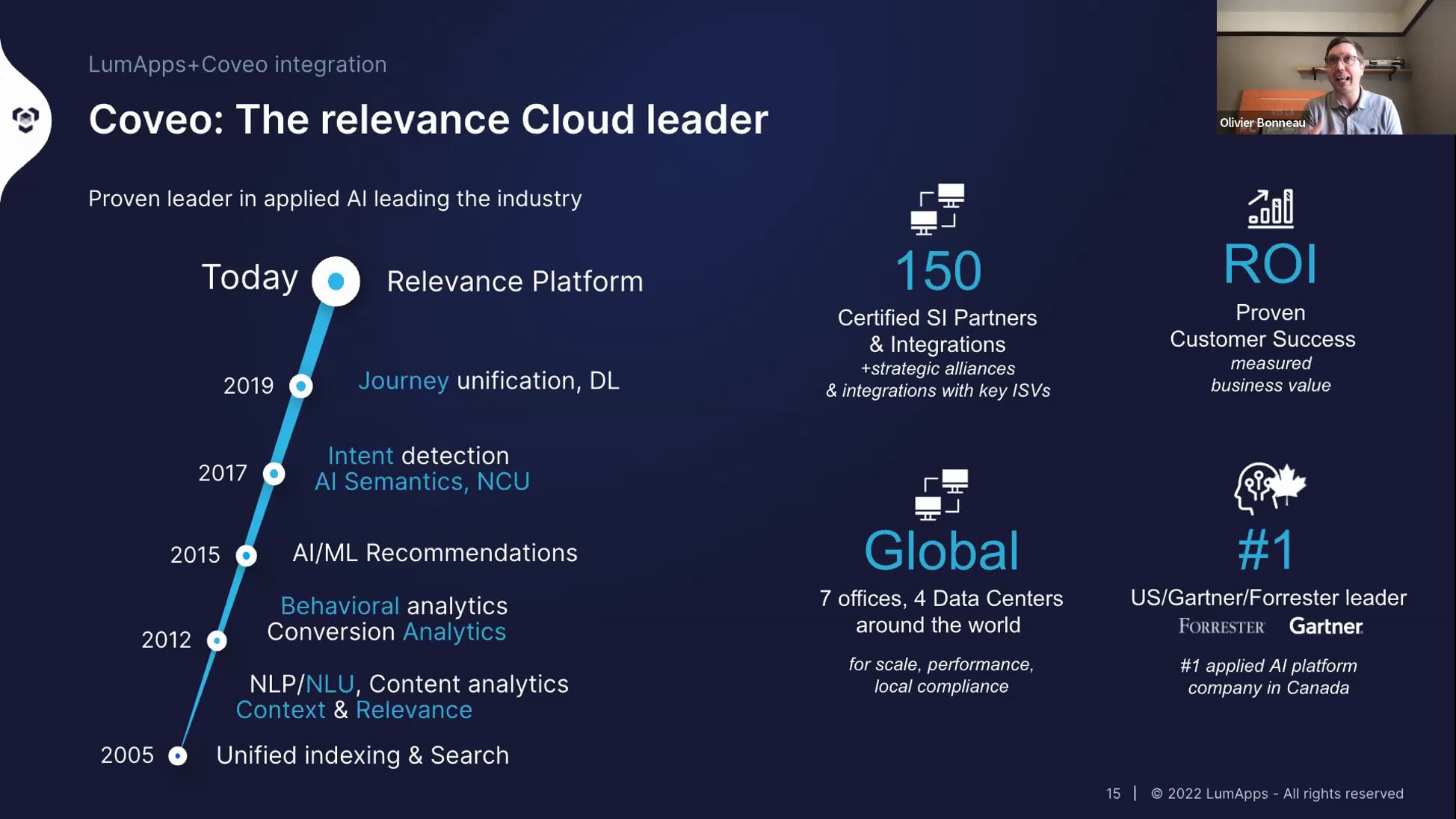
Okay. Hello, everyone. Good morning, good afternoon, good evening, depending on where you are in the world. Welcome to this webinar session today on the next generation employee experience. My name is Colin Stracken. I work in product marketing at Coveo, and I'm gonna be moderating today's session. So I'm joined today by a very knowledgeable and experienced panel. We have, two great minds behind the Lumox products, Chris McLaughlin, street marketing officer, and the product manager, Lina Limoiseau. Representing Coveo today, always a pleasure to introduce my colleague Olivier Bonneau, senior product manager for Coveo for Workplace. And, also delighted to welcome, Colin Ryan, who is the product manager for intranet and search at Intuit. And, he's gonna be able to demonstrate a bit about how he's been using these technologies to drive the digital workplace experience at Intuit. So you can see the agenda here on the left. We'll start by covering, what it means to create a next generation employee experience. And then Colin's gonna share a little bit of what's under the hood at Intuit. We'll take some time to focus on search, the importance of search and knowledge, the employee experience. And then we're gonna cover, you know, the real value drivers of employee experience. So how does it lead to increased engagement, and talent retention, of course, which is a huge topic of focus for most companies at the moment. We're also gonna fit in a quick demo of the Coveo and Lumapps integration so you can see how these two technologies fuse together. And, of course, we'll cap off the session with some questions. So if you have any questions as we go, don't be shy to drop them in the q and a below, and I'll I'll make sure that we put those to the panel at the end of the session. So, Chris, I'm gonna come to you first. Obviously, there's been a lot of upheaval in the workplace, particularly in the last couple of years. Things are changing very quickly. So, you know, in today's context, what does employee experience really encompass, and and what do you consider to be the building blocks of delivering an effective one? Fantastic. And thank you for the kind introduction, Colin, and good morning and good afternoon, everyone. Pleasure to be here. Why don't we go to the next slide? And as Colin kinda, prompted in here, what I really wanna do is just spend a few minutes talking about employee experience and kind of the larger context of employee experience. Obviously, we're gonna focus a lot today on the role that search plays and effective knowledge management plays in the employee experience. But I also wanted to just expand the topic a little bit and focus in on the totality of employee experience. So first and foremost, just as, you mentioned, Colin, when we look at employee experience and kinda particularly the focus on digital employee experience now, we've seen a real shift in the conversations that we're having with customers. So when a lot of companies were forced to deal with the reality of having to have an entirely digital experience and by the way, I like to bring in here, I literally, beginning last week, read a new survey. Right? And seventy percent of employees stated that they preferred remote working conditions, another twenty five percent hybrid, and, like, five percent preferred in office. So even if we move past the pandemic and think past COVID, which hopefully we're getting to the end of, we're still faced with reality that employee preference is very much digital and remote and hybrid. And so what we really need to do is begin shifting that conversation away from and it certainly has. Right? First, it was, oh my gosh. How do I deal with the now digital world? And the focus was really on continuity and resilience for the organization. And in many cases, for many organizations, like, how do I get a laptop to an employee? But now, you know, more recently, obviously, the conversation has been very much focused on productivity. And I think a lot of what we talk about here today together will very much focus in on how do we make it easier and more efficient for employees to find information, be more productive inside the organization. But I think another important topic here and and where we really need to be going and focusing on with customers and where I think search knowledge plays such a critical role is around digital transformation. It's around innovation and really long term for the organization to be successful from an employee experience standpoint. How do we kinda, create this culture of innovation? How do we drive innovation when we no longer have that in office experience to rely on? Next slide. So love this quote. It's by Jacob Morgan. He wrote a book called The Employee Experience Advantage. And for years, we've talked about, you know, supply efficiency variance as a source of competitive advantage. But really now, in a world where money is no longer the primary motivating factor for employees, focusing on the employee experience is the most promising competitive advantage that organizations can deliver. Next slide. So when we talk about competitive advantage, we talk about this culture of innovation, and we your employee experience. We like to talk about engagement, enablement, and empowerment ultimately and kinda being the three key building blocks for employee experience. And this is actually from Sanjay Johnson who's a PhD in this. So what we really look at and very simply on the engagement side is just about aligning the organization, making sure we're focused on the big picture. We have a clear focus on key initiatives like customer and quality. But today's conversation where we'll focus a lot on is around enablement. Right? How do we enable effective knowledge sharing? How do we enable collaboration in the organization? How do we and efficiently. We think longer term from an employee experience standpoint. And I'll talk a little bit more in the end about the benefits that we see here, but how do we create that culture of innovation? How do we give employees agency and in the organization? And then, you know, finally, you know, we make the organization more adaptive to change. Next slide. So, clearly, as we talk about those business blocks, we also talk of those building blocks. We also have to talk about some of the challenges that we see there. Right? And for most organizations, they really struggle to drive effective engagement, to really communicate well and get employees aligned. And so first kind of fundamental challenge from the engagement standpoint typically is around communications but it can also be around work experience and work environment. And we find a lot of times that technology and tools in an organization interfere with the employee experience and engagement. The other piece, and I actually stole this quote from our friends here at at Coveo and this survey result, but it's the challenge of information overload. So when we talk about enablement, we talk about search as a key of effective employee experience. Clearly, that amount of information that employees are faced with and the challenge of it not being relevant to their role, to their job becomes another major major impediment in the experience. And then finally, from an empowerment standpoint, just, you know, making sure that we have an organization that is fully plugged into the strategy becomes really, really critical as well too. But I think we'll spend most of our time today talking about that middle piece. Finally, last slide. Just as we talk to organizations, and I think at a super high level to kinda finish up here. Right, we find a lot of organizations are still kinda stuck down at the bottom end of this maturity model, thinking about transactional efficiency, you know, and really focused on, hey. We're giving our employees the tools to get the job done. But over time, from an employee experience standpoint, when we really want to get to those long term outcomes for an organization, we wanna shift that focus more towards culture, more towards their ecosystem, and really instantiating and utilizing culture and all the tools and capabilities that go around that to achieve that competitive differentiation that we talked about earlier. So we wanna continually focus not just on tooling and capabilities, but organizationally on how we achieve long term outcomes that enable that innovation, that long term adaptivity. With that, Colin, I'll hand Barca to you. Yeah. Thank you very much, Chris. And, you know, when you talk about this competitive advantage that can be achieved, by focusing on employee experience, I feel there's no better example of that than Intuit. You know, it's a company that's been consistently recognized as a top employer for many years. And and therefore, you know, it's a great privilege to be joined today by Colin Ryan. He's played a key role in driving the digital experience for employees there. So, Colin, great name, by the way. What can you tell us about Intuit's mission and, you know, how you've been approaching employee experience, at Intuit? Yeah. You bet. And thanks for having me. It's a pleasure to talk to you guys. If you go next slide, we'll kinda get started. I only have a few slides. I'm really just gonna talk through a few, fun experiences, I think, that really ties us together pretty nicely. So, for those of you who don't know, Intuit, has brands like TurboTax, QuickBooks, Mint. We have give or take twelve to fourteen thousand employees depending on type of year. We are a global company. We operate in nine countries. And, you know, we build products that make financial lives easier for consumers and small business. It really you know, ingrained in our DNA is this idea of customer obsession. I'm sure many of you have heard this this kind of term and and try to use it yourselves in your your workplace. But we take this a step further. We actually you know, we treat our employees like our customers. And so, I'm in a product management team, on our IT team. It's a team of, we we product manage the collaboration and productivity tools at Intuit that includes Internet and search. My focus is primarily around Internet and search, myself. And so we're you know, we take the same sort of passion to our employees. We do user research. We do user validation testing. All the same things you would do with consumer grade products, we try to do internally with our own tools where possible. So it gives yeah. Just one one, example here. Next if you go to the next slide. What I'll share here is, and I can't share this in in person, but, we have a little graphic here for you to to look at. But, basically, this is, an experience that we do twice a year, and, this has had a couple of revisions over the last two years, before we've landed on this experience here. But this is what you're seeing here is a LumApps page, but it's a a React app that we built that, makes this very performant. But but twice a year, our CEO emails out to the company, in celebration of, midyear and full year promotions. And as you can imagine, immediately, many of employees actually click that link all at once. And so we have to create a very scalable performance application, that's easy easy to redo each year, and, is a delightful experience, obviously, for, not only people getting a promotion, but it gives you opportunity to celebrate their, you know, celebrate amongst your peers and and leaders. And so this is in Loom Apps, but it's it's built with a React app that's kinda hosted in AWS. So all the pictures are hosted. You can't really put this in, you know, g drive and have it work very well, especially if you're getting, you know, thousands of calls at once, to to the web page. So this is one example where we just made a really delightful experience celebrating, obviously, employee promotions, and, it's something that we can scale and repeat, twice a year. I should say we've been, partnering with LumApps since, like, late twenty eighteen. So we we've had a number of years, pleasure of a number of years working with, with LumApps. And, and then more recently, if you actually go to the next slide, we'll talk about search. So more recently, actually, most of twenty twenty one, this is August. That was kind of our formal launch to all employees, the the search experience. But a quick little context. We have sort of a blended Internet where, we do have a a SharePoint, formal Internet site, and we have a a Lumap site, which actually looks very similar. In fact, many employees don't even know that they're going from one tool to another. We try to create that seamless experience. So we have search in both, environments, and it it actually has the same search results if you're searching from one or in the other. We came from Google Cloud Search, before this, and, we were able to do with Coveo in about three months what we couldn't do in about two and a half years with Cloud Search. So our focus here is enterprise search. So we go beyond just news and events and, you know, intra HR, intranet stuff. This is, really all the meaningful content in the company we try to index. I believe we have some twenty one search connectors, all enabled either through custom or out of the box connectors, from Coveo. And just, we're able to create a really delightful, experience to search anything in the company that that's relevant and give personalized results, through, very clever sort of query pipeline rules as as Covideo calls it. And so this allows us to index, index, you know, lots of things and have, employees be able to come to one place instead of having to know where something lives before they go search and, you know, searching three different tools to triangulate what they're looking for. This really, you know, puts everything in in one place and is a reliable, relevant search, solution, which, like I said, we're we're able to put in in multiple different places where need be, so that employees just, you know, just use the search bar naturally, and they get they get their results. So with that, from one call and back to another, I think that's my time for now. I'm happy to answer questions later. Yeah. Thanks, Colin. So, yeah, a great example there of search being deployed in different locations and how you can create this kind of consistent, experience across the workplace. You know, I think every employee would probably agree that finding information has become a lot more challenging, particularly as the workplace becomes more digitized. So I think it's a good time to bring in, Olivier Bono from Coveo. Now, Olivier, what can you tell us about the importance of search to the employee experience in in today's context? Yes. Sure. I mean, thank you, Colin and Colin for for for that that that great introduction. So, yeah, so, basically so why search matter for a better employee's experience? I mean, this statement is pretty obvious when you when you take it like that. Like, we all agree that a better search experience improve an overall digital experience. You know? Of course, if you bring better search, it will have the positive impact to on employees' performance just like Colin was stating, you know, bringing the right content at the right moment. Actually, any employees can benefit, of that. On our end, with Coveo machine learning and other platform capabilities, we can make sure that the most relevant information is distributed to the right employee, at the right time. So either an employee needs to fill in an expense report or change its VPN password, with Coveo, this information will be quickly found. And, of course, if we consider it punctually for one employees, that's not a game changer. You know? But if you scale it to thousand of employees searching for hundred of different topic, then, I mean, we start to improve the overall efficiency for an enterprise. So this is kind of the main and the most obvious benefit that we can all agree that. Like, good search, I mean, everyone's gonna employee's gonna be happy with that. But there is another benefit, a little bit more subjective that that I really like to to to talk to to to bring here. It's a better search is on needs to be on par with users' expectation. And what I mean is that employees are user and consumer as well in their daily lives. So, and their experience and they are expecting a search experience to be like, you know, Google, Netflix, Amazon, etcetera. This is what employees think about when they're looking at the search bar and, interacting with search interface. So, you know, just simple features just like type ahead in the search bar, document ranking based on visit history and past search. Those features are taken for granted now. So failing failing short of providing them, you just break the whole the whole experience. So with Coveo, we bridge that gap, and our cloud platform offering managed to meet such expectation, therefore driving a better search, therefore, driving a better employee experience. So for me, it should be why it matters. I mean, from a relevance perspective and from an expectation perspective, those are two key points that needs to be taken into account. So on the next slide, basically, what drive our search strategy? If we if we assume that a better search experience is a direct driver of a better employee experience, How do we execute this property within a digital ecosystem? What I mean here is that even if you do have the best search in the world, it's kind of become useless if you if your people can find it. Again, I'm just stating the obvious. We all agree with that with that statement. But just see it like this. You know? If we take the the use case of commerce, you know, ecommerce, the complete experience reside into a single page, and all visit gonna last, you know, couple of minutes. And service in the service and customer care use case, you know, service agent will use the same portal all day long in which they're gonna close cases and and answer clients' questions. So, again, the interface that they're using is pretty it remains the same, and it's gonna last for the whole day. But when you bring that idea to the workplace, that's a bit different. You know? Employees, they all use a wide varieties of web application and portals, and each of them with a different needs. You know? We're gonna use Confluence and and Jira to actually track project, progress. We're gonna draft idea in Miro and Figma. We're gonna use Google Drive to actually, you know, draft quick PowerPoint, a quick quick presentation and document. And we're gonna look for HR related questions in Workday and or other Internet, that portal. So the experience in the workplace is highly disjoint. Therefore, our strategy here at Cove needs to take that into account. So with Coveo for workplace, we want to deliver content in the flow of work, which mean that delivering many integration all powered by the same Coveo platform organization. And this is exactly what we've done with with Lumap, basically. They provide this beautiful enter intranet interface that, you know, Colin was showing to us, to drive your intranet. And we, Kavo, we power the search bar, and we bring all your other content within the the Lumen app interface. So for a company like Intuit, which has a lot of different interaction point, we make sure that Kavo power each of them and deliver the same quality and the same relevance and context, to each of their employee. And, actually, from an employee perspective, they feel that the whole experience is is seamless. You know? Even if they are in a Lumap portal, if they are into a community portal, if it's powered by Kavu, that's gonna be the same quality. So from an user experience, it's way better. So we execute our vision by providing different kind of integration option, which streamline the experience and provide an easy to access interface wherever the employees are. In other words, we want to bring the content and the flow of work. And this is actually a we could do another webinar on what are the different option, of integration with Cavelo. But, this is basically what drive our workplace strategy to make sure that we deliver with our front end library, with our API as many option possible for our company to deploy their solution, and their search experience, all across. So if we go on the next slide, basically, everything that I just say, I mean, that has been built on, on pretty much on the last, close to a bit more than more than fifteen years now, basically. Cavill comes from, I mean, has been around since, like, two thousand five, basically. And it it was actually, founded by, a couple of guys that were working at a a company called Copperneck Enterprise Search back in the day. And, basically, these guys are doing enterprise enterprise search, from the very beginning. So the the Experian started like that, but the more, Coveo, the the the more Coveo, started to work in the cloud, then we managed to bring analytics data. And with that, we managed to build our AI platform. So when you put all of that, we manage now to serve over, you know, one on one thousand fifty more customer deployment and or r and d is growing fast, etcetera, and which we managed to build that old Kaggle platform, which is now highly flexible, have out of the out of the box machine learning, analytics tracking, and so on, and all of that is used to actually power the modern digital workplace. So this is, what drives Cavelo, and this is where we we we had a pleasure to work with Intuit and Lumenap, in the in those solutions. So this is it for my part. If you have any question, I'll it would be my pleasure to to answer that in chat. And back to you, Colin, Colin, the the one. Thank you very much, Olivia. So, you know, a lot of what we've seen so far is is really about, how you can deploy this search experience into different touch points, using integrations. And one thing I know you'd love to see today is, how the Caveira Luma's integration actually actually works, how it looks and feels. So, what I'm gonna do is I'm gonna stop sharing now, and I'm gonna hand over to, Lina Lina Moiseau, the product manager over at Luma's. And, he's gonna give you a quick demo. Thank you, Corinne. And it's always a pleasure to hear a French name this well pronounced by an English speaker. So let me give me a second, and I'll share my screen. So you've seen an example of a platform with Colin from Intuit. As Colin said, we are able to customize the experience a lot, with Lumapps. So each LumApps platform is very different, and this is very important to us because personalization starts with identification. And, when someone gets to a LumApps platform, they need to recognize their brands. So here we are on a demo platform, of course, but you see that we have something very different from the Intuit overall look and feel, and still, this is Lumapps. But before I dig into the search experience, I wanted to show you the building blocks that lets us provide Coveo with the necessary data to actually create a personalized result search result page. As we said earlier, sorry about that. Lumapps, is sending a lot of information regarding activity, to, Coveo. So every time someone, navigates to a new page, clicks on the search result, we send activity to Google to build the models machine learning models to recommend content. But the one of our strengths Barca Lumapps is that we have a lot of information, about the user inside the user profile. Lumapps is an employee experience platform. We are connected to the, IT ecosystem, so we know who people are. This is what also differentiates employee experience from customer experience. All the data is already there. And this lets us, feed even more information into the machine learning model that's going to be able to identify specific profile for users, but it also lets, admins such as, Colin implement, business rules in order to boost content or personalize even further the experience of users. Here, we're going to look at a a fictional, account manager called Chloe, and Chloe is part of a team. She has a she's under a VP, a sales VP, but she also has pretty interesting information. She's part of the sales organization. She's interested in yoga, and her industry is green tech green tech. And with this three information, you'll see that we are able to really, change the way she is going to access information quickly and create this almost magical experience of having almost nothing to do to get to the right information. So let's start from the home page and from the search bar at the top. And here, even before I have started to make a search, I have a number of suggestions for content that are relevant to my interest. These are based on digital profile of, Chloe, of course. Because she's in the US, she has access to benefits to benefits in North America. So she won't see the advantage page from, France. She will see the benefits from the US. Beyond that, she's new to the company, and maybe she needs to go and take a look a little bit further look at her boss, what he's doing, where he's coming from, what his activities. So she's going to be able to go to his profile pretty empty right now. Maybe her boss is not spending as much time as her on the on LumApps. And because she's into yoga, we are going to recommend to her to join this great community in LumApps where she will be able to share our practice, of, this, discipline with other people and maybe discover other ways to enhance, well-being. But that's a lot of information about recommendation. Let's look at the search page. So remember, Chloe's industry is green IT. So at some point, she's going to try and look if there's information about, green tech tech. And here, what she's going to type maybe is the word tech. Tech is a pretty, ubiquitous term in a tech company. You're going to have it in many, many content. But here, what we want her to see is this, case study about eco industries. See that she's tech is in the content, but it's pretty down. It's just one word in the whole page. But because she's interested in green tech and we've created a rule that this case study is for people interested in green tech, it's going to be the first result. So, of course, you can go and see see. In order to illustrate a little bit further our integration, we are able to, display very, customizable filters from, Coveo. So on the left side, everything in this list is customizable and has been defined by an admin, based on Coveo fields. And we are also able to customize, the search, results to an extent where external sources can display as, native sources. This is the maps content, but this is content that has been, script, scrubbed from the Internet, from the maps, official site. And here, I can directly see external content inside of search inside maps. And that's it for me for my, presentation. Thank you, Leonel. Amazing. Great example of, how to personalize the experience to each employee. I know that's something that's, you know, really the cornerstone of of of what both Caveo and Lumapps are are doing. So I'm just gonna come to the last section here. I'm gonna, put this back to Chris McLaughlin, Lumapps c at MO. Now, Chris, obviously, the most important aspect of running, an employee experience initiative or any initiative really is, the outcomes. So, you know, what can you tell us about the value drivers of the digital experience and and how modernizing this for employees can help to increase things like engagement and hopefully, you know, talent retention as well, which is so important to to companies now. Fantastic. And, Colin, I understand I had a little bit of bandwidth challenge earlier. Am I coming across clearly now? Yeah. It's a little choppy, but we've got you. Don't worry. Okay. Sorry. Office Internet seems to be a little bit slow today. Why don't we go to the next slide? And what I wanted to emphasize here really was two things. And this is actually from, McKinsey and and company, blog posting. But I I really like this concept of the employee experience factor, but I like to from the standpoint a lot about technology and the role that technology plays in the employee experience. And, Colin, as you pointed out from Leonel's, demo, right, we've got a seamless integration there of search and employee experience and personalized experience. And it really is about technology enabling people to perform work efficiently and without friction. We talk a lot about friction from an employee experience standpoint. Context switching, moving between multiple applications, multiple search experiences has really been a a detractor to the overall employee experience. But I also like to emphasize, and the other column did a outstanding example of this earlier. You know, there are more aspects to employee experience than just technology, but technology can facilitate that. So growth and rewards on this slide is a huge one. Right? And when we talk to customers, one of the biggest things they focus on from an HR standpoint, rewards, recognition, and really in reinforcing company culture through that process. And so what I loved about Colin's example of Intuit and and kind of the semiannual promotions piece is really, helping to recognize, promoted employees, drive that recognition, but utilize technology under the covers to achieve that outcome. So from a bigger fabric standpoint, right, we need to think about people in relationships, the social climate we enable in an organization, work control and flexibility. This is all about, continuing to support remote hybrid work and really making that a seamless experience for employees. And then finally, as I talked about earlier, that aspect of purpose, agency in the organization. And I love this quote, not because it's not about pay. Right? And, obviously, compensation is important to employees. But, really, as we think about the modern employee and kind of the new priorities in the digital office, it's about wanting this powerful sense of agency and being able to influence outcomes that matter to them allied with a strong sense of identity and belonging. Right? And that personalization becomes critical in that prospect. So it's agency in the work that they're doing, but also agency about the work that they're doing, ultimately empowering employees to feel responsible for the outcomes that their organization's generating, and that can be bigger than just work that they perform themselves. So when we get EX right, and if you wanna go down to the next, slide, The impact to the organization is phenomenal. Okay? First and foremost, we talked about retention. Companies that have a strong employee experience and a strong employee experience strategy are more than five times more likely to engage and retain their employees than those that don't. They're also more than five times more likely to be great places to work or regarded as great places to work as Intuit is. We also see from an employee experience standpoint when you think about enablement and enabling key outcomes for a company, strong correlation between employee experience and customer experience. So more than two times more likely to delight customers. It's really simple. Happy employees make four happy customers. And then we talked earlier about innovation. Right? These organizations are more than four times more likely to innovate effectively. They're also more than four times more likely to adapt well to change. So not only are you keeping your best employees around, and when we think about information and knowledge, we also have to think about the individuals who create that and keeping them as part of the organization. So you're attracting better talent, you're retaining better talent, you're better servicing your customers, and you're set up for long term success because you're innovating more effectively. And then if we go to the next slide, what we also see is bottom line impact to the organization. Right? If you improve retention, you have a significant reduction in your hiring cost because you don't have to hire as many employees. You also don't have lost productivity and cost associated with onboarding new employees into the organization. Now when we talk about, you know, kind of the relationship between Coveo and LumApps, of course, we have to focus on productivity as well. And what we typically see is if employees are able to find information more easily, if their employee experience is facilitating their day to day tasks and activities in the organization, you can see a significant reduction in time spent on tasks, projects, activities in the organization. And sometimes that's work related tasks and sometimes that's non work related tasks such as HR automation type activities in the organization. But the bottom line the bottom line from an employee experience standpoint when we talk about innovation and we talk about adaptivity, it's ultimately about how you perform in relation to your, competition. And these organizations achieve, exceed their financial targets, and they are almost two times more likely to outperform their competition. So ultimately, delivering top and bottom line benefits to the organization all through just a superior employee experience. Colin, with that, that's it for me. Excellent. Thank you so much, Chris. So now, let's let's throw it over to the audience. I know we've had a few questions come in, that I that we can put to the panel now. Yeah. Colin, thank you so much. So the first question that we have is from David, and David is asking what things could you not do with Google Cloud Search that you can do with Kaveo and Lumenets? Or let's just tell me what you can do with Cloud Search. It really boils down to personalization. There's lots of levers that we expected that Google would would give us with, Cloud Search that were just never built into the product. Personalization, things like, you know, you know, partially custom machine learning models that Coveo does so well. These are all things that we're just years away from what what Google Cloud Search was was able to do. We we stuck it out for two and a half years before we finally gave up on the product and and moved on. I hope that answers the question. Thank you so much, Colin. And another question to, the Caveo team is kind of what can be expected as far as results and speed to results? Do you have kind of any estimates around when customers can start seeing the value of their investment there? Yeah. I mean, the the the you're very good question. Basically, the the usually, the the the main question is, like, you have two faces. You have two things to consider. I mean, you have, like, the the instant value of the Coveo search API and index. And what I mean here is that, I and Colin was referring to that a little bit is that, within the Kaggle platform, we have an extensive set of capabilities. So, you know, the workplace digital owner would, would be able to fine tune and implement business tools that would have an instant effect on the ranking and all those document would be seen by different user based on their persona, etcetera. On top of that, we do offer an out of the box machine learning, a wide variety of machine learning model that each of them, I mean and, again, that could be another webinar, but, basically, all machine learning is trained, with the analytics, which mean with the usage analytics, each employee is gonna do within a portal, which mean that, click and search and views and all of that very rich data is being used to train our machine learning. And the more you're gonna have, like, people, look going through your portal and content, the better the machine learning gonna start to train itself and try to detect trends and things like that. So, usually, based on the volume, it takes couple of days to you know, no more than two or three weeks for a very old volume interface. But if you do have, like, you know, hundred or or thousand of user going to a website, going to a portal, daily, it's gonna take couple of days. And of already, machine learning gonna start to kick to kick in, and we do have the old reporting platform to show, you know, the the to show these uptrend and the positive impact that it has. So, usually, it's it's pretty quick. You have the instant way to do it with business tools, and you have machine learning that actually do it by itself, over and over, actually. So I hope it answered the question. It did. Thank you so much. Another question that just came up is, does Caveo have a promoted search capability that allows for curating search results to push content to the top of results based on certain keywords? Yeah. I mean, Colin I mean, I can I I can take this one, Colin? I know that you're you're you're used to doing that as well. But, again, like I was saying, everything around, like, business rules, feature results, and that kind of thing, this is all handled by by the Google platform. So, of course, you can basically create highly complex rules that would say if a personal like this one under that condition, etcetera, I want to make sure that only these three document gonna show up at the very top and the other result gonna be further down the list. So, basically, yes, we do have, like, feature result, test or recent entries, boosting ranking. We, you know, name it. We have it all within what we call our query ranking pipeline. So but to answer the question, yeah, future results can be added with complex loads, you know, quite with couple of clicks. Wonderful. It looks like that is the last of the q and a questions, Colin. So I'll turn it over to you to wrap us up. Great. Well, thank you so much to the panel here today. Thank you to all the attendees. I really hope that you've taken a lot away from the session. You know, we do have a lot of resources online on on on each of the websites for CoveriLum apps. And obviously, don't do not hesitate to reach out to us or book a demo, of course, if you if you would like to see more about how each solution works and how the integration itself works. So if there are no further questions, we'll we'll leave it there. Have a great day. Oh, wait. We do have one more. So the question is oh, we got a couple more. Actually, they're all coming in. See what happens when I'm about to close it. Any AI can become a silo of information provided to the client if it's focusing on user personalization and specific algorithms. How does this platform weave in ensuring a siloed solution or echo chamber does not occur? I mean, that that that's a very good question. A long one, but, basically, from a and, again, as simple as possible, or, I mean, the machine learning train with a fresh set of data, pretty much daily. So the idea I mean and the echo I I like the the echo chamber idea here, but it has a very positive effect to actually clean up your dataset. For instance, one of the most obvious, one of the, kind of, not not obvious way, but a a really a very clear way in which, machine learning sanitizes, basically, your content. It's with the with the type ahead, feature in the search box. You know? So if you start to type in for a specific topic and, actually, there is a typo or something, are you calling something that has another name within your your industry? Actually, people gonna start the machine learning gonna start to pick on that kind of trend. So if you enter something that is related to another topic, it would show this topic as well. So people gonna click on this one instead of bringing kind of the old version of the one with typos inside of it. So on one end, it actually retrain itself daily. So, actually, it's kind of a moving knowledge windows in time. So old content and old data and old old learning is actually dismissed because it's farther down the down the timeline, and it's actually gonna boost more what is really highly relevant at the very moment. So, we have a huge team of data scientists that actually work, to, you know, improve this algorithm and make sure it's it's robust and and can cope with, you know, use cases and corner cases like that. Yeah. Hope it answered the question. If you do want more, one more, I mean, feel free to to contact us, and we'll be our pleasure to to answer more questions. And if if I may have a really quickly, sorry for the interruption, this is also the interest of having a search engine within a highly customizable communication platform. Machine learning is awesome and saves us a lot of time, but being able also to push information knowingly to to people, prioritize, profile the information within the platform will ensure that beyond high searchability, you also have high discoverability where people are going to happen to find, content that is relevant to them because it has been placed on their journey. And Kovu can already do this with business rules. You can also implement it through navigation or promotion of information on the search page or within the user feed in LumApps. So it's really, feeding each other feed two system feeding into each other to create a superior, experience. Thank you very much. We do have one more. David's asking, if we if there's advanced query matching by regular expression. Yeah. I was about to to to type in the answer, but the the short answer is yes. I mean, the Coveo search API has a full, a complete regular expression, capability. So, basically, it's really up to it's up to to to the end solution and the design. Some search bar, you don't want to bring that kind of complexity, but we do have, like, advanced search bar for, you know, mostly in the service use case where, you know, finding based on dates and that kind of thing. So you can type in a query, only show result, you know, that are less than two weeks old and that kind of thing. So we have, like, advanced rig x, capabilities. Yes. Excellent. Okay. Any more for any more? If not, it's been a pleasure, and, everyone have a great rest of your day.
Next Generation Employee Experience
Many companies struggle with digital transformation, achieving unified communication, and knowledge sharing while providing an engaging employee experience. AI-powered search, recommendations, and personalization can bolster your digital workplace, bringing employee productivity to new heights and making enterprise-wide knowledge more discoverable.
In this session you'll discover how Intuit is combining the power of corporate communications and accessible knowledge management with a fully branded digital workplace to make every employee journey a personal one.
Key takeaways include:
- Steps you should be taking now to improve the employee experience through better engagement, enablement, empowerment, and recognition
- Use cases that help employees remain continuously informed by delivering a more relevant and personalized search experience
- Programs and communities that influence employee trust, talent retention, and prevent turnover
Make every experience relevant with Coveo