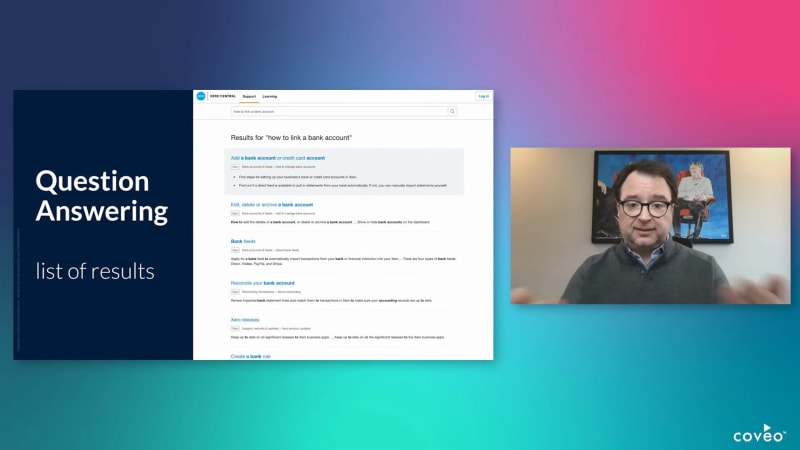
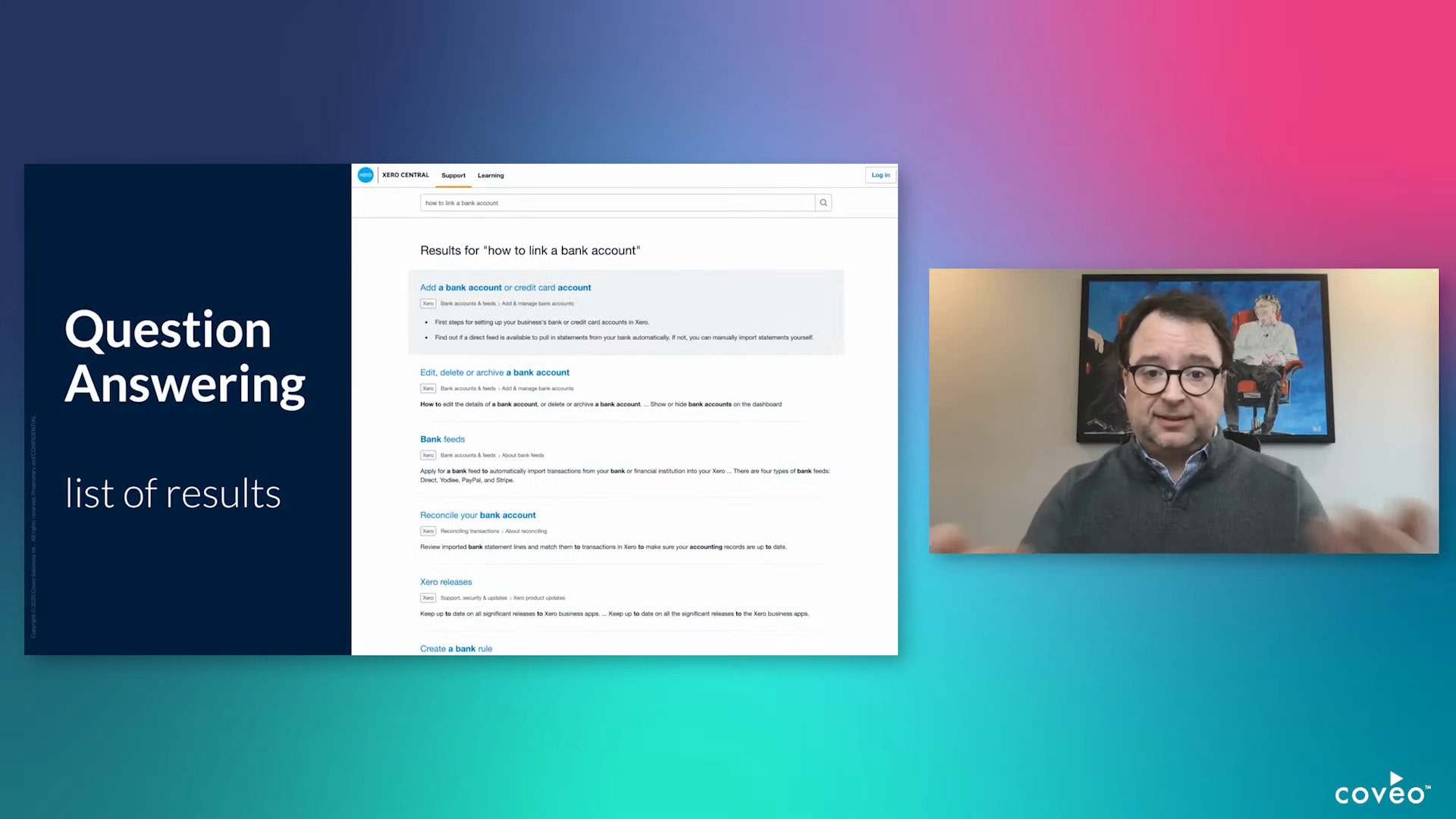
Hi, everyone. Thank you for joining our session, meeting the digital demand with data and AI. I'm your host, Tracy Carson, and I work on the global marketing team here at Coveo. It's a privilege to be with you today. Today, we have Laurent Simonot. He is the cofounder, president, and CTO of Coveo and is considered one of the industry's top enterprise search experts. A couple of housekeeping items to cover quickly before we get started. Everyone's in listen only mode, but we absolutely wanna hear from you. Please use the q and a panel, and we'll get to your questions at the end. We are recording today's session, so you'll get a recording in your inbox within twenty four hours or so. Now I'm gonna get out of the way. Laurent, it's all yours. Alright. So welcome everybody, and, good morning. For those who are in the West Coast, good afternoon, and, even good evening for our friends in Europe. So I'd like to start by saying that, obviously, a fifth of humanity is under order to stay at home. So, we are all alone, as they say, in this together. This obviously has huge impact, on the health and safety of people, but this also has very important economic impacts. We are indeed reconfiguring our lives around working from home, teaching at home and relying on home entertainment as we shelter in place. Customer service agents are under pressure because most of them are now working from home. So call center have either closed or, moved their people working remotely, which is a challenge, obviously. In store commerce is halted. So online is the only alternative. Online, for many retailers, used to be a drive to store channel. Now it's the only channel. So now what? What does that mean? What does that mean for those organizations? Well, it means in the short term that those organizations will have to ride out this storm, obviously. But yet you have those organizations have to set up for the long term. They have to transform to compete in this new future, in our opinion. And, while this is this is not a comfortable place to be, we believe that the leaders of tomorrow will, really start their their transformation today. So here's here's what we're seeing. If you think about the transformation agenda of companies, green is the normal course of business, right, and personal lives, I would say. So there's a normal transformation that is happening over months, over years in the organization, and it's quite organized. It's following a path of transformation that deals with, the pains and demand and, the constant progress that we see in normal normal times. But, this recent COVID crisis has, has just created disruption and in a way accelerating obsolescence and transformation plans when you think about it. There might be a second wave of disruption, we believe in, after after, the first wave is, kind of, cult in for six months. So this will have this will have a lasting impact. The this will accelerate the transformation agenda, we believe. And, basically, those who have to invest will invest faster to transform the organization faster. In a way, this is also what we saw in two thousand eight, two thousand nine, and, during the great recession. A lot of, a lot of businesses and organizations decided to accelerate some of the pivot they started. And there were events also like the launch of the iPhone in, at the beginning of this the beginning of this period that helped accelerate the mobile transformation. So we believe that right now, there will be an AI transformation helping those organizations, do better. And so what is what is the new normal for these organizations? Well, they will need to they will need to invest helping customers to get to next level of customer self-service. Many organizations today have some self-service portals and some self-service assets, but now these customers working from home or, or just consuming services from home will require more self-service and better self-service, basically getting next level of self-service. And those agents, those customer service agents that are under pressure working from their remote office, organizations will need to provide them tools, advanced tools, making them, more, making them more proficient and efficient. So and, so they can understand their customer better and and serve them faster. Employees also need to be more proficient and efficient on their own. They, they will need to have tools to do that and access knowledge internally. And from a commerce standpoint, the world the peep people are expecting retailers to provide an advanced commerce experience, if they if they wanna receive if they wanna get their business. So those retailers will have to compete with the best in the world like the Amazons of this world and and the Walmarts of this world to create those engaging experiences for commerce for their customers. So how do we get started is the question. Right? So our view is, number one, we get to unify. We have to unify data. So organizations need to unify their silos, their silos of content, their silos of customer journeys, and apply that in context to provide better service and better commerce for their customers. And if we look at it at the high level, at a high level or large organizations have to serve their customers and their employees according to multiple touchpoints. And those touchpoints at the top represent website portals, customer self-service, counters, some mobile apps, some contact centers, and so on. And each of them has interactions with users of employees through search, through recommendations, and through other means. What we believe is search and recommendation is a lot better when it serves contacts content, sorry, that is coming from multiple data sources. And this is brought in by connectivity and security into unified index. But then on the right side here of the screen, the behavioral data that is supported to, make relevance better is really captured from each of those touch points and recycled to machine learning through search and recommendations. So not only with this in this model, commerce will be better because machine learning will take into account what's happening on the commerce storefront to improve relevance, but also it will do this by understanding what's going on in the customer service portal or on the rest of the website on mobile apps. So it's quite important to unify both the data on the left, content on the left, and the behavioral data, meaning the clicks, the queries, the page views, and all of the elements of behavior that a user will express on a website. One of the key components, to serve that relevance is the user profile service that is part of the Coveo infrastructure that basically understands all of this behavioral data by user and keeps it into the service, that will not only understand what's going on with a a single user, with a single user on on a website, but also will help categorize this user and this user session according different dimension based on different dimensions. So what you see on the right of this slide is what's happening on a customer service portal right now and from this. So you've got two different users typing exactly the same thing and receiving different results in real time, from a Query Suggest perspective. This is why those users based on their journey have been categorized into different clusters or buckets of users. And this is always rebalanced automatically through machine learning. This is transparent for the administrator, and this helps provide real personalized results on the fly. And down the road, what Kaviyo is working on at the user profile level is using machine learning and AI to, add additional dimensions categories for those users. For instance, what's the cost to serve, of this user? Is there what's the propensity to buy for this user? What's a long term value? One would think that someone that is always buying stuff when it's discounted and has a high rate of return, the cost to serve is probably a lot higher and long term value is probably lower, than the opposite than the one that is always buying the new gizmos, high margin on the first day that is available for sale. So these kinds of these kinds of signals are typically available, but they are not easy to compute and make available at the user profile level, that is then the foundation to derive relevance down the road. And this is used to this is used really all what we saw. The goal here is to get relevance and get personal and tailor every interaction for every user wherever they are. So it means that with AI and machine learning, we can compute all of this behavioral data has been captured, and this is or that is organized a user level profile and transform that into relevance to power search and recommendation and personalization. So let's see some examples of what users do expect. This is, this is Google. Right? So people are expecting an experience Google like experience when they're searching. This is a simple example. So someone is asking who's the president of France on Google, and, hey, this is the answer, Emmanuel Macron. We don't want a we don't want a a series of links or results. We want the answer. Right? So this is fairly easy, but it's really hard to be perfect on this and to be good all the time. So this is the next example. So next question on Google. If you ask Google who built the Eiffel Tower, people tend to know that the Eiffel Tower was built by Gustave Eiffel, who gave his name to the Eiffel Tower. He was an engineer, then he was in the business of building big projects. Google doesn't know that, it seems. Right? So this is hard this is a hard problem to solve. This is even harder for organizations that have their own lexicon and their own knowledge and their own own set of truth internally. So the way we address that today is like, most people do. And this is an example of one of our customers here on their knowledge portal. So if you ask portal. So what we what we believe is, what we believe is important here is to get to this, which is surfacing an excerpt of knowledge and making that available, in the list of result. This is, this is quite important because if you've got the answer, you don't want to go through all of the list of result and go through it. So this is this is an example through machine learning and AI on how we can surface all of this, information. And this has to be in the flow of work for users and employees. So this is an example on how Coveo is inserted inside a, a, an application. It's zero. It's got, two million plus users out there, and Coveo is embedded in the application. So users, if they ask question, can get results directly in the app. So on the commerce side on the commerce side, we are, introducing a new concept that we call personalization as you go. And there's a very interesting blog post on our website, about that for those who, who want more details on it. But, basically, the way we see it is, seventy percent of visits on b two c commerce are first time visits. So all of this great user profile information that we got and cost to serve and long time value of users, a lot of time, it's first time visits. So it's, it's not very useful because we don't have all of this background. So what we're working on here is through AI and machine learning, understand the catalog of product and all of the behavioral data on the site. And by processing both together, we can see multiple dimensions across products, multiple dimensions of similarity across products. So based on behavioral data, we can start clustering products together based on different themes and different dimensions that are derived automatically, basically. So let me and this is this can be quite powerful. So let me give you some examples here. And this is a demonstration that, that we're building right now where sports retailer classic sports retailer that will sell apparels, that will sell, equip sports equipments, generic equipments around tennis, running, hockey, and so on. So someone here on this mobile app is looking for pants. So you see that pants are around the board. Right? Running, women, tennis, and so on. Well, so this person will go through a catalog and will slice and dice. This person really was looking for golf pants. So these are the golf pants. Right? Now because of that, each of those clicks and each of those selections and each of those events kind of builds up the session of this user and helps this user with NextSearch provide some real context on what's going on. So when this user starts typing for gloves, the system will understand that golf gloves are more likely to be interesting for this person than hockey gloves or winter gloves, obviously. So because of that, very quickly, we can surface, golf gloves, in a few clicks. And that's what we call personalization, as you go, and we believe this will have a huge impact, on the performance of commerce websites. So the third aspect of, of the strategy here is to enable the experience, in a way that makes good business sense. So and drive value. So there are all sorts of dashboards and, and tools to understand the outcome of what's being offered to to users. So in customer service, we will measure case of flexion in agent productivity. We will measure the time to resolution. In commerce, we will measure the funnel, and we'll be able to do AB testing, between different strategies about relevance and so on. And we have a variety of tools that are available in platform, and this one is, is basically a Tableau dashboard that is embedded in our admin console, and that surfaces a lot of the information that has been captured in the system. So I'd like to, I'd like to to to highlight here that all of this AI is great, but it's gotta run on a platform, that is in the cloud. And for us, this cloud platform is multitenant. It's the same platform that our thousands of customers, are using. There are no version numbers on that platform, and it's quite important because it allows it allows customers to scale. The platform fuels innovation because when we invest for one customer, everything else all of the other customers will benefit from it. Kavio releases between six hundred times and a thousand times a quarter automatically, in a transparent fashion with zero downtime, with, zero, zero pause in service. So this is all done in backgrounds. We don't need to do change management. We don't need to deal with statement awards. It just not. Hence, when we apply a hotfix on a platform where when we apply some, some scalability improvements, it's done automatically. Therefore, it's more secure, and we believe that it's more reliable. So all of this is, put to serve use cases around the websites, commerce, service, workplace, and knowledge, and all of this runs on the same platform. And hence why we believe that, it's the right time to enable that strategy and be an experienced intelligence hero. That's great, Laurel. Thank you for that. We're gonna jump right into the q and a. Busy busy panel here. Let me try and pull out as quickly as I can just because I wanna make sure we get time for everything. The last slide specifically, I think, you know, we talk about all those use cases. We do a lot of work with Salesforce. Where what other platforms are you seeing playing, well with Coveo in those use cases across your, business the enterprise, really? Right. That's a great question. So the platform is generic, and most of what we build, is done at the platform level. Yes. We have native integrations in Salesforce and ServiceNow, InsightCore, and a few others. But most of our customers will have some Salesforce, but also will use Coveo in the generic fashion on their self-service portal or some intranets and others. So we have native integrations, but, really, you have to look at Coveo as a generic platform. Okay. And there's a ton of activity here around chatbots. Do you have anything you could share? I know you've shown some some in the past, past impacts, for example. Yes. But where chatbots are today with Coveo? Yes. Yeah. So that's a great question. So we believe chatbot is another very valid interface to interact with information. Chat and chatbot. Problem is or challenges it's a different real estate. So while you may have some questions or you may want to search on chatbot, they're not asking the information the same way. So two dimensions to that. Integration to chatbots. We have multiple integrations with chatbot that have been delivered with customers where when the chatbot does not find the answer as defined knowledge base, it will point to Koveo, and Koveo will return results. Now second point to that is with the question answering element that I highlighted a little bit earlier, these answers, not only are they really interesting in a browser, but they are critical in chatbot infrastructure because the real estate is different, and people are asking more questions and are doing less navigation. So that's that's where we're going. So chatbot are certainly, a valid use case for Pavia. And then I guess that any good follow through on that is and in multiple languages? How else does Coveo play across across the globe, really? Yeah. So so that's interesting. We we have, first of all, we have search notes across the globe to serve our customers in Europe and customers in Australia and so on. Now we we support, we support a wide range of languages across the globe. Now we're adding, we're adding Uzbek and Farsi, part of the list. So you can imagine that we, yeah, we have a global reach now. That's it. We definitely do. And how about voice? It's it's coming up here in the panel quite a bit too. Yeah. Voice is tricky. Voice is tricky because voice voice, involves a different way of asking questions. Again, what we are doing in our lab right now is through knowledge graph, doing semantic mapping of the complex query that may come from voice and linking that to a knowledge graph that will provide, some good some good answers. So this is, today, of course, we can provide a voice interface to our search box and provide results. I think that the next step or, the the holy grail, if I may, is to be very granular on the intent of the question and voice, and provide a, a Siri like experience down the road on, on internal knowledge for organizations. Right. Especially now with this being remote. That would be a dream interface for sure. Exactly. I I wanna make sure we respect everyone's time, so I'm gonna have to wrap up. If you've asked a question and we haven't gotten to it, not to worry. Our team's gonna follow-up with you. Two quick items before we sign off, though. Another session next week, I think a lot of you will find interesting. It's called the ecommerce imperative, pardon me, an action plan. Andy Hoare is gonna join our own Brian McGlynn. You can't miss it, and we'll send you a link in the follow-up email today. And then finally, I'm really happy and privileged to announce that, Cobio Academy, which is our online learning platform, you can access it directly through, our community or even, directly through the URL that we've shared there, past dot coveo dot com. We've decided to open it up ninety days free. Some of our customers have subscriptions for a limited number of their team members, but, you know, now this now is the time to make sure that everybody has the knowledge they need and it's at hand. So please take advantage of that. If you have any questions, the academy at coveo dot com team is there. And, of course, please reach out to me at any time, in any channel you can find me. After that, we want your feedback. There's gonna be a survey, so please take the time to fill it out. We wanna keep delivering this great content to you over time. And as, I have the again, privilege to wrap this up. Laurent and the hardworking team behind the scenes, thanks you. We hope to see you next week. Take care and we'll chat with you soon. Thank you. Stay safe everybody. Bye bye.
Meeting the Digital Demand with Data and AI
Get in front of the digital revolution with AI designed to drive your business with personalized experiences
Users expect a Google-like experience when searching.
In the span of a few short weeks, the entire world’s buying habits, service demands, and working patterns have been fundamentally shifted to digital.
Changing your entire business in the span of a few weeks? That takes skill.
Even people who may have shunned ecommerce channels are now being forced to engage through them — for many retailers, online is now their only channel.
Service and support departments are scrambling to enable easier customer self-service, to ease pressure on their call centers. And workers across the globe are seeking help from their IT and HR teams, as they grapple with working-from-home regimens and health coverage questions.
What can you do today to answer these demands? Join Coveo President, CTO, and Co-founder, Laurent Simoneau as he explains how data and AI can help you scale up digital experiences across your enterprise to cope with this demand.
Businesses that embrace the change are speeding to become digital leaders. They embrace AI that’s designed to increase their online visibility and drive positive traffic to their website.
Why not get in front of this digital revolution?- Help your customers with next-level service.
- Help your agents serve your customers better and faster.
- Deliver personalized experiences.
- Tailor every interaction.
Learn how to seamlessly harness business applications you’re already using like Salesforce, ServiceNow, and Sitecore. Walk away with an approach to move quickly with Coveo and know how to apply these innovations in commerce, service, and across your entire workplace.

Make every experience relevant with Coveo