Hi. I'm Juanita Oldine, senior director of platform marketing at Coveo, and I'm really excited to be presenting to you today on you can elevate your KM strategy by using AI to power knowledge. For those of you that are not familiar with Coveo, we are an AI search form that's been around since two thousand and five, and our mission is to help companies solve those their toughest, most difficult challenges when it comes to managing and prize information and knowledge, and I am really excited that I get to co present today with Rosanna Stevens from Adobe. Hi, everyone. I'm Rosanna Stevens. I am a digital employee experience leader at Adobe. And my team focuses on enabling and fostering, decision making through knowledge search and insights. Kilometers is passion. I've been in this realm for about twenty years. And I'm especially interested in how we bring product management and design thinking mindsets into how we build knowledge management strategies. So I'm looking forward to speaking with you today about that. As a cam practitioner bringing those experiences in. And thank you so much, Juanita, for inviting me to speak with you. This is going to be a pleasure. Yes. Looking forward to it. So why don't we just get started and jump right in? So today, we're gonna talk to you about three main topics that, we hope help elevate your cam strategy. The first is the biggest obstacles to elevating cam at the C suite level. The second is how you can use AI to transform the perception of kilometers. And the third is the expected business outcomes and benefits that you can achieve from using AI. So let's jump right in. Starting with the biggest obstacles to elevating kilometers. So I wanted to really get started by looking at more at trends and what was going on in the world of kilometers. And so I looked at a few different sources and really came up with these key points that I feel like are important to cover and to set a baseline on. So the first is that there is an increasing use of AI in the world of CAM today. That's probably part of the reason that care today. Secondly, we see that there's more growth in the use of informal channels such as slack as reputable sources of information for Cam practitioners as well as users when they're thinking about information they're trying to find. Third, we see that there's more integration with business, teams, and systems. So KM practitioners, the leaders are getting more integrated into the business working hand in hand to solve those real business problems. We also, of course, see a move to more conversational expectations with the rise of chat GPT and a growing increase in a focus on key business outcomes and results, we're seeing more of a justification for these different CAM projects and initiatives that needs to be shown. What I what I also found very interesting was that there's actually going to be a new escape for knowledge management discovery software that should be coming out later this year. And so all of these things point to the fact that kilometers is under transformation, and I'm sure that you can relate to or probably thinking about or seeing some of these trends as well. We also see that our customers and companies that we talk to, and by the way, we are speaking with the meeting with global enterprises. In all types of industries. And what we wanted to share is that companies are starting to, you know, take notice and take action to these one fundamental shifts in kilometers. And so a few points I wanted to share with you are that we see that companies are starting to focus more on an expanded view KM where it's not just about internal employee experience, but also the customer experience as well. We also see that business teams and IT teams are starting to work together much more collaboratively sometimes forming centers of excellence, which help really drive successful projects. We also see interestingly a move to agnostic composable technology and capabilities, more, UI variety or headless UI options so that you're kinda meeting that user wherever they are in their journey. Lastly, of course, similar to the market trends, we do see companies really trying to focus on the business outcomes and the business value that they can bring to their end users. So there's a lot happening not only in the market, but companies are really taking action and Rosanna, I know that you're seeing some of this as well. Any thoughts on this? Definitely, Yavonida. So my team, as I mentioned, at the beginning, We look at knowledge management and at insights, that's, I believe, part of knowledge management, and that insights space Gartner put out a study in twenty twenty two about what they call the total experience. And they define the total experience as looking at poor disciplines and experience to create a whole. And that's the employee, the customer, that a user and the multi experience. And what they say is that organizations who look at the total experience by twenty twenty four, we'll have twenty five percent more, success in their overall experience with their customers and employees. So Just saying that more broadly outside of cam coming into cam. I think that this is the right direction. For us to be going. Also, I've been working in IT on and off through various years and, you know, in the past fifteen years or so, I've heard a lot about the transition from IT as an order taking business into being more of a business partner. So I like to think of it as a business transformation team. And the reason is that we sit within the organization partnering with our business and the business units focus on their specific outcomes. And IT, we see the holistic picture of the entire business. So we can work with these business units and then bring in their outcomes into, like, a holistic picture for the entire organization. And so finally, this is focused on the business outcomes. So as I said in the beginning, I'm really interested in a product management mindset in. So we're not looking at, like, taking orders from people. We're looking at What's the value to the business of what we're doing? And how are we gonna measure that success? What problems are we solving? So on the next slide, we can also look at this from the employee perspective. So As I mentioned, I I look at Cam from a product leadership standpoint. So when I go into Cam, I look at it through research talking to people, talking to my investors within the organization, the users, the customers, the employees, We're also all employees, so we hear these as well, and we can relate to it. And there are two main themes that I hear is, like, the root issues for kilometers. The first one is that people work in silos, a lot of organizations are complex and matrix. And so what we hear is, oh, yeah, I feel really comfortable within my team, and I know what's happening, but I have no idea what's what's going on. Outside of my team. So then, you know, what happens is we have a lot of different projects and initiatives going on that actually crossover each other. The second one is around information, which I believe is the explicit knowledge that's written down. We hear a lot of people saying, Oh, my goodness. There's knowledge in everywhere. It's duplicated. It's out of date. When I get to it, it doesn't work for me. I can't find what I need. I can't find who I need. There was a story of someone I spoke with who found information on Awicky. She thought that was gonna solve her problem on her laptop, but when she used it, it actually made things worse since she had to start all over again. So these are kind of like the root causes. There's kind of peripheral issues around that, especially in this remote, and hybrid kind of work environment we're in now. We hear a lot about I have too many meetings. They're ineffective. I don't know what decisions are being made or what needs to be made. People are leaving organizations with their knowledge walking out the door So all of this is related together and it is definitely an issue still on more so now in this environment that we're in. Absolutely. And I think what I wanted to share was that, to your voice, Rosanna, if companies still have a long way to go, although we see positive ships and transformations, the reality is still far from perfect. So what I wanted to share is that Coveo runs an external third party, research report and has lived Coveo the last couple of years, which pulls, IT professionals and their views on search and AI. And so I wanted to show you two key stats from that report that I found interesting and really highlight the existing challenges that we see in the market today. The first is that ninety nine percent of companies report having one or multiple issues delivering relevant search results to their end users. Ninety nine percent. And so this is important because this means if your end user is a prospect, you might be missing out on future revenues if they can't find what they need. If your end user is a customer, this might be increasing your cost just because they're gonna be calling your contact center. Not to mention it could impact a c add a customer loyalty down the road. And lastly, if your end user is an employee, you're not really helping them do their best work on a basis, and you're impacting their productivity. So very interesting stat that I that I wanted to share. And the second one is that eighty four percent of practitioners see search as critical to digital transformation, but they struggle to engage in management about it. And so I found this really interesting because what this is set is essentially saying is that people that are working day in and day out on kilometers practices and processes really see ways of improving this, but have a hard time engaging management. We do see this changing a little bit though with the rise of chat GPT, we actually saw Microsoft c Coveo, Satya Nadella, actually say that AI powered search has been the biggest thing for the company since cloud fifteen years ago. So again, a lot of work to do and a long ways to go, but we we see that you know, impressions and sentiment is changing when it comes to k m. And, Roseanne, I I think you, you had some views on this as well. Yeah. So I have a confession to make. As you know, my name is Rosanna, and So people have told me that I wear rose colored glasses, and it's partially because my name is Rosanna, but also because I'm an ID list. And I think that a lot of you who are here at this conference listening to the fantastic bot leaders we have speaking at the conference you're probably an idealist too. You're hearing these amazing concepts and ideas that you wanna bring back. To your organization about the ideal state of K. Where you wanna go? The challenge I've found with this is that there's a reality within organizations. And I work in a business environment, you know, in high-tech, where the reality is we move really fast. Leaders are making decisions all the time changing priorities all the time, looking at the market and having to shift. And they really focus on the top priorities for them. KAM is a priority, but usually not the top priority. So we run into some issues with investment to reach that ideal that we want to do. So using the, maybe changing the rose colored glasses to the product manager or product leader glasses, we can find what's the right fit. We know what the industry and academic research is telling us. Four k m, and we know that they're reality as well. So with those two, then we can use those products mindset to look at what are the problems to be solved of where can, these KM interventions come in, and that's where we get to the fit in the middle So as Juanita was saying, there's these changes in the market happening right now. And this is an opportunity for us to think about with something like AI that's coming up to the forefront. Perhaps there's something there that the company is already looking at that fits with KN as well. So this leads into the next section, which is, okay, how do I think, like, a product leader and and do this from my organization. So we have a checklist here of some potential things to start with with an Adobe where I work, we use this, design thinking product mindset we call Infuse, where we start with discovering and defining what it is we're doing, really doing the research to understand what's going on. So first, the very first thing you need to think about is what's crucial right now to your business? Then from there, you can drill down into what's the business need. How does my effort fit into that? Who are the people I'm working with? Who are my stakeholders? Meaning who's gonna invest in it? Who's gonna be the end user? Who are you helping? And, of course, you need to be able to tell a story and measure an outcome of what you're going to do. So with this research, is, like, how are you going to measure success and how does this return on investment come back to your business? And kind of leading into solutioning later, you might think about what already exists in the organization, what processes exist what resourcing exists, what technologies exist. Because with the company moving really fast and then in this economic environment, you're probably not gonna have a lot of resourcing to pull off of. So look at what exists already, and then how can you move in that direction? So, this leads into number two. We just talked about AI. How can we use AI to transform how kilometers is being perceived within the organization? So when people ask me what I do or or they come to me and say, I need knowledge management, I hear really common themes, and the direction they usually go is I need some documentation. I need content management or a content life cycle I need knowledge bases or they start talking about library type, terminology like taxonomy and metadata And I think these aren't wrong. Like, I'm a librarian as well. You know, my profession, these are definitely not wrong for knowledge management, but I also think that it limits our view of what's possible because we're looking just at the solutions at this point. We're not looking at what the outcome of knowledge management might be. So if you go to the next slide, this is what I believe people should be thinking about when they hear knowledge management is more the outcomes. So how are we enabling effective decision making? How are we solving problems. We talked about those business outcomes. How are we connecting those silos within the organization and learning from each other And finally, knowledge management builds a foundation from my experience to the innovation that organizations want to build towards. In the future. Thanks for that for that Rosanna. I I agree with you, and I love your examples. It's often a matter perception. And I think what we often see is that companies really see these different areas and capabilities as very distinct and separate So, for example, you have your canned practice, your new canned strategies and processes. You may have some intelligent search sprinkled around within the business. You also obviously have your database systems and connectors that you're trying to integrate more closely together. And then maybe you you decide to add in a little bit of AI on top of that. The reality is is these different capabilities and air focus areas are really interdependent. They must coexist, and there are real AI platforms out there today that help bring these all together a little bit more closely so that they're really delivering those a tangible and clear business outcomes that we've been talking about And so what I wanted to show you were a few examples of what this looks like in practice and how you can move from a maybe search only or kilometers only, viewpoint and perspective to really an AI powered knowledge focus that really is delivering world class digital experiences to your different users. So let's jump into those examples. The first one I wanted to show you was more of a CX or customer experience oriented use case. So what you can see here is that there's a user that's starting to search and they're getting different AI powered recommendations. They're getting help on the query or search itself, so they're getting some suggestions, based on what other users have found to be successful. In addition to that, they're getting product suggestions. So AI and machine learning is learning and recommending things that are relevant to that end user, and they're also getting content recommendations that is that are related to the search at hand. And so as you can see, this is trying to make the user's life easier, reduce the time they need to search. And if this is a prospect that's looking to buy, which in this case it is, this has an impact on revenues to the company. So I hope you get this example as really important in a good, I would say world class digital experience that you can deliver to your your end user searching. The next example I wanna to give was more of an employee or internal use case. So here what you see is an employee searching what could be What what is known as the intranet? We all know intranets. We use them every day. They're the gateway to the company. So what you say here is that this employee is getting recommendations. They're getting ai powered recommendations on people that they might wanna connect with. They're getting ai powered recommendations on content based on their role as well as their search history and activity. And what's notable here is that The employee is not searching. There's not a query in the search box, but they're still getting recommendations. And so this is what AI can help do is reduce the need to search overall proactively suggests content to employees so that they can find the right information that keeps him productive reduces the time to search. So again, valuable ways of applying AI for your employee stakeholder. And lastly, I wanted to give you an example another customer experience example, this time more on the agent side. And so what you see here is an agent working with the customer trying to resolve ticket that came into the support center. And what you see here is an insight panel, which is something that lives within the server management system that the agent works in on a daily basis. And what AI is is providing to this agent is not only recommendations on the next best content that will solve the customer's question and need, but it also gives the agent insight and into the customer's digital journey prior to speaking with the agent, at the small end. So again, valuable and tangible use cases for what AI can do. And in this case, it's reducing the cost to serve, reducing time to resolution, right, answering that customer's question much more quickly and hopefully improving customer satisfaction rates overall. So I hope these examples give you an idea of what you can do with AI and how you can use it to power knowledge to be available wherever and whenever your different state cultures and edict. And as I mentioned, there are platforms today that have these combined capabilities that are trying to make this a lot more seamless to end users. And what you can see here are just A few of those capabilities that are powering those examples I just showed. Things like your unified index, your UI of choice. Out of the box connectors, business rules, did you wanna feature or suggest specific content? Recommendations and personalization, of course, driven by our AI machine learning models, and last but not least, the analytics and insight so you can see what users are searching for and learn how you can improve their experiences over time. Roseanne, I know you had some thoughts on really the outcomes of what we wanna to here. Can you share some of those? Yeah. Absolutely. So, we've had consultants come in to our organization to look at some of our information finding problems. And what they had recommended a while back was we need our central repository for cam. And we knew that building a central repository wasn't going to solve the problem that we had of, like, finding information because actually All of the knowledge already existed, and we have different personas with different use cases across the organization. There was no way we were gonna get them to all use a central repository. I've talked with other companies, practitioners at other companies where they tried that and it failed. And now they're going this other direction of connecting things together, connecting that knowledge together, which, is what you showed or what this AI powered knowledge does. We've used all of these capabilities at Adobe, to connect what exists today, with success. So building into the next thing here. So, you know, Juanita just showed you a lot of different use cases for AI powered knowledge that you could apply to. And so putting those product leader kind of glasses back on, How do you decide what you need to do to go forward? And how do you move from your strategy to the solution? And so here's some questions again. You need to do a little bit of research and merely define what direction you're going for. So first, think about, is there a clear use case that you're solving for? So for us, it started with, the support engineer use case, engineering use case. Do you know what audience or personas or perhaps it was the support engineer that expanded out later? Then you need to think about, okay. So now that I know my persona and their use case, what are their pains? What systems are they using? What processes are they in? What's the, content owner and process? What are their preferences? You can build all of that together to create a solution criteria for your So when you go out to start solutioning, you're going to bring the right solution in for the the problem that needs to be solved at your organization. And finally, in the middle here, think about if you don't do anything for these personas, what's the cost? To you. So that's how you can prioritize, which if you might have a lot of use cases, how you might prioritize which to go with first. So let's say we've built the AI powered knowledge, like, we have at Adobe, like, what's the key outcome you know, that you're going to see when you do this. So at Adobe, we look at two buckets We have our kind of legacy way that we looked at this through productivity, the productivity lens, where we put in AI powered knowledge for the support, customer and employee support use cases. So what we were looking at was reducing the time spent looking for people and information. We put this in place before the pandemic started, and so people had easy access to the information and knowledge they needed to answer questions to do their job. And what we saw last year, just at one year, that we saved two hundred and thirty one thousand hours of activity time for our employees. Looking forward, we're thinking aspirationally about what are the actionable insights How do we enable that by tying knowledge and insights to decision making? So we're looking at ways of measuring that And then the final outcome being that we're building better products, putting out into the market, we're increasing our sales and retention and employee engagement as well. Really great results, Rosanna, and thank you for sharing. And I like the Miuwon, moving from legacy to more, interesting and and new ways of thinking about the benefits to the organization. And we wanted to cover that as well, which is the use of AI really has a holistic set of benefits that are beyond the typical financial metrics that we're all used to, showing and displaying such as revenue and cost. So what you see here are all the other categories and areas of and that you can benefit from by using AI things like operational areas, talent, experience, and longevity. On the operational side, it's reducing the manual efforts that not only your end users have to make, but also the people that are managing your systems. It's moving to more inferred and automate automated ways of making relationships with AI. On the talent side, it's really upscaling your your team, your talent, making AI a little bit less scary because you can now introduce specific use case and show employees what's possible with AI. And this could potentially lead to retention because some employees do wanna be working with cutting edge technologies. On the experience side, of course, you wanna make sure that you are making your customers, your employees happy, and AI can help with this as well. And lastly, longevity. When you think about technology, it really is a competitive advantage and can help future proof of your company as well as reduce the technical debt that every company is dealing with on a day to day basis. So just a few ways for you to think about benefits more holistically from AI. With that, we are gonna move into our final, slide and offer for you For those of you that are ready to learn more, that you wanna explore a specific use case, you can book a meeting with our specialists, and they will help you understand what's possible to you. And for those of you that need a little bit more time, a little bit more inspiration, we wanted to offer our lead ebook on the intelligent road map to KF. So, I've added that for you to learn more here. And with that, Prozan and I would like thank you for joining us today. We hope you've learned a few things and new ways of thinking about the world of kilometers, Rosanna, any parting words from you. Yeah. Thank you so much for the invite. It's been a pleasure speaking with all of you and speaking with you as well, Juanita, If you have any questions, feel free to reach out to us. We're on LinkedIn, and we'll put our information in the chat as well. Take care. Thank you.

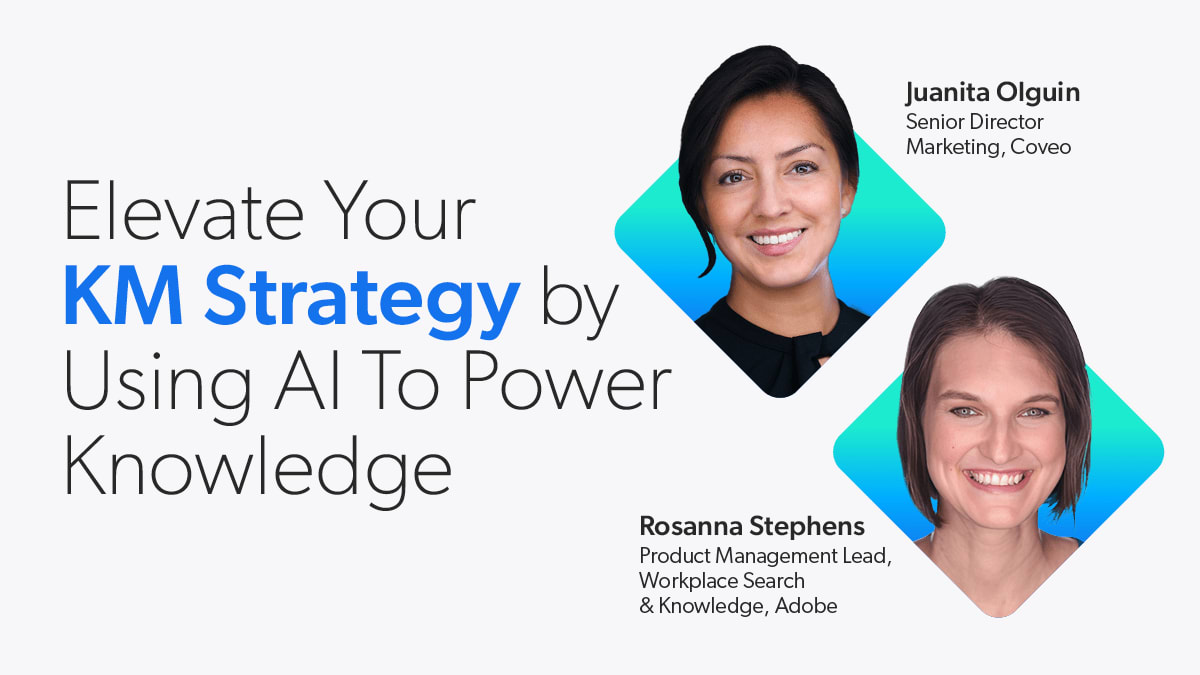
Elevate Your Knowledge Management Platform with AI
Watch today to gain valuable insight into:
- The importance of knowledge management systems
- Measuring and optimizing knowledge performance
- How AI-powered search and recommendation engines enhance user access to relevant information and personalized content