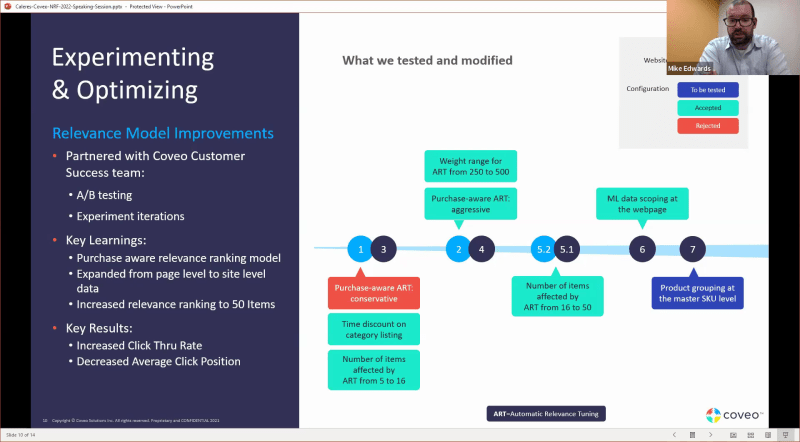
Alright. Hi, everyone. Thank you for joining us. We'll just give a few seconds for everyone to join us. Alright. Thank you for joining for our webinar today, how Calriss transformed their ecommerce experience. My name is Clara Boulanger, and I'll be your moderator today. And I'm really excited to be a part of today's session. I just have a couple of housekeeping items today to cover before we get started. So first, everyone is in listen only mode. However, we do want to hear from you during today's presentation. So please feel free to use the q and a panel on your screen to submit all of your questions. We'll be answering them at the end. We'll we'll keep some time for q and a. So, all through the presentation, you can, post your questions, and we'll we'll look at them at the end. The webinar today is being recorded, and we'll make sure to send that recording to you, within twenty four hours of the conclusion of the webinar. And, on that note, I'm gonna leave the floor to Brian McGlynn, who's our, general manager of commerce at Kaleo, to start this off. So, Brian, over to you. Thanks, Barca, and thanks again. It's a great opportunity to talk, at at a talk we were gonna have in New York City back at the beginning of January, but we, ended up, going on the virtual way with with things. We're actually we've got some great attendance right now and and really some amazing content that people are here to see. So really wanna thank, Caleras for coming in and really, wanna thank Craig Fels and Mike Edwards. You guys have been doing some great work with us. I really have some good stories to go in and talk about what we we've brought together and just from your involvement of Sitecore, your involvement with ecommerce. Yeah. I'd really love to get your guys' insights, around that as well. So, yeah, maybe, Craig, maybe a couple words about yourself, and then, Mike, maybe the same. Sure. Thanks for having us. I'm Craig Fels. I'm the manager of the Sitecore, subject matter expert team. Internally, we're called the functional analyst team. We really take everything within the Sitecore as well as Coveo space, and we learn as much about it. And we spread that knowledge across, multiple teams, including the developers, content authors, merchandisers, and so on. I've been with Polaris, since two thousand six, and I've done pretty much, everything in IT, but it's always been on an ecommerce focused basis. Great. Thanks. Mike. Yeah. So I am, Mike Edwards. I'm the manager of, ecommerce, merchandise and product catalog for our, for famous footwear and many of our other, ecommerce sites here at Calarus. And so my team is responsible for, making sure that all the products are available on the site and ready to sell for our customers. And within that, includes, oversight for Coveo on our, some of our largest branded sites, including Famous Footwear. I have been with Polaris since I was in high school, so since two thousand and two. So almost twenty years now, with experience ranging from working in our stores to to moving to our corporate office, and specifically in the ecommerce space now for, oh, boy, almost ten years now. So it's been quite a while, quite a journey, and, excited to share with you today. Great. Well, thanks, guys. Really appreciate it. And, by all means, everyone here, on the call and all of our guests, we've got our q and a panel. So we'll have time for q and a. And as the questions pop in, start dropping them in, and we'll certainly be in a a great position to have a a dialogue, afterwards. So without further ado, over to you guys. Alright. Great. Alright. So just a quick agenda just to cover some of the things that Craig and I are gonna talk with you about today. So we kinda wanna walk you a little bit through, the ecommerce transformation that's happened to Calares over the last couple of years. And Sitecore and Coveo especially have been a big part of that. And so we're gonna talk a little bit about kind of the vision of what we were trying to accomplish, a little bit about how we accomplished that. And then we're gonna spend some more time talking specifically about FamoSPO. We're our largest ecommerce site and how the, how the the new experiences on that site, how those are powered by Coveo, and then also talking a little bit about some experimenting and optimizing that we've been doing with Coveo since we've been up on the platform in live. And then we will, wrap things up with, what's what's on the horizon, what's coming next for us. Thanks, Mike. So you may not have heard of Calares before. We are a portfolio company, and we're not really a household name as far as our the the the, parent company goes. However, you I'm sure you've heard of some of these brands. Famous Footwear, as Mike mentioned, is our largest. We are, we have brick and mortar stores as well as the site, which is our largest ecommerce site. And then we have, twelve other ecommerce sites on our platform that uses Sitecore and Caveo. And then we'll be moving our, next site over to this platform as well, which is Allen Edmonds, which you see on this screen as well. So here, we've, during this project, which actually started back in twenty eighteen, we had a lot of challenges that we were facing. We partnered with Caveo and Psycore in order to create this new ecommerce platform. One of those challenges was this large and complex catalog. So this large catalog, we needed a search partner that could handle this catalog. We have a lot of, records. We have a lot of products, And we have this, relationship that we had to build out between the sellable items that would be like a color of a shoe as well as the size and width, because we need to make sure that our customers can can search that catalog and filter down to the products that they're looking for. We also needed to make sure that inventory was factored into that. We wanna make sure that we can, only have items that are searchable that are purchasable. So for us, that means those are in stock or they're, potentially backorderable or maybe a custom shoe like Allen Edmonds. Yeah. And, add on to that. So, additionally, one of the, challenges that we had previously was, minimal personalization capabilities within our website. So in today's marketplace, everything is about delivering a personalized experience for your customer, and that can show up in a lot of different ways for a website. That could be content and many other things, but also within that, could be search, and how that search experience goes for you. Additionally, for our on-site search, we had very manual rules and no machine learning to assist us. So we were in a place where, basically, we were deciding on our own interest what we wanted how we wanted the products to show up. And oftentimes, as a as a as a, merchandiser, you have thoughts about how you bought product and how you want and what shoes you want them to buy, but, generally, the customer is thinking a lot differently. And so, some of our rules may have served us as an organization really well, but we're not really designed with the customer at the forefront. And so, that was another challenge that we definitely look to address as we look to move to a new web platform. So if we go back to, the project starting in twenty eighteen and our first set of sites going live in twenty nineteen, we really needed to, approach this project from a tactical point of view. We started with those simple sites, sites that are single gender, no brick and mortar stores. They're pure play only. So that was Beezy's, Franco Sardo, and Circus n y. That those sites launched in October of twenty nineteen. We, we launched those sites probably, over the course of two or three weeks. Trying to remember twenty nineteen is kind of hard these days. But after that, we, we went into the next four sites with a little bit layer little bit more complexity, complexity. So Ryka, Viasbica, Zodiac, and Livestrud went went next. Again, these were still single gender sites, and they were still, single channel. So there were no brick and mortar. There was no buy online, pickup in store. But some of the features the feature set was a little, a little more complex, and the product catalog kept getting larger as we went through these sites. Going into doctor Scholl's, we started adding additional gender shoes. So we had men we have men's shoes. We have a couple brands there that are, sub brands of doctor Scholl's. We have doctor Scholl's original and doctor Scholl's work. Again, layering on that complexity, building on everything that we've had before. We get into Sam Edelman, Naturalizer. These are larger larger sites. The risk is higher because the traffic's higher. So we needed to make sure we got things right as we approach these larger sites. We finally get to also notice April twenty twenty, June twenty twenty, we March twenty twenty. We were launching these sites right as the pandemic was starting, and we were all working from home, and we just kept going at it. We launched these sites, very successfully. We can fast forward up up this, chart to January twenty twenty one. Now we have Naturalizer Canada, our first bilingual site, where we're sending, product copy category names to Coveo in both English and French so that our French speaking, customers can search naturally on the site. We have Famous Footwear where the product catalog is now gigantic. We we get all of that out into Coveo. We launched that site successfully, and we prepare for buy online, pickup in store. Then next is Famous Footwear Canada. Again, we just take that complexity of Famous Footwear with buy online, pickup at store, and what turned into curbside pickup as well. And now we layered on the, the multilingual aspect of Famous Footwear. And then the project that we're currently working on is Allen Edmonds, men's shoe, men's brand. It's one of my favorite brands as everyone at at Claris knows, and we are launching that within the next month or so. And that's just leveraging everything that we've built to date. So Allen Edmonds will be able to, have buy online, pickup in store. They'll have all of the other features that we built along the way. And it just kinda shows how we've been able to build out this platform and leverage what we've done already. Absolutely. So now you, Mike. Yeah. At this time, I'd like to start to, you know, dive into, now that we're on that new platform and we're, have Coveo powered on-site search and all of those fun things, start to talk about how that experience started to change for our customer on the website. And as Craig mentioned, one of the most complex aspects of, launching famous footwear dot com was the buy online pickup in store experience. So what Coveo kinda brought to the table for us was basically the ability to, begin to manage our store locations and start to multi select store locations. So you can kinda see on the left nav, highlighted there the ability to filter down or facet down your selections to multiple stores. So you can set your store, only review the products that you wanna be able to go pick up in that store. So, yeah, so Coveo is powering that behind the scenes and really kinda setting up that new experience that, is really kinda it's it's pretty complex to start to think about, all those intersections of stores and products and colors and all those fun things. And just a kind of a fun fact to talk about that store facet for a second, we introduced obviously the ability, like I said, to select multiple stores, and we actually know that fifteen percent of our customers are using that facet directly in that manner. Right? So selecting multiple stores when shopping. So it's definitely a very powerful tool for that experience. Craig, I kinda started to steal your thunder there a minute to talk about that, you know, inventory and catalog. Do you wanna elaborate on the complexity there? Sure. I think I told you yesterday that I could talk about this part for about an hour. So, I'll try not to do that. We do have this large catalog. So we have what we refer to as a sellable item. So using the screen as an example, the Nike women's Air Max Motion two is a sellable item. It's that specific color, that specific style. But we sell that. Of course, we sell that color in multiple sizes and multiple widths. Right? So we need to create this relationship and the Caveo catalog creates that relationship for us. So it rolls together all all sizes, all widths of that color into a single displayable item on the on this result set. But that allows us to even though you can't see it in the facet, container on the left, you can filter down to the size, you can filter down to the width, and it's going to, manipulate the results that coming back from that catalog and only show the sizes that are available in that color. Or, I'm sorry, only show the products that are available in that size. Layer on top of that availability. So it's an availability, configuration within the Kaveo, catalog, and we're using store records. So we send all of our what was that number, Mike? Eight hundred and forty three stores? Eight hundred and I think it was eight hundred and seventy something were in the catalog. But yeah. So we have over eight hundred stores for Famous Footwear alone that we're sending to the to Caveo in our in our, daily index our our hourly index. We send all of the avail available SKUs. So all of those variants at that size and width level up to the Caveo catalog. We're mashing that together in this in this configuration so that we know what's available at every store. So we have an online store that powers, I that that provides us the ability to just display items that aren't available in a store. And then we have every single store that we have, and it's available products. So when you select that prestige outlets, which happens to be a store near my house, we will only see the items that are available in that store. If, you select multiple, you will see the items that are available across all those stores. This, commerce catalog with this ability to have an omnichannel approach was key in providing us the ability to do real time inventory powered buy online pickup in store. So as soon as we sell out of an item that is, that was at Prestige Outlets, we update the index at Caveo, and that item will no longer be listed for that store. And then as you filter down, you won't see that item again. So let's go on to the next screen. And okay. So here, this is what we call the product detail page. We are leveraging, the Caveo Commerce catalog again here. You might not think there would be much for Caveo to do on a product page because we're just pulling a lot of this data out of our Sitecore commerce catalog. The but that box that box, halfway down the screen or so, that's our delivery method. So that's our buy online pickup in store, user, user interface. So here, we have to make a call out to Coveo. It's the fastest way to do this. So we're leveraging Coveo again. We make a call out to Coveo and to see if this particular shoe in this particular size eleven medium is available at my selected store. It's kinda hard to see on this screenshot, but right right below the famous logo is, is a store rendering. It's called My Store. It's it's set to Prestige outlets. Again, that's a store near me. So this page, when it loads, it's querying Coveo to see if this particular shoe and the size that I have selected is available at my store. If it is, it will tell me what options are available. It's available for in store pickup, but it's not available for curbside. That store on that particular day was not participating in curbside pickup. We sent all of that information to Conveio so it can be quickly and easily displayed here. So this, again, is just leveraging that complex catalog and makes it really easy for us to pull that data out of Coveo and display it to the customer in a very usable way. Alright. So moving yeah. Moving on to different, another experience or feature, powered by Coveo on our website. So one that's really important to us and that we spend a lot of time talking about and working on, is product recommendations. So, Coveo has a, machine learning model with a lot of different strategies that we can implement to do product recommendations. And so they can show up in a lot of different ways and places on our website as different merchandising elements. So we we like, on our home page, for example, you would find top sellers. As you move on to the product detail page, you can see items similar to the item that you were shopping. And then this particular one that is, featured here is our, model that pops when you've added an item to the cart. So this particular one is using the cart recommender strategy, which is recommending products that are frequently purchased together. And so Kovea is taking a look at that product, that you've added to cart and then showing you some other styles that you might like that were frequently purchased together. And so what we really like about this is not only are you gonna see other shoe products that you could, potentially purchase with your item, but we can also start to begin to add accessories and other, upsellable items, if you will, into the stream as well. So, it's another great experience that Coveo is powering on our websites and that we are spending a lot of time now on refining and reviewing where are other places that we can use product recommendations, which we'll talk a little bit more about later. Alright. So here, I wanna talk a little bit about guided navigation. So Caveo is not just about search. Any of our pages that you can get to through the guided navigation, so that would be going up to the in the header, hovering over women or men or kids, brands. You're gonna get this, this nether this extra layer, with deep links to our different category pages. We call those PLPs, product listing pages, and those are all powered by Caveo just as much as searches. So here, what we had to do, we wanted to make sure that our, PLPs are, have a lot of SEO value. That meant that the URLs needed to be SEO friendly. Our search page, we don't want those indexed. So the out of the box way that Caveo, handles the history in that in that, address bar works fine for search. We wanted to augment that. So by leveraging the JS UI, so the JavaScript user interface library and different APIs at the Caveo endpoint, we were able to build a custom implementation for history, browser history. So that's manipulating the URL based on what people are clicking. So as I click through a a PLP, what I've done here, I'm sitting on the women's, running shoes. So you can look at the bread crumb and kind of understand where we're at. We're on the women's page. We've clicked into sneakers and athletic shoes and then running shoes. As I click the various facets, you can see, maybe if you zoom in on your screen, you can see that some of these facets are clicked. So in the category facet here, you can see that sneakers and running shoes is a parent, and then running shoes is a subcategory to that parent category. As we click those, we are manipulating the URL. We're, we have a very, sort of distinct pattern that we want the URLs to take on. So it's shoes. So we have a department first, then a gender, then a category, and then the subcategory if it's been clicked on. And then from there, we layer on the other facets. So we can click on color. So maybe I've clicked on black. I can click on size, and these are multi select. So I could click on size ten and ten and a half. Maybe I run-in between those sizes, and I wanna filter for all of those. We take all of those facets as they're clicked, and we add them to the URL. This provides a very SEO friendly URL. It also gives us a URL that can be shared. So if you wanna, search for some shoes and maybe you've got it narrowed down, you wanna send that to a friend or you wanna send it to your spouse, you can copy that URL, send it to someone else, paste that in, and we will load that page and preselect the facets that you had already selected. It's very it's a very great, implementation, and we were able to do all of that through those APIs in the JavaScript UI library. Here, we also have, let's see. We've got, we're leveraging Caveo for our store locator as well. I don't have a screenshot for that here. But, again, because we're already sending stores to Caveo for the BOPUS functionality, we built a custom store locator rendering that queries Caveo, sends in the lat and long of, of the customer or whatever address they've added, and we use that distance function that's part of the, JavaScript UI to, find the stores closest to them. And then let's see. We also are, well, I I already talked about search guided navigation and BOPIS. So, yeah, it just, you know, just to reiterate, all of these APIs are super powerful and really allow you to build a custom, implementation in addition to what you get out of the box with their, with their components if you're building on top of Sitecore or any of their other integrations. Alright. So we're gonna shift gears here a little bit. And, at this point, instead of talking so much about, that front end, you know, customer experience, talking a little bit about the back end experience that we, Caleras, have had in partnership with Coveo and really talking about, some of the experimenting and optimizing that we've been able to do. So we've partnered with, the Coveo's customer success team and many other supporting teams at Coveo to start doing some AB testing and experiment iterations on a lot of different changes within, the machine learning models and other things, within Coveo. And so this chart here is is really you know, you don't have to spend too much on it, but I it's I wanted to include it because it gives you an example kinda of the interaction in this in the work that we're doing and kind of the level of detail, that we get back, when we're partnering with Covey on these things. So, you know, this is just a kind of a journey map tracking the different experiments that we did as we were, working with the ART model to make some changes, to kinda make it more purchase aware, less driven on clicks and, views and starting to add actual purchases into that model and then starting to make different changes with a couple of our different websites. And so as we move through the different experiments, Coveo has built in a b testing. So, it wasn't one of the things that we talked about on the front, but, one of the challenges again that we've experienced in the past with our platform was just generally the ability to do a b testing. And so to have a b testing built in within the Coveo, platform is, pretty excellent that it allows us to do these a b tests, and start to experiment and learn and optimize. And so in this specific example, actually, we ended up, delivering, improvements to the AR team model, which actually started to, increase the click through rate that we were experiencing to customers and decreased, and that's a good thing, the average click position, with customers as they were engaging with, search on our sites. And what's really fun is so we did this experiment. We did it with two sites. We did it with Famous primarily and also Doctor Scholl's. But immediately after doing that experimentation and finding those results, we could then take that and integrate that platform wide. Right? So instead of improving one business or two businesses, immediately, we could start to improve ten or twelve, whatever we decided would be relevant. And then if we decided to, we could continue to do more experimenting and optimizing. So, I think it's just really powerful, the ability that, you know, the tool Coveo, the tool provides, but also, the customer success team and the engagement that we've been able to have with them to really make, tangible improvements to our business and do that all the time actively in in iterations. So, continuing on and moving back into kind of another application for, Coveo and how we've been able to provide, a better customer experience. So one thing that we've been doing is, what we call feature item boost. And this is basically within, Coveo, we have the ability to provide, a little bit of boost to certain items that we target, to help them rank higher within the machine learning models. So in this application here, what you're seeing is a gifts for her page that we had set up during holiday. And what we'd like to do is it up at the top, you can see that the, Birkenstock, Arizona is featured up there in that creative. So we wanna make sure that when a customer hits this landing page that they immediately can find the styles that are being featured. If that's the reason they clicked or at least if they see that creative and, like that shoe, we want them to be able to quickly see that, which is great. And so we can apply those boost, which is a little bit of a manual override to the machine learning, but still gives us that merchandising control that we like. But the other part that balances with that is not only, you know, then are we boosting that item, but the machine learning model is still filling in around that. So it's still gonna use, its knowledge to populate a result set that is relevant for that customer, and provide a great experience. And what we found through doing this is, you know, when we boost that featured item versus when we don't on other pages in our testing, we found that doing that boost is actually increasing product views and purchases for those items, so it's driving real business results and outcomes. Next slide, Mike. Ready? Yes, please. Cool. Thank you. So, moving on from there, I think there's you know, so we've we've talked about a lot of different areas, and so we just kinda wanted to take a minute to just really kind of touch on a few more of the different places, where Coveo is showing up on the site. And some of them are a lot more obvious maybe than some of the things that we spent time talking about to this point. But one of them is just the machine learning powered query search suggestions. So you can see up there at the top of the screen, as you start to type in sandals, the, Coveo is immediately trying to figure out or show you different options that you may be searching for. And so it's gonna start to recommend, you know, some top brands, some top categories, basically, top search items to help, guide your search as you, continue to, work and, interact with the website. So then, moving there from there, as you look at the product listing pages and all the search results, we kinda already mentioned previously that we have, machine learning driving those search results. So, there are gonna be items that naturally react to the search and are gonna pop to the top because of the just the relevance for them. You know, if you're searching for, black sandals, for example, you're gonna start to see the color black and other things start to pop to the top. Additionally, the machine learning models are gonna start to fill in around that and provide additional search results that, are relevant to the search or relevant to your behavior to help kinda fill out those search results. Kinda a few other things that we've kinda talked about in this place, you know, multi multi select facets. Craig talked a lot about that. So all of those facets that are along the left hand navigation there, the ability to select multiples. We have the store bill store availability and locator. We have product recommendations. So just a lot of different ways that, Coveo is showing up on our website to really provide a complete experience for the customer and shows up in a lot of different places, many of them expected and some of them pretty unexpected. Alright. Alright. And so I just kinda wanna take a minute here now just to you know, as we talk about all these different things that we've done and, all the interactions and things that we've worked on, we had some we've driven some really great results within our business. And so when we think about, you know, increased conversion rates for on-site purchases, so what we're seeing is a twenty four percent increase on average, like, for, transactions that involve search. Right? So we were converting previously at a certain level. Now we're seeing a twenty four percent improvement when that customer is searching in their conversion. And then this one's a little more complicated, but a twenty eight percent improvement in the average gap. So that gap that existed between customers that searched and didn't search, well, that gap grew wider with Coveo, which kinda makes sense as you think about is we're improving that conversion rate on the search. It's become that much more effective of a tool, for our customers. And just generally speaking, even when we don't see necessarily immediate changes in conversion, We're seeing strong engagement. Right? So our customers are utilizing the facets. They're utilizing, the different tools that are available to them. They're, when we are trying to show different products to them, they're engaging and puing and clicking it on those products. So we are actually putting things in front of the customer, that is relevant to them. And that's probably bottom line the most important thing, right, is if we can get the right products in front of them out of the, I don't wanna spoil it, but I what did we say? Thirteen thousand items that might be on the site at any point in time. If we could get the right ones in front of them, then our chances of converting on that customer go way up. Craig, do you wanna talk about a couple other, results that you've seen? Sure. So, alright. So so the volume of queries, we have a lot of traffic. And if we go to the, the cyber seven so let's just talk about from thanks giving day through, through cyber Monday. So that's not quite the full seven days, but we had eighteen point six million queries across guide navigation and search. Coveo is handling all of that load for us. Those are client side queries. So a customer comes in and hits a PLP or they they do a search query. That call is made directly out to Coveo. They're handling a lot of our load for us. So I think on the previous slide, we had, like, a scalable architecture was on there. We didn't really talk about that bullet, but, this is definitely scalable in our in our minds because we don't have to take on all of that load anymore. Another, some other statistics. Okay. So eighteen point six million queries, across about four or five days. We had seven point five million recommendations, that just these are relevant recommendations. All of that machine learning might talk about. We had, we are recommending items that are going to be more likely to be purchased, by our customers. We had three point three million query suggestions. If I were to just make an assumption there, that means three point three million, approximately, people used our search box, as opposed to use guided navigation. Because pretty much anything you type into that search box is going to give you a query suggestion. We had thirty five point two million usage analytics events. So you might wonder where all of this machine learning data is coming from. Every time a customer is clicking, we know, Caveo knows what they're clicking on. So they're going from page to page. That data all gets sent to Caveo. It gets, consumed into that machine learning model. When a customer clicks let's see if I can, properly go back here. Slide. Let's say the customer clicks on, maybe the seventh item in this. Caveo knows that. They know that click ranking. So, anytime a customer is clicking anything, Caveo knows, and they're going to, affect their machine learning model associated with all that clicks. So we sent through thirty five point two million of those events over those five or so days during holiday. Getting back to this, our site, knock on wood, I always hate to, like, brag about this, but our site really had no issues, related to search and really anything during those those cyber seven days, which really just highlights the fact that, Coveo was a great partner. Their system handled everything. We were able to, serve up all of our PLPs, all of our search to our customers in, quick response all day long on Black Friday, Saturday. Sunday's a lower day, cyber Monday, just without even event. It's it was really great. Mike, do you have anything to add to that? I don't. That was that was great. And I think we have, one more slide to talk about. One more. Where are we going next? Well, so from a dev standpoint, we we may be pursuing headless development. I know for sure that we'll be, digging into leveraging the APIs and the JavaScript UI to create custom renderings. One thing that was great with, with our implementation of Caveo on-site core, was the ability to to use those out of the box renderings that Caveo gave us. So, we have Sitecore SXA, nine dot two with SXA, and all the other various features. Caveo Hive for SXA, it really gave us those out of the box renderings to get started. We wouldn't have been able to do that timeline we saw earlier launching twelve sites over the course of, about eighteen months or so without those renderings out of the box being available to us. But now that we've learned, now that we've we've matured in our ability to consume those APIs and to learn that JS UI, we're we're getting ready to build some of our own things, and we started that with one so far, and that was the, that was our store locator. So if anyone wants to go check out the Famous Footwear store locator or Sam Edelman store locator, you can see what we've built ourselves. Our dev team is great. They built this, leveraging those APIs. Aside from that, we're we're going to be migrating, our catalog well, we're gonna be migrating from a push source to a catalog source. So what this means is it's going to be different, a different integration where, it we're getting the data into Caveo in a little bit different way. And that catalog source is going to allow us to share our the attributes across items, and then those attributes are gonna be consumed with into the machine learning models. Might get this a little bit wrong. So, Mike, please correct me if I get a little bit any of this wrong. But I didn't say that so far. We we currently are populating machine learning model with the attributes of a single product. We know we know just about that product. But if a customer buys, let's say, a Nike running shoe, the attributes of that Nike running shoe can then, be used so that we can just take the brand part or maybe the category part, and we can recommend other items that are related to those attributes and not just the item itself. Yeah. If I was outright. Yeah. If I was gonna sum it up in a in a much, much simpler way, I would say that through all of the testing and, optimizing integration we've done, one thing that has been pretty well consistent is the more information that we can feed the machine machine learning models, the better the recommendation and results that we get from them. And so by making this this, migration from the push to the catalog source, We're just we're just arming the machine learning with way more information about each of the products to then have it spit back to us even better recommendations. And, that's that's how I would sum it up. Thank you. Yeah. And so, the kind of the last thing on on on what we continue to work with is is this continued engagement with the customer success team at Coveo. And so we are doing a ton of work around like, right now, we're really focused, as I mentioned, on the recommendation strategies. And, in particular, right now, they're doing a lot of work on the PDP. Right? So, how how many merchandising elements is the right number, and what should those strategies be for those product recommendations for those merchandising elements? And so we're doing starting, I think, any day now. So it'd be, AB test launching around that, where there's been already a lot of conversation and work and that's gone into it. And then that's just the beginning, where we'll continue to iterate and learn. And so I really look forward to continuing to have that conversation, because, bottom line, I think the that partnership is where we're really starting to get, you know, move into that strategic partnership and really drive a lot of value, not only for our our organization, but I believe for Coveo's organization as well. And that's that's the kind of partnership really that you wanna strive for is that strategic partnership. Awesome. Thanks, Mike. So, Brian, I think I think Craig and I have covered, what we what we set out to to talk about at the start. We can turn it over to you if if you have any questions or anything you wanted to fire our way. Yeah. Thanks. Really appreciate the insight and definitely a lot of insight and a very, very interesting journey. So, yeah, I've got a couple of questions, and and those in the audience, I've got a really good participation today as well. So, anything you guys have as a q and a panel, down at the bottom of the screen, feel free to drop in a couple of questions, and we'll answer those, as they pop pop in. Right. Really, a a lot of focus on AI and ML. You guys have been around for the journey in this part. So I'm curious from your perspective, kind of day to day living with AI and and machine learning. How has it impacted what what you guys have seen kind of prior in the the pre Coveo and the twenty nineteen world and and really, your use of AI today. How how's it changed things? Yeah. From so from the business perspective, I I think I would answer that. In in a lot of ways, it's kind of, challenged, maybe some of our traditional thinking, because we we've spent a lot of time selling shoes over the years, and we have certain ways of thinking about how we wanna do that. And we're, I don't know, we're pretty good at it. But, machine learning is considering way more information than we could ever. And I think drawing connections that is just it's impossible for us to do. And so as we're doing the testing and optimizing what we're learning, a little bit is to maybe kinda step back and challenge some of our own assumptions about how we want things to show up and kinda trusting the ability of giving, the algorithm some information and letting it come back with those recommendations. So I think, for me, kind of the the biggest learning there is is really just kinda, embracing and allowing it to do what it's going to do. We can continue to improve by adding more information and making good decisions and testing and measuring. But, certainly, I think that for the most part, it's it's kinda get out of your own way and embrace and allow it to, make your organization better. Great. Thanks, Mike. Sir, Craig, what's your thoughts on on that? How's AI changed the world for you or change things or make things different at this point? Honestly, I'm gonna I'm I'm really gonna just echo what what Mike has said. I think early on so, of course, me being, more on the IT side and the implementation side, We're me and my team, we're the ones to dig in first and try to figure out how all of this stuff worked. Right? So our previous search provider, we don't have to name names. We we worked we worked with them to, like, pretty to to figure out how to fake AI. How do we fake machine learning? So we would just establish a bunch of rules. This is that old thinking Mike is talking about. We want to, let's say, owned inventory is up at the top and, drop ship might be a little bit lower. And then we wanna make sure that maybe sale is a little bit lower, but we had to do this, like, very, formulaic. If you you can do some you can do a lot of this with ranking expressions, but you're but you're you're augmenting machine learning with ranking expressions by just moving things a little bit. We had, like, hard sorts where we would, you know, force things to the top and force things to the bottom because that was the way that we were thinking about it. And when we initially rolled out Coveo and, really, the the teams that we were working with before, it's allowed the same people. Right? We still have they're all still with us. And, like, okay. How do we how do we move these things down? And we were trying to just throw in ranking expressions, like, minus five thousand or plus five thousand and, like, really just move these things to the top and the bottom almost manually like we were doing before. And we just had to really back off and say, let's use smaller numbers. Let's let's let machine learning do what it's supposed to do. Let let's let Caveo's AI that they've spent so much time developing really present the, relevant products that our customers are looking for. And I think we've, like Mike said, we've we've accepted that, especially as more click data supports the shoes that really should be shown, we're overriding that less often. Yep. Makes sense. Now altogether, I mean, I certainly in machine learning, I like the way you guys put it. We see that with our other customers as well. There's there's a change on there. And I think, Mike, you had a good point, on your side. Quick question on, metrics. What just curious. What are some of your key metrics, your North Star metrics that you you look at in evaluating and with machine learning? Absolutely. So, it's a lot of a lot of standard metrics that we look at, like, that are not surprising to anybody. So looking at, revenue or looking at conversion and looking at, you know, cart size metrics of average order value or, average units in that order. But kind of the newer things that we spend a lot of time thinking about and looking at, are, like, that average, click rank. Right? So that's not something that we had before. So looking at, when, on a product listing page or in the search results, where is that customer clicking? And to be honest, we were pretty surprised, with how far customers often were scrolling before they were engaging with that first item, before they're moving to the product detail page. So that is one that we, we've definitely targeted to to look in to see how do we how do we continue to improve that? How do we keep making that number go down? Because we want them to be finding the right shoes quickly. So I would say that that's probably the highlight from that conversation is, like, average click rate is, a new metric to us, that we're definitely engaging a lot with and looking to to drive. Interesting. Great. Craig, any thoughts on that as well? I actually, I we'll just use Mike's answer here. He's he's in the merchandising world, and, I don't look at metrics like that very often. I'm I'm intrigued by them, but I don't dig in. Gotcha. Gotcha. Paid all kinds of stuff. Well, I think this is good. Thanks, guys. Really appreciate the opportunity to come in and and have you guys speak on a on a webcast. I'm very impressed with your execution, the work you guys did, and the the program. So a a really warm thank you from from us at Coveo and certainly our audience. Clara, any, comments on your side? Thank you, everyone. This was really great. We're out of time, but wanted to, say that if we didn't get to your question, we'll make sure to follow-up with you, afterwards. And a reminder that this was recorded, and we'll send a recording to everyone, within twenty four hours, so you'll be able to rewatch and share if you if you, need and want to. Again, thanks so much, Craig and Mike. This was so insightful. And, everyone, thank you for joining. We hope to see you again. Have a great afternoon or morning or night wherever you are. Thanks, Bye. Bye.

How Caleres and Coveo AI Transformed the Ecommerce DX for Famous Footwear
- Obstacles Caleres faced — and overcame — when integrating online and in-store experiences
- Caleres’ AI-powered search and personalization strategy
- Famous Footwear’s upgraded and ML-driven ecommerce experience
- Results of Caleres’ new omnichannel approach
Make every experience relevant with Coveo