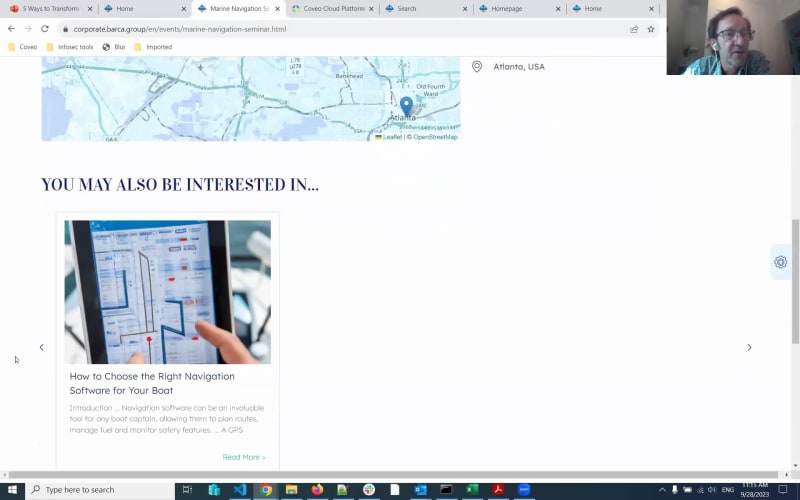
So, I will just get started by welcoming you all. Thank you for joining our session today. I'm Juanita Oguin. I lead product marketing for platform division at Coveo. And joined, here joining me is Paul Sheridan, one of our solution engineers at Coveo. So we're really excited. To talk to you about five ways you can transform your site into a growth engine with AI. Just a little housekeeping, this is being recorded, and we will give you access to this recording after today's session. Do feel free to ask questions in our chat or our Q and A along the way. We'd love to hear from you. But we are going to definitely run through the presentation in two parts One, I will cover five ways, with a little bit of a a different perspective. I am calling it five misconceptions. So I'll go through that. And then Paul will take over and demo to show you, more along the AI side and how this can help on your sites. So let's jump right in. Of course, it's always helpful to get started with why are we here and why this topic in conversation. Matters at all. And, the reality is, as you can see here, there's still work to be done. We conduct relevant reports. It's an external, survey that pulls two thousand users. And as part of these reports, We were able to surface these particular insights and stats, and that's that ninety two percent of users are still struggling to find information online. And also, employees still spend three hours a day searching for information. You know, when I look at this, it just means there's still a lot of work to do. And hopefully after today, we can give you some good insights and ways that you can rethink your overall strategies to help your key stakeholders, whether that's, an end customer or or prospect, as well as your employees. So as I mentioned, I wanna take a little different approach to this and cover five common misconceptions hindering the growth on your sites and for your overall digital experience strategy. I'm excited to cover these because it's it's a challenges and misconceptions that we hear a lot And I think really by taking a different perspective, a little bit of a mind, set change, I think it could really help unlock the potential for your area of the business. So I'll jump through each of these five and then, you know, we'll pass it over to Paul after that. So the first misconception we hear a lot, and it is that my website is a catchall. And this is typically thought of and said in a bit of a negative way, I think companies are still out there trying to figure out the best ways of optimizing sites. And so I, you know, I thought about what might be a better way to think about your sites. And and I wanted to offer the following. Which I'm calling the reframe. And that is that your website you could say it's a catchall, but I would look at it as your website is a high intent opportunity for engaging with your visitors and the fact that they are visiting your sites means that they are looking for something in particular. And this gives you insight into exactly what they're looking for and interested in. And what I wanted to just offer were considerations, things you can look into to really uncover the opportunity here. And the first is keyword searches on your site. There's some stats out there that say that forty three percent of site visitors use the search box immediately So this right here is telling you their specific intent. There's, specific keywords that you can use to understand exactly what they're looking for that might shape your overall strategy, you can also look at the clicks, the journey, their change in their authentication status. So are they logging in some point in their journey telling you a little bit more about who they are as an end, customer or visitor. And of course, we'll explore a little bit deeper how AI can help to amplify that user journey by suggesting and recommending and helping in the overall discovery of content and products. Alright. Moving on to misconception number two. Outbound com campaigns are all that better. So I'm actually within our marketing organization at Koveo. And so this one, I I see very clearly, you know, marketing, as an organization and function is so focused on driving, you know, pipeline, demand gen, legion. We we deploy these flashy, beautiful ads. We're out there. Across digital channels, trying to again entice people to come to our sites, engage with us, convert, get them down the funnel. All of that's great. We have to do it, and it's important. But I would offer that outbound campaigns and inbound ex experiences are equally important and must be consistent, especially if you wanna view your prospect and customer holistically. And what I mean by that is, yes, of course, marketing is a little more top of funnel sometimes in some organizations, but at the end of the day, you are bringing in a new potential cut prospect that becomes a customer, and you wanna keep them. Right? You want to grow and retain them over time. So that means, you know, it's important that not only are your initial enticing, you know, tactics and mechanisms nicely structured, but your inbound, sites and channels are equally as considered. And So just some considerations is, yes, we know Alban is super important, but don't forget about the inbound experience. Is it as consistent and, and seamless as as the efforts that you're putting on the outbound. As I mentioned before, inbound is a high intent activity. You know, if if people are coming to your sides you wanna maximize and optimize that experience in that journey and what that user is telling you, right, what they're offering you, whether it's in the search box, the clicks, and and the content or products they're engaging with, and we'll talk about how AI can help with that as well. Third, which is another favorite of mine, is that, a lot of companies think that their website is just their dot com. Right? So my website is just the main page that visitors are going to. And of course, your website, that dot com, it is the front door, right, to your organization. It is, what visitors are judging you on it. It's the first place that they typically go to. But we like to offer that your website is actually your end to end digital customer experience. And although you may not own the different parts of a site, for example, of course, there's your dot com, but you also have your doc site, your support sites. If you are more on the commerce side, you have your, transactional sites. Right? And you never know which of these sites your your visitors are gonna be engaging with, but you do wanna ensure, again, you're driving that consistency across sites, whether you own them or not. It's it's very important, right, because you, you know, everyone goes to their own buyer journey. And so what we'd like to offer is a reframe and a change of mindset to know that your website is the customer journey. And you can use, again, search analytics and information about the user to identify what are those top sites what are those top portals that you wanna put a little extra work to optimize and enhance, but also to ensure you're equipping your digital teams with core site capabilities or global capabilities across your sites to drive those consistencies. Again, we know that, you may not own all of the sites but you probably are in charge of enabling teams to have consistent site experiences and making sure the features or capabilities they have on those sites are consistent whether they're in the US, Europe, a partner site, and so on. So we'll talk about how we can do that. Misconception number four. So content publishing and curation are all I need. Obviously, if you're marketing, we're marketing, content is absolutely important and critical. It used to be say said that content is king. We absolutely agree with that, but we all still think that and know that findability at scale is a critical part of your content publishing and curation equation. And so here we're trying to highlight that. Yes. Of course, you wanna have that powerful high impact content, but you also wanna make sure it's getting to people when and where they need it. And I also wanted to point out that a lot of, you know, teams might think It's about centralizing. This kinda goes hand in hand with curation of content trying to, you know, curate, you know, exactly and manually kind of push content to people where you think they're gonna be. But it's really not about only curation or centralization. It's about having the ability to give end users access, secure access to that content, again, no matter where they're searching or looking for that information. And so here what we'd like, you know, to offer us considerations is that buyers prefer to do their own research. We know this. We've seen the stats. You know, people want to be a self sufficient they wanna self serve. And so, you know, you need to think about how you're enabling them to do that and making your content and information or products findable for them as they do their own research. And also, you know, if you have good tools, then you can really take the mindset of published once and surface anywhere really removing that need for manual curation or manual work. And, you know, that might be important on some sites. It's not something that might be scalable across your your many sites that we know you have today. So we'll talk about, how AI helps from that perspective as well. And moving on to the last before I hand it over to Paul, I think it this one's really important, and its UI is more important than weeks. We hear this a lot, but we also see it. Right? You know, companies are investing millions of dollars into site redesigns, hiring external agencies to at that site looking great, and yes, that is absolutely important. But we would like to offer form form and function both matter. Your UI and UX are equally important. And I shared some of these stats in the past, but wanted to share them again here fifty percent of consumers believe website design is crucial to a business overall brand. So that's why UI is absolutely important. And I mentioned this earlier, forty three percent of site visitors are using your search box immediately and are two to three times more likely to convert. This is saying your UX, the function, the findability is as important as as your UI, and we know that oftentimes it's a little bit of an after thoughts. So here, we're offering you a different perspective and way to think about it. And as you're, you know, building new size or going through a redesign or considering your user journey, build with user intent in mind, use what you know about their keywords, their clicks, their journey to help you understand which sites need to be a lot more functional. I know UI is a big thing when it comes to site. So leveraging tools that have the latest, modern frameworks we know the future is headless and composable, so you wanna be using tools that support that. And lastly, we'll explore how again AI can help more on this UX and functional slide. So with that, I hope those five, were helpful. It'd be great to hear if some of them are familiar to you. At this point, I will turn it over to Paul to take us through a demo. Paul? Yeah. Thanks, Manita. Always fascinating to, see This sort of presentation taken from the point of view of somebody who who faces these challenges every day like yourself, and is really focused on, how marketing works well. Together with the other parts of a company to to really, engage with, with customers. And, well, I'm gonna take a little more of a, a technical, approach to this. I'm I'm gonna try and call back to each of the different misconceptions and ideas that you've shared here as well. I'm just gonna share my screen. And, we're gonna take a little bit of a journey here with a Fictitious company that we use for demo purposes, and the various, sort of websites and experiences that have been built for this company. The company's name is is Barker. Again, they don't really exist, but they're, involved in any anything around, boats. Let's say, boats and accessories for sailboats and motorboats and things like that. So we've built up a bit of a, a demo brand here with a variety of kinds of content experiences and we'll be using this, to illustrate, I think, some of the points that Wendy took us talking about, and also to talk, of course, about, how our our brand Caveo, our technology can assist a company like Barca or perhaps an organization like Euro, in their journey with their with their customers. One of the points that Anita had mentioned was, inbound versus outbound marketing and the fact that, marketing organizations rightly put quite a lot of emphasis on outbound marketing and getting a person, a customer, prospective customer to their site, via outbound marketing. Now, let's, take as an example here, for Barker. They, they have a seminar coming up around a Marie navigation, and one technique or another. I've I've been brought to their site here to, to look into this seminar. It's very interesting to me. I'm, I'm interested in sailboats, and also had to navigate because I'm not really a very good navigator, at all. So naturally, you land on this landing page, but as Anita was saying, one of the first things you're likely to do is then to start to to search for more information. I've gathered a little bit of information from this seminar. I know where it is. I know what's being discussed. That's great. But also, I'd like to be able to be recommended other interesting pieces of information. Now, the way that, Kavell can assist with this here is really driven by machine learning artificial intelligence models that that we provide as part of our, our platform so that we can at scale start to recommend content that other users who've been brought to this page have also clicked on, have also read, have consumed, and perhaps, also customers like myself perhaps in the same geography have, have clicked on as well. So automating this process. Clearly, of course, you can, as a marketing person, you can curate what other recommendations you want to make. That's great, but at scale, taking advantage of, machine learning model to personalize and, and automatically start to make these recommendations is also a really key thing to be able to do. So whether I actually take that recommendation, engage here, start to read other articles, that are about the the subject, or that have been recommended to me, or whether I go to the search box, up here, and start to to search, as I will do in just a second. We're increasing the engagement here with, a person who is visiting Berca's website. Of course, one of the main goals of any kind of website or any kind of marketing organization is conversion, getting getting that customer to do something to, to sign up for this, for this seminar or to simply send in, a contact us form. That's a simple kind of conversion. Of course, there are many other kinds of conversion events that, that are important to you. In a commerce context, it would be perhaps purchasing something or adding, at least adding something to your your checkout cart in a customer support context that we'll also talk about today. It might be not creating a support case. We'd like people to be able to serve themselves better. And we'll talk about all these different kind of conversion events. But in this case, what Kaveo where Kaveo comes into play with Marcus website is we'd be tracking what the users doing on your website. Certainly, what they search for is we'll see you in a moment. What they click on, why they land on this page. And in this case, do they click on the submit event? Do they fill in the form and, request a contact? Now tracking that in conjunction with the other activities that the user is doing on the site, what are they searching for? What do they click what do they click on What do they do after that? It's a really key part of what we provide both, from a reporting point of view and also to feed into these machine learning models to start to promote. Content, activities, searches, let's say, that are leading to a successful outcome to some kind of a conversion. And just to show you, an example of that, I'm gonna go and log in to the the Cavell console here. As in, you know, here I'm an administrator for Barker who's helping to administer that website. And I've got access to a lot of kinds of information, including a variety of kinds of reports here. So I can I can report on activities here leading to form submission? What queries have, what queries have been done to lead this, this event, what documents and people collect them, and so on. There's many, different kinds of, reports Kavejo can provide as part of the, our platform. And of course, they're very customizable to suit your particular use cases, whether it's marketing conversion, whether it's, commerce related, whether it's, support related or simple findability. We'll dig back into this, side of things, in, in just a moment, but I'm gonna go back into my journey on the barca marketing website. So let's say I've, I've started to explore this site, and I'm starting to perhaps consider various kind of I'm I'm going to that big search box. I've got a nicely laid out, a large prominent search box on the barcode website, and I'm starting to type in a query here. I'm looking for information about navigation systems perhaps at GPS, and we can start to see type ahead query suggestions happening. Now, once again, this is artificial intelligence slash machine learning model that Kaveo provides to be able to make good quality query suggestions, whether I actually type, the word GPS correctly or or have a misspelling in there. What Kavell is doing is learning from success. Once again, what queries have actually led to good outcomes? It led to results. It led to results that people click on. They've led perhaps to conversion events as well. So we can start to, again, at scale. Not curate exactly, but at scale suggest and dynamically learn what's leading to a good kind of outcome here. Gonna cover a few different things on this in this search experience here as well, but, to start off with, I think that type of head query suggestion what everyone expects now and that's something that really is provided out of the box with Kubeo for, for BARka here. Then, of course, the next import thing is, well, what do we have in terms of search results? The goal here, again, being to help the the user, the person who's on your website as in as frictionless a manner as possible or with as little with as little friction as possible, get to what's really of interest to them. So the ability to narrow the scope, perhaps, of, of what I'm looking at on this, search result page through filters or facets over here on outside. Maybe I'm looking for a video. Maybe I'm looking for an event. If there's metadata associated with many of these pages around tagging perhaps, or or date or where it comes from within their organization, perhaps even the author. So you can select and choose the kinds of metadata that are appropriate. For the experience that you're looking at. You can see a couple of different, user experiences, as as we go through the rest of the session as well, but picking and choosing the appropriate information to display, to the user on each of your user experience sites is really key. It's a design aspect that is often overlooked. I think also important, here, is really the layout of the search results themselves. You should be providing more than just, you know, a link to click on and perhaps a little summary of, of the, the, the document of the article or the video where we'll have you. So providing something along the lines of nice images, I give a bit of an indication what this article is about or what, what the event looks like perhaps. Various tags to say what is this sort of thing, to help the user to help guide the user to decide whether or not to click on it. We'll also notice here a little flag saying that this is recommended. In this particular case, this is, again, being recommended by, a machine learning model that Kaveo provides that we call, automatic relevance tuning. And really what this is saying is that a lot of other people who've searched for GPS or something along, around that kind of subject have gone clicked on this, this article, have consumed this article. There's various kinds of recommendations that we could make. We saw one really embedded into that landing page as an example. People who've read who've gone to this seminar, let's say, or who have, clicked on this, the various landed on this page have also read this article. But here what we're saying is we're tying that query to a couple of different documents that are popular with people, clicking on that document. Again, these, and Juanita's gonna go over this in a little bit, but Causea provides quite a variety of machine learning models, appropriate different kinds of use cases. This automatic relevance tuning model, really appropriate to, marketing information to frequently ask questions, and, to support, kind of, use cases as well. So again, picking and choosing the right kind of layout, applying the right machine learning and manual or where appropriate rules to help guide the user towards, towards the content that you want them to consume, and that they want to consume for that matter. It's really important to what we're doing here. I'm gonna switch gears a little bit here and and and take Me, the user who's on the the, Barco website into a bit of a, more of a shopping experience, a commerce experience. And we're gonna go here to You know, I've, I've explored Barker's offerings, I've explored their marketing information, I've explored the events they have. And now, I'm, you know, maybe I'm actually interested in buying something around navigation. So I'm going to the Ark engineering, site here, and I'm starting to look for information about, GPS, for example. Picking and choosing again appropriate machine learning models, rules, and layout options for the different parts of the user experience, the different parts of the user journey are really key. Again, you know, Kevayo being able to, to, guide the user appropriately with, type ahead query suggestion. And in this case, more of a, visual kind of experience right within the search box here for that kind of shopping experience. It's the sort of thing that people expect really on, on, on a website, on a shopping website in particular, and also expecting perhaps a little bit, of a different experience once you get to search results. Typically, you're dealing with, less in the way of text, perhaps, applying to each different product, but visuals are very important prices are very important. Perhaps even ratings that other people have left on these products are very important. As I go in and I start to look into a product, once again, those, embedded recommendations are really important as well. And these are, once again, machine learning models that Kavail provides, especially in the commerce space, be able to recommend a couple different things. One being people who purchased this product have also purchased these. Oh, a frustrating, a commonly frustrating experience on shopping websites tend tend to be that I'm only seeing other similar products. Well, in this case, these are more like complementary products. So we're learning, in this case, once again, from what people add to their cart, from what they check out and so on, that someone who's looked at this GPS FishF finder have also looked at various chargers, perhaps, and mounting devices once again, being able to scale this kind of experience is really key, and that's what, Cavejo can provide through our, machine learning models. You can also see different kinds of recommendations. People also viewed these, these other products that are in the same category. Perhaps I am still in kind of a browsing mode. I'm trying to pick the right GPS fish finder. So it's a different kind of recommendation. And once again, something that we can provide, out of the box here. I think this kind of calls back a bit to, one of Anita's points about, you know, understanding that your user experience that you're providing is not just your dot com site. It is it is your commerce site. It is your blog site, which may be on a different platform. It is your customer support site. And that's a bit of a segue then. I'm taking my imaginary journey a step further. Let's say that I've gone and I've purchased. A product from, Barika. And in fact, I've purchased, a product they call a Skipper, which is a navigation device here as well. Now, I've I've I've I've had this product for a little while. I've been using it. I'm pretty happy with it. But I do need sometimes more information. And so the support experience is also a really key thing to do, and it's an ability, it's an opportunity to once again personalize, the user experience. So I'm, I'm logged in. I've I've connected to the the BARka support site because I've got some questions, and Burka can start to make some recommendations to me once again powered by, of course, Kavehosa platform, but recommending documentation knowledge articles, recommending, discussions on a discussion board common queries that other, customers of that particular product have had here as well. So having this unified index, the Caveo bills, point to all of your different, properties where there's useful information for a person who's a a barca customer. Super important, whether I'm doing a search or whether I'm simply, browsing for information here. Let's just say excuse me, that I have got a question. I need to update my map within this navigation device. So I can go when I can do that search. And I can get, again, a different set, different kinds of results here. It might be from the knowledge base. It might be support cases I've opened in the past, community posts, and so on. What you can see here is an ability of the Cavell provides to, provide not just links to results, but actually little paragraphs snippets, if you will, answers to to commonly ask questions. And that's something, again, we we can provide based on machine learning model that we provide to our customers that allows them to, automatic it automatically analyzes the content that they publish and extracts good quality, answers from, from, from that, and also applies semantic search capabilities here. So it's not necessarily an exact match to what the, question within the, document is. Now, of course, the user, me can go in and look variety of kinds of information down here as well. Once again, the layout being super important, I can see other recent queries, other similar people have done. Another interesting topic, especially in the support area these days, and a very hot topic for almost anybody involved in, websites, information management, search, and so on. Is an ability to generate a response as well. So Cavell is, relatively recently. Launched an ability here or is about to launch an ability here to leverage, generative technologies to put together a more thorough answer, and this may come from multiple different sources. So Cabello being able to, create and manage, a unified index of content. The most useful trusted up to date, content from your particular site can also be used to generate a response. And here, this isn't the main subject of our our conversation today, but I thought it was very important for us to, to show you an ability here to generate from a sited, sources here within the barcode website or multiple barcode websites, a generated response tailored towards the prompt that the user is entering, the longer question the user is entering. With that, I think we're just about out of time. I'm gonna stop sharing here. I I realized we need to. We probably don't have enough time to cover all of the additional points that you were hoping to. I hope it's been interesting and useful for everyone. Yes. Thank you for taking us through that. Hopefully, everyone, you saw the possibilities. I am gonna just fly through a few slides. I won't spend a lot of time on there on these slides. Sorry. But what you just saw was truly an end to end digital customer experience and lots of sites and a journey that your customers and even your employees go on as they're exploring, your your sites and products or or your company. And what Paul shows you was just a subset of the many AI models. We actually have eleven different AI models that you can visualize across different parts of the journey. And, if you wanted to learn a little bit more about these, I have included them with just a short description. Some are search based. Some are more proactive. The recommendations Paul was showing. Some are non generative answers. So smart snippets, which you saw, and others are more commerce oriented. Of course, we have our generative answering capability as well. So number of models and ways to help you enhance your overall user experience, again, whether that's for employees or customers, And the last thing I will say is, you know, we really do take pride in offering one AI platform to help amplify your customer and employee experiences, and we do take a techno tech agnostic approach. So it doesn't matter which CMS you have. We've worked with, site core, Adobe users on Drew and many others. So we invite you to, connect with us if you wanna learn a little bit more. In terms of an next event, I would point you to an upcoming relevance three event that we have on October twelfth, where you'll hear a little bit more about these AI models, the AI experience advantage, and we just wanna thank you for your time today. Hopefully, you learned a few new things or different perspectives. And Paul, thanks for demoing. Thanks, Anita. Great to, participate with you. Yes. Thank you. Have a great day, everyone.
Building a Digital Customer Experience Growth Engine with AI-Powered Search
- 5 website misconceptions hindering growth
- Coveo AI models for personalizing user experiences
- Live demo of Coveo's ecommerce capabilities


Make every experience relevant with Coveo