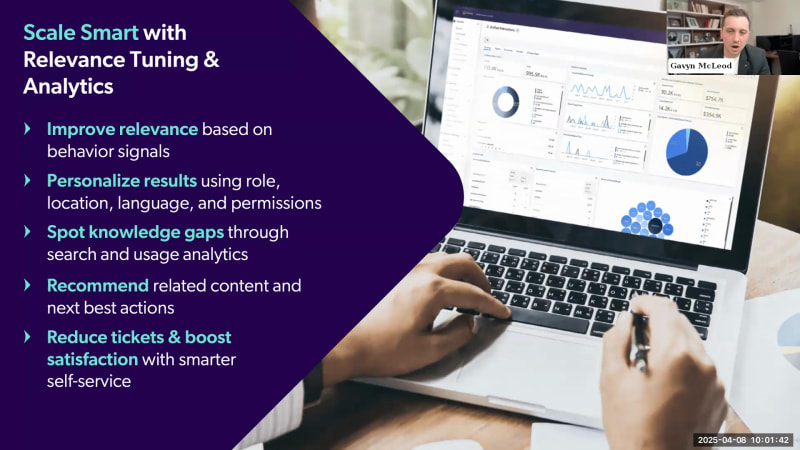
Welcome back to the CX and Service Excellence Virtual Summit. My name is Alex Roberts, and I'm a producer here at SSON Digital. And I'm delighted to be hosting our session today on an AI roadmap to cultivating world class service operations and experiences at scale. Before we get into the session, let's go through some housekeeping for those of you joining for the first time. At the bottom of your screen, you will see a series of icons. There is an attendee chat where you can pose your questions to the speakers, and we encourage you to do so. We also have some time reserved at the end of the session to take any questions as well. And if you have any technical difficulties during this session, you can also message me and my colleagues here, and and we'll do our very best to come right back to you. It's not always easy presenting online when you can't see the audience, so there's also a tab with emojis where you can give the speaker a thumbs up or a smiley face if you agree with their point. And finally, there's a resources tab with some great additional resources from our speakers, sponsors, and the SSO network. And in this tab, you can also find details of the speaker for today's session and connect with him on LinkedIn. The resources we have for today are SSON CX report, the ultimate guide to service excellence and shared services, a link to Covio's webinar on Zoom's roadmap to scalable self-service, a case study by Covio on how Zoom achieved a two point three increase in case deflection, a link to Covio's customer success stories, and a PDF copy of the slides for today. Now I will introduce our speaker for today. We have Gavin McLeod, lead product marketing manager for AI service and knowledge at Covio. Gavin is a product marketing leader focused on AI driven search, generative and agentic AI experiences, and knowledge management. At Coveo, he helps organizations improve information retrieval and harness generative AI to enhance customer service and drive business efficiency. With fifteen plus years in tech, including roles at OpenText, BlackBerry, igloo software, and Sybase, Gavin has decided has developed go to market strategies that enable businesses to unlock the full potential of AI, data, and content. A thought leader in content strategy and AI powered solutions, he delivers insights through webinars, case studies, and industry collaboration. Now I'll hand over to you, Gavin. Thanks so much for that intro, Alex. Hi, everyone. Thank you for joining today's session. As Alex mentioned, my name is Gavin, and I am a product marketing lead at Coveo. I'm really excited to share what we've learned from working with companies like Zoom and walk you through a practical roadmap for getting real results with AI in your service operations. So whether you're supporting employees through HR portals, resolving internal finance requests, or managing customer facing support at scale, the pressure that we hear is the same. You need to deliver faster, better, and more personalized service while keeping costs down. So I'm really excited to talk to you about how AI is becoming a powerful enabler for global business services, helping organizations like yours scale operations, improve service quality, and boost both customer and employee satisfaction. Now AI normally don't start with a company slide, but if you haven't heard of Coveo, I wanted to give you a sense of why we're here talking about AI. Coveo is an enterprise AI powered relevance platform that helps organizations deliver smarter digital experiences across service, workplace, websites, and commerce. We specialize in AI powered search, recommendations, personalized content discovery, and generative answering rooted in real time relevance and grounded in your trusted content. Our platform is used by hundreds of global enterprises and has been recognized as a leader in by analysts for seven plus years in a row. We help companies scale self-service, improve support, and drive efficiency without compromising experience. And that's exactly what we're here to talk about. How can you use AI in a structured, scalable way to drive measurable impact across your GBS organization? I'm gonna talk about what works, what doesn't, and how companies like Zoom Communications and many others have already done this. But before we dive in, I'm curious where all where are all of you in terms of your Gen AI adoption? Have you been talking about a lot? Not doing much? Actively researching? Do you have proof of concepts, but nothing in production? Are you in production with AI internal only? In production with external only? Maybe you have multiple curious. I'll give the audience thirty or so seconds to just answer that question. K. Alright. A few more seconds now. Okay. So the results of that to the question of which of these states statements best describes where you are at with AI, we have thirty seven percent of the audience saying lots of discussion, not a lot of action. Twenty five percent of the audience said actively researching how to use Agentic. Five percent said running POCs, but nothing in development. Sixteen percent said in production, internal only. Two percent said in production, external only. And sixteen percent said in production with internal and external use cases. This is, an incredible spread. AI happy to see how many we have in production, both internal and external. It's pretty common to see internal only well above external only. From what we've seen, it's very common to start internal use cases. And then once you build the confidence, go external. So that's not surprising. And the heavy skewed results that, you know, lean towards discussion and research, is also not surprising. And that's why we're here today. That's why we're gonna talk about a proven roadmap for getting you from just a lot of discussion all the way through to multiple Gen AI use cases, deployed and how some of the some leading organizations have done that. So let's jump in. Before we get into the roadmap, let's set the bigger picture. According to Gartner, eighty nine percent of companies now compete primarily on customer experience. It's no longer just about price or product or reach. Experience is the new battleground. And for GBS leaders, that's not just about external customers. It's also about the experience you deliver to your employees, to your partners, and internal teams across HR, finance, IT, and beyond. That's where AI and a specifically generative AI comes in. Not as a shiny object, but as a way to scale experience, relevance, and efficiency without scaling cost. So today, we're gonna go look at what it takes to actually deliver on that promise. But here's the reality. Most organizations aren't ready. We're in the middle of a global AI race. Everyone is experimenting. Everyone is investing, but very few are actually delivering value at scale. Why is this? Well, because custom AI builds are taking too long, costing too much, and often hitting roadblocks AI hallucinations, bad data, security concerns, and governance issues. And at the same time, the pressure is on. Investors, boards, executives, they're all asking the same question. When is this going to pay off? The gap between the leaders and the laggards, it's widening. According to Gartner, nearly sixty percent of CIOs list hallucinations as their top concern, followed closely by security threats, privacy risks, and IP protection. These aren't just tech problems. They're business problems. They lead to lawsuits, churn, brand damage. And here's the tough part. Gen AI is no longer optional. The companies that get this right will lead, and the ones that don't may fall behind. So what's holding us back? Well, many organizations are running into the same wall. Headlines like these are everywhere. Everyone's excited about Agentic, but the question now isn't what can it do, it's can it be trusted? Concerns about data quality, hallucination, security governance are dominating the conversation and for good reason. Because whether using AI to support customers, employees, or agents, the output is only as good as what the model can retrieve and reason over. That's why your foundation matters. Not just what systems you have, but how your knowledge is structured, accessed, and used. These headlines are symptoms of a deeper challenge. One that many of you are living every day. Now one of the biggest root causes behind fragmented experiences, whether for customers or employees, is this. Different teams own different parts of the experience, have different needs, and that means different tech stacks. Each function, digital marketing, commerce, customer service, HR, procurement, finance, you name it, makes tech decisions based on its own needs and priorities. And that's fair, but the result is siloed knowledge. Everyone's optimizing for their piece, but fewer looking at the whole picture and how that may impact a future reliant on AI. Just look at what's represented here. Digital experience platforms, commerce tools, contact center platforms, intranets, ITSMs, content systems. These systems don't naturally talk to each other. And as a result, the content and knowledge inside them is hard to connect, hard to access, and even harder to use consistently across experiences. So a simple question. What platforms are you relying on for knowledge today? SAP? Salesforce? Probably. But what else? SharePoint, Confluence, ServiceNow, Zendesk, shared AI. Most teams don't even realize how many sources they have and how non standardized the data is until they try to make them searchable. And this is why search breaks down. And this is why there are so many disjointed AI efforts across enterprises. It's not just about picking an LLM or connecting it to a data source. So if you've been wondering why scaling gen AI is hard, this is a big part of the answer. So how do you move from hype to real results? At Coveo we've seen that successful organizations follow a phased approach, a practical framework that follows a crawl, walk, run mentality. In the crawl phase or the first phase, the focus is on laying a strong foundation. That means indexing your existing knowledge in place, whether it's HR policies in Workday, SOPs in SharePoint, or help content in ServiceNow, Salesforce, or Confluence. You don't need to rip and replace. Just connect what you have and make it searchable and usable across your organization. In the walk phase, you start to optimize the experience using AI and machine learning. This is where relevance tuning comes in. A AI begins to learn from behavior, what users are searching, clicking, ignoring, and asking for. It gets smarter about understanding intent and surfacing the right content at the right time. Just as important, it helps you identify critical content gaps where users are searching but not finding helpful results. And that insight becomes fuel for your knowledge strategy. Then in the run phase, you're ready to layer in generative AI. But here's the truth. AI is only as good as the content you feed it, and I'm not just referring to its training data. Without a strong retrieval layer, without trustworthy, clean, and searchable knowledge, GenAI will hallucinate. That's where retrieval augmented generation, commonly abbreviated to reg, unfortunately, comes in. By grounding responses and real citable content, you eliminate hallucinations, increase user trust, and dramatically improve the accuracy and relevancy of AI generated answers. Not to mention, maintain the ability to link answers and resolutions back to the knowledge article. The key here is that you can start small, scale smart, and choose the best generative AI models and applications based on your readiness. You're in control and you can move at the pace that makes sense for your team and your tech stack. Best of all, you will start to see ROI right from day one of deploying Better Search. So let's dig into the first phase. In the first phase, the most impactful thing you can do is make your existing knowledge usable. For most GBS organizations, content is everywhere, buried in the tools we spoke of earlier. That content is is useful, but it's siloed, duplicated, outdated, impossible to surface at the right time. So instead of trying to migrate or consolidate everything into one system, which is expensive, political, time consuming, the better path is to index content where it lives. This approach allows you to unify access across systems without replacing them. Customer info stays in CRM, service knowledge in your support KBs, HR content in your HR tools, you get the picture. But through a single search and retrieval layer, employees, agents, customers, partners get fast, relevant, and permission aware results regardless of where that knowledge lives. This is a massive cost savings and operational efficiency as well compared to migration or duplicating data. This index is the foundation of AI ready GBS operations. And the best part, this step alone delivers major gains in efficiency, especially in customer service and shared services environments where requests often span multiple departments and knowledge domains. You can solve fragmentation, improve findability, and start enabling self-service all before you touch a single AI model. Now, once your knowledge is indexed and unified, you're ready to enter the walk face. And this is where things start to really accelerate. Now that you've made your content accessible, you can begin using machine learning to optimize how people interact with it. This means applying AI. And I mean that in the traditional AI and machine learning sense to understand what users are actually trying to do, not just what they type into the search bar. The system learns from behavior, what people search, what they click, what they ignore, and how successful those interactions are. Over time, it gets better at predicting intent and surfacing the most relevant content for each user in each moment. This goes far beyond keywords. You can tailor relevance based on user specific metadata, things like job role, department, location, preferred language, or permissions, leveraging a combination of authenticated profile information and application or browser history data. This allows customers or employees to find what's most relevant, based, and personalized to their unique context. Just as importantly, this data reveals where users are struggling, where searches return no results, where high volume queries lead to outdated or incomplete answers. These are your knowledge gaps, and they become a strategic content roadmap for your HR, IT, finance, and customer service teams. You can also begin introducing contextual recommendations, things like related articles, people also asked, or next best actions based not only on what users are doing, but who they are, what they've done before, or what others like them have done before. Now, whether it's a customer trying to troubleshoot an issue, an employee updating benefits, or an agent handling a finance policy request, they all benefit from intelligent AI self-service that reduces friction and delivers answers faster. This is how you start deflecting tickets, reducing time to resolution and improving satisfaction all before you start attempting to generate answers with an LLM. Now I'm getting a little bit technical here, but now that we've talked about optimizing the experience with relevance tuning and analytics, let's talk about what happens when you introduce Gen AI. Here's the reality. Gen AI is only as good as a source content. And I've said that before, but I'll say it again. Training data alone isn't sufficient to eliminate hallucination. You need clean, unified content and good search to ground it in the most relevant information. And that's why retrieval augmented generation or RAG is critical. Instead of relying only on large language models training data, RAG retrieves trusted real time knowledge from your index enterprise content. So think support articles, HR documentation, procurement guides, policy libraries, community posts, and more. So whether you're powering a customer facing virtual agent, a self-service portal, or an internal HR AI chatbot, accurate retrieval ensures that the answers being generated are citable in what's actually true and current. And this helps in three different ways. One, it reduces risk and misinformation, which is important in areas like HR, compliance, finance, product troubleshooting, and especially important in regulated industries. Two, it builds trust with employees and customers because the answer isn't a black box. It's transparent and answers are cited with links to learn more and verify the answer. And three, it reinforces knowledge reuse. When AI references a known article and we attribute answers back to knowledge, it encourages agents and content teams to keep that article updated and to keep attaching content to resolutions. Now that last piece ties directly into a KCS AI culture where the best answers are reused, improved, and measurable. Bottom line, whether you're solving employee requests or helping customers self serve, Gen AI won't work without the right retrieval layer behind it. And this is what makes it safe, accurate, and scalable. So with your foundation in place, clean trust and unified knowledge, you're ready to scale Agentic AI across your enterprise. And here's the key idea. You don't have to choose between managed Gen AI experiences, custom deployments. You can do both. Many organizations start with fast wins, like embedding generative answering directly into their support portals or employee help centers via fully managed solutions. These experiences are quick to deploy immediately impactful, and they deflect cases, improve findability, enhance user satisfaction right away. This slide I'm showing you here kind of gives you an idea of what that future looks AI. When you combine generated answering with the ML powered search experience established earlier, A full stack AI powered digital experience that moves beyond simple search rankings and curated web pages. Behind that single intent box is a layered stack of relevance AI models from smart query suggestions to LLM generated summaries, dynamic navigation and auto faceting and facet ranking. And every one of those capabilities is grounded in the same unified index you've already built during the crawl and walk phases. This is how you truly scale relevance across every channel and audience, enabling better self-service and knowledge discovery. Query suggestions and predictive typing to guide users before they finish AI. Dynamic navigation and auto facets that adjust based on search behavior. Smart snippets and generative answering that surface bite sized answers and full summaries, recommendations, not just on content, but on session behavior, history and user profile, personalized ranking so results are relevant not just to the query, but to the person behind the query. Together, these models allow you to create one integrated relevant experience across your dot com, your support channels, and your employee workplace. This is the future of self-service, not just answering questions, but orchestrating experiences that guide users, deflect cases, and drive real action. And it's all powered by the knowledge you already have. From there, you can expand into more custom use cases, integrate Agentic into your chatbot or case form workflows, power co pilots and agent facing experiences, feed knowledge into agentic systems like Salesforce Agentic Force or Microsoft CoPilot through accurate high performance retrieval. The best part, it all runs off the same index, same clean, secure permission aware knowledge layer you've already built. That means every experience, whether it's employees, agents, customers, or your AI, is retrieving knowledge from that single index to drive consistency and scalability across your organization. No more disjointed AI projects all over the place. No more disjointed knowledge, a single retrieval layer that can work for it all. This is how we've seen organizations scale quickly and effectively. Starting with the quick win, search, and grow into more sophisticated embedded AI experiences across your ecosystem with incredible time to value and reduce development overhead without duplicating or moving data or creating more siloed projects. Now to bring this all to life, let's look at how Zoom Communications AI this exact model to transform their digital support strategy across both self-service and, customer agent experiences. When Zoom's growth accelerated dramatically in twenty twenty during the pandemic, when work from home became the norm, they were overwhelmed. Content was scattered across multiple disconnected subdomains, each operating on different platforms with their own strategies. Knowledge was siloed, taxonomy was inconsistent, and users, both customers and internal teams struggled to find answers. They were growing fast, but their support systems and strategy weren't yet built to scale. Now they started with Coveo by indexing what they had across support portals, documentation, community, and internal systems without forcing every team to replatform. They allowed them to establish a single search and retrieval layer so users could find the answers they needed from anywhere in the ecosystem. And when some teams did eventually replatform, because they did, they were able to very quickly and easily index those new sources without impacting the customer experience. From there, they applied machine learning to improve relevancy, automatically tuning search results based on real behavior. They also ran deep regular analytics reviews to track top queries, content performance, and identify high impact content gaps. One of the powerful insights I learned from Zoom was around language disconnects. Users search differently than content was written as they do. So Zoom adjusted terminology, AI, and metadata, applying an SEO mindset. And that's a very interesting change for this world is applying an SEO mindset to everything we do. How are customers looking for this? As to align content to actual user behavior, this dramatically improved click throughs and findability for Zoom. With that solid search foundation in place, they then introduced generative AI, starting with managed Agentic experience, the Coveo relevance generative answering solution. And they expanded into case deflection with Gen AI in their case form, providing generated answers beside the form as users fill it out. Crucially, they grounded all GenAI output and real trusted knowledge using RAG. Every answer was citable, traceable, and aligned with their KCS practices. That helped them maintain control, governance, and trust even as they scaled. Today, they continue to expand their AI capabilities with confidence because they're building on that clean, structured, and measurable foundation. Now Zoom didn't get there overnight, but they did follow the same search first roadmap we've AI, and the results speak for themselves. Zoom isn't the only one to follow, and see success with generative answering. Coveo has helped over thirty organizations go to full production with managed generative answering and even more with custom gen AI solutions using our retrieval and answering APIs for custom search interfaces, chatbots, and agents. We generated over ten million answers to user questions in the last quarters. But it's not about the answers delivered. It's about the business impact. Organizations deploying Gen AI are seeing results. These numbers are incremental numbers of going from phase two of our roadmap to phase three. That's going from ML powered search to generative AI alone. Xero, like Zoom experienced twenty percent increase in self-service. SAP Concur experienced eight million dollars in annual savings for cost to serve. And Forcepoint improved case deflection on their case form by sixty percent with AI. So what can we learn from organizations like Zoom and the others that have followed a similar journey? First, don't try to boil the ocean. You don't need to index everything you have. The most successful teams start by indexing and activating the twenty percent of content that drives eighty percent of user demand. This gets you to value fast, especially in high volume areas like HR policy requests, technical troubleshooting, benefit inquiries, product setup, billing issues, or the like. Second, use search and usage analytics as your compass. Don't guess where to focus next. Let the data show you where people are searching, where they're getting stuck, and where content gaps exist. This helps your content and support teams prioritize the work that will have the biggest impact instead of just drudging through old content. Third, build AI in layers. Start with search, then layer on relevance tuning, recommendations, proactive insights. Only once that's in place does AI truly make sense because that has something meaningful to retrieve and generate from. And finally, treat this as an ongoing program, not a one time rollout. The organizations that see long term success are the ones that invest in continuous tuning, knowledge optimization, and feedback loops between AI usage and content quality. Whether you're supporting customers, employees, partners, or AI, the goal is the same, deliver relevant, trusted answers at scale and make it easier for people and machines to find the knowledge they need to help themselves. So what's next? We're moving into a new era of AI. One where the focus isn't just on answering questions, but on taking intelligent action. This is what the industry is calling Agentic AI systems that can be given goals and the agency to act, to reason, plan, and execute tasks across different parts of the business. We're already seeing the early signs with Salesforce Agentic Force, Microsoft CoPilot, Amazon Q and Bedrock, and other frameworks designed to embed autonomous assistance style functionality into business workflows. But here's the catch. AI agents are only as smart as the content and context they're built on. If they can't retrieve relevant up to date and permission aware information in real time, their actions may be inaccurate or worse, a highly believable, but completely false fabrication. This is where Coveo plays a foundational role. We're not just powering answers. We're powering relevance at the heart of AI experiences. Whether it's for customer service, employee self-service, or website interactions, Coveo ensures that your AI systems now and in the future have access to the right knowledge in the right context at the right time. We see Agentic AI as a natural extension of where the market is headed, and we're actively building the infrastructure, integrations, and intelligence needed to support that evolution. So while others are just starting to explore what agents could do, we're focused on what they'll need to succeed. A trusted relevance layer that enables security, accuracy, high performance, agentic action, and incredible time to value. Now I do have some final thoughts for you, but before I do that, I'd like to open the floor for some q and a. Thank you, Gavin, for such a great presentation. We don't have too much time left, so we only have time for one question today. So we had one question from the audience, and they said, how does Coveo compare to built in AI in ServiceNow, Salesforce, or Microsoft? That's a great question. And I think the answer is we're not trying to replace those platforms. Coveo is designed to enhance and unify what you already have. Here's how we're different. We're platform agnostic. Many built in tools on major providers are not great at utilizing data outside of their own platform. We are agnostic to all data sources and front end interfaces. So regardless of where your data is, what you run your website on or what Agentic copilot or chatbot provider you use now, or switch to in the future because everything's changing rapidly. Coveo works across all of it without asking you to rip or replace anything. And two, we provide really smart relevance and fast performance. Our ML adapts to user behavior, roles, permissions, language preferences to deliver highly relevant, accurate, and personalized results, not just generic matches. And we offer incredible throughput to improve the performance of GenAI. So if you're using Copilot or Agentic, we can feed those tools clean, citable, permission aware content, which massively reduces hallucinations. Thank you so much, Gavin, for that. And, yep, we that's been a very great session. Thank you so much for, your insights today. I will just hand AI back over to you to close out the session. Thanks, Alex. AI just want to leave you with this. AI is no longer a moonshot. It's a practical lever for scale, but like any transformation, it works best when built on a strong foundation. One that starts with your knowledge. So start with what you have. You don't need to boil the ocean to see results. Remember the eighty Agentic principle and that you don't need to rip and replace. Use the knowledge you have inside the platforms you already use. Focus on what matters most, what to your customers, employees, and agents. Two, build in layers, Scale with confidence. AI success isn't about giant leaps. It's about smart steps. Index your content, tune your relevance, use analytics to close knowledge gaps, then layer in AI when your foundation is ready. And three, think beyond answers and enable action. The future isn't just about responding. It's about acting. AI should empower people to do more, self serve, resolve issues, make decisions, and with the right retrieval, your systems and even your AI agents can do just that. And I wanna end just by saying, it may feel like you're already behind, but that's because we're moving so fast. Don't worry. You're not behind. You're right on time. The future is generative and agentic AI, but the foundation is search, and the time to embrace both is now. So if you'd like to see how other world class organizations are using search and AI to deliver better service experiences at scale, I encourage you to visit coveo dot com slash customers. You'll find real examples of how organizations like Zoom, Dell, Xero, SAP Concur, Salesforce, Athena Health are improving self-service, reducing friction, empowering employees and customers with Coveo. Or if you're already ready to explore what this could look like for your team, reach out. We'd love to start the conversation with you. Thank you so much, Gavin. We so now we will take a short break, and we'll move on to our next session, which will be a panel discussion on building a solid employee experience foundation for optimal CX. Thank you so much, Gavin. Thank you, Alex.

AI Roadmap to Cultivating World-Class Service Operations and Experiences at Scale
Generative AI is rapidly reshaping how GBS organizations drive efficiency, enhance service quality, and elevate customer and employee experiences. According to SSON’s State of the Industry Report 2025, 48% of GBS leaders identify Generative AI as a top investment priority—yet many are still navigating how to turn AI’s potential into real-world impact. This session will move beyond the hype to explore how AI can transform GBS service operations, improve access to knowledge, and balance cost efficiency with exceptional service.
Learn how AI-powered search, personalization, and generative experiences can help GBS teams scale service excellence—without scaling cost

Make every experience relevant with Coveo