So welcome, everybody. I'm excited for today's conversation with two world class chief marketing officers. We have Sheila Moran for from Coveo and Neil Dowling joining us from RightPoint in this amazing discussion. Today, we're gonna talk about some really hot topics, both total experience and AI, specifically the impact AI and Gen AI can and will have on digital experiences. And I'm excited to hear the perspectives of these two CMOs at companies that are at the leading edge of this curve. We've all seen data on the topic. The vast majority of marketing organizations are adopting AI. In fact, oftentimes ahead of other areas of the business. We saw one study recently that suggests that ninety eight percent of marketers, at least in this study, are using AI in some way now. The majority are still experimenting, and, it's exciting to see that nearly a third of those in the study have integrated AI into their workflows. But today's conversation is gonna dive a little bit deeper into the role that AI can play to create profitable and relevant experiences for customers and and employees. So I'm super excited to dig in. Now let's meet our CMOs. First, Sheila, would you tell us a little bit about your role and your background? Yes. So okay. I've been in, in marketing and sales for more than twenty years. I won't say the exact number of years. And I've spent a lot of time in CPG, most of my career at L'Oreal in Montreal and Paris. I also worked at Procter and Gamble and Danone. And, from two thousand seventeen to two thousand twenty, I was at Cirque du Soleil before joining Coveo. So my CEO often present me or introduce me as someone who worked in shampoo, yogurt, with clowns, and with AI. So not sure what that means about me, but that's what he says. So, yes, I'm with Coveo now for three year three years and a half. Coveo is a leader in AI platforms. We bring, AI search and generative experience to every point of the experience of the enterprise. We have a robot robust, suite of AI models that transform the enterprise, the total experience that Neil will probably talk about from website, ecommerce, customer service, and workplace. So that's what I do. That's great. Amazing, Sheila. That's a funny introduction too. I haven't haven't heard that one before. Neil, I'm curious. Could you tell us a little bit about your role and and your background too? Yep. Sure, Mike. Thanks for having me. So Neil Dowling. I'm the CMO of RightPoint. We're a leader in the global experience industry. Similar to Sheila, I've been in the in the marketing sort of roles for over over twenty years, always in the professional services or technology space. Wasn't the plan. I wanted to be a footballer back back when I was younger, but, that's how it's transpired. So we've got some great organizations, global organizations like Fujitsu and Cognizant and Genpact, and now I'm at at RightPoint, which is actually part of the the the Genpact family. RightPoint go to market delivering what we call sort of total experience is our is our is our sort of approach to transformation. So that's really trying to help organizations think about how they take a consistent, brand experience through the lines of all of their sort of customer experience initiatives, things like, you know you know, websites and apps and tools, but also looking at internal environments, the employee experience, and even all the way through to their actual physical product experience. So trying to get that balance right between this or the intersection between sort of humans, processes, and and technology to deliver clear and consistent, experience. Yeah. Amazing. I'm thrilled to have both of you here and talking with us, about the topic. Let's let's start things off, on your own teams. I'm curious, you know, reflecting on the data that I shared earlier that many marketers are using AI. Could you tell us about your own top objectives and company goals, you know, in your CMO role and how you might think about using AI to solve any of those challenges in your own organizations this year? Maybe, Neil, we could start with you. Sure. Yeah. I mean, the objective is kind of, like, same same, but different, I think, in terms of marketing role. So, really, it's to try and help the organization define where and how to go to the market. So we we spend a lot of time looking, you know, working with the executive team in terms of where is the growth for the organization. Clearly, it's a fairly challenging environment for for a bunch of folks. So a lot of that comes around where best to focus, where best to invest, where best to prioritize. And then it's down into sort of the marketing's role within that. So thinking through what is the best program plan and mix and balance of all your initiatives, whether it's driving the brand at scale or more tactical demand generation sales efforts or down into some of your current client plays, and then executing on that plan. So I think that's fairly fairly traditional. But I think to your point around AI, that just becomes a much bigger part of the converse on conversation on a number of levels where you I think you have to think about it externally and then internally. AI becomes a big part of the customer buying, lens and and what are they actually looking for, and how do we how do we have a point of view, and how do we try and anticipate and help organizations think about their AI strategies. The it's the one thing that we get asked the most now with our clients is what do you think about AI? Where are you going with it? How can you help us with it? So you have to become an expert in terms of having a viewpoint, but knowing that might not be, you know, correct tomorrow or the next month, but also then enabling organizations and certainly with some of our partnerships, including folks like yourselves in terms of, like, bringing the best of breed partnerships to them to to implement AI. And then you have to return it on yourself, I think, in terms of your own operating model internally. So you want your marketing operating model to be fit for the future. You want to develop your skill sets and your team internally. You want to have the best marketing tech stack and the best ability to to be as efficient and creative as possible. So a lot of it then becomes how you're actually embedding AI into the, into the into the work program and into the technology stack or whatever it may be. And then I think so back to sort of the objectives, really, a lot of it is around commercial growth and focus. Clearly, I think it's with the macro environment being what it is, I think the cost of money is still pretty high. People are very focused. I think marketing's role becomes even more so powerful in terms of demonstrating the value and and and the the through line to commercial returns. And AI definitely plays its part within that, like I said, from the external viewpoint and and internally. Neil, thanks for thanks for that the thoughtful, actually, take on how you're how you're thinking about your organization. Sheila, what would you what would you add or how are you, thinking about AI and, you know, solving for top challenges in your team? Well, first, our top challenges or our goals are, of course, to, like Neil mentioned, to drive revenue growth. And our role as marketer in a b to b organization is to bring the pipeline to the team, so to the sales team so that they go and drive booking. So it's about knowing, our ICP. And, Neil, you talked about that, but understanding clearly who we wanna go at and who can actually be interested and who can we help solving their pain points. So understanding that the ideal customer profile is one of our, of course, our our main goal. And then to make sure that they know we exist, they know what we do. That's our role in marketing. We need to make sure they are aware that we exist, that how are we gonna help them, and that we're a leader in our space. So that's what my team is doing day to day. And how do we use AI to do that? But first, we use our own AI at Coveo. We're AI providers. So we use our AI on our website. We use our AI in customer service. We use our AI internally, in our workplace. But we also use AI of others in a from a marketing standpoint. We use AI to scale, to create more content. We use AI to, like and when we talk about content here, I talk about written content, images, videos, demos, how we can we scale and go faster with AI. We use it for translation. We use AI for writing emails, personalized emails, and also analyzing data for what I've what we've talked about, like knowing our ICP. We're testing right now how we use AI to look at all our insights, all our win loss, and to refine our ICP in real time. That's a major progress in our in our industry. And we use AI to personalize at scales. We've been trying to do that for so long in marketing to be good at personalizing. I think now AI is really how we make it real and how we scale this. So, for example, on our website right now, if you come to our website and you're a shoe retailer, then you're gonna have a pop up with our case study with Calabrioze, our customer that use, our AI and with great results that we have. So we'll make sure that we are hyper relevant to you when you come to our website with personalized information, and that's through AI for sure. So, so growth is our objective, and AI help us scale, be more efficient, more personalized, and win more customers. That's the end goal of what we do in marketing. So, yeah, that would be my answer. Amazing. Lot lots of, yeah, lots of great, use cases actually from both of your your teams and organizations. I'm I'm wondering if we can zoom a little bit now out and think about both the market and some of the clients and customers that that we're serving. We have the hypothesis that AI is gonna change the way that you know, similar to Shili in that example you gave about the the footwear. AI is gonna change the way that customers are gonna be interacting with brands and and, in fact, changing what they expect of digital experiences. Neil, I'm I'm curious, you know, in your discussion with clients, how are you seeing organizations respond to and prioritize using AI to, you know, improve those experiences? Yeah. I think it's it's the everyone's a very different stage of the journey would be my sort of, like, conclusion from all the client conversations that we've had. They get some some folks are very work for organizations that are very sort of, growth orientated and agile and fleet of foot and wanna really go after it, but don't necessarily know what the opportunity is. Others are sort of more in this risk averse camp and probably more concerned about the risk compliance aspects and not even getting involved or maybe just have their own sandbox kind of piece. I think the one thing that we we continue to go back to with our organization is just how do you think about what do you think about the experience that you want to drive, through your brand, through your through your employee initiatives? And then how how can AI help you get there. And a lot of it actually then comes back to fundamentals of any type of digital transformation is that you need to you need to think through what is the what is the identity of that experience, what are the processes that you have in place that you can actually affect, What data do you have as a foundation that you can attach it to and actually to Shiva's point, like, learn from it and help make my hack my gains and whether it's predictive models or whatever it is. So a lot of it, I think, when we talk to our customers, there tends to be a there's a quite an open conversation, I think, in terms of people don't know what they don't know around it. The the what we would bring to the table is that trying to think it through in terms of some massive opportunity for you to have a differentiate differentiated experience. If you can identify what the experience is, you understand the the different demographics in your organization, the personas that you want to sort of impact. And then you need to think through how you're actually going to execute that at scale. To Sheila's point, you do need to think through things like customer journey, employee touch points, what's your data foundation, and how can AI kind of, impact that. And often, we'll start in a smaller place and look to scale that within an organization before going, you know, right the way through sort of front, middle, back office. Does that make sense? Yep. Yeah. It makes sense. So, yeah, focusing on the fundamentals essentially. Sheila, I'm curious, curious about your take and if you'd add anything around the the the, changing expectations that customers or consumers may have, when they experience great AI. Could you talk a little bit about that? Yeah. I think we we knew that was coming as marketers and CMOs. We knew there was a change. Again, people will expect more. But now with AI and Gen AI in the last year, it's there. So, customers have high expectation now because they're one browser away from switching to another brand. So you cannot you you you you cannot miss this. You have to be to at their expectation. And what does it mean to be what are they expecting? What we see is that is three things. First, we see that they're looking for personalized relevant experiences. And, yes, it can sounds like cliche because we've been saying it for a long time, like I said, but now consumers or customers have seen it. They know brand can deliver that. They know brands can live deliver that. They've seen it in other brands. So if you don't give it to them, they'll be disappointed, and they'll move away. They won't settle for less. So it's not like just now a dream or a a goal to personalize. It's now. You need to do it. They also want, your experience to be fast or speed and efficiency. They don't wanna waste their time. They don't wanna look everywhere on your site to find what they need and then lose time. Like, they wanna go and find what they need. And most of the time, that means and I'll I'll probably sell what we do at Coveo, but it's in the search. They're gonna go in the search. They're gonna type what they wanna find, and if they don't find it, they'll move away again. So it needs to be fast. They need to get to the the product they're looking for, the content they're looking for fast, and it needs to be right. And then there what we're saying also that in the past, they were exactly like I've just mentioned. They were looking for what so they were asking for something and looking for an answer or product or something. Now they even expecting brands to be proactive on their needs. Like, predict what I'll what I would what I will need next. Help me not have to come back to your site maybe. Help me know what's gonna come next. What am I gonna need next? If I buy a product, can you also send me some information about potential problems that could happen? Like, be proactive with me. And even, like, going to from proactive then to advisory. Help me use it. Give me some advice. A bit based on they're a bit looking at the one on one purse like, in person experience and try to replicate this online, like this advisory, this one to one conversational experience that they're looking for. That's what we're seeing as customer expectations, and now brands needs to deliver on that faster than we did in the last ten year. When we were talking about that as CMO, we were talking about personalization. Now we don't have a lot of time. We need to make it happen now. So you're you're essentially saying that, not only we need to make it happen now that customer experience or the experience is the differentiator, and it is gonna make or break this transaction, that relationship, etcetera. So it gotta be right, and it's gotta be right every time. What I'm what I'm thinking about is, you know, if you're looking at large organizations, oftentimes, different teams are responsible, if you would, for different parts of the experience back end, the journey, etcetera. And and while CMOs have a tremendous amount of capability, leadership, and innovation, they don't necessarily always control everything. And I'm I'm curious, you know, Neil, if you could talk a little bit about, you know, for in your from your words, what makes it effective end to end experience and and talk a little bit about the costs of maybe that fragmented journey. And and part three, I guess, is how you bring it all together when you may not necessarily own the whole thing. Yeah. I think it's a great point to raise, actually. And it is it definitely is out there in terms of sort of that sort of dis disconnection. I think and that is why I'm in a sort of fairly fortunate position even with the role that I've got. So if you think about what Genpact does for a living, Genpact is a global transformational partner, works with, you know, key global clients in their processes across front, middle, back office. And gen Genpact is always differentiated on understanding how to transform organizations throughout an organization. And if you look at what RightPoint do, it's much more on the front end, if you like, in terms of some of those real client facing or customer facing assets. But you what we and, again, back to sort of total experience. What you we try and speak to our customers about and where we see the real value and where we think actually competitive advantage will come from, I think, to the previous conversation. With sort of the universal sort of, you know, accessibility to AI, there'd just be fewer places for competitive advantage. A lot of stuff, I think, will feel the same. A lot of people will be able to do the same. A lot of smaller organizations will be able to push in to where enterprise organizations are and and close close competitive advantage. So experience becomes one of the sort of few battlegrounds, I think, for real differentiation, competitive advantage, premium pricing, etcetera. And in order to do that, we do think you have to have that killer kind of through line in terms of your experience to be very clear and consistent with it. Because often what you might see is that marketing own customer experience, but really what that means is the the brand assets. But inside an organization, you might have, a real high touch moment for customers or employees, that contact center, for example, owned in a very different place and run to very different metrics and actually, completely opposite direction from what the experience that you want. So you might have a a brand, if you like, or a marketing or organization trying to push a perception around premium and luxury or whatever it might be, but then the call center environment is actually measured on getting people off the phone as quick as possible or or just on NPS. So what we try and do is, again, look at that as a more holistic picture. And the important thing with that is actually to try and try and think about experience across multiple touch points, processes, different personas, employees, and customers, and then think about the measurement that comes with that. Again, some of the traditional measures of experience are pretty outdated, I think. And, certainly, I think with AI, we can speed this up in terms of getting to a more, realistic picture of it. But we talk a lot about the return on total experience, which is actually looking at business impact outcomes across product, employee, and customer experience. So employee experience might be outcomes like engagement rate or, you know, reduction in attrition or whatever it might be. Customer experience might be much bigger than just an NPS score. It might be a bunch of stuff based on your products or your loyalty, etcetera. So trying to get people to think a bit broader in terms of the business impact metrics. And internally, I think it's okay for those organizations to maybe sit in different pockets or ownership or budgets or whatever. You do have to try and drive, and I think it's a CMO's role as well as, you know, typically head of operations and and client or customer touching processes to try and drive a conversation around experience and what type of brand you want to be. But it does have to come top down. But it's, it is one that is often disconnected and often actually works against each other sometimes. So I think, again, back to trying to trying to differentiate, the more organizations can think about, well, what experience are we actually trying to drive given that everybody can drive similar experiences now. How do we actually get ours to be clearer and more confident and more and more different than competition? You do have to think about it as a of a sort of a more total experience picture. Yeah. So it sounds like a it's a change program. There's fundamentals at play, but there's alignment inside the business that's really Yeah. And it's a and it might be you know, you can't eat the elephant hole or whatever the phrase is. It can be overwhelming. So it does tend to be you know, there is there are ways to start, and it might be starting on one customer journey or one process or one element of it and then building out to scale from that. If you're in a large organization and you have hundreds of thousands of employees and tons of processes and different touch points, I could see how that becomes overwhelming. But we're working with clients where you actually take one thread or one product or one journey or one, or one process and then actually think about that and and work work through that model and seeing, big momentum. Yeah. So almost like going journey by journey and and and build Yeah. A step. Start start small thinking. Mhmm. Sheila, I'm curious. How, thinking you know, bearing the those challenges in mind, how can AI amplify or help connect some of those experiences to essentially give teams working on integration a leg up, and create experience? Well, first, I think what RightPoint is doing is crucial for CMOs. Like, CMOs should think that way. And, yes, it's hard. It's really hard to get everyone on board to offer that, but we need to see as CMO the experience as the sum of all interaction and not just the one we we own. Like you said, Neil, is all of them. Every time your customer interact with someone, a department, it's part of the experience, and it needs to be connected at Coherent at one point. And one of the way to do it definitely is with AI and not having AI solution in silos in silos. It doesn't work. It it won't offer the great experience. So you have to think about about it from the customer point of view and not from your own internal process point of view because then you're gonna fail at making it coherent for the customers. So for example, at Coveo, we have website. We offer AI solution for website, ecommerce, customer service. Ecommerce and customer service are often owned by two different leaders. Like, they they're not even often, it's many not even talking to each other. But customers, they buy a product on one side and then they call the customer service on the other side and then the experience is totally disconnected. AI can help there. AI and the spinal AI or AI platform can help connect it altogether so that the customer can feel that, oh, okay. They know what I bought online. They're aware of my behavior, my context, where I come from, what I bought in the last two years. They know that when I call the customer service center. So connecting it altogether is key. And the first the mistakes you could do is by working in silo for your AI project. So we truly recommend to think it totally expand. And like Neil mentioned, it's hard. You need to start probably smaller and doing because that's a lot of people you need to convince to come on board with you, but this is really how you need to do it. And by working with partner like White Point, I think it's the the solution. And then, you in your question, I think before, Mike, you talked about, or or Neil, you mentioned that the business outcomes, like, the impact it can have on your business. And we see AI having impact on business outcomes days in, days out. So it's really something that we truly care about, and I'll I'll give an example of that on on ecommerce. On ecommerce, we see a lot of people using basic AI model. And what do basic AI model do? They would they will propose that most popular product. Most popular product is what? Often on promotion. What is a product often on promotion? Low margin. Low margin, reduce. And that's what people say about ecommerce all the time. It's low margin. Well, if you only propose your most popular product, you'll make less money. And then what happened to your high margin product? It stays in inventory. And then what you have to do to sell it, you need to reduce price. And then it's the bad vicious circle. If you have a good AI model that understand your customer and not only understand your customer buying, but customer service, what are they returning? What are they complaining about? Can you connect it all together to actually propose the best product for that person depend like, independently of what is most popular. It's for them. That person on the other side of the screen, they maybe have more money or they're looking for quality or they returned so many product in the past that don't send it again. But this is this has to be connected altogether. And this is the future of AI. It's connected altogether not only to satisfy customer, but to make business more profitable. Mhmm. That's amazing. I'm I'm curious, to know. So if if if experience is the new competitive frontline and and we know that differentiation matters a lot, I'm I'm curious if you can, you know, I I I can imagine the need for great content, the right products in general is very, very important. So I'm I'm curious if you could talk a little bit about how and maybe Neil and and Shelley could both cover this, how AI and Jenny and I can do more to help, companies make the most of their content and products. You know? What what are some of the additional capabilities that are needed for a great experience? Do you wanna take it, Neil? You want to? Yeah. I think there's a few obvious sort of dimensions, and we're definitely seeing it playing out. I think there's one on the whole, just sort of content creation and personalization cycle. I think she Sheila touched on it, and that's it's not it's long been the promise to to to what Sheila mentioned, and it's you know, I think people raise roll their eyes a little bit about personalization, but, actually, I do think now it's it can go to a level beyond probably what we ever imagined. So I think there's that that content creation and imagination around, yeah, in different sets of content and and different formats and how you can personalize that. It's just a completely new ballgame to where it where it where it was. And I think there's been that's probably one area that we've seen really good gains on, and I think, most marketing functions have really lent into that. I think even if even if folks haven't got enterprise level AI embedded in their organizations, they're using sort of bring your own AI tools to to do that. So we're seeing really good, I think creativity and a bunch of efficiency that goes along with that. So I think there's a lot of creation and speed to market benefits, and you're seeing people being able to, you know, shorten a bunch of cycles. I do think there's a risk with that. I do think, like, if if you're the owner of a brand and AI is democratized so much even in your own organization, how do you continue to have a clear and differentiated brand when everybody is kind of maybe stretching that and you don't have any type of recall? Might be a might be, so the negative outcome of that because you do see that the proliferation of content becomes kinda hard to cut through and even your own brand and your own team creating multi formats could dilute your brand, but that's one thing to sort of look out for. But definitely really good really good gains on that that part of it in terms of creation and personalization. I think the inefficiencies and cost savings is an obvious one that comes with that. I think cycles have been shortened. I think people are, you know, willing to use and trust sort of AI as a sort of in the Copilot kind of sense and are, like, sort of using the eighty twenty model to get down the road with a lot of content pretty quickly and and certainly sort of shortening cycles probably internally and and even cost with maybe lack of copywriters and and that type of thing. And then probably the biggest one, I think, is the data that comes back with it. You get so much more data now based on your content and AI added onto that data just extrapolates your insights and what you can learn from it. So the data that you're now getting back in more real time informing your your next plays or how you're thinking about developing new segments, etcetera, becomes a huge, a huge part of it, I think. So there's a bunch of creativity around it, I think, and then some real meaningful gains on on the insights that you can get from it. And that is one area that I think marketing folks have really lent into with with AI. Yeah. Amazing. Sheila, do you see, marketers taking a new view to the importance of search or recommendations technology on their sites? Well, I hope they do because it's, like, honestly, I think it's been the, the most overlooked asset. We have an expression in French. I'm not sure it's working, but the unplayed piano in the living room. You know? It's like this opportunity you have that you that you should use because now think about it. There's this search box where it's easy to go to ask anything. A consumer can go user can go to ask anything to the brand. So if you're if you capture them there and if you use that search box as your first point of contact at at your window to the to the your consumers, it can become so much more than a boring search box. It can become an intent box where you get their intent, where you get so much insight. It can become a conversational box with NowGen AI because it can, like, extend to, like, an a full answer, and then you start a conversation with them. Like, almost like a like a a real one to one conversation, in person conversation. And you can advise them and you can really capture them and understand what they need better by better using that search box. And that's what consumer are looking for from our research is that they're looking for much better performing search because that the first play place they go, if they don't find quickly what they're looking for on the site, they go to the search box. So forget about, for me, forget about the chatbot and other interaction point. If you spend more time on this making it better, you can get gain a lot of information. And and on top of that, with GenAI, search has become crucial because, from our experience, like, writing the answer, getting the answer is the easy part. But then feeding your LLM with the right accurate information is the hard part. You need a strong unifying index of all your content, and you need, like, a a powerful AI search to go find the right nuggets to insert that question. So if you don't have that, it's garbage in, garbage out. You're gonna send the wrong information to your customers, and that's the like, as CMO, that's the worst you want for your brand. You don't wanna send wrong information to your customer or, Gen AI can like, our CTO always say that Gen AI can lie with can lie with confidence. You don't wanna lie to your consumers, to your users. So you need strong AI search and strong unified index of all your content to get the most out of the ad content and generate the right information, to your users. So I think search more than ever should not be overlooked by CMO. It is a crucial point of your CX and your EX, actually. Yep. Building on that, I'm Double down on that. So one thing I think is really interesting, phrase. It was was new to me. I don't know if it's new to the industry, but thinking about content as a supply chain has become kind of a big kind of, mantra, I think, and that and that that sort of changed my mindset in thinking about it in terms of just having that visibility of all your content. Search would definitely come into that. And then the insights and the data that come off that, I think content content is now by far the biggest process with it. So if you strip marketing down to its bones, I think content becomes the biggest process that exists within marketing. And then the data that it comes off the back of that. So the more that teams are spending time trying to optimize their content, thinking through all the way through from search all the way through to formats and and distribution, and then the data that comes off the back of that, that is I do think those are the marketing functions that will progress the fastest, and some are already on that track. But to shave as well, you you do have to you do have to think about it as a as a complete ecosystem or supply chain, and search is a huge part of that. Yeah. And we're seeing customer now to bounce on that, seeing customer using search and generative AI to find content gaps. That's exactly what you're talking about. So now the content gaps go much like we saw, it's ACP, our customer, who saw eighty or sixty four percent reduction in content gap using GenAI because suddenly they're able to identify what are people actually really looking for, what are we missing in our content to answer those those questions. So that's that's amazing, and that's a big part of our role now in marketing. You're right. So that's a great example. I'm curious, to to from both of you, you know, who is doing this well? So, Sheila, you mentioned SAP example. Are there other, clients either you can mention or or Yeah. In general that are that are using GenAI or AI in an interesting way that's improving the experience? Sheila, do you want to start? Yeah. Yeah. I can I can start on that? We have a a a lot of our customers. So our the first adoption of Gen AI was with our own installed base at first, and our our installed base is really they like to try new things and their first adopter, so they jumped on this pretty quickly. So there was a lot of hype and buzz around Gen AI in the last year, many people talking about it, not many people actually doing it. But we're we're there but there are actually few brands that are actually delivering and in production, and we're lucky to be part of that. We're in production with a lot of our customers and having already amazing results. So you mentioned SAP Concur. They actually saw a reduction of cases. It was like customer service cases by five percent by using GenAI, a reduction of number of searches by visit of eighty percent and the sixty four content gap that I mentioned. Zero, one of our customer like, a long term customer. We've been with them for a long time. They saw on top of our Coveo typical solution, when we launched the NAI, they saw a reduction of twenty percent of this actually, an improvement of self-service resolution by twenty percent in six weeks. Other customer we can mention is f five, an improvement of eleven percent of self-service success rate, four point four fourteen percent. So when people are going on their site, on their self-service portal or the on their website, they actually find the answer faster and the answer is better. So they don't have to call a call center. They don't have to talk to a human being. They have what they have on the site so they can self serve much better with GenAI. And on ecommerce, we see also amazing results. Like, we saw two time conversion rate thanks to AI search. We saw plus twenty percent click through rate. We saw plus ten percent, revenue per visit. So it works. It it does work. And those are not just it's not just exceptions. It's like our customers are seeing that all the time. And and so I think it's a question of just trying it, AB testing it, and making sure because brand will see impact. And I know it can be scary sometimes. People are afraid of taking some risk, but it does work, and it has a huge impact on your customer satisfaction and on your bottom line. Excellent. Neil, are are you seeing any other examples that you you'd like to share? I think one one that we could offer up is definitely in a a large utility company that we partner with, and that's partnership that's gonna come strength to strength into in the in using AI in the, delivery of experiences, but then also measurement of experiences like we what we talked about. They actually have a an incredible kind of blueprint of all the different touch points where they feel that their brand experience makes a difference, whether it's internal or external. And we manage all the datasets around that. So it's kind of probably one of our most progressive projects when we think about return on total experience. We are sort of, you know, lucky to have access to all of their data in terms of their experience driven data. And we're creating models with them in terms of predictive experiences and actually feeding back client sentiment, employee sentiment, and how they're actually building that into their brand experience overall and their and their and their and, fundamentally, their go to market strategy. I can't share their name, I don't think, at this point, but I think that's a really useful one in terms of just they're using AI within the delivery of their experiences, but more so probably on the sort of the sophistication of understanding what to what to measure and and the role of data within within looking at it. I like I love the idea of the blueprint of all your interaction. Yeah. It is a really, really cool piece of work, and I think we just continue to it's one of those ones that continues to snowball where you sort of you Yeah. Yes. It's a great client relationship, and that actually they've got very sort of sophisticated attitude and clear view of what their experience is. And then then with AI deployments and then the the the access to the data, it sort of continues to sort of build, really. Amazing. So I'm I'm walking away, with, you know, with really with the confidence that companies are out there in a lot of different ways making great progress on their experience with AI. Before we go, I'm curious, if you could think about your peers, so CMOs and large enterprise. If, you know, if you were speaking with them, what what one or two pieces of advice would you give them if they're just starting out to start to bring their experience together and and applying AI to do so? Neil, why don't we start with you? You know, I think that the sort of the clearest advice would be to start somewhere. I do think, like, it's kind of equal parts exciting and overwhelming. I've definitely been in that spot. And, actually, you know, you could sort of, like, get yourself into paralysis, I think, with it with all the sort of the commentary in the market and the tools that are available and all that sort of stuff. I do think, though, I'd encourage folks to just start, you know, and most people are, I think, to your point at the start of the at the, of the call. People are doing sort of bringing their own AI anyway. So people are using this in a consumer environment in their personal lives even if they don't have enterprise levels or deployments within their company. So people the teams are already getting comfortable with it. So I think definitely start to have an have a plan for it, whether it's just a small sandbox or whether it's a particular campaign or whether it's one part of your organization where you're gonna try and affect it and and use it. I would definitely have, you know, carve out time to make sure there is an AI driven strategy, and that can be either the leading thing for your organization or maybe it's just a kind of a pilot program or or a small team that's, sort of looking after it. I think the other one is then to think about the experience. I'll keep going back to this, but I I do think what we're seeing with AI is that even if you think about some of the enterprise level tools that are being deployed, there's some feedback now that sort of there's a bit of a saturation in terms of productivity or people have a great couple of months in terms of, like, summarizing meeting notes or maybe getting content done quickly. But then it's like, well, what next? People have plateaued a little bit. I think to avoid that, there's a really sort of interesting conversational piece of work to be done around. Well, what is the experience that you're trying to drive fundamentally? How can AI help that? And then have you thought about the processes and the journeys to get there? So, again, trying to to think about a customer journey or a campaign cycle or something to attach AI to and then experiment on it because I do think a lot of people are sort of getting to that. So not I wouldn't say it's that trough of disillusionment yet, but I do think people are plateauing a little bit with some of their use use cases of it. And I think you can be you can avoid that by thinking through the experience and then the adoption sort of plan and the personas that you want to sort of use it within your organization and externally. And then the third one is the dataset. I think, again, not the sexiest thing in the world, but, like, I think, you know, I think Sheila mentioned a garbage in, garbage out. That is something that people know. I do think the foundation of AI and its applicability and its, and its success will come down to your data strategy, whether that's, like, some of the foundations of your CRM or even starting to build first start first party data products that you can use AI on to be to be differentiated. AI enables you to have a ton more data, but also you've gotta get your house in order in terms of your current datasets in order for it to really perform. So you kinda have to straddle it with whatever you're doing with AI. You have to be thoughtful about what is actually the dataset that we've already got or what dataset are we trying to build with this, because it'll become it'll become the difference, I think, in terms of ongoing success. Amazing. Sheila, what what would you add? Well, I think the first point, I would say, almost the same as what you said, Neil, is start somewhere and start now. Like Yeah. There's a there's a we see also the market stalling, and I I agree with you. There's a bit of a fear of missing out, but a fear of messing up. You know? There there's this there's this dichotomy of CMOs and many people who are they know they have to go, but they're afraid of making mistakes. So Yeah. Yeah. So but there's partner like us, like RightPoint, like Coveo that have been doing this and that no. So don't try to do and that probably the second one. Don't try to do it by yourself. Work with people who have done it before, and that can reduce the level of risk and reduce even more new level of anxiety doing it. So then you can be you know, they will be with you along the way. RightPoint will be with you along the way, and then Krehok will be with you along the way together to help you do that. And then if you don't have the results you you want or we will fine tune until you get there. So so work with people that, that know what they're doing, so that's gonna help you. And then second point is probably I need to talk about search. Don't overlook search. Search is is a key point. It's you can make it sexy, actually. You can make it great. You can make it your destination point, your one stop shop for your customer to interact with you, make it great. And because total experience is so key, I agree with you, Neil, and that's why we're partnering with you guys because we truly believe what you're doing is, is truly important for brands. And how do you, like, inject in AI in all of this, not in a siloed ways? How do you inject AI at every touch point and that it's all connected together? And and this is hard because people are not shopping that way right now. Companies are still thinking in department by department. We know it's hard, but I like what she said, Neil, at first, like, start somewhere. Like, take one part of the journey. Take one product or choose somewhere to start, and then you can scale this. But, yeah, start now. That would be my conclusion point is start now. Don't wait or your competition will do it and you will lose. And the other thing I think I just that point is, like, you know, you can get anxiety around it, but just, you know, there's no right or wrong answers, I don't think, with it. As long as you're within the the right walls of compliance and risk, there's a lot of fun to be had with it in terms of experience, certainly in sort of creative sort of in content cycle. But I do think you can you can there's definitely the opportunity to get overwhelmed with it. And there's Yeah. And then she and Sashida's point is there's organizations like Coveo and there's bigger, you know, tech partners than the right point, to be honest, but we that we work within the order to sort of take advantage of their AI investments. There are a bunch of leading organizations that have done the have done the investment, but they don't necessarily have the have the time or the skill set in order to think about the experience deployment of that. And that's where the folks like us come in and and and convey to to to help implement. Amazing. Well, I I wanna, say thank you to both of you for a great discussion, some exciting and empowering thoughts on how to get started and how to feel great about the journey that we're on to make our businesses better. So, thank you again for the the time today, and, really appreciate your insights. Thank you for having us. Awesome. Thank you.
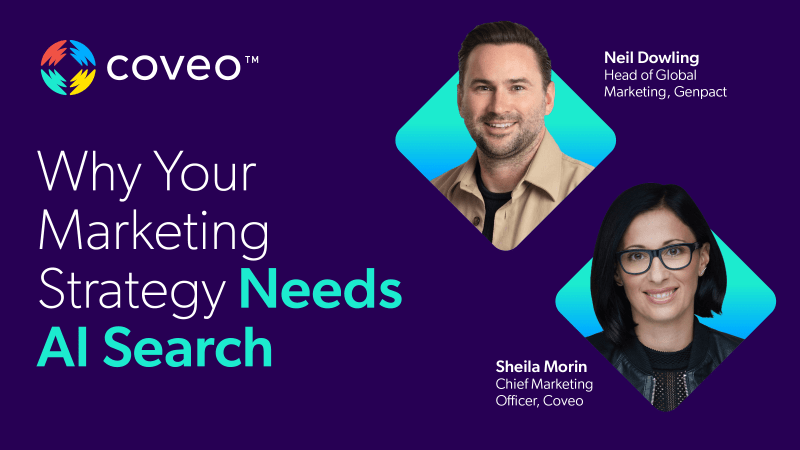
Why your Marketing Strategy needs AI Search
Learn from two experienced CMOs who have tried and tested GenAI, attesting to the unprecedented power of the technology to transform digital marketing strategies and achieve objectives — delivering one unified, personalized CX across all digital channels and thereby enhancing customer engagement in ways no longer possible with conventional methods.
In just 40 minutes, you’ll learn:
- Why typical inbound marketing efforts are now insufficient following the GenAI revolution.
- How AI-fueled personalization is an unavoidable paradigm-shift for increasing customer engagement and retention.
- The ways an AI-fueled platform spots your own weaknesses before the competition does.
- Three crucial steps to get ahead of the field now on AI search and achieve exponential growth.


Make every experience relevant with Coveo