
Hello, everyone. Welcome to today's webinar. My name is Brenda. I'm here today to help you, with any general or technical questions that you may have. Now, before we do get started, I would like to welcome you to today's webinar, which is three secrets to accelerating transformation to improve CX and EX. Now, here on the screen, you'll see a quick overview of today's agenda. Now this is just a rough breakdown, so please don't hold us to these exact times, but we'll take about five minutes for introductions. We'll have the core of the content, for about thirty five to forty minutes, and then we'll jump into some q and a questions here towards the end. Now here on your screen now, you'll see a little bit about CMS wired. Now we were founded in two thousand and three, and we do cover these primary topics that you see here on your slide. You can read more about our great content, register for upcoming conferences and webinars like today, all by visiting cmswire dot com. Now, of course, we're here today thanks to our sponsor, Coveo. A big shout out to them for making today's webinar possible. And here's a little bit just about Coveo here. So Coveo provides solutions for ecommerce service website and workplace applications. They are designed to provide tangible value to their customers by helping drive revenue growth, reduce customer support costs, increase customer satisfaction and website engagement, and improve employee proficiency and satisfaction. Coveo has more than fifteen hundred successful implementations around the world with clients including Tableau, Dell, Palo Alto, Xero, and Motorola Solutions. Coveo is supported by a network of accredited global partners, integrators, and alliances, including Salesforce, ServiceNow, Sitecore, Accenture, Deloitte, and Ernst and Young. You can, of course, learn more about Coveo by visiting their website, which is coveo dot com. Now, before we proceed, I do just wanna go over a few housekeeping items. So, on your screen, you will see a few different sections there. So you'll see the chat, which you can, engage with other attendees or ask questions to our presenters. You can also reach out to me. Again, my name is Brenda. You can reach out to me and let me know if you're having any technical issues. I will go ahead and jump in and address those there. If you have any questions throughout the webinar, please feel free to submit those using the ask a question feature on the left hand side of your screen. And, we will, of course, address those during the Q and A session. Now, during today's webinar, we will be utilizing, the polling features. So once we, see or once we launch those polls, you'll see a pop up on your screen. You'll have the question with some answer options displayed. You'll just need to click on them and then you can close out the window. We will also send the results of the poll to your screen. Again, that will show up as a pop up so you can see what yourself and the attendees today, selected for that particular question. Now, I would like to go ahead and introduce today's speakers. I am joined by Isaac Sacowick and Juanita O'Quin. And, here's a little bit about them. So, Isaac is a former CTO and CIO and currently president of Star CIO, where he leads their digital transformation center of excellence programs. He has over eight hundred articles published on c I o dot com, info world, and his blog, Social Agile and Transformation. He's an Amazon bestseller and his new book, Digital Trailblazer, he tells his stories and shares lessons on leading transformation. Now I'm also joined today again by Quanita Oguin. She is senior director of marketing at Coveo, focused on helping companies make sense of their enterprise wide and departmental focused digital strategies with a goal of creating a connected experience. Juanita, Isaac, thank you both so much for being here today. And I am gonna go ahead and pass it over to Juanita to get us, just to jump straight into the content here. So, Juanita, over to you. Thank you, Brenda, and hi, everyone. We are really excited to be here with you at a time when there is so much disruption, but also so much opportunity. When we think about the state of business, what we really do see are three, interconnected trends impacting all of us today. The first is macroeconomic shifts, the evolution of talent, and digital transformation. On the macroeconomic side, we know this by things such as a pandemic, thoughts and discussion of an impending recession, as well as the volatile stock stock market and how that responds to all these macroeconomic shifts. Similarly, on the evolution of talent side, there's a lot happening. Everything from the shift of power dynamic from being employer to employee led, discussion of layoffs, as well as the latest trend of quiet quitting. And on the digital transformation side, really, this is about the fact that business must continue and organizations have to continue to optimize. And these three together really provide an opportunity for everyone to take a step forward, which is what we're here to talk to you about today. I think the other takeaways here are that change and uncertainty are here to stay. We can all agree with that. Businesses are always going to need top talent, and technology can really be that enabler and provide a competitive advantage if thought about in the right ways. Many might say and think there's such an abundance of tools that are out there today. What you see here is a chart from Gartner that shows just the emerging technologies that are out there, and each different slice represents a different area of the tech space. And it it's just the emerging technology. It does not necessarily represent, what's there in place today, the need to innovate, as rapidly as possible. And so there's an abundance of technology out there today. The hard part is making sense of it and trying to figure out where you can have the greatest impact. And our view is that you can have a great impact and kind of kind of move through all the noise by focusing and simplifying your customer and employee workflows. These are typically thought of as distinct and separate initiatives and programs and are sometimes looked at and owned by different groups. But when you take a step back and think about the employee experience as well as the customer experience, there's actually a lot of similarities and similar knowledge that both key stakeholders are looking for. And so that's what we wanna talk to you about, are ways that you can accelerate your transformation by rethinking your digital technology. And I'm really excited to be here with Isaac to talk about those three secrets that you can use to help accelerate your transformation efforts. And so, Isaac, are you ready to jump into secret number one? Absolutely. It's great to meet everybody, and I'm happy to share some best practices around implementing search and customer and employee experiences and really driving impact during this time of incredible transformation and lots of things going on, in our organizations. Awesome. Thank you so much. So let's talk about secret number one, which, you call force multipliers. Can you tell us what do you mean by that? What are these force multipliers? Yeah. So a force multiplier basically means when you take two or three things that you could do independently, you can invest in independently, you can you can, allocate teams independently, too. But when you put them together, you start getting more than the sum of their parts. It's actually a military term that works really well when we think about all the different things that we're trying to transform in our organizations. And today, I think it's incredibly relevant. You know, we used to think about being able to invest in customer experiences. You know, let's go upgrade our applications. Let's go make sure that we can personify different areas or personalize different areas of our applications. So we'd have one group of teams and people really working on customer experiences. We'd have another group of teams thinking through, you know, how do we improve employee workflows? How do we automate more? How do we use different sets of tools to actually run different operations within our business? And when you look at those that separation between customer and employee experience, you know, it was really technology driven over the last ten years, right? We had one set of technologies they were using internally, a different set of technologies used for customer facing. They require different skill sets to manage. And so we ended up with information silos, and we ended up with disconnected workflows. And the place you could see that most is in customer service. So what what force multiplier says is I'm gonna connect the entire ecosystem from supplier to employee or to customer to customer support, make sure that they have access to the same information or at least consistent information, and build one set of unified experiences off of it. Another example is just thinking about how we invest in technology. We sometimes think of technologies that are in in platforms that are gonna help us grow, our business, and then we think about other technologies that are gonna enable us to save costs or to be more efficient or, improve quality. And when I think about force multipliers, I think about platform investments with transformation, which means I'm actually changing both how the business is operating from a business model perspective, but also how we're operating inside. And we're doing one investment that's impacting both top line and bottom line. So that's a full force multiplier. We're doing a couple of examples around this. And what I need, you know, just to share, you know, kind of a story around this, this is a little bit ways back, but I was, I I've spent half my career as a c I CTO, half my career as a CIO. And, again, very often, we'd have to separate our investments out. But here we were, we were actually a construction data company. That means providing data and analytics back to our customers, that we were also using internally for internal products. This this product had several hundred thousand, different documents that we were enabling through search. They were being searched on, I think, somewhere around forty or fifty different terms. And what our users had at the time was an advanced search that looked this big. I'm trying to see if I can get it on screen. But it was like one mile long. You'd have to sit there and scroll through rows and rows of field information. It was because, you know, our product teams at the time said we don't know how people are searching. You know, some smaller contractors will will wanna search on this handful of fields, larger ones will wanna search on more fields. So we kinda threw them the kitchen sink, and that was the only way we could develop, an application back then was to put everything on one page. Today, we can develop personas. We can develop different products. We can use APIs to give access to those different products. I can use a low code developed, interface for my internal users. I can build a pro code interface for my external users. And then all of a sudden, I can build one set of capabilities around this dataset, but also build out many products against that. And it wasn't easy to convince back then, talking to my CEO, hey. We should do something completely different, in how we're building our technologies out. But we went on to build five different products over eighteen months with that mindset that we're going to bring our information together, we're going to understand what our employees need, what our end users need, and we're going to create one set of capabilities that enabled all of our different personas and customer segments to be successful. That's great. Thank you so much for sharing that. How easy was it to try and bring that all together? That's a great question. Back then, so this was two thousand nine through twelve, it really wasn't all that easy, you know? And the reason is the technologies were very development centric. We had to first deploy, more than one technology into a data center. So, you know, what we take for granted today, not just in terms of the cloud, but what we can get in terms of SaaS, integrating with SaaS platforms, you know, every single data source that we wanted to bring content into. We had to build, a set of APIs and a set of connections into those data sources. So that wasn't easy. And then I would say probably the hardest thing was working on search relevancy. Okay? We had different stakeholders coming at the problem from different vantage points. They wanted the results ranked differently, so they had different mindsets around this. We didn't have machine learning built into the search engines back then, so we kinda had to figure out the heuristics ourselves. And every time we figured something out, it would make one area of the application work better for a segment of users and probably reduce the experience for others. So, I mean, you look at it today, you know, I can use SaaS environments to get my environment my search up and running right away, as integrations with all the common platforms with Salesforce, with Workday, with different content management systems. So I don't have to figure out how to do all the connections. And then I I really look forward when the machine learning is built inside the product. And instead of having heuristics and hard set rules coming from my stakeholders, I'm using feedback loops from my customers to help gauge what content to prioritize in what situations. There's so many game changers compared to the legacy search technologies that we worked with five, ten, fifteen years ago. No. That's great. I mean, isn't that wonderful how fast technology advances over time? Yes. Yes. I wanted to take a moment to just pull the audience in, and just get a sense for what types of digital transformation projects you're looking to, implement at your organization. So if, Brenda, you could help me run the poll. Are you looking to really transform internal employee workspaces, external customer support sites, internal customer support agent efficiency, or external customer facing conversion sites. Be good to hear what people are working on and what challenges, they're experiencing. And if, of course, you can let us know, your thoughts in the chat. Isaac, if if I had to ask you ask you, what do you think the results might be swayed towards? Well, I I that's that's a hard question for me to answer, but I will tell you what I think. I think it needs to be a little bit of all the above. And and the reason is is, again, you know, for me to you know, I play the role of CTOs and CIOs. I am looking for areas where I can impact the business in multiple different ways. And tell me I can get something that focuses on one business at a time, maybe, enables them to improve customer experiences, provide adequate information back to my customer support teams, and then really create analytics and knowledge for my employees so that they're smarter around an end to end workflow. You know, my perspective is sign me up. Let's see how we can do this. Show me that we can do this rapidly, and bring the alignment together between our stakeholders and our technologists so that we can have successful outcomes and that we can continue to iterate and improve as end users tell us what's important and as they give us feedback through their product usage. Well, that's amazing. Well, I will share with you that we are seeing a top, response be internal customer support agent efficiency. So a lot of people who are interested there. There's also almost a tie between Internet use cases as well as just those external marketing basing sites. So a little bit across the board in terms of multi use case. Yeah. I think that's I I think that's fascinating and really important. I mean, this is a story I tell all the time. I mean, I open support tickets with SaaS technologies all the time. I probably use probably between fifteen and twenty SaaS technologies just in my business. And I love it when they call I call them up and they know nothing about me as a customer. They know nothing that I'm a little bit technically savvy, that I'm right a writer, that I'm a social influencer and when I get sort of that, you know, Go restart your browser or restart your computer as a as a response to my problem They're really not figuring out who I am what products I'm using, maybe, you know, connecting it into the, you know, the DevOps, logs and system errors and showing, hey. Maybe Isaac is actually having a problem here. So there's incredible opportunities when you look at how to bring real time information to your customer support teams, make them, enable them to be smarter and enable them to actually solve problems on behalf of their users. Lots of good things happen when that when you can be able to provide that capability. Yeah. Absolutely. I think this is a good segue into our second secret to accelerating transformation. And you talked about this a little bit, which is how do you build alignment and relationships across the business? So secret number two, uncomfortable collaboration. Can you tell us what you mean and what experiences you've had here? Yeah. My version of this is collegial debate, and sometimes it's gets into even, some some very heated debates on how to actually prioritize the work that you're doing, how to think about, what areas of the business to focus on, what areas of the business to focus on less. I mean, just looking at your last poll, right? Every organization is a little bit different in its point of time in terms of what area to invest in, whether it's a business unit or a department that you're serving. And so, you know, as a transformation leader, I want to be able to bring that debate out. Okay? I want to be able to see, what people are thinking. I wanna hear all the voices in the room. And then I wanna pull back and say, okay, we have to make some decisions here about doing things a little bit differently than we have done in the past. Because, you know, first and foremost, there's different areas of our business that become more important. But second is that, you know, the technologies change so dramatically. So I'm gonna share a story just going back to my book, Digital Trailblazer. I tell a story from when I was the CIO at BusinessWeek magazine. And if you looked at a magazine website back in two thousand seven, it was operating very close to how a magazine operated. You know, magazine, you produce your article, and you go into a set of tools to actually decide what goes on page one, two, three, four, and five. You figure out all the layouts, and it's a pretty, laborious process to actually go out and construct the end to end magazine from page one to sixty. Well, they took that process and not just BusinessWeek. This is the way it was done back then. You took that process and you mimic that on the web and you took your editors and you gave them a content management system and you said, you know, what goes over here and what goes over here and what terms should people search on and what's the ordering of the different, articles. And if I wrote an article for Business Week back then, I was being asked to, tell the readers what articles they might want to read as follow on articles. And what you see there is a lot of time consuming effort. Right? Doing the layouts, figuring out what related content was. And, you know, our editors, they were incredibly smart people. I mean, they were, you know, reacting to the financial crisis of two thousand and eight and trying to guide, business people what to do after them. Really, really smart, intellectually, really amazing people, to work with back there. But we have to really challenge their thinking and say, look, the web is different. We have algorithms that we can help us do this a little bit differently. And I tell the story when we implemented an ab test around related content. So we took some pages where the, some deliveries where the article had the related content, that the editor picked, you know, and they would pick five articles that way. And then we put up an algorithm that said, we're gonna come up with the related articles that the algorithm tells us based on semantics in the content, based on what people were clicking on, based on other factors that we could feed the engine, maybe the the duration or the the, the, the length of time the content was up. And we came up with our own file We did an ab test and lo and behold, the algorithm was outperforming the editors for the very simple reason the algorithm had better data and more real time data It understood users. It could do machine learning against a lot more parameters than the heuristics that our writers did. And we presented that result back to the editor of BusinessWeek at that time, and that his his expression on his face was just something that I I will remember for the rest of my life. It was just not so much of shock. It was more of, well, what do we do now? How do we do things differently, now that we know this as a fact? What do we have to establish as a new operating model, if we put this technology in place? And so that's what I mean by uncomfortable collaboration. You're gonna bring technologies, capabilities into your organization that are vastly different than how you were operating before. And sometimes that's on the business side when you think about using automation. Sometimes it's on the customer experience side when you start using the information that you have to create personas, and using the capabilities that you have to build not just one way of, of working with your data and your content, but multiple ways of using data and content. It's about, letting a machine learning algorithm present results back to you. Even back many of you are developers or engineers. Even back to I'm gonna use low code for some of my interfaces and use pro code for other interfaces because I wanna be more efficient when I'm building certain tools out. So all those are just challenging the way we're thinking. And, again, when you're trying to bring new transformative capabilities into your organization, you're going to put your people in your group into that uncomfortable situation where we're doing something completely different than the way we've done before. Is this safe? Is this gonna work? And the answer to that is you have to do it through experiments and using feedback to continue to adjust and improve, what your experiences look like for your different audiences. Thank you for that. I do wanna, ask you because this is I call it the great debate. IT versus the business. Any tips or suggestions for the audience here on how to think about really being partners with the two between the two, creating a great partnership? Yeah. I you know, a couple answers around that. There's first some education that really needs to happen. And very often, this is IT led education, but there's still a mindset, particularly around the business, that business buys technology, business rights requirements, and IT implements. Okay? And IT, therefore, can look at implementing things that you have enough subject matter expertise on, that you understand how an ERP works or you understand how content management system works or learn working within the confines of a workflow for one department. When you start looking at technologies that are, again, force multipliers, they're impacting both employee experience and customer experience. There's a little bit of education, and it really comes down to agility and agile collaboration. You know, what's the role of a stakeholder? What's the role of a product manager and a product owner? How do things get prioritized? How do we work as a team? Right? If I'm doing one of these technologies that is a force multiplier technology, I'm gonna lead with that. How do we bring our business teams together, business leaders together? So they learn a little bit from us as technologists. Technologists learn a lot from our business users in terms of what customers want, where's the market going, how do we make money in what we're doing, who our competitors Barca. And we're working as a collaborative team after that. And, you know, Juanita, I just finished a white paper that talked a lot about bringing together IT, data, marketers, operations together in one agile team. And then they're looking at how do we evolve these different customer experiences and employee experiences with these different personas so that we could start driving outcomes off of it. Yeah. No. That's great. Thank you for sharing that, and looking forward to reading that. I think this is also a natural, segue into our third secret, which is around knowledge management. Can you talk to us about why this is why this made it on the list of the top three, and what does this mean from your perspective in IT and the business and why it's so important? Yeah. If you look at, quite frankly, where we where if you look at where we were I'm getting an echo. That's why I'm pausing. If you look at where we were, before COVID, right, and we were using a set of tools to operate, to collaborate, to make decisions. You know, the tools we were using back then largely relied on our ability to get into a room, and to be able to have a conversation and to be able to make some decisions, whether it's at a water cooler or in an office we spent the last two years figuring out how to Do basic operations in a hybrid working world how to work from home how to be remote And now you look at where we are today, and many of you work at companies that want to try continuing with hybrid work experiences. Many of you are working in companies that have really important talent, that are subject matter experts in how things are working today. And we're living in a time when, you know, the the knowledge is potentially getting lost when employees leave the organization. We're also bringing a lot of people into our organization either to replace them or to continue to bring talent in. And the most important thing that we wanna make sure is that knowledge is kept, is is retained, is that we have a single place to go to, when we bring on in a new employee and they say, okay, I've got my computer checked, I've got my mobile device checked, I'm starting to learn a little bit about my job, and I wanna know a little bit more about who the people in our organization are that I need to interface with. Tell me a little bit more about the operation. Show me a little bit about what the KPIs are and how we've been operating in the past. If we have customers, market segments, personas, explain those things to me. And the question is, you know, how do I find these things? Right? We're all still working with a limited amount of real estate on our screens and our mobile devices, but with a vast amount of knowledge out there that's been created in the past and that continues to get created. And so I think as we're looking into the next couple of years, I think knowledge management becomes tremendously, important, because we're losing some of it and we need to accelerate, our ability to transform with new people coming in, with new partners coming in. So we need a base of knowledge that we continue to operate. I think one of the challenges I see with this is the is really two things. Number one, this notion that you have to have all that knowledge and all that capability running and operating at once. Right? We're so used to this notion of we have website or portal number one, we're gonna move everybody to portal number two, and it's gonna have all the capabilities that our old portal have before we go to our new portal. And that's just not how I've done things in the past. I've always looked at, you know, which department, which business, which set of users are really gonna be our our early adopters. What type of content do they need access to? How do we want to structure it? How do we want to enable search around it? How do we want to think about different roles? You know, so customer support may need different types of information than our sales team, than our developers need. So I'm going to try to think of that, solve that problem in one small area of our company, and then look at and say, okay, how can I replicate this? How can I create a a search center of excellence that says once we figured it out for one group, we're gonna continue to replicate that and figure out who's the next group that we're gonna go out and do this with? Very agile, way of thinking about releasing capabilities in increments. I think the other side of this is, you know, I talked to a CIO a couple years, a couple months ago actually, and his organization was going through lots of mergers and acquisitions. And if you've ever been through that, you start thinking about how do you integrate. Right? How are we gonna bring the systems together that bring company a and company b together? How do we bring the culture together? How do we start creating some synergies in an operating model? That, again, is a force multiplier. We wanna improve top line and improve efficiencies around that. And so, yes, we go through some block and tackling. We gotta get everybody on the same email systems. We gotta potentially merge ERPs. So we have one way of doing financial systems. So there's some basic block and tackling that needs to happen with that. But the part that I really get excited about is when we start merging our knowledge management tools, merging our ways of working together, and finding ways to collaborate so that when I bring a company in, I know a lot about how they operate. I know a lot about their terminology. I know who the go to people for different parts of the operation. And that's all a combination of Pirtle knowledge management and search technologies that are so critically important for us to put on the radar as we're thinking about not just responding to where we are from a hybrid working perspective, but also being able to handle acquisitions going into the future. That's perfect. Thank you for that. I I also wanted to share, you know, we were hearing from certain customers or prospects that they wanted their taxonomy and knowledge management systems to be perfect before getting started with any sort of, search projects. And so what would you say to someone that thinks they have to have all of that taxonomy perfection in place before making changes? I got news for you. Amazon doesn't have the perfect taxonomy either. You know? It it's it's you always have to look at knowledge management capabilities as a work in progress. Okay? And if we try to boil the ocean, you're gonna end up with a search screen that looks two miles long because you're trying to do too much too quickly. You unwind that and you start looking at what is the smallest increment that I can provide back to a segment of end users so I start can start getting some feedback? And if you're providing a value service, if you're applying valuable information, they're gonna come back and be vocal. And if you're going to continue to push the envelope, I talk a lot about what digital trailblazers have to do, go out and ask them. Right? Is this working for you? What else would you like to be doing with the information? What what's not working well? And you're gonna get, feedback that you expected to hear, and you're gonna get a lot of feedback that you didn't expect to hear. So what we really wanna be able to do, you know, especially around taxonomies, is is not try to get the perfect taxonomy. Get a rudimentary one. Get one that you know that's underserving what your expectations ought to be. Put it out there. Put it out there with reasonable quality. Right? I don't wanna put out something that I know is broken. So what you put out there should work reasonably well and then come back and start asking your end users, how do we improve this? And let them be your guides in terms of how you grow your taxonomies and how you grow your categorizations. You know, when you need another part of this, there's a lot of people on this call probably creating content. Right? And so you start asking questions about, you know, how does the taxonomy and usage give us indicators about what content I create. I'm a content creator. I write ten articles every single month, and the most important thing I do is go back to my analytics and tell me what people are looking at, who's looking at them, what are they doing after they look at my content? So what is the content analytics that look after this? And then I bring that all together and I say, you know, how can I discern what my end users, what my customers are telling me about what content I should create and what questions I should answer in my forward looking articles that I'm creating? A lot of that is unstructured. Right? As you talk about, you know, what we've been doing really well over the last ten years is working a lot with structured data, which is, you know, rows and columns for all intents and purposes. When you look at trying to get qualitative feedback, I'm gonna do a survey, or I'm gonna ask an open end question, bring that information back and say, you know, how do I develop some analytics off of this? This is this is where we're gonna be pushing the envelope in terms of capabilities with our organization, and that's how we develop competitive capabilities that push the envelope and allow us to leapfrog our competition. Amazing. Thank you. You talk a lot about going from strategy to going diving into the weeds and being able to do both. And so what I wanted to do is pull the audience to get a sense, from a higher level perspective, what are some of those business outcomes you're looking to achieve? Is your project really intended to increase revenues? Is it to lower cost? Are you looking to just improve overall digital experiences? Maybe it's future proof the company. We'd love to hear your thoughts here on what you're really trying to achieve, and it's a balance. You were talking, Isaac, about how about more of the tactical and technical aspects of of running out a project, but it's always good to step back and understand why we're doing this. So any any thoughts here on what the audience might be, trending towards? Oh, I think you're gonna see improved overall experiences, mostly because we can directly impact that, through through capabilities that we build. You know, increasing revenue has a lot of other things that need to happen to make that successful. Even lowering costs have a lot of things that have to come out of that. And so, you know, I talked earlier about collaboration. Right? If you ask me, you know, as a leader, I'm trying to do all of those again. Okay? And I'm trying to hit a home run and try to do all those at once. But I'm gonna bring my stakeholders, my executives together and say, you know, let's align on a vision. Right? I can't dramatically increase our revenue on our first three or six months of working with this technology yet because I have to impact customer experience first. I have to see that they are using our capabilities, that our repeat visits are going up, that our time on-site is going up, that, you know, if you're a retail site, what they're spending with us is going up. If you're a bank that they're finding the information that they're looking for, if you're focused on employee experience, you know, I I wanna see that they're engaged with content and not having to do five, ten, fifteen searches to find the things that they're looking for. So I'm gonna look for those experience metrics first, and then I'm gonna say, okay, How do we drive financial outcomes after that? What did our poll tell us? It looks like you you you predicted the future here. It looks like overwhelmingly, our fifty two percent said improved overall experiences. So spot on. Super. We are now going to move into, hopefully, a fun, exercise here, what we are calling a lightning round of questions with Isaac. So I do see a few questions in the chat. Please do feel free to send others along. Isaac, the instructions for you are, I'm gonna shoot you a question or a topic, and you have up to thirty seconds to answer that first thing that comes to mind. So let's see how this goes. Sure. Go for it. Alright. What is technical debt, and how how do you manage it best? Oh, boy. Well, the one on one of technical debt for me are the boulders in your way from being able to accomplish a business objective They're technical in nature. I mean, I have data debt. I have operational debt technical debt could be as big as a legacy system that I have to do modernization on. It could be some code that I wanna get cleaner to be more scalable, more reliable. Very often technical debt are things that I have to do upfront before I can actually work on the business objective. But I'll share a secret. The art of this is finding alignment between fixing technical debt and improving a business capability at the same time. And then you get that false force for, you get that force multiplier where you're able to fix a technical debt issue, which I'm sure all of our technologists on this call, are very interested in doing, but also delivering something toward a business outcome. Thank you. EX or CX first? CX. I'm sorry. You know, I, and I've done this many, many times, but I'm going to focus on the customers first. Let them work with my business capabilities, my products and services, and that's gonna start telling me what their new needs are. Once I know what their new needs are, I see what they're buying, I'm seeing what they're reading, I'm seeing what services they're looking for, that's gonna start changing my employee model, what types of workflows I need to create, what information I need to provide our customers support. So I generally start with customer experience first unless I know I I find out I have something that I call a burning fire. And a burning fire means something is completely not working. You know, if you have a customer support function that has no access to information against a really significant revenue stream, maybe I'm gonna go solve that problem first, make customer support more successful, and then go back to customer experience. So couple of ways to think about it, but in general, I'm gonna focus on the customer first. Okay. Thank you. Build versus buy. Oh, I'm gonna go with none of the above. How's that for an answer? You know, I think that's a legacy question. It comes back from the times, before cloud and services and SaaS, and low code and and no code where you really had that choice. You were either building a dot net app or a Java app, or you were buying what we used to call COTS, custom off the shelf software. And, you know, if you were a business, outside of the technology space, you were more likely to buy. And if you were, in the technology space or required a really differentiating capability, you would go out and build. If you look at it today, I have a lot of shades of gray that in or that fall in between those two extremes. I'm looking for how do I deliver the best capabilities? What do I need to improve customers and employee experiences? Where is the business going over the next two or three years? And I'm probably defining a set of platforms and an overall architecture that's a mix of these two things. In some cases, I'm doing some pro code. In some cases, I'm doing some low code. In some cases, I'm buying a technology, and sometimes I'm completely building it. But my end to end experience is probably gonna have a mix of these different ways of thinking about how we invest in technology. Amazing. Thank you. Why agile and agile gone wrong? Wow. So, you know, if you read my books, I'm always starting transformation programs with agile. And there's a couple of reasons for this, but let me try to keep it short since it's a lightning round. First is I know I you know, we never know what our real requirements are. Our customer needs are changing. Our you know, we learn from the experience. So I wanna be able to be agile, put things out in small releases, measure feedback, and continuously change what I'm working on. That applies to not just how I think about software releases, but I'm also thinking about the transformation impact. How do I make sure that the value is coming from where I expect it from, that our end users are actually using the technologies that we're putting out there, that they're growing with us. How do I create that collaboration, that multidisciplinary collaboration between marketers and data scientists and technologists? And, you know, agile is, a way of working. It's a way of operating. There's some structured ways in scrum and kanban to do this. But I think it's really important for organizations to realize that we're on a journey. Transformation has been something we've been focused on for at least five years, at least from a terminology perspective. If you read my books, you're gonna say transformation is something we have to continue to do, that what we've figured out over the last two years, there'll be new capabilities and new ways of working that we wanna evolve to over the next two years. And I think it's a core competency. So I think agile is a way of saying, how do I think medium term? How how do I consider longer term and build vision? But how do I focus my planning and my delivery on the short term? So that's why I think it's so important. Amazing. Thank you. Alright. Structured versus unstructured. You know, I I I think, actually, this is a place where we do have to leverage this terminology, and it's because our data technologies are still evolving. You know, if you think about SQL has been around since, I think, the seventies or eighties, table structures, being able to query, manage data at scale, being able to handle, data quality issues and data integration issues when it comes to structured data. I mean, there's still lots of challenging areas in the structured data spaces, but unstructured data has its own set of challenges, being able to look for entities, being able to understand sentiment, being able to bring my internally created, my first party data with third party data, with social data, being able to handle, you know, small snippets of text that somebody put into a form versus being able to navigate an entire book. You know, I mentioned my construction data company. We were scanning building documents, specs, plans, blueprints and plans, bringing all that information and making it all searchable. So it's a much more wider variety of data. We're also getting now into IoT off of unstructured data, right, when we listen to information or as we prepare to have the dialogues during the metaverse when that becomes wildly available. So we still have a lot of work to do to continue to scale and improve the quality of our structured data, but the technologies tend to be very different around unstructured data. And, you know, what I get really excited about is when I can bring my content into one place effectively, I can use a query language, I can use APIs to be able to query unstructured data like it's structured data, and then I can start doing machine learning and analytics off of it. But I think it's very important to use those two terms because we still haven't gotten the maturity of technologies that could do everything with every type of technology. And we may never get there when I ask the experts on there. That's fair. I'm gonna ask you your favorite new technology. Oh, wow. You know, I I struggled thinking about this, because I tend to actually be a laggard when it comes to using some technologies. But, you know, I think so much of what we do today is about interfacing with people, and understanding how they feel and how they work within a group, the empathy that we've had to build up over the last couple of years, the new collaborative model. And, you know, we have to be smarter about how we're partnering with our teams. And that means also understanding a lot more about ourselves. So I started using this app called How We Feel just, I think about a month ago. And every few hours, it just asks me to click on, you know, am I high energy, am I low energy, am I feeling productive, am I angry about something. And I'm starting to do a little bit of data driven analytics about when am I best to do my writing or when am I best to do a collaboration exercise or, you know, what can I learn from, best practices on how to handle certain types of emotions? So, that that particular tool has been really helpful for me. That's Barca. And I think it kind of highlights the importance of culture, wellness, which is absolutely essential, in business and teams. And you talk a lot about that in your book as well. We're nearing the end of our time, so I'm going to just move forward here and put forward two special offers for our audience in attendance today. We talked a lot about, strategy tips to accelerate transformation, and we hope that that gave you enough to get insight into how we think as well, and are helping our customers transform their organization. So for those of you on the call, we have a special offer, a limited time. For the first thirty people that book a meeting, we will get you a signed book from Isaac. You can see his digital trailblazer background. And in this meeting with us, we'll just look to understand your challenges, your pain points. But the book, which by the way I'm reading and I have a personal signed copy, is filled with so many great insights, many of which Isaac shared today. So that offer stands, and you can book directly in the chat here. Olivia has, posted it. If you're not ready yet and looking to just learn a little bit more, Isaac also just released a new white paper, and, it's called revisiting search for your enterprise tech strategy. Do you wanna share a little bit more about what people can expect in this white paper? Yeah. I mean, the number one question I often get is, Isaac, you know, we since since we have a problem here, we have tech debt, we have lots of search happening all over the organization, we don't know how to bring our business users together, to actually prioritize, a technology that I've said on my blog is probably should be in the top one or two technologies that IT departments and digital departments and marketers go out and, prioritize going into next year. So it talks about the sources of tech debt. It talks about how do we form a collaboration between the business to actually go and invest this. And then I actually give you a whole bunch of financial areas, customer experience metrics, other, KPIs that are influenced by investing in customer and employee experiences through search. So I really hope you'll download it. I'm always available to ask questions. You can find me on Twitter at n y ike, n y I k e, and I'd love to hear from you about your questions around search, customer experience, and transformation. Thanks for that. I'm gonna leave with one more question for you, which actually came in from the audience. And that question is, how do you predict the future? How do you predict the next best thing and plan for it? You know, let's go on a journey of how I might do this. And, you know, I do this manually, but a lot of other groups do this in a more automated fashion. Number one, I'm collecting a lot of information from a lot of different places. I'm looking at, you know, what's happening around social media, around who's talking about a particular technology. I'm looking for online metrics in terms of usage. I'm looking at what writers like myself are writing about. Offline, I'm going to conferences. You know what I'm seeing? I'm looking for people who are really excited about a particular technology that are stepping up and saying that, you know, they wanna talk about the use cases about where they're successful at it. I'm also looking for platforms that are applicable in multiple industries. I think it's so important to be able to say, you know, here's a technology that works in retail, that works in media, that works in financial services, that's working now in, in insurance, and, you know, I think about higher ed and I think about government and I think about patient experience in hospitals. Everything I just said has an experience that is dictated by information. And but when I bring this all together, those are some of the indicators I'm looking for, to say, yeah, this is something that I wanna pay attention to. Thank you for that. I mean, you've certainly been a trailblazer in your career, so your insights are super appreciated. With that, I think, this has this has been a great, session with you, Isaac. Thank you so much for joining us. And for our audience, thank you for tuning in and just continuing this digital transformation journey with us. You have a way to contact us. We'll be following up to just extend that offer to you, and we hope to hear from you soon. Thank you, Isaac, for your time today. Thank you. Thank you, Juanita. Thank you, Isaac. I'm gonna jump in here just for a few, closing remarks here for our audience. Again, thank you to Cabello for sponsoring today's webinar. Juanita Isaac, I know that our members, very active in the chat, had a lot of great insights and takeaways, so we truly appreciate you both being here today. For our audience today, you will be receiving a link to the recording of today's webinar in your inbox. So just keep an eye out for that so you can rewatch it, take additional notes, and even share it with your team members here. But with that, that's all we have today. And if you have any questions, please feel free to, email us here at webinars at c m s wire dot com. Again, we'll send some follow-up materials from our our sponsor, Coveo, today, via email. So thank you, everyone, and have a great rest of your day.
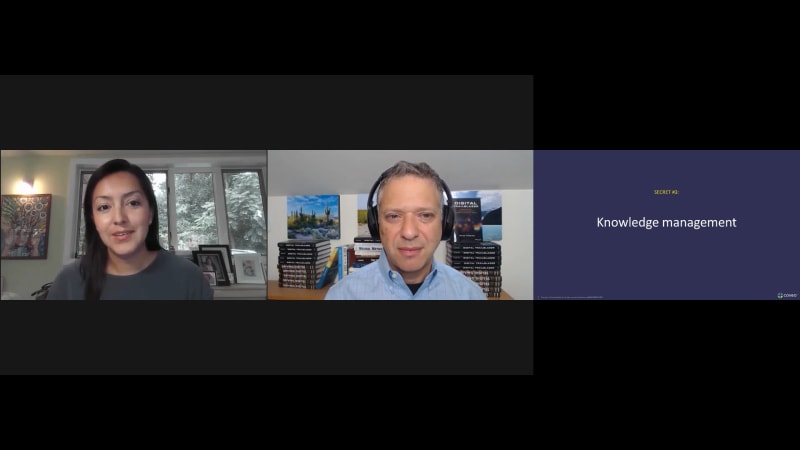

3 Secrets to Accelerating Transformation to Improve CX + EX
Join Isaac Sacolick, founder of StarCIO and author of Digital Trailblazer, and Juanita Olguin, Sr. Director of Marketing at Coveo for an intense conversation on driving digital transformation.
Sacolick, a veteran technologist who has held CTO and CIO roles, shares and unlocks the secrets of technologies, collaborative practices, and how you can deliver business outcomes by incorporating them.
In this webinar you'll learn:
- How information silos undermine CX and EX initiatives
- Platform capabilities that provide a competitive advantage
- Using an agile, feedback-driven approach from POC to production
- Realizing business value and transforming the organization