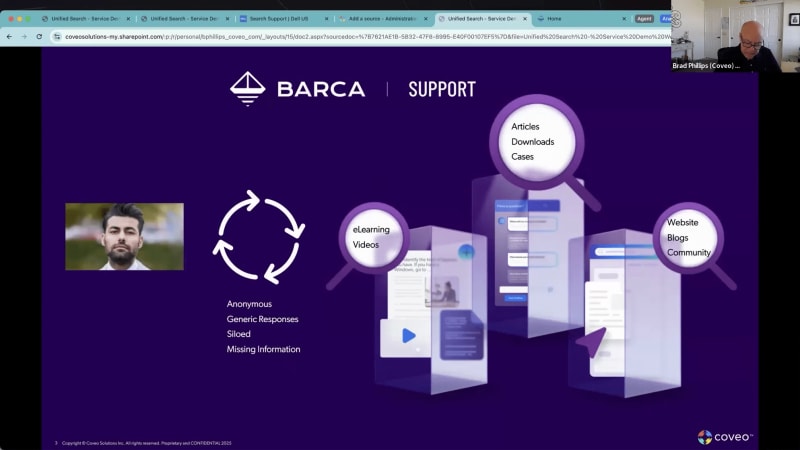
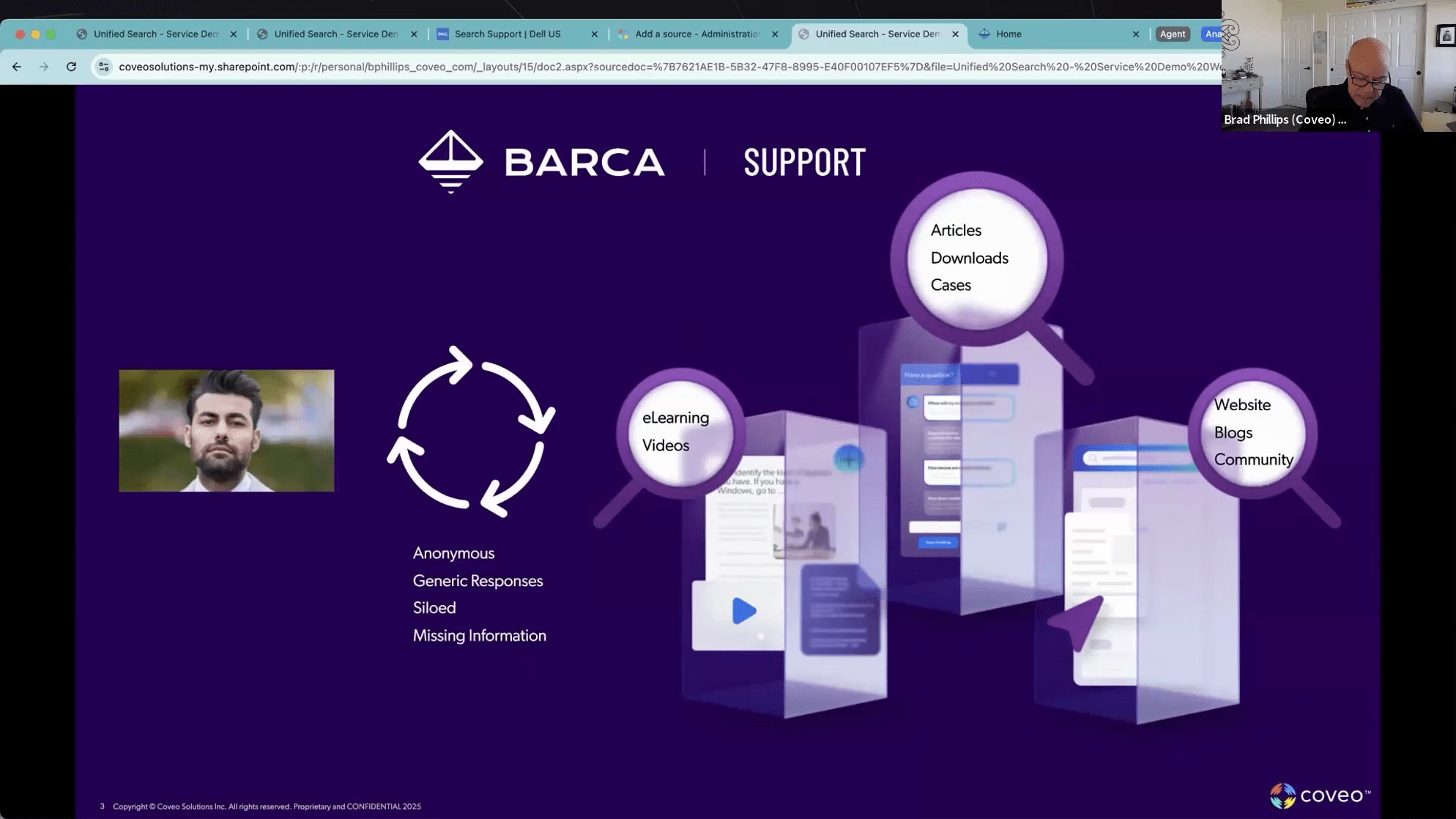
Hey, everyone. Thank you for joining our webinar today. My name is Daniel Drazen, and I am the lead product marketing manager for our service line of business at Coveo. I'm also thrilled to introduce my colleague, Brad Phillips, who is our lead solution engineer here at Coveo. We're gonna discuss a very exciting topic, AI search, the AI foundation your support strategy needs. Before we get into the content that we have prepared today, I have a couple of housekeeping items to cover real quick before we get started. First, everybody is in listen only mode. However, we do want to hear from you during the presentation. So we'll be taking some questions at the end of the session, so please feel free to send those along using the question answering section quest q and a section, on your screen. Today's webinar is being recorded. You will receive the presentation within the next twenty four hours. So with that out of the way, we have one more thing to quickly cover. Coveo is a publicly traded company, so we advise you to look at our latest earnings and our annual report on the business. And we may use some forward looking statements in the presentation, and so we recommend you to make decisions based on products that are available in the market today. So here's a quick overview of the agenda and what's gonna be covered. We will start with why unified AI search, what it is, and how you can apply that in various use cases for customer service. Everything from self-service to case deflection, to when grounding AI agents. And through the course of the webinar, Brad and I will share some real world success stories and examples of how Coveo customers have used unified search in production. And then we will switch to a live demo where Brad will take us through how Coveo looks like and how you can, how how unified AI search really works under the hood. And then at the end, we will be taking some questions. So before we get into the nuts and bolts of AI and such technology, I I wanna start with the AI. Because if we are all honest, we're drowning in these initiatives that that addresses these value drivers for customer service. We have operational efficiency, we have service quality, we have revenue growth. So these are three strategic value drivers that are defining customer service success. And what's interesting is all these three value drivers are all interconnected. For example, if you if you take service quality, it's it's no longer just about solving problems. It's service quality has really become your brand differentiator in twenty twenty five. And when customers, they can switch to a competitor with a few clicks. And because they can do that, that experience that you create for them is actually what keeps them around. And when it comes to CSAT and NPS scores, they are really important to track more than ever as those metrics are directly tied to whether customers stick with you or walk away. On the operational side, everyone's trying to figure out how to handle more volume without hiring more people. And so you want to automate the simple stuff so your team can stay focused on on the more complex issues. But you can't automate your way into terrible service. There there's this balance you have to AI. And then there's revenue growth, And this is where it gets interesting because the smartest teams aren't just thinking about support as a cost center anymore. They're actually using customer interactions to drive sales, whether that's through upselling or cross selling or just preventing churn by delivering some amazing customer service. And so when you have the right information at your fingertips, and that doesn't just and that doesn't mean hunting through five different systems, suddenly you unlock better service, you work more efficiently, and then you're able to spot revenue opportunities using analytic using analytics. And this is what's happening with the brands that have been using Coveo. So I'm excited to share more of the story and the demo and the stories that support it. And so to put some real numbers behind why this matters so much, these aren't just theoretical problems because this is what's happening right now when customer service falls short. Nearly three out of four customers, that's seventy two seventy two percent, these customers will switch companies after just one bad support experience, not multiple bad experiences, just one. So even if you have a great product, competitive pricing, solid marketing, you actually can lose a customer because they can't couldn't get the help when they needed needed it the most. And when you add all of that churn across just the US alone, we're talking about one point six trillion dollars in lost revenue annually, and that's that's a huge number. And then there's what's happening to your teams. Agent turnover is sitting at forty percent annually and it costs about twenty thousand dollars every time you have to replay some replay someone. So the bottom line is that frustrated customers and burned out teams aren't just operational headaches. They're directly hitting your revenue. Every interaction that goes wrong, every agent who quits, and every customer who walks away because they couldn't get answers, it all adds up. This is the cost of actually doing nothing about customer service today. And as a response, what's happening is everybody is turning to AI. And so with all of the costs that we just talked about, it's no surprise that service organizations are looking for AI solutions, and everybody's making a big bet on it. And what we're seeing is this massive wave of AI adoption happening in three distinct phases. It started with conversational AI, which is your basic chatbots, your FAQ automation, that kind of thing. It's pretty rule based and deterministic, but it got people comfortable with the idea of AI handling some customer interactions. Then came the generative AI boom, and suddenly we have AI assistants helping your customer service reps write better responses and summarizing conversations, even creating content on the fly. This is where most companies are right now. They're still keeping humans in the loop, but giving them some AI superpowers. And and now we're starting to see Agentic AI emerge, AI that can actually handle entire workflows end to end, make decisions, and, I mean, take actions. So that's the future state that every that everyone's racing toward. But here's the reality check. Gartner found that this was a twenty twenty four report. In twenty twenty four, they found that ninety three percent of service organizations think AI capabilities are really critical for their tech investments. But the reality in twenty twenty five is Gartner and Kane put out a report which said that only ten percent are seeing success. So the question becomes, what are those ten percent of companies doing differently? It actually comes down to something, pretty fundamental. Great AI starts with great data, and AI know it sounds pretty obvious when you say it like that that great AI starts with great data. But think about what's happening in most organizations right now. They are buying the latest and greatest AI tools, and they're excited about the possibilities, but they're feeding these systems with fragmented, outdated, or inconsistent information. So the companies that are actually seeing results from their AI investments, they aren't just thinking about the technology. They are thinking about the foundation. This is the reality most enterprises are living in today, but their knowledge is is scattered everywhere from Salesforce to SharePoint, Confluence, you name it, it has different apps. And each of these apps with has its own search, its own structure, and its own level of governance. TSIA found that support reps rely on seventeen different knowledge repositories just to do their job. It's imagine being that customer service rep AI to help the customer. Where where do you even start? Do you start finding answers in your knowledge base? Is it in Salesforce? Was there an update in Confluence last week? And so by the time a service rep checks all these different systems, your customers already spent ten minutes waiting for their answer. And so if a customer service rep has to depend on seventeen different knowledge repositories, it's the same problem for AI. If your AI is pulling from fragmented inconsistent sources, you get fragmented inconsistent answers. And so for AI to really work, it needs a unified trusted source of truth. And that's where unified search comes in, and that's the problem that it's trying to solve. We need a solid retrieval layer to solve the problem of scattered fragmented knowledge that's everywhere in the enterprise. Gartner, a couple of months, came out with this report where they said, AI requires a solid search and retrieval layer to succeed. And at Coveo, this has been our conviction, and we had been strong advocates of this principle. And now even Gartner affirms it. And so the diagram that you're seeing here shows that how traditional enterprise search typically hands results to a human who had to process that information, decide, and then act on that piece of information. But as we move into an era of AI assistance and autonomous agents, search doesn't just support the experience, it powers the whole experience. And and Gartner put it really well when they said, search is no longer a tool that's used intermittently. It's becoming the continuous fuel behind insight, decision making, and action. Coveo serves as this search and retrieval layer for over seven hundred of the largest enterprises in the world. And when I say seven hundred of the largest enterprises, I'm talking about companies you interact with every day. When you look at these logos, everything from Adobe, Salesforce, Dell, Intel, Vanguard, United Airlines, these aren't just customers. They are brands that actually serve millions of people across billions of interactions. And what's really interesting is the breadth, of these different customer, industries. You have technology companies, you have retailers, You have manufacturers, financial services, health care. So each of these industries has their own unique challenges, but they all have one thing in common, which is that they need to connect their customers and employees with the right information at the right time. And here's what gets us excited. Many of these big many of the same big enterprises are now using Coveo's relevance generative answering solution. So they're not just doing traditional search anymore. They're using AI powered Agentic to transform how they serve their customers. I want to highlight one brand that we all know, Zoom. And Zoom was dealing with the same challenge that we are talking about, siloed knowledge. And they had a rapidly growing customer base, and their customer support costs were growing right along with it. So if you look at the support site over here, you'll notice how clean and simple the interface is with that one unified search bar front and center. But behind the scenes, they're using Coveo's AI powered search and generative answering to deliver something much more sophisticated than traditional search results. And the results, Zoom achieved two point three x increase in case deflection. That means more than double the number of customers are finding answers on their own, which translates directly to lower support costs and happier customers who get instant help. And so this is who we are. This is Coveo. For over a decade, Coveo delivers superior relevance at every digital point of experience, whether that's in commerce or in service or even the workplace. By unifying content, context, and intent across millions of interactions, Coveo ensures that every user gets the most relevant experience possible through unified search, no matter where they are or how they engage. And better relevance doesn't just improve experience. It drives better business outcomes. And and so this isn't our first rodeo rodeo because we've been doing this for over fifteen years with a single focus that's making AI powered search and relevance work at the enterprise scale. And that means we've built deep partnerships with the platforms that you use, whether it's Salesforce or Genesys or Zendesk in context of customer service or even SAP. So we fit into your existing tech stack without any heavy lifting. And second, we check all the boxes when it comes to compliance and security. Our platform meets all the security standards, so your data and your customers' data is always protected. And finally, we are proud to be KCS aligned, which means our approach to knowledge management is grounded in best practices that actually work in the real world. I'm not gonna spend too much time on the slide, but if it helps to give you a visual of our credibility with analysts, we hope that you can take from the slide. We've constantly being featured in the Gartner Magic Quadrants and the Forrester waves. Before we jump into the live demo, I want to give a quick visual of Coveo's platform. So on one side, you have all of your content and your context data. And as we discussed, it's scattered across dozens of systems and formats and teams. And that could be Salesforce. It could be ServiceNow. It could be SharePoint, Google Drive, Confluence, or any of the dozens of other systems that you use today. On the other side, you have all of your different points of experience, your service portal, your community, your AI assistants, your agent consoles, and even beyond service, you have your commerce store, marketing AI, and workplace. So you have these different touch points. And in the middle, we have the Coveo AI relevance platform that sits right in the middle acting as that connective tissue between these two worlds. It unifies all of that content and context. It understands it. It enriches it and then delivers the right answer or recommendation into every digital point of experience. Now if when we open up the hood just a bit more, what you would see is we bring in all of this data and knowledge securely using our out of the box connectors. That means you don't you don't have to migrate or duplicate any of your data. Using our out of the box connectors, you're able to retrieve all of your data and knowledge and index it securely index it, securely and vectorize it using our unified hybrid index, And that's where the knowledge gets stored. And on top of that, you have Coveo's core relevance layer, which includes lexical, semantic, behavioral, and intent aware ranking models. It can also optimize and balance these different models, and additional factors are introduced so it can tune and rank these different answers and results towards a specific business outcome. And what's interesting now is we are we are we're excited to extend these capabilities by bringing your own LLM into the mix through your chatbot or AI Agentic. And you use Coveo to retrieve all the relevant context and content grounding your AI agent or AI assistant with our passage retrieval API. Or the other option through our answer API is if you wanna skip the complexity and you can just leverage our out of the box generative answering solution, where we handle all of the prompt engineering for you. And so with our answer API, you can seamlessly deliver trusted context rich generative answers directly into your chatbot or AI agent. And so now that you've seen how the platform works under the hood, I want to set up the story for Brad, who's gonna share the demo in a minute, to talk about the different use cases that he's going to show. If Coveo delivers these accurate, relevant and secure experiences across all of your touch points in the customer service journey, everything from in app support to your self-service portal, to even grounding AI agents, chatbots, and co pilots, and help deflect cases in your case form submission workflow. And finally, finally, even helping Agentic, your human service reps working in their agent consoles to discover knowledge more more quickly and more efficiently so that it could empower them to resolve cases much more faster. So all of this is isn't just theory. It's actually what global leaders are doing today when I spoke about these different use cases and Coveo bringing relevance to different touch points, Dell Technologies is actually a great example. They use Coveo across more than twenty five use cases spanning their employee, consumer, and business customer interactions. So you have AI relevance embedded in their commerce store, in their online community, in their support portal, all the way to agent consult. So Coveo is embedded throughout their ecosystem. So I'm really excited to share how this looks like in production. Brad is gonna help, demo Coveo, and excited to bring Brad into the conversation. Alright. Thanks so much, Danny. So, yeah, Dell is seeing tremendous business value from Coveo AI. So we thought this was a good starting point. Obviously, as Danny talked about, several customers, you know, nearly a hundred customers right now using Coveo's generative AI solutions growing every day. There's many in your industry or use your use case we can talk about. This happens to be one of those production customers that you can go out and visit yourself. Hopefully, we can keep your attention for today, and you can visit it after the fact. Many others AI Zoom that we can also show you as well. But I just went ahead and preopened Dell's support AI, just one of the scenarios that they're using Coveo AI, within. So here we've executed a query, and you notice this is not a single word query, a two word query. This is a natural language query that I'm performing here. How do I remote control a Dell server? Now you might have noticed the banner at the bottom or the sign in link up at the top here. I'm gonna talk a lot about relevance as well as unified indexing here because Dell and others recognize that they wanna treat each customer uniquely. Customers have different intent. So if I were to authenticate, they might recognize Brad's got a room full of servers or they might recognize Brad has one single latitude laptop. And my queries then may lead to very different generated answers, very different search results, and so on. So here you can see I've executed a query how to remote control a Dell server. On the left hand side, as Danny described, we go really deep in indexing and surfacing all of these different, items, all these different repositories, and bringing those together in this one interface here. As I scroll down the page, you see some of those search results that are very relevant to me. This is very knowledge base heavy, but they have a lot of, video content, manuals, etcetera. And then this is really where AI, bonus happens as far as generated answering to just answer my question. Yeah. I may not even have to do any further navigation here. You notice I've got citations that indicate, in this case, there were a couple of different items where passages were retrieved, passed to the LLM, and compiled together to give me this very meaningful step by step answer. So I can certainly drill into the details here. I could do more filtering. But, generally, the answer I'm looking for is typically provided right above here. Alright. So that's Dell. Let's oh, actually, how did Dell do that? Let me just briefly give you a little idea of that. I'm in the Coveo admin console here. We talked about connectivity. So Caveo has a library of connectors that Danny described on some of our architecture slides. Those connectors, certainly for cloud systems that are well known on premise systems, databases, you can push content to Caveo. You can use one of these, point and click, pull connectors as well to index content. So once Dell went through the process of indexing their manuals, their SharePoint, all of their different content, they use Coveo's tools to configure the AI models to set up relevancy rules, and then to set up the user interface AI you saw multiple other use cases. So on other session, we can certainly go deeper with you on how Dell and others implemented this. So let's go a little bit deeper though here on how Kaveo is delighting customers, reducing costs, and increasing agent efficiency as Danny was describing earlier. And the example I wanna use here is a demo company, but this is Barca. They are a software and a hardware provider for the boating industry. And like most large enterprises like Dell, as we just saw, Barca's got a variety of information systems that ranges from, know, their reason Salesforce for their knowledge articles. They're using Adobe for all their website and marketing content. They've got, software downloads sitting out in file servers. They've got their cases in the CRM. They've got customer collaboration, communities, elearning, so on and so on. So this first scenario AI I'm gonna take you through, we're going to step into the boat shoes of Barca's customer, and that's John Steele. Now before Coveo was introduced, this was the experience for John. What did Danny say? Service reps have, like, seventeen reps typically. Well, same thing for customers. We were, in the past, forcing those customers to find their way to these different silos. Each of them might have had their own search or navigation experience. Very painful for customers. It was a very anonymous experience. We didn't know anything about the customer without Coveo. So Barca was just providing these very generic siloed responses. So when Coveo was introduced though, what we see now is that, we're basically securing or sorry, securely unifying all of those different AI, and we're taking into account personalization so that this is very relevant to each individual that comes. So John, for example, has this whole profile. We're now using all those known attributes for you and his behavior, all of that information to personalize. We're giving him one pane of glass or a specific pane of glass to find content from across multiple silos here. So let's, I'm actually gonna go into that journey a little deeper with John in just a second. But, of course, Coveo has all those silos. That is still in the same way, relevant for your customer service agents as well. We wanna provide that same efficiency with relevant case resolution here from across the enterprise. So when we look at Amy Walker in a bit along with John Steele as a customer, Amy is gonna have access to a lot of additional information, probably internal only information AI Jira bugs, Slack, Confluence, etcetera. Coveo can bring all that together. Alright. So let's dig in here to the demo. So here's John. He's visiting Barca's new Kaveo powered single pane of glass site where he can find these answers, solve his issues. You know, right up here at the top, you know, with this personalized unified search, we're gonna go deeper here. But John can jump right in and start asking questions. But you might have noticed on the page here, Coveo is also providing these AI recommendations, all these recommendations for you pieces that you're seeing here. So this is using John's session behavior. You might have noticed John has not yet logged in here, so we don't truly know who he is. We're using session behavior as browser information, and we're combining that with other user activity to begin personalizing. So we can go a lot further, though. Let's actually log in. As you saw on the Dell site, our customers really wanna encourage customers to, you know, use their profile detail to have it personalized. And so when I log in as John here, what you're seeing is we're going much further, especially around those recommendations. Now we AI, well, great. You know, John may be this sorta mild mannered finance manager during the week, but he's he's Superman on a sailboat. He is He's got this goal of sailing all five of the Great Lakes. He's already started doing that. So, Barca's GPS is keeping track of that. They're using that as profile to personalize search results and then even personalize these recommendations. So the recommendations now are not just wisdom of the entire crowd. They're now specific to what does John care about? Trending discussions from other customers, maybe about sailing or about the Barkus Skipper thing. He's got videos that Coveo has indexed, and people that have common profile attributes like sailors are also finding interesting. So we've really Coveo, working together with Barca, has created this very sticky experience where John comes back here time and again as these Coveo recommendations are gonna cover highly relevant topics, and they're constantly changing based on what people are consuming at any time. Now, of course, that personalization is going to come in when John searches as well. So let's go ahead and perform a search. Let's look at Coveo's heritage, which is providing very relevant unified search results. So I'll do a query here. We're using one of our AI models for suggesting queries, especially in this brave new world of natural language queries. Sometimes it's just challenging to know what to ask or how to ask a question. So Kaveo is gonna help with that with our query suggestions. But let's ask a question here. John wants to keep his maps up to date for his Barca Skipper GPS. He's gonna go out sailing again on the Great Lakes. He wants to be sure he knows the latest navigational charts, etcetera. So what are we looking at here? Well, first of all, again, like you saw on the Dell site, multiple sources of information are being surfaced here. So John no longer has to, you know, swivel chair to all of these different silos. He's seen a lot of good recent information where he can pick up where he left off recently here. He's got other, you know, filtering metadata that can be used. If John wants to narrow his search, for example, if he just cares about downloads, he could do that directly here, or he could use the tabs to to narrow his results. At the bottom of the page, you're seeing, as I said, our heritage, which is these unified search results. And for John, that means show me knowledge articles, show me secure information that only I should see, that only John should see his cases. Another customer has no business looking at the cases that John has submitted and have been resolved. He's seen downloads. In fact, he's even seen downloads here where, again, we're using that profile to say, hey, John. You've recently been sailing the Great Lakes. Chances are you don't care about the maps for Europe. You care about the maps for that region. So the other great or sorry. The other maps are gonna be here, but those Great Lakes ones are automatically boosted through Coveo's automatic relevance tuning. Collaboration discussions, all of this content brought together securely and unified for them. And, of course, we've been talking about generated answering. This one's pretty straightforward. You see the citation where this was brought from part of the Coveo index and serviced here. Now I wanna reinforce one point here. We're greatly reducing or eliminating hallucinations because these generated answers are based on your indexed content. So here, John gets those descriptional descriptive steps. He can walk through, solve his problem. Chances are he doesn't have to do any of that additional navigation that I just described to you. Alright. So hopefully, everyone's tracking here. Danny also AI several different touch points for Caveo relevance, and he mentioned in app. So if you're an in, if you're an independent software vendor and you've got your own software, we have customers of Coveo. They're actually embedding a Coveo help directly within their software systems. We're also seeing a lot of bot adoption here. So this is an example here, and and this one has a little bit of a debug view turned on. Let me go ahead and I'll just do a similar query. Let's say, I prefer to use a bot experience for either interacting, you know, with the machine, with AI, or even maybe reaching out to a human being. So let's ask about how do I download map updates. And, again, you're seeing a little bit of a debug view here. You're seeing some things that are happening behind the scenes that we're presenting. You probably wouldn't do that in production. But let me see as this answer comes up. First of all, I get, once again, sourced from that index of all those different silos. We're bringing all that together. Passages are retrieved from that, and we're using LLM technology now to just directly answer that question. Now we can go deeper on other sessions here. I said we've got a full debug view. Danny made brief mention of this as well, but we're working on constant innovation where additional orchestration can happen with a query. Maybe we're helping customer rewrite query. Maybe we're doing some things that are making it more conversational where multiple queries are taking place and we're stitching together multiple passages. So again, an area that we can go much deeper on with you as well. Now you've seen traditional search. You've seen recommendations. You've You've seen generated answer. But there's gonna be times where customers like John just go, just get out of the way and let me log a case. I want support to help me out. Maybe I want a human to get involved. And Coveo certainly can help here as well. So I'm gonna show you capabilities we call case assist. Coveo's customers came to us and they said, you know, our end users are saying, as I said, just get out of the way. Sometimes I wanna log a case. Make it easy. Don't be so concerned about deflection. Well, hold on for a second. We want to help deflect. We want, but we also do want to assist in those instances where customers are submitting cases. And if you look at this sort of typical case entry form, we're kind of asking our customers to do some pretty heavy lifting in the past. Right? We've said, you know, tell us about your issue, categorize it. And no offense to our customers, but they don't always understand our categorization. They might just choose to pick the first option. They're a little confused about that. So part of our case entry is really going to be classifying that case to help that customer self resolve as well as to assign that case to the right agent if it is ultimately submitted. So let's do a a query here. My GPS trip option is not working. And I'm kinda tip I'm kind of entering this slowly so you've kind of noticed what was going on the right side. And I'll use this little cheat to fill in the rest of the details so you don't have to watch me type. But all of this information around this classification took place because Coveo indexed all of Barca's cases. We saw how those cases were ultimately categorized by agents when they were resolved. Then we take text from this, and we use technology to say other cases that have had similar attributes, similar keywords, similar semantic meaning, this is how they've aligned and ultimately been categorized. And the customer can certainly override that if they were to disagree, but customers like Salesforce themselves is using Coveo and using this exact capability to classify their cases for their agents as well. Now on the next page, and, of course, I could have presented this on the same page if I wanted, I'm going to give that extra opportunity to deflect, to allow that customer to self serve. So here we see a generated answer. Again, just chances are these three items being brought together have answered my question. I can walk away satisfied. But I do get underlying search results if I care about from multiple sources of content. And as we said, our goal here, ideally, is that I'll abandon that request. I'll go away happy. If I do send that request, then we'll send that off to Amy Walker and the team in the agent side of things. I'm gonna go there next and show you that experience. So hopefully, that all brought together some thoughts for you. As I said, we can certainly go a lot deeper in custom demos, for you to understand our self-service options. So now we switch gears. Now we are using one of our CRM integrations. And this one happens to be Salesforce. By the way, that last portal experience that was Salesforce experience cloud, Coveo has multiple integrations. If you're using ServiceNow, if you're using other CRMs, we can integrate with that as well. So here's Amy. Now she's handling dozens of customer issues every day. So she needs very efficient tools to be able to handle this. Again, going back to, what Danny was talking about, when reps have to find information across the enterprise, super painful, super slow for them to find that. So what does Coveo do? We're gonna talk about this insight panel in bringing all of that information together, consolidated that. So how does this panel get populated? Well, we're using context that's important here automatically. When John created this case, he told us his subject, his description. He told us the categorization as we just saw. We also know information about John, about his profile. All of that is context, then that's automatically fed over here to provide unified relevant results. This is a case around error code twenty two. Right up top here, I've got very meaningful information around resolving that similar cases. You can see some of those other repositories that Amy or another agent might wanna walk into. Maybe a customer has posted a community work around. Now automatic relevance tuning is gonna boost the most relevant items though and what makes the most sense right to the top. You might have noticed, and Danny made mention of KCS, knowledge standard service. So Coveo very embedded in that process. Here, any item, it doesn't have to just be Salesforce knowledge. I could attach a community post. I get attached Slack conversations. I can go ahead and attach content to a case. What that's gonna do is inform our AI for the future, and it's also going to just give that historical context for other people that view similar cases to see how were those cases solved. And, of course, you've already noticed the generated answer right there at the top just AI for sharing. It's going to solve that customer's problem immediately here. Now I kinda went through solving a case because it just happened quickly, but agents would typically start here, and that's in Kaveo user actions. We've monitored everything that, in this case, John Steele did on the self-service site before he submitted this case, and we're surfacing that to the agent as well. It paints a bigger picture. Maybe by the time John logged his case, he's not very descriptive. He was tired. I can see other queries he's performed, other documents he's accessed. In fact, even those documents that he's already accessed, it'll show before I share those, you know, hey. John's already viewed this, so I may not wanna share those items with him. Alright. We talked about KCS a little bit. We do have an upcoming session on, Agentic force integration specifically. So another KCS capability that's part of our agent force package would be not only solving cases, but also create content on the fly. So I've gone ahead and I've tip I've chosen a prompt, one of the agent force actions here. And what we're asking Coveo to do now or agent force and Coveo to do is dip into that index of content. Look at this case. Look at other cases. Look at supporting content. Maybe we had a, swarm in Slack where we worked on solving that. Maybe we use some Jira content, etcetera. And then hopefully in a second here, we're going to see that, that information is all passed to the Atlas reasoning engine in Agentic force. And there you go. A brand new knowledge article, draft knowledge article has been created, bringing together all of that content. So very, helpful with KCS. Now just to close out here, I will we didn't talk much about, you know, how does this all come to life as far as configuration. I touched a little bit on that in the admin console. I'm back there now. At the end of the day, we give you very deep analytics. And I think Danny has, like, one or two slides he can touch on this as well. But to really understand the voice of the customer, you know, what are people searching for? Product managers love our analytics because they can understand. Are there challenges customers are having with certain features? Are there gaps in content where, you know, maybe people are asking questions and we just don't have any content to resolve that? We go very deep on generative answering performance and even capturing feedback from customers. So fed you with a fire hose. Hopefully, we can set up one on one calls with each of you to go a little deeper on your use case. At this point, I'll pass things back to Danny. Thank you, Brad. You did such a great job. And like Brad said, we have content and webinars and demos for each of these different use cases, and we can go as deep as you would want to so we can meet with you when you are ready. And so just to touch on the analytics part that Brad, spoke about, in the interest of time, I'm just gonna go really quickly. One of the biggest advantages of Coveo is that you are not going to be flying blind. Our analytics will give you complete visibility into how your experiences are performing. So out of the box, we have over ten, detailed reports and dashboards that lets you track everything from search behavior to journey paths. And then also our dashboards are fully configurable. So you you have that control and that flexibility as well. And when it comes to analytics for generative AI, we recently released a product called feature called knowledge hub, where it gives you visibility and control over your gen generative AI performance. And that's really critical given how much people are skeptical because of hallucinations. We wanna give you that full transparency into how these how those answers are being generated, with the tools to moderate those outputs and and force data cleanliness best practices for your teams and also troubleshoot your performance. You can do all of this without writing any single line of code. So end of the day, what does impact look like? What does the Coveo story look like for these brands? This is, one of our highlights where we actually deliver real impact for these brands, everything from self-service to case deflection to cost to serve, some really, really amazing numbers that you are seeing. Want to call out a couple of numbers, especially when it comes to cost to serve because operational excellence and and saving money is critical in today's economy. So I want to call out Plex by Rockwell Automation. They use Coveo, and they recently shared a story with us. That's another webinar that you can check out where they told us using Coveo, over three years, they deflected cases and they realized cost savings in the value of, half a million dollars. And then another stellar story with SAP Concur using Coveo, they've they saved, over eight million euros. And there's more coming from SAP, so we are we are excited about what's to come and what we can share in the near future. So why Coveo? I wanna take us home by summarizing why Coveo. It's to do with a few things. One is the simplicity of our platform. Scattered knowledge is the reality for for most AI. And if you resonate with that reality, it's really easy to connect all of your data into the Coveo index without leaving, with without migrating. So you can leave all of your content where it is using our out of the box connectors, bring it into the Coveo index, and you have the flexibility to to bring these relevant experiences to any ecosystem, to any digital touch point that your customer service, team operates in. So, it's really easy to, to to adapt these experiences to, the platform of choice. And also the speed to results, it the the way we work with your customers is the implementation is is not months or years. It's it's a matter of typically, it's it's weeks. And so there's ongoing, measurement and where we improve your results over time. And then of course, the lower cost factor that we spoke about, security is top of mind. We always prioritize security and compliance. And when you buy Coveo, you just don't buy the platform. What you get is a subscription to our innovation, that we are constantly, innovating in in the in the space of unified search, knowledge retrieval, generative AI, and now we are getting into the space of Agentic as well. So lots happening. So you wanna make sure that you AI to these different innovations from Coveo. So I wanna open it up to questions. I know we covered a lot. So I would just wanna take a couple of questions where, Brad, if if you don't mind, I would love to pick your brains. Give it a try. There's a couple of questions lot of questions coming in in the chat. And just to remind, you, if we don't get your question answered in this session, we will follow-up with you. But one of the questions that I wanna highlight that's come through the chat, how does Coveo AI learn? Alright. Interesting question. Could probably spend quite a bit of time on this. I think what was the the quote you said earlier, Danny? Great AI starts with great data. And, you know, in our case, that data, a lot of that is monitoring end user usage. I like to say we kinda put wet paint on the feet of our end users. Now, of course, customers can opt out if they don't want, you know, any personalization, tracking, that sort of thing. But that usage I gave that example of John Steele going through, and we monitor his queries, his clicks. We learn, you know, someone on day one worked a little harder to get all the way down to the bottom of page one, and that item is valuable. So it will be pushed up in relevance to other people. That in turn affects the answering the AI that we're seeing as far as generated answers go. So, really, it comes down to just monitoring that usage. All of that raw data, it's it's a lot of what's exposed in those analytics, those dashboards and reports, but it is that fuel for personalization and for powerful AI. That's awesome. I know there's a lot to share. I really wanna, commend how you put it so simply. So thank you. There's one more question that's come up, which is how does Cobeo index content in a nonstandard repository like a custom built CRM system? Oh, okay. So I briefly showed, after I showed a little bit of Dell, some of the connectors that are part of our connector library. So, of course, customers are coming to us all the time, and there's a lot of well known sources they wanna index, SharePoint, Salesforce, ServiceNow. The list goes on and on. For those, we create these very friendly user interface driven point and click configurable adapters. Now all or connectors, I should say. All those connectors, behind the scenes, they're sitting on top of API calls. Coveo has ensured we stay up up to date on all those API calls from each of those vendors so we can pick up content very deeply, metadata as well as security along with that. So when you have a repository that's not in that list, and this happens all the time, I like to say we rarely bump into a source that we can't index. And the way that we would typically do that is using one of our generic connectors. So I mentioned, APIs. We have a generic rest API connector. So if a system has any kind of an API, we can help customers configure that to index, keep that information very up to date. We also have the ability for you to push content to the Coveo index, so a lot of customers will do that. We have database connectors. So if that information is sitting out in a database, that's another method of doing that. So we've got that library of, you know, well known repositories connectors, but, certainly, bring your sources to us. We do that all the time as far as connecting to brand new, know, maybe homegrown systems or smaller vendors or whatever it happens to be. We'd love to show you that we can connect to that as well. That's awesome. Thank you so much, Brad. Okay. And that brings us to the end of this webinar. And if you think Brad was awesome, you should meet the rest of our team. If you're ready for AI AI search, we would love to have that conversation with you. All you have to do is request a demo through our AI, or if you're an existing customer who is interested in, in extending these different capabilities to your AI agents, and we we can have that demo as well with you. So, thanks for joining everybody. You should receive this webinar in your inbox that you can refer to later. So thank you so much. Have a great day. Thanks, everyone.
Unified Search: The AI Foundation Your Support Strategy Needs
- Why AI agents and GenAI struggle without unified search and knowledge
- How Coveo powers relevance across portals, communities, agent consoles, and case deflection flows
- Real-world success stories from companies like Zoom, Vanguard, Rockwell Automation, including SAP saving $8.4M in annual support costs


Make every experience relevant with Coveo