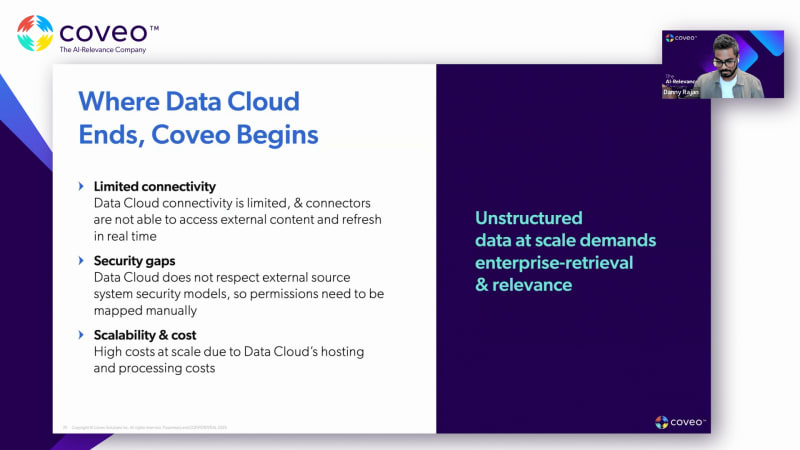
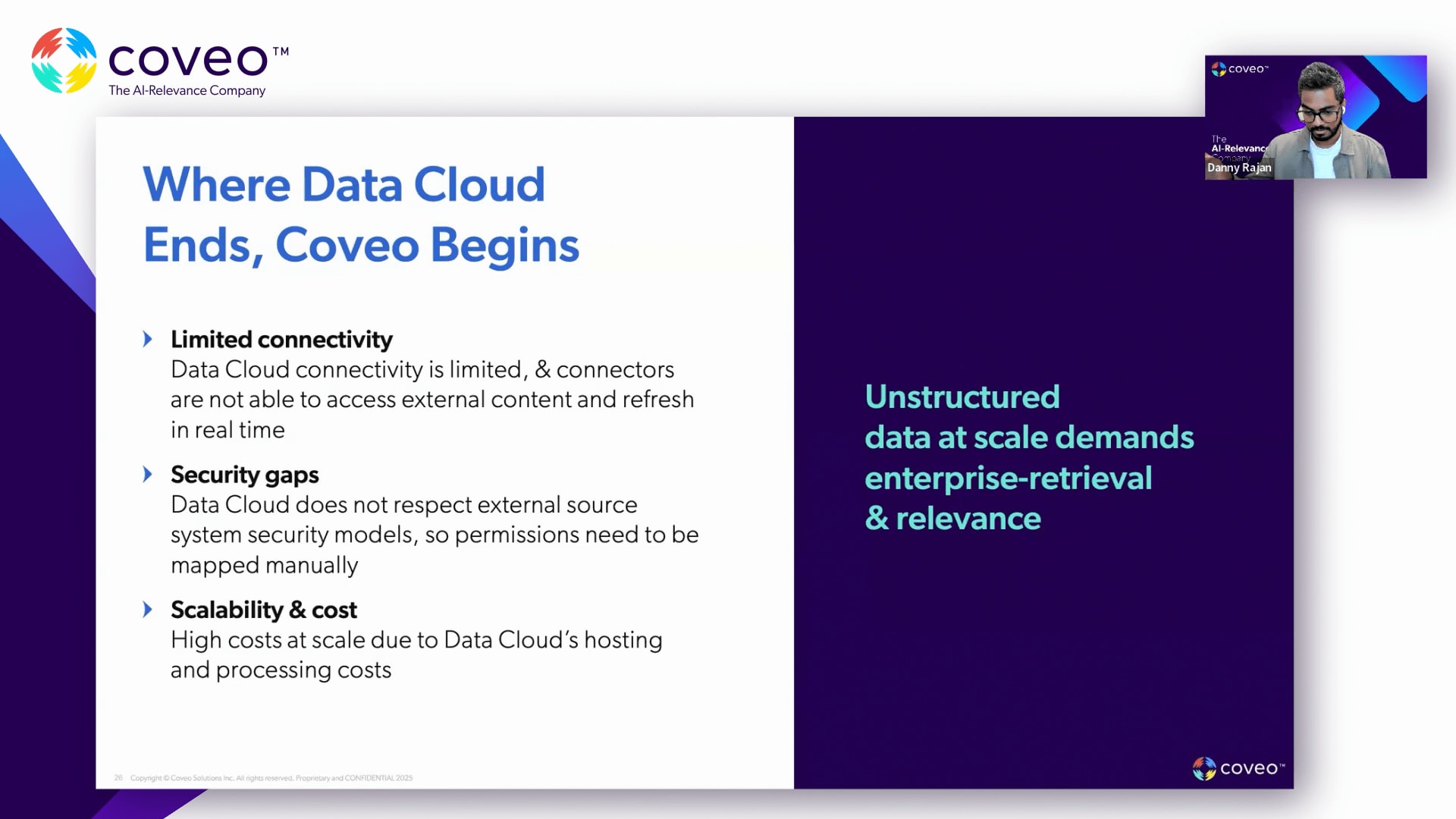
Hi, everyone. Thank you for joining our webinar today. My name is Daniel Rodgin, and I am lead product marketing manager here at Coveo. I am also thrilled to introduce my colleague, Matthew, who's our product manager here at Coveo. I have a couple of housekeeping items before we get started, to cover really quickly. First, everyone is in listen only mode. However, if, we do want to hear from you during the presentation. So please make, use of the q and a section, send in your questions. And today's webinar is being recorded, so you will receive the recording through your email. It will also be available on demand. I'm excited to talk about, how Coveo fuels Agentic force with enterprise knowledge without the lift and shift. Should be fun. Yeah. I know I I have to say this, but a quick disclaimer. Coveo is a publicly traded company, so we advise you to look at our latest earnings and our annual report on the business, and we may use some forward looking statements in the presentation. So we recommend you to make decisions based on products that are available in the market today. So here's what's in the agenda. I wanna start off by addressing the role of search and retrieval for AI agents, and then we will talk about how that applies specifically to Agentic and other Salesforce touch points. And, of course, the main highlight of the webinar today is gonna be a live demo where we show our integration with AgentForce and those actions and how it actually functions in the real world today. And we will wrap things up with some time for questions, and we will have discussions. It's gonna be it's gonna be good. So I wanna start by, level setting with everybody that customer expectations have fundamentally changed. They don't just want the answers. They expect right answers instantly. They want it to be done smarter, faster, more intuitive, and enterprises are racing to keep up by adopting AI. We're seeing this whole wave of AI adoption, everything from generative answers on search pages to custom gen AI apps that are, you know, built for productivity and to agentic tools like Agentic Force and how that's really poised right now to reshape customer service and the way it functions. And Gartner is saying by twenty twenty eight, thirty three percent of enterprise software applications will include agentic AI, so it's it's promising. But the question to ask right now is, are organizations getting the results from agentic applications today? The the truth is AI, it can't deliver value without access to the right knowledge, and that's why search and retrieval isn't optional. It's actually foundational. At Coveo, we've been seeing this a lot. It's really been our conviction that search and retrieval is foundational, and we've been strong advocates of this principle. And now Gartner affirms it, that AI success starts with a search and retrieval layer. Traditionally, AI search, you know, it hands results back to a human who then has to process that information, decide and then act on it. But as we move into this era of AI assistance and autonomous agents like AgentForce, search doesn't just support the experience. It powers the whole experience. If you redirect your attention to to the diagram on the slide, Gartner, I think they they put it out really well that search is no longer a tool that's used intermittently in the funnel. It's now become this continuous fuel behind insight, decision making and action. So Coveo really serves as the search and retrieval layer for nearly two hundred Salesforce customers. We've been doing that over the last decade, in their experience cloud, in their service cloud, and in commerce cloud. And now we are excited to extend these capabilities to Agentic. Quick quick note on that, Daniel. AI thing I really like to say is that historically, we've been serving humans and helping humans search, and now we're going kinda going into this new paradigm where we're helping AI agents actually search for content. So very exciting. Yep. That's really well said. So the challenge to implementing AI before we talk about Agentic force actions, while all of that is really exciting, I think it's really important to address, like, the reality in which modern enterprises, like, are living in today. It's the fact that knowledge is everywhere. They have knowledge stored inside Salesforce, outside Salesforce, like in tools like SharePoint, Confluence, your help portals, wherever. Right? It's scattered across AI. And each has its own each channel has its own search engine. It has its own structure and level of governance. And TSIA now found found out that on an average, a support rep AI on, like, seventeen different knowledge repositories just to do their job. So if a support rep relies on seventeen different knowledge repositories, it's the same for AI. If your AI agents like agent force, like, are pulling from fragmented inconsistent sources, you are going to get inconsistent and often inaccurate answers. And so to be effective, we believe that AI and AI agents needs to be grounded in a unified trusted source of truth. But what happens, like, when knowledge is disconnected is it's really starts to hurt your service experiences, and that kind of comes up in in the form of poor answers. It's likely due to the fact that AI is not optimized to to process and retrieve that knowledge efficiently. And when users can't get a clear or correct answer, they start to lose trust. And, again, when you don't have that unified layer, that connects all of your knowledge, you also start getting inconsistent answers across channels. So a customer would get an answer from AI and then a different one a different answer on a help site and then a different answer from a support rep. So you start seeing how it creates confusion, and it just erodes the confidence in your brand. So and, of course, it would lead to more escalation. So at this time, really, AI starts to become a liability and not an asset, and that's really a slippery slope. We don't wanna get there. But here you we are here to say that there is a better way. When your when unified relevant when your knowledge is unified and when it's relevant, it has the potential to transform service just like it happened with Zoom. And customers can actually find what they're looking for fast with more accurate answers, and the result is it immediately boosts self-service success, and it saves your support reps time for on they they can focus on high impact cases. And because knowledge is unified and relevant, AI is grounded by a single AI index. It ensures that answers are are the same no matter the channel. And so the way we deliver this relevant enterprise knowledge is through what we call as unified AI relevance. It's this concept where the convergence of service and commerce, it it manifests through AI search, generative answers, personal recommendations. It all works together coherent from one single source of truth that's grounded in relevance across all of your enterprise data. And so what you're seeing over here is the anatomy of unified AI relevance starting with the intent box, understanding those natural language queries, and then also has the capability to identify user intent. And from there, Coveo applies layers of AI and ML models to understand the query to and to then generate the most relevant answers surface surfacing the right content and guiding the next step. Everything that you're seeing over here is ranked, it's relevant, and optimized for your outcomes, and it all happens instantly in, like, half a second, and that's the beauty of it. And so AI, historically, Coveo's DNA is in AI search, we are excited to now extend the function of AI relevance to newer mediums AI Agentic force that are more conversational. So what this will ensure is the end user will always receive consistent, reliable information regardless of the channel, be it search, be it a chatbot, be it a help center experience, or even in conversational experiences like AgentForce. It's important to understand that when we're talking about Coveo, it isn't here to replace Salesforce. In fact, it's it's here to enhance it, especially for enterprises with complex needs. It it's for these enterprises that Coveo really becomes critical. And this graphic that you see over here, illustrates exactly when Coveo becomes critical. We tell our organizations that we speak with, if your organization deals with a large volume of content and it serves a wide diverse audience, you are really operating in the ends of this quadrant, and that's what you're seeing over here. That's where Coveo plus Salesforce delivers the most value. Coveo brings the relevance and scalability that's needed to index millions of documents to respect complex security models for data that lives outside of Salesforce and then deliver personalized discovery across different formats, different languages, and even different systems. So to summarize what what I'm saying here is, if your business is big, complex, and global, Coveo is the retrieval and the relevance layer you need to maximize your Salesforce investments AI Agentic Force. Yeah. And some of you who are listening might be wondering now, what about data cloud? Right? What does data cloud have to play into that? Well, you can rest assured we'll be touching on that in a few slides, ensuring that you can understand really where Coveo can complement data cloud. Yeah. That that's a great comment. Data cloud, is a hot topic with every customer conversation that we have. So excited to show you where Coveo sits within the whole Salesforce ecosystem. And so this point, I made on the previous slide, on where Coveo serves those enterprises with complex needs, it's it's not it's not just us seeing it. It's the leadership from Salesforce. They are validating our point of view and our positioning in the market. And we've been partners with Salesforce in taking our joint solution to the enterprise market for over a decade. And Salesforce recognizes Coveo's extensive connectivity to content sources and our capability to add relevance, is is it's really crucial for enterprise customers with these complex search AI. And this is really who we are. It's it's part of our DNA. For over a decade, Coveo delivers superior relevance at every point of experience, whether it's in commerce, service, or the workplace. So it's by unifying the content and the context across millions of interactions. Coveo ensures that every user gets the most relevant experience possible no matter where they are or how they engage. And the relevance that we're talking about doesn't just improve the experience. What we're seeing is it really drives better business outcomes. And to spend a a minute really on Coveo's background, Coveo is is publicly traded, and our area of expertise is working with AI, over seven hundred enterprises. And we walked that journey with several ISP partners, including the likes of Salesforce, where we are extending Salesforce's capabilities with AI search, generative answering in in different Salesforce clouds, and now we're excited to augment Agentic. And this is over fifteen years of work where we are iterating and innovating our AI relevance platform, and we are proud to reinforce our commitment to the AI standards of cloud security, trust, and transparency. And, also, Coveo is widely recognized by industry analysts. I I don't wanna spend too much time on this, but if it helps to give you a visual of our credibility with analysts, we hope you can take that from this slide. I want to show a high level view of our platform. And there's there's a lot we can go, but, really, I think this high level picture will set the foundation for Agentic force and where we will fit in. So Coveo brings this unified this is how Coveo brings this unified AI relevance to life. At the foundation, Coveo unifies all of your content and context data regardless of where it lives. So you don't have to really go to another team and request them to migrate your content into a specific, you know, cloud. Coveo does all of that through our out of the box connectors, and that's why its title of the webinar is fueling agent force with enterprise knowledge without the lift and shift. So regardless of where your enterprise content and context that data lives, whether it's inside Salesforce or outside Salesforce, Coveo unifies that knowledge and stores it in this unified index. And from there, we apply relevance where Coveo understands intent, applies machine learning models, and then surfaces the most meaningful results and answers. And finally, we deliver it across all of your engagement channels, including Agentic force, which we're excited to talk about. So it's one platform that's built for relevance and ready for every experience. I want to, Matthew, I wanna bring you into the conversation Yeah. And share I know we've been talking about, like, Coveo brings relevance to all these different touch points. Can you talk us through how, Dell actually uses Coveo across their Salesforce touch points? Absolutely. Dell Dell is really a phenomenal example of what enterprise grade retrieval and relevance really means. We our partnership with Dell has been, you know, it's been going on for quite a few years now. Right? We go way back and Dell really had this need, AI, lots of large enterprises that we work with to bring content from multiple repositories into a unified index that then power different experiences. So the first step, of course, was to go and fetch this content from different places and replicating the security models of all of these repositories, bring it into the Kavio AI index so they have one single source of truth. And then having this one single source of truth really allowed them to scale. Right? To deliver powerful AI AI experiences at many touch points because it did not require them to redo the work of bringing that into AI index, so bring building a dedicated search for one use case and then for another one, having Coveo as the central retrieval layer allowed them to rapidly scale into multiple use cases. And this is what really Dell did. We now power more than twenty five use case in Salesforce across four types of solutions on a global scale with them. Whether it's their commerce store, their online community, their support portal, their agent consoles, their intranet. They have different tools and offerings within ServiceNow, and we're even empowering chatbot applications with them. Right? And again, this was made easy by having that central agnostic retrieval layer as Coveo, which you can then tap into from multiple different use cases to deliver personalized and consistent experiences across all these different use cases. If we take a look real quickly at what this actually looks like in reality, Dale really perfectly exemplifies the idea of using an intent box. AI? Where you can ask both simple or very complicated questions, which can then fetch results from multiple content sources and deliver generated answers from the relevant results with, of course, the sources and citations always presented. So you know that this comes from, you know, real content that's available in index, grounded in the truth, it's grounded in their real enterprise knowledge. We also provide things like query suggestions or what you might want to do next, recommendations for product based on information we know about those users, and, of course, the search results with AI relevance. We also recently moved into multilingual support with Dell. Because they're such a large company with use cases all over the world, we're now able to provide answers in different languages based on their user's preference. So a user who speaks Japanese, for example, will be able to get generated answer in Japanese, and we can do so even if the content itself is not in Japanese. So we're actually translating answers to the user's preferred language using multilingual retrieval, multilingual encoder, and multilingual generative model even if the content itself would be for example in majority in English would still be able to answer in different languages. Now it's not only Dell who had tremendous success with us. We've been seeing success for many years with many large enterprises across the world in Salesforce use cases specifically. We've recently seen over the last year Xero improve their self-service success by twenty percent on their support portal. They're actually one of the first to use our generative solution, and we were essentially one of the first in partnership with them to deliver an enterprise grade generative answering solution on a public website. Right? With the security and permissions and the grounding that we built into our solution and our accurate retrieval, we're able to deliver this safely to the public. Right? Which was unheard of at that time where generative answering was just starting to get known and to become popular. We've then seen similar stories with f AI, we saw improvement in self-service success. With Forcepoint, we saw massive improvements in case deflection, tremendously reducing cost to serve. For Salesforce themselves, we've seen tremendous improvements in case reduction using our technology. And recently with SAP Concur, who saw a massive eight million dollars eight million euros, I'm sorry, in cost savings thanks to Coveo reducing caseload by deploying powerful, accurate generated response in search results under support sites. So I'll pass it back to you now, Danny, to AI walk us through where we're moving with this now with Agent Force as our next integration. Yep. Thanks, Matthew. We're super excited to bring the same unified AI relevance platform to a new channel, which is AgentForce. And Coveo grounds AgentForce with secure, accurate, and relevant knowledge from across your enterprise. So we ensure that no content left, is gets left behind, and we bring it all of that into the Coveo index with out of the box connectors. And through our AI relevance platform, it ensures answers through Agentic are highly highly relevant. We improve the answer rate and the quality of AgentForce and then also accelerate the the the time to value for organizations that are implementing and adopting Agentic force. I want to, spend some time explaining the architecture and the platform. Like I mentioned earlier, AI agents, they are only effective as the intelligence behind it, and that's where Coveo comes in. So Coveo provides the mature retrieval and relevance layer Agentic needs to accelerate its success. And it's not just AgentForce. It's it could be literally any agent. We are an agnostic platform in being the search, retrieval, and relevance layer to any agent ecosystem. So wherever your AI strategy goes next, Coveo is built to scale with it. So it starts with the the secure secure connectivity layer to all of your enterprise content that's done using our out of the box connectors. That content is indexed using our hybrid index, which combines lexical and semantic models to truly understand user intent. And from there, queries are passed through our multilayered retrieval and relevance engine, applying business rules, behavioral AI, and advanced semantic matching to then power Agentic force with powerful actions, which we'll show you in a demo in a bit. So we have relevant passages that gets passed on to agent force. We have our case classification action, and then we have a case resolution action that's coming soon. So let's take a look explaining what these actions and use cases are. First, we have the question answering question answering action that's available today. Is powered AI, Coveo's passage retrieval API to retrieve the most relevant passages living anywhere in your enterprise in real time. It it it retrieves that in real time, grounding Agentic Force to power to provide accurate trusted answers. And then customers, including Salesforce, are using Coveo's AI classification models in their case submission form to triage cases, ensuring accuracy in routing, and then leads to productivity and overall seamless experience in in the the case submission workflow. So what Coveo is doing right now is we just released this exciting case classification action last week. And so it extends our case classification models to an agent force use case for classifying cases based on case subject and case description for better routing and reporting. And then we are working on an exciting case resolution action where Coveo enables agent force to automatically pull case details to retrieve relevant content and enable agent force to then solve the case. So I want to address the topic of data cloud because this comes up in our conversations with customers. We found that while data cloud is great for indexing structured data, it could be AI customer information, customer data, it's not purpose built to index large volumes of unstructured data, especially when that data lives outside of Salesforce. And unstructured data in the enterprise world really makes up for ninety ninety percent of data for enterprises. So for all these use cases, data cloud alone is simply not enough because there are we've identified three fundamental obstacles. One is limited connectivity. So there are no out of the box connectors for repositories AI Google Drive, Jira, SharePoint, Confluence, all all of these different sources an enterprise will use. So for these enterprises that have the needs, to index and refresh content in real time, they need to look for solutions that are beyond data cloud. The next topic is about security, and it it is a big pain point or a need for enterprises. The the fact is data cloud governance does not respect external source system permissions. So for data that lives outside of Salesforce, that's where it does not enforce those source permissions. They need to be mapped manually, which leads to slowing down implementation. It also increases effort in maintaining these different security models, and that, of course, has that increases security risks. And the last point that I would say on this slide is the scalability and cost factor. So for enterprises that have large volumes of content, especially, like, in the hundreds of thousands or even in the millions that that need to be indexed, the indexing, hosting, and processing cost through data cloud can be expensive and can go out of hand because data cloud works on a credit consumption model. So every time content is indexed and queried, you consume credits that will quickly surpass any free credits that you might have in your Salesforce plan. So it's it's not a scalable solution. So I hope this illustrates the AI this highlights the need for Coveo where, it fills in some of these gaps with data cloud, especially in the unstructured data use case. Matthew, did you wanna add anything? Yeah. And maybe I can add a bit to to the because you did speak briefly about the difference between structured and unstructured. Right? And you've mentioned, like, customer information. I like to give the example of, like, looking who's the owner of case one two three. That's a structured type of request. Right? It's kind of like searching in an Excel file where you're essentially looking for case number one two three, and then you'll go to the owner column and you'll find who's the owner. Data Cloud is really good at that. When it comes to searching across your technical docs, think of AI large amounts of knowledge in different repositories. Think about large technical PDFs that are hundreds of pages long, complex documentation, again that lives in different places. Think about all the SharePoint information you have, you know, policies, any complex type of information and the types of enterprise we work with will even have very complex technical stuff. We work with a lot of software companies for example. Right? So this is really where Coveo is powerful. We're really equipped to handle that scale, that complexity, and to be able to surface the right piece of unstructured content, to find the answer wherever it lives essentially across those large technical documentation, getting really to the best bits and pieces so we can then inform the a the AI agent to solve those. So we'll talk about that again in in in a few slides, but I I thought I'd add a bit to that distinction. As we can see here and as you're gonna go through, Danny, we're really kind of focused on that part of the the ecosystem. Yep. The role of Coveo in the Salesforce ecosystem is that Coveo is a search, retrieval, and relevance layer for unstructured data. And so, really, it's complementary to DataCloud's, value proposition for indexing structured data. So what you see over here is how Coveo fits in the Salesforce ecosystem. And what you see in the center is the Atlas reasoning engine. That's the brain behind Agentic force. It evaluates the query and then determines the topic, which agent force action to use. That's the role of Atlas. So if the query calls for structured insights, like, let's say, AI, account status or order history or the example that Matthew spoke about, data cloud then becomes the primary source. But when, like, the query requires surfacing rich contextual answers to long tail queries, AI, it could be how to instructions, it could be policy clarifications or troubleshooting guidance, that knowledge is usually trapped in PDFs or in Confluence or knowledge bases. That's where Coveo steps in, and it retrieves the most relevant results from a unified index of all of this unstructured content. And so and from there, agent force can assemble the response using the right action type, whether it's through an, running an Apex class or triggering a flow or a prompt template. But enough of all of the boring theoretical stuff. I'm excited to hand it back to Matthew where we can see all of this in action. Thank you, Danny. So, yeah, I'll be going through what we've been doing with our our Agentic force integration and we'll we'll start essentially from the context of a support agent trying to solve a case. Case resolution as a whole has been a specialty of Coveo for many, many years. Whether it's, you know, providing self-service and a support portal, helping with case deflection or even classifying case which is not something new for us. So what we've been doing recently is we saw an opportunity to bring those capabilities into Agentic Force to further enhance the resolution experience but also using our grounding allow for more flexibility in the different types of actions, the different ways that our passages at our retrieval layer can be used. So in the context of solving a case, the first thing an agent will typically want to do if the case was not properly AI, let's say it came through an email channel which did not allow to to fit to select in this instance here to both in the first category. Right? We're in the service cloud of Barca. Barca is a both equipment company that provides both both hardware as well as software. So the first thing that as a support agent AI will wanna do is to actually just properly classify the case that I have here. So this will call Caveo's large language model called the case classification model which is a purpose built LLM designed to properly classify new cases learning from past historical cases that have already been solved and properly classified. So what you can see that it does here is that for this specific case, we're both identified that look, this seems to be a Mercruiser GPS issue. Right? So now that this was done and we've provided the intelligence, well, we can marry that with the out of the box agent force actions that can then update the record which will allow me here to apply this classification. Hence, taking the classifications that I've just retrieved from Convios LLM and applying them to the record that I'm working on so it can be properly classified as a recruiter GPS. Now if I have a question, that's not necessarily related to the case. We'll use the case subject as an example here as a support agent that could go now and search, try to find a solution. So I'll go and ask that question directly, issue with map not updating based on location. This will use Coveo's retrieval layer to find the best specific passages to answer that question. This is essentially our Q and A action or question answering. Right? And based on the problem that we've provided out of the box, which can be edited, of course, to fit your needs, to fit the tone, and the way that you'd like the Agentic Force to answer, We'll find the most relevant passages, provide those to agent force to allow agent force to be able to provide an answer to the case that we have here at hand, answering the issue with map not updating question. Now, this is kind of a way to just ask the questions you'd AI. Right? And manually form a question, manually ask the question to the agent. But the next action and with the flexibility that we're bringing to that question answering action, we're looking to allow for more automated ways of searching and solving for a case. With the next action that I'm gonna have here would just be to ask directly to solve this case. What if as a support Agentic, I could just ask to solve a case instead of having to manually write the question? And on the other hand, what if we could take all the information that's available? The both and first category that we've already classified, the subject and description, and use all of this information to then retrieve the best passages, not only using that short query that your user entered, but using all the details that are available to the with the case, which is a specialty of ours. And as we can see here, we're able to just go ahead and provide a solution to the case using the same grounding retrieval layer from Kaville to accurately find within all the corpus of information that lives within Barca the best specific passages and the best documentation to solve the case at hand, providing that back via Agentic force as an end to end solution, which as a support agent that could then copy or ask Agent Force to even rewrite it as an email if I want as, of course, Agent Force has those conversational capabilities to reword the information and the intelligence that Cameo has provided. And now the last thing we'll do here as part of this demo, which is a bit of a custom flow that we've built with that passage retrieval action of ours, which will also be possible with the flexibility and the, different options that we're adding to that action. What if as part of this flow, I've now solved this case. I have different notes and information as part of that case. I know which resources were useful to solve this case, but there's also actually new intelligence that I'd like to document and bring into my knowledge management flow. Well, we've built a custom flow here that will essentially create a knowledge article based on the information from the case, the internal notes and different comments or the solution field that a support agent has entered, which will contain the new knowledge and new information that we've learned when solving this case. But but also ground that with proper passages from the Kavoo index to make sure that we're actually grounding this new knowledge article and providing resources in this new knowledge article, which will both solve the issue at hand, but also actually provide, you know, the best references so you can go back and find how this actual knowledge article is written. What are the other interesting or pertinent relevant information that already exists in the documentation that are important to go through troubleshooting map update issues with Skipper app in this specific context. So this actually would essentially build a draft. So this was a pretty quick demo as you could see but within just a few minutes we were able to classify an incoming case that was misclassified and lacking information, which could have come from like an email channel, for example, to answer questions related to that case rapidly, to provide a solution, an end to end solution to that case to help the support agent then email that back to the user. And even in terms of completing that knowledge management workflow and bringing new knowledge back into the flow for other agents, support agents, as well as AI agents to use to answer or more problems, creating a knowledge article about this issue so then becomes a known issue, which can then allow us to move the resolution upstream into a self-service channel so that this similar issue, if we were to recur in the future, would then be solved thanks to existing knowledge, which can then be surfaced in a self-service search powered by Quavio, in Quavio's case deflection solution, or even in a chatbot or a user facing AI Agentic, which can then serve those answers, solve those cases before they even get creating, hence reducing cost to serve and bringing further operational efficiency to a support organization. So that'll be it for the demo. I'll go back to the deck AI I'll share a bit of a story here because we've already seen some interesting success in using Coveo to power, AI agents. We had this client out of, the APAC region with about four thousand employees, who saw an opportunity to use Agentic AI to solve cases and reduce caseload by addressing questions directly on Facebook. And as you can see by looking at this slide here, you're gonna see if you look carefully that they've actually been using Coveo as their retrieval layer. So there's been a tremendous success that they saw. We've been seeing that this, you know, thirty percent reduction in issues requiring a support specialist. About seventy percent of messages handled by a customer, social media team were eliminated thanks to this AI Agentic. And they saw an eighty percent decrease in time spent monitoring the Facebook Messenger social media channel thanks to bringing the Cavillos retrieval and intelligence into an Agentic AI experience which could then be deployed in a customer facing use case in this specific example in Facebook, which of course as I've just described has brought tremendous success and operational efficiency. So merging the relevant, accurate, intelligent retrieval with Agentic capabilities to handle a conversation are really the next way to deliver personalized, accurate, powerful, and conversational experiences directly where your users are interacting with your company on a day to day basis. This example in Facebook can be on your support portal, it can be within your product, But of course, that retrieval can also help enhance workflows and experiences for support agents internally or even employees. So obviously, this is a great opportunity to further increase operational efficiency across, large enterprises that we work with. Yep. Thanks, Matthew. I just wanna add this slide. What you're seeing over here is pulled directly from Salesforce's website, and we're we're just excited to share the success story. Absolutely. So we are wrapping up, but before we do that, I want I think it's worth to take some time to explain the technical differences. And customers that we speak to, where we show them the value of Coveo for Agentic is in these parameters, which is connectivity, content volume, answer quality, security, and content freshness. And so when it comes to connectivity, because of our out of the box connectors, it gives it gives them the immediate edge to use gets that seamless integration with their unstructured data. And then with even content volume, with stand alone for Agentic force, I think it's it's suboptimal when you index, content over hundred thousand unstructured documents. That's that happens through data cloud. But in comparison, Agentic with Coveo, what you get is we support large scale indexes up to fifteen million documents and supports up to fifty million chunks of passages. So that's the scale at which we operate for those enterprises. And answer quality, it's it's a big one. Without Coveo, answer answers can be low quality due to the just the limited relevance and the lack of access to unstructured content. And Coveo brings real time access to AI and AI team and relevance and personalized experience that actually drive those business outcomes. And from a security standpoint, Agentic alone, we discussed this earlier, it requires manual permission mapping that's especially for data that lives outside of Salesforce. And Coveo sim Coveo simplifies this by inheriting item level permissions automatically during indexing. And AI, when it comes to content freshness, stand alone agent force refreshes every two hours. But for enterprises that have needs where they have to deliver the latest and the greatest content in near real AI, Coveo's index, refreshes every five minutes or even on a custom schedule. So your answers are always based on the most up to date content. Yeah. Now the quick distinction on that too, we pull the content in. Meaning that we essentially abstract the complexity of taking the content from those different repositories and bringing it into Caveo and Doug. This is only for you to make to do any work essentially in packaging this content, structuring it, and then pushing it to us. We'll essentially, with our out of the box connectors, go and fetch that content. And we'll take care of, as as Danny mentioned, inheriting the item level permissions, but also allowing you to properly map that content, to normalize it, ensuring that, you know, content from twelve different repositories will all use the same product names. So you can use that for filtering across that content. And then again, refreshing and pulling that content, making sure that we always get the latest additions, the latest changes to that content without any manual interventions on your part. So this is a really big differentiator and this is what a unified index essentially brings as a difference in terms of bringing that content in and and, you know, scaling to large enterprises that have complex needs, removing the headaches, and the lift and shift as Danny, initially mentioned. So really to AI, why is Coveo critical for Agentic force? It's I wanna emphasize that Coveo if you are exploring agent force, it's Coveo isn't just a nice to have. It I AI we believe it's critical especially to make it enterprise ready. So it delivers the connectivity. It ingests, indexes, and refresh refreshes real time content from over thirty, thirty sources out of the box connectors. And then with enterprise, it delivers enterprise level security. It respects item level permissions. We spoke about that during indexing, so it eliminates, security risks. And then Coveo enhances the generative AI output quality from Agentic force with our advanced hybrid retrieval, models. And it provides all of this really accelerates Agentic success because it provides that foundational knowledge and relevance to support these agentic workflows from day one. Your unstructured data is really foundational if you are really on the path to unlocking agentic workflows. And AI, this is this is pretty interesting because it minimizes reliance on data cloud for unstructured query and those sort of use cases. It so it really is a cost saver for you. We are excited to share that Coveo for Agentic force is available in the agent exchange today. So this is something that you can self serve. We are excited to bring this to the market. Matthew, would you add anything? No. That's essentially it. You know, we've just, recently upgraded to our latest package that includes the case classification action on top of the question AI, and we're always making improvements and adding and doing new versions of the packages to make it more flexible, but also to add different actions that bring more capabilities into Agentic force, helping the transition and helping making agent force, adoption implementation easier. Yeah. Matthew, why don't you take us home with Yeah. Really giving the audience, like, when should they consider Coveo? Definitely. And we spoke about a few things. Right? So the first thing was the complex content across multiple sources. AI? That's really the Coveo differentiator. It's what we've been doing for fifteen years. That that's your expertise. The second one is diverse global audiences. Right? So if you have clients that have different needs, different languages, different pricing models across the world, and you need to find a way to personalize experience to all those different users, this is really, again, where Coveo can can meet you. Good one is access control. So we mentioned you have sensitive information, you need to enforce permission. That's again built into Coveo and built into infrastructure. If you need things like real time updates, AI? To ensure that new or updated content should be retrievable almost immediately. If you need, to optimize, right, your support experience to reduce cases, improve self-service success, reduce escalations and rerouting, that's really, our expertise. And then, you know, if you're looking to and you are you're already using KCS practices across your organization, you know, we follow and we help to implement knowledge centered services practices to reduce known issues, essentially solving them upstream with Coveo. So so yeah. If I could add one last thing maybe is that you know, you know, we're seeing a lot of interest from our clients to use Agentic Force and we really see our solution as a way to facilitate that. Right? So if you're exploring Agent Force today and you're wondering, okay, how am I gonna bring all the content out of cloud? It seems complex. Do I have to go and fetch it? Do I have to use an Amazon s three bucket and then push that to AI cloud? And you're wondering how are you gonna bring all that complexity from different multiple repositories across your enterprise into agent Force to make this a success, well, we're here to help you. Right? And we'll love to hold your hand and since we guide you through the process, simplify the indexing process to then facilitate and accelerate time to value with Agent Force, so that your enterprise can benefit from, you know, this new powerful agentic framework that Agentic Force delivers with Coveo as the grounding and retrieval layer to make this an enterprise grade, secured, ready to use for your customers as well as for your employees. So I'll pass it back to you, Danny, to to wrap us up. We've have some exciting questions coming in. We have a lot of interest. I'm gonna take a few, but for the questions that don't get answered in in this session, we'll make sure we follow-up with you. The the first one is interesting. I think you spoke about this, but how customizable are Covey actions? That that's a great question. So because we allow our actions to utilize prompt template, essentially the, you know, the flexibility is is is made available natively. Right? So we'll provide an out of the box prompt and out of the box topic instruction as well to user action. But because those topic instructions are adjustable, as well as prompt templates, which could also be adjusted to have Agentic Force talk in a specific way, use a specific tone. If you wanted to talk like Scooby Doo for example you could certainly do that. So because you have all this flexibility you can use our grounding and retrieval layer to make Agent Force do multiple different tasks. From solving cases like we showed earlier, but also to writing emails or providing a a reply for example to an incoming case or even a reply to an incoming chat, live. Right? So it's quite flexible. Agent Force has built an interesting stack where you have full flexibility to write the prompts you want. You can even use different LLMs within Agent Force. And because we've made our actions Agentic, to essentially just allow to call our APIs and provide the grounding with different tools within the Salesforce, ecosystem. It really brings you full flexibility to use your actions for for different things, different purpose, different actions that will best serve, your objectives to achieve the best business outcomes for you. It's awesome. Yeah. A lot of sounds like a lot of flexibility over there. I wanna squeeze in a couple of more questions. I know we are slightly over time. But how will Agentic force know when to query retrieve from Cobayo versus data cloud if both are present in That's a great question. Yeah. So, really, this is all depends on how you build your topics. Right? So the topics within agent force allow you to determine or tell the LLM when it should use this action or another action. So this is gonna be entirely flexible. We just spoke about flexibility and this this to me is another example. So where you'll wanna use, you know, structured data is for inquiries about a case, an existing case. Inquiries about an existing record, for example. Whereas, what you'll want to use Coveo is when it comes to answering questions, providing resolution, providing classification. So as long as your topics properly describe and adequately separate the different tasks and different things that an agent can do, The agent should be able to very easily understand for different types of question which action it needs to use. So you can use a healthy mix depending on the need and depending on the question it's answering of structured retrieval from data cloud and unstructured retrieval from Coveo to answer those more complex case related issues, or complex questions from an employee or from a user, for example. Yep. And if you have any follow-up questions on on this topic, please reach out to our team because we understand every Agentic force itself is a new topic for everybody. So, we we are happy to lend our services and really hand hold you along this journey. So one last question is how does Kaverio for Agentic force pricing work with the native pricing that Agent Force requires? It's an excellent question. Yeah. We, we can say we're the experts in Agent Force pricing. Right? That's a bit outside of our of our expertise. So the Agent Force pricing will not change with Kyvyl. Where Kyvyl will have an impact is really when it comes to the data cloud credits. Right? So we help essentially save credits so that those credits can be used to focus on structured data retrieval which is data cloud strength. And then Kyvyl at large scales will essentially end up saving you cost by being more efficient and more scalable when it comes to retrieving a lot of unstructured data from a lot of content repositories as well as indexing that content. So the key differences AI say between I guess us and and data cloud for unstructured is data cloud will work with credits when you index, when you refresh, as well as when you query. Right? Which is much more efficient for structured data that doesn't change so often. Whereas on our in our on our side, we don't charge or we don't have, essentially AI a consumption based model when it comes to indexing content as well as refreshing that content. This comes out of the box with the Coveo platform. Our model is really based around queries. Right? So you only essentially be AI paying Coveo when you actually get value by retrieving and add accurate content and this is really made available by the fact that we've built our infrastructure to be specialized in refreshing large amounts of unstructured data at high frequency. So, you know, it comes that Coveo is going to be really specialized in a slightly different purpose and for scale we end up saving you on costs and helping you deliver more value and allowing you to use those data cloud credits in places where it delivers more value for especially for structured retrieval with again Cavu handling the complexity of unstructured questions. Wow. Okay. We've covered a lot, and I know this might have I don't know. I hopefully, this wasn't too overwhelming, but we invite you to have a conversation with us, where we will, like I said, hand hold you along this journey to unlocking Agentic force for your enterprise. With that, we wrap things up. And I don't know, Matthew, I don't know about you, but I've had a lot of fun hosting this webinar. It's very interesting. It's a very interesting topic. It's evolving very quickly. So as Danny just mentioned, we're really happy to work with you and see how we can help your enterprise achieve its its business objectives. Alright. Thank you, everybody. We will see you at the next one. Cheers.
Fuel Agentforce with Enterprise Knowledge—Without the Lift & Shift
For over a decade, hundreds of Salesforce customers have trusted Coveo to deliver best-in-class unified search for Experience & Service Clouds. Now, we're doing it again—this time for Agentforce.
Agentforce promises transformational AI agents, but its effectiveness hinges on access to relevant and trustworthy enterprise-verified knowledge. The challenge? Most of that knowledge lives outside Salesforce—and Data Cloud, while effective for structured data, requires migrating unstructured content into Salesforce, which is often costly, complex, and impractical.
That’s where Coveo comes in.
Coveo serves as the retrieval and relevance layer for Agentforce—securely indexing enterprise knowledge across systems without migration. It ensures that every Agentforce action is grounded in accurate, secure, and relevant knowledge. And now, with our new AI-powered Case Classification, you can go even further, automatically categorizing cases in real time to reduce triage, improve routing accuracy, and accelerate time to resolution. The result: better self-service success, higher case deflection, and faster resolutions.
In this live demo webinar, you’ll learn how to:
- Securely connect and index enterprise knowledge—without moving your content
- Create Agentforce Actions powered by Coveo’s hybrid search and AI models
- Extend relevance across Salesforce: Agentforce, Experience Cloud, Service Cloud
Whether you’re planning your Agentforce rollout or looking to boost existing deployments, this session will help you get it right from the start.
Join us and be among the first to make Agentforce truly enterprise-ready with Coveo.


Make every experience relevant with Coveo


Hey 👋! Any questions? I can have a teammate jump in on chat right now!