From Search to Intent Box:
The Future of Ecommerce Product Discovery

-
From Search Box to Intent Box
-
Why Traditional Search Fails Today’s Shoppers
-
The Power of Intent-Driven Search in Ecommerce
-
Coveo’s Approach: Generative Product Discovery – Blending GenAI & Product Discovery
-
Different Queries. Different Needs. One Intent Box.
-
Say Hello to the Intent Box
-
The Anatomy of the intent Box
-
What the Intent Box Gets Right That Chatbots Don’t
The search box has long been the backbone of ecommerce sites, a familiar tool where customers type keywords, hoping to find the right product. But today’s shoppers expect more.
Think outside the
search box
Their behavior is changing, they are starting to search the way they talk, using natural language and asking full questions like, “What are the best shoes for marathon training?” instead of typing “running shoes men.”
Visitors may come in with a simple goal such as a list of products. But more often, they expect expert guidance that’s conversational. They want to know what’s right for them, why it fits their needs, and how it compares to other options. And they expect that clarity instantly.
Yet many search experiences remain primitive, failing to understand intent. They still rely on outdated keyword matching, returning generic results that force shoppers to scroll, refine, or abandon the journey entirely when they can’t find what they need.

This is where the evolution from a search box to an intent box changes everything. Powered by AI and GenAI, the intent box interprets user needs, understands context, and delivers precise, relevant answers and product suggestions in real time.
By combining machine learning, vector search, and generative AI, it seamlessly guides shoppers through discovery, decision-making, and
purchase.
In this ebook, we explore:
- Why traditional ecommerce search falls short — and what today’s shoppers really expect from product discovery
- How the evolution from search box to intent box is reshaping online buying with helpful, expert, generative guidance.
- What makes Coveo’s intent box different: grounded in your product catalog and content, it delivers relevant answers you can trustIt’s time to think outside the search box and create an experience that makes your brand the first — and only — choice for your customers.
Why Traditional Search Fails Today’s Shoppers
Search is ubiquitous. It’s the default discovery tool for ecommerce sites. Whether shoppers are browsing, researching, or ready to buy, they instinctively turn to the search box. It’s always there, always accessible, and unlike passive browsing or clicking through filters, the only place where customers explicitly state what they want.
But traditional search makes shoppers work for it, forcing them to think in rigid keywords rather than the natural way they’d ask a question to a sales associate when shopping in-store.
The problem? Shoppers don’t think in keywords, they think in needs. Increasingly, they expect to search the way they naturally speak, without having to translate their thoughts into simplified terms. A customer searching for the best laptop for graphic design under $2,000 doesn’t want a generic list of laptops; they need a tailored list of options and expert guidance on their specific use case and a clear path to the right product.
of website visitors with a specific goal start by using the search bar.
of shoppers abandon an ecommerce site when they can’t find what they need quickly.
Source: 2025 Commerce Relevance Report
The real revenue opportunity isn’t in generic searches but in the complex, high-intent queries that signal serious purchase intent and can best serve the customer in the moment. If search fails to interpret them, businesses lose out on ready-to-buy customers and miss the chance to build lasting relationships. Instead of guessing at keywords, the search box needs to evolve into an intent box. One that not only understands queries in natural language but the intent behind them.
That’s why the search box needs to evolve into something more intelligent, more adaptive, and more context-aware: the intent box.
The Power of Intent-Driven Search in Ecommerce
For ecommerce leaders, the impact is clear: An intent-driven, relevant search experience leads to higher conversions, bigger orders, and stronger customer relationships — driving real revenue growth.
An intent box elevates your site into a premium destination where shoppers can learn, explore, and buy with confidence.
By delivering intuitive, expert-level guidance at scale, it creates a seamless experience that builds brand loyalty and keeps customers coming back.


Shoppers who use search already know what they want — they just need the fastest path to it. An intent box with AI search, interprets queries accurately, providing tailored and relevant results that reduce bounce rates and maximize conversions.
An intent box dynamically suggests contextually rich recommendations grounded in answers to queries, driving higher order values.


Scaling personalized interactions is difficult — but the intent box acts as an always-on digital shopping assistant. It guides decision-making, adapts to individual needs, and provides expertise at scale without increasing customer support costs.
An intent box delivers expert-level answers and tailored recommendations in the moment, positioning your brand as the go-to trusted source for reliable guidance — not just transactions. Customers remember when a brand makes their experience effortless — and they come back
Shoppers who use search already know what they want — they just need the fastest path to it. An intent box with AI search, interprets queries accurately, providing tailored and relevant results that reduce bounce rates and maximize conversions.
Scaling personalized interactions is difficult — but the intent box acts as an always-on digital shopping assistant. It guides decision-making, adapts to individual needs, and provides expertise at scale without increasing customer support costs.
An intent box dynamically suggests contextually rich recommendations grounded in answers to queries, driving higher order values.
An intent box delivers expert-level answers and tailored recommendations in the moment, positioning your brand as the go-to trusted source for reliable guidance — not just transactions. Customers remember when a brand makes their experience effortless — and they come back
Turning search intent
into business impact
Coveo’s Approach: Generative Product Discovery – Blending GenAI & Product Discovery
At the heart of this transformation is a powerful GenAI solution that enhances enterprise search by providing context-aware, permission-secured answers to complex natural language queries. Using a combination of machine learning, vector search, and GenAI, Coveo can generate highly relevant, well-grounded responses — ensuring shoppers get the right product, information, or advice effortlessly.
Seamlessly integrated into Coveo-powered search interfaces, Coveo’s generative product discovery supports both simple and complex queries, delivering AI-optimized search results and generated answers from a single, unified search experience.

Coveo’s unique approach to Retrieval-Augmented Generation (RAG) retrieves only the most relevant content using a four-step process:
-
Identifying Relevant Documents
Coveo applies machine learning and semantic encoding to retrieve the most relevant content from an enterprise’s indexed rich content while respecting security and permissions. This ensures that only trusted, high-quality sources are used to generate answers.
-
Extracting the Most Relevant Content
From the selected documents, Coveo pinpoints the most contextually relevant text chunks using vector embeddings. These text segments are chosen based on their semantic similarity to the user’s query, ensuring accurate, meaningful responses. -
Answer Generation with AI & Controlled Content
Coveo builds a structured prompt that includes both the user’s question and the extracted content. This is sent to a large language model (LLM), which generates an answer based only on this verified data — avoiding hallucinations. The final response appears alongside traditional search results with clear citations and filtering options.
-
Product & Category Matching
Coveo extends the generative experience beyond just content. The same understanding used to answer the user’s question is also used to retrieve highly relevant product listings and category suggestions. Whether a shopper is asking about features, comparisons, or best options, Coveo generative product discovery improves engagement, conversions, and customer loyalty.
A Four-Stage Approach for Maximum Relevance
For ecommerce leaders, the impact is clear: An intent-driven, relevant search experience leads to higher conversions, bigger orders, and stronger customer relationships — driving real revenue growth.
Different Queries. Different Needs. One Intent Box.
Every query reveals something different: a goal, a challenge, or a desire for guidance. But most search engines still treat every query the same. The intent box doesn’t. It adapts in real time, tailoring the experience based on query type, complexity, and context.

The best response? A curated list of products basedon catalog data and semantic understanding of how “small,” “modern,” and “light-colored” map to product attributes.

This calls for expert advice — articles, buyer guides,or product descriptions powered by GenAI that summarize the best options and even surface relevant categories based on the semantic intent of the answer.

This isn’t a product search — it’s a support query. The ideal response is a precise, contextual answer pulled from policy documents, powered by GenAI, with direct links to the supporting resources.
Here’s how different types of queries map to growing complexity — and how the intent box enables shopper success at every level:
Complexity & ambiguity
From First Click to First Choice
Search is no longer just a box — it’s an intent engine and a loyalty driver. When buyers consistently find exactly what they need, they come back, again and again.
Start evolving your product discovery experiences by focusing on these three goals:
- Decoding shopper intent
Move beyond keyword matching to interpret intent dynamically, surfacing the most relevant products, content, and recommendations seamlessly. - Delivering credible guidance
Create generative discovery experiences that position you as a trusted advisor, providing expert answers and personalized insights that help shoppers make confident decisions. - Streamlining the path to purchase
Intelligently suggest product categories or items that align with the generated advice — ensuring contextual awareness and seamlessly driving engagement and conversion
Say Hello to the Intent Box
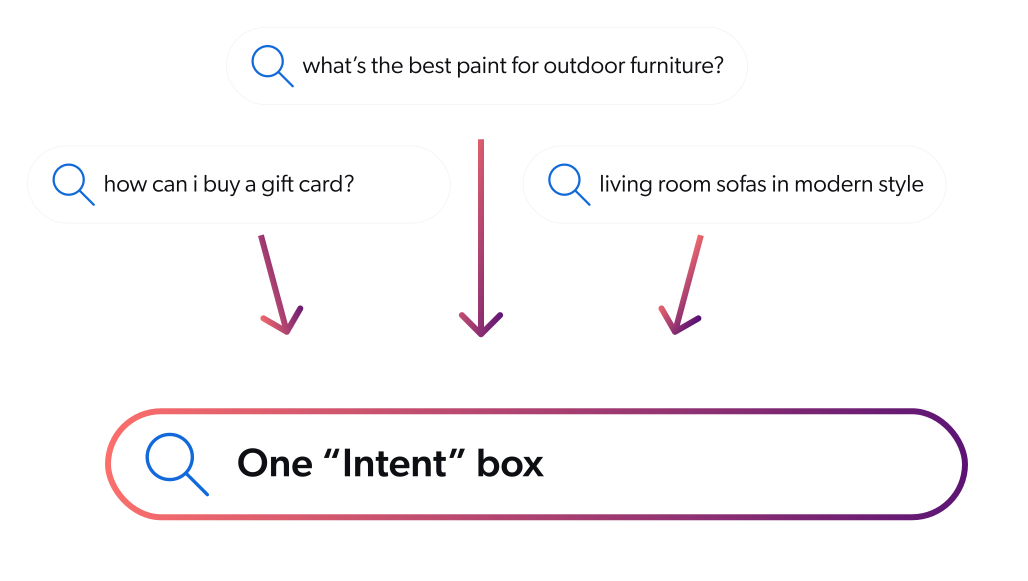
An intent box is the intelligent brain behind ecommerce discovery. It understands nuance in queries and surfaces products, comparisons, guidance, and support answers dynamically, pulling from multiple sources such as product catalogs, buying guides and expert content to deliver relevant products, guidance, advice and/or answers, ensuring shoppers find exactly what they need.
This shift powers what some might label conversational commerce or what we refer to as generative product discovery, where search doesn’t just retrieve — it guides, recommends, and refines.
Instead of forcing shoppers to adjust their queries repeatedly, the intent box interprets needs, filters results intelligently, and delivers meaningful answers. It makes search feel more intuitive, accurate, and relevant.
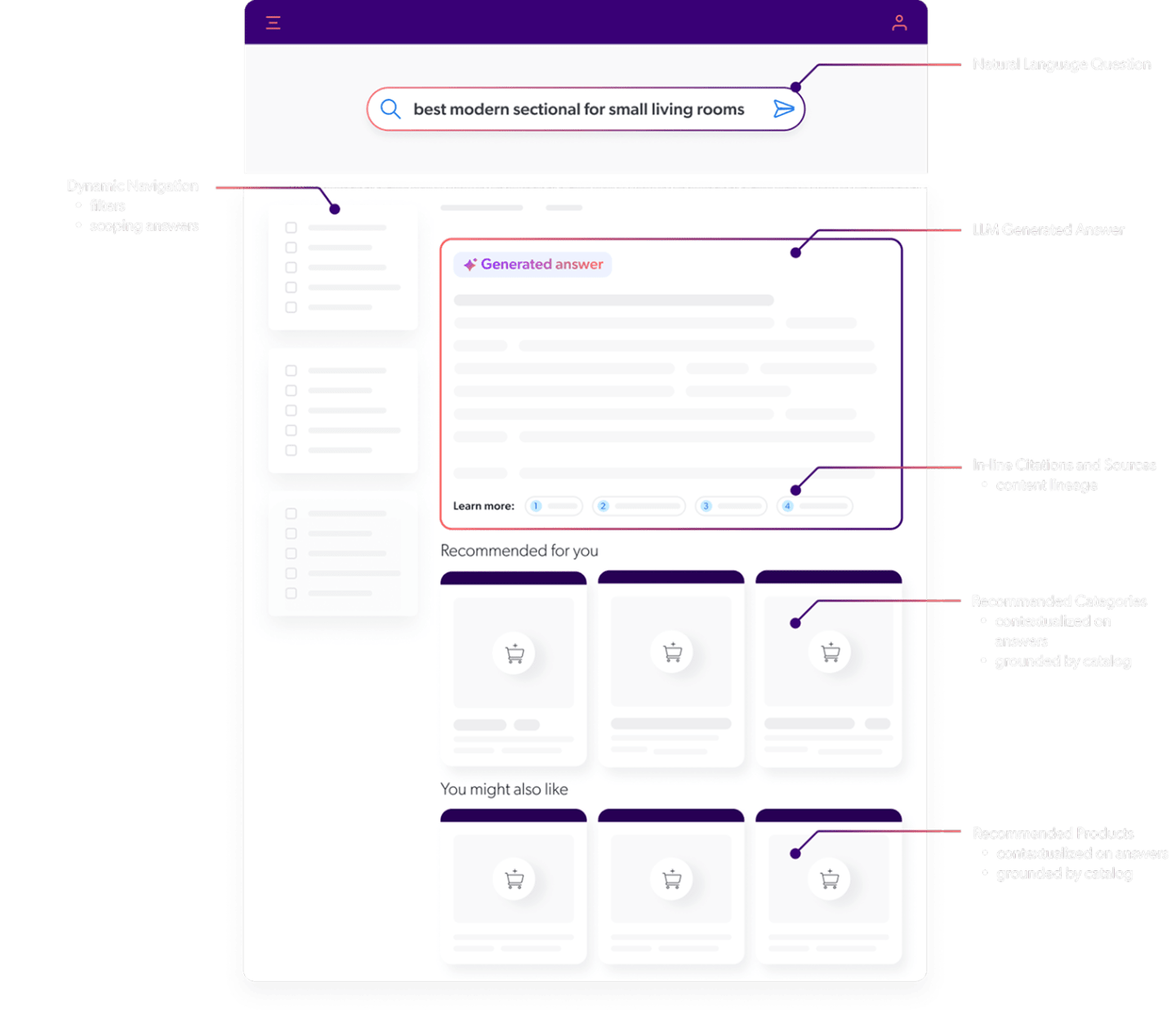
The Anatomy of the intent Box
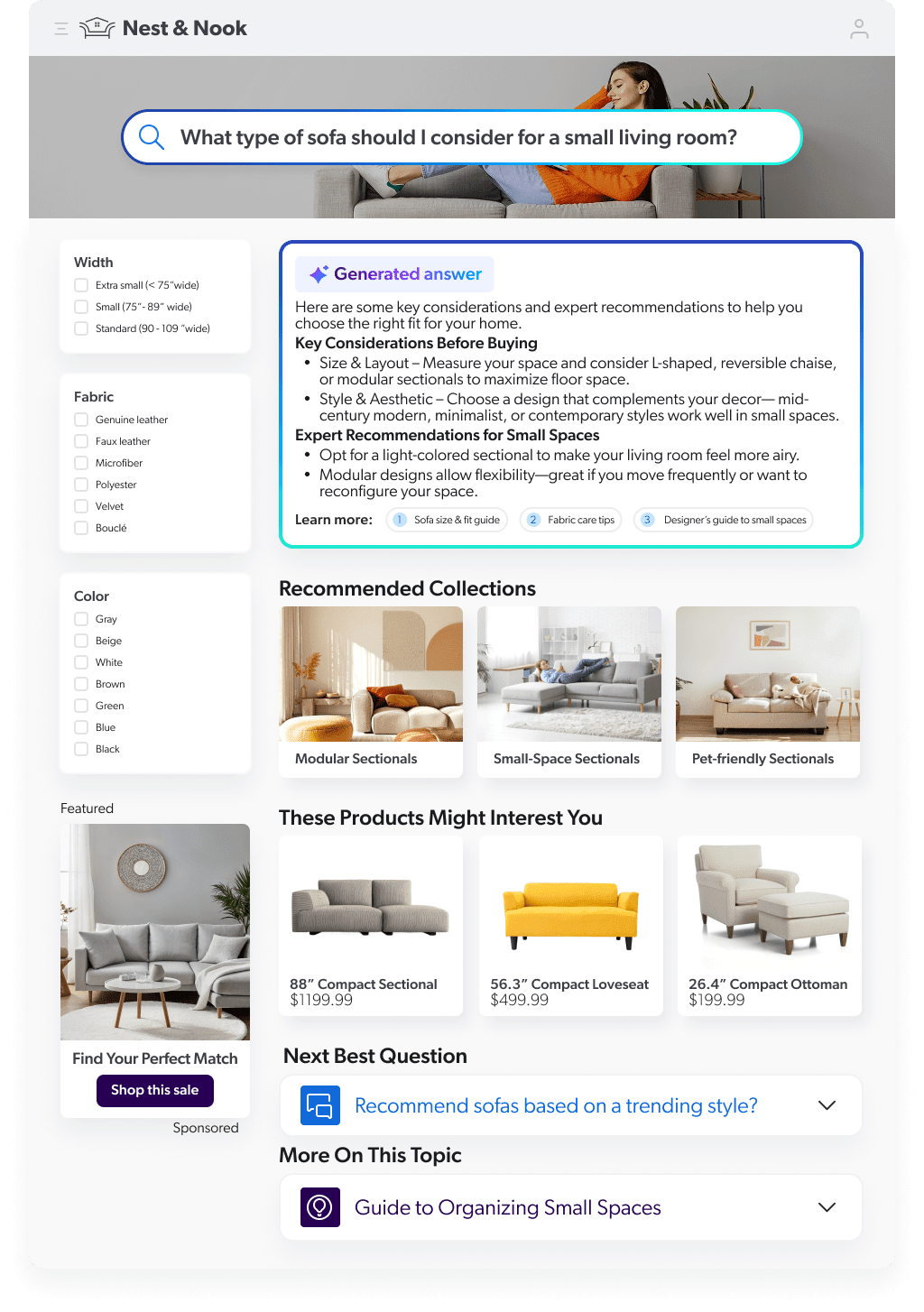
Example Spotlight: Finding the Perfect Sofa

A shopper searching for what type of sofa they should be considering for a small living space doesn’t want to see random sofa listings, be redirected to a chatbot, or have to rephrase their query multiple times to get the right results. They expect search to understand their intent and deliver relevant recommendations instantly.
An intent box should be able to dynamically surface:
- Expert advice on key considerations, configuration, materials, and space-saving features like sleeper sectionals or storage chaise
- Category recommendations optimized for small-space living
- Suggested product options that match space constraints and style preferences
- Featured products relevant to the intent of the generated answer
- Expert-rich content such as articles, blogs or guides that can offer more in-depth guidance
- Next best questions that help the shopper refine or expand their discovery journey
What the Intent Box Gets Right That Chatbots Don’t
For years, brands have turned to chatbots and virtual assistants to make ecommerce feel more interactive. But generative product discovery is something else entirely.
Chatbots typically follow rigid scripts, often creating frustrating, disconnected experiences. Shoppers don’t want forced conversations — they want quick, relevant answers.
Shopping assistants usually can’t handle complex or vague queries, and they’re limited to the product catalog.
That’s the difference: chatbots interrupt, assistants have limits, but the intent box listens and responds in real-time — with full context.
Instead of frustrating shoppers, the intent box delivers seamless, relevant guidance that connects education, discovery, and support, in a single interaction point. It’s efficient, intuitive, and personalized.
And the impact is clear: 62% of shoppers are more likely to buy when supported by GenAI-powered guidance. The intent box doesn’t force interaction — it enables the right one.