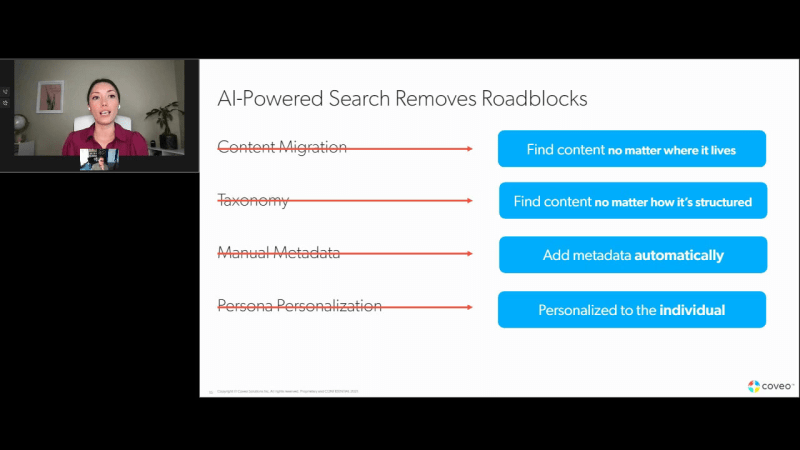
Hello, everyone, and welcome to today's webinar, Your Roadmap to Knowledge Transformation in twenty twenty two, brought to you by Technology and Services Industry Association and sponsored by Kazeo. My name is Vanessa Lucero, and I'll be your moderator for today. Before we get started, I'd like to go over a few housekeeping items. Today's webinar will be recorded. A link to the recording of today's presentation will be sent to you within twenty four hours via email. Audio will be delivered via streaming. All attendees will be in a listen only mode, and your webinar controls, including volume, are found in the toolbar at the bottom of the webinar player. We encourage your comments and questions. If you think of a question for the presenters at any point, please submit through the ask a question box on the top left corner of the webinar player, and we will open it up for a verbal Q and A portion at the end of today's session. Lastly, feel free to enlarge the slides to full screen at any time by selecting one of the full screen button options, which are located in the top right corner of the slide player. I would now like to introduce our presenters today. John Raxdale, distinguished researcher and vice president of technology ecosystems for TSIA, and Bonnie Chase, director of product marketing and service and support for Caveo. As with all of our TSIA webinars, we do have a lot of exciting content to cover in the next forty five minutes. So let's jump right in and get started. John, over to you. Well thank you Vanessa. Hello everyone and welcome to today's webinar. I'm very excited about this one because it's a topic that both Bonnie and I are very passionate about. We've both spent a lot of time in our careers in knowledge transformation, knowledge management, knowledge technology. So we're really excited to share some of our best practices and lessons learned with you today. You know, I've been doing this knowledge management survey every year since twenty fourteen, and in it I ask people to rate their employee facing and their customer facing knowledge management programs on a ten point scale, with one being needs a lot of work, and ten being awesome. And if you look at the scores over, the last number of years, you'll see that despite the millions of dollars that have been spent on knowledge management, people, process, and technology, the scores really haven't gone up very much. So today we're gonna talk about some of those challenges, juggling some of the priorities, and hopefully give you a roadmap, to move forward this year with improving your Kilometers program. Before we get started, I'd like to start with a question for the audience. What do you consider your biggest obstacle to a successful knowledge management program? Is it people? You don't have enough resources dedicated to creating and maintaining content. Is it process? A lack of defined processes for creating and maintaining that content. Or is it technology? Employees, customers struggle to find content due to poor search technology or badly designed portals? Or all of the above? Are you struggling with people, process, and technology? So we're, I'm gonna give you a couple minutes to get those votes in. While we do, Bonnie, I know you talk to a lot of companies about the technology piece, but, I'm sure you're also seeing the people and process side as well. Yeah. Absolutely. I mean, it it definitely takes all three, to be successful. But, you know, what I see is is it's not necessarily just the fact that it's not enough resources, but also it's not necessarily the right people who are involved as well. So, you know, maybe maybe it's not bringing in the the right level of, you know, maybe an executive sponsor that's needed or, you know, not being able to even show how like, you know, how to to show that you need more people. I know when I was a knowledge manager and and we asked for resources, you know, we didn't get resources if we needed another person. We had to prove that we needed a resource. And how do you prove that you need resources? Right? So so that was a challenge as well. Well, let's see what, the audience says. We've got almost everybody in the audience has voted so far. And interestingly, it's pretty evenly split, across people, process, so whether you are struggling with one of these three or all of these three, hopefully you're gonna pick up some useful tips today. So thanks everybody, for for taking that polling question. So I'm sharing some data from, the Tech Stack survey of support services that I completed the end of last year. And yet again, as it has every year, I've been doing these technology spending surveys going all the way back to two thousand and six. There's always a lot of budget earmarked, for spending in anything related to knowledge management. Eighty six percent of companies are planning an investment in their portal. Eighty two percent knowledge management, communities, chat bots, intelligent search, even video content management. So how do you create a logical sequence for investing in multiple technologies? Obviously, you can't invest in everything at one time. You're just going to boil the ocean and probably not get really great results. And I want to talk about, really figuring out some sequencing on these investments. So those of you who have read my book, Lessons Unlearned, I've got a whole chapter in there about, what is the root of most technology failures. And I talk about the challenge of companies that invest in technology when they don't really have processes to find or they've got broken processes, and you really need to iron that out first. But there's sort of a rare example of when that isn't the case, and it's around, intelligent search, advanced search, analytic based search, whatever your term for that is. And I wanna talk about why investing in that before you have your people in process can really help you figure out the best strategy for those other aspects of this equation. So let me give you three reasons why investing in intelligent search early helps. And this is a conversation I have when I'm doing technology evaluations or Kilometers workshops with companies, and they often tell me, we know we we can't find the content, but the content is really kind of bad, and we wanna wait until we get content, in a better shape before we invest in search technology. And I'm always encouraging them to go ahead and move that expenditure, on the search technology first. So let's talk about why. First, if you're leveraging analytic based searching, it's gonna give you a content gap analysis. And that means you understand what people are searching for and not finding. And it's not just at the product level. It's actually at the the concept level. So, you know, you may have a ton of, content about how to use a certain application or feature, but there's nothing in there about how to customize it or create reports for it. So by doing this content gap analysis, it's really going to help you understand from the employee viewpoint and the customer viewpoint what people are struggling to find. And armed with that information, then with the limited resources you do have available to create new knowledge content, you can focus them on creating the content will have the biggest impact because historically, support management thinks they know what they should create, and they create a lot of content that may never actually get used. Another analytic that's really helpful is usage analysis, and that is really looking at the consumption patterns. What content is being used the most? Who is using it? Is it certain levels in the organization? Is it certain geographies? You know, you're gonna find out that maybe certain formats, you know, as we're saying in our channel preference study, that there's a much growing preference for video content over text content. We're also seeing much more reliance on community content because it's pure information. So really understanding what people are consuming is gonna help you, again, understand what content you should be creating. If nobody is reading manuals, then, you know, you don't need to prioritize getting more manuals uploaded to the website. If it's all video content, you know, you need to figure out the best way to start recording videos easily and getting them on the website. The other thing is, you know, I I did a a project with a member a couple of years ago, and they were struggling with who should be in charge of creating knowledge. So we ran some reports to see the top rated content, across their, global service organization. And what we found is of all the top rated content, eighty percent of it have been created by two people. So there you go. Those people need to be, if not in charge of creating content, you need to understand what are they doing that's making this content so good. Can they create a workshop maybe for for everyone else? So again, that comes with with usage analysis. And the final point is the search technology can be used both for employees and for customers. And I usually see companies focusing one or the other, but not necessarily both. And what you need to keep in mind is every time you search for something and you click on a match, you're improving the learning of the analytics, the machine learning behind the scenes. And your customers use very different terminology than your support employees. So by rolling them out both, that means when a customer calls in and an agent is searching for what a customer is talking about, they're gonna find the right content because it's what the customer is searching for online. And your more technical customers who are more likely to search for maybe what your support employees are searching for are gonna find that because the employees are using it as well. So I think that your machine learning probably, grows twice as fast, when you're you've got both audiences. Bonnie, do you agree? Is it if you start with both, do you see a benefit there? Absolutely. And and I like to say, if you wait six months to get to get this in place, then you're missing out on six months of data and six months of of being able to capture all of those insights from your customers that can then feed into making that experience better sooner. Absolutely. Well, I've got one more slide, and then I'll turn things over to Bonnie. I've got some data here comparing twenty to twenty one, from the Kilometers survey asking what approach do you use to staff your knowledge management program. And if you read my state of knowledge management, that came out in October of last year, you know that in general, a lot of the metrics kind of went down, with the pandemic. People had maybe bigger things to focus on than their Kilometers program, and some of the best practices slipped a bit. One thing that we saw that actually improved is an increase in the percentage of companies that have designated knowledge workers, or at least a combination of everybody's responsible with some dedicated staff. It makes me very nervous when companies say, oh, we don't need dedicated knowledge workers because everyone is accountable. Because we all know if everyone's accountable, no one is accountable. But one of the things that did slip is the percentage of companies that were incorporating some sort of Kilometers participation or metrics into employee MBOs and incentive compensation. And now we're just at fifty one percent of companies. So only half of companies are even grading their employees on whether they're participating using knowledge, contributing knowledge. And you know, at the end of the day, what employees get comped for is what is important to them. So if you have pulled this out of your MBOs and out of your bonus program, you're sending a subtle or maybe not so subtle message that if you don't have time for for knowledge, it's okay because we're not gonna ding you if you don't. So, you know, keep that in mind. I'm hoping when we do the survey this year, those numbers will will start climbing back up. So that was my quick look at technology, a little bit on people and process. And now I'd like to turn things over to our guest speaker today, Bonnie Chase. Take it away. Thanks so much, John. Yeah. That's a great overview, and and this is definitely a topic that that I'm very passionate about. As John mentioned, my background is in knowledge management. So although I'm in a product marketing role at Coveo, this is still something that's very near and dear to me. So I wanna take a step back really and kind of look at the components of knowledge management. And these are really the four pieces, you know, create creating the content, you know, storing the content, distribution, and the use of content. And, you know, I think if you're starting from scratch, you don't have anything. This is a great order to look at, you know, how to build out your knowledge management program. But what we're seeing especially as technology has evolved and the way that we do work has evolved, you know, this this can create issues if you're following it in this order once you have things in place. So there's some roadblocks that that we end up seeing if you're if you're focusing on creating and and storing the the content, before you even look at distribution and use. So I wanted to kind of talk about a few of these. So I put four up here. You know, one is content migration. So a lot of times, I'll see companies who maybe they're moving from one knowledge management system to another. Maybe they're trying to consolidate all of their tools into one. But this content migration piece, you know, can hold up a process. If you're waiting to migrate all of your content before you put something in place that will help you understand your people and your content, you're just delaying that process. Right? Because content migration can take a really long time, especially if you don't have the insights that show what content is important and what content isn't. And John, you made a a great point about, you know, you're not gonna create these manuals if if people aren't going to use them. And so I remember when I was a tech writer, for example, we had a list of content types that we had to create. You know, we had to make sure we had a reference guide. We had to make sure we had the overview guide. We had to make sure we had the troubleshooting doc. Not because it was what the customers were asking for, but it was because that's what we knew our customers needed. And so there's this big gap that happens with what we think our customers need versus what they that can really put us behind if we're trying to migrate everything. Taxonomy is another piece. Taxonomy is really important. I'm a big fan of making sure that your information is is structured in a way where you can identify how how content is connected and where it all fits. But this can this can also be a challenge and a and a roadblock because it's so time consuming. And again, you know, you may understand how all the information fits together, but your customers aren't going to see it in the same way. Metadata is another critical piece that's part of that. You know, we wanna make sure that our information is tagged appropriately and it can surface up in the right results without, without machine learning. You know, metadata is really the way that we can drive those those search results and and, you know, improve findability. But, you know, it also becomes an area that that holds you back from making that transformation. And then the last piece I have here, just personalized experiences. And so this is, you know, so this is, you know, sitting down and identifying the groups of customers and, you know, this group a needs to see content for this particular thing, and group b needs to see content for this particular thing. And so another example of this was, you know, when I was, building out a self-service experience, we had customers who were on versions of the product. And so we didn't want them to see every version, of every product. We wanted them only to see what they should be able to see. And so in order to do that, it was really we had to do a lot around the tagging. We had to do a lot around the structure of the content, the permissions. We had to map that out. Then we had to program, you know, if they're part of this group, then we show them this content. And it worked. And, you know, the the the experience was personalized, but it was, again, it was very manual and time consuming. And the maintenance after the fact took a lot of time. Now we're at a point where technology has evolved. Right? And machine learning is is being used everywhere, and we can really tap into that. And, you know, search is different too. You know, we're not depending on keyword search anymore. So it's we can still find information without digging too much into that. Now these are just four roadblocks that I'm seeing. John, what else are you seeing out there as as roadblocks? Well, I I always say the biggest driver for success of a Kilometers program is culture. And that's another thing that I surveyed for is asking people to rate their knowledge culture on a scale of share knowledge and somebody's gonna take credit for it. Or at the high end, executives encourage and reward knowledge sharing. And you know we've all worked in environments where the only way you can get promoted is to be the only one that knows something. And if that's the culture of your company, it makes it really really difficult to encourage employees to document everything they learn and share it. I think in general we're seeing improvements in that, especially just because younger workers tend to be so much more collaborative. We us baby boomers and and the, you know, slightly older folks, are. No no compliance, not everybody older, hoarded, hoarded knowledge, but very collaborative social minded folks. So I'm hearing that that is less and less of a barrier. But I'm definitely seeing it a lot in professional services. We're trying to push more knowledge sharing into professional services so they can what you learn on a project, you can share with future project teams. And, boy, they don't wanna share anything because that's how they get high utilization rates in the best projects is because they're the only one that knows how to implement a certain product well. So, you know, it I think, if if it's the culture in your company, you can definitely work on it within your department. You may not own the culture for the company, but, you know, it's something you can recruit for, something you can train for. So, you know, think about that as well. Yeah. Yeah. That's a that's a great add. Yeah. And so, you know, with with the culture in mind and and thinking about these pieces, you know, what can what can happen is that you're stuck in a cycle. Right? So you've got you're so focused on how you're creating the content, how you're storing the content, where does it live, how is it structured. You never really get to improving the distribution and use of the knowledge, especially since you've you've you've made a statement that I'm doing this before I do that. And then it just continues in the cycle. And that's really what what I'm looking to kind of break. Right? So how can we look at this differently and approach it in a way where we don't have to stop progress just to make better quality, you know, information here. Actually, we can do it both at the same time. And that's really what what I'm proposing here is just kind of flipping it on its side and saying, yes, the creation and storage of information is really important. And we do need to think about those things. And there's some great things. And and, you know, this whole idea of garbage in garbage out. Yes. That's true. However, we also need to be thinking about how we're going to distribute and use this information. And, you know, in just looking at at these two side by side, we can we can see how our perspective kind of changes from from an inside out perspective of looking looking at ourselves and what we're doing to an outside in perspective and looking at what the customers need and and how do they want to use our information. So instead of asking where does the content live, we ask how will my customers find it. You know, instead of what content do we already have, what content do customers need? And so, so so that my proposal is, you know, you don't have to do one before the other. We can actually do them both simultaneously. And what this does is it can actually eliminate some of those roadblocks that I mentioned on the previous slide. So, you know, looking at, AI powered search, you know, if you have that implemented, you can find content no matter where it lives. Even if you're in the middle of a content migration, if you have that AI powered search in place where it's connected to all of those systems, it really doesn't matter where it lives. So you're not preventing your customers from from finding information because you're you're busy changing it. Right? They're still able to find it. Taxonomy. You can still do the taxonomy. But, again, it enables customers to find content no matter how it's structured. No matter where it lives in the site, you know, they can find that information. You don't have to worry about manually adding that metadata. You know, let's say you migrated from one system to another. You know, an AI powered search can actually do that automatically for you. And then the last piece with the persona personalization where that was so manual before. Again, you know, having that AI powered search capability can can help personalize it to the individual. And so really, you know, as as John mentioned, getting something in place sooner can help you, you know, look at that whole, content strategy, understand where to focus. But ultimately, it keeps it moving. It keeps the projects moving. It keeps your customers you know, they're continuing to find the information. And you're actually making progress for a better experience down the road because you're capturing all of that data and getting those insights early on in the process. Now when I talk about AI powered search, you know, it's it's not just search. Right? It's beyond search. This this idea of AI powered search, you know, we've we've heard this for years and years, and there are a lot of, solutions out there. And it's definitely one one AI powered search is not the same as every other AI powered search. So, you know, what I'm talking about specifically is is one that has, you know, the search, the recommendations, the analytics behind it. You know, obviously, those are things that that Coveo does. But those are the things that really help with that transformation. So as John mentioned, understanding the usage. We can see what customers are using. We can see how they interact with the content. Automatically optimizing. So here, you know, the the search can can optimize that experience, can create that personalized experience depending on on who they are because, you know, it has the data about the customer. It has the data about what they own, what they are searching for, and what they might need to to view next, which is where those recommendations come in. We can start moving to that more proactive, recommendation model. And then again, you know, the the the most important part. Right? Having relevant results. So when they search for something, the results are are relevant to them and their needs. And not, you know, not something that they have to kind of dig through to really find the information. Anything you wanna add here, John? I I think your point about personalization is incredibly important, and you used an example of it earlier. But, you know, I I know that, sixteen percent of TSIA members, which is a pretty small number, are personalizing the FAQs on their website. And that means that FAQs, which should be the first stop shopping for self-service, But if you're not filtering them to only be to the the products and versions that are relevant to a particular customer, it's just a list of noise. And so you're taking what could be one of the single most powerful features on a self-service site and turning it into junk mail. So, you know, I think that that is something that even companies that are using a sophisticated tool like Coveo don't often think about leveraging it to better personalize the results. But, you know, the power is right there in that platform you're investing in. So if you haven't started personalizing and pre filtering content for your customers doing self-service, really put that on your roadmap for the year. Yeah. Yeah. Thank you. And and I'll just kinda jump right into an example of of what those analytics look like. So this is just an example from Coveo Analytics. But, you know, as I said, you can really kind of break down and really understand your users, your cohorts, your content, and even the machine learning. So, you know, usage by channel. A platform like Coveo can can connect to your existing systems. Right? And so it can pull data and insights from each of those systems. So your chatbot, your community, your, you know, maybe even your your training site, you know, wherever those areas are, you know, you can start seeing how the content is being used there no matter where it lives. You know, insight into machine learning trends. Like I said, you know, not all AI powered search searches are the same. Take a look at the machine learning capabilities. You know, is it in a black box? Is it something that you can actually see working and tweak and tune? And so that's something that that we also show in our analytics so you can kinda see how it's working and and choose to to tweak it or allow it to to work on its own. And then, of course, the content trends, you know, what are the top keywords? What content is trending? You know, where are those gaps? And you can really slice and dice it however you want. And so having a view like this and having those insights across that entire journey can actually help you determine, you know, where do we need to focus first. Should we be spending more time improving the content in the community? Should we be spending more time, you know, you know, getting our agents to to, you know, contribute to content. So these are insights that can really help. And and like like we said, you know, the earlier that you can get this in place, the sooner you start capturing those data points that can then help inform your overall, knowledge management strategy. Now just to give you an example of a customer who's done this, you know, Salesforce is, you know, a customer of Coveo, and they've used us, across multiple areas within their, within their self-service and employee experience. But it really, you know, a couple of years ago when they they came to us with a, a knowledge transformation project, you know, they were really focused on improving that self-service experience. And so that's really what that initial focus was. Right? And so once once we put, Coveo in place to start capturing, you know, where that information was important, and how they were using it, you know, they they were able to see some good results. And once they got good results in one area, then they brought it over to another Barca. And you you can see, you know, their agents started using it, and then they transition into other areas. So, you know, even today, if you and I were to go on the app exchange, we would have different experiences because it's powered by Coveo. So these are just examples of how, you know, it doesn't have to be, you know, a one time kind of thing. Right? Transformation is ongoing. It's always changing. So what I like to say is it's really important when we're thinking about knowledge transformation that we're not thinking about it in a silo. Knowledge is not a departmental problem. It is a company wide issue. And it's something that that multiple departments care about. We just don't talk about it in the exact same way. Right? And so what can happen is, you know, being being a part of a knowledge management conversation, in the company is is really valuable. And so how can we how can we level up this conversation so that we're not just fixing the the customer support content, but we're fixing the content across the entire journey for the customer. But doing that, you know, is is hard. Right? And like John said, if people process in technology. And I did wanna talk a little bit about the key players who are part of this, and and part of making this successful. You know, an executive sponsor, obviously, is really important, and that's something that at Salesforce really drive change. Having change agents. So, you know, when I say change agents, one of the things that is often a missed opportunity when a transformation happens is the change management side. You know, we think, we say it, we tell everybody it's out, that's it, we're done. But there needs to be, you know, people who are focused on making sure that not only we're aware of the change, but that we're all taking part in that change as well. IT is important to keep involved. I think, you know, as with any, you know, technology decision, IT is a part of that. But just keep that in mind. You know, I've I've seen where we've gotten to a point, of, you know, we've we've we've gone through so many steps, and then we forgot to loop in IT until the last minute. And then there's, you know, it just extends the process. So if they're aware of it early, maybe there's some things that, you know, you can get figured out before before it's too late. I also wanted to to mention these cross departmental champions. You know, I firmly believe knowledge is not departmental and the more you can have champions across departments and aligned with you, the better. With the Salesforce example, now they have champions in multiple departments, you know, and and they've been able to extend that same great experience across the organization. And so when you're thinking about a knowledge transformation, again, the overall goal should be that entire, organizational knowledge. And then, another missed piece is marketing. So, this one's this one's interesting because, you know, marketing isn't typically seen as necessary for knowledge management, process. I know when I was a knowledge manager, I didn't want marketing to touch anything that I was doing. But what's important about bringing marketing into this is that communication piece. You know, it takes seven times to say something before it sticks. And marketing can really kind of, you know, hit that over and over again, making sure that your customers know where to go to find information, you know, putting out the communications of those changes. You know, putting out the communications of those changes. Program owner. Again, you know, if everyone's accountable, then no one is. So who is that one person that is accountable for this program and the success of the program? Maybe it's the executive sponsor. This program and the success of the program? Maybe it's the executive sponsor. Maybe it's somebody who's more hands on. And then, of course, we can't forget knowledge managers. You know, those knowledge domain experts, those people who know content, know how to get great content out there. It's really key. John, would you add anything else to this list? Are there other key players you're seeing? You know, something that occurs to me is we think of the the analytics and owning the analytics as maybe an IT function. But I don't know what you think, Bonnie. I I think companies have better results if they've got a technical savvy person within the department kind of overseeing those because they've got the business savvy to really understand the search terms, the content, fine tuning that relevancy. I just, you know, I don't know that IT is gonna have the walk and talk to really understand the products and the customer business challenges and the the customer problems. So, you know, I think make sure that you've got some resources within support or PS or whatever department is funding this to spend at least a couple of hours a week on fine tuning those analytics. Because, yes, there's a machine learning engine that's gonna learn on its own, but you can make it learn a lot faster, if you do a little tuning. And if you're expecting IT to do that for you, I suspect they may not necessarily have the business acumen to to do that. But do you what do you see? Is it usually IT resources, or do you see techie resources within service doing it? Yeah. That that's a great that's a great point. So on the IT side, I see that more of, like, you know, making sure that the technology fits with your existing stuff. But you're absolutely right. There should be that technical resource that that's there as well to help, you know, with that tuning and and the tweaks that you need to make. Because it is, you know, when you're working with data, when you're working with machine learning, there there's a a piece of that that's, you know, where it's technical. Right? And and so you need that person on your team to support you. When I've seen IT owning that, it just creates tension. It creates, you know, more trouble trying to access the information. So if you can get that on your team and you can get hands on, it's better. And the one other thing I'll mention, I'm glad you've got marketing on here. I I know a lot of companies that have done a complete overhaul of their self-service website and never bothered to tell customers about it. So you know if you've if you've had a kind of a a poor or mediocre website, customers are kind of trying not to go there. So if you're gonna start introducing new capabilities, you've got to involve marketing and do a big launch. I mean, you're doing something exciting. Tell them what's coming. Yeah. Send them, you know, emails, do webinars promoting your new capabilities because they're not gonna find it by osmosis. So you need to make sure marketing is out there, so you're getting the the new traffic and convert some of those people that maybe didn't have such a good experience last year. Yeah. Yeah. And you're kind of thinking about the experience as a product as well. You know? If you're going to to take a product to market, you're going to announce it. If you're gonna take this new experience to your customers, you want them to be aware of it too. And they'll get excited. They'll get excited because they wanna know, you know, if they've been to your site before and they didn't find what they need, and you're saying, hey. We we know that it didn't work before and we've made a bunch of changes and it's really awesome now. They're gonna they're gonna go take a look. And and if it is, you know, if you've made those improvements and they they get that better experience, then they'll keep coming back. Alright. So, you know, just kind of wrapping up here. This is this is how Coveo views relevance to maturity. And when I talk about relevance to maturity, that's really about getting that right information to the right people. You know, starting you know, people typically start on the very far left where maybe they have a siloed search. Maybe the the AI searches in a knowledge base, or maybe they have a federated search that kind of pulls things together. And so that's really kind of that starting point. But really, the next phase of that is making sure that all of your content is unified and it's all connected and you're really powering that that search experience. And once you're you're able to get those, you know, relevant results, then you can go into the recommendations. And this is all just based off of the the same analytics and and the system that's that's capturing the search, you know, as people are typing in and where they're interacting. That same that same data can be used to to provide those recommendations and to provide the personalization. So, again, it's really, you know, we we in thinking of knowledge transformation, it's thinking beyond the content itself and thinking, you know, what can we do to make sure that this is that, you know, we're getting relevant information to people wherever they are in their customer journey. You know, and we start small. And then once we're successful in in one area, you know, if that's customer support and we're successful there, then we can start extending that, that same kind of methodology into those other areas. And and yeah. That's basically, you know, what I had to share. So I think I'm I think we're ready for some questions. Great. Well, thanks so much, Bonnie. We already have quite a few questions in queue. But just as a reminder, if anybody would like to submit a question for Bonnie or John, please enter in the ask a question box in the upper left hand corner of your screen, and we'll get through as many questions as time allows. Bonnie, I'm gonna jump right in with this first question. And they ask, our support agents are hungry people, and they wanna troubleshoot the problem for themselves and very and are very reluctant to read solutions should suggested by someone else. How do you solve this? It's a good question. And I think this kind of points back to John's point on culture, which is, you know, if you're if you're not a knowledge sharing culture, it's going to be difficult to, to get people to to participate in that. Now one thing I've seen I mean, there there are a few different approaches that people have done. So so, John, I'll I'll kind of share a couple, and then maybe I'll ask you to jump in as well. But, you know, being able to, to track how how these how your, support agents are doing. And what I mean by that is, you know, do you have data that shows, you know, how many how many, cases they've been closing, and then how how many times they're attaching content to cases. What we've seen is that, you know, if we're able to show kind of a a leaderboard of, how agents are interacting with content that kind of, you know, makes people want to participate more. They can kind of see what's happening across the team. But really, it's about making sure that, you know, it's it's not about content. It's about, you know, making sure that we can answer the questions quickly and get the customers on their way. And if the the way of doing that is by using existing content, then they need to understand the value of that. So what is the what is the reason why we want them to read this content? It's not just, you know, you need to do this for solving the problem, but because it's going to make it faster, we want you to to learn from others, you know, things like that. So there are those culture things that I think should be addressed first, and then that that process piece can come in after. What would you add, John? Yeah. I I agree. It's rooted in culture. But, you know, Rajeev, I'm I'm happy to hear that you've got these really, you know, hungry people that love digging in and problem solving. But I think it may help if you really emphasize the customer experience. So hopefully your data will show that people that are quickly finding documented solutions are going to have, shorter resolution times, shorter talk times, higher first contact resolution rate, and ultimately, that's delivering a better customer experience. So if that is emphasized in their performance goals and their quality monitoring, to show that they can streamline the experience, lower the effort for the customer, by relying on that, I think that's gonna help them understand why they need to rely on on other content. And also, if you've got a really collaborative culture, then everybody's sharing what they know and helping each other out, so they don't feel like they've got to go fix the problem on their own. And the final thing I'll mention in the dark ages when I ran call centers, I had a rule, in the system that wouldn't allow them to close the support case if it wasn't linked to either an existing knowledge article or a new article they submitted. So if they didn't do that, they couldn't close the case, and then their case time started extending out and they got dinged on that. So, you know, that means you're forcing them to solve search and link the correct article. And if there isn't one out there, then they need to be submitting it for the next time somebody calls in with that problem. So a rule like that, which is really easy to do in Salesforce, can force them, into that behavior. Okay. Our next question asks, how easy or difficult is it to find tools that can overlay existing TAM tools and content that an organization has? Well, that's a great question. Very easy. No. I'm kidding. So, you know, there are a lot of platforms and I I make that joke because Coveo is a platform that can do that. But, you know, I think, you know, when you're looking at tools, I think asking that question is is a good first step. Right? You don't necessarily want to overhaul all of your technology during a transformation, especially not all at once. And so, you know, making sure that that you understand that is really key. But I think also when you're looking at, you know, not only does it extend into these existing systems, but how difficult is that to set up and how difficult is that to maintain. So for example, you know, Coveo has out of the box connectors that can, you know, kind of plug and play with the UI and you can kinda set it up through that UI and it's fairly easy to to to connect to those external systems. But if you're going to have to, you know, manually code those connections and then maintain that code afterward, you know, that's going to be a lot of a lot of effort, you know. And, so I think, you know, looking at tools that not only connect to existing systems, but have the capabilities that you're looking for, you know, the maintenance. You either have, you know, it's it doesn't have the the high maintenance or you have people on staff to help support that. And then looking at, you know, what are those AI capabilities? Is that black box? Is it something that I can see working? And then that can kinda help you identify, you know, which solution is best. Okay. Well, unfortunately, we have come to the end of today's webinar. I know there are quite a few questions that we weren't able to answer for our audience here live, but don't worry. We haven't forgotten about you and we will absolutely get back to you. So with that being said, I would just like to to thank everyone for a great webinar and really just let everyone know that there will be an exit survey at the end of today's webinar. If you could take a few minutes to provide your feedback on the content and your experience by filling out that brief survey and know that a link to the recorded version of today's webinar will be sent out within the next twenty four hours. I'd now like to take this time to thank our presenters, John and Bonnie, for delivering an outstanding session. And thank you to everyone for taking the time out of your busy schedule to join us for today's live webinar, Your Roadmap to Knowledge Transformation in twenty twenty two, brought to you by Technology and Services Industry Association and sponsored by Coveo. We look forward to seeing you at our next TSIA webinar. Take care, everyone.

Your Roadmap to Knowledge Management Transformation with TSIA
Knowledge management and search strategies are bowing to the twin demands of customers and support agents. Why? Search fatigue. This year, organizations are focused on content findability.
This year organizations will tackle the complexities of a KM transformation but they must overcome numerous hurdles: content that supports multiple intents, living in siloed content sources. With limited time and resources, where do you begin? With content, search, or something else? There’s a lot to consider.
This session will share insights on the people, processes, and technology that are key to a knowledge transformation and best practices including:
- Who should be involved in the knowledge transformation process
- How to identify and prioritize the most important content
- When to bring search into the equation
- Case study example of success
- Why you should be considering search this year


Make every experience relevant with Coveo