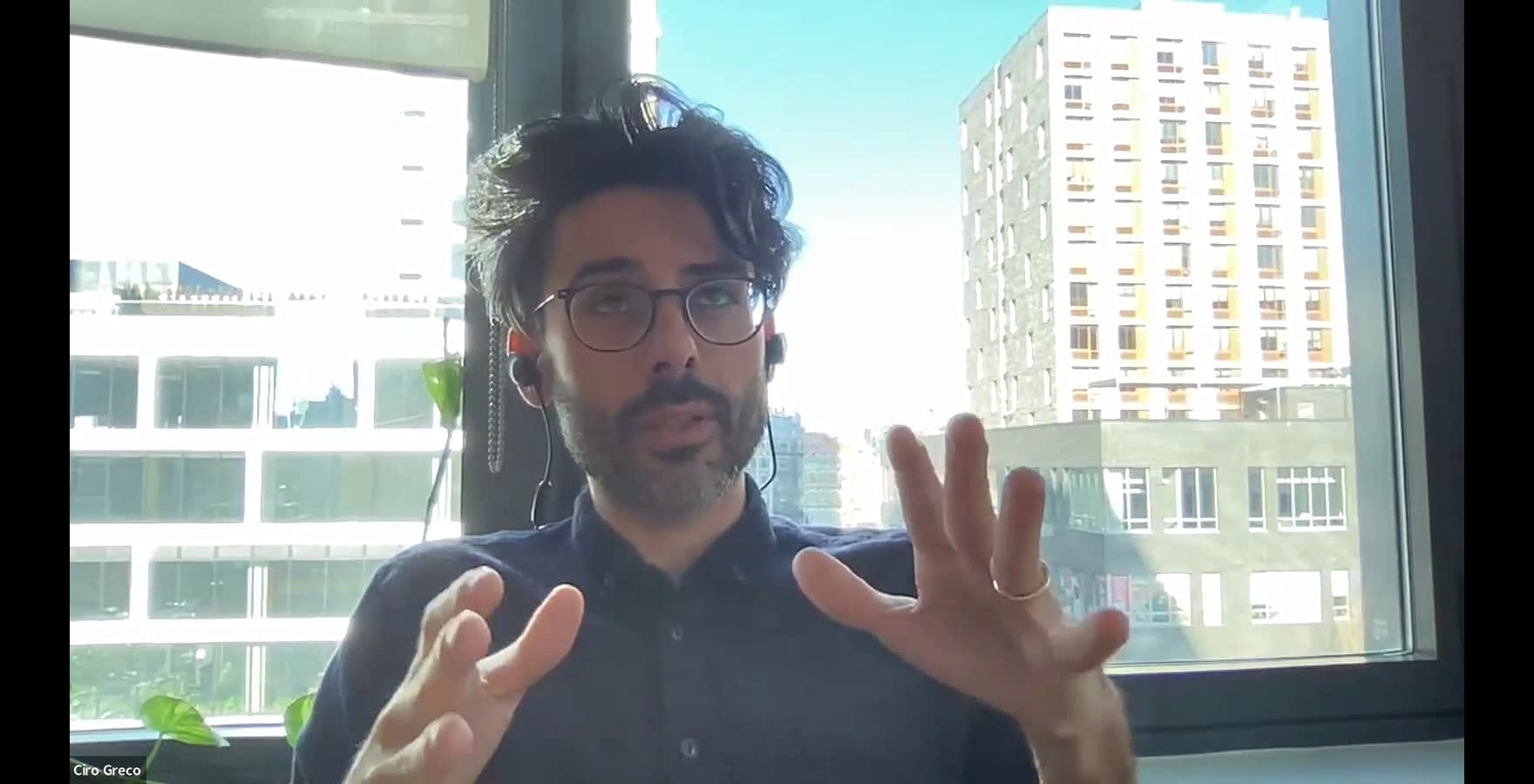
Alright. Hi, everyone. Thank you for joining us. We'll be starting in just a few seconds just to allow time for for people to to log in. Wonderful. So, again, hi, everyone, and thank you for joining us today for our webinar, called the present and future of intelligent search in driving digital transformation. And my name is Clara Blanger, and I'm very excited to be here with you today. I'll be your moderator, and I just have a couple of housekeeping items to cover quickly before we get started. First, everyone is in listen only mode. However, we do want to hear from you during today's presentation, so please feel free to use the q and a section on your screen. Throughout the the the webinar, feel free to post your questions there and we'll, cover what we can during the q and a section portion of the today's webinar at the end. Another, quick point is that this webinar is being recorded, and we'll make sure to send it to, everyone after so you can rewatch and share if you want. On that note, I'll leave the floor to Isaac Sacolick, the press president and founder of STAR CIO, so he can kick things off. Isaac, over to you. Thanks, Clara, and, thank you for having me on this webinar, the president and future of intelligence search and driving digital transformation. And I'll tell you, I, you know, I've spent a career being a CTO and a CIO, and I probably implemented a search engine and sometimes two in every one of those companies. They included media, construction companies, financial services companies. It really is both the heartbeat of running your internal digital workforce, but also running your customer experiences and customer support. And so I'm excited to be here today with two panelists who are also equally knowledgeable experts in the enterprise search field. First, let me introduce you to Paul Nelson. He's a managing partner at Accenture. Paul, thank you for being here today with us. My pleasure. Thanks. Great. And Ciro Greco, he is the VP of artificial intelligence at Coveo. Talk about intelligent search. Hi, Ciro. Hi. Thanks for having me. That's great. So, again, today, we're gonna be talking about intelligent search. We're gonna try to keep some of our conversation practical in terms of what people are doing today and why people are, making it at the forefront of their digital transformation programs, but also a little bit about the future and where intelligent search is going. We're going to start today talking about one of the more common use cases for search and that's an ecommerce. And, Chiro, when we last talked, you mentioned something to me that it was intriguing that there's a lot of customer and people's intent how it's happening outside of the search engines and, capturing what their behaviors are. Can can you explain what you meant by that? Sure. Yeah. So in ecommerce, I mean, search and ecommerce is a driver of of revenues ultimately, and it really you know, it depends on the vertical, the specific website, and and so many, on so many factors. But, ultimately, what you wanna have is a is a very effective way to connect people, users with products so they can convert. So there's a lot of that. It goes into understanding the intention, which, by the way, is related to, you know, kind of the surge of personalization and so on. So it's a lot about that. And there's a lot of context about the user and what the user does that can somehow inform us to what the user wants when she types something through the search bar that doesn't necessarily happens with the search bar. It happens just because the user is browsing around. The the user is is adding something to a wish list, adding something to the cart, purchase, and so on. So there's the vast majority of the behavior doesn't happen on the on the on the search Barca, and there's a lot of benefit in having these two things connected, what happens on the search bar and what happens outside of the search bar. Right. So there's tremendous amount of context here out there, I think, is what you're getting at when, I used to talk to some folks and they'd say, well, you know, why should we update the search engine? Only eight percent of our users ever type a keyword into the search box. And the reality is you're collecting a lot more data around that user. They're doing a lot more things around the site that are telling you intent. You're starting to build a profile up. And so when they click on something, that click ought to be hitting that search engine, giving you some more data around them. Am I getting that right? Yeah. I mean, like, consider I I know the the the point about, like, the eight percent very well. Because, yeah, I get that a lot. But I used to get that I used to get that ten, fifteen years ago. I think it's a lot higher now. It's a lot in ecommerce, it's usually actually in between, like, usually fifteen to fifty percent. But Okay. There's also an interesting data point there is that, in my experience, you know, firsthand experience, the conversion rate of users who use the search bar is way higher, like, way higher than than just, like, browsing users. So Yeah. There's True. Maybe there's not a lot going on. Data from Amazon, which says their conversion is double for, for people who've used searches over people who haven't done searches. And the other thing to not forget is that all lists of products come from the search engine. So all the browse list of products come from the search engine as well. Yeah. Exactly. So, ultimately, exactly, it's kind of the spinal tap of of your website. But in general, the point about the the search engine is I don't know. Like, having the search engine informed by the browsing behavior and vice versa, I think, is beneficial because, like, I'd like to think of a website as an organism. Mhmm. So, like, you don't wanna optimize, like, one organ and not the other. Like, usually, it has to work in harmony. Thank you, Jira. And and, Paul, thanks for jumping in. Maybe you can continue the thought. I mean, we've been investing in search engines and ecommerce sites for two decades now, and there's a couple behemoths in the room. And you, you know, shout out some stats about where Amazon is successful at it. So, you know, what must companies do now to improve their search experience now that we're doing so much more online and on mobile phones and so forth? Yeah. I I mean, intelligent search, not just for ecommerce for but for everything, is about including information from the from anywhere you can get it. Right? Chiro is talking about getting information from the user behavior, the user events, the user clicks, and aggregating that up to provide better personalized search for the user. But you can get data from your sales channels, from your SAP system, from your support calls, from, you know, all around your organization and, you know, machine learn on that, add that into the index. It helps a lot. And then you think of, let's get information from the world at large, like neural networks that are trained on Wikipedia. Right? And, so so now now you're talking about, you know, not just the person's knowledge, but, you know, knowledge about the products from manufacturing, knowledge about the products from, you know, all the sales channels and support channels and everything that else you've got, knowledge about the user based on the user's behavior. Right? And then knowledge about did I miss one? Knowledge about the world at large. Right? That, that that and you can bring all that. And this is where we are. Like, we we have these pots of knowledge, and it kinda takes specialists and scientists and artists, dare I say, who who can blend all this together to create you, like, that the perfect search experience. So it it hasn't been figured out. You know, we're all trying to take these random ninety nine signals and figure out which way. And we play with things, and some things work and some things don't. It's a little bit of artists, a little bit of scientists. So, you know, I think we're at that kind of wonderful, playful part of figuring out intelligent search where we have, all this data that we can pull in and all these different things that we can do. You know, five years from now, it'll probably be dead boring. Everyone will know how to do it. It'll all be done in the same way. We'll have, like, five dollars I don't know if I believe I don't know if I believe that. I mean, we're continuously pushing the envelope around, you know, what we can do with machines to implement intelligence and to increase the scope of knowledge that it can get access to. I mean, we talked about, you know, ten, fifteen years ago, there were indexes. And now that Right. Being over over over optimistic in artificial intelligence goes way back. But remember remember that Marjane Binsky wanted to solve the language problem with some interns during one summer project. So Right. I didn't say it's it's in the field. It's in a good tradition. I don't know. I think That's an excellent point. I think ambition is great. I think, you know, trying to shortchange where innovation is gonna become commodity. I don't I'm not sure I'm ready to sign up for that on intelligence search yet just yet. I think we just keep pushing the envelope in terms of the amount of data, the amount of where the algorithms are providing insights and a little bit less around the heuristics that we have to put in, around taxonomy, around categorization that make, you know, search engines possible. Folks, I wanna remind everybody on the webinar, please do throw your questions up in the question and answer panel. We have at least two, maybe three experts here. I'll be the maybe three, around search engines. We're happy to answer your questions. Paul, I want to move on to enterprise search from, from e commerce search. And, you know, you're a fast growing company. You do a lot in your organization around search, but other industries are also doing this. It's not just happening in ecommerce or media where I was getting my starts from. It's happening in manufacturing. What's driving the growth in priority around search today inside the enterprise? COVID, I suppose. Right? We were all working from home. You know, we can't, walk around the office and talk to people. You know, there's a a lot less human interaction, a lot fewer opportunities just to randomly run into somebody and say, hey. I need this thing, or how can you help me with this thing? And so people are, you know, dealing with the digital view of the of the organization. And, you know, they're discovering that search is a critical component of that digital view in order to get people to the content and the knowledge and the people the other people they need because you can't just bump into somebody, right, or you're you're not, you know, you're not at that hallway and somebody drags somebody over and says, I'd like to introduce you to this person. Those sorts of, you know, interactions don't happen anymore. And so you you'd like for a computer to say, these are the five experts who I think may have information that you need and, you know, based on the data that they've written and, you know, the the PowerPoint presentations they've uploaded and things like that. I think it's a good example, Paul, because, I mean, when we talked about equated search with indexes, you know, we indexed all our file systems. We indexed documents. And now we're you know, we could be searching for people. We could be searching for information in our CRM system. We might have, you know, you know, again, documents, but it might be on our file system. It might be in one drive. It might be in Google drive all over the place. And so, you know, Chiro, maybe expand on that a little bit. You know, why is enterprise search still so hard that we're still working on it? There's there's so many I don't know. Like, there might be some historical reasons that I don't that, maybe I can sort of see, but I'm not one hundred percent sure. But in general, I think enterprise search is frankly a complex problem to solve, and it's a very different problem from other types of search. So search is kind of an umbrella term, but then what you actually do is depending on the use case might vary widely in what you actually have to do to be efficient. So enterprise search is complex because you have a lot of different sources. They might be completely unstructured. They kind of depend idiosyncratically on what your company looks like. And the data that that I was referring to before, so the behavioral data that you can use to somehow infer a lot of the context and so on, is it there there there's few there's there's way less data than than in other context like, you know, web search or or ecommerce. So it's you kind of have to capitalize a lot on what she on on what is encoded in the knowledge that is encoded in your company in some in some things that are there and you don't think about. Like, for instance, the org chart. Mhmm. You wanna be put in touch with an expert in your company. You might have some information that you cannot collect from what the user does, but you have it somewhere. You have an org chart. You have, like, people that are closer or or farther away in the organization. They might you know, depending on who they report to, you can infer what the area of expertise is. So it's it's it's a it's a complex problem because it's, there's you need to be clever in the usage of data, I think. Sure. I think that's good point. I mean, I mean, when you think about how to make intelligent search, part of it is being very expressive around the data that you're presenting to it. And, you know, if you're only gonna show it documents, it's only gonna tell you about documents. If you only show them unstructured data, it's only gonna show you unstructured data. And Paul, we had a conversation around this a couple of weeks ago. I mean, we're building data lakes. We're building data catalogs out there. I may wanna throw a question at the search engine and say, you know, does this system do we already have a a data store around weather data or econometrics data or data coming from a particular country? Are we talking about those kinds of problems as well? Yeah. Absolutely. And you talk about intelligent search for digital transformation. Right? The title of this webinar, there that is really where search, I think, is starting to truly digitally transform organizations. You know, we have had this notion of big data in the, you know, around the the early two thousands. And then, you know, in the in the twenty tens, that became data lakes and Hadoop and and so on. And now it's all about, you know, cloud. And and, really, all the work over the last twenty years has been about machinery for processing large datasets. But now we have a scale problem that we're everyone finally realizes, hey. Data is important. Right? And so now they're gathering it from everything and saving it. And now instead of, like, thirty, you know, key corporate datasets, we have thirty thousand key door corporate datasets, and nobody knows where the data is. And it you know, we're adding another ten thousand every year. And so now we need search to find the data, to get to the data, to use the data. So I think it's more than just call I mean, I I think it's not just just the data that's growing and the datasets that are growing. It's the number of people in the organization that we want to to interact with it. Right? We used to have BI systems, and IT was the only one getting access to this data and the only one producing reports. And now, you know, I have more data. I have more data scientists. I have citizen data scientists. I have people producing content all across the company. And the last thing I want them to do is reinvent content that I already have or buy content they already have or not know what we have the content or not know how to use it. And I think search plays a role in that. Is that right? Oh, yeah. Absolutely. And you have everybody with the BI dashboard sorry. Power BI dashboard that can do, you know, Power BI. But no. You're absolutely correct. And, you know, it's not just searching for the data as well, but it's also searching for dashboards and reports and all these outputs that everybody is doing. And that's what we see, we're getting asked to do more and more is that enterprise search is not just about searching over knowledge documents in content management systems. Now it's about let's find datasets and show you datasets. Let's find dashboards. Let's find Tableau dashboards and Power DBI dashboards and reports. So and bring that as all part of the, you know, the experience. So and I think that's what's also transformational because, really, what is the goal of search? I think overall, it's to reduce the distance between the user and the information that they need. And, you know, if we can provide access to that data with just a a click and then also tell the user how to, you know, load that or even a single click to show it in their their, you know, Power BI dashboard so they can start playing with it. You know? How powerful is that? That's amazing. And so now all these huge barriers to try and ask a friend who knows a friend, who knows somebody, who knows the data. You find the data owner. You go through training. You get you know, do the firewall thing. You finally get access to the data. You discover it's the wrong data. Then you go through the whole process two or three more times, and finally, you've gotta you know, we can just, you know, lower all those barriers. Then we we're talking about something that's truly this, like, mission critical data, you know, enablement for an organization that is just amazingly powerful. See, Paul, I love this because you just answered the question. Why is this more complex? Well, we have more data, more use case, more different types of questions that our end users are expecting our systems to be able to answer. Whether I'm doing that on a phone or through a portal or embedded in a third party application like inside a a Salesforce system or another CRM system or a CMS system or the dozens of CMS systems I might have out there. And, you know, Chiro, the one group I think about most around this inside the enterprise is a customer support group. Right? Because I'm gonna come in and ask a question and, you know, I'm active on, I'm active on Twitter. I'm active on social media. I'm clearly technically knowledgeable. And I come in and I ask a question, and the first response is a canned response because the customer support person doesn't realize I probably cleared my cash already before opening a ticket up with the with the SaaS solution. So tell me about customer support functions. You know, how can search help them improve their ability to respond to a question or address a user issue? Yeah. So customer support is fascinating because it's it's it's complicated. It depends on on on a lot of things you don't see necessarily. But search there helps enterprises to so there are many mainly two functions there. One is to well, if you do a good job, you should be able to connect people with the right content and I mean, if you do a good job and if there is the right content, which is not up to the search engine, it's up to whoever produces the content. People can self deflect. Right? There's this notion of self deflection. It means, like, they never reach the point when they open up a ticket. They don't need to get in touch with you. They just, like, figured it out, which is per se quite complex to figure out because we're trying to measure something. It doesn't happen. Mhmm. So it's like, you know, looking for a black cat in a dark room. Maybe there's no cat. So this this it's impossible to tell. But then the other the other function that you have is the very same, role that a search has in connecting us to Paul's point of user to the to the information he needs goes also for the agent. So for the person inside the enterprise that needs to to take care of the tickets. And so and that has an impact dive and a a direct impact on on the money. Because, like, if the case is misrouted, for instance, or if the case is mishandled, that usually it's fairly easy to attach a a dollar sign to that specific event that just happened. And so you want the search engine there to streamline that process internally. So once the ticket is open, can the agent find information right away? Can we make sure, for instance, like using artificial intelligence to help people classify their tagging, their their, cases, their tickets in a way that they don't get misrouted and things like that? So it it it has an impact on the bottom line, I would say, as opposed to ecommerce where you expect your a good search engine to impact your top line. Well, Jira, I mean, my my opinion around this is so much of what organizations focus on with customer support is trying to answer a lot of the easy questions extremely efficiently. So we put up FAQs, we put up chatbots, we make it easy to reset your password. You know, all the things that we get the volume of of questions on, we focus on answering that. There's the other twenty to thirty percent that come in. They're asking really hard questions, very specific questions. Yeah. And, you know, that's gonna go to a customer support rep who needs to know as much context around the person? What equipment am I running on? What version of, of, of a browser is, is connecting into here? When else has this person opened a support ticket? Who is this person? Do we know anything about this person? Is it a customer? Is it a prospect? Yeah. I mean, for example, having data from the knowledge like, when you have, if if you look at a customer journey, like, having data, browsing data, even just limiting ourselves to buyers and data, nothing particularly fancy. Just having, like, browsing data from what a customer did on the community page, for instance. So what documents this guy already read or at least opened and give this information to the agent, it's important because, like, that it's implicitly tell the agents, like, look I read the manual already. Right. If the if the top three documents you have are these, this guy already read them. You're just gonna piss him off. If you're just I'm just like, have you tried to restart the road? It's like, yeah. I did that. Alright? So so it's exactly the point of you're saying, but that is true because, like, ninety percent of the times, it's actually probably one of those things. I I I And they should be self deflected. Like, the simple the simple things should be as much as possible, self deflect. They shouldn't reach the agent. Look. I I think this is really about, you know, making intelligent people super intelligent. And I I do think artificial intelligence and machine learning do play into that because we're dealing with a lot of information. I get a phone call, I'm picking it up. I'm hearing a few bits of things coming through. And not only do I want to make sure that the screen in front of me has access to all this information, but there's artificial intelligence around it. That helps me understand context that helps me provide insight and says, here's the next thing you might want to talk about, right? This is, this is where we're going with things, but Paul keep this real for me. I mean, we would been talking about personalization for decades. You know, we've, I remember programming neural networks back in the nineties, and then being excited about them. I got, I did that at the university of Arizona. That's what my grad work was in. It was super cool, but it would come out with an answer three or four hours after I programmed it. And I didn't know what the answer bet. And now we're putting neural networks, we're doing deep learning and we're going back into this world of, yeah, we can personalize the experience. And yet, you know, I put my, you know, vantage point of personalization comes in from tools like Alexa and other voice commands. You know, sometimes they work really well. Sometimes they don't work very well. You know, tell me where the art of personalization has been, where it is now, and where is it going. Maybe I'll I'll I'll ignore the word personalization and just tell you about intelligent search. Sure. So, I don't know if anybody knows, but, there's always been a problem since the beginning of neural networks for neural networks to understand sentences because sentences have syntax, and the sequence of the war the words, you know, matter. And so understanding that sequence has always been sort of this unsolved problem in in, neural networks until recently, where a series of trans transformers have been invented, and, you know, Bert was probably the first one to really pull it all together. There's a a seminal paper called attention is all you need, which simplified how neural networks understand the syntax of sentences and are able to provide a true understanding of the entire sentence, and that has just completely transformed the capability. It's made neural networks vastly more scalable. Right? Whereas before, you had maybe thirty to a hundred very hard coded nodes, now you can have millions of nodes, and BERT has three thirty million nodes. And that every node is is basically or parameters, I should say. Every parameter is basically like a neural network connection in your brain. Now since then, they've invented GPT three. GPT three has five hundred times that. It has one hundred and seventy five billion parameters. Right now That's right. That's, like, a hundred and seventy five billion neural network connections. Now how many do humans have? Well, we have about anywhere from, what, three to five trillion. So we're Uh-oh. Chiro, I think we lost Paul there, so I'm gonna jump over to you Okay. And see if he can finish his thought. Right? We're getting superintelligence machines and artificial intelligence. And, where is this going? Right? Are we getting better at natural language querying? Are we, you know, are we making it easier for the developer to get tap into this intelligence? What what's your perspective on that? We're going door so it's pretty clear that there's a there's a movement towards pretrained models. So the basically, this is how it works. You have some organizations that have enough technical talent and enough money to to train this, like, humongous your networks. And they usually are kind of general purpose. Like, GBP three is a good example is it it's a it's for a number of tasks for natural language, but it's huge. Like, it's it's twenty million dollars just of literally cloud. It's it's the the the like, well, it's not their amp. They they're Microsoft, so it's an Azure bill. But your Azure bill at the end is gonna be twenty million dollars. So you're not gonna do that yourself. Like, it's Right. Now are these models now becoming, like, available to other developers who can either improve and fine tune them for their specific things or, you know, like, piggyback on this. And then, yes, the the answer is yes. Like, you have things like hugging face, for instance, where you can use you can get your bird model, and then you can fine tune it for your use case. So it becomes like a very I think it's very exciting in that sense because, like, there's a lot of the legwork is done with the pretrained models. But in the end, it becomes in terms of, like, businesses who wants to leverage this effectively in, like, practical use cases in fine tuning them, and most importantly, in embedding these capabilities in products. Paul, you're back. Paul is back. There he is. Hey. Sorry about that. I was, pulling my, the sun is is, coming in and I'm pulling my computer back. And at some point I pulled it so far back that it unplugged the the Internet. So Oh my gosh. We follow the rules that we get get wired in for these things so that we have better, connectivity and and then we get through Barca by it. Then you call Verizon and they ask you, did you unplug? So you open the ticket to end the ticket. Don't get don't don't get me started with that one. I'll I'll I'll go on a on a soapbox around it, but you're I think you're you're hinting on something that is gonna be really interesting over the next five to ten years. This idea of pretrained models, we're starting to see it with image processing. We're starting to see it with natural language processing. In some cases, we're doing, you know, cat video kind of stuff with it. You know, is this a cat and a dog? But, you know, I think about, you know, the question. We got a lot of question. Is it That's my dog answer. I think about the question, you know, I can go search Edgar and get information about a certain stock, but, you know, a financial service institution wants to look at an entire portfolio of stocks, look at an entire risk analysis, you know, get some intelligence about what's happening in the news and come back with information around that. So I think when you start thinking about what pre trained models are going to do, they're gonna be able to give us answers, but we're still gonna need a way to plug in our proprietary information. We're still gonna need a way to present our information in a way so that we can do intelligent search around it. Do I have that right, Paul? And what's your thought about the the future of pretrained models? Well, remember early on, I said, you know, you need information from the user and information from the products or the sales and the company, and then you need information from the world. And so pretrained models is like the perfect way to bring in that information from the world and then bring that in. So, you know, you train on I mean, we all speak English, so, you know, there's a certain level of semantic, you know, context that comes with the words that we use every day that we've been training ever since, you know, we first started learning English, to to to understand. And all of that background information can come with that pretrained model, and you can fine tune it on your local data. But it it just adds so much richness and so much deeper knowledge into what you're doing. I'm I meant to pull all this back to support search, which is to say that a support search is especially, you know, ripe for digital transformation by virtue of these deep deep learning models because you have well written FAQs by professionals. You have well written documentation by professionals. Now we can start, you know, searching not just to the document, but getting you to the actual sentence, and the system can actually start extracting the actual answer from the actual sentence from the unstructured content to present that to you. And that's kind of the the state of the art right at the moment. That's pretty cool. I mean, that means to me that, you know, taking that bar up higher and saying we can do a better job of search in the next percentages of support calls that are coming in knowing that we have pretty good input in terms of what those questions are. We know some context in some cases because some of them are customers. We have context information around it. And the information that we're trying to find is usually pretty well structured anyway. Right? So would you put this in a realm of digital transformation? And would you put this in the one of the easier categories and more important categories for cost for people to go after? I think I would. Yeah. I I definitely would. And, you know, Chiro was saying it's all about call deflection. And so the more that you can start answering the user's questions based on available data, you know, the better. And then, you you know, I think the whole notion of an FAQ might change, to be something a little more interactive such that you can just ask the question, and it it's either able to answer the question based on available data or it actually sends it to, you know, a specialist who then answers the question and then adds that to the data and then, you know, eventually grows that knowledge base. One one thing about this that I think, like, is just like a word of advice for, like, you know, an enterprise or whoever wants to bring some either through a vendor or developing that internally, some some machine learning capabilities and so on, is one thing that I think is very important that happened quite recently is, a very justified shift from the model to the data for kind of everybody who is not immediately falling under the category of big data player. So, you know, the usual the usual Google, Amazon, Facebook, and so on. So there's a lot of emphasis on the model. That's an historical quirk. It comes from the fact that the begin like, the the companies that push the envelope were data first companies with huge amounts of data. What happens in real life for what we call, for instance, the reasonable scale. We and we wrote extensively about that is the model is super important. Don't get me wrong, but it's one piece of of a chain. And it's not more important than other things. Frankly, in my experience, the marginal gain that an enterprise has in adopting machine learning based applications is spending time and resources in in in making the data good. Like, if you do that, capitalizing on whatever downstream application you wanna build on top of this data, being that BI or machine learning model, that is gonna be way so much better. If you don't do that, you find yourself in a strange situation where then you're gonna you try to model your way out of that data. It's not don't get me wrong. It can be done, but it can be done at a scale that very few companies have. You can brute force your way out of, like, data that you collected kind of in an unstructured Sure. Wild way. But you can have to be open AI. We need to give advice to mainstream companies. Right? And what I'm hearing is, you know, concentrate on the data, making the data accessible, making the, presenting the data to these engines. You know, we're in a situation right now before that. Put the data in one place. Put the data in one place. Since the format final format of the data will depend so much on the downstream application that you wanna build, and you might not know what these are right now, store the data in the most verbose format you can. Then you transform them, but store everything. Keep it there. It's gonna be useful at a certain point. And then every time you transform the data, never ever ever touch the raw data. Transform it. Log it. But keep the raw data. The raw data is really is the is is the, you know, the fundamental matter of what all this pipeline is gonna be built of. And so it's that like, in my experience, this thing, not understanding small things about data management and data engineering kind of torpedoes a whole bunch of stuff that you do later on. And then there's gonna be some executive that goes, hey. We hired five PhDs last year. They've been working on models for a while. Like, did we get something out of that? It's like, sort of. I mean, we get some notebooks, and we have, like, some dashboards that we send in through email. It's like, alright. So maybe it's not worth it. It is worth it. The problem is that it's like a river. You you fix the problem upstream, not downstream. I think there's also I mean, you talk about, you know, data silos out there and what's the impact today. I mean, talk talk to me, Paul, experiences. Right? If I have eight different search indexes, what does that mean for an experience out there? Well, it's bad. You know, I I mean, obviously, we like to put all of our our data into one index as much as possible because you get the best, most accurate re re results. You know, I'll just, you know, echo what, Churro said, getting access to the all the data elements and cleaning up the data and making it, you know, usable, is always ninety percent of the project. And then the ten percent is is the actual modeling of it and, you know, looking at the results. And, you know, even there's there's robots today that will model it for you automatically and just, you know, automatically find the best model. So, you know, I agree that the algorithm is is starting to become the the least important aspect of the of the the program and, you know, which I think is another aspect is that, you know, we need to make sure that when you have intelligent search, that you're not just stuck. You wanna make sure that your your technique, you know, like Coveo has, you know, a wide range of different ways of of looking at queries and looking at data. And, you don't wanna be limited to just one model or one technique. You really wanna be able to, you know, have an assembly of techniques and possibilities for how to process the data, process the query, you know, do business rules, handle exceptions, you know, do machine learning on users and so on. If the data is in the right format and and it's the pipeline is really data centric, you the model can be swapped. That's that's that's a key part. Like, at Coveo, for instance, we had a bunch of benchmarkings on fancy models. And we and it's usually the same thing. You do a simple model, then you do a fancier model. Then you need to do, like, the last thing that you that you that you heard of because Google Brain just, like, published the paper. And usually, in short, the last thing that Google published, it is better. However, it also requires something like six GPUs to train. So then now it becomes a question, and it's a business question is, okay. So who's my client? Is my client going to make a billion dollar because this model is one percent more accurate? Or is gonna is gonna make, like, forty thousand dollars? Because in the latter case, we can all settle for the simpler version. It's still gonna be a major improvement with respect to not having anything in place. But it it becomes easy for me to kind of, you know, forecast. Okay. So what model this client is gonna need? But I I need to put myself in a situation where I can swap the models in and out. It's like simple, so on. And that only depends on the fact that your data and in the right place. And you constructed basically basically a graph. You you construct the pipeline. And the pipeline is clean. So this this single piece of the model, you can put whatever model you want. That that makes total sense to me. You know, I I did some writing recently. I don't think it's just about putting all the data in the one place. It's how you're enabling building the experiences now that you have the data in one place. And so I did some writing that I want to make sure that everybody here understands a little bit about, sure. I want to hear from you about, you know, things like low code searching and headless searching. I used to have to make a choice. You know, I would put my index one in a SaaS platform and another index in a search engine and a third index somebody else put somewhere else. That's why I was ending up with all kinds of different, data sources. But the reality is in some use cases, I wanna do something really easy, something really out of the box. In other cases, I wanna go customize something. So tell me about what this headless searches and low code is allowing me to do. I'm not sure about, like, the the low code. But, like, the the point I think there is, like, you can choose a partner like Coveo, and and one of the of the of the value prop would be, sure, we can kind of index everything you need and but then you we then we take then we take it from there. Right? And then it becomes a matter of understanding what happens in the KPIs that you're monitoring for the different use cases. For some use cases, you might be, you know, you might expect a lot and rightfully so. For for others, we might wanna just be the very low bar that is like, going one from from zero to eighty has a lot of value. Mhmm. And then it's usually hard to go from eighty to a hundred. Right? So in some cases, you might be already advanced enough, so you come to me because you won that twenty percent. And some others, well, you have, like, you know, like an application that is just, like, impossible to search stuff on. And he goes, like, look. This has to stop. Because, like, nobody in in my like, in enterprise search, this happens more often, for instance. And so he's like, alright. So let's do something about it. So our customers use these things for different use cases, not by accident. It's because, like, the idea of building a platform is basically this. Like, you you wanna have something that is flexible enough for the different use cases, but not that doesn't treat all the use cases with the same, you know, with with the with the same with the same pace, with the same with the same expectations. It's a cost value equation. It's really in a in a limited town pool. Right? So I'm putting all my data in one place. I'm building an experience out for different segments of my customer support teams. I'm building different experiences for my other employees. I have, you know, customer facing e commerce site search, all kinds of other use cases, and there's an opportunity there. And there's a cost there and there's limited talent there. So if there's a huge opportunity, okay, and I wanna maximize the experience for that group, you know, I'm gonna bring my UX teams together. They're gonna conceive of what that journey, that customer is looking for, and they're gonna cope, use a headless search experience to go build that out. And then maybe something else is, you know, I just need some quick and dirty information. Right? Need to put it in the hands of my sales team. The information is still there, but I can take advantage of a low code platform to rapidly go out and develop something like that. Is that Yeah. That sound about right? Yeah. Paul Yeah. I was just gonna say, you know, search is hard. Right? And, you know, installing a a search engine, you know, installing a search engine an open source search engine from the Internet and making it work for you, you know, that's a long road. And so, you know, having a system like Coveo where or, you know, some vendor search engine where they've got the machine learning models, they're recording, you know, popularity ranking, You know, they've they've handled all the hard stuff. You can just do configuration for a lot of the most, you know, you know, boosting and, you know, business rule preferences and things like that. That is, you know, obviously, the easiest way to go and the way that most customers should go in order to get, you know, the high you know, a very high quality experience for, you know, a a lot less worry, a lot less risk, a, you know, faster time to market, and and so on. And then if you ask yourself, well, what does it take to get to the next level after that? Well, almost always, it's better data. Right? And so almost always, you can just prep the data before it goes into the search engine a little bit better, incorporate external signals like sales data signals and other activity signals and user signals, stick that into the exact same search engine, and then you get to the next level. And what does it take to get to the next level after that? Well, you know, by that time, you're probably done. Right? And so it's probably good enough. You know? It's only extremely rare situations where you really need to go to the next level after that, and it has to be very closely tied to revenue. And so it's gonna be, you know, the the the Amazons and the, you know, the Googles and the Netflixes and things like that that are are definitely gonna go to the next level over that. But, you know, most, you know, ninety eight percent of the corporations, you know, they don't don't have to go that way that far. Well, what what I'm hearing is if I had, you know, x hundreds of thousands of dollars, I'm gonna spend my time consolidating my data, cleaning my data, getting it all in one place. Oh, yeah. And then I'm gonna spend my time on the other side of building experiencing experiences out, putting my dollars against the most biggest opportunities, using versatile tools to build out more experiences with that leverage source against the other ones. And in the middle is my intelligence search. Right? It's the thing that, yeah, Google couldn't go have an army of people building, but most companies, manufacturers, financial cert, they don't have the time to go, you know, really, really think through all those models and more of those models are gonna be available to me as pre trained models anyway. Right. I'm gonna use models that other people have come up with. And I look. I remember doing this back in the day. I mean, you know, if you looked at, a content management system ten, fifteen years ago, you asked people what you asked the writer, what kind of related content should I be putting up next to the article that you just wrote? And an editor would go and say, okay, I'm doing an article on edge computing and would go do some searches on the backend and plug those links in. And someone said, well, maybe I don't need to do that. Maybe I could put a recommendation engine against this, and it's gonna find the related content. And maybe I'm gonna go plug in the searches people are doing, the clicks people are doing, what content is most popular for these types of searches, use that information and, not ask Isaac to decide what's the most relevant content. Let a search engine tell me what's the most relevant content. Before I get to my last two questions, make sure everybody knows, please ask me your questions. We've got about ten minutes left. AI search, intelligent search. Give me something they're really interested in, a hot button that that, gets you excited that you can do today, that people are doing today. Paul, what what are people doing today in intelligence search with AI? Oh, I I mean, these massive neural networks are are super interesting. So, you know, I'd say being able to search to the sentence level with, deep meaning searches, is is for and then being able to answer actual questions from those. You know, that that's that's the thing that I think is super cool today. It's a little bleeding edge, but, you know, that's that's where my my my brain is at. Right. So I'm not just typing keywords in. I'm typing something with a little bit more intent, and I'm not just doing that on, you know, the Googles out there. That's that's what customers are perceiving. Now they're gonna come to your website and expect to be able to do the same thing against your store or against your site search. Gerald, what what gets you excited? I'm gonna say something that is very exoteric and nobody knows about, but I like it very much. It's program synthesis. I don't think it's mainstream yet, but it's gonna be, like, some follow semantic machines at Microsoft with a lot of interest. And it is basically the idea that you can teach that queries, like, natural language queries are not only about, like, retrieving an information, but it's about telling the machine to it to do something, to literally do something. So, like, set up my schedule or things like that. You know? Like So action oriented? Yeah. It's an action oriented. And so you have, like, this chains of actions that need to be like, chunks of natural language that needs to be translated into actions that need to be chained together for a machine to interpret that. And it's like it's super cool. But I don't think if right now we have anything usable, like, in in the but, you know, it's you you asked me about the future. No. I'm gonna bring it down to the present here. My last question is some recent research that we're gonna share with everybody. Six hundred respondents talked about investing more in enterprise search over the last ten, twelve months, fifty percent labeling it significant and dramatic increases in their investment. What does everybody think? What are people trying to do in, search today that makes it so much more important, and why are they increasing their investment? I'm gonna go for that, Paul. I think that's where you started from, but let's talk about the nuance of what they're I mean, I, there's the great realignment. So we're seeing a lot of knowledge drain Mhmm. From the organization. And when you, you know, lose, your, knowledge in that way, You need to compensate by capturing knowledge and then net managing that knowledge and searching that knowledge. So I think that's one thing that really comes with that. A second thing is the millennial sorry, not the millennials. The newer generations are are used to, just do a search on Google and get exactly what they they want. So they expect that same experience from from, companies, and they're not getting it. So there's a you know, we're seeing an increased emphasis on search to be able to handle those expectations. And then, of course, the third thing is COVID. Right? People are are dealing with this this this view frame and, a a a fully digital interaction experience with their their entire organization. And that search is, you know, the way to to it's the oil that that makes those connections, happen. Whereas it might have been hallways and and elevators, now it's it's surge. Thank you, Paul. And and, Cheryl, your thoughts, people investing in search? I I really think, I really think COVID is, is a major shift because, like, it is a kind of a it incidentally performed a natural experiment that made people figure out that a lot of of jobs and a lot of works could be done, if not completely remotely, but, like, at least, like, half and half. So it is hard to see that we get out of well, hopefully, we will get out, like, of the kind of the ongoing COVID emergency. But to get out of this with enough with with a workplace that is that is unchanged. Like, we all go back to the office and we do exactly. I think, like, it it was very a a lot of in a lot of ways, a catalyzer for the idea that a lot of jobs that were not perceived as necessarily something you can do remotely, they can actually be done remotely. And so now the way in which people have to interact with information and and the internal systems, we're talking about enterprise search specifically here. It's really important. It became more important. What it wasn't nice to have now becomes like something that I have to deal with eight hours a day. I think what you guys are saying is like replacing the water cooler conversation where you're learning about something from your experts that you don't see every day is actually really important for enterprises to do, to, you know, to be able to do that in a hybrid working world, but also acknowledging the fact that that expert who is at the water cooler may not be in the organization anymore. Right? And how do you retain that knowledge? How do you retain that subject matter expertise? And that brings back to, you know, brings it back full circle. You know, it is really hard to get relevancy, right? Right. Search relevancy, and presenting the right rank set of results. I remember building indexes out and we'd go through debates, debates, debates, internally over who had the right set of business rules that would optimize what the number one result would be and what the number two result would be. And now, you know, look, this is coming from machine learning. Now this is not something that we have to use subject matter experts. We may not even have the subject matter experts. If we improve our data around this, we improve the ability for machine learning algorithm to be able to provide improved relevancy. And that's what we saw in that research as the number one thing people are going. So I want to thank, Chiro. Thank you, Paul, for joining us today for this webinar thing. Thank you for everyone for being here. Thank you for Coveo for being our sponsor today. They want to make sure that you see the latest research on this four strategies to overcome obstacles and improve search relevance. You could see that, and get access to itcbo dot ai slash search dash relevant dash report. Thank you for being here today with us, and please reach out to, any of us if you have follow-up questions around our topic today. Have a great day. Thanks, everyone. Absolute pleasure. Thanks, Isaac. Thanks, Gerald. Thanks, Gerald. Cheers. Have a great day.

The Present & Future of Intelligent Search in Driving Digital Transformation
Digital transformation touches everything: digital commerce, customer service, and fostering a smarter digital workplace. In this webinar, Isaac Sacolick, president of StarCIO is joined by Paul Nelson, managing director, Accenture and Ciro Greco, VP AI, Coveo to talk about the state of enterprise search. They will focus on how organizations in financial services, retail, and other industries are differentiating with ML and low-code enabled search capabilities, and also discuss how AI is driving the future of intelligent search.
Topics include:
- State of AI-powered search today
- Why personalization is so elusive
- How AI can work with sparse data
- Advantages of low code/pro code
Make every experience relevant with Coveo