Hi, everyone. I'm James Maguire, editor of eWeek. And thank you all for joining us today. Our webcast is entitled, How Comcast Revolutionizes Employee Experience, the Power of AI and Unified Search. To present our talk, I'm joined by three industry experts. With me is Patricia Petit Liang, product marketing manager for Workplace at Coveo. Patricia, very good to have you on the panel. Thanks for having us, James. Also joining me is Jesse Murray, senior VP and head of employee experience at RightPoint. Hello to you, Jesse. Excited to be here, James. And rounding out our panel, we're joined by a major digital workplace leader, Kirsten Culbertson, executive director, digital technology strategy internal at Comcast. Hello, Kirsten. Thank you, James. Great to be here. Okay. Just a bit of housekeeping before we start. We do have a few polls as part of today's webinar, and we'd love to hear from you. Please be on the lookout for the polls. Also, everyone of the audience is in listen only mode. However, we do want to hear from you during today's presentation. We'll be answering questions at the end of the session, so please feel free to send questions along using the Q and A section on your screen. You don't need to wait until the end. You can enter your questions anytime during the presentation. Today's webinar is being recorded. We'll send you the recording of this presentation in the next twenty four hours. Okay. Let's go ahead and get started. Patricia, whenever you're ready. Thank you so much, James. So hi, everyone. Like James said, today we're gonna be interviewing Kirsten Culbertson, the executive director of internal digital strategy of technology at Comcast to learn about how they're revolutionizing knowledge discovery across their digital workplace. And, of course, Jesse and I will also work to unpack the latest trends in employee experience and dive deep into how leading employers like Comcast use innovations like generative AI to connect employees with enterprise content from countless systems with an exciting sneak peek and preview of Coveo's latest twenty twenty four employee experience industry report. But before we start, Kirsten, can you tell us a little bit more about yourself? Sure. I've, been in the, Internet space for about fifteen fifteen years. Previous to that, I worked in, external marketing communications, primarily in the in the Internet space. And I've been at Comcast close to eight years now, working actually in the same team. So I've been kind of had a front row seat, in all of the changes that have occurred at Comcast. So it's great to be here. Thanks. That's so exciting. Thank you so much for joining us today. And can you tell us a bit more too about your team? Sure. So we currently have, four team members, that support, eight eight different, employee communications channels, eighty thousand employees, around, ten thousand contractors, and, all of those are communicated with, through teams of close to a hundred employee communicators. That's a lot of people. That's so exciting. What a wonderful initiative. Well, thank you so much for joining us today. And before we proceed to interview you and learn more about all the wonderful things happening at Comcast, I think Jesse's going to be doing a really great deep dive into the state of employee experience for twenty twenty four. Jesse, take it away. Yeah. Thanks you. Thank you, Patricia. It's interesting, when in the world of kind of AI driven everything, that we're in right now, the the similarity of the challenges, to to many of your technology driven transformations. So I'm I'm gonna start on, one of the most common challenges that we're seeing, was in twenty twenty three is persisting into twenty twenty four. It's it's a tech kind of a technics technical centric view of of world or what I, you know, techno centricity. A lot of the the EX technology enablement is coming at the problem from what a technology does and not what an employee needs. And and we keep seeing this persistence of, I need to find what my use case is, I need to understand what this might do. And there's a recent survey, and then I think we'll share the links out afterwards where only thirty one percent of these kind of new employee experiences were actually co created with employees. Actually leaning more into kind of leadership and and technology needs and not employee needs. As a user centered design agency, that's foreign to our kind of entire world view. But it it stood out to me. And and you see every day the challenge of adoption. And so I I think that's a big one, that we we all need to kind of push back against. Start with your people. That usually gets to problems faster. We also do see that AI is expanding whether you know, or are supporting it or not. And recent report from Microsoft, kind of focused on the knowledge workers, where it's seventy five percent are using AI in some kind of of capacity. The numbers for corporate supported or enterprise supported rollouts of AI much much smaller than that. So the demand is definitely there, on the employee side to be you to to be using AI technologies and generative AI. But there's a gap in kind of enablement from organizations. So that's that's pretty persistent. I thought there was a really interesting one from Qualtrics. It's actually related to AI usage. There's there's always been this kind of disconnect between engagement and productivity discussions in the employee experience space. And I thought this one really presented the the story very well. The key to productivity is engaged employees. Engaged employees take on more risks. They take on more, chances to drive and think differently and work differently. And and in this instance, you're kind of seeing a gap of fifty three percent of employees that are engaged were working with AI, but only thirty percent of disengaged. So again, adoption, it's not a technology issue. That's an employee experience issue. And I think the one that is, and has been the most pervasive probably across my career, that remains, is just the lack of clear ownership of employee experience. And I think this this one when when we talk a little bit later with Kirsten was was, I think you call it stakeholdering, Kirsten. Right there, there's no single owner of employee experience in most organizations. And so that really requires this strong cross functional collaboration. And the, and those that are doing it the best have those relationships built across the organization to be able to to generate the best employee experiences. So it's, I'd like to say that there were some great new trends in twenty twenty four, other than the fact that AI is probably the more prevalent technology these days. But kind of a persistence of those trends of employee experience, in years past. That's true. And so moving on to the next part of our presentation. Jesse, do you wanna start this poll? So one of my favorite, favorite questions, how many applications do you use throughout the day? So as a user user design agency, we we, are familiar with context switching, and the cost of that and how painful that can be. Like, I think Kirsten will talk about that a little bit later. For my own purposes, I did a count on the applications that I've used so far just today, and I am running at eight. So, I may not be the the the proper use case, but, yeah. We we have seen this actually get worse in the last couple of years. Gartner did some studies. It says the amount of applications you have to use every day is kinda doubled. I think it's almost up to, twelve or thirteen, something like that on average. Right. So just kinda curious, what everybody else is seeing, in their kind of usage throughout a day, and and how many different tools you have to use. Yeah. With so many different tools too, knowledge is constantly kept in silos. I've spoken with customers that have more than twenty tools too, and still can't wrap my head around that. Alright. So let's just give this poll a few more seconds. Alright. Let's take a look at these results. Let's see. Alright. I can't see the poll results, but that's okay. I'll move on to the next part. Oh, I see. I see. Yeah. Let's see. So we have nobody has one to three apps. No surprise. Nobody had ten to fifteen. So very little over on the the ten on the the upper side as well. Sixty percent, four to six applications a day, thirty three percent, seven to ten. And so you're we're definitely seeing that creep up. So that bears out, with with what we've heard in the research as well, just with our our smaller sample size here today. Yeah. That makes a lot of sense. We'll talk a little bit later, Kirsten, when, when we get into, like, kind of how did you address that, in in some of your your work. Right. So moving right along, Jesse, you presented so many things that overlap with a lot of Coveo's latest findings too from our twenty twenty four employee experience industry report that I'm so happy to be giving a sneak preview of with all of you today. And so the latest version of our report is coming out at the end of June, and it's called can GenAI empower employees to do more on their own? And so we really wanted to focus this year on really exploring the end to end interconnected digital employee experience journey and examine how workers really do shape the backbone of every customer interaction. And so we really wanted to explore as well how information to flow will affect work quality, the overall customer experience, and how these new trends in generative AI and other AI powered tools are are really helping to reshape and alter workplace expectations. So if we take a look at the top four key stats from our survey of four thousand adults across the United States and UK, we can see that about fifty six percent of employees still struggle to find the information they need to do their work on their own, which has huge effects on their performance. And as an AI search and generative experience company, one of the things that we've been studying closely throughout the past few years is the struggle to find information and knowledge. And I really think that one of the main reasons that this persists is due to the exponential growth of data across institutions. And as we saw in the previous poll as well, the increasing amount of systems and apps we have to use every day. Another thing that we can see here as well is that thirty four percent of employees feel burnt out due to inadequate tools, and about thirty percent of them as well feel less confident in the quality of their work, and don't wanna share information externally sometimes, which can be really difficult when you're trying to support your key stakeholders or answer customer questions. On top of this, though, we are seeing a lot of generative AI optimism with about fifty two percent of field support workers and fifty percent of sales staff wanting to use generative AI to better serve customers and prospects, similar to Jesse's findings too. So this is likely to give faster responses and to make more informed business decisions as well in the face of urgent deadlines. And, of course, finally, thirty six percent of employees, say that they always fact check a generated answer. Well, about one third are unsure if they've ever encountered a hallucination while using generative AI. So as we can see here, techno technological literacy and change management are still crucial at this very moment in time. It's taking a lot of time in this space currently, and a lot of employees likely need a little bit more training on the risks of generative AI and other tools like this. And these insights really emphasize the importance of equipping your employees with the right tools to enhance not only their productivity, but, of course, to help improve, the friction to to help reduce friction in their everyday interactions and, of course, help them improve customer satisfaction in the process. And so this full report is going to be a comprehensive overview of how to leverage all sorts of AI tools across the employee experience, and I hope you look out for it at the end of this month. So moving right along, we have another poll. So what are the biggest challenges you face with your current digital workplace tools? Would this be difficulty finding information, poor integration between applications, lack of relevant content, slow performance, unintuitive user interface, or other. Please let us know in the chat. Let's see. For me, probably difficulty finding information is still one of the main things for me because applications take so long to load. But yeah. Alright. We'll just give a few more seconds for this. I'm going to vote for, applications that don't integrate with each other. Yeah. Although although maybe it's not because of the technology, maybe it's because of the silos of the organization not making them be integrated. So I'm not sure if it's the the technical or the organizational side that I go with there. Right. Technology needs to learn how to play well with each other. And that's the top answer too is poor integration between applications and then difficulty. Really great polls. Thank you all so much for joining on this. Alright. Now is the time for the part of this presentation I'm most excited about to dive into Comcast's employee experience journey. So we're gonna be exploring a real world example of workplace excellence with one of the world's leading employers, Comcast. Comcast creates incredible technology and entertainment that connects millions of people to the moments and experiences that matter most. And they've really achieved some remarkable success by partnering with employee experience leaders at RightPoint and leveraging Coveo's robust suite of AI models. Kirsten, can you tell us a little bit more about how you've been reimagining employee experience at comcast? Sure. So we recently, relaunched our Internet. We've been live, since July two thousand twenty three. And it was a complete, redesign re rethinking of the entire experience for for employees, going from, you know, more of like a static website into, we moved over to the three sixty five, which is a much more integrated, you know, suite of suite of tools. That's really fascinating. And what what really what were some of the drivers for you to to dive into employee experience and and transform it a bit? So, yeah, some of the, we had several challenges. So we started working, actually with grade point rate, shortly after COVID hit. And so one of the biggest challenges there was, ensuring that employees were able to connect with, not only information, but the people they needed to connect with most. Everything you can imagine when when an entire workforce, you know, leaves the building, and if not allowed back, we had to look to technology to kind of fill some of those gaps. So, that was a critical time in our company. And we knew that we even before that happened, we knew we had to move over to a different platform. I think that COVID experience kinda helped inform, our decision making process as well in terms of the platform we ended up choosing. Other challenges were the the, aging platform we are on. We know we had to move off of it. Our employee communicators who were building pages and trying their best to communicate, we're spending some of them over an hour just to build a page, and get it published. So the efficiencies there were were not where we needed them to be. We had limited reach and personalization on the old site. And we also had a lot of as, you know, you mentioned earlier, the the the Internet was not the home for all of the critical information. Right? It it what was on there was source of truth information, but there are also, smaller Internet set up for different business units on SharePoint sites or or even other platforms that people couldn't access or didn't know how to access. Wow. Well, it sounds like you've been on a really exciting transformative journey when it comes to Comcast's Internet, and we can see a lot of really great metrics and stats here too. Would would you like to speak to them a little bit? Sure. I'd love to. So hold on one second. So, yeah, these, these stats are actually holding steady. It was very exciting. Right out of the the the door with the, the Internet, we we moved, you know, we had Coveo on the old site. We moved Coveo over to the new SharePoint site. And I fully expected that we would see some somewhat of a drop in in our success rate, and we didn't. So we it it right out of the gate, the first within the first month, we were back up to, an eighty eighty one percent success rate, which is amazing. The adoption rate on the site overall, on a monthly basis is ninety three percent, which is also much higher than any other Internet that I've managed in the past. And I think I'm not sure what the industry, numbers are there, but for us, that's that was extremely high and great to see. Most exciting, I think, for us was the, kind of the content consumption and engagement we're seeing on the site. So because the site was built with so many so many more engaging features, employees have more reason to to stay. Right? They have even without so we're on Viva Engage as well, and sometimes people pull Viva Engage feeds into their pages. But even without that, there's so many features on the site now that, give them a reason to stay and and read information, get things done on the site. So, our content sharing is up ninety two percent. The old way of content sharing was a tedious process. It was several clicks several clicks to be able to share with anybody. That's now a one quick process. Sixty percent increase in content consumption and engagement, which is amazing. And then ninety two percent, increase in video viewership. So the old site had over eight thousand videos on the site. People could search for them, find them as needed. We have a different approach to the video on this site, so we're just integrating video from a different platform. But the viewership on videos has gone up significantly as as you can see. So very exciting numbers. Yeah. They really are, and it really is a testament to to your your dedication and leadership and and and really the the passion of your team too to be able to design an experience like this for for so many different employees as well that that really fits each of their their unique contexts is is really inspiring. Jesse, were you going to say something? Well, I was going to add very similar to that. Right? Like, Kirsten, you kinda highlight the authors were having a hard time. It was hard to get to the videos. There were too many clicks. Your your view I would almost a relentless obsession on the user experience, and making sure that it it it was not only just personally relevant, which which I I think did drive a lot of that, but mapped to why somebody wanted it and how it was gonna work best for them, and and just making sure that you are removing friction in the user experience. I think you you see that payoff here in Yeah. In the numbers. And and I'll I'll I'll come afterwards on your your benchmarking for industry rates, but the industry standard is definitely less than ninety three percent. Yeah. Yeah. Seriously, these are these are such great results, and they really do exceed all of all of the benchmarks. And with a team that cares so much too about employee experience, like, it makes sense that adoption rates and and content sharing are gonna be up so high. That's that's so exciting. Perfect. So I think tell us more about this quote before we launch into the interview section, but tell us a bit more about your your specific vision for for heading into the digital workplace. I think Yeah. So we, we had started, you know, kind of drafting a vision and strategy, even before we brought Brightpoint on, but they really helped us kind of refine what what we were shooting for and what that vision needed to be in the, in the current state. So, you know, we're aware as we've already talked about so many, even just looking at, HR systems, so many different platforms, to get the employees have to go to to get things done that are required of them. Right? So there's no they they have no option but to figure out how to get where they need to go to get these things done. And so many of the systems are are, are not integrated. So we're we were looking at not only the the communication space, but also HR technology, IT intake process, facilities intake process. What can we do to streamline this experience and make it just easier for employees to, number one, find what they needed, but also get get to the point where they could actually complete the tap task they're trying to to get done. I think we're gonna talk about this later, but one example of, something we improved with the with the new site was making it easier to just take time off. Like, I can now with one click, I can get to the point in Kronos what that I need to, you know, ask for time off. But previous to that, change, it was six clicks to get there, and then often he needed to kinda, like there's a, I think we're using a tool that kinda can give you, advice in the moment if you're if you're not sure how to complete a task. So, just a lot of time savings there and more importantly for employees just, less frustration. Right? They can just get things done. They need to get done. That's really remarkable. And I think too, like you said as well, this this is a huge team effort with so much collaboration from so many different teams. So it's it's really inspiring to see how all of this has has taken taken shape. Alright. So we're gonna be starting the interview portion of our presentation, and we'll be answering questions as well from the audience towards the end of this interview. I think we already covered a bit of the challenges that Comcast faced before partnering with RightPoint. So, Jesse, would you like to start off with the second question on our interview list? Well, I actually Yeah. Kirsten, you and I had maybe one of the the primary challenges, that maybe we I can kind of tee up a little bit for you, because because we were both living that together. The the level of integration that you achieved, in removing that friction, and the the kind of breadth of those different platforms, that you were working with. I would have highlighted that maybe not early on, but definitely looking back, as a primary challenge because there were so many different systems and their schedules and their teams, to be able to make that. So maybe maybe we'll talk about that one a little bit on kind of the challenges in getting the systems to just even talk to each other and and what it took to be able to get all of our teams aligned. Right. Yeah. So that, that process took, you know, incredible effort both around stakeholdering, around finding the right team to, figure out which APIs were available from from the, different systems, and and making sure that we were building something that was, gonna be dependable and make it much easier for for employees. It was a it was a I think the the work needed leading up to the point where development started on was probably three times as as long of a a road as, like, actually doing their development to get it done. So that that was it. You know? And that's something to think about, you know, as we move forward. Like, how I was talking to our, HR technology lead recently and, you know, I think we we solve for maybe two or three kind of tasks that employees need to get done regularly or want to get done. In her mind, she's got over a thousand potential tasks that that need to be streamlined. So, like, when you think of all the effort and, Jesse, I don't remember how many was it ten weeks maybe it took to, actually do the development on the the API. I can't remember exactly how long that took just for that piece, plus all the stakeholder and just for two or three tasks. Right? So when you look at this plethora of over a thousand additional tasks that we need to think about because they're they're they're we're wasting people's time making them click, you know, ten, twelve times to get to where where they need to go. So, it's a it's a big effort. But it's like I agree. I once you got to actually writing, like, code, that was definitely the easier part than the alignment of all the different teams and and what had to happen for it for sure. Right. Right. The technology piece becomes the easiest part, you know? Right. A lot of times. Yeah. You so you you said you were working with a vision ahead of time. Ultimately, you did end up choosing a services and technology partner to work with in in RightPoint and Coveo. Mhmm. Maybe maybe a little bit on the kind of thought process, for, like, how how to work and and who to work with, to share with with, everybody today. Sure. Sure. So we were, we were actually, I I started at comcast in two thousand sixteen, and so I came in right at the tail end of them, selecting a search any search vendor. So that that was the point where, Coveo was selected originally. However, the, the additions to the platform have been significant, and we just continued to work, you know, with RightPoint to, make sure we're getting the latest and greatest, from the Coveo platform. With both Coveo and RightPoint, you know, an organization of this size, our few process has, we kicked off, and we, went through a very lengthy, assessment, process to to get Coveo and RightPoint, in house. Yeah. We we as I'm the partner, obviously, we experienced that from the the outside in. But just the journey to be able to bring people in and obviously we were working with Microsoft as well. On the M three sixty five platform that you were using. I I think the the thing that I I thought was really interesting for our side in that relationship with you, was how open to partner to partner collaboration with you. It was it was it was a very collaborative experience amongst amongst us all. Right. Right. And I will say to the, you know, I my previous, boss and I had we we've known Brightpoint for many years and known how them. And I think, you know, they ultimately were selected because their of their knowledge and expertise in the digital workplace space. So there's a lot of when we're thinking about Internet, a lot of times it's it's, it's tempting to just say, well, look, there's a lot of web vendors out there. There's a lot of people who know design and UX and and websites. The Internet and, you know, digital workplace space is is very it's very different from just, you know, other other web development agencies. So that that was a key, reason why we selected RightPoint. And not to mention the the, what they offer to in terms of everything from, like, leadership, you know, thought leadership strategy all the way through, you know, design, UX, and technology. So it was yeah. That was it was an easy choice, for both of these these vendors, honestly. Thank you. Yeah. And I completely agree to RightPoint's employee experience strategy is is is really inspiring, and it's really sophisticated as well. It's it's a beautiful practice. I love reading your articles, Jesse. They're they're really, really, really great reads. Well, well, thank you. But we're gonna focus back on Kirsten. Yeah. So when we're when you were implementing kind of the the Coveo AI search, I wanna hone in on that a little bit as part of the the the new intranet workplace. Kinda what was the what's your big for that for search? I I know there you had some expectations, that you might have seen drop off, and it came in. Maybe talk a little bit about that growth, in that specifically around the search tool. Search. Yeah. This is actually, so I've I've in my many years, I've implemented, six to seven different search tools. There was one organization I worked at that would try a search tool and then get annoyed with it within a year and move on to the next and then the next and the next. So I had I've had this experience of implementing several. Coveo search is one of my favorite stories here. Again, I've been watching the growth, you know, over the course of eight years, and, our Internet search started at a six percent success rate, which was horrifying. People and as you can imagine, you know, the employee NPS scores were were were low because of that, or or I should say where we're getting people were asking for it to be improved. Right? We're getting tickets asking to please improve this. We can't find anything. Right out of the gate with Coveo, and this is way back before we had the AI machine learning platform, we hit a thirty percent, success rate, shortly after we, implemented Aveda, which was we were so excited about that. As we continue, we my team started running kind of, sessions with with our people who are managing the content. So helping them understand too, like, the content piece of this is Kaleo is amazing, and we have to clean up our content. And we have to think about how people are gonna be searching for the things that we're we're communicating or the things that they need. So working with them to better understand kinda SEO and what role that might play, and what role content cleanup is gonna play. So as we, you know, continue those workshops, we were slow slowly seeing that the search rate increase and increase and increase, which, again, my favorite story. And even better, once we moved from the old site, we we had it at maybe, like, seventy, eighty percent. We moved over to the new site, and I fully expected the rate to drop, and it didn't, just because of, you know, the implementation was done was done well. And, we had a lot of discussions about being able to pull the existing feature results Coveo, which we did as well. So, we've been very I've been very excited to to see the results there. You you highlighted something that I think, oftentimes gets missed, your content cleanliness, content quality. I know you and I have talked around kind of like getting degenerative AI and getting to trusted answers and some of the work that you're doing with that. And a lot of it comes down to trusted content. Yeah. And nobody likes that because that can be, you know, not fun work. But being able to to have trusted content is one of the biggest, at least in our, on the right point side, one of the really biggest predictors of, search success, and satisfaction from employees and tool, because nothing nothing kills adoption faster than I tried and it failed and I didn't get what I wanted. And and just maintaining that adoption and improving upon it, really, really has shown, just an investment in understanding your user needs to their to your content. Now that that thought was really, really great. Yeah. And, you know, no one likes to hear this, but as we consider, like, adding additional data sources to to search, one of the governance I don't do we have rules? I'll say we have in places like that. The content has to be managed by somebody. The content has to be clean if we're gonna pull it in because we're pulling it into the Internet. Right? And it has to we have to maintain the reputation of the Internet as that source of truth. So, again, it's that's a hard conversation to have sometimes because content management is doesn't happen by itself. You know? It's, takes resources, it takes, often budget. And so that yeah. That's one of the, something we're keeping a close eye on as we add additional data sources into it. Yeah. And I think as a follow-up, are there any best practices that you can share to ensure this content and data cleanliness, while maintaining high quality content across SharePoint? Yeah. So I I just started talking with my team about kinda content life cycle. We don't we don't have a true content management team, but we have started talking about that a little bit at a very high level. Like, what is what does it mean as we move forward? We have over a hundred content editors. How how can we reach out to them and help them remember to go in and check their pages, make sure information is accurate, archive information we don't need. So how we have to we're starting a program around that, this year to do a better job there. And also just having I think also when you're when you're supporting a group of over a hundred people who are editing content, you just need to have an open dialogue happening there all the time. So you can throw a little it's not just a once and done conversation. It's important to to keep, you know, reminding them of what needs to be done and and encouraging them to reach out when they need help. It's true. It requires a lot of continuous improvement too, I think, and intentionality. Yes. Yeah. Yeah. I think one of the biggest things, and this is where you have all done such a great job, broadly in EX when you're dealing with generative AI initiatives right now. A lot of them are stumbling over poor content management structures. Right? And so I think there's back to my the techno centricity, like, can do, can it do, can I get data in, what like, can that work? Your your governance comment really jumps out to me is, like, is that data good enough to be used in a trusted sense by employees? And then I just just wanted to kind of amplify that. Like, you're you're you're looking at it through the lens of will this work for the employees, not will this work. And I and I just I just Right. Absolutely. Yeah. It has to the other thing we're looking at, we need to, kinda dig into this a little bit more too is as we're adding so HR there's a a large HR question and answer database, right, that people, that we've just pulled into our site recently. What does that mean for the employee experience when we're integrating like, if we pull all of that data, the question and answer data into the other kind of news and evergreen content and events, what does that look like for employees? And is that the best is that the best way to do it? To just let them all kinda show up in the same search results page? Or can we do a better job of how we're displaying that information, in a way that's kind of more visually organized, but still still relevant to the to the employee. Yeah. I think that makes a lot of sense. I think too I'm curious to know how do you measure the success of these employee experience initiatives? How would you what what do you track to ensure that these are working? So we, so adoption is one. We're keeping a close eye on the metrics I shared earlier. You know, how, how people are using the site, how they're interacting and engaging with content. I love the the the the the stat around sharing. So if people are sharing the content that's telling me that they're finding something useful in there and they want to share with their peers. The other, what else am I missing? Oh, and and, like, employee sentiment. The other thing we need to kind of, do more of, and we did a lot of this during research with Brightpoint. We we actually to touch on that research a bit, that was the most time probably we spent with employees in a really long time talking to them about their experience. And that was that was an amazing part of the the, you know, pre work as well. But continuing that conversation with employees. So we opened up a, Veeva engaged public community inviting people. Like, if they had questions, if they had issues, you know, drop us a line right in that community so that they can come right to us instead of having to open up an IT ticket, and then wait for that process to happen. So that's that tracking employee, sentiment around the site is really important too. For sure. And I think that overlaps with a lot of things that Jesse was discussing earlier too about maintaining building your your employee systems with employee feedback and getting that continuous feedback loop. Absolutely. Wonderful. Yep. Yeah. Yeah. Certainly plus plus a thousand for voice of the employee. I think most gathered and least leveraged data set, in a lot of senses, and using it before and after. Right? Ongoing. I think the one thing that I would add on how do you measure ROI, specific to EX, is did we save them time? Yes. That was the other one. That that's huge. Yeah. Did it did we remove an hour a week from somebody just having to click around to find stuff, or a poor user interface. Like, so it's I think a lot of it comes back to time. If you have a CFO or a financially oriented discussion, I might answer that differently. But I think a lot of this does come down to, like, did we make your job a little easier, and faster? And we do I have one metric on that I didn't share earlier. The, the two integrations we did with with, Kronos and Workday, We've ran some math on that, based on, an employee base of eighty thousand, and we we saved, employees ten million clicks, just from those two integrations. And that if you add a dollar sign to that, you know, that's a lot of time and and money and and frustration. I always go back to the frustration if people are getting frustrated, they're they're less productive employees as well. You know? Yeah. And less engaged. I might have peeked ahead to the Yeah. So maybe I can kinda get us to, you'd mentioned, you know, working with more advanced AI in your, you know, q and a and Gen AI. Like, how how do you see the role of that in, kind of your future forward looking, workplace? Yeah. So that's a great question. I think we're at the you know, we're we're all at the very, very, like, early, early stages of envisioning what what Jenny and I can do for for companies and, in particular employee experience. I think that we've started, so on our search results page, we have added a, an Ask Me capability so that people, it's not at the top of the search results right now. It's as off to, to the side on a different tab, as we pilot it, as we're gonna keep, you know, watching how it how it, continues to improve. But I think, you know, technology like that is gonna be key for the employee experience. It's gonna if you imagine the ability it has to just cut down on the, as you keep saying, the friction. So instead of us instead of me having to figure out which which site I have to go to to take time off and then figure out through, like, six or seven clicks where to go. What if I can say through voice or what if I can type in the teams and say, hey, Kronos, I'm taking next week off, and Kronos can do it for me. Like, what what if that could happen? I think there's a there's so many what ifs here, and I I love to play that the what if game. But I think there's just so much in addition to leveraging Gen AI as as this kind of more conversational way to pull information. There's just a lot of opportunity there to improve efficiency and and get things done, faster and, you know, less frustrating way, you know, for employees. Yeah. And to execute, that that's such a dream. Yeah. I think I mean, Jesse, you probably have more ideas than I do right now of, like, how Jen and I can show up in the in the workplace. But just already thinking through these few use cases, I think that, I feel I've always been a huge search has been my passion for many, many years. The addition the combination of search and GenAI really are gonna I feel like it become the backbone of employee experience and revolutionize it in a way that we haven't seen in a long you know, in a in the many years I've been involved in this. So It it is one of those we we oftentimes can't talk about, like, employee experiences are driven by consumer expectations. Yeah. You don't search the same way anymore. Yeah. Right? That's just not, that's not how it's done. And whether that's pervasive yet or not, that right, that is the expectation coming in. And so what is that going to mean? And why and for me, why, do I think search and generative AI pair nicely together? Search has a very well proven what type of content is going to be most relevant to the query technology set and algorithm. And generative AI, it has a very strong language interpretation and language creation, so it's the capabilities. And that and as all all those just not to do too technical, but as all of this is working out, right, we can leverage the strength of search and and its ability to get to the right types of content and then generative AI to get the right types of answers created. I think in this you'd mentioned we're all very early in that. Right? And I and we're not I mean, it's eighteen months in, but we're still all very early in generative AI deployment and and kind of realizing value. I think they it presents such a good now value story. Right? I think, one of the problems that we have seen, which you you fought, very well against is lots more technology, lots more technology. It's all more technology. And some of it is marketing where, right? You can see a lot of that in your Gen AI sales demos. Some of it's just not connected to a need, and so it's more technology than is user. But this search and generative AI, they were best friends right at the beginning. And I think you can get a lot of value now, in in using those two together. Yeah. Yeah. I agree. All right, so just taking a look at the time. I think we have a bit of time for Questions from the audience. James you want to join us and ask some of them on behalf of the audience? Absolutely. We've got some interesting questions here. Here's one. What are some strategies to get leadership buy in for AI projects when the organization might not feel it's fully ready for it? It's it's about leadership buy in. Who wants to answer that? Have to go first. Sure. Don't be afraid to talk about the impact to time and dollars. Mhmm. Right? But you can't you can't sell I don't know. I guess, I suppose you can't sell. You're not really getting buy in by saying this is the most fanciest new thing. Look at it. It's amazing. Right? It's gotta be measured in, we think we're going to gain some efficiencies here. We might have a cost avoidance here. We we're going to make satisfaction and engagement better here, which we have retention. Just get to the user need and the impact on, those roles as fast as possible. That's that's a more real conversation to get by and then newest whatever the thing is, that, you know, will be old in a week and a half. Yeah. People want data backed decision making. Yeah. Alright, James. Let's see. Here here's another one. I think the three of you talked about this a bit, but I think it's a great question. What are the primary value drivers for integrating AI in an organization? That's a big question. Kirsten, you can start. There's a lot. I mean, I feel like how to answer that would be a really good question. Value drivers. I I feel like, so the the productivity piece and the efficiency piece, but we also, as Comcast, pay very close attention to, how our employees are feeling about their day to day, how they feel about the company, how they the leadership, all of these things. And I think that that as a value, kinda also speaks to technology like this that can help continuously improve, you know, their their day to day experience as well. That's that's where my head goes right, you know, when I'm asked Mhmm. From the real value of this, technology in a workplace. Yeah. And I think I think things like engagement and, like, employee effort scores too are are sometimes hard to quantify, but still really important. I think we have another question here. I'll just go back. We have another quick question too. Jesse, this might be a good question for you. How would you define employee engagement? What is an engaged employee? I did glance that one as it came through. I also saw the AI answer to it Mhmm. Which I I, Mike Mike there must have beat me to it because I I went and asked Copilot what it thinks what is. I think engaged employees are, there's a satisfaction element, that you can measure kind of like on ESATs, or EMPSs on are they engaged. There's a, buy into the organization and vision, like, do I feel purpose? There's a productivity element, as you would in some of your even reporting, somebody that's burned out and and frustrated is not going to be engaged or productive. Right? So I think the the relationship between an engaged employee is they're satisfied in their job and they're able to be productive in it. And they're able to be connected to their purpose of their organization, I think is the kind of bigger strategy. But I think there's it's really satisfied and productive. And I don't think they're two different things, as you heard me say earlier. But that's the simplest version I would go. I have heard things around discretionary effort and, like, willing to to give above and beyond. You know, you get it's that's a little difficult because you have different generational expectations of what work means. Right? Are you fulfilled in in in the way that you want to be fulfilled, as an employee? So it's not it's not an easy answer, but I will try to give you one that I that I believe in. So it's not a consulting answer. But that's how I would answer it. Yeah. I would I would add one more to that too. And, like, do do you feel proud to work for the company you work for? And I think part of that, the the role kind of internal technology plays around that is people are coming in expecting that in like, experience internally from a technology perspective should feel as smooth and light and easy as it does in our day to day outside company. Right? And I think that that can help drive, like, pride in a company. For for Comcast, for example, like, do you do does, you know, do the twenty twenty somethings, think it's a cool place to work and why? You know? Like, I think that that can add to, their experience as well. For sure. And I think that's such a beautiful point actually to end off on. Just taking a look at the timing now. So thank you, Kirsten and Jesse, so much for sharing your wonderful insights and expertise with us today. As we've learned, the journey to revolutionizing employee experience is complex, but can be incredibly rewarding with the right technology partners. Comcast's partnership with RightPoint and the implementation of Coveo really helps to illustrate the transformative power of collaborating with seasoned employee experience experts and using AI technologies to help enhance your digital workplace. Jesse, do you have any final thoughts before I promote some assets? Just just thank you for kind of coming out and inviting Kirsten as well. I think we're all kind of striving to have great employee experiences, and, every little bit helps. So I hope we added some value, to your your your day today for everybody that joined. And obviously, we have some, some ways that we could help if anybody is interested. Yeah. So we have some really exciting assets to promote that will hopefully help to inspire your digital employee experience strategy. And these include RightPoint's knowledge AI and search guide, which will help you learn how to revolutionize information access, improve worker well-being, and boost customer satisfaction. And on June twenty sixth, Simon Hassoun, who's the senior manager of employee systems at Coveo, and I will be hosting a workplace demo webinar together to show off some of Coveo's really wonderful workplace capabilities. Thank you all so much for joining us today. Again, a huge thanks to to Kirsten. Huge thanks to Jesse. Thank you, James, too, for presenting. Thank you, everyone. Thank you, audience. Thank you all. All right. Great stuff. Thank you
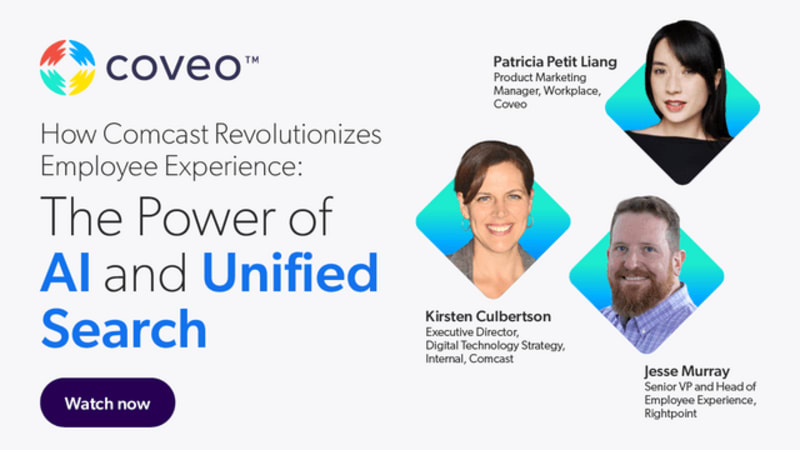
How Comcast Revolutionizes EX: The Power of AI and Unified Search
The digital workplace is entering a new era of intelligence and connectivity, with organizations reporting +50% efficiency improvements after adopting new AI tools, according to BCG.
With Coveo and Rightpoint, discover how Comcast is revolutionizing knowledge discovery across the digital employee experience, with unprecedented proficiency gains via their intranet.
Learn how AI innovations like GenAI can connect employees with enterprise knowledge from countless ecosystems, including SharePoint, Google Drive and ServiceNow, right within the flow of their work to maximize productivity and the ROI of the digital workplace.
Webinar takeaways
- How Digital Workplace Leaders Excel: See how Comcast raises the bar for knowledge management and streamlines employee processes using AI.
- Empowering Engagement With AI: Discover AI models that are pivotal to transforming employee experiences. Uncover the tools to build a smarter, connected workplace.
- Measurable Success:Learn key metrics & KPIs for quantifying the impact of AI across the end-to-end employee experience.

Make every experience relevant with Coveo