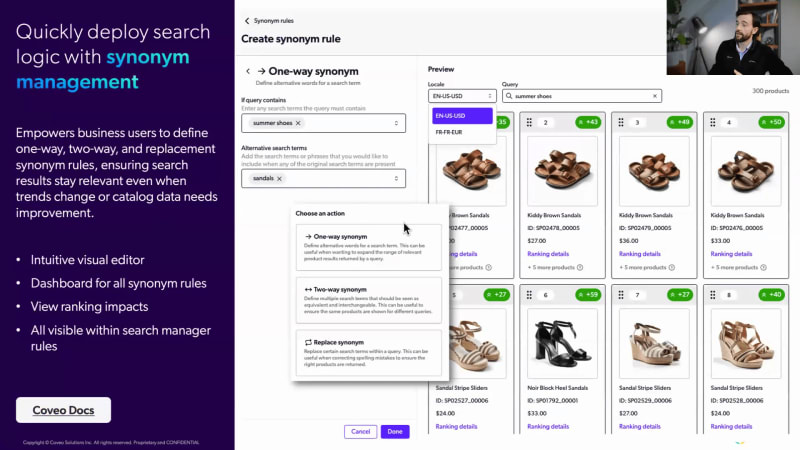
Hello, everyone. Good morning and good afternoon to those of you joining us from Europe today. So this is the new Incoveo for Commerce fall release session. My name is Shareen Reed. I work on the product marketing team here at Coveo, and I'm joined by my colleagues, Simon Lange and Benoit Sibaut. Hello, everyone. And they will be the ones that will be walking you through some of the newest functionality for commerce today. First, before we get started, before we get to the agenda, Simon, I have a couple of, housekeeping items to cover quickly. So everyone is in listen only mode as you might imagine. However, we wanna make sure that we answer any questions you may have, and so you can submit those by accessing the q and a chat feature on your screen. And we do have a few minutes reserved at the end of the presentation to answer any of the questions that might have come in. Today's webinar, I'm gonna highlight this because it's always a question that comes in. It is being recorded, and you will receive the recording and related materials about twenty four hours or so after the conclusion of the event. Now we're going to just quickly talk about the agenda for the session today. So first, we're gonna cover, of course, the latest and greatest in AI, machine learning, followed by, updates on our Gen AI solution, relevance, generative answering. Then we're gonna move into our merchandising hub. And a reminder for those that are not aware, the inspiration behind the merchandising hub is really to make every, decision and action easier to execute for merchandisers. So that's our focus. A bunch of new functionalities being released for our merch hub with that in mind. So including, updates to the search manager, recommendations manager, plus the ability to very quickly and efficiently create listing pages. Also some exciting new fun functionality around ranking transparency. So if you've ever wondered why, products are ending up on the first page of your search results or maybe why they're not, well, now getting those types of the insights and details is gonna be really, really easy. Just a couple of clicks on the product card. So Ben's going to demonstrate that to you later. And then we're going to finish off with some updates on certifications. So with the agenda being covered, I just wanted to kind of set the context a bit before handing over to Simon. And I wanted to find out a couple of interesting stats from our most recent commerce industry report. So we do this report every year. We've been doing it for a few years now, and we, survey over four thousand consumers to get an understanding more about, you know, shopper buying habits and where they're going and and what people are thinking. So I pulled three quick stats here that I want to share with you. And the the first one, of course, is no surprise, and we see this consistently year over year. Sometimes, you know, it's ninety percent, sometimes it's ninety two. This year, it's ninety one percent, and people expect so ninety one percent of people expect their online experience to match or surpass their in person experience. So definitely a high bar in terms of expectations. So that one's not so much of a surprise. The interesting one, though, is the middle one. So what we found is that ninety four percent of people either start or end their purchase journey online. And when you pause to just think about that, about your own behavior, it kinda makes sense. So we often consult online before we go into, a store. We research or we're maybe we're inspired by something we've seen on social media and then vice versa. Right? We browse in store and then go online or maybe we to comparative shop or maybe we even use our mobile while we're in the store. I know I do all the time. And then we might head home, complete the purchase. So even though it might be difficult to track these kinds of, you know, physical digital conversions, They're definitely happening. And so optimizing your product discovery on your site is both strategic and critical for your overall business, not just your online business. And there's third stat here I wanted to share, which is a new question we've added on the survey this year, which is about Gen AI. Right? So there's been a lot of buzz, a lot of hype around, you know, ChatGPT, Gen AI. And we wanted to ask people, did they really think that there would be a potential impact on the way they shop today? And very surprising, seventy two percent. So almost three quarters of people responded that they expect their shopping experiences to change or evolve in a number of ways due to Gen AI. So it could be, you know, that some of the answers that came back were anything from, you know, having a virtual shopping assistant to guide them or maybe having GenAI help them troubleshoot with issues on the products. But the strongest response was really related to shoppers getting help to to really educate them on products and, like, the their different attributes before they start, shopping for a specific product. And that was almost half of that seventy two percent. So we were actually happy to see that because, really, that's where Coveo is investing, and we'll cover a little bit of that later. So with that as a backdrop, I'm just gonna pass it over to Simon, and, we'll get diving into our, functionalities, new functionalities and road map. Thank you, Shereen. And, indeed, we will go back to that idea of, education using GenAI. It will be a big part of what we have on the road map. But before just, driving back a little bit to, into AI and mostly AI powered relevance, and, you know, before I start talking about the, the different feature, just wanna show again, what are the, I would say, the the stacking element of, AI powered relevance. So at first, you know, a standard search at a a search solution, you will expect him to be able to do filtering and boosting rules, obviously. So to be able to tell, what is the order of the different products, what is the sort order mostly, if there are any pinned or featured product, etcetera, etcetera. And then obviously, you'll have keyword and lexical matching. So the moment that you have an index, an index of of products, which can understand, you know, language. You'll start having, you know, some form of lexicon matching, which is used mostly for precision. So in this case here, for example, I'm looking for a dark gray hoodie for men. As long as there is a concept of dark gray and hoodie, into the title, the description, any of the relevant field, it should return these items. But there's a good chance that it might, filter down and they'll be too much, hence why, you know, we invest also into semantics. So semantics ensure a concept of similarity expands also the original keyword, to make sure that even if it's not necessarily found exactly, the the the term is not exactly found the same way in the result set. It will still return. And, obviously, you know, when you see, a, you know, project, a solution, a vendor that say, you know, oh, we don't do keyword search anymore. It's not that useful. We just do semantic or just vector search. Always be careful because you might get a pretty good recall, like I show here. So more product than the original query, but you might not get as precise. So the importance of hybrid approach to, lexicon semantics is is really important. So in this case here, you know, the products that I had at the top are still there. Precision is still there, but I'm expanding the results set to other products that fit, you know, that query without necessarily be a precise match on it. And then, obviously, we in in our case, we do popularity ranking using clickstream. Our our model is called automatic relevance tuning, which will simply look at the kind of the wisdom of the crowd. That's a kind of a normal approach to to big data AI. And our intent to wear product ranking, product, which reorders, based on current intent. So this one, is is a much more advanced, model using vector based cosine similarity, where pretty much the behavior of the users regarding product will be kept as vectors into the product themselves, as embeddings into the products, and then we will match together the current intent of the shopper just looking at pages they're looking at, product that they're adding to cart and then match them with the product. This is something that we've showcased several time in this, webinar in previous, previous presentation, where, for example, you know, the suggested queries, suggested products will be reordered as you, as you just create your journey across the solution. So as you look at product and add product to your cart, you will start seeing a different ranking, paradigm in front of you. So the intent aware ranking so so pretty much all of these models are available to you as a Coveo customer to make sure that you have precision or or large recall, a certain reordering, and then personalization one to one. The semantic understanding, improvements were, were released at the at this last webinar, back in spring. Now the new release for, this quarter, is really around the intent to wear product ranking, product. We have made a new release for large multilingual catalog around a vectors, again, because this model here is is quite sensitive to the size of the catalog because it needs to really keep that behavioral information in each product, meaning that the more products you have, the bigger the vector space become and the more complex it become. Kaveo being an enterprise only product, we really focus on these large, multilingual, multi brand, multi location catalog. So if you are you know, you have a catalog with more than forty million products, more than a hundred languages, the Coveo index would always work with this kind of catalog. But now we're making sure also that the one to one personalization, the one to one intent detection will also work for these large catalogs. This is also important if you have, for example, content outside of the catalog, for example, rich content, and you wanna make sure that it's also considered. So think mostly product here, but it could also be external content. Now, you know, to increase also the number of variables, we have defined, you know, new models in the last year or two. So, you know, we we consider precision, similarity, popularity, intent, but then, you know, we start adding also all of these other, all of these other variables, add to cart purchase, conversion, trending, new nest location, inventory, which are always, you know, variables you can use to boost, bury. But what if we take all of them and then combine them together into a perfect balance, for the perfect relevance? And then we also take considering this, what are your business goals? For example, do you want to optimize for revenue versus margin? And this is what we call the business aware product ranking product. It was announced is as it was announced as a research element last, last quarter. Now it is a product available for better access. So what it will do in this case, for example, I still have that kind of same results set that has been reordered for me based on popularity, based on intent, But now we're looking at pretty much all of these different, elements, including manual rules, and we are kind of orchestrating them properly so that the perfect relevance is being released. So at a, I would say, lower impact, I would say kind of a lower impact test, if you want to be part of the early access program, we're starting with listing pages with a model called the listing page optimizer. So what it will do, mostly when you look at your your different listing pages, it will make sure to properly reorder, the item based on popularity, again, with Top of the Crowd, based on your current journey, but also based on, the the the the the, I would say, the propensity to convert on each of these different products based on the current user input. So if you want to be part of the early access, please reach out to us. The first that first phase is really on these different listing pages that you have, which, you know, still cover a large amount of traffic, the listing pages. Usually listing pages convert less than search pages. We want to bring, the listing pages to a level conversion that is at least as high as a typical, search search, interface. Now, switching back to the generative answering portion. So on the more AI side, we had improvement to intent detection and improvement to, our our business aware ranking model. Now on the generative answering portion, what Shireen said is, you know, a big emphasis on shopper education. So at the moment, our our generative answering product is tied to a search page, and tied to what we call rich content. So not necessarily product content, but really content that are rich. So for example, blog, it can be, how to articles, buyer guide. If you are more on b two b, it can be tech sheets, for example. And our our system is is called RG, relevance generative answering, and it uses, at first, a semantic search query, which will, you know, consider all of your different boosting rules, boosting and filtering, then returns relevant documents, separate them into small chunks and passages, as we call it, and then this is fed to the LLM model. And then the LLM is able to return, obviously, a, an well, a passage that will explain, for example, you know, how to do something, what to buy in what situation, etcetera etcetera etcetera. And it will obviously return also relevant content that are used to power this response. So it is really a search driven experience that will happen within a search page, and it is used mostly for education. So the goal here is for you or for your, for your your users and your shopper to gain some sort of of of trust into the brand. So mostly to to for them to feel comfortable that they can be educated into your ecommerce solution so that they can pursue with their shopping journey. Some improvement to this system. So we've added a, our new semantic encoder to improve recall. The generated answer will feed from a larger subset of items. We've increased also the vector capacity, again, to be able to target a large amount of datasets. If you want, for example, to index a large amount of reviews on documents and use them, to educate your shopper on which product are the best for their use case, this is, you know, usually content that could expand quite quite, easily. With this new increase in vector capacity, we're able to have, a much larger RJ response. We've also added, some commerce specificity, mostly around, you know, retailer and brand policies. So for example, you know, did you want the Gen AI response to be more like an associate in store? So have, you know, certain limits, certain things that they might say or might not say typically in the store so to to be closer to your internal policy. And we've also increased, our LLM. So we're using GPT two point five turbo now, which has overall, increased the answer rate by around fifty percent, which has been quite massive, in terms of, of education. And also this has led to less, or or reduced the the length of time it takes to to actually, get to to your answer. Now with this in place, this is kind of the first phase of that education experience, where we actually want to go is into, into showcasing or paving the way to product discovery. So the one of the first thing is now we allow you to do rich answer formatting. So being able to return, for example, you know, a table for comparison, being able to to return a step by step solution on how to how to, for example, perform a task, so including the product that you need. But the next step and what we're currently, doing into our beta program with our customer is to showcase, products as well as categories, for example. So being able to really surface, recommended product, recommended categories so that you can pursue your journey. So the beta program here so you can see the LLM generated answer, that will be tied to, you know, a longer query. And then, you know, you will see, categories being categories of product being recommended. And the reason why we go with categories is really to allow you to pursue your product discovery journey. So we want to avoid, obviously, that kind of side journey with a chatbot, for example, that you know, tried to to show you recommended product, we wanted to be part of that kind of search for information, which would then lead to a search for products. So really, you know, a search driven experience that is tied to generative answering. If you wanna be part of this, better program, you need to have a CRG license, with Coveo, and you need to have some form of rich content. So, again, blog, tech tech sheets, anything that can be used. If it does not belong to you, it's something that can be indexed with a web connector. Just have to be careful, though we'll have to make sure that we properly scope the content, so that it leads to product that you hold in store. So, you know, going back to this, this idea of relevant generative answering, it comes into, you know, two stage at first. We have the first stage, which is a query, a semantic search query sent to the Kameo index, and the second stage being, the passages being retrieved and sent to the LLM system. We are now offering also a new product called the passage retrieval API, which would kind of remove that last part where, we actually send these passages to the LLM with a proper prompt so that we get a response. So if you do want to build a system that is somewhat parallel to the search, for example, a chatbot or simply another system, but you still want to use the relevance, the semantics of Coveo, you want to have everything kind of pre filtered, pre grounded so that you can use it into your own LLM, you can use the new Coveo, passage retrieval API, which has just been which is currently in better program. So if you have any reason to use, the relevance of Kaveo outside of the search experience, you wanna use it again with a chatbot, or simply you have your own LLM provider that you trust, you don't want to use the the the default Kaveo, OpenAI GPT three point five turbo, you are free to do so using the passage retrieval API. This will obviously avoid the issue that we saw pretty much everywhere online on social media where, for example, you know, you had the you had the wrong information that was, that was being showcased or full on hallucination by the LLM. Coveo reduce greatly this, of this by doing proper grounding. And finally, in into relevant generative answering, the we also, increase the support of for different languages. So you have the list of language here on the left, so including European languages as well as more Asian languages. So on this, that was really for the AI parts. I will switch over to for what's happening really in the core of commerce around merchandising and putting the AI in the heads of the merchant. Yeah. Thanks, Simon. Cool AI stuff, and I hope we can match it with equally cool control. So like Shirin introduced at first, merchandising hub, big area of investment for us with the different, managers, search manager, listing manager, Rex manager that that we've presented in the past already in such events. So let's dive in, what's new. But first quick reminder, search manager and the the intent of of refactoring the the experience for the these managers, making it more visual, making it more integrated, and going away from, an experience that that gives more of a a platform vibe. So, let's jump in the product to take a quick look at this, and you have this ability to switch between, the platform that you're used to that has very comprehensive features and and control around content ingestion and very broad coverage of functionality. But now we've done this this effort to centralize the experience for our our main user, the the merchandiser in in commerce. And what you see here is is a high level. You can guide the, the user in in those three experiences, manage your search, manage your list of product listings, and manage your recommendations. We'll get to that in in a bit. And you land on a list of your, queries that you can sort by highest traffic, highest views, best conversion, and so on and list of rules, filter rules, ranking rules, synonym rules, and, preview tab. We'll get to that as well. You can also customize a little bit the the display of the reporting at high level compared different periods, and deep dive in any of those queries, to get more performance metrics, both around the the events that are collected on on this view. So, views, visits, visitor, purchases, and so on, or slightly more analyzed metrics such as average order value, revenue per visitor, the average click rank, and so on. You can also have this information available at the product level for the different products that are retrieved by these queries and and pages with, metrics such as the average ranking position and the revenue attributed to to these individual products. So your best sellers over that time period, for each of these queries. You also have the ability to, segment the the experience and segment the control. We don't have it in this instance, so I'll just jump to a different environment where we have a few different use cases of Coveo configured. Here you would have two storefronts, one for sports, one for engineering. And so if you switch between the two, you would see that, you have different configurations available. So much smaller traffic on the engineering website, only eight queries. If you switch to sports, you also have different locales. The English and and French, in that case, it's it's two languages, and the the metrics would would change very low traffic again on on the these these are demo instances, obviously. And this segmentation also follows you when you're trying to create, rules. So if we jump in the the rule creation flow and try to create a rule for a specific query, you can also first, decide for which locale it applies to. Does it apply to all locales or you wanna select an individual locale, and you can also switch back and forth in the preview. So this more guided, like, segmentation of rules and reporting, is available across the the product. If we switch back to the deck quickly, so that was a bit about the integrated metric and localized merchandising. Next, another thing we introduced recently was the management of Synonym that shares some of the benefits of, the other rule creation flow. So let's take a look into this one. You have a high level, a tab for all your synonym rules. We have a few here that exist over the kayak and and slipper queries. And if I'm to create another one, let's say I'm looking at diving suits, and I'm curious what I'm retrieving for this, oh, error, live demos. This happens. And let's just yeah. Okay. I think it was just a small delay. If we look at diving suit, I'm looking to extend what is retrieved for those diving suit for, for example, a better fit in my catalog. Let's say I have, wetsuits. And yeah. Okay. My example doesn't work. Let's, check for another one. That's because I didn't go back to my production environment. I'm, sorry. That's the shame of, trying to do things too quickly. So let's take the same example, I guess. A more stable production environment will will help. So diving suit, if I'm to add a synonym, for example, because I wanna change the the retrieval for this and I want to extend it to wetsuits, for example. You will see how, it maybe adds different products and will also change the positioning of of products. So same feedback, same quick quick feedback from the the live preview, for for synonyms rules. And you can click done and publish this and see it appear in in your global list of synonyms for the the diving suit query. Next, we also added rule scheduling. So, again, more control, over over rules. If we look into ranking rule, for example, you would see in the list of existing ones that a few of them have this new icon where it gives you detail about which which schedules are set with the start and and end time. You can also filter for only the rules that are live versus, any of the the schedules. And if we are to create one again, for example, we go in. We say that it's I wanna create the rule for cert boards, and we'll try to boost our, more expensive cert board. So let me take is greater than or equal to and what would be a good price for this, around three hundred, let's say, as a cutoff, and you can buy a low boost to that, see a little movement as a few items being boosted, or you can, boost it more and see that it would, progressively, move up and compete with the different rules that apply to to this page. It's not moving as much as as I thought, but there's competing rules, on on those pages. And the scheduling part is really when you hit publish. Here, there's an additional step here. If you give it a name, boost, expenses, surfboards, and you can also set the schedule, decide on the start date, quick calendar picker. I want this to start at the end of October. Confirm that and, do the same and say, okay. I want this to last for a month. And then in November, apply this and and publish your rule now, and, you would see this appear with the the details around that that schedule. Next, Shireen, you also mentioned this one. Really nice feature, quick listing page, creation. So that's back in the product listing manager. So let me switch to this one, and also introduce you to the the storefront that we use for, a lot of the demos, which is the Barca sports, storefront, like a water sports, fake, website. And we have this promotion section, for example, where our merchandiser will create different pages for campaigns and so on. So let's try to add a a page to that. So we see all the categories that exist, and we can, use the search box, see what would exist around surf, see that, oh, yeah. We have this campaign, surf with us this year, but we could go in and say, okay. I wanna create a new listing page. We'll define a URL that resembles a bit the the other pages that we have here. So let's say, that's the one for surf with us this year. We'll start from from this one, change it slightly. We'll just say let's see. New new serve with us, this year twenty twenty four. And we'll say, serve twenty twenty four. Obviously, I didn't click, and we'll create that page. The next step in that creation flow is to decide which products should be retrieved on that page. So, I'll be asked to create a filter rule. I'll say just really quickly, let's say I wanna take the category. I want to say just, fetch all surfboards. So I'll pick, skis and surfboard, and it will retrieve my my twelfth product. I'll click done. I'll save this. I'll I want to publish now, retrieve, surfs, and we'll publish this. The page is now created. I get access to obviously, I don't have metrics collected yet, but I get access to the the normal page configuration and and the preview. And we'll go to our website and quickly refresh and see that now in the promotion section, I have my serve twenty twenty four page with the products that I define. So really quick feedback loop, really quick way to provide control in the hands of of merchandiser to control the the products being displayed and the pages being displayed on on the website. Little caveat. Obviously, there's dependencies on on the storefront and the CMS that you use to, like, make make this this flow work, but this just gives you an idea of the the capacities in in in Coveo. Next, recommendation manager. It's also a topic we've introduced in the past, but now it comes with a a bunch of nice invest enhancement, namely because we've really unified the experience with with the two others manager that that CMH provides. So product listing search and now recommendations When you dive in instead of seeing pages or queries, what you see is is slot. And you can have a flow to add slot to your websites as well. We won't get into that right now, but you can also tune and curate the content for the existing slot. So let's pick one. Let's say you have a carousel on your cart. You can go in. Again, you have the metrics for, this this interface on your website, but you can also select which strategies and rules will apply to this. So you have a strategy picker. If you go in here, edit strategy, you'll get access to a few of them. And the nice part of this is you can select some that takes in context from your website. So in this case, it's on your cart. So it will adjust to the the items that were added to your cart. So let's say I tried to preview this. Let's say I have a couple of pair of pants, in my cart. This is what I would see as as a user, and you can switch your your, strategies like this. You can also, go in and create rules. So let's say I wanna create the ranking rule, in this case, and I want to boost products. Again, let's say we we keep using the the price, and additional flexibility that's available in the context of of seeded recommended recommendations like this. Let's say I I pick a few products again to add to my cart. I could say, oh, I don't wanna set a fixed price for my rule. I just want to say, it's in the cart context, so I wanna boost cheaper items than the ones I have in my cart right now as as just, like, additional. So I can just click this, and it will adjust to the price of the items that are present in the cart and boost only the cheaper ones. So you would see, these move up in in the ranking of of that recommendation carousel. If you've paid attention also at the bottom here, you can choose when to apply a rule. This is, something that's coming soon. Having the ability to set additional, conditional, rules. That's for the recommendation manager. Next, something that was very recently released and is is now in early access is everything around ranking visibility. So all of the cool stuff that Simon mentioned around AI, then we want to make sure this is well integrated in in CMH as well. So that's that's one of the key functionality, to to provide, better transparency over how the ranking works and with the with different layers, apply. So let's jump in the product as well, quickly to show this. And it comes as well with a few improvements to the the preview. Those two are are sort of tied together a lot. So if we navigate to this new, preview tab and search for a query, for example, as I'm I'm searching for slippers, I see the the preview like this, but I can also go in and customize. Say, okay. It would be useful for my situation description of the product and and, know which which keywords are present and so on. And, also, I would like to see the the brands of this product and start to customize the the product cards that I see in in my preview. And you can also add the ranking details. So it would provide you with the, the summary of the different layers of rules and and relevance computation that contribute to the final score and the final ranking of each product in in your preview. So you see if your rules, AI, the semantic part, and the lexical, keyword matching. So if we, go in and expand that, obviously, you can get the details of the list of rules that apply to each product. In that case, we have this rule to boost products with a price over ninety dollars. You You also have, maybe as part of your implementation, some more advanced rules like boosting based on the star rating of of each product. So you would have visibility over those as well, and also visibility over, which metrics, the AI is training on. It's just like a proxy of of their learning that is being done and the the the score coming from the AI layer. Same thing for, the semantic component. You'll have, the detail the score that comes from from this and see how it it balances with the the lexical component. A lot of detail is available, over the lexical part seeing the the specific influence of, let's say, the title, the summary, and the different, steps applied by by the index over the importance of of different keywords. Also in this model, you can navigate and just get the full picture of all the metadata that's available for, any any product, which can help in in the rule creation flow or just, understand better we maybe why the the the, lexical part is is scoring so high, and you can navigate, to the the different products to compare those, different scores. And, yeah, these preview, improvements are also available. You probably noticed when we went over a bit earlier, but, in all of the interfaces. So, also in the rule creation flow, you have the same flexibility to start to customize the the product card and help you with your your rule building. And same as, when you deep dive in a specific query instead of of browsing globally across queries, you can also have access to the the quick preview and the customization. So that's for ranking visibility, configurable preview cards. That's also what we we went over. That's also in in early access. In terms of, what's next, facet management, so and another part of the the control and the the manager that we want to bring to the CMH experience. You get a sneak peek of, the design and the kind of control that we want to provide over this. But, like the rest of CMH, we're trying to focus on having, intuitive UI and easy configuration, and having a good integration on the the control of AI in this because, as as you may know, AI is also a strong component of how facets are retrieved and and ranked in in Coveo. So, this manager is a way to provide control over both, in some cases, some manual tuning by merchandiser and also visibility over why maybe the AI retrieves specific assets and specific context and and so on. That was my last, slide. Simon, back to you. Thank you, Benoit. Indeed. So I will, on the last topic, before we're, done for today is around compliance and certification. Just to to let you know that we keep updating our certifications. So, you know, adding to the bunch we already have, sorry, in different, different location or even different vertical, we're adding the I the ISO twenty seven zero eighteen. And still, you know, just a reminder that our system is secured by design, early binding, several level of, of user access, always with the idea of lower access as much as possible, as well as encryption at all time in transit and as at rest. So your data is obviously extremely important. This includes both the index data, including product and external content, as well as the behavioral data tracked, using the Coveo event protocol. And finally, we've decided to join the Mac club, the Mac alliance as they call it. We've always been, Mac compliant. Actually, Coveo since our very beginning in the cloud, we have, always used the concept of microservices, multi tenant architecture, API first, pretty much hundred percent API coverage of our administration since day one, cloud native, headless at all time. Pretty much all of our, UI can be deployed. Well, all of our UI for search pages listing recommendations can be deployed in a headless fashion. But we've decided to properly join the Mac Alliance as a certified member, this year. So, to mostly to join our partners that are already part of that alliance, and to make sure also that we can offer, solutions, with these partners that are completely MAC certified. So do expect us to be more and more into that Mac ecosystem. And on this, Shareen, over to you. Sorry. I have to find my unmute button. And here I am back. Alright. So there's still time. If you do have any last minute burning questions, throw them into the chat or the q and a, and we'll get to them. I do have a few that are lined up already. So, Simon, first one for you. So when you were doing the Gen AI portion and such, so a question came in around, you know, what's what how do we measure? How do we measure whether Gen AI is successful or not? I mean, it's not necessarily conversion, or is it a conversion? Like, what are the KPIs we're looking at right now? That's a great question, and we have our, our our business value team that can help you kind of set up an assessment and a realization. But mostly, Gen AI is indeed a bit of a of a puzzle. We actually do it in kind of two stages. So the first stage, I kinda mentioned it at the start where we retrieve information and the goal is to do education of shopper. We will look there at, for example, bounce rate, answer coverage, so how many time did we actually answer based on the query that was sent? Do people time even time on page? So do people actually stay there to read? Do they click on other results so that they're looking for more information, or it was not complete into Geniac? So that's really for that first phase. We're really looking at adoption. And in the case of commerce, we also want to, change shopper behavior. So an increase in traffic into, you know, that instance that you have, for example, you know, you you can call it let's say you're a grocer or you're into food and beverages. You might have a section that is called recipes. If that that section of your site or your your mobile solution becomes more and more active and people use the search more and more there, we will see that as a success metric because it means that you're slowly but surely, transforming the the habits of your consumer, towards a more education, journey that is happening prior to the the shopper experience. Then once we have enough adoption into that that resolution, that's where we will start introducing, products into the mix. So product recommended product, recommended categories. And there, we will start to do, I would say, a more, complex attribution system where we will start from, you know, that first query to be educated, the click on these products, and then finally the add to cart and the purchase if it happens. Or if it happens over a multiple journey, through, user ID stitching, will be the way to to actually tie purchases and conversion and even AOV and revenue to that original query that was done for education. So it's done in a two stage process usually over quite a long period of time. Okay. And I I guess the first part of it is, yes, enticing people to go to this area of your website. But at the end of the day, it's really around engaging people in the content that you have so that you become kind of like the trusted adviser. Right? Exactly. We we want to avoid that, let's go back to Google to find, you know, a blog on what are the best products, you know, to start campaign. Right? We we really wanna make sure that you become the Google, you become the expert, and you avoid, you know, customers jumping to your competitors or ending up on Amazon because we know that all these blogs on Google always have links to Amazon or or Target or Walmart. Yep. Top ten, you know, be directed to Amazon or maybe one Walmart. I don't know. Indeed. Alright. Okay. Regarding Merchandising Hub, then. So a couple of questions came in. One was around access to the merchandising hub because there are some, obviously, some customers on the call today. So how do they get access to the merchandising hub if they're currently not using it? Very good question. We didn't cover it today. I think we we covered it maybe in the the latest, the last, new in Coveo, but, we it also came this this release of of, the merchandising hub, it came with a release of a completely new set of of APIs, that is specialized in the commerce use case and that is simplified for this. And, that is specific to each of these interfaces that we're now powering the product listings, the search, the the preview search box, the recommenders, and and so on. And so it has a dependency, the adoption of CMH on adopting as well that that new set of API, which for existing clients may represent, like, some some changes to the implementation of Coveo, for new prospects. Obviously, it would be just the the new default set of APIs that we would, implement. So it's not only a matter of of turning on a feature flag and and providing access. It's a case by case analysis of of what needs to be done to to get access and and implementation dependencies there are. Okay. Understood. So speak to your customer success manager, and they will carve out a path for you to get there is the short answer, I guess. Yeah. License wise, I just wanna be clear. It is available to everyone with the enterprise license. K. So there's no additional fees for any of the panel that you saw from them. Right. It's just the deployment that maybe needs to be tweaked. Understood. Okay. And, one more. I I know we're almost out of time here. We're probably over time. One more question. When you were showing the ranking visibility, you showed there was a few that that you kinda dug into, like, drilled down to, and they were showing the rules and you could go and view the rules. There was one line item there that you couldn't go and view the rule. And somebody picked up on that, and they said, it shows, like, a computation of some kind. So where does that come from? Yeah. Very specific. That rule, like, CMH is meant as, like, a a simple, easy to use platform and so on, but the platform of Coveo still support very advanced configuration and so on. And and that one specifically is called the ranking function where you can set any of those, like, math equations to, like, really fine tune the the ranking or leverage some more complicated metrics that you may have in your catalog and and, adjust your ranking this way. So that was one example of that. The missing link is just a matter of time. Like I said, this one is in early access. It's It's an early release of ranking visibility. It's it's completeness that will come over time, but, there's no, like, a big difference between one and and and the other. And an important element of the the pipeline ID was actually, was was visible directly under the rules. So for those, who are used to our query pipelines inside of the Kuva administration console, where you create these advanced rules, the the you will be able to find your goal using the pipeline ID that is that is written there. So it's really it's in the pipeline, these rules. Right. And just to highlight again too, you did go through, you know, one of the synonym examples. There was a few in there. But any synonym rule that you create in there is also reflected in the admin console and vice versa. Right? Yeah. We make an effort of having sort of, like, backward compatibility with with all the functionalities, available in in the platform. It's not like a one, like, one hundred percent fit. Obviously, there's things that we we bring that are just new and that are not present. But for those that are, good matches, we we offer this this sort of, two windows on on the same configurations. Alright. Excellent. Okay. With that, we're gonna wrap up. Thank you, Simon. Thank you, Ben. Thank you, everyone who joined us today for this session. If you're a current Coveo customer, wanna understand more about these features, obviously, reach out to your customer success manager. They'll get you in touch with the right people, the right experts to, walk you through it. And if you're not a Coveo customer and wanna find out more, well, then just head to our website, fill out a request form, and one of our experts will reach out to you that way. Thank you, and have, for joining us, and have a good rest of your day. Thank you. You.

New in Coveo | Commerce | Fall 2024
Discover our latest AI innovations featuring our listing page optimizer proven to drive more revenue per visit and the next evolution of generative answering in commerce with catalog aware category suggestions. On showcase will also be new and expanded functionality for the Coveo Merchandising Hub focused on making every decision and action easier to execute. Tune in for a session full of new features and demos.



Make every experience relevant with Coveo