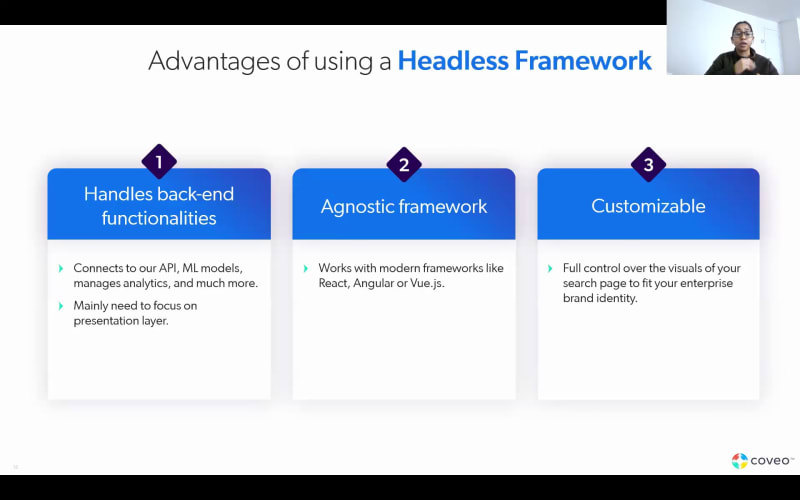
Welcome. Welcome. Thanks for those of you joining us. We will give you all a few minutes. To, login and get set up. Thank you for joining. Happy almost Friday. Right. I'll wait just another minute or two before Muku and I jump in. Hello? Alright. In the interest of time, I am gonna go ahead and get started. Thank you. Welcome. Thanks for joining today. My name is Juanita Ogin. I, lead product marketing for our platform solutions at Coveo. And today, I'm joined by my colleague, Muka Leekade, who is a product manager for search UI and workplace at Coveo. Today, we'll be talking about the future of DX or digital experiences, and we will be discussing topics from headless to GenAI and everywhere in between. Today's session will be recorded. We'll get that to you in the next twenty four to forty eight hours. We do want this to be interactive. Those of you on the call, many of you are our customers today, so we wanna hear from you your perspectives and what you're seeing. So I do have a few polls sprinkled throughout, which means, you better be paying attention. So, we're gonna jump in, and we'd love to hear from you throughout this presentation. Feel free to post any questions along the way in our Q and order engage on the chat as well. We also have my colleague Ahmed on the back end helping us to run today's presentation, so he's there in case you need any additional support. So let's get started. Here is our agenda and here are a few of the topics we'll talk about. I'll cover the state of websites and DXPs. Of course, this would not be a webinar without covering GNI. We'll then move into the discussion on the importance of headless and other frameworks. I'll talk about some business value metrics and some different ways you can start to think about it. And then we'll give you a high level sneak peek into our product roadmap. But, of course, what is a presentation without starting with the impact of generative AI. So I wanted to share with you a quote and something I heard at an event mid last year. Of course, things are changing rapidly for all of us. But there was a statement made around what will be the impact of generative AI. And the follow-up to that was the first impact will be the death of the web. And this is something I heard at Forrester CX mid last year, from the CEO forrester, a bit of a bold statement. And while he was certainly discussing the World Wide Web because now we are all being, you know, becoming used to using chat, UBT and new interfaces to get our information. He was also and did also allude to the fact that a lot of companies today have websites that they still are not operating optimally. And so there was very much sentiment around that there's still work to do to get our websites right and performing the way that they should. Especially with advanced technologies like GenAI coming to ROA. So I wanted to also, cover Popular themes we hear from our customers, from prospects, from the market and analysts, that are underpinning DX or digital experience leaders, concerns impacting their strategies. And I'd love to hear if these ring true for you. Spoiler alert, these things are not all about AI, especially if you're more on, the website or external site side of the house, and also it's might be the same from an employee experience or digital employee experience perspective. So the first, key theme we hear a lot about, and there's a lot of questions, a lot of activity. But also very fundamental, right, to running anything from a digital perspective, it's infrastructure. Right? And so we know that there's a a big trend towards headless and composable technologies, more modern ways of working We hear a lot about third party cookies and moving away from that, tracking and analytics and being really able to show more impact as well as attribution, how can you show, the results of your efforts and make sure teams are getting credit for all the work that's being put in, especially if you're on the marketing side of the house. The second big thing we hear about is omnichannel. Obviously, omnichannel is important, in terms of having variety and as to where you're meeting your end users, your customers. So this is everything from, of, of course, managing your dot com websites, your chat bots, having mobile enabled, mobile friendly options, thinking about sites beyond just your dot com. Maybe maybe you own the dot com, but you still need to provide global site capabilities for your support, colleagues or perhaps your docs colleagues, right, really trying to think about that end to end digital customer experience in driving consistencies, not to mention being able to provide multilingual support, especially if you're international organization operating in many different countries. And last but not least, we, of course, we hear about AI and gen AI. And here it's more about how to be proactive, how to help, end users, in the moment of their to make sure they're getting the right information, sometimes even before they need to search for it. It's also about using AI to do less manual cure curation of content, especially if you're on that marketing side. Obviously, content is king. Content is very important. And we see that a lot of teams still kind of do manage things manually. And here we we see AI can help make a difference and help teams move more into that mentality of being able to publish once and ensure it's accessible anywhere for people searching on your sites. Lastly, using AI and gen AI to help build team scalability. The fact of the matter is, you know, times are tight. There's still a difficult macroeconomic environment going on. And so, you know, teams are still being asked to do more with less. So anytime AI or other technologies can help team scale, obviously, wanna explore that a little bit further. So we'd love to hear from you, and I believe we're gonna launch our first Well, we're not gonna launch our first poll yet. But after this, just wanted to go a little bit deeper on the different themes and areas that you all are likely thinking about or talking about. I'm gonna start with a tech leader perspective. So what you see here are all the different areas that your potentially thinking about on your day to day basis. It could be the UI, the UX, site search, content variety, multimedia formats, relevance, personalization, performance, speed, scalability, security, localization, authentication in your user type, of course, analytics, and then skilled, a skilled team, as I mentioned, before, very important to have a skilled team to help deliver those great experiences. But what you see here is more on the tech leader side. And what we often see and find is, there's just it's almost like a semantic and word usage or verbiage difference in terms of how maybe the business side of the house thinks about things versus the technology side of the house. So you'll see some other words here being used, but many of which mean the same thing on the tech side. So business leaders might be thinking about brand and see self-service conversions, of course, discussing whether to have content open or gated paid versus organic, obviously building that sales funnel to drive those key business outcomes for the business and also talent. So again, we'd love to hear, you know, do these things resonate for you. Are they overwhelming? Because, you know, thinking about this less myself, and the fact that both tech and business leaders are both involved in creating great experiences. It's a lot of different things to think about, which means it's probably also hard to, set clear strategic goals and prioritize where you put your time. So I'm gonna pause here and actually ask Ahmed to run our first poll for our session today. So we'd love to hear from you on what your key digital experience priorities are for the year. Are you focused more on-site search findability? Do you need better analytics? Is modernization really, an area you're investing in? Maybe you are you know, down the path of bringing in more AI or gen AI capabilities or perhaps there's something else you'd like to share. I'll give you all just a minute to, select, and this is multiple choice. So you're likely probably doing a lot of these different things. We'll give you a moment and anyone that has anything else, please do feel free to comment in the chat. Ahmed, I will look to you to share with us, when you think we have a good percentage. Seventy six percent. Alright. Why don't we see what those results look like? Okay. This is multiple choice. So that means you might have selected multiple. But here, a couple of big winners, improving site search and findability at sixty nine percent. And adding AI or gen AI capabilities to sites as seventy seven percent. I'm a little surprised to see that, but it's a great sign. I mean, we're surprise, but we we do find that, obviously, there's a maturity, a more maturity process there. So really great to see that. Also wanna call out getting better analytics for insights. I think that's always a challenge and important for teams. Here I see last on the list for focusing on modernizing infrastructure. So we'd love to hear more from you in a in our section there. Won't we talk about headless? I'm Luke talks about headless a little bit more. But thank you for participating in that poll. We will go ahead and continue to move further. So when it comes to GenI, I'm sure you all know there's multiple applications of GenI, but if you're familiar with Coveo, you're a customer of Koveo, you know, the application and the specific area we are applying GenI in is for that question answering capability. In case you have not seen this in action, I just wanted to provide a view of what this looks like, in real life. This is actually from our Coveo documentation site. And what I wanted to do is just highlight a few of the key features here that we are using to help our customers improve their various digital experiences. So, of course, you have your generative generated answer Number one, you have your thumbs up, thumbs down capability, number two, to be able to provide that feedback on whether the content and, content and answer was was useful. You have the ability to copy answer. Should you wanna perhaps share that with others? You can toggle this capability on and off. Maybe it's a site you don't want to have live, or maybe end users have the ability to decide whether they wanna use Jenny air or not. So that's where that comes in comes into play. Number five is our citation. So, being able to show you where we actually pull this information and generated it from, what while also allowing you to link to that information directly and rephrase, which is being able to show the answer in different formats number less bullet points in other ways because everyone does learn quite differently. I think the other interesting thing to think about with generative answering, and, we will be asking you your thoughts on this, is its use across multiple use cases or UI. You know, what I showed you just now was on a typical full, you know, full web page embedded within a typical search interface and screen, but there might be other places that you would want generative answering to, be implemented. So that could be your, you know, internal sites as well, your intranets. And so you see a, a sort of image here of someone asking about how to to get access to an office, so generative answering within the employee experience, you may want it to be implemented within your locations, whether that's your Salesforce console, ServiceNow, other applications that you've invested, you know, a lot of time, and resources into. You may also want it to to work with an a bot experience, and I use that word very generally, again, because we all think chatbot. But, it could be an insight panel within an application. It could be within, in app experience or in product experience, which is the capability we have. And so the point here is that really these type of advanced technologies should be applied across your business, across different interfaces, and be agnostic enough to support your needs regardless of what technology stack you have. And that's what we hope to not only hope who we plan to and are building tours with everything that we're doing. So I'm gonna pause here and, ask you all, where are you implementing GenAI today? And if you can please run this poll, I put a few different options here to just understand if you're implementing GenAI more on your public sites. Maybe it's more internally. It could be content creation, which is not necessarily what we do. Again, we're focused more on the general and answering perspective. Maybe it's something you're thinking about for authenticated sites for dealers, partners. Maybe there's specific use cases around sales or r and d. So we'll just love to hear what you have going on today, and we will give you a moment to, make your selections. And I will say, based off of our engagements with our customers on our our generative answering product, we do see, both, you know, public and internal use cases. So, I'll be curious to see the results here. I'm at Harry Looking. Thanks for that response, Megan. We'd be happy to follow-up with you on that a little bit more. And I'll dive in just a bit more on that side, but we have a ton of resources and perspective for you on the self-service side. Right. Okay. So this, this set of responses is a little bit different to the first poll where Most of you said you were focused on AI and gen AI. For the year, maybe you're still early in the planning stages and phase. That makes a lot of sense. There's been a lot of movement in the market, a lot of changes, also a lot of validating, right, from pop up vendors and It's a lot to make sure that you are selecting the right technology and options based off of your needs. So to see thirty five percent of you say you're not implementing Geni Anywhere, I'm assuming It's because you're in that planning phase. And again, if if you wanna follow-up and chat more about, considerations, happy to do that. But I also see a few ties here for, some of you implementing on public sites for question answering self-service some internally for content creation purposes, which is which is great. Again, not where we're focused, but, I know our teams also use other tools for that internally as well. And then authenticated sites for customer partner dealer support, which is great, especially when you have high volume of those that you're trying to support with your own limited team. So really great insights. Thank you again for participating in that one, and we will continue to move on here. I would now like to pass it over to Muuku though because, again, from here, we're trying to, cover topics that have been popular amongst our customers and things that you care about or ask us about. So headless and composable is one of those topics. So I will hand it over to move tell us more about that. Awesome. Thank you so much, Anita. Alright. So as Juanita said, nowadays, the term, composable architecture is something that is getting a lot of attention today because as enterprises who are looking for a search solution, we want to ensure that our applications can serve multiple audiences, but moreover need a more personalized experience for each visitor without impacting the entire systems architecture. So regardless of that, today's presentation is not specifically about the composable architecture, but I still wanted to highlight this concept because I want us to see how Kubeo's platform is already that flexible solution where enterprises can already easily work with multiple front end frameworks, a wide range of different connectors, different machine learning models and a variety of other package capabilities that can help serve a very specific function within your business. So if we go to the next slide, with that, I want to talk to you specifically about our UI frameworks that are available today to help you build a composable search page. So why are we talking about headless? What didn't work with our legacy UI libraries, and why should we think about the headless framework? Well, before I walk you through the headless framework, it self, the reason behind why we needed to move away from our legacy UI library, like JSUI, is because we were a very tightly coupled solution. We didn't have a lot of flexibility when it came to making customizations, or we couldn't work with different web languages, and we have to stick with languages like just a vanilla JavaScript. But today in the tech industry, if we want to stay on trend and have a modern offering, we need to be able to adapt to any other frameworks that are out there and allow our customers to make those customizations that they need for their enterprise and brand. So with that, if we go to the next slide, this brings me to headless. So headless is our UI framework that you can use to help guide you reach a composable architecture for your search solution. So with this headless framework, back end functions like working with our APIs, analytics, are entirely decoupled from the front end customer experience of your search page site. This means that you have full control over updating and editing the front end presentation layer without interfering with your back end functionality, which would help ensure a smooth and consistent experience for your customers so that you have a consistent branding across all of your search page websites. And just to list a few of the benefits that we can think about when we're using the headless framework. The first one is a very powerful advantage, which is, as I mentioned, because we handle all of our backend functionalities, we're handling things like connecting to our APIs to help power all of your UI facets. So when you're thinking about your search box, when you're thinking about your filters and facets that you have on your search page, we connect to all of the necessary endpoints for you. We also help you connect to your machine learning models. We help you manage your analytics events and much more. So the only thing that you really need to take care of here is the front end UI layer where you decide what the UI of your search page should look like. Secondly, with headless, developers would love this, which is that they can work with a wide range of different front end frameworks. So whether they like working with React, VJS or Angular, headless is able to adapt and work hand in hand with them. And finally, it is super customizable. So you're able to take full control over the visuals of your presentation layer and customize them to your enterprises brand. So with that, now that we've gotten a better understanding of headless and compostable, I'll hand it back to you, Anita, to give us more insight on building some key business value needs. Awesome. Thank you. Thanks for explaining that. I do see some questions. We will ensure we get to towards the end of the presentation. But before that, let's talk business value. This is, one of my favorite areas because it's a challenging area to talk about. And so what I wanted to do here was take a little bit of time to offer a different way to think about your business value, your key business outcomes and the metrics you're thinking about. I'm gonna start by approaching it with a marketing, marketing mentality or marketing and sales funnel perspective. But it'll apply to internal employee experience, views as well. So every company out there has a marketing in sales funnel. Maybe you call it a sales cycle, but it has a a phase and steps a journey if if you wanna call it that, that your customers are going through. Right? And so they are building their awareness of who you are, what you offer. They're considering whether they want to buy from you, whether you can meet their needs, they then may purchase, right, and then there's also a loyalty factor. And so I wanted to take this funnel and and place it along that buyer journey and just give you a little bit of a deeper view and a different way to think about this. And so what if you thought about that funnel and applied it to the sites that you are managing or the sites and solution areas that you are managing within your enterprise today. So we still see that awareness consideration purchase and loyalty phase there. But now we see it kind of, shown across the sites, right, the sites journey. So Of course, everyone has sites. People are going to your dot com. They're browsing, reading, finding. If you have a commerce component, people are shopping, selecting, buying, right, considering you there. Once they move to that purchase stage, they are becoming a customer. Right? So now they might go to more of your support sites, and ways to get, get activated. And loyalty, there, I would argue does get into a workplace and employee experience. I'm sure you've heard that great employee experience means you'll have a great customer experience and you can't have a great customer experience if your employees aren't enabled and empowered. So I I would argue that that loyalty factor really an employee experience, you know, kinda go hand in hand there. And what I also wanted to do is show you from a public site perspective, what are all the different sites or activities that a user might be, you know, visiting or downloading or form filling as they're going to cross this journey. And I also wanted to show that from an employee experience perspective because there's also a logical flow of, you know, onboarding, upskilling, collaborating, connecting, and getting service from an employee experience perspective as well. So hopefully this gives you just a different way of thinking about, your sites, the the funnel and business value. But now I'm gonna try and connect all of this to help you think about those KPI specifically. And the way I, have thought about this is, you know, it's everything is layers and maturity or layers really. So really, we you have this top level strategic layer and key business outcomes that you are all helping to contribute towards. Then you have your middle layer, which I'm calling operational here. And so this might be your, day to day, you know, KPIs and activities that you are kind of measuring to see how things are going. And then you have the more tact tactical you know, more, let's say, product specific or app specific metrics that are helping you feed that information up you know, up the up the level on the ladder here. So you're tying your product or app based metrics to operational up to strategic. So let's see what that could look like. Again, taking these different sites or solution areas and the buyer journey, into consideration here. So starting with, you know, when you're building awareness, website, to your marketing team in department. It's so hard to show direct revenue impact. And so many teams show revenue influence or they speak about it in terms of pipeline. Some of the operational metrics they're using there are things like conversions, right, are people downloading, form filling, booking demos, They're showing pipeline. They're showing other engagement factors. And then on the more tactical, this is looking even, you know, more deeper into the details to see what what's that visit or traffic looking like? Are people clicking through? Are there content gaps? Are you helping people self service and be successful on your sites. So, hopefully, this gives you a view of how you can tie your metrics back up to tie into that revenue influence factor again, which many know it's very difficult for marketing to show direct revenue impact because, obviously, you're handing things off to sales. Now if you do have a commerce component within your business, that's a little bit easier to show what your direct revenue impact is right because you're able to show and say these capabilities or these sites as we're building them, we can see how people adding to cart, what the transaction is. You still might be looking at conversions and pipeline as well, but it's a little bit easier to show that one to one revenue impact because, you know, people are are buying things from your site directly, but you're still also looking deeply at those detailed tactical analytics as well. You wanna be able to look at traffic, impressions, click through rate, and even self-service success. Once prospects become your customers. This is when you get into that whole service side, cost management side, here you might be looking at a CSAT fours, NPS, customer effort. Right? You wanna make sure you're helping your customers be successful, get activated, use your product, and even grow. And some of the metrics on a detailed perspective or tactical perspective, you might look at are things like your ticket or case volume, First call resolution average handling time, self-service success, and content gaps. We cannot forget again, about that experience factor though. Right? I think sometimes when we think of c level management and others, there's a big focus on revenue, cost, profit, experience also matters because that ties into loyalty, your customers desire to, you know, grow with you, So here are things that you might be looking at operationally are your ESAT E NPS score worker effort And then on a detailed level, you might be looking at, you know, turnover. Also, your own employees' experience within your company, you know, are they getting the right that HR IT support, are they able to find things to perform while on their jobs? Do you have the right knowledge management strategies there to make your teams proficient and successful. So I hope this gives you just a view of how you can maybe rethink, success, different KPIs and layer them from strategic down to very detailed and you don't have to use these words. But the idea here is we know it's been difficult to show the business impact. It's difficult to tie these things and roll them up to show that you really are making the difference in the business. So I'm hoping this helps you think about it a little bit differently. And with that, we did wanna show you some of these different, outcomes we've been able to deliver for our different customers. So you see some focus on revenue and profitability if you're in the commerce area. More focused on cutting costs, on the service side, increasing website engagement or conversions on the web site side and then increasing workplace proficiency on on the workplace side. And you will see a mix within here. Right? You'll see some of those strategic operational tactical metrics. The fact of the matter is every company and every team is at a different stage of maturity. And so there's no wrong answer here. I think our goal is to help you make sense of your business and showcase the great work you're doing, and we try to bring you the right, frameworks and best practices to do that. I will pause here and we will run our final poll for today's session, which is around what metrics you're using to measure your performance or the success of your efforts. Is it revenue, cost, experience, maybe it's conversions, pipeline, or even web traffic, would love to hear what you all, have going on here. So Ahmed, if you don't mind learning that last fall, I'm not seeing the poll. Ahmed, I'm not sure if you can hear me there. Michael, do you see the poll on your end? I don't see the pull on my end either. K. So maybe what, if you all don't mind, even just providing in the chat where you're focused. I'm glad I sit on through the poll. Sorry. K. I see. Issue resolution case selection. Okay. We now see the poll live, but thanks, Susanna and Nicole for sharing in the chat. We'll give it just a minute for, the rest of you to give us your thoughts here. Where are you how are you measuring success today? And it'll be different. Right? I expect this to be different because there's a variety of different, focus areas, for each of you. Some of you are in marketing. Some are on employee experience size. Some are in service. Some might be on the commerce. So really do expect this to be a nice variety. Ahmed, I will let you keep us honest on percentage completed here? Perfect. Okay. So I see some great experience. I think, again, we're we're all on the digital experience place, so not super surprising, but I, obviously, very important. I also see, web traffic. So that kind of tells me maybe there's some marketers, maybe even support online support portal owners here that, that are measuring maybe efficiency or effectiveness of their sites. But I also see costs and conversion. So nice spread here. Again, no wrong answer, and it also depends on I think direction and enforcement by management in terms of, like, what you're measured on. So all all good areas and good ways to really assess the business, along these different customer journeys. So thank you for participating in that one. I will end on our final topic, which is our road map themes. And I was going to give you a few, you know, product feature updates and and whatnot, but we just had our new and clavail in the fall where we showcase a number of our capabilities. So if you're not familiar with New Enclaveo, I I recommend you kinda go to our site to check out the latest releases we, put out at in October of last year. What I wanted to do here instead is talk about our roadmap themes from category perspective so that you understand where we're making those investments ongoing. And the first category is around modernizing and future proofing our technology to make sure it's up to par with the latest standards, and trends. And so Mooka talked about headless and composable, atomic UI our UI library. So we're continuously innovating and enhancing in these areas so that you're always, you know, using the latest frameworks. The second thing is builder or business friendly tooling. So we have this Coville builder framework. And the idea there is rather than have to wait for maybe IT to come and implement changes. Here, we're trying to make it easier for business, users to quickly make those changes, quickly set up that search page, that is dynamic. And you can do that right within the Coveo admin counsel without requiring external support. Lastly, of course, we're really highly focused on cutting edge AI. We've been in AI for the last ten years. Have our first, you know, LMM based models three years ago. And now everything's around Jenny, our generative answering. So we're gonna continue to bring new enhancements there, including conversational follow-up, enhancements to our generative answering capability on the commerce side. So you know, providing answers and then being able to link to products, from that answer, as well as exploring new UIs. I I shared a a variety of way air areas or UIs you can use generative answering in today. We're gonna continue to expand that, to allow it to be used in the hosted insight panel within your agent consoles. So these are the three big buckets. They are, by no means, the only areas we're investing in, but these are areas that I thought would, be useful for you and relevant to you in your day to day as you're trying to be quick fast and, you know, apply innovation as as soon as you can. So that concludes our presentation. I wanted to point you to a couple of areas. We do have our spring twenty twenty four Coveo relevance three sixty. And you and Coveo, that'll be in late March, which is gonna come by really quickly. I put a save the date link here. I think Ahmed will drop that link here in the chat. We also have a demo webinar In a couple of weeks, we will talk about five best practices for AI powered site search. That'll be a live demo webinar. With my colleagues, Carrie Ann, and Paul. So if you wanna see a little bit more in action AI, gen AI, and also thinking about your end to end digital customer experience, I recommend you join this session. We'll also post that link in the chat. Before I open it up, I did want to also see that if you wanna join any of these sessions in the future, you wanna present, share your findings, your best practices, the difference you're making at your companies, we are always welcome new people to join us on these webinars. With that, Muku Ahmed and I would like to thank you. We hope you've learned something new today, and we will now open it up to questions. I'm going to just go to the q and a. There's a few questions here around Jenny, I, which I think we might have to follow-up on. I will I also see sorry. Go ahead, Moku. Yes. I think for the first one, we can do a follow-up on, but regarding your second question regarding, using APIs and the JENI component, just to make sure everyone is aware, today, your actually able to use the GNI component with headless, atomic, or quantic. It's also available through our Coveo builder to easily add it to your hosted search page. And I'm pretty sure you should be able to use it with our APIs as well. It's just not currently documented, but I think conversations are being had about that one so we can follow-up with you guys as soon as we have more information. Also, I'm the question around Slack integration UI. Great question. Where are we've been talking about lately. So, I think we can come back to you with the response there. We typically try to, you know, as a move will cover, like, decouple the front end from the back end. So I think, let us come back to you with the response on that one. And sorry. One question here, Moko, around, tips to and do you have any tips for getting buy in to migrate to headless frameworks? Hear that a lot by the way. So any any tips there? Yeah. So I think, the biggest advantage of using headless is when we think about flexibility and improved performance compared to our legacy UIs, with headless because you have will control over your components that you add to your page. You can decide on what tech stack you want to use. You can decide and lead the UI UX best practices for the components that you place on your search page. And you can innovate a lot wicker because you can make those changes very easily because we take care of all of the back end functionalities, as I mentioned, and moreover, I think I might already linked it in the chat, but we actually have a page in our public documentation where we show you the comparison between the different UI offerings that's available today at Prevail. So you can take a look at that and see what best makes sense for your use case in your company. We have headless, we have atomic library, we have our APIs. And we have the pros and cons that are listed for each of them. So you can make a very informed decision. Thank you. Another one here is around, what are top use cases you see being used for GenAI? I can take that. Probably, generally, we do see, companies wanting to use it more for the public self-service, from a customer support or service perspective. So that's a very popular use case for us and one that we're continuing to make a lot of additional investments in. We also do see some explorations on the internal employee experience side. Still some, you know, some validation, I think, to be done there. Obviously, employees, we all have the same questions around HR IT. Which which are important. We're also exploring more role specific, content as well to see, where that can be used. So really it's it's both sides web kind of service and support oriented or internal kind of employee experience. One last question I'll take just for the interest of time is what metrics can Coveo help with? So I would answer by saying we do have what I consider more of those tactical metrics or product specific metrics, things like content gaps, helping you know where, You you you don't have a a existing content that users are searching for. We have operational things like average click ring to make sure the best content is is showing up in the highest places on the search result. But beyond those metrics of which many were capturing and helping you to use and identify, we also have a business value team that's there to help you establish those key business value metrics, key business outcomes, and roll up those very tactical or operational metrics into the true business outcome that you are trying to achieve, whether that's reducing costs, perhaps increasing experience or even revenues. So we do have that team that does help perform those custom business value analysis as well as value realization, right, because we wanna make sure you are getting that value over time so that kind of post, you know, post implementation follow-up is is part of the process as well. So hope that's helpful. If we did not get to your question, we will follow-up with you separately, and offline. We do wanna thank you for your time, your attention, and your participation in the polls We hope you've learned something new today. If you wanna follow-up, please feel free to connect with Google or I on LinkedIn. We thank you again, and we hope to see you at a future one. Maybe even presenting. Muku, thank you, Ahmed. Thanks for your support. Thank you so much. Take care.

The Future of Digital Experiences: From Headless to GenAI
As AI continues to revolutionize our digital landscape in 2024, it's crucial to understand its evolving role.
According to Gartner, search augments AI, highlighting the significance of using search and AI together to amplify your existing systems and customer engagement.
To help you start the year off right, join this Coveo customer roundtable and gain strategic insights from Coveo experts, engage with your industry peers and learn from fellow customers.
Dive into the latest trends and developments for digital experiences from composable architecture to enhancing the omnichannel journey. This session will also offer an exciting sneak peek of Coveo's 2024 product roadmap.
In this session we'll:- Analyze the current state of websites and digital experiences in 2024
- Discuss the importance of embracing headless & composable to future-proof your DXP
- Offer key strategies to measure value and establish effective KPIs
- Share our exclusive product roadmap for 2024

Make every experience relevant with Coveo