Hi, everyone. Thank you for joining our digital leadership through crisis session. I'm your host. My name is Tracy Carson. I work on the global marketing team here at Coveo, and it's a real privilege to be with you today. Today's conversation is going to feature Jim Roth, our, executive vice president of customer support at Salesforce, and our very own Louis Tetsu, chairman and CEO of Coveo. Jim is joining us from Austin, Texas. He joined Salesforce in November of twenty nineteen to lead their global support organization. He previously held senior positions at Dell, where for seventeen years, he worked in services, marketing, and IT, the real run through run through the organization there. And Louie is joining us from his home in Quebec City. As I said, he's the chairman and CEO of Coveo. And prior to Coveo, he founded Thuleo Corporation, which was acquired by Oracle in twenty twelve. A couple of housekeeping items to cover just before we get started. Everyone's in listen only mode, but we do want to hear from you. So please use the question panel in the GoTo, webinar, interface there for you. We are gonna record the session and we're gonna send it out to you after the fact, within twenty four hours. Enough for me. Louie, why don't you get us started here? Thank you very much. And, Jim, thank you for, being with us today. Start off, with, obviously, the usual, forward looking statements. So, if any of you wish to either trade or make purchasing decisions, these are made on your own and, you know, the the usual, drill here. We're gonna communicate to you some some, some opinions and, some some personal analysis of this situation. And, it's it's each and and everyone's responsibility to exercise their own judgment. With that, I would kick it off, certainly, by acknowledging the gravity of the situation, and, and the fact that, it's it's certainly amazing to all of us and everyone on the line here, how the world can change so quickly in, such an abrupt way and it's such a a short period of time. Billion and a half people are under orders to stay at home. Work and education are remote from home, and and this is obvious. We all live through that. Contact centers are overwhelmed, and and often, you know, there's more customer demand, and less agents, and agents are also working from home. Obviously, on the commerce site, site, in store commerce is halted and online is the only alternative. And, this essentially all unfolded, within about a month. And I would say, at a high level that, you know, the major transformation here is that people are on their own. People need to do more on their own. And so to us, when we look at this, there's obviously an immediate response to this, which we're gonna talk about, both Jim and I. And, but there's also a longer term response and a profound transformation. And, and I would say this is a proficiency challenge, not only an efficiency challenge. And, as a French Canadian, I will pull up Celine Dion, all by myself. This is, I believe, how a billion and a half to and and perhaps more people feel, right now. And so the question is is is how do we how do we react to that change? And, and and how do we think about that change both, short term and long term? I think it's fair to say right now that no organization wishes that they were less digital right now. Everyone, every business, obviously, must adapt to this virtualized world. And, obviously, you know, some are more prepared than others. Some were more prepared than others. And I believe this, will have an impact on how people think about that. So there's there's really a notion, obviously, of adapting, to cope immediately, and, we're gonna talk about that. But we're also gonna talk about, you know, once once, you know, that that is taken care of, you know, how does that impact, long term transformation to compete, and and what does the new future, look like? From an immediate perspective, I'm certainly happy to share and, we'll talk to Jim in a minute about how we've been dealing at at the issue here at Coveo and then with Jim at at Salesforce. You know, this this fundamentally, requires a priority framework. And and for us at Coveo, just like every organization, you know, what we did as as a leadership team is we picked up the phone, we talked to our board and our shareholders, and we we got broad agreement, from them that this would be the order of priority. In other terms that, you know, protecting shareholder shareholders assets, although a priority, would not come before protecting our employees and, and continuing to serve our customers. And, and so we've taken, obviously, the immediate measures, I think, at a high level beyond the traditional, you know, safety, and health measures that, we've taken, the way we think about this is we wanna try to protect the company as a source of security and, and stability and safety for the employees. And so this is really important. From the customer perspective, we've actually augmented our investments in, in both r and d, and I'll talk about that. That's for the long term. But also in customer service, because one of the ways you can help your customers in this day and age in in these times is to make sure you don't stand in the way and to make sure that you're dependable even more than ever. And, and, you seek perfection and and, you're you're not a cause. You're not introducing new variables in their businesses and you continue to run flawlessly. And, of course, we've challenged every employee to to to see how we could contribute socially and, and and we're gonna talk about about some of the ideas, in in a minute. Longer term, however so here's here's what we're seeing. So what we're seeing here, if you think about the transformation agenda of of companies, You know, we're here in January and and, you know, this is pretty much the the normal course of business and personal lives despite the events that occurred on December eighth in China. And then suddenly, you know and and and every company is sort of a a a planned obsolescence curve from a transformation standpoint, and and is planning transformation and digital transformation accordingly. So every store on the planet knows about ecommerce, but this was growing. Right? Nobody thought that it would be the only alternative and that, you know, stores would be closed as an example. So there was sort of a pre crisis obsolescence and transformation plan, which we think was around a a, you know, as a ballpark of five year horizon. What we think is is happening now, is that there's obviously an immediate effect. And if you think about the transformation agenda, essentially, this causes very high levels of business disruption. And so companies are are are implementing immediate coping measures, and, we'll have a discussion on that, And, of course, midterm coping measures. And and we can anticipate and, you know, a lot of this is is hope on my part and on on on the part of all of us that, you know, in a few months time, this will this will obviously reach a peak and and go down and there will likely be a second wave of disruption. There will be a tail, like, in any crisis or any situation. There's always a tail, a tail effect. And the question is, you know, whether from a transformation perspective, you know, this will become companies will become back on the curve. We actually don't think companies will come back on their standard curve. We think that everybody will come back from that crisis wanting to be more digital. We think there will be a digital rush, sort of going from a a short term digital crush to a long term digital rush, if I can use these terms. Because because no company I don't think I don't think retailers are gonna rush the landlords to rent more square feet, after the crisis, and and, and I think the world of work has term permanently affected. So there's a transformation timeline gap here, which is we believe that, you know, companies, who who obviously can afford long term thinking right now, and god I know that not all all of them can, but those who can right now might be thinking very differently about digital transformation in terms of accelerating the digital transformation agenda against what we call, you know, what is gonna be the next new normal. And, of course, nobody has a crystal ball. But, you know, we can certainly start anticipating the next new normal. We think the next new normal is a world that is is obviously a a world where, you know, we technology in particular and businesses will need to help people help themselves. Where where, you know, companies are gonna have to help customers help themselves and products are gonna get smarter and self-service are is gonna have to become more intelligent. Where where where, you know, technology is gonna help people help customers, help agents get smarter and and help more people, you know, be more helpful to customers and enable employees to be more proficient. Proficiency means, you know, as opposed to simply efficiency, the ability of people to do more on their own, and and and so handle more complex problems on their own, essentially. And and and this can be done, you know, through information. And, of course, in the area of commerce, deliver experiences that engage customers because this is what the world has come to expect. And if if if if retailers and distributors and and people in business doing commerce don't engage on this and don't engage customers in in an intelligent way, you know, obviously, you know, they're gonna compete against against digital leaders who need who will. Businesses will need to compete in this new economy and and actually, we don't think it's a digital economy as much as it's gonna be a digital experience or really an experienced economy that is enabled by technology. We believe that this is what tech leaders are delivering today and and that, you know, people right now don't have the choice but to deal with you know, Amazon is is is hiring right now, has hired, as you all know, a hundred thousand people to cope with increased demand. And and companies like Chewy in the in the dog food business or or Spotify or Netflix are actually growing very quickly because it becomes the only alternatives. But the world's not gonna go back. The world will want these effortless experiences that fulfill people's intent, whether they wanna buy something, they wanna get help, or or fix a problem, with which is what Jim's organization does in particular, watch something, listen, get on the move, and and and and, and and call Uber or or anyone else or or connect. So businesses are gonna have to learn how to compete in that new world while maximizing the business benefits. None of this is new. It's just gonna happen faster. Experiences that are relevant for people at moments that matter. Experiences that are unified across every channel so that, you know, you're you're you're carrying the signal across across service, across web, across every digital experience, and and, of course, commerce and experiences that businesses understand how valuable they are. Think about Uber. I was given a talk about a month ago when that was still possible to hundreds of people, and I asked the audience, you know, how many of you would cancel your Uber ride if it came if it if the app said it came in nine minutes? And half of the audience raised their hand. And then I said, well, only five years ago, ten minutes for a cab was perfectly normal. And yet, Uber also understands through their algorithms when to charge you one point eight x or when to when to charge you two point two x. These are the experiences that are valuable for the business, but that are are also valuable for users. So companies are really you know, this is not a new transformation agenda. The move from persona to person, the move to personal relevant experiences is something that was already underway, but it's gonna happen faster. So we believe that once you've coped with the problem that companies need to are not gonna go back to to the normal the normal curve, the normal transformation curve. They're gonna look to harness the capabilities that these tech giants have invested in, the Amazon, Netflix, Apple, Google. And I would say, you know, companies like Wayfair or Restoration Hardware and and many others. And the what what's what's particularly interesting is is it's not about digital, it's about leveraging data and AI. And I'll use the example of of Amazon and and why they bought Whole Foods. You know, for for most people, Amazon bought Whole Foods to sell food. But yet, you know, from from, you know, from our perspective, and and this has been well documented, Amazon bought Whole Foods because first of all, Whole Foods had a high margin audience of wealthy people shopping there and buying food. But also because what's in the grocery cart is the most behavioral and and recurring data around purchase that you can make that you can get. And Amazon was so convinced of that that they gave away the margin, you know, on the Whole Foods purchase by saying give me a prime number, I'll give you ten percent. Literally, two weeks in the deal. And so now you go to Whole Foods and you you buy a certain number of items three weeks in a row and your ranking suddenly changes on the main Amazon site. The thing I wanna say is that in the eyes of Amazon, Whole Foods was a data company. It wasn't a food distribution company. It was a data company about the behavior of people and about additional context that, you know, combined with AI would create better experiences. So the truth is that capabilities have been democratized. What Amazon uses and has built over the past fifteen years, essentially, all these technologies, you know, have been around. They are now converging in the cloud. We believe COVID is gonna be a massive, massive catalyst for cloud right now. Many companies right now or I would say most you know, a lot more companies wish they were in the cloud than than than not. And and, certainly, you know, this is because the convergence of all these technologies, essentially culminating to delivering, the experiences that are gonna be competitive in this new era is available now and and has been democratized. So I'll conclude by saying that, you know, in in this era, you know, short term, you know, in in terms of responding to this, you need to be an experience intelligence and a digital experience intelligence hero. Long term, you absolutely need to also think about, you know, how the world will be redefined and, and how to compete. And with that being said and, in fact, speaking of a hero, you know, Jim, is, is with us today. Whoops. Welcome, Jim. Hey, Louie. Thank you. It's great to be here. Thank you so much. Jim, why don't you start off by, quickly describing a little bit your role at, at Salesforce and, and perhaps prior to that, little bit of your, your background, which is which is quite amazing. Yeah. Yeah. Sure. Sure, Louie. So my role at Salesforce is I run customer support globally for all of our products. Prior to that, I was at Dell for a long time and did a whole bunch of stuff in the services business and in IT. That's where Louie and I got to know each other a few years ago at Dell when I was, running running some part of the IT organization. So it's good to be here today, Louie. Always good to see you. I hope we get together face to face before long. Well, I hope I I sure hope so too. Jim, I'll start by asking, you know, generally, if you think about your organization, which is rather large at at Salesforce and, and and very global and, certainly extremely technology enabled, What was your immediate response to the COVID? And and and walk us through the sequence of events, which literally unfolded within days. Right? Absolutely. You know, the the first thing that we did was to make sure that our people were okay. And so as a customer of yours, as a partner of yours, and as a supplier of yours, I'd like to commend you on your leadership and your team for making that your number one priority. I think a lot of organizations have done that, through this crisis, but certainly not all organizations, and so you should be commended for that. That was our first, objective, of as well is to take care of the the team. And then after that, we we click quickly moved into kind of business continuity. Some interesting stats. On March seventh of this year, we had two hundred and sixteen of our support organization working from home already. By March twenty third, we had twenty eight hundred. So we ramped almost twenty six hundred people in sixteen days, which was no small lift. A lot of it was pretty smooth, but there were certainly some things that we had to be creative about, in particular with outsourcers. As an industry, you know, we don't normally think about having outsourcers work from home. They typically are working in a contact center, you know, with the exception of there are some niche outsourcers who only do work from home, but but, traditional outsourcing is working in a contact center. So there were some there were some hurdles there, but, just huge kudos to the entire Salesforce team, our IT team, our, HR team, and our support team to to make that happen. And so now we're completely work from home, which we never could have contemplated a few months ago, and and overall going pretty smoothly. And and and, Jim, what what are you what are you hearing from your customers? Because you you you're in charge of, you know, worldwide customer operation support at, at at Salesforce. And, you know, this is obviously a a big task. You know, in in the spectrum here and and there are suggestions here of, you know, short term versus long term transformation versus short term reaction and immediate needs. You know, what what's been the mix for you and what what are some some of the the situations you've been you've been dealing with? You know, I'd say it depends. There's probably three classes of of customers that that we're hearing from. Certainly, the most urgent are the ones who are, you know, fighting this virus globally on the front lines, whether it's, health providers, hospitals, medical organizations, etcetera, first responders. And in in that case, they're just looking for any help they can get to keep their operations up and running, keep their employees safe. And so they're seeing enormous, stress on the systems. They they're asking us to up their limits and things like that, and we're we're responding. Also, even even folks in kind of the food supply space, huge, you know, demand increases that, again, they couldn't have anticipated. So that's probably probably one class. There's a second class of customers who I would say are seeing huge disruptions, may maybe not quite as directly as, first responders, but, huge disruptions in demand and they're they're asking us to help them with, you know, on the shelf technology to transform their businesses literally overnight. So you think about, retailers that that are now having to move to curbside delivery or even hospitality or restaurant organizations. They they didn't have that capability, so they need help with mobile apps and ordering through mobile apps and pickup and scheduling of things. And so, there's a lot of, customers coming to us asking for that kind of help. And then I think there's probably a third a third class of customer who maybe even seeing an increase in demand, through all of this, and maybe their their business, is is doing okay. But they they definitely have learned as as most organizations have that the more digital you can make your organization, the more flexible you're gonna be in the future. And so they're coming to us saying, hey. How do I do more? How do I go faster? How do I double down to, accelerate my digital transformation journey? Very similar to the graph you showed, a few slides ago. I'd say those are probably the three types of things we're hearing. And and and so on that topic, you know, I guess the question that's on everyone's mind and, you know, none of the two of us here, know the exact answer to that. We certainly have we we're start we're trying to think logically about about how the future will unfold and what will the future look like. And we pretty much agree, I think, on the fact that, you know, status quo or or, you know, that it's it's not gonna get back to to the normal before the crisis. There will be some some permanent changes. So how is this a catalyst for change and and what do you think what is the kind of transformation that that businesses and people will go through and that some of probably the wiser and that maybe the richer ones also are thinking about right now? Well, I think, the flexibility thing really stands out for me that that through this crisis, and this certainly won't be the last crisis that we encounter and and maybe, you couldn't plan exactly for this one, but I don't think it was a black swan in in any way. There certainly are case studies even emerging of of businesses that that had planned for something like this. But flexibility is really your friend in this. And so I think, you know, flexibility in in your business and digital transformation kinda go hand in hand. And digital transformation is definitely a bit of a buzzword, but the more Right. You're able to have flexibility in your business, the more your applications can be accessed from anywhere, the more you can run your operations from anywhere, the more you have flexibility in your choice of how you engage your customers through different channels and different touch points, the better you're gonna be able to respond to something like this or something we can't even comprehend yet. And so I think that's really what's key behind it and and and we're starting to hear examples of, organizations, you know, most organizations have started down this path, but there may be pieces of their, infrastructure that aren't quite transformed yet. That's that bottleneck becomes the problem. I've heard from others in the industry, you know, with things like, hey, I've got all my applications, in Salesforce service cloud and that's great, but my telephony is on prem. And so that's really hard because I can't I can't deliver calls to, my agents who are not working from home and so they're scrambling on that. So even though the vast majority of the applications are there, if it's not all there, you don't have the real flexibility that you need. And so I think that's those those are the the lessons learned that are gonna come out of this, down the road as we get through this crisis. So it's a it sounds like what you're suggesting is that is that digital leads the flexibility to adapt. It's it's a little bit, you know, I hate to say it in the circumstances, but there's a form of of, of business Darwinism here where, you know, only the most adaptable, you know, will thrive. Right? And, and that technology enables that and and especially, you know, in this case, cloud technology, which, you know, offers so much of that flexibility. That seems to be what you're you're suggesting here. Yeah. I think that's a that's a pretty astute compare. I think I think you're right. That's that's how I'm kinda thinking about it. Yeah. So if you think about if you think about if we peel the onion a little bit and and and you think about the new normal, you know, we talked about the workplace earlier. You know, everybody, we talked about Celine Dion all by myself. Right? But, you you know, the the future of work, you know, is is, are people gonna stop doing this, these these virtual things? We should we should all short the Zoom stock and, and, and and, work is gonna get back to normal. People are all gonna fog back to the office and so on, or is it gonna force organizations to think? So so what's the new normal in the workplace to start with? Well, I think, there's no doubt we've learned a lot through this. I I think all of us would probably admit to ourselves it's it's a little bit surprising how productive you can be when you've got a hard constraint that forces you to kind of work work in a certain way. And I think organizations are gonna say, wow. How can I do more of that? I I think it's certainly gonna force people to look at facilities and do I need as many facilities? Can I do more virtual? What's the productivity benefit I get by people not having to commute? We're already starting to see some of that. In some pockets, our productivity has actually gone up because people aren't commuting. Now there's some balance there too because it's easy to get distracted and it's it can be overwhelming to just be be working all the time. But I think I think we're gonna see more of a blend of, work from home being, you know, much more accepted and much more leveraged And, I think you're gonna see companies continue to invest, and I actually think you're gonna see more innovation along the lines, of of working from home. And I I don't know what those are gonna be yet, but, you know, things like Zoom, you mentioned, are are here today. But what what are the next things that we can't really contemplate to make it easier to work from home and and collaborate? So it sounds like it's gonna fuel a lot of innovation in the area of of of the cloud infrastructure to support the workplace and, and enable people to do more on their on their own, by you know, we're all we're all alone together, I guess, is is kind of the the paradox here. Right? I think so. I I I look at things like the entertainment business and and, you know, in the first days of this crisis, content kind of shut down. All the talk shows shut down. Then people started doing these kinda talk shows from home and they were kinda kinda cool. Then they started to figure out the technology of, hey. I can invite guests on the show. Then then musicians figured out, oh, I can play by myself. Then musicians figured out I can actually play as a as a whole band. And so I think they're figuring out how to collaborate and how to do things in this new virtual world, and some of those will stick and be better in in some ways for certain audiences and some won't be. I don't I don't think it means we're gonna not meet together. We're not gonna have offices. We're not gonna have in person discussions and meetings because a lot of good things happen there. But I think it's it's teaching us we've gone to one guardrail out of necessity, and I think the new normal will be somewhere in between it. We won't go back to the to the old way of working. To the old way of working. And so speaking of that, in your particular area, if you think now about about service where, you know, the world of service has been, you know, initially around, you know, contact center operations and, and and and making that effective, you know, for customers and then obviously leading into into a bit more self-service to drive call deflection and then using AI for intelligence and so on. But now that that that agents are at home and and, you know, you know, customers may be empowered more with, you know, using AI and data with the knowledge they need to to to help themselves to troubleshoot on their own, you know, how do you how do you think about all that, aside from the the on prem telephony, which clearly will get resolved. Right? I think there's a couple a couple of things there. You know, one is that support portals have been work from home forever. And so the more you can push to self-service, and the more you can supplement self-service with automation, I think that's gonna scale no matter what. So I think you're gonna see, more investment there. It also helps that that's actually what customers in all industries and all walks of life want is they want self-service. They don't actually wanna engage the contact center unless they really have to. You're right. You know, the contact center used to be something that people came to work and that was kind of expected and I think this has forced us to say, you know what? Actually, there's some real benefits of working from home and And I think you're gonna see more companies be much more open to these hybrid models where you may have I mean, we've even kicked around ideas like, you know, do you have, to to double the size of your capacity, could you have, the team a and team b? And in one week, team a comes into the contact center and gets coaching and training and all those things, and then the next week, they go home and team b comes in. So if you have facilities constraint, you can double, you know, the size of your capacity just by doing things like that. So so I don't think it means everybody's going to work from home because if you're a new hire, you need some, you know, care and feeding to to kinda learn the culture and the processes, but I think it opens up other opportunities. And, you know, the last one that I think will be really fascinating is I think we're all experiencing how valuable video communication is and how how how being present from a video is so much more engaging and so much more effective than just voice. But in contact centers, we haven't done that. Right? There's not a lot of contact centers that do video and there's been paranoia about, well, what's going on in the background and do I really wanna let customers, you know, see into my contact center? Like, I don't know about that. But I think now people are getting much more comfortable with it. They don't care. They're more comfortable. And I think you're gonna see more and more video contact centers will will emerge, and I think that will be, a big, transformation in the industry too. So I I look forward to getting help from, from, for our Salesforce instance, from an agent with a child on their lap. Right? That's right. And a dog and a dog barking in the background. That's right. Exactly. No. And what do you think what do you think what do you think, you know, it's it's it's kind of interesting that we're also at the confluence of of of the democratization of AI. Right? You know, where AI is now on tap, is now accessible to to everyone, you know, intelligent bots and, and and the world of service was already changing very quickly. Is the technology ready, you know, to to to accelerate this transformation? I think it's getting more and more ready and it's ready in pockets. And I think really the role of AI is to make your self-service better and to make your your agents better. And so I think that's that's a journey that will continue and I think, you know, to the extent you can help scale your agents and scale your self-service, AI is a a great tool and will keep getting better and better. So I think you're gonna see continued investment there for sure, along the lines of of making self-service better in particular. So let's now let's let let's now shift to to to to one that perhaps is a little more obvious, but, but, you know, commerce. You know, was my earlier statement true or or or or not? You know, our our are retailers gonna rush to landlords to to to rent more square feet and, and and, and open up a lot of stores, or or or bigger stores? Or, you know, what do you think is the the the model? Or or are we gonna live in a world where there's only a few stores? Yeah. You know, I'm not a lot of product. Can compete. Yeah. You know, I'm not a I'm not a retail expert, but I think it's probably unlikely they're rushing to to open new stores. I think you'll probably see some consolidation in that industry. What strikes me during this crisis is that the ecommerce sites are open twenty four seven just like they've always been. And so back to kind of the, you know, using technology for flexibility, having those different channels is really helping retailers here. So whether it's, the the online commerce or whether it's curbside delivery, which more and more stores were starting to, grocery stores and things have that, or whether it's ordering through mobile apps and having pickup like McDonald's and Starbucks have invested in. So I think, you know, this flexibility of channels enabled by technology only only serves serves you well. And if you're if you're too, you know, if you're not diversified into all these different channels and you're only in bricks and mortar, I think it's it's pretty tough right now. So you don't think you don't think, the successful ecommerce vendors right now wish they had more stores? I I doubt it. I doubt it. I Yeah. No. I don't I don't I well, unfortunately, we all knew that was gonna happen, but, I mean, you know, not not so abruptly. But, you know, it's certainly gonna force a lot of them to think again about their transformation timeline and their agenda, which is why we think about a a digital rush, after the crush. Right? It's it's it's, it's gonna be fairly important. How about AI and data? You know, you know, we talked about it earlier, you know, Amazon Amazon and the like don't run with data. They run on data with AI. And and there's a there's a massive difference. Right? You know, that that, you know, between between looking at data through through through BI and, and running the business on data, with AI, which means, you know, fairly automatically. And and so so what how how are you guys at Salesforce thinking about that? Well, the way the way we think about it is, there's certainly kinda data for kinda ad hoc analysis, but the the real value to unlock in the data is to really understand what it means in the context of your customers. And not just customers at a account level for, you know, the whole organization, but at an individual level. So what do you know about the individual people that you're working with? And lots of companies, probably every company in the world has these silos of data where they may have their service data in one one silo and their marketing data in one silo and their sales data in one, and then there's other silos in there. And the trick is really how do you connect those silos and have kind of one source of truth on who's this person I'm interacting with because that's when you can really deliver. I love your example earlier from persona to person. That's when you can really go to live these truly personal experiences. I think that's in this experience economy, that's what's gonna differentiate it. So, you know, we think about it like in my world, Hey. When a when a when a customer contacts us for support, what do what do we know about them? Do we know that we know the organization they're part of? Do we know their role? Do we know that Louie is the CEO? And in in companies that are b to b and b to c, they may have the same person contacting them in a business context, in a consumer context. You better sure know that that the the CEO is contacting you to buy something for their kids. You might wanna understand the the broader relationship. But it it goes beyond just service. So what do I know about customers, in terms of the marketing campaigns we're sending them? Are we trying to close a big deal with them? And so being able to stitch all that together and to get to one kind of truth profile, I think that's the ultimate journey that that companies are on. And the trick there is that newer companies, kinda digital natives, if you will, have architected their whole business model around that And companies that have been around for a while, even ten, twenty years, maybe have these silos have crept in and they aren't able to stitch together the experience in quite the same way. So we really think the data is really understanding your customers at an individual level because if you do that, then you can apply AI and other technologies on top of it to really deliver kinda wow experiences. Yeah. The way the way we we the way the way we say it to to make sure people simply understand is is, is businesses need need to be from a from a from a a a an experience and a data perspective in the stitch and tailor business. They need to understand how to stitch data to create unified experiences, and they need to understand how to how to use AI to to to create, you know, personal personal experiences that they control, that are that are valuable. And and god knows, you know, you guys at Salesforce, you know, we're we're one of the your largest technology partners worldwide and, you're also a a a highly valuable customer and we're a customer of yours. You guys you guys really, push the envelope there. So, so kudos on that. So with that, Jim, thank you so much. And, I think, Tracy will, will turn it over for the remaining, twenty minutes to, to a q and a session. Yeah. Absolutely. So again, I'm gonna encourage everyone to use, the the questions panel in the GoToWebinar, interface on your screens now. But we, of course, have questions already, already filling the box, for us to get started with. You both touched on your teams and how important they were to the success of the transition. I wondered, or the the audience is wondering, you know, have you done anything out of the box from an enablement perspective, any upscaling from people who've been traditionally in in, you know, introverted who now have to be on video or or be more, expressive while being alone, you know, more connected but by but by themselves anyways. Good one. That's an interesting dimension. Go ahead, Jim. Yeah. I don't I don't know. I was reading there there's some there's a lot of, a lot being written out on kinda work from home and the new normal and how do you do it. And I saw somebody there saying, hey. You wanna be more expressive with your hands because if you're just here with a talking head, it gets kinda flat. I'm not aware of any enablement that's been done yet, but I I think, you know, I can imagine just like we've all had training on presentation skills and things. I could see a a niche coming out of, you know, effective communications over video conference, being a more important skill, but I'm not I'm not aware of anything that's been done on that quite yet. Yeah. I I I like the thought, though. I think I think, I my my philosophical thought on that, is back to some of the things that Tim mentioned earlier is people are getting used to a new model that perhaps, and there's goodness in that, but perhaps it's more genuine. And and I I've I'm personally a big believer that business happens, you know, in in moments where, you know, relationships between individuals are are at the most genuine, and and open, you know, and and so that fosters collaboration. And, and I think I think you're you're getting a lot of that right now. You know, you're seeing people, you know, in their in their their their home environment and, you know, as more as real persons. So the world there's no question that the world is gaining a lot of empathy right now. And, and, you know, I I remember, sitting at a at a at a table a few years ago with the, the head of the, United Nation. And, he said I asked him. I said I said, what's your, what do you think is the biggest issue in the world? And he said, lack of compassion. And I I remember this to this day. So, you know, in a way and, again, that's a little bit chill philosophical, but I think this whole virtual and and, you know, world where we have a little more empathy will will facilitate, business. Now some people are more, introverted. You know, that that's not gonna change. I'm not sure I'm not sure being digital, will exacerbate that, in one way or another. I think in a way, it'll it might create more space for them. That that would be my initial thought. Yeah. Absolutely. I think we're we're all learning day by day as well and evolving our our own working styles and and ourselves as as employees, here as well. What what is one, pre COVID action or investment that is helping your teams most today? I'll just say one word, cloud. Yeah. I think I think it's it's cloud. You know, it's interesting. In in contact centers, we we've had, business continuity plans or BCPs forever. But what's really stunning here is those BCP plans were typically related to things like, what if we lose power in one site? How do we get the other pieces of the network to pick up that capacity? But we never imagined the entire the entire network, being kinda taken offline all simultaneously. So I think grid down. The whole grid down. And so, you know, the the cloud technology has really saved us, in this for sure. So I I agree. I think the the sooner you can get not just some of your applications to the cloud, but all of them, so you can get to kind of the even if it's not a single pane of glass, it needs to be everything needs to be mobile. Meaning you could take it anywhere and do your work, I think, is critical. I I I will I will add, beyond that, you know, it goes back to people. We're fortunate to work in in in technology in a way, you know. We could we could be working in in other sectors and so on. And and by default, in companies such as ours, you know, people embrace technology. They embrace the future. They embrace the cloud because we're both both Salesforce and and Coveo are are are leading SaaS vendors. And and I don't mean SaaS. SaaS is a software delivery model. It doesn't mean because it's SaaS, it's it's it's it's pure cloud. We're pure cloud vendors. And, and I think I think by default having a culture, I'm thinking about businesses in other areas as well. Having a culture that typically needs to be driven from the top. If you're if you're an airline, if you're in hospitality, if you're in, in, in, in, any other, you know, manufacturing distribution or finance, it doesn't matter. If if you have a culture of embracing technology, and if you if you had that historically, I think today you're pleased that you did. You know, and and, if if you didn't, perhaps you don't realize because maybe you've been driving it anyway and you didn't you never embraced it. And, you're probably wondering what's happening to you today. Yeah. Absolutely. And what would be, in all this this change and all this, you know, fortunate position we find ourselves in, is there something you wish you'd done three months ago, you know, as it felt very distant or remote from from today? The the challenges had it that we, you know, saw coming, but probably accelerated over the last three weeks. What what's one thing you wish you'd done differently, three months ago? Maybe spend more time home because now I'm home and I you know, there's there's an advantage. I'm a road warrior. So, you know, that would be it. On a personal note, I'm discovering that. It's a good thing with my daughters at home and and so on. But, from a from a business perspective, you know, I, again, you know, when I when I personally reflect on on what we've done, you know, I've been in the software industry for thirty years. I've never been in a situation where I've said that we've embraced the future too quickly. You know, so, you know, every investment we've made and every investment we could have made and, I can't list them all today, but we made a lot of mistakes and, not invest we're we're typically always around not investing fast enough. The future tends to come faster than you than you plan. And now, obviously, right now, this is this is this is the extreme, you know, evidence of that. Right? Yeah. I would I would say that, you know, prior to all this, I spent a lot of my time, dealing with case backlog and and checking on things like that, and now I'm dealing with the backlog in my kitchen sink with all the dishes. So, I'm really better than I've ever been at at doing dishes. I can honestly say that. You know, from a work work perspective, one of the things that that really stands out is, through this, understanding that it's very disruptive for all of us professionally and personally. I think we're doing a a much better job as leaders checking in with people to see kinda how they're doing, how they're feeling, And I would just say that, it it the the empathy for our employees is is kind of higher than I think it's ever been in a very positive way, and I would just say that's a lesson learned looking back. I I it would it would have been easier to do that historically than it even is now. And that's something that I know and I I hope that we all kinda retain with us kinda coming out the other end of this is just checking and understand how people are doing on a personal level. Hugely impactful, hugely valuable from a business perspective. Doesn't take a lot of time. It just makes business much more personal. Yeah. I would agree. I would agree for sure. A more data driven question, which is is a good way because we are running out of time. This one for Jim. Are you already seeing changes in behavior? So volume of calls or or or activity on off peak hours from your customers? I'm wondering and are you adjusting your teams to respond to that more, effectively? Yeah. We're seeing we're seeing a few things. We're seeing, mix of of of calls change slightly. So our overall volume has dipped down a little bit. As you can imagine, there's a lot of organizations that are distracted with more important things right now. The mix has shifted a little bit as well. The hours have spread out slightly more as people are kinda working probably more around the clock than traditional business hours, and people are are pushing their applications to the limits. And so we are seeing an uptick in, hey. Can you increase this limit? Can you do things there? Because people are really pushing things. So you think about, examples like products of ours like Barca cloud that pushes email communication and SMS notifications. There's organizations that are pumping out more emails and SMS for safety and health reasons than ever before, and so we're seeing customers really kinda push our applications to the max. I'd say that's the one big thing that stands out. Okay. Well, I'm gonna have to stop us there because I I don't wanna run out of time before I mention what's coming next week. We have two sessions that I think this audience would be incredibly interested in. First, we have our own, LaRoz Dimineau, president, CTO, and cofounder of Coveo, hosting a session on April ninth. It's about meeting the digital demand with data and AI, and you can register there on coveo dot com slash impact, where all of our upcoming sessions will be, will be there and and easy to access. And then next, Jim and team are, putting together a really fantastic session around this pivot, this transition they've made in just sixteen hour, sixteen days, sorry, hours. My goodness. That would be ambitious. But days, and nonetheless still very ambitious. And that's on Wednesday, April eighth, and and there is a quick link there. We're gonna send the links to both those sessions out to you and the follow-up from the session. With that, we can't thank you all enough for joining us. Louie, Jim, thank you for letting us be a part of that conversation. Appreciate it. On behalf of all of us, thank you for spending your your time with us today, and you'll get, as I said, the recording in your inboxes tomorrow. That's it from us, and thank you again. Thank you, Tracy, and thank you, Jim, for joining us. This is super interesting. Bye bye. It was great. Thank you both. My pleasure. Bye bye.

AI Digital Leadership That’s Revolutionizing Business
Is your business ready for the relevance age?
People are working remotely. Businesses have ramped up their attention to online ventures. And the world as we knew it changed.
When you have a manual way of collecting data, you may never know how many people you lost in sales due to irrelevant products or recommendations.
Their needs weren’t met in the growing online world.
Customers are focusing more on their personal experiences, and businesses are catching up to meet this huge shift in Ecommerce.
Do you not want your business to be able to effortlessly make the switch to AI learning and enhanced relevancy?
Businesses have to adapt to a new reality: an office-less workplace, agent-less service, and store-less commerce.
Businesses that didn’t adapt fast enough risked being left behind in the competition.
Relevance became the catalyst for a new business model — making the old way of doing ecomm obsolete.
Watch our webinar to become a leader with AI that meets today’s expectations.
As the trend rises for cloud adoption and AI learning implementation, businesses will find themselves needing to embrace these changes as more Ecommerce blossoms.
See how Coveo solutions are revolutionizing Ecommerce in all industries and spectrums.
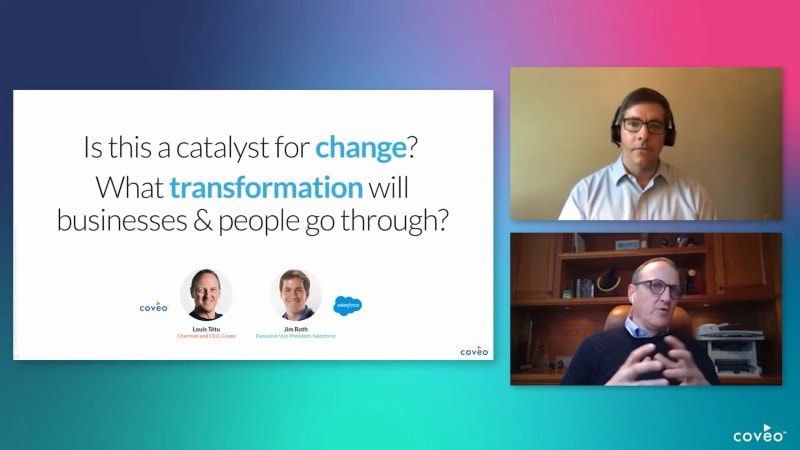
Join Louis Tetu, Coveo CEO and Chairman, and Jim Roth, Executive Vice President, Customer Support at Salesforce, for a conversation and update on digital leadership through crisis, the role of data and AI in the next experience economy, and more.

Make every experience relevant with Coveo