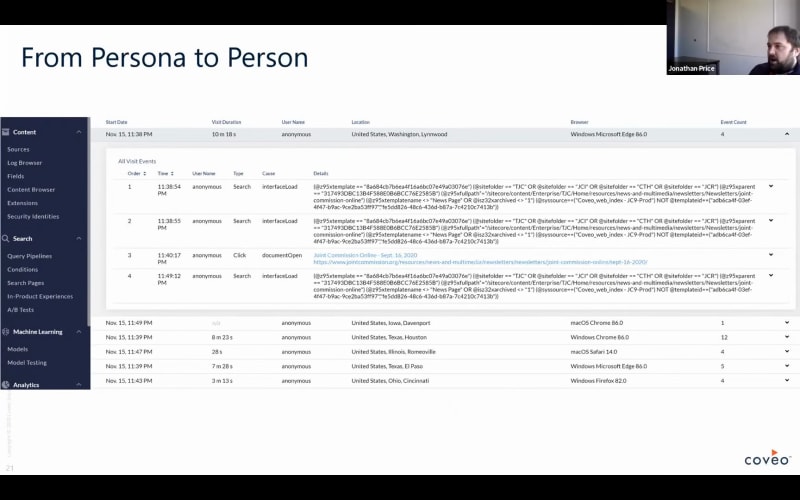
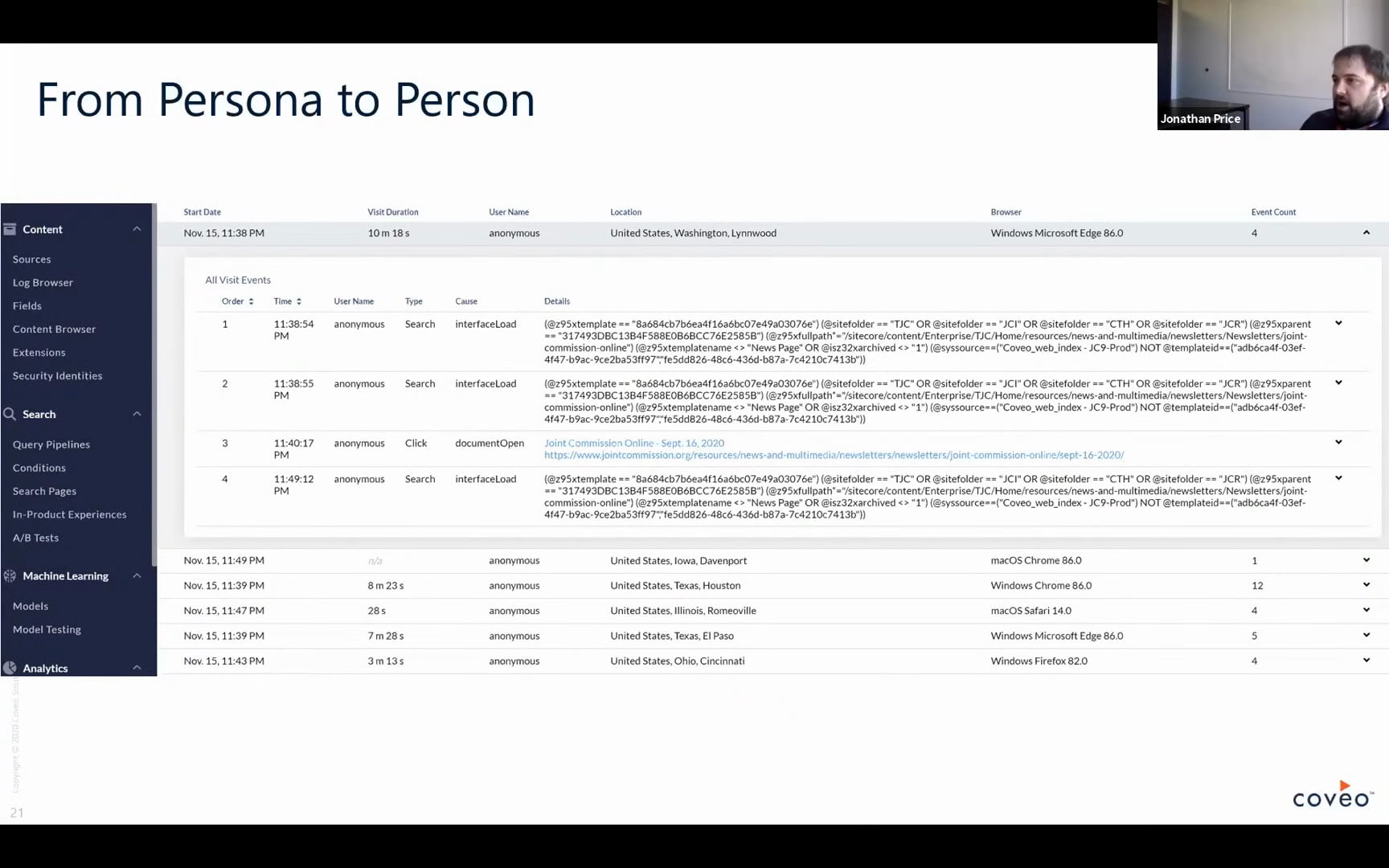
Hello, everyone, and thanks for joining our webinar today, Deliver Web Experiences Tailored to Persons, Not Personas Using Search and AI. So my name is Shereen Reid. I work on the product marketing team here at Coveo, and I'm excited to be, part of today's session. It's my pleasure to introduce to you also our speakers for today, mister Daniel Janssen and Jonathan Price. So Dan is the leader is the lead site core developer at the joint commission, and he works directly with the marketing team on all of their public facing websites. He has over six years of site core experience and has been with the joint commission working in Psycor and Coveo for the last three years. Jonathan joined American Eagle dot com in two thousand thirteen and has worked closely with enterprise clients such as Rust Oleum, the Joint Commission, Sanford Health, and many more. So Jonathan currently manages the Psycor and Coveo practice at American Eagle dot com, and he has the distinction of being one of five in the whole world that is both the Psycor MVP and Coveo MVP. So kudos Jonathan on that one. He is also what we call a road warrior speaker. So he spoke at the Coveo impact, events, customer events in both two thousand eighteen and two thousand nineteen. Unfortunately, we didn't have one in twenty twenty. So looking forward to getting you to present again in twenty twenty one, Jonathan. And, he also recently presented two sessions at the virtual, site core symposium in twenty twenty. So welcome, gentlemen. Thank you. So before, we get started, I just have a couple of housekeeping items as usual to cover quickly. First, everyone is in listen only mode. However, we do wanna hear from you during today's presentation. So feel free to send any questions that you have for our speakers today in the q and a section of your screen. And I will preempt this question that always comes in. The webinar is being recorded and you'll receive the presentation within twenty four hours, of of the conclusion of the event today. Alright? So for those of you just joining us, welcome to the webinar. Deliver web experiences tailored to persons, not personas using search, and AI. So before handing over the reins to Dan and John, I just wanna set the scene a little bit for today's discussion. And as everyone is very much aware, I'm sure if you're tuning in today, that a website visitor now expects to really search like Google, get those same, personalized content consumption elements like on they have on Netflix, and get those relevant recommendations like on an Amazon site or Wayfair. And when we look at creating those best website experiences, we really need to acknowledge one fact and the fact that search and discovery is really fundamental to making a website a success. So if, Jonathan, if you wanna just go to the next slide. So, the stats show that forty three percent of website visitors use site search when first looking for either content or product on a site. And we all know that many experiences that are living out there still leave a lot lacking. When you think of your own site and and the search experience that you have, a good litmus test to use is, would you feel comfortable putting a big, prominent search box on your home page knowing that whoever would come to that page would be able to quickly and easily connect to the content that they needed, that was relevant to them if they use that box. So that's a good litmus test. So today, we're gonna hear about the journey, that the joint commission took to transform their experience. And before we dive in, I just wanted to take a moment to talk a little bit about, the three pillars that we see or we talk about at Coveo and you'll see reflected these are reflected throughout the story today, which is really, really interesting. So the first pillar is the ability to really unify content access to increase discovery. So you want visitors to your site to be able to access the content they need no matter no matter where it lives on the back end. So whether that's in different branded websites or functional websites, maybe it's a support site, community site, or even a a lot of times, our customers will have training or documentation sites that live separately. So, first pillar is to unify. The second is using AI really to create those more relevant experiences through predictive search and recommendations. So you want your search to be intelligent and auto tune really based on how people are interacting with your content. So elements like query suggestion as you type, relevance based, ranking of results, dynamic filters, recommendations that are not hard coded but evolve automatically based on-site behavior. These are important elements. And the third pillar really revolves around value. So ensuring you have the right data and insight into what your visitors are doing when they're on your site. What journeys are they taking? Because when you understand content consumption and how it's being consumed by visitors and you can identify those gaps, then you can be more strategic in your content creation and even some of the UX decisions that you make as a result. So with that being said, I'm going to hand over the reins to Dan and, for him to tell us a little bit about joint commission and their journey. Yes. Thank you, Shereen. So the joint commission is made up of four entities. It's the joint commission, then you have the joint commission resources, the center for transforming health care, as well as joint commission international. Now these resources these, entities are made up of thirty different business units, and each business unit specializes in its own different sector of health care. And so, this is really interesting because that means that the joint commission becomes a leader for health care standards in the medical industry, and it also means that our audience is massive. We have not just the trauma centers and, physicians, but we have nursing homes in the general public. And so this became very relevant, when the coronavirus become a sought after topic. John, I think we're two slides behind. One more slide. Yeah. And then just, one thing to quickly point out about the audience of the of the joint commission. I I like to refer the joint commission as, you you know, almost like the IRS of health care, helping define, standards throughout. And the one interesting about their personas is that, you know, someone may be one day searching on ambulatory content or one day searching on pharmacy content. That individual could cross multiple personas. So the concept of implicit personalization and explicit personalization, we're gonna talk pretty heavily today and how the joint commission actually helped, I'll say, kinda solve that problem for that that more of that umbrella, persona. So just wanted to note that real quick, Dan. Yeah. No. Thank you. And, actually, it's it's, really important to note because some of our challenges were that we had a large business entity, presence. And so we had multiple technologies, aging technologies, outdated design spread across, you know, our four business units and thirty business units. That meant we had, people competing for digital space. People were trying to design their own pages without talking with other sites, other other departments. And we kind of had this this inconsistency. And so we had to kinda figure out how to to bring in a structure and a governance that we didn't have before. And so we actually reached out to American Eagle, couple years ago actually, and this was a huge project we brought in. And so we did cover all these challenges. And, John, you wanna kinda talk us through some of the solution overview? Yeah. And before we even get to that, Dan, there are a couple of things I'll highlight here. You know you know, having multiple business entities on multiple platforms that were built over time, you know, things like having multiple technologies, outdated design, and inconsistent branding is somewhat common. But I'd say probably one of the biggest challenges, the joint commission faced is with all these desperate systems is that there was numerous logins, user repositories, you know, through ecommerce sites, for internal systems, which led to really kind of the lack, I'll say, of centralized analytics and data. So those pain points and challenges, Dan, you rattled off, which is great, led to really a lack of centralized analytics and data. So the joint commission had a tough time making business decisions and digital decisions without a centralized analytics and data warehouse, which will which is really a key to the success of this project. Another thing I'll point out, is just simply vocabularies and taxonomies. Again, multiple business units going into the, I'll say, the concept of governance, was something that was a large, I'll say, challenge at the forefront of the project. So coming up with a, standardized taxonomy was also very important. But just a general you know, going over these challenges, you know, we really saw these as opportunities. Right? And if I highlight a few of them, right, governance, standardized UX design, you know, a massive amount of content, especially in a very complicated industry such as health care, so see the standards of health care, care, but also just general personalization. So, really, what we helped decide was, you know, what are what are the gonna be the technologies we consolidate all this data and, mostly user experience to? And so we really came up with Sitecore and Coveo. We're gonna be the quarterbacks to the solution. Really, they're gonna serve as the data repositories, and they're really gonna serve as the systems helping drive the experience throughout all joint commissions' web properties. So talk about robust governance and flexibility. So first off, again, four separate companies, thirty plus business groups, could be ten plus users in each business group. Sitecore was a no brainer for its robust capabilities and workflow and security. So right off the bat, helping streamline how content was not only created and curated, but published this site helped create, I'll say, standards. And when I talk about flexibility, I'm talking about the reduct the reduction of reliance on IT. So I'm talking about giving individuals like marketers and content authors the ability to go in theme pages, create their own templates, create their own variations of components, button colors. So not only giving them a nice, I'll say, bumpers of how to create content, but also giving them the flexibility to not have to go back to IT to code every single change they need. Right? When we talk about Coveo, you know, looking at the previous joint commission site, a lot of, I'll just say, links and pieces of content on pages, I'm talking about tens to hundreds of links, those have now been consolidated to use Coveo search landing pages. So Dan's gonna go over that in a little bit, and I'm gonna talk a little bit about how that led, into the personalization strategy, that we landed on. Revamped IA, pretty much, I'll say, a a no brainer in a project like this, consolidating four sites and consolidating ten thousand pages into a few thousand. I was at the forefront here, right, that's streamlining the experience. And another interesting thing, especially with the tech stack we've decided on, it fit the rest of the tech stack of the joint commission. So we're talking about Microsoft Active Directory. And so what we did is we consolidated hundreds of thousands of users, us, across number of you of repos into one user repo and one method of single sign on for all their digital properties. So this helped not only user experience not having to remember multiple usernames and passwords, but also gave the joint commission the opportunity to look at a user in that three hundred sixty degree view. And on that topic of analytics, so we have Sitecore and Coveo, the leaders of, platforms collecting data. We're we pair that with Google Analytics and Google Tag Manager, and we create a data warehouse in Power BI to push all this data. So not only website users, but really any executive stakeholder or business stakeholder could just simply look at all the data coming in from the digital properties, which we'll show you in a little bit. And as I mentioned, you know, this kinda just comes in a project like this. Coming up with one standard way of terminology for tagging, taxonomy really helped drive personally personalization in search as well. And it's hard to believe. It's already the Thanksgiving of twenty twenty. But the site launched almost about a year ago. We've seen a lot of success in metrics, which we'll get to here in a little bit. But, generally, we have a unified look and feel for all the digital properties and their ecommerce sites. And we really have a design that caters to the current customer. Right? So we have the guardrails to give the business of what they need to you know, the flexibility they need to expand, but we also they also have the governance to keep within that, I'll say governance structure. And then, really, what you'll see here is search is really driving the experience throughout all the key landing pages and all the key pages that really have complex data. So with that said, Dan, I'm gonna turn it over you to talk a little about, you know, kind of our revamped UI and our user experience and how we use Coveo for the general user experience. Yeah. No. Thanks, John. As we said, you know, we launched all four sites. They now function and look similar because of Sitecore, but the search, functionality is what really unifies them. And because of Coveo, we're able to do this. Now what you're seeing here is our main search page after I just went to joint commission dot org slash search. This search, you can see on that left hand side, we have our websites. All four websites that are able to toggle on their results and toggle off just through the facets. What's also really great too is that with, Coveo, we use relevance for sorting our search results. In today's day and age, coronavirus is the most relevant topic when you don't search for anything because that's what everyone's what's on everyone's mind today. So let's go to the next slide here, John. Or do you yeah. So in here, we started talking about how we wanted to use Coveo for everything. We wanted to use it across our site. On the right hand side is a blog page for the center. Now the center is a small, section a small entity for the joint commission, but it's still very important. And they love, you know, what we did with their site by highlighting their twenty three blogs specifically on their site. But then we went one step farther. On the joint commission's blog page, we're able to pull in their twenty three blogs into that site as well. So now the center has presence both on their site and on the joint commission's main site. And this was easy to do. We're able to do this just through a simple include sites, checkbox in Sitecore. This functionality, we couldn't do before, and now we have this here. So then continuing on, we were able to also do this to our products page. So the joint commission resources, houses all the products. All of our products exist in the ecommerce platform external to Sitecore. And so we developed a way to, pull these products nightly from the ecommerce into Sitecore as Sitecore items, which this meant we were able to search these search they search these results now and present them to the users, in our main site, in the joint commission site as well as joint commission resources site. And this was another simple thing to do. We set up the groundwork and we said, alright. On this search page, let's filter a content type, then let's add some tags to it. So this search result page that you see here only has two results because this is very specific for our conferences and seminars. And unfortunately, in this day and age, we don't have many conference and seminars, but we're still doing live virtual events. And so it's still relevant to show these results. And and because we're importing this data in from our ecommerce platform nightly, this page set up once will be dynamically pulling these results as long as the ecommerce team keeps updating their end. So our content editors kind of, like, set this page and they forget it, and it just keeps growing and shrinking based on the upcoming events. Not only that though, but, John, you can kinda help us out with this. We were able to set up some customized Coveo experience with the ecommerce. We were able to add some of that tracking to the products, John. And, kinda walk us through what we did there. Yeah. And and I'll take a I'm gonna take a pause here as well, Dan. I think, you know, you've shown just a few examples of how we've scaled Kaveo. Right? We scaled Yeah. Obviously to global search, which is a very common use case for Kaveo, but we've expanded it to all the other content types, blog listing, news listing, events listing, products listing. You're even using it on your newsletters. And the reason why we did that is not just for the flexibility, that you showed there. Right? A marketer can simply this gonna come in later, especially when we talk more about the coronavirus and how you guys responded to it. But it gives the marketers the ability to create these dynamic search pages and create these experiences. There's over fifty configurations you guys can use to create these search pages. Obviously, you guys can boost and do other very, I'll say, very important things as well. But the other reason why we wanted to deploy Coveo to all these important pages was not just for the flexibility, but also for for you guys to be able to collect the data. So Coveo will segment each individual user, which we'll show here in a little bit. And since we're collecting all this data on all their searching and faceting, that can be used for future segmentation and future personalization as well. And taking that one step further, you're basically seeing here we wrote a very simple Koveo extension to actually track ecommerce in Koveo. So, basically, every time someone adds something to their cart from their ecommerce site, we're track we're capturing that unique event and storing it to each individual user. So now we're knowing now we know someone actually purchased a hospital product. Coveo then knows, alright. Next time they're doing a search, we may want to boost other hospital products or like minded related products. So deploying Coveo to this extent really gave us three things, the data and analytics. It gave us the flexibility, and then it gave us all this individual user insight, which I think was probably the most important with how your personas are, which we'll get to here in a second. But, that was a great overview, Dan. Yes. Thank you. And, actually, I like to touch up on one last page here. Great. This page is our kind of like our bread and butter. This is the standards FAQ page. This is the fourth most visited site on our, website. It's behind the homepage, the login page, and the actual main search page. So it's kind of big, deal to get this correct. And so we then went ahead and we kinda customized Coveo to kinda do some things specific for us, which included being able to sort this, almost twenty five hundred search results by three different, set setting subjects. The manual, the chapter, and the topic. And so this this custom sort available was, really strong and really important for us to get done correctly. And then also, our business unit wanted to be able to say, hey. You know, when they come to this search page, let's not show them all of our FAQs. Let's let them make the first decision. And so we did a custom, overlay where it kind of blocks out and says, hey. Before you see our results, make a search, in the search box or select one of the manuals or chapters on the left hand side to help filter out the results before we show you everything. So this functionality and this flexibility was really great to to use here to really give our, end user some some search relevance before they saw all twenty five hundred of these search, FAQs. And so now we have all this data, John. You gotta help me. How are we gonna do, what are we gonna do with this data? Sure. Personalization. Yeah. Absolutely. And I think, you know, for a project of this scale to be successful, really, data is at the forefront. Right? It's hard to personalize things without data. So, you know, data and personalization, how do we unify our experience with it? So, again, if we go previous state, the joint commission really wasn't in a position to make informed decisions based on data. Everything was segregated. Everything was segmented. There's really no way to get an overview picture of what people are just browsing on, searching on, and even campaign wise, there was no way to bring all that data together. And with health care, it's also interesting because there is inconsistent terminology used across not just your sites, the four business entities, but just the industry in general, just the variations of how people say COVID, COVID nineteen, coronavirus, spaces, no spaces. All that data becomes exponentially important, and you need to be able to respond swiftly, based off the changing landscape. So, really, going with the Sitecore and Cobayo, our internal message to the stakeholders was we're gonna make informed decisions based off real data. We're not gonna make it off opinion. We're not gonna make it off feeling. We're gonna make it off what what are our users looking for, and what do our users need to see, all these key data points. So our plan really just drove these teams to build this consolidated search experience, to search through this complex and complicated data. But what we're gonna show here in a minute, it also enabled machine learning to kick in on a page by page basis, not just on a global search basis for Coveo to actually start recommending results based on each individual person. So, again, I'm gonna take a little bit of step back here. So the joint commission, like many organizations, is using implicit tracking and personalization. We're still doing persona traffic persona tracking if someone hasn't logged in, hasn't filled out a form, hasn't come in through a marketing campaign. So we're still doing that tracking. We're still doing a little bit of personalization there. But as I mentioned at the beginning, the joint commission has personas that really cross many different genres. So, again, if I'm an individual that works for a health system, one day I may be looking for information that may be hospital hospital related, or I may be looking for information that's pharmacy related. And this is what we call a corporate persona. So if we were just simply only using implicit tracking, this user's profile may look very, very confusing. So that's where explicit tracking really helped us with this project and overseeing success. So we went a little bit over on the Coveo front on being able to search, being able to segment a user on individual search landing pages for every one that visits the websites, but we're also doing it a few others few other ways. So number one is this, enterprise single sign on platform for over a hundred thousand users. We have contact us forms when a user fills them on the site, gets submitted to Salesforce and Marketo. We also have Sitecore EXM up and running, blasting out emails to hundreds of thousands of users as well. And if a user engages with any one of these platforms, they now become known. And for the for those that may not be familiar with Sitecore, this is Sitecore's xDB profile. Other platforms may have something similar. But, basically, what you're seeing here is a known profile. So we have their name. We have their email. We have what pattern or profile they match. So, again, if they're accredited or not accredited, what setting they're in, maybe their laboratory, maybe their hospital, or maybe their corporate persona. And we're tracking each and every one of their visits, so emails being opened, campaigns coming in on, and goals being tracked. And with all this data, we know exactly who this user is from the past, and we can make informed decisions because we're explicitly tracking this information for actions in the future. And just a quick example, if I'm on one of their web properties and I do not know who this user is, on the left, we're just seeing, you know, standard standard content. It's just some information around their stand or international standards around the world. And if a user clicks on a few hospital pages, we could show a personalized experience. But at times, if we don't necessarily know they're interested in hospitals just because of the implicit browsing, we let explicit tracking take over, and we start labeling personalized messages. So for this individual user, we know they're interested in hospital because of past tracking, and we're explicitly personalizing content to them on their website. Just a very simple exam example to show everyone more on the Sitecore front, the web browsing front of personalizing data. Right? And then jumping back to the Coveo front, for those that haven't seen this, this is Coveo's unique individual, web browser. So it tracks every single user that ever visited the site and uses Coveo and tracked every single action they took. So this individual user shows that they searched for an individual item, they actually clicked an individual item, and they did another search. So with all this data, you know, we have Sitecore keeping track of users individually. Now we have Coveo keeping track of users individually. Site Coveo now segment users based off users that have done similar type actions. So it's not, like, it's not an overall catchall on a global search. This is taking place on every single individual landing page we've deployed Kaveo, which helps us drive the personalized experience on the search front as well. And with all this data comes great power, but we also need a very easy way to look at it. So we have multiple systems in play here. The Joint Commission is now using Power BI to push all this data into more of a data warehouse model. So this is just a couple quick examples of a few reports showing the ability to be able to filter some of this information by site, being able to actually search through what this information is, and even looking at just how much content is on their web properties, the status of that content. This is just a quick view of how they're managing the governance from Psycore. So they're managing workflow in Sitecore, but all the statuses, all the content is being pushed to Power BI to get an overall look on the health of the site, how many pages are in draft, how many pages are out of date, etcetera. So, Dan, before I turn it back over to you on how you guys helped respond to the coronavirus and the growing need for new content there, just a quick over a little bit deeper dive of this, tech stack that Joint Commission is using. I mentioned Sitecore. I mentioned Coveo. We're using Hotjar for heat mapping and polls. I mentioned Power BI, and we also have Salesforce and Google Analytics. And all these platforms together have helped give us this three hundred sixty degree view. So, Dan, with that said, how about you tell us a little bit about how the joint commission responded to COVID nineteen and how, you know, even just without the news, how you saw the ever growing demand, and I'll say content needs based off, the coronavirus. Yeah. So, you know, when coronavirus hit us, you know, no one's expecting it. And we're kind of this crazy situation. We just launched our website two months prior. We're still getting up and running. We're still trying to figure out all of our, quirks that we're working through. And then we're starting to look at our analytics. And we see, you know, February, March, this surge, of demand for COVID content. And so we knew we had to get out, not just because we're a health care provider, but because it's something that's very relevant. So we had to get the content out there. And so we built out a couple quick small Coveo pages, and we just, from there, kept building on it. And we were able to add, tracking also. So we're able to track our users and see when they come to the Coveo section, where are they going? Are they getting what they want? Is everything relevant? And so from there, we also needed to understand our gaps. Oh, no. John. Oh, looks like my PowerPoint crashed. Well, it wouldn't be a live webinar without something happening. So give me one second here. Yeah. And I'll just kinda talk through it a little bit. So, it was really interesting when Coveo happened because we had an entire content section to cover that, didn't exist. We just we knew nothing about it. We weren't really ready for it as far as the website. And so we had to kinda figure out, alright, what do we need to provide? What do we need to, include? And how are we gonna go about showing all this data? And so I'm pulling it back up one second here. Alright. Yeah. So it's really great though because we were using the analyst in Sitecore, but we also were able to use, Coveo. Coveo has some great functionality on tracking not just the content, but the content gaps. And so as users were searching, we were able to figure out if our content was there or not. Kinda like how we're trying to figure out if our Koveos slides are here. Sorry. The PowerPoint, threw a bit of a fit here. Give me one second. K. Maybe, while we're waiting for John to get the slides back up, I can ask a quick question. Oh, please. So, yeah, so some of these questions are coming in while you guys were presenting. Something that was asked, and I think it was earlier on in the presentation is what teams and departments worked on the unified taxonomy? So when you talked about that near the beginning, can you Oh, yes. We're sure to do that. That was a challenge. So the team that actually worked on it, the main team would have been myself as well as the digital marketing side. There's four of us on the digital marketing and myself as well, and we kind of worked on it with the entire company. So all thirty business units. We took a first stab at consolidating. We pulled all of our taxonomy and our tags from our other prep platforms and we were like, these seven tags are the same. Can we consolidate this into one tag? These all look the same and we kind of just we spent months doing this. Alright. Here's a list. Let's look through it. Here's a list. Let's look through it. We just kinda kept refining it and re cleaning it up. And then we also got to a point where we said, you know what? We can't tag everything as something specific. We need broad ideas. We need concepts. I can't say, like, broken finger, but let's, bring that back into, like, osteoporosis or something with bones. For diabetes, we couldn't be very specific, but glyco glycolysisema? I'm a I'm a murderer. That's horrible. The general concept of of something like that. So we had to get work through with everyone essentially in the company and kinda get this very concise, like, list of terms. And so, actually, what's really cool is our facets is that list of of tags and key terms. And, I wanna say before we did this project, it had to have been hundreds, if not couple of thousand. And now we're we're, like, a tenth of that list. It's just kind of crazy how we we brought down and consolidated that group. Yeah. And the other interesting thing around that, I think someone just asked a good question, is how do you make the call then? You know? So what we help put in place is a governance committee. So every quarter, every few months, we get together saying, alright. Does the terminology need to change? Does something need to be added? And that's really a business decision amongst the groups. Not one company is adding their own. That's basically a committee, that come together and helps make those decisions. So just simply setting up that type of governance cadence, definitely, I think, helps you guys as well. Yeah. It kind of helped us identify where we're missing stuff. And Coveo itself actually helped us identify some of the missing stuff as well. Yep. And so here, now that we have this slide back up Yep. So this these analytics are specifically for our COVID section and our COVID searches. As you can see, in April, May, we got close to thousands of searches each month. And to that same time frame, our queries without results dropped from a hundred and fourteen to about forty one. We were able to figure out, oh, no. Like, people are searching coronavirus and then coronaspace virus. And so we had to add those into the source because coronavirus wasn't norm normal terminology. And we're able to even see, what our big searches were for. So you can see there COVID search, COVID webinars, COVID nineteen. There's around PPE, cleaning, vaccines, all this stuff kinda came in. So we're like, these are what the people are looking for. This is what the end users care about. We have to have this content on our website. If it's not on our website, we have to be able to get them from that search. If I'm searching fire drills during COVID, I need to get them relevant data that talks about COVID and how fire drills will will be affected, whether it's, you know Yeah. Different different standards or, hey. Do everything the same. Nothing's changing. Just wear your mask on top of it. Yeah. And that one I the an interesting comment came in. So there's still human intelligence in order to get AI to work. The one thing that to note about that is what these reports alluded to and why the machine learning recommendations didn't kick on initially because there was no content to recommend. So the interesting thing, Coveo helped identify those gaps, which is why we have it deployed across so many key pages. It helps identify those gaps across the entire enterprise over over fifty other key acquisition pages. So what you're seeing here is Dan's initial response of adding these keywords. Then after content was created, these these the stores items were removed. So, yes, there was a bit of a manual process at the beginning, but it also helped the the joint commission identify what content they need to create as well. Yeah. And our our COVID section grew from, like, one or two pages to, I think, a dozen or so. I probably should have counted that, but it's it's a lot a lot larger than it was, come January first last year or this this year. It's a dozen pages presenting probably about five thousand pieces of content. Yeah. No. Yeah. So yeah. So then this using this, learning experience, this COVID, kind of like a scramble, I'll call it, showed us how to use Coveo and how to use a site core analytics. And so we started to understand our gaps across our entire website. We talked about terminology just a little bit ago. We found out that not only internally we were not using the same words that our end users, the hospitals, the general public, physicians, they were using different terms than we were using, that we never knew about. You know, we've been in business for over fifty years, and here, we found out that, you know, people are searching EOC instead of environment of care, or they're searching for, file a complaint when they really they're looking for a report of patient safety event. And so doing this, we were able to, figure out, alright. Do we need to change our content? Do we need to make small updates to how our search is working? And do we need to fix our terminology? And this led us, to take, queries without results from twenty three thousand in January to just under four thousand. This is in under a year. Not just that though, we also were able to kinda track our our click rank. We found out that that standards FAQ page I showed you earlier turns out to be that it is the fourth most sought out after page, and that we didn't have it on our main search page. And so just by adding that whole section to our main search, because Sitecore's flexibility and Coveo's flexibility, it took us under a day to get it added on to our main search and our click ranks dropped from seven to two point seven, meaning that they didn't have to click through all these results. They didn't have to click next a bunch of times. They found the FAQs they're looking for much faster, off the main search than going through a couple pages. This was huge because this is stuff that we just didn't know about our end user, and stuff stuff that we probably would never would have known without these, this technology at our hands. No. And so then we talked about, machine learning too earlier. Machine learning was huge. We didn't have anything to go off of. And so Coveo's machine learning just picked up. This is being searched. This is being searched. This is being searched and started building its own repository of recommendations. And so here on the main search, when you type in c o v, it gives you a list of relevant terms being searched. This helped us in, increase our query click through, by twenty percent just using machine learning, which is incredible. People being able to find the content that's relevant, especially in this time period where, you know, COVID is on top of everyone's mind. I think the one thing I'll point out as well is beyond this a hundred percent increase of click through is the one reason why the data was able to learn so quickly is you guys do have good amount of traffic, but we have Coveo deployed so vastly. Coveo is just intaking all this data and helping be able to, train and learn quickly. So instead of just presenting a search page with Lucene or Solar, without much data or, I'll say, machine learning behind it, Coveo was able to refine the results and refine what people are looking for. So deploying it vastly, I don't know if you agree, Dan, but helped lead to some of these drastic results you guys have seen. Yeah. No. We were we were very pleasantly surprised and and happy with the results. Just getting this information is important for our business, and this is just so it's just so helpful. Yep. Yeah. So I guess you wanna kinda look through here. So, John, this is how we were able to do this. Yep. Yeah. Well, we touched we touched on this a little bit earlier, but with the nice close integration with Coveo and Sitecore, which is why we picked these two as the two leaders for this project, what you're seeing here on the right is one of their new COVID nineteen resource centers. So you're only seeing thirty thirty seven results on this page. Some of these other pages has meant have many more results. But the nice thing is when you have, I'll say, a content crisis like this where you need to respond quickly instead of a developer going and setting all this up, the joint commission's marketing and content authors are actually able to go in and configure this all themselves. So they're able to go in, choose what site the data was coming from, what templates they wanted to pull back, and what taxonomy to only pull back. So that's how they're able to create all these individual landing pages as they have all these configurations available to them to create these experiences. So this page was able to be created in just an hour or even less. Whereas if we're scrambling on a technology that wasn't flexible, you may have had to go on back to IT to code one of these types of search interfaces. So having all these configurations available to the marketers or content authors helped you guys respond to the situation and the growing need for this type of content and experience. Yeah. And and really quickly too, I saw a question come in about, you know, is all of our content in house or is it external? And it's really, it's commission of both because while joint commission is one of the leading, health care standards providers, we don't know everything. And so, like, with COVID, the CDC and other third party, suppliers were the real true knowledge of this information. And so we actually had already set up a way that we can link out our Coval results to third party, content. Our COVID resources page is I think it's a hundred percent third party resources. And so there's thirty seven results. That means there's thirty seven different articles on this page. Each one goes to a third party website to help someone get information about, the coronavirus. As you can see, the first one here is the CDC, then right below is American Society of Hospital of Pharmacists, and those are external links. So we do have internal internal data, but for COVID and coronavirus, a lot of it was external. Yeah. And the other half of that question as well as syndicating content, again, there's four unique business entities. The user could, on a single day, browse three or four. More likely three because one's international. But if I'm browsing three web properties, we're syndicating content from one site to another. So I can easily search content from their joint commission resources site, and I'm gonna pull back re information for the joint commission site. I can search in the joint commission site, and I can receive articles or even products from the joint commission resources site. So content is syndicated. It's very easily to navigate across the four web properties, as well. Alright. Yep. Yeah. This is just kind of a quick overview of how we're just able to set up in Sitecore. Just Yep. Just like clicks, drop downs. Yep. Just kind of expanding what I was mentioning before. Just all you know, just a a sampling of the configurations, of how someone would set up on these search experiences. But, Dan, I know we're we're starting to run down on time here. You wanna kinda just give us a general overview of the results you guys have seen from, this transformation? Yeah. So let me, be quick about this. We dropped our content pages by forty percent. Like you said earlier, we have thousands of pages. We're able to consolidate using Sitecore, using all this data we gathered, and figuring out how to do this. And this able to, you know, pull content from every site was also just new to us. Like and so this helped us kind of govern all this data together. One of the cool statistics is that we dropped our home page, time on page by a whole minute. Meaning that people left the home page faster to get to their content because our bounce rate also dropped and our exit rate also dropped. This is huge because when you come to website, you don't wanna spend time looking for your content. You wanna spend time looking at your content. And Coveo and Sitecore helped us do this, and this redesign as a whole just helped us get this better experience. And we've had great feedback both internally and externally, about how the website looks great now, and they're finding things that they need that's relevant faster. Yeah. I I think the interesting thing is as well, just to highlight that that that that time on page. Right? Before, you were throwing everything at all users, right, which is why they're spending over two minutes on the home page searching for what they're looking for down to fifty nine seconds, but you've decreased it while also dropping your bounce and exit rate drastically. So that's kind of a testament to, you know, the items we are personalizing and the data we have consolidated has helped streamline your users' experience. So that's great to see. Yes. Yes. Yeah. And then just on the right are just a couple quick examples of how we're also looking at how our users browsing site is heat maps, watching how they're scrolling. And these heat maps have also become extremely clean. The clicks are very clean. The users are very evidently looking or for very specific things, but we're not seeing, I'll say, neurotic clicks all over the screen, which is great to see. And there's a lot of other data we could share, but just wanted to share a couple things here as well. So, Dan, I'll quickly cover what's next. So right now, as I mentioned, the scale of of how we have Coveo is over fifty pages. That's just gonna continue to grow. COVID COVID nineteen has helped add more. But the one interesting thing is, right, you guys are on a little bit of older version of nine. And the interesting thing is you guys aren't even on Hive yet. So this is all accomplished, I wouldn't say, with older technology, but you guys aren't even on the latest and greatest yet. So the plan is go to Sitecore ten, the latest version of Coveo and Coveo Hive, but also tap into the one feature we haven't utilized, which is passing XTB profile data to Coveo. So right now, Coveo is segmenting and tailoring results to users. The next step we're gonna do is start taking all of our Sitecore profile data, pushing it to Coveo cloud, and creating personalization rules for certain search experiences. So I'd say those are the next things on your road map. But even without though, I think you guys have achieved pretty great results so far. Yeah. I agree. Because I know one of the biggest things we're looking forward to is, being able to personalize those facets on the left hand side. Right now, it kinda throws everything at you because we haven't gotten there yet. But as soon as we can start personalizing that, we'll be able to rank the, the facets. Like, if you're from the hospital, we'll start putting these up higher. Or if you're from a nursing home, we'll rank up these more important up. And that's gonna be huge, a huge advancement of of what's already a great platform. Yep. No. Absolutely. I did I just see another quick question come in. You know, what tool are we using to generate the heat maps? So I'll answer that one real quick. So the heat maps, are with a tool we call Hotjar. It's a very cost effective tool I'd recommend to any organization. I think it's less than a a hundred dollars a month, but I we can create heat maps on unlimited amount of pages. We can create videos. We can create scroll maps. We can create even polls to ask how users are enjoying their experience and offer triggers off of those. So Hotjar has been a very valuable tool. And bounce rates, we're using a couple couple items. Those came from Google Analytics. Yeah. And I believe those results were, year over year. So last year compared to this year. Yep. And so that was that improvement alone was a testament to last year's old website this year's new website. Yep. Then one one other quick question. Perhaps, you know, Dan, they're asking about, the external link tracking with that COVID page in the CDC. So there are external links on the site. The nice thing is we are using Psycore Psycore's, external link tracker, so we can actually trigger goals based off some of these external links. So even though they may be linking off the site, we've actually set up goals, and that goal right there for the CDC is they've triggered they're viewing COVID content. So even though they may be exiting the site, not a few of those use cases, we're still triggering site core goals, as they hit that button from our site. Just wanna answer that real quick. Oh, thanks, John. Go ahead, Sherry. Yeah. Thank you, gentlemen. We're we're just about out of time, but we have a few more really good questions that came in. A lot before we get to them, just to highlight that Coveo does offer a free website search assessment. So if you're interested, you can go to that URL, and our search gurus will go ahead and assess your site and and give a report back to you. K. So some questions that came in that you might not have seen and for those that wanna stick around to hear you answer them, that would be great. So how is Sitecore accessing the Coveo user stats to personalize a page based on search history? Is the tracking information combined, rationalized in the data warehouse, then pushed, or made available for Sitecore to use? It's a long question. Yeah. I can. I'm I'm gonna answer that in pieces. So first off, we're using, obviously, Coveo is deployed on-site core. So Coveo itself is capturing all that data, in its own cloud platform. So that visit browser I showed you is capturing every user's visits when they've interacted with Coveo, search terms. There's also some custom events we've created for, like, viewing standard FAQs, like Dan mentioned, adding things to the cart. And we also have Coveo's page tracker deployed, so we actually know what pages they're viewing after they've used, Coveo as well. So Coveo itself is taking in data and tailoring the events or the analytics to users. And the next as part of the next steps, we're gonna trigger additional personalization from the Sitecore side. So that's the one step we haven't gotten to yet. So we're we're using Sitecore based off explicitly known data. We haven't started, personalizing other content based off Coveo data, if that makes sense. Dan, you wanna add anything to that? No. That sounds that sounds accurate. We're, we're learning a lot of this as we go, and so we're using American Eagle as guidance and help. For me, a lot of this is new, and so using this, functionality, we're still learning on my end. K. So typical questions that we get we've gotten a few in today, but that we get on many of the webinars that we do is understanding team structure and who does what and how you're organized because that's always the challenge. Right? You never have enough resources to deal with all that you need to do. So one of those related to that is, does your org have a CX team? So we do not. As big as our organization is, the digital marketing team actually is a new team. This team has only existed for about a year and a half, two years. And that consists of digital marketing director, for content editors on that side. And then myself as a developer and one of the developer in house for the joint commission. And then a lot of it, we use, American Eagle's external help as well from their UX, their CX, and just their, like, general knowledge of what customers are looking for. So we don't have that in house. Okay. And, again, related to that, who in your organization is responsible for reviewing the search analytics to identify new terminology to add missing content, zero search results? So I think you answered that. It's you and somebody else, two of you that manage Well, so we have actually the, there's two developers, but this actually falls on to the digital marketing team, the content editor. So So the site core content editors are in there. They're reviewing the analytics. We have one member who's really good at just using, the Coveo Analytics inside and some others are good at Google Analytics. And their combined power of of four people help drive what's missing and what needs to be updated and kind of, figure out how to get this website working best. And they also work with the thirty business units that are are out there. So so everyone knows who they are. Okay. Great. Thank you both. Amazing presentation. We have more questions that came in. We're not gonna have time to get to to them all, but we'll get back to those individuals separately, based on, Covio team, I'd like to thank you for attending today's webinar, and have a great day. Thank you both. Thank you, everyone. Thank you for letting us present. Yep. Thank you.
Deliver Web Experiences Tailored to Persons – Not Personas – Using Search and AI
You don’t have to sacrifice opportunity for the sake of outdated search
We expect personalized and relevant experiences. Search and discovery are fundamental to it. 43% of website visitors use site search first when looking for a product or content.
They expect to find what they need.
Coveo for websites helps people experience this relevance so that they engage, learn and convert.
Relevant experiences for every person, not persona, is the best way for your business to scale and serve your customers.
Watch our webinar to see how it’s possible, with search, data, and AI.
Join the Joint Commission and Americaneagle.com as they share how they created a unified view and relevant experiences across their web properties for every customer by:
- Consolidating and streamlining technologies
- Unifying user experiences
- Creating a consistent brand
- Centralizing organizational operations
You don’t have to limit your business’ ability to serve your people. With Coveo on your side, there’s nothing holding you back from providing the most relevant search experience to your audience.
It’s easier than you think.


Make every experience relevant with Coveo