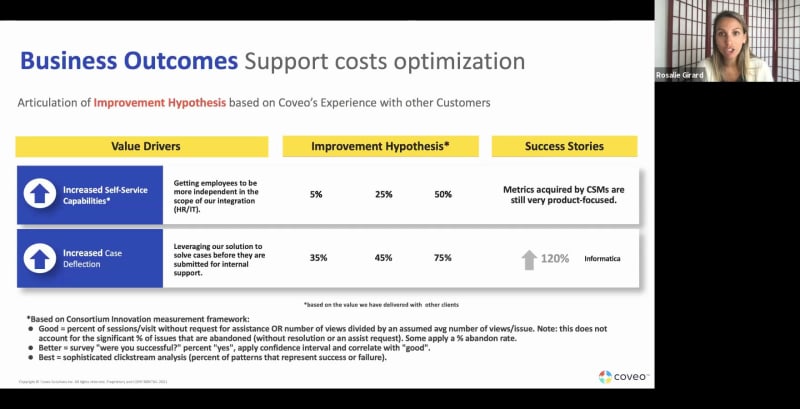
Hi, everyone. Thanks for joining. We'll just give it a couple more minutes. Rosalie, our speaker, was having a technical difficulty, so she'll be hopping on in just one minute. Hi. For everyone who just joined, we're just waiting a few minutes. Rosalie, our speaker, was having a tech technical difficulty with her computer, so she'll be joining just a few minutes. You'd think after a year of working for home, we would have worked out all these technical difficulties, but they are still here. If you want, feel free to say hi in the chat. Let me know where you're joining from. Love seeing where everybody's where everyone is joining from. I'm here in San Diego. It's cold for me, fifty seven degrees. I'm sure that's not cold for some of you guys. Yes. Colorado is probably much colder. Welcome, Jonathan. Thirty nine. Oh, I don't think I could handle that. Richard from Massachusetts. Welcome. Fifty. It's about what it is here. It's only nice in the sun. Alright. Just a few more minutes. Thank you for your patience, guys. I really apologize about this. Feel free. Grab some late morning, early afternoon coffee. If you want, it'll just be a couple more minutes. Wow. It's warming up fast in Massachusetts. Fifty six degrees. I should check. It's probably warmer here as well. Sixty one. I'm still very cold. Seattle. What a beautiful city. Hello, Rosalie. Welcome. Hi, everyone. Sorry for the technical issue here. No problem. Everybody's joining. We were talking about the weather, how cold it is, November second. Oh, yeah. But so, everyone, welcome. This is our webinar, building a solid business case for investing in AI for your workplace experience. We're really excited to be here today. Rosalie is our director of business value, and she'll be giving our presentation. She's amazing, and you guys will learn so much. I learned so many new things on these webinars, so I love moderating them. So you're all in listen only mode. You've all been in webinars for the last year and a half. You are experts. If you have any questions throughout the presentation, put them here in the chat or the q and a, and we'll follow-up during and after. And then this is being recorded, so I will send it to you later today or tomorrow morning. And with that, I'll pass it over to you, Rosalie. Perfect. Thank you, Maggie. I'm gonna share my screen here and turn it to PowerPoint. Alright. Excellent. So really, really happy to be here today and talk about the value of of Coveo for a workplace. This is something that, this is a a really, really great conversation to have because this is probably the least, straightforward use case that we have at Coveo here in terms of, of value delivery. And our customers and our prospects usually have, a hard time justifying the purchase of a solution like Coveo for workplace internally. So I'll, I'll walk you through the various benefits and the various way to build a business case, for for this type of purchase. But before I'll just go over what is Coveo for Workplace solutions. So when we talk about Coveo for Workplace, there's various ways that we can think about it. We can think about adding Coveo for an intelligent Internet and portal. So just, one stop shop for the entire enterprise, that is powered by AI so that, you know, the the users can have a relevant experience there. We can talk about intelligent employee self-service. So we can think about, any any well, on an Internet standpoint, but any departmental, self-service that is available, we can make sure we get we make it relevant for all of the internal users. Intelligent departmental, solutions, that's an a very specific one. But if we can think about, you know, HR, for example, if, HR has a portal and they wanna power it, with with, with relevance, and make sure that all of the employees in the organization have access to the latest and the greatest, HR material at any time. That's an example as well. And we can think about an intelligent internal, help desk as well. Think even if, you guys are on ServiceNow or any of, any type of portal, we can integrate directly in this, in this solution and offer relevance there as well. This is really worth we're talking about, this whole breadth of experience, but always, serving the internal users. Okay. In terms of advantages, there's various advantages. I'll go over advantages for a little bit, but I'll really deep dig in, to the benefits in a second because this is really what this webinar is about. Advantages. Transformational strategic play to gain relevance as an organization, increase proficiency inside of the organization, making sure that people can do more on their own, and increase, will improve the employee experience and satisfaction by offering better tools and enablement. In terms of, the whole rationale of this and this graph on the left is something that we developed with one of our customers when they were, presenting to their board for approval of, the purchase of a solution like the Veo. It is really about maximizing the time spent by talent on meaningful tasks. So really the shift between spending a lot of time on low value add and a little bit of time on high value add, we shift that and then we are making sure that all the resources are focusing their time on high value add task and that the low value add task such as looking for information, asking your colleague, have they seen that, do they know about that. All of the tribal knowledge, times the time spent on tribal knowledge, knowledge that is not reused in the organization, is not serving the organization after its creation and its use, we wanna make sure that we limit this amount of time. When I say that we build that with one of our customers, the example here was, it was an engineering firm. And, we were looking at, at the Powering, their, the portal that they have internally where they store all of their, credentials. So their their oops. All of their prod project sheets are their credential, the other project that they've done before that they typically insert in their proposals. In engineering firms like that, we typically have a couple people that work on proposals, but mainly people who work on proposals are the engineers themselves. And we were seeing a lot of engineers working on proposal, spending a lot of their time searching, calling the other office in another country to know, you know, do do you guys have done have you guys done this type of, of project in the past or having a meeting with another office in another continent to see if they had any relevant experience. There was a lot of time spent by very high value people that could have been doing amazing things, doing very, very tactical stuff. So this is really what, we developed with them, and that's the kind of framework that we are still following, when we're talking about value delivery with that organization. We're looking at how much time is spent by engineers on on, high value add work, such as working on projects, developing the value proposition part of a proposal versus the credential and team part of a proposal, for instance. And how do we make sure that we, you know, switch that equation and and and focus them on the high value add stuff and minimize the low value ad, part of, of their job. Now how do we quantify that? How do we build a business case for it? How do what are the business outcomes, of a project like that? Well, there's three categories of business outcomes. First one is productivity gains, support, cost optimization, and employee satisfaction. These are the three families of business outcomes that we are thinking about when we're building a business case for for, workplace. I'll dig into each of them. Productivity gain. So if you look at productivity gain, we have various value drivers here on the left, in purple. The first one is, reduced time spent searching and gathering information. That's exactly what we were talking about for the engineers. Getting employees to be more productive and accelerate the work that they do. Making sure they don't spend that time on, low value add, activities. Reduce time spent creating existing documents. So anything related to duplicate and creating documents that, will not be reused in the future, that's all time that could be removed, from, you know, the the the equation, of, the time spent by an employee at work if they have access to relevance, in their workspace. And reduce time to proficiency. How much time is spent between the moment that a resource gets hired and the resource gets to full proficiency? How do we make sure that that, we can get them to do their job sooner by arming them with the right knowledge? So for reduced time spent searching and reduced time spent creating documents, it's a bit intangible because because this is something that we typically never measure. Right? If I'm asking you, how much time are your spend are your engineers, spending searching right now? I mean, probably their manager can give you an estimate if they do, you know, a survey in their group or how how much time is spent creating, recreating existing documents. I mean, it's gonna be an estimate. Right? A way that we can measure that accurately is basically by doing, a time study. So this is something that we use a lot here at Coveo. We are big advocate of the Lean Six Sigma methodology, and we use a tool called Dilo, d I l o. Basically, Dilo stands for day in a life of. And that's basically a way to do, time studies where we're basically tracking activity by activity, what the employees are doing during a day. So how does that look like? That that looks like me going to spend a day with an engineer in a random group that we have defined as, you know, the the person that we want to evaluate for the study. I go spend a day with them, and now with COVID or or the the restricted travels, we do it online by Zoom and by sharing screens. And then I would sit right next to the engineer, and I would record activity by activity what they do during a day. Okay. They are, opening the computer. Okay. They are opening a document. They're reading the document. What is this document? Okay. This is a proposal. Okay. Now they are, writing an email to a colleague to know if whatever, whatever, whatever. So we actually record activity by activity with a time stamp next to it. And after that, we actually categorize the data. Then then it allows us to understand, well, you know, twenty percent of the time in that engineers, they will spend, writing emails. Writing emails about what? Oh, writing emails, looking for information. Okay. Well, that's a red flag. You know, twenty percent is a lot. So this is really how we get to having accurate estimates of the time spent doing various activities. Now, one issue that comes up a lot is, well, we have a large organization, and we don't have time to spend time with every single employee in the organization. How do we do that? The best way to do that is basically to take a sample that's representative of, the whole population, but also to focus on the population that's the most, impacted by the lack of productivity that's due to lack of relevance. So usually high value workers like, you know, engineers, like, the support organization, any support organization. It can be IT, it can be HR support functions, that are spending a lot of time supporting, even if it's internal customers, that can be helped by knowledge. I would focus on those groups. And then I would go, with, you know, the most representative sample. Their their real answer is always do as much as you can so you can get the most accurate, results. But the most as you can is is usually a little bit. Right? Spending a day in engineering group, a day in IT, a day in HR, and that's fine. At least it will give you a starting point to understand what is your current state, and is it bad? Is it is there a room for improvement? Now I talked about the value drivers here on the left side of the screen. Improvement hypothesis and success stories. So this part of the screen is basically to, inform you, about how we typically build those business cases. So improvement hypothesis, that's basically based on what we see with our other customers. So we keep a repository of benchmarks of how our customers see these KPIs impacted over time, when they adopt Coveo. And then we look at, okay. Well, minimum is the most conservative, situation. So once we establish the the cure and save, we say, well, if we are very conservative and you improve that KPI as much as our customer who improved it the least, how much can you get to? And then how much is that saving you? So five percent would be in that, situation. The most conservative, improvement hypothesis, fifty percent being the most aggressive that's based on our best performing customers. Success stories are basically, just, customer stories that we are allowed to share to support, those numbers. So when we build a business case, when you use Coveo's service to build a business case, that's usually something that we provide. We make sure that when we take assumptions, we always back it up with some, tangible Coveo stories. So in terms of productivity gain, inform providing your employees with, relevance and access to relevant knowledge will help reduce time spent searching, reduce time spent creating existing document again that don't need to be recreated and will help reduce the time to proficiency of new hires. In terms of support Hey, Rosalie. Real quick. Somebody asked in what is the middle column? Is that the average improvement? Yes. The that's the average improvement that we see across our customers. Awesome. Thank you. Mm-mm. No. Thank you for asking. The next one is support cost optimize optimization. Two KPIs that we wanna look at, to, to see how we can shave some costs, for internal support. First one is increased self-service capability and then increase self-service, case deflection. So what we mean by increased self-service capabilities while getting employees to be more independent in their the scope of, our integration. So for instance, IT or HR. I'll take IT as an example. We wanna make sure that when employees have IT issues I don't wanna say issues. I wanna say if we we take the ServiceNow language, we wanna say request. Because, an incident typically requires an escalation to, an IT engineer or an IT agent. But, a request such as, how do I how do I do my upgrade to the next, version of iOS, for instance. It's not an emergency. My I can still work today, but I still need to talk to IT to know how to do it because I know it's at a certain point, it will come and bite me. Right? So this is usually something that, you know, if the knowledge is available, I can I can self serve? Right? But most of the time in most organization that we talk to, the knowledge is available but not findable. So that's really where we can have an impact on self-service capability. Now how is self-service calculated? That is an existential question that was, answered basically by the consortium of service innovation last year when they when they kicked off the project, to, to define how to measure it in a standard way across the across the industry. So basically, what they they came up with is a good, better, best model. So good is basically looking at the percentage of session divided by well, the the sessions divided by, the visit without request for assistance. So that's that's a pretty straightforward way to do it. A better would be to include a survey in the flow. So when there is a search, there's automatically a survey that pops up that ask, were you successful? If the yes, well, we can apply the the confidence interval and correlate with, with good. And best is a sophisticated click stream analysis. Then we calculate a percent of of patterns that represent success or failure. So that's the most sophisticated one, the most sophisticated way to measure it. I would say most of the organizations are measuring it at the good level. And some organization are going all the way to better. Some of the organization we're working with, are are working with a survey as well to make sure that they are, they are measuring their the good accurately. But very few organization that I've seen, are working with the best model here. Again, the sophisticated click stream analysis, it all depends on the organization and what you consider a success. So that would be, really personal to your organisation. Now self-service capability really wants to when we are measuring that, KPI, we really want to see how many people were able to get their answer without having to contact us. Now increased case of flexion. Case of flexion case of flexion is basically when our solution is leveraged a little bit, farther in the, in in the stream is basically when we know that the customer or the internal customer, in this case, if we're still talking about an IT situation, is when we know that this person has a clear intent to create a case. In this case, it would be a request or, an incident, are we able to deflect them at that point? So usually it's, when I I'm talking about intent, it's usually when they are now on a request creation page or, incident creation page. When they change from the general page where they can look for information, that would be self-service success. When they change and they really enter the page where, the the the request can be created, can we deflect them? Can we discourage them to, contact a person or, an engineer or an agent at this point by suggesting the relevant the most relevant knowledge? So that's another integration that Coveo has as well to come and make sure that we are limiting the amount of tickets that are that go, through this flow, and we are coming back and increasing the self-service as well. So this is something that most of our customers are measuring internally and externally in the case of flexion rate. So we have a lot of benchmark for it. As you can see here, thirty five percent, forty five percent, seventy five percent in best case scenario. We have success stories that go even, you know, even further than that. We have Informatica here at hundred and twenty percent improvement, since implementation of Coveo. The reason why we don't put them in in our improvement hypothesis ranges is because, you know, they're outliers. Right? When we have amazing, amazing, numbers like that, that's probably because they started at at a lower rate. So we don't want that to influence our improvement hypothesis. I'll pause there before I I switch to the next slide. Maggie, do we have any other question in the chat? Doesn't look like it right now, but if anybody has questions, please put them in. Perfect. Oh, employee satisfaction. So that's something that is that can sound super intangible, employee satisfaction. By Coveo for your workplace, you're you'll increase, employee satisfaction. It's not that it's it's not tangible. It's not something that you can put in a business case and really convince, anybody to get budget for. So how do we calculate that? Well, we usually look at turnover cost. We look at okay. Well, if we can have an impact here because employees are our day to day consumers. Right? That our goal when we implement for workplace is to make the employee experience, better, and they are our consumers. So employees want to offer relevant experience at want to offer a relevant experience at work, but turnover is what matters. We want people to stay employed because it's costing us money when they don't. So when we think about turnover cost, what goes into that? Ramp up cost, cost of training a new employee, loss in productivity, time due to time to proficiency that, again, we can also reduce, but still, there's a cost associated to it. Coverage cost, vacant position coverage cost. You know, nobody's doing the job. It's costing us money. There's a loss of opportunity there. Filling cost, everything, you know, screening, interviewing related, assessment, background check cost, advertising and referral cost, everything to fill a position. That's how much it costs us when we are losing somebody. Now we wanna we wanna reduce that cost. We can influence, turnover cost, but can we influence turnover rate? Can we keep people employed and happy at their job? The answer is yes. I'll I'll, drive your attention here at the bottom of the slide, to this little survey that was done by g two. Have you ever considered looking for a new job because you didn't have the right software? Twenty four percent of people said yes. Have you ever, have you ever dissatisfied at work due to missing or mismatched software? Fifty two percent said yes. I mean, I think we can all relate the of the at a certain point in our career, we used, we used the wrong tools and really, really that drove our our satisfaction down. I can relate various times. Have you ever left a job because of the software you're required to use? Twelve percent said yes. I know twelve percent sounds little, but twelve percent is twelve percent. I mean, twelve percent of employees out there have left a job because the software cut the software that they were using was not the right one to do the job. I'll bring you back to the previous slide here. Can we influence a turnover rate? We can. We can because we can make sure that the employee experience gets better, and we can get this twelve percent to zero percent, right, in a in an ideal scenario. So, that's another thing to put that we can also include in business case, creation, the employee satisfaction through the, employee turnover rate. An easy way to do it would be probably to, survey your employee base the same way that we would, you know, do the time studies for, for for to quantify the the time spent looking for information. I really suggest employee surveying the employee rate with the third question here and looking at, how much, of your employee base would turn over because of, of dissatisfaction with the tools that, they are using. You'll have the you'll have your benchmark there, and then you'll know how much it could cost you, to, to keep your your employee or to to to make sure that your employee remain unhappy then. Building a business case for workplace. So when we build a business case, this is just an example of how it looks like, the executive summary of a business case. So I told you about a lot of value drivers during this presentation. I talked to you about those that are productivity related, that are support cost related, those that are satisfaction related. Some of those KPIs or value drivers might resonate with you. Some of them might not resonate with the need that you have right now, and that's fine as well. You they are all there because they are all KPIs that are typically affected by Coveo and that are considered by our customers as, you know, current state to take into consideration when we are building business cases. However, they're not all relevant to anybody. So the goal of a business case is really to know which one are relevant to you. And and to do that, we usually look at the business outcome first. So business outcome in this case, in this example of this slide here, enhancements of the employee expand from an end to end standpoint, driving cost reduction, and employee satisfaction. Alright. Perfect. So that's really what this customer wanted, to have the employee experience from an end to end standpoint. Now what they were measuring internally or what they wanted to measure internally are the pain points that they heard internally was a lot of people was spending time searching for information. A lot of people were creating documents that they shouldn't be creating because they already exist, but they're spending their time redoing it because they have to. They have a lot of turnover, so, they have a lot of, new employees joining all the time, and it takes time to get them to proficiency. So it's costing them a lot to train them. And, the self success rate self-service success rate was not great. People were looking on internal portals such as IT and HR, and, they were not looking what they they were not finding what they were looking for. So, consequently, they had to, create a ticket and then the cost, the support cost in those, internal support organizations were growing year over year versus staying stable, with a a stable workforce. Now these were the four value drivers that were the most important for the customers. So that's what we put, in the the business case here. Now improvement hypothesis, when we build a business case for a project like that, I personally always like to keep it as conservative as possible. So I usually apply the most conservative assumptions because then what you're looking at there when you're looking at ROI and even NPV of of, net benefits for the the duration of the project, you're looking at results that are basically a feasibility study. You're looking at okay. Well, if we improve as much as the customers who improve the least, do we still see value after three years? If the answer is yes, well, you have a pretty healthy ROI and, you have a positive ROI and then it's the the answer is yes, then that's pretty that's usually a a very good sign and a very good way to start a project. Versus if you are going with average and max assumptions, then you might be committing to a lot. And you might be committing to, you know, investing a lot in, you know, change management and, a lot more than just this project. So that's this is usually what I suggest. We stay as conservative as possible. We look at if we have an a healthy ROI over three years. If the answer is yes, well, that's a first good step. Then what we usually do with our customer is basically we come back a year after, two years after, three years after with this exact same slide. And then we actually measure against, our assumptions to make sure that we are meeting our assumptions. And usually, you know, we're we're usually a little bit over and we're setting new targets. So that is what, a business case typically looks like, when we're we're looking at, at at building it for buying Peveo in an Internet situation. I'll pause there because I covered all of the different value drivers that I wanted to talk about in the structure of a business case. I just wanna turn it to you guys, see if you have any questions or any specific challenges that you're, that you're seeing in your organization when you're trying to justify a purchase like that or justify a project like that. Let's see if any questions come through. This is super fascinating stuff. Like, just looking to see how long it takes and how Coveo can help. I mean, we live in the data world, and I feel like the more data we have, the better you can build your business value. Yeah. Absolutely. Well, it doesn't look like anything is coming in. Everyone says it's very interesting. Richard asked, these are great value drivers. Can you provide a few more examples? For an Internet use case, yeah, I can provide definitely a few more examples. If we're looking at the I'll go on the on the productivity gain side of things. We talked a lot about search time and then document creation, but what we don't talk about is the task completion, time. So if we're if we're thinking about, any support organization internally, it's gonna be easy to measure the task completion because it's usually a case handle time. Right? They will they will measure that in in inside of the CRM directly, and it's gonna be pretty, pretty straightforward. Our time to resolution, because it's a case and it's an issue, and it's all measured into them. That that is for the support organization side of things. I would really look at the task completion side of things. So if I look at my team internally, my team build business cases. That's what we do for a living. We help our customers build their business case so they can, you know, justify our purchase internally. So my team carries a quota of amount of business case delivered per quarter. So that's a task for me. That's a business case. Right? So I measure the time it takes for a business value manager to create a business case. Now to create a business case, my business value manager will need knowledge internally. They will need time to, you know, they will need to search for success stories. They'll need to work collaboratively internally to to understand, you know, how how aggressive or conservative we can be for a specific industry or a specific customer. Now this knowledge exists out there. Obviously, we use Kuveo internally. We we, so it's it's usually, pretty optimal at this point. But a very good KPI for my team would be, you know, business case completion time. Because I can really see how is access to knowledge and access to help helping, you know, to reduce that KPI and consequently be more proficient at their at their job. So at the end of the day, it's proficiency, but how do I get it down to a KPI that can be measured and I can link to a dollar value? Because if I can do two more VPA's per quarter, then, you know, I can save more money because I don't have to hire new business managers. Right? So, this is definitely linkable to a dollar value. So that's in my situation. The subtility about, Cavill for intranets is is this. Right? We are talking about intranet. We're talking about the entire organization. So we're talking about a lot of different natures of work. My job is different than Maggie's work at Coveo, but having her in a marketing team having access to knowledge, then we'll help them in a completely different way that it would help my team. So I would suggest if you really wanna know on a team basis or even on a nature of work basis, how can Coveo or access to knowledge help specific team? I would look at what are they trying to achieve? What is their business outcome, that team? So my team wants to build business cases to help our customers. That's my business outcome. Now what are they measured on? Well, amount of BVA done per quarter. And from that point on, then you can actually see, okay. Well, will having access to knowledge impact that KPI? Yes or no? And how does that translate into a dollar value? So that's more at the the the team level. Did that answer the question? I think so. I mean, it makes sense. I feel like you can apply this across any organization and any team. Mine, marketing, yours, business value, even internal communications Yeah. Everyone who's dealing IT. It's very fascinating. It doesn't look like we have any more comments or questions coming in, so we can wrap it up here. Thank you everyone for staying on, and we apologize for the late start, but thank you for staying with us. We hope you found this information useful. This is being recorded. I will send it out to you, either later today or tomorrow. And if you have any questions, please just respond back to that email, and we'll get them answered. And with that, I hope you all have a great day. Thank you, Rosalie. Thank you, guys. Nice to meet you guys through this webinar. Love it. Thanks. Bye bye.

How to Build a Solid Business Case for Your Workplace Experience
Think about your daily operations — opening a document, reading a document, writing an email to a colleague about the email, then writing more emails to find the information …
That takes up hours.
Searching for lost or hiding files is redundant and results in a massive loss of productivity. The more people in your team, the more time is lost.
G2’s release of ‘State of Software Happiness’ reported that 53% of employees were dissatisfied at work due to missing or mismatched software.
Poor software and high employee turnover rate often go hand in hand, and companies are beginning to realize the cost attached to clunky, ineffective software.
Coveo AI provides enterprises with increased employee experience and satisfaction through better tools and enablement.
Reaching Full Potential Through Coveo AI
- Employees want relevant work experience and a workplace that doesn’t have a high turnover rate.
- Coveo’s software guides employees to their full potential with:
- Increased productivity
- Keeping a happy work-life balance
- Maximizing the time spent on meaningful tasks
Employees are happier when armed with the right knowledge and can maximize their time on meaningful jobs and projects.
Enhance the employee experience from end-to-end, driving cost reduction and employee satisfaction.
Watch as our business-value team walks through the measurable benefits of investing in AI that empowers your employees to do more.

Make every experience relevant with Coveo