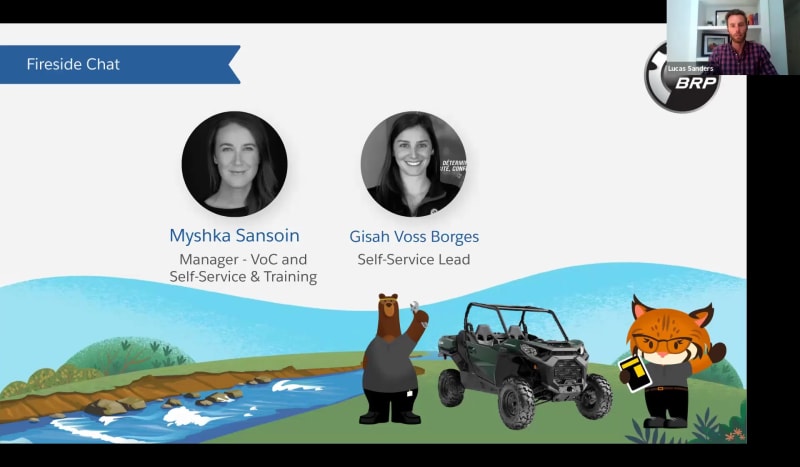
Hello, and welcome, everyone. Thank you so much for joining today wherever you are in the world. We're excited to present this collaborative session to you. I'm your host, Luke Sanders, with Coveo, and I'm here to introduce our participants and panelists and to take us through the housekeeping items. So if you go to the next slide, please. I know we're all Zoom pros now, but just to touch off on the the housekeeping portion, the session will be recorded. Link will be sent out afterwards, and will be available on demand for you to share as needed. We absolutely welcome your questions. They can be submitted via the q and a feature of Zoom webinar on the panel at the bottom. We'll save some time at the end to answer those questions. As with the structure, this first part of the session will be a discussion of best practice and benchmark results, led by JM from Salesforce and Esme from Kaveo. The second part will be a fireside chat, and we're very privileged to be joined by Mishka and Jisa from BRP. They'll share some of their lessons from their own self-service transformation with Kavehle and Salesforce, and I'll introduce them in more detail then. But for now, I'll pass the baton to JM. JM, the floor is yours. Perfect. Thanks a lot, Luke. And to kick things off today, folks, I just wanted to talk quickly and briefly around how Salesforce really allows their, their customers to find their answers faster. And, realistically, when we look at the world here within the manufacturing, whether it's b to b or b to c, what we've noticed across the board is really clients and, you know, some of our partners as well are trying to to get as many answers answered, if you will, themselves without having to call someone else or be on hold with someone, from your brand. And to do that, there's many tools at their disposal. And a few of them I wanted to highlight here very quickly is, you know, when we talk about certain types of portals, help centers, communities, forums that can be embedded within those communities as well, that all falls into place, and it's a great way for you to get the brand name out there. But what we've noticed the most is actually individuals having the ability to self serve themselves across different channels, which we'll be touching on as well here, within those different portals. And those are ways that, you know, you can actually surface the information to them as you start understanding the way that they navigate your different web presences. Different ways that we can accomplish this, obviously, we're looking at things like bots. There's the ability within Salesforce to create your own, Einstein bots, and those can be embedded whether it's, you know, via a traditional channel like a chat functionality. But bots can actually be live be be living across many different types of channels. They could be via SMS, via social interactions as well. These are all ways that you can leverage bots. Now the great benefit of Salesforce is when you create a bot via Salesforce, it can be used the exact the exact same bot can be used across all those different channels. When you combine some of those functionalities with the power that Caveo brings to the table as well, this is where we start seeing tremendous benefits from our clients. And as you'll see here within, the next few slides in the in the short demo as well, Kaveo brings another layer on top of Salesforce, which really allows for that self-service functionality. And why is it so important to self serve our customers? Well, realistically, you're always going to have that customer service team. Right? You're always gonna need individuals out there helping out for for your brand, but you want them focusing on really the important questions and the hard questions that can't be answered via other means. And so you're basically paying them for their expertise within that field. And the rest of the applications or the platforms that you're you're, you know, solutioning with really can handle those first types of questions or the initial types of questions as well, and that's why that self serve capabilities is so important for you as well. So finally, just touching on the fact that we've got a a channel menu built natively here within some of those portals, some of those communities. But, basically, it's the ability for the the end consumer or the end customer and whether that's one of your different partners or dealers, it's in the same vein of thoughts here. But basically having them giving them the choice to reach out to you on the channel of their choice. And so all of this tied together with the power of Kaveo on top of it really allows your customers to find answers fast on their own terms via the channel of their choice as well. And that's what we wanna talk a bit more about today as well. So right back to you, Luke, and and let's get going here. Fantastic. Thanks, Jam. So we've talked about what it is and and why it's important. Let's talk about a little bit how it affects the business. This is some the survey of our own customers using Coveo and Salesforce, revealing, as I think you'll see, that dealer portal experiences can and do have significant impact on businesses. So here, we've organized them under two loose headers, one of cost optimization, one of revenue growth. And I'll briefly touch on these points, as they're they're dynamic to what we see driving success through through these types of initiatives. So the first case deflection, we often think of answers as searching for a great fix. Right? But by taking a proactive approach, we can listen to signals throughout the support journey and proactively recommend solutions. We see customers using Kaveo and Salesforce in concert being extremely adept at deflecting the types of routine cases that customers actually prefer to self serve for, and it's a very low hanging fruit for calculating cost and ultimately justifying those technology investments internally. As far as enhanced CSAT, we're taking the ability to serve customers on their own terms and allowing them to find their own answers, finding answers in the way that they want to find them. Importantly, still allowing case submissions, but giving an overall frictionless experience with your brand that that we see bumping a few points in terms of CSAT. And finally, reducing dependency on key personnel or in the affirmative, increasing autonomy. I'm not gonna steal their thunder, but this is a big part of BRP's implementation and how, this was a key selling point for them with their their dealer network. And then on the other side, the revenue side, sales via channels. So as Jan mentioned, we see sales and service organizations becoming increasingly tied together, and Salesforce research indicates that the pandemic has only accelerated, these types of service experiences turning into commerce experiences. And all the while in self-service success, technology's ability to create these personalized experiences creates this kind of virtuous cycle of customers who want to find their own answers, and then they're satisfied when they do find their own answers, which further propagates the the positive experiences that dealers will have with your brand. And then finally, by improving dealers' knowledge, we're able to enhance the proficiency at selling and ultimately make your support organization a competitive advantage within the revenue metrics of your business. If you'll advance the slide, please. This is how Coveo works essentially on the inside. We've covered how Salesforce and Coveo together work, where you can expect the business results to be. From here, we're gonna take a few minutes to look at the technology that enables these results. So we'll divide the screen up into two pieces that that form the Caveo and Salesforce solution. On the left, content, on the right, context. Starting on the left, if you think of service, what good service is, the surprise and delighting of your stakeholders, its right answers at the right time. And what we see is that even for enterprises who are standardized on Salesforce, there's a great deal of content all scattered across the enterprise. This could be sales collateral, warranty data, spec sheets, structured or unstructured content. So all of this is on the left side that Conveyo is consuming along importantly with the associated permissions, making sure that only the right stakeholder groups see the content for them. Then part two is the context. So we're applying machine learning to all of the click stream data, all of the ways that this contact content is interacted with to see who is searching, what the problem is, and, ultimately, what the best solution is for them. And we're serving up all of these experiences, all of these personalized experiences in the Salesforce frame tailored for the individual wherever they're interacting with that Salesforce investment. So that's combining the content and the context, which overall lends relevance. So with that, I'll pass it to Esme to show you this in action. Amazing. Thanks, Luke. So hi, everyone. I'm Esmeen, a product manager here at Coveo, and I oversee most of our Salesforce use cases. So I just wanted to take a few minutes, to show you a live demo of an experience that's similar to, what BRP and the team are gonna discuss in just a few minutes. So, just before jumping into the demo, so Luke shared a good I think a good overview of Coveo and what our platform can do. Right? Being able to bring a whole bunch of content together and then making sure it's served in the right place at the right time. I just wanna put an emphasis on a couple of things here. So a lot of our customers offer several different channels to serve their customers as, Jam was mentioning earlier. So it could be a dealer portal, a dealer center, customer center, a chatbot, which we touched on. And Koyoka can contribute to making all of those different experiences relevant for the customer and also, bring them all together and make sure that we're collecting data on all of those interactions across those different channels and, gaining insight from that. So, in the in the diagram you see on on screen here is just to show, the different channels and how we can actually bring all the information we learn from our users' interactions, into, the the agents' experience when they, do pick up cases, and then are solving problems, and they can use that information to actually help, solve those problems more easily. So I will jump straight into the demo here. Alright. So this is a a Salesforce lightning community. This demo is focused around a a made up company. It's called Speedbit. And, so I just wanna point out here, first of all, the prominent search bar that you see at the top. So we really wanna encourage customers, you know, just search for what you're looking for. We're confident you'll find what you need. So notice as I start searching for something like how do I track my heart rate with a a sports watch, I'll notice searches, search suggestions popping up there. So those are powered by Coveo's machine learning. They've been learned by previous users searches and what's been successful for them. And, notice that even with a typo in in the word heart here, Koveos is, sensitive to that, and we're still able to suggest something that makes sense and that's relevant to what we're looking for. So if I search for something here, we land on a a Coveo search page. So I think the most important thing to to point out here is really that we we, get to a a unified list of results that are ranked by relevance. As we've mentioned a few times, we have content from several different repositories showing up here. So I have a video. I have a knowledge article, a blog article, a PDF document maybe from SharePoint, and it's all here in a in one list for the user. They don't need to know that those that content is actually managed by different teams. It's managed in different systems behind the scenes. They find everything here in in one place that's relevant to them. These recommended badges on the top results are to identify results that have been automatically boosted by Koveo's machine learning. Again, this is based on previous users' successful interactions with the with this content, after a search that's similar to our our current session right now. So, again, bringing the the relevant content at the right time. And, finally, it's we make it easy to navigate these results, by exposing any metadata you might have on your content here in facets to be able to go, you know, look for something more specific and make sure that our user finds the content that they need. It might also take the form of tabs to really segment content into categories of of, types of content that they might be looking for. So I just wanted to to point that out. Another, interesting use case that Coveo can power, and that and that ERP actually leverages as well is case deflection. So, you know, obviously, we want customers to self serve. However, there are problems that will end up, in a case. But, to the very last second, we're going to try to deflect that case and try to make sure that the content, a customer needs gets in front of them. So what you see here is a is a case form right on the left, and on the right is the Coveo case deflection component. And this component is actually listening to the fields here on the left and then surfacing content automatically, that is contextually relevant to the problem that's being described. So I'll start filling this out here, something like this. And notice it's it's updating dynamically. And even when I when I have a problem that I describe, you know, in a in a long text, Coveo's machine learning is able to identify what are the most important keywords here in this text and use that to surface, the best the best content to try to deflect this case. So, again, it's really easy to to report on how often a user lands here, clicks on a piece of content, and then never submits their case. We can consider that we've deflected a case that way, associate a dollar amount to that as we mentioned before. So so I think that's a pretty interesting use case. And then just to to wrap this up and, to give you an idea of how we we tie all of this together, we're here in the in the lightning service console. An agent is working on on this case that's been submitted. Coveo also provides an out of the box lightning component in our coveo insight panel, which is what you see here on the right. And similar to the case deflection component is going to listen to this case and expose the most relevant content to our agents as well to help them solve this case faster. We often see our customers, our customers customer support agents or technical support engineers using tons of different content to, to help solve their cases. So we bring it all here into one view for them. Of course, they have access to a clear search bar and all that. The the last thing I just wanted to to show you here is, we have, a feature in the insight panel called user actions. And when our our agent pops that open, they get a kind of a view into what happened before this case was submitted. Right? So our customer maybe interacted on, your your, partner portal, on your dealer community. In the last week, they interacted with the chatbot, and all of those are Coveo touch points where Coveo content was exposed, and we've gathered data about that. And we can tell our agent what this user has clicked on before, what are their search terms, what did they search for, and then a full timeline of all of of their activity under that. And I think in in the manufacturing space, this is particularly interesting because you could see, what specifically what part numbers or what versions of of, of your products they've been searching for that they maybe didn't mention in their case and can give some more insights to to those engineers to solve this faster and also have more a more personalized approach if they have to follow-up, with the customer. Just a little, last extension of that feature is, you know, we we tag any any content that the that a user has seen before right there in the insight panel. So we don't recommend the same content over and over, which can lead to poor, customer satisfaction scores. Alright. So, those those are the things I wanted to cover just so everyone had kind of a visual on on what we'll be talking about in just a couple minutes. So I and I'm I'll be there at the end to answer any questions if there are any. So I'll hand it back over to you to you, Lucas, to present, our panelists. Fantastic. Thank you, Esme. Alright. So now I have the privilege of introducing in in more depth, our customers who have been so kind to spend some time with us today. So Mishka has spent a decade managing the customer service operations of Quebec's national parks. She was then hired by BRP in twenty fourteen to lead the voice of the customer program. Fast forward to twenty twenty one, Misha still leads VSC operations and has expanded her scope in CX, now managing dealer self-service and training with the help for passionate team of nine CX professionals. Jisa is a Brazilian industrial engineer specialized in project management. She has over eight years experience in the automotive industry and joined BRP in twenty nineteen to lead self-service projects related to the b two b knowledge base and the b two b community. Mishka, Gisa, welcome. Thank you for joining us. Glad to be here. Thank you. Great. So I think a lot of us already probably know. But for the benefit of the rest of the audience, can you tell us who BRP is? Yeah. So BRP is a global leader in power sports vehicles, propulsion systems. We recently added boats to our product lines. We are for this might sound more familiar. We're the makers of the popular brands like Ski Doo, Can Am, Alumacraft. We were actually founded in nineteen thirty seven in Quebec, Canada. This is where we are headquartered. We were founded by Gilles Monbardi. He's the inventor of the the first snowmobile. So we have a really great history behind the company. And now in two thousand twenty one, we have over twelve thousand employees all over the world. We partner with over four thousand dealers and distributors in a hundred and thirty countries. So we've grown quite a bit since nineteen thirty seven. That's great, Mishka. Thanks. I know we're gonna be talking about the relationship with dealers as we get through this discussion here. And can you explain to us the importance for your dealers of what knowledge means to them and why you got into this conversation of, you know, how can we allow more knowledge for the for the different dealers that we'll be talking about? Yeah. Sure. So, I've touched this already a bit in the introduction of BRP, but we have many brands. We have hundreds of products. So it's impossible for dealers to know when we obtain all the information. It's even impossible for for us. So our duty as a manufacturer is really to provide them the information they need to give the best experience to our end customers. So, we have, of course, a whole department that's there to support the dealers. We have a contact center, but we also have a self-service portal. So, very similar to what Esme just presented, we have what we call the knowledge center, which is kind of like, I guess, our our BRP Google. We have the search field, and dealers can search what they want with, keywords, symptoms, whatever the question they're answering for, and then they will have access to the different content that we have, like repair procedures, warranty bulletin, blog posts. So, of course, I I don't think I I need to touch on the fact that self-service is important. We just, Luca and Jean Michel just gave us all sorts of reasons, but I'd like to add that in addition to call deflection and and all of that, it's what the dealers or what any customers want. Just think of you as as users. We wanna find the answers ourselves. We don't need to call a manufacturer or company. So it's it's the same thing that that dealer's experience and and what they want. So that's what we offer with, to them with the knowledge center. Makes total sense. And and to your point, like, it it's exactly what they need. It's what they want, and it helps both parties out, both the dealers, and it also helps BRP out, having the best solution in place possible. So that's great. So we know in in two thousand sixteen, you made that decision to implement Coveo with Salesforce. So that was a project in itself, obviously. Can you explain to us what that project was? Yep. So at that time, we we did already have a a knowledge base. To be very honest, it it just wasn't performing to the standards that that we had. It was mostly the relevancy and the ranking of of the search results that that weren't adequate. So the impact on that was that dealers had to call us for and then I I I smiled when Luke was saying this earlier, but they had to call us for very simple quick questions, which they should find the answers themselves. So not only was that wasting time for them, but it was adding delays for the end customers because their questions are always related to something they need to deliver to to, the the customers. So that's when we decided that we needed to revamp, and we, decided to work with Covio, to implement really a powerful, a best in class, efficient search engine. We had three objectives with the project. One, we wanted to increase self-service adoption. Two, we wanted to increase dealer autonomy. And three, yes, we did also want to lower support cost because, of course, it's it's much more cost efficient to write one content that will answer ten thousand questions than pay one agent that can only answer one question at a time. So, we decided to start the project The it was in two phases, and we really had two focuses. One was the user experience, and the second was the search performance. So everything in the project had to do with one or the two, topics. That's great. And and I think you covered it in the response. So the importance for BRP around all of this was it was many folds, but, obviously, again, helping the dealers out, but lowering your cost, making it everything more efficient, getting them the answers as fast as possible, all of that in globed into one really made for a super powerful solution in the end there. Yeah. And I can add also, maybe I didn't mention this, but the availability. So self-service is available twenty four seven, and it's also available in their languages. So when you're dealing with humans, they need to sleep. There are hours for the call center. So so self-service can also increase the availability of the support that that you can deliver. That's true. That's great. That's great. I'd like to ask, Jisha this question. So Mishka talked a little bit about the, the objectives, right, and and the the the big top level initiatives. But what were some of the unique requirements that that you faced in implementing this project, and how did you how did you solve for that? So I think the first one I can mention is what Mishka just said is about the multilingual aspect. So today, BRP supports twelve official languages. And, when we decided to implement the, the solution with Covio, we decided to create a glossary with more or less five thousand words allowing a multilingual search and also the equivalent of terms. So we have to keep in mind that our dealers were going, in our platform and looking for different documents in their languages. So, since the beginning, we worked with this glossary, and, we were able to provide them this, multilingual search. So they are able they were able to look for the documents on their languages, and then Coville will show up the results considering all the languages. I think, let me think about the second thing, maybe, the metadata quality. So when we first started, the tests from our side, we saw that the results that we had in, in the result page, they were not as good as we what we were expecting, And then it was due to our metadata. So we decided to take a look internally and to reorganize the the documents that we had. So, after doing this, we continued to make the test, and we saw that the platform was performing very well. So it was really not a problem of the platform. It was really a problem of our metadata quality. So we work it on this, this issue. And, also, I think the third point I can mention here is the technology itself. So as our Salesforce is super customized, also, Coville needed to make a bit of customization from their side to be able to personalize and to work with all the customizations we had with, Salesforce. Nice. That's, super powerful in in terms of a solution. So well, obviously, you had the benefit of seeing things beforehand and then seeing things after this this new implementation, this new project. So it's been running for a few years now. What what are you hearing from some of those dealers that maybe voice their opinions a bit more than others? So what do you hear from them? But, also, what impact did that have from the BRP standpoint as well making that that transition? Well, in the last couple of years, we didn't hear that much from the dealers, so I think it's probably a good thing because their behavior speaks for themselves. So we have many support channels, and the knowledge center is the most used tool. And, year over year, we keep increasing the number of activity, meaning searches, clicks on the documents, and also a case is deflected. So this is showing us that we are in the in a good way, and, we have a great support tool. And, also, as Mishka said, we are giving the dealers autonomy to answer their questions twenty four seven, so they don't need to wait until our support teams are there, and they don't need to call us and open the cases for us with us. I'm sure that, that the agents who are getting more sleep, thank you for that. Sure. And now it's oh, this is great. And so to to kind of bring it back around, you know, you guys have obviously been very successful in this implementation and, and in this initiative. Would you mind sharing some recommendations or advice to people who are considering this type of solution? Yeah. I get well, Giza just, mentioned this, but, I guess my first recommendation would be around customization. So, like like, they we hear so often choose the vanilla option. Coveo has done their due diligence. I they know what works. They know what their customers need. Just pick that option because anything that you will customize will not only complexify the implementation or the deployment of the project itself, but any future updates or improvements for sure will be more, complex because you have a customized environment. So that's for sure a a learning that that we have and and that we live with. But, if we were to go back, maybe that was would be one thing that would be different. The second thing is one thing that we did do, and I think that that was great, is to really focus on the user experience. So that ensures that the tool works. It ensures that it will be used, and it's basically the only way to meet your objectives. So I was talking earlier about, you know, increasing the autonomy and the self-service adoption. If your user experience isn't good, that just won't happen. So I think it's as important as the technology performs. Last, I would say, and it's not directly related to to the the search engine or to Koyo, but it's it's very close. It's to not forget about content. And I I think that a lot of projects that we do are very focused on the technology, and it's, of course, super important. It's the enabler. But if you don't have good content in this case, but you have great search, you're just not gonna find anything. So even if your search tool is really performing, if you don't have any good content behind it, there's just no value. So I think projects like this need to have really two different phases or they need to be parallel. One is on the technology, but two, you need to step up your your content game and and close all the gaps that you have. So I think that that would be my probably my top recommendation. That's great. Thank you. Well, very much appreciate your wisdom and your willingness to share your experience with us. Thank you. Open it up now for a few minutes for q and a. So, again, if you have any questions, you can submit via the question and answer bar at the bottom of your Zoom webinar panel there. So one we have here, I think I'll direct to Esme. Can the solution work with content that we have in homegrown storage including on premise? Yes. Great question. So I'd say, typically, there's nothing can't index. There are some types of content that may be a bit more of a challenge than others, but, so I would say, typically, yes. And those are you we said a homegrown systems. Yes. We have experience indexing, content from homegrown systems or on premise systems. So there's really nothing out of our reach. I suppose there are a few exceptions to that, but, I'd say that the answer is is globally yes. And, just to come back on what, Mishka was was mentioning about having, great content, I think is a really good point. I thought I might add what's interesting on on being able to report when you report on how users interact with your content and what they're searching for. When you have that reporting, it makes it really easy to, to help identify where the gaps are. So if you're doing those both those phases in parallel, you can use one to help to help the other to identify, oh, okay. We've got lots of people searching for this and and not being successful. So that can be an area of focus. I just something that came to mind when you were talking about that, Mishka. So quite interesting. I don't know if there are any other questions. Yeah. We've got we've got one more. It says, trying to fully understand conveyor's role in the overall solution. Is it primarily the ability to intelligently index content? If so, how much human interaction is required to do that? Is it also the ability to, quote, parse the search terms? Okay. Should I take that one? Yeah. So so yeah. I mean, I think what we presented today was kind of an overall overall view of what Coveo can do. Yes. A big part of what, enables all of the technology that we offer at Coveo is being able to index content. That's the very first step, and then everything kind of comes on top of that. The reporting on how that content gets interacted with and how you set up search and and how you set up rules on how, different keywords should be interpreted. Earlier, I think is Jiza was was mentioning, you know, terms across different languages. We can set up rules to make sure that those are interpreted correctly and the right content shows up. But the base of it is being able to index all that content. We have a lot of several out of the box connectors to do that. And then anything that we haven't seen before, we typically are able to find, a solution. We have a a generic rest, rest connector, which which typically covers everything we haven't seen before. And then the second part of the question was about, parsing, at least, parsing search terms. Search terms. Yeah. Correct. Right. So, has been around for, over fifteen years. It's so we've really optimized our search engine to surface relevant content based on on the keywords that that we see. Part of that is, just, optimizing search for, you know, how how how often keywords show up in content, how close they are together. And those are all parameters that we've tweaked over the years to to be super powerful. And then we also have a layer of machine learning on top of that to learn from, you know, specifically per organization, per customer, how do users interact with content, and what are they looking for, in particular situations and contexts. So specifically for parsing, search terms, I'm hopefully sort of answering, the question or providing some some some, some context around it. But, you know, typically, a search term is is cut up into keywords or or or actual terms, and we'll be looking for that in the in the content. And then for for more advanced use cases, there's the possibility to use advanced syntax to be able to, you know, put certain terms together or, you know, that is that is a a feature that we offer. That depends on the type of user that we're addressing. That's right. Great. I think that addresses the question. So next question, and I think the last one we'll have time for, question for Mishka and Jisa. What are the next steps in your journey to help your dealers? You probably won't be surprised by my answer, but it's content. So, we and and, Esme, you touched it, right on the the the dot. But, with the analytics, we're seeing that we have a gap in our content. BRP is growing, incredibly fast, which is great news, but we need to, be able to follow. And right now, we do have a content gap. So we not only wanna create more content, but we also wanna maybe change the types of content, more video, more how to. So we are really at the beginning of a a new content strategy. So that, will I'm I'm sure bring much, much, value to our wholesale service strategy. Fantastic. Alright. Well, I think with that, we'll wrap. I just wanna thank our friends from BRP again for joining us, and thank you all for spending some time of your morning or afternoon with us. Appreciate the time and attention, and be well. Thanks, everyone. Thank you. Thank you.

Best Practices to Transform your Self-Service Experiences
Avoid the mistakes that make your self-service experience frustrating and inefficient
Salesforce Einstein bots can live in different channels (SMS or social).
When you combine these functionalities with Coveo, you start to see how Coveo brings another layer on top of Salesforce that allows for self-service functionality.
As manufacturers with reams of complex content in internal systems — it can sometimes be challenging to get the right answers, assets, and information when you need them.
You want your sales team focusing on hard questions that can’t be answered via other means. You want to pay them for their expertise in that field. Get initial questions answered easily through self-serve.
Bombardier, a global manufacturer of recreational products, was able to transform its global dealership self-service network to support over 4200 dealers and achieve new levels of customer efficiency and cost control.
The company’s self-service system was getting overburdened by the increasing number of dealerships, as well as by the growing complexity of their business processes.
They needed a robust, flexible, and scalable solution to allow them to process customer requests 24 hours a day, 7 days a week. The new system needed to be able to cope with peaks during busy periods.
Watch how Salesforce and Coveo work better together to enhance your portal experience driving more self-service and autonomy for stakeholders.
Let AI do the digging for you.


Make every experience relevant with Coveo