Hello, everyone, and welcome to today's webinar, Zoom's roadmap to scalable self-service with AI and knowledge, brought to you by TSIA and sponsored by Kaveo. My name is Vanessa Lucero, and I'll be your moderator for today. Before we get started, I'd like to go over a few housekeeping items. Today's webinar will be recorded, and a link to the recording of today's presentation will be sent to you via email. Audio will be delivered via streaming. All attendees will be in a listen only mode, and your webinar controls, including volume, are found in the toolbar at the bottom of the webinar player. We encourage your comments and questions. If you think of a question for the presenters at any point, please submit through the ask a question box on the top left corner of the webinar player, and we'll open it up for a verbal q and a at the end of today's session. Lastly, feel free to enlarge the slides to full screen at any time by selecting one of the full screen button options, which are located in the top right corner of the slide player. I would now like to introduce our presenters. John Ragsdale, distinguished researcher, vice president, technology ecosystems for TSIA, Gavin McLoyd, lead product marketing manager for Agentic AI and knowledge for Kaveo, Jeff Harling, head of digital support for Zoom, and Julie Hamlin, lead SEO analyst on the digital support team, also with Zoom. As with all of our TSIA webinars, we do have a lot of exciting content to cover in the next forty five minutes, so let's jump right in and get started. John, over to you. Well, thank you, Vanessa. Hello, everyone, and welcome to today's webinar. One of the most common requests that we get from our members is stop talking about the potential of AI and show us companies that are doing cool things with it. So you picked a great day to join because the Zoom story is really impressive, and I'm really happy that we've got members from the Zoom team here to share it with us today. So a quick look at our agenda. I'm gonna go over a a few industry data points just to kinda set the stage, then I'm gonna turn it over to Gavin, Jeff, and Julie to cover, the Zoom case study. We've hopefully, we'll have a few minutes for audience q and a, and we all have lots of opinions. So, we'll give you some final takeaways at the end. So I recently had a wonderful opportunity to speak at Caveo's, Relevance three sixty Agentic. And my discussion was about how companies who are getting value from AI and Agentic investments are unique, and what is really, the best practices that are encouraging companies to get, faster time to value. And Val Golovski, who is the vice president of research, for TSIA's support services practice, recently published, the TSIA knowledge maturity model, with updates including AI and Agentic. And he did a lot of survey work, to prepare for that. And what he found is a lot of companies that are struggling to get the desired results from technology investments are getting a little sloppy on some of the old best practices that have been around forever for knowledge management. So I wanted to touch on four of those quickly this morning. The first is linking knowledge articles to cases, which in, the dark ages when AI ran support was always a standard practice, currently, only eighteen percent of of our members are requiring agents to link a a closed support case to one or more knowledge articles. And this is a real lost opportunity because it is such a good training vehicle for GenAI to understand the relationship between certain problems that are listed in cases and, ultimately, the content that is resolving them. Another one is dedicated knowledge authors, and I know that there's a philosophy that everyone's responsible for for knowledge, and I agree. However, we are saying that, the percentage of companies that have dedicated knowledge authors, only nineteen percent, tend to have much better metrics around self-service deflection, first contact resolution. And I think we all know in our hearts that not every agent is the ultimate author, and having a team of authors who are spending full time or part time dedicated to, creating content, editing content, publishing content really does push up the quality of your knowledge. The third is having a Kilometers program manager. And luckily, that is something that the majority of companies have. But we're finding that, again, having that Kilometers program manager means that your content is being published much quicker. So when a new problem occurs and maybe the the call comes in from five different companies, you're getting it published very quickly so that, you don't have support techs going off and researching that problem over and over again when someone has already figured it out. And the final one, which I think is the single most important thing, is cleaning up your content. And this data shows that twenty two percent of companies say they've never cleaned up their content, eighteen percent more than a year, twelve percent greater than eighteen months. And this is one of the biggest challenges, particularly with Agentic, because it's a garbage in, garbage out problem. And if you're training your generative AI technology on old, duplicate, outdated content, it's very unlikely that you're going to get results as quickly as you expect. So if you haven't cleaned up your content for a long time, I would prioritize the content that is most important, really focus on that, and then start that as really the entry point for, training your large language model. And I promise you, you will get much better results, from your AI investments, in a a much more timely manner. So enough for me. I wanna turn things over to our first guest speaker to get today. Gavin McLeod is the lead product marketing manager for Coveo. Gavin, take it away. Thanks, John. And and John just hit on a really critical point. If you don't have the right knowledge foundation, AI won't deliver the results you're expecting. And similarly, if you don't have a way to search and retrieve that knowledge, AI or specifically generative AI risks hallucinating or generating answers that are irrelevant. We see this all the time. Companies wanna move fast with AI, but they're working with complex, unstructured, and structured data combinations. It's outdated, full of duplicates, spread across a variety of systems and repositories. And unless that's cleaned up first, unified and index, everything can be normalized, AI can amplify the problem. The companies that succeed often take a structured approach and focus on getting that foundation in place first. Think about this like a crawl, walk, run framework for AI adoption. First, we start on a small set of content and data so we can deploy fast. This allows a focus on strong knowledge management while establishing a unified index that will allow you to scale search and retrieve quickly. We always recommend companies start by indexing only the most relevant content, that high value information that serves the bulk of the volume of what customers actually need. And then next, you expand smart with analytics. This is where AI and machine learning can come into play. Once your knowledge is in order and properly indexed, you can start applying machine learning to process user behavior signals, profile data, query inputs to predict their intent and therefore improve search relevance. Over time, AI gets better and better at surfacing the right content at the right time, reducing friction and increasing self-service success. And then through this iteration, we learn too. Analytics helps you or knowledge managers to continuously refine the content strategy, filling gaps that will have the most impact on user experience and business results. And then with this foundation in place, you can scale to Gen AI with confidence, extend beyond AI powered search into generative experiences to deliver real time conversational answers, personalization, and proactive suggestions. We leverage the same clean tested index and query pipelines to retrieve the most relevant information to pass to the large language models so they can generate accurate AI responses to user questions. This reduces case submissions even further, improves customer satisfaction, and drives greater operational efficiency. But don't just take our word for it. This isn't theoretical. This is exactly what Zoom did. It built a road map starting with solving their most immediate challenges and then evolve from there. So, Jeff, I know a lot of companies in the audience are still figuring out where to start. Can you take us back to Zoom's journey, the challenges that you had to overcome, and how you got to where you are today? Thanks, Gavin. Well, as most of us, probably know, like, Band Aids and Kleenex, Zoom has become synonymous with the the new world order around working from home and, hybrid workspaces. And and during COVID in twenty twenty, you know, in the eye of the storm, we we were we were launched from from a very small company into young adulthood, very quickly and rapidly with, with with, users coming to us in droves, in the early years of twenty twenty and us not being prepared with a a solid self-service road map or strategy or even one that was considerate to AI. In in twenty twenty, when when all of this started, we were just looking at chatbots for the first time. We didn't have a solid knowledge management practice. You know, as John said, this, of course, was key for us. When I came in and joined the team, I was I was I was one of one, in the self-service space, and had to build a team, a structure, a road map, a plan going forward that was not only one that would solve Zoom's immediate problems and the needs around, AI digital support and self-service for our customers, which they were demanding. We were not able to answer phones, quickly enough. But it was also it also had to be considerate for where customer support and service was going. And that, of course, is is is the AI space. We knew that, I think, for for, you know, half a decade or more. You know, really, the the industry's been predicting that AI was going to come in and and, really, you know, complement the customer service experience, to provide better, more more rapid response to customers across the space. And especially that was true for Zoom. Right? We had a we have a a very, you know, a a platform that is that is, quite technical in nature. But at the same time, we have to be able to speak to all audiences from from young children that are just, you know, attending second, third grade classes over Zoom to, you know, senior citizens who were just trying to, you know, connect with their families. So we started with a basic content practice. We we, you know, we began to AI of build those, functional building blocks around that Zoom self-service and digital support strategy very early on, creating a collaboration space with the Zoom community, you know, understanding how could people get better, you know, and and faster response and find those solutions better with a with a site search and a search query strategy and SEO strategy, if you will, which Julie's gonna talk more about. And, John, of course, again, AI, knowledge centered service, such a critical component to our, self-service delivery model in the future of digital support. When we think about contextual reasoning and and learning and and, of the LLMs and so forth, all of those concepts that we take for granted now, you know, not only having a good content strategy, but also ensuring that agents were validating with every interaction, every engagement we had with customers that knowledge centered service that KCS, methodology was in place, and we were attaching cases. We were we were suggesting new knowledge articles. We were closing knowledge gaps so that we could build a better, content library because, again, AI was looming on the AI. When we first implemented KCS, ChatGPT was just launching onto the scenes, you know, in late twenty twenty two, early twenty twenty three. So, you know, most folks weren't even, you know, familiar with the AI vernacular that is so commonplace today. And then, of course, we we looked at, chatbot capabilities that were AI powered. Zoom happens to have a Zoom virtual agent, which is a an AI based, chatbot, which we implemented with great success and really setting the stage for how we are going to later adapt and move into the Agentic AI, opportunities as well. Automation first moving into AI and really driving autonomous decisions, that was next. So Julie's gonna talk a little bit about how we took one path with Coveo. Yeah. Thank you, Jeff. Like Jeff mentioned, you know, it is important to have a very good foundation to start off with. But we found that users still were struggling to find the right information. Part of the reason for that is we had a very siloed search experience previously. So we have lots of different subdomains at Zoom, and each one was kind of operating independently of each other. They had different goals and strategies and even were in entirely different platforms from each other. So the user, because of that, was having to jump from site to site, to find what they needed and and really risked missing out on key information altogether that could potentially solve their issue. On top of that, with all of these different sites, we had lots of different types of content as well. We had support articles, blog posts, community forums, videos. And so users were kind of getting lost in this maze of information that was not really connected in any way. So one of our initial challenges was just finding kind of a scalable and flexible solution. We knew we really wanted to bring all of this content together in one place without forcing everyone into one singular platform, just given kind of Zoom scale and the amount of diverse teams we have. That wasn't really realistic. So we needed something a solution that could be independent of that, that could index content from various sources and really standardize it into one singular format. Coupled with that as well, we also needed to be able to manage the content easily from an admin standpoint. We were doing frequent product launches and feature launches, and so we needed to be able to very dynamically and quickly adapt to changing business needs as well as user feedback. And the solution for us to our kind of global search problem came, through Caveo. And so they really helped us unify that search across the entire Zoom ecosystem, giving us really consistent forms of indexing, standardized content, and just greater ability to really surface the right information at the right time for people. So going from an experience that was previously very disjointed and disruptive to something that was a lot more cohesive and accessible for our users. And this all AI of was driving us to a very digitally optimized search experience. So we wanted to really make sure we were creating a search, experience that worked for users and not against them. And we did that through, primarily data driven insights, which Kaveo was able to provide us a lot of, really just to help continue to refine that search and content strategy. So we're definitely gonna dive into some of those specific strategies for success that we employed. Thanks so much, Julie. Julie just shared how Zoom was able to scale and unify search across the organization. It's such an essential step. And we do wanna leave you with some some best practices and strategies for how you can, follow in their footsteps. One of the mistakes other AI sometimes make when implementing search, retrieval, and AI for self-service is trying to apply it across everything all at once. We've seen that lead to long delays and added complexity. Instead, we've noticed companies have much greater success and faster results when they follow the eighty twenty rule. They start with the twenty percent of content that answers eighty percent of user inquiries and thus has eighty percent of the impact on your business. This ensures that AI efforts deliver immediate value with fewer risks AI allowing teams to scale intelligently over time. Think about the content you already know is well curated and effective, and this is typically where you wanna start. We've seen this approach dramatically impact time to value. For example, companies that focus on this core twenty percent can deploy in weeks AI those trying to clean up, restructure, and index everything at once takes six to nine months before launching a single use case. So once search has stood up and you have AI and machine learning live, the key is to continue to iterate using the analytics to identify gaps and refine the long tail of your use case over time. And Zoom followed this almost exact model starting with making their search experience great in order to enhance self-service before scaling to generative answering. So, Julie, maybe you can share with us, how your team approached this role. Yeah. Absolutely. So as Gavin mentioned, you know, we we had Coveo as a tool as well to help us kind of bridge this gap. And so we were able to get a lot smarter with our strategies because we had more tools available to us. I think there's maybe this assumption that AI can fix search, but without a really solid foundation, you run the risk of AI potentially just amplifying issues that already exist. So, before we even kind of considered any sort of AI adoption, we really knew we had to get the basics right. And so part of that was understanding search behavior, optimizing existing content, and really identifying and closing knowledge gaps. And AI coupled with that as well, we knew we needed really good insights in terms of what our users were searching for and whether they were actually finding the right answers. So some of the specific strategies we really looked towards, initially was, first off, just really deep dive into the usage analytics that were available. We looked daily, weekly, monthly just to try and understand, okay, what were our top queries? What were our top performing documents? And this allowed us to really evaluate whether, the most popular queries actually had relevant and helpful answers available to them. Like Gavin said, you don't have to focus on everything. We we did a really, targeted effort of volume, focusing on things with the most case to get volume, search volume, community post volume, and using all of that to kind of understand what are people talking about, what do we have, and is it working. I think another point to that as well is just making sure that there isn't a disconnect between the language that users are actually utilizing in search and maybe the terminology or industry kind of language that you might be using, making sure there's no disconnect there, and that the language you're using in your content is the language that users are actually looking for. And that also AI of falls in line with content gaps as well. That was a really big effort that we undertook, really cross functionally as an organization. And KaVeyo's insights were really, like, a focal point for us and highlighted areas where users were searching, but really found little to no helpful content. And so using that as kind of a guiding light, we were able to create a team together and start to pull together from all of our channels. What are we seeing in case data? What are we seeing in community post social social post, KCS methodologies? And really all come together to understand, again, what content was already available, what was missing. Maybe we were addressing it in one channel, but not another channel. So really AI a process, collectively, and then really just make sure that our content was complete and accurate off of that. And with that, we saw much better alignment between what users we're looking for and the content that we were providing them. And because of that, we saw really good success. We had higher click through rates, less content gaps, and just overall better self-service. I would just say overall, it's important to remember that a lot of these AI models, they're gonna rely on your own content to generate answers. So you really need to make sure you have the bottom of this pyramid, the content quality and search relevancy in place, really, to set yourself up for success. And once you have kind of that baseline, you can then move into AI adoption as we've talked about. Really, once we knew we had the basics down and we had a really good understanding of what our customers wanted and what they responded well to, it set us up in a really good place to then focus more on using AI methodologies. But we wanted to make sure it was in a way that wasn't confusing or jarring for users. So we ended up going with a very AI of controlled rollout to start. We limited the initial scope to just our knowledge based articles since we had done a lot of work optimizing them, so we knew that they were accurate and complete. We also did a lot of testing ourselves and with the Coveo team, and ended up AB testing as well just to really validate that the AI enhanced search, performed against the traditional search. And we did see overwhelmingly positive results from that, reductions in case volumes and, self-service success rates. So, overall, we're really looking towards working alongside Caveo to kinda continue to validate AI effectiveness and explore other areas. We're starting to look at adding it to our case deflection experience, for example, and just provide faster and more personalized support for users as well as continuing to have very advanced reporting mechanisms just so we can make sure that we're measuring that long term impact. Well, speaking of measuring impact, nothing makes us happier at Covalency. Our customers succeed in achieving their goals, with our solutions. It's important to us, and we take it very seriously. Success doesn't end after implementation. In fact, it never stops. It's about realizing and being able to report that real business impacts, the value of your investments can be clearly seen and communicated to stakeholders. That's why we build teams for this, not only to deploy successful and securely, but to ensure that ongoing success from, you know, the account managers, the customer success team, our solution engineers, technical account managers, the business value practice, people who work alongside, our customers just like Zoom to define key success metrics upfront based on industry best practices and their own organizational goals, establishing a measurement strategy to track that solution's impact over AI, and support continuous optimization to AI relevance, enhance the end user satisfaction with the solution, and ensure customers are maximizing the return on their investment. And Jeff and Julie have both I I believe you both had a lot of experience working with our, success and implementation teams. So I just wanna throw a question out to both of you. Julie, from an implementation perspective, when you evolved from that AI powered search or machine learning powered search rather to including generative AI and generative answering, how did working with the Coveo team impact the deployment? Yeah. It was a great experience overall. I mean, I think first off, there's a lot of just industry knowledge with Coveo that we were able to build from. You know, we're just one use case, and you guys have seen a lot of different use cases for this. So that was really helpful, just having kind of best practices to go off of. In terms of actual implementation itself, very easy within the platform. We had a lot of support. And then, again, I mean, just we really knew we needed to prove the value of it. Right? I mean, AI is a very much a buzzword, but at the end of the day, we need to see results. And so that was something that the Coveo team also partnered very closely with us. And, also, again, why we rolled it out in terms of an AB test just so we could really showcase that it was making measurable impacts in terms of our business outcomes. That's excellent. And then, Jeff, from from your perspective, backing up a little, how has the Calleo team helped you and and your team achieve its digital support objectives, And what's next for you guys? Yeah. As, as as you all knew, coming into this that that we were hungry. We're hungry to do a lot more than what we were probably initially asking, and and, and we still remain hungry in this space. So, you know, we, you know, we were already analyzing our data, analyzing strategies, adjusting for those strategies, knowing that AI was looming again on the horizon for us. We really wanted to move into this, you know, autonomous space, Agentic AI, and so forth. Like, Julie said, not buzzwords for us. Really, we we looked at them as as, you know, codified, plans of attack, for for Zoom going forward. So so we had, you know, AI would say, you know, accomplished much of that with the CRGA capability that Coveo brought us. We're now in the generative AI search when you come in your query looking for, you know, as sixty to seventy percent of our users do begin with a query. They were getting the generative response. We knew that the content was proving itself. And in some cases, if it wasn't, we were evaluating knowledge gaps and so forth. An agent self-service side, you know, leveraging the the, contextual reasoning and so forth around how they were responding to our customers either engaging with existing knowledge or driving new content into our knowledge base. All of this, again, you know, AI of feeds the beast. This learning, you know, that we were doing around AI was just building up to something much more. And and as you guys have probably seen working alongside us, you know, we're we're already you know, we're leveraging generative AI for case deflection. We have that capability in place today where where, Agentic, when they do when stuff does fall through self-service, we can't quite answer the question. We still have the the Agentic, again, of course, you know, leveraging KCS methodology as well alongside those AI capabilities to proactively determine the best path for the customer solution, and then learning from those. So then where do we go next? Right? Driving content recommendations. Yes. That's happening. But are we are we are we tuning AI enough? Are we learning enough based on, you know, our all what we've already solved for the customer? I think we still have more work there. We're continuing to move towards this autonomous space. So how does that look for us? Right? First, we have to build these dynamic experiences to understand the user, whether it's on the AI, it's it's when they're in the chatbot, or when they're querying us, you know, using the Coveo search tool. We have to begin we have to get better at at really understanding their relationship with us, as it exists past queries, things they've looked for before, and anticipate what it is that they might need, right, to better predict what outcomes, that they they are in need of. So I I think that that's that's kind of the phase that we're at now. But now, you know, next up for us as we're moving into this, we're starting to implant some proactive tooling, some some, capabilities AI, I mentioned the chatbot and the AI driven space that complements this CRGA capability in the search for us. You know, we're we can leverage now the full expertise of our Zoom workforce, of all of our prior responses, all of our content, those many different sources that Julie mentioned. We can anticipate. And I think, statistically, we're more accurate in giving outcomes to our customers. And that we're already seeing we're proving that out. Case deflection numbers are moving in the right direction. Handle times are going down across the board. The metrics are moving in the right place, the first call resolution. All of that points to this this suggestive, space that we have, this ecosystem of of AI driven, materials to the to the end user, to the customer, to our agents, and even to our partners. It we're we're narrowing the focus. We're getting them to solutions faster, better, and we're cultivating this glorious content life cycle of understanding what our customers need, what they're coming in for. We're documenting those experiences. We're we're teaching the LLM to do better. And then and then, of course, you know, creating this more, a I wanna say AI Agentic ready space for for those customers in the next phase. So now we're automating the simple task. We're automating the medium to hard difficulty tasks. Next up for us with all of the content, with platforms in place, with CRGA and so forth, we we really the next step for us is being able to make autonomous decisions on behalf of our customers. So that AI think is is where, you know, we we are gonna count on, the platforms, the capabilities, the platforms to empower us. And I think one great example of that is is is Coveo and what they're doing for us as well. Gavin, would you agree? Yeah. I think I think our our visions are are really well aligned on where we see AI supporting, supporting self-service, supporting the service industry as a whole. I think, you know, I think it's exactly what at Coveo we're really trying to do is is help the best in class service organizations just like Zoom, to do that. Because modern self-service isn't just about answering that single question. Right? It's about creating this integrated, intelligent, and relevant experience at every touch point. And our approach to AI powered self-service is is about building off that foundation of incredible search to your point, bringing it together and leveraging it for driving incredible relevance across a variety of use cases AI recommendations, dynamic navigation, conversational AI, personalization, all in one unified experience. And to your point also, Jeff, also embeddable in things like your products and chat bots and agentic AI systems where we can help make those decisions for customers and and take action, on their behalf. And, you know, it's because AI Agentic, at the end of the day, they need good search just as much as customers and employees do, maybe even more so. Right? So we try to imagine this world where every customer interaction is driven by real time relevance, where the the system understands intent, can proactively suggest next steps, seamlessly blend knowledge, automation, and agent assisted support. You know, we may start with providing a relevant answer to a single query, but that leads to better self-service. And then from there, the ability to build an experience that continuously learns, adapts, improves, guiding customers to resolution faster, reducing friction, boosting loyalty. And for service professionals, this is huge. Right? And and the best part, I think, is everyone on this call, you can get there in a structured, scalable way just like Zoom did. So with that, I think, it's time for some q and a. I'm gonna pass things over to Vanessa and, see what's on the minds of our audience today. Great. Thank you all so much. And just as a reminder that if you would like to submit a question for any of our panel members, please enter in the ask a question box in the top left corner of the webinar player, and we're going to get through as many questions as time allows. With that, I'm actually gonna jump right in because we already have quite a few questions in queue. And the first one says is from Ashley. And they say, how do you ensure the accuracy and reliability of the AI generated answers, and what safeguards are in place to prevent misinformation or irrelevant responses? Yeah. I can start off with this one. I think, you know, some of the things we've talked about, right, making sure that your content is accurate itself. Right? Making sure you don't duplicate content that has conflicting information. So really focusing on that content quality. Something that we did as well at Zoom and and that Kyvayo allowed, which was great, was really limiting the sources of content that it was pulling from. So we made sure originally to only have knowledge based articles, and that was our only source pulling into our kind of generative AI experience. And so because that was a lot of the content that we did do a lot of cleanup work on, we knew that it was complete and accurate, and it was gonna give, you know, majority good responses to our users. So just also making sure that the sources that you're pulling from, you trust those sources, right, as well. I might add to that too a little bit. Right? Because I think large language models typically are unless you're training your own custom model, they're typically trained on a broad spectrum of information, which gives them incredibly powerful language capabilities, but also means they don't inherently understand your organization specific context. This is why grounding generative AI and trusted relevant content is so critical. One of the things we do at Coveo is in to ensure accuracy is with a process called retrieval augmented generation or RAG, which is a bit of technical it's a bit of a technical framework. But in essence, what happens is it's first retrieving that most relevant real time knowledge from your enterprise sources before generating a response. This means that the Gen AI isn't making assumptions. It's working from the most up to date verified content. And when we do that retrieval, we're also considering the user's permission, the context of where they're doing their search, any profile data that we may have such as geography, language, registered products on file, etcetera. So beyond that, we're also looking at, like, applying and we talked a little bit about this during the presentation, but AI powered relevance tuning so that the results of that retrieval are getting better over AI. Adding things like inline citations so users can always trace the answers back to their source. And then really this back to Julie's comments, I think, is a really important point is the adaptive learning and content gap analysis. So you could constantly refine the sources of those AI outputs, to ensure that they're not only that you have the the knowledge there, but it's it's also written in a way that's easy for the LLM to understand and put a smart answer. Okay. Our next question comes from Jared, and they ask, how did Zoom prioritize which areas of self-service to focus on first when implementing AI, and what were the key factors that influenced those decisions? I can take this one. I think, you know, when we think about Zoom's plan, you know, that was really developed, in the midst of, a lot of chaos, you know, we we reflected back on really what are best practices. What what what have we learned from, you know, our own previous experiences from from industry experts, you know, mister Ragsdale, etcetera, and TSA? What what what is it that that really is the foundation for self-service? And then where are we attempting to go? All that stuff in the middle is is the is is is what was left to figure out. Right? But but if once we knew our goal, we knew what we had, then I think that, you know, understanding that content, of course, is key. It is key and king in any instance, any kind of customer engagement model, no matter what you're building. Right? If we don't have the knowledge, if we don't have the institutional and perfected knowledge that is anointed by our experts, our product experts, SMEs, from, you know, past experiences that we have, solved with other customers with the same issues, like, that, of course, is, you know, was paramount to our future success. And, of course, as we learn later on, very important to the AI model building, as well, the learning, that that did. So so we really focused on content. We, of course, needed a space that, that customers could, you know, submit or, offer up a a place to close knowledge gaps. And that was, of course, when we leveraged KCS, we leveraged our community, quite a bit. We we, we did a lot of analysis of what queries were coming in, how customers were responding to us. You know, a a lot of Google search impressions were being evaluated to determine whether customers were indeed getting their answers, clicking through or not. And so we, you know, amalgamated all that all that, experience, all that background, and we analyzed. And then I think that became a factor those became the key factors for what we were going to approach going forward with specific product areas that were, easy, you know, like setting up a Zoom meeting or, you know, turning on your camera. Those are AI universal needs that anyone, regardless of whether they're using Zoom or another platform, you know, how to connect your microphone, etcetera. All of that stuff was relatively simple and, and and and, you know, probably less necessary for us to focus on. But then we had more complex products that we're rolling out. We knew that we had needs in those spaces AI our contact center platforms and such, which are, you know, historically very, you know, technical, very in-depth. Usually, there's there are experts that are needed to to implement those. So we need a much more in-depth technical content, so we needed to focus more on those spaces. So that was really what we decided or what we used as, decision points around self-service, but then we needed to feed, as I said, AI going forward. So content, collaboration, knowledge gap analysis, then ultimately, it was about We switched gears from internal to external in understanding what platforms did we need to help to to realize, AI capabilities for our customers. And that that is effectively the road map, and now we're in the space now where we're looking at the next generation of AI tools and the Agentic, methods. Well, funny you should land on Adjentic at the end there, Jeff, because we actually have a question from Hector. And they say, what are your thoughts on Adjentic AI and what it will mean for customer service? That's okay. I think we could probably all chime in on this one potentially. But, but, you know, you you it's very important to understand where we're coming from. AI, which is understanding and automating those simple tasks, to Agentic, which is now taking those learnings and then autonomously discussing, working, collaborating, agentic AI to agentic AI bot to solve for you on your behalf. And I think that that is, that is the the AI. I think, you know, people are still, maybe, you know, understanding what this is really going to mean for us. But at some point, that Agentic bot will be a personal assistant that will work on behalf of the customer. There may be bots that work on behalf of sales, you know, account executives, of marketing, of, you know, other interactive spaces, personal assistants, whatever you wanna call them. But it but that's really where we are, you know, seeing customer service go because we're finding that majority of our customers are calling in for technical questions or how to, you know, address their account or fix their billing issue. But there are there's a decent percentage of our customers that call us to say, how do I purchase new licenses? Or how do I how do I engage Zoom in a better way? Or or how do I learn more about, you know, investing in Zoom as a company? Like, all of those are true, and those those bot capabilities provide us little pods of expertise that we can then leverage for the customer to create that experience regardless of the question they ask us. Theoretically, they could call us and ask us how to bake a turkey. Like, we we could potentially interact with other, agentic bots that could answer those questions on, you know, addressing best recipes and so forth. So I I'm super excited about the space. I think the next three or five years is going to be a remarkable time for us potentially, massively paradigm shifting what customer service really is with Agentic, of course. We we at Covey are extremely excited about this space too. And, you know, we are taking the approach of how do we make these agentic AI systems, whether it's Agentic or Amazon Bedrock, Amazon Q, or Amazon AI. How do we take these agentic AI platforms and make them smarter? How can we make sure that they have access to the most relevant information when they're trying to achieve that task to as you said, Jeff, when you're trying to or they're trying to help you make a turkey or get your billing issue resolved. There's a there's still a need to base all of that in relevant information. And that's the layer that that we add to the Agentic system with things like passage retrieval API and answer API. Okay. Well, let's go on ahead because we are running out of time, unfortunately, for today. I know there were some questions we weren't able to answer here live, but we will make sure to follow-up with you. And with that, let's get our panel's final thoughts with one last question. What advice would you give companies either starting or on their AI journey? Well, I'm on the slide first, so I will kick things off and clean up your content. You know, if you have not cleaned up that knowledge based content for more than a year, please take some time, go through it, get some edits, remove the duplicates, all the outdated stuff. Just get it out of there, and it will help you really accelerate time to value. But the other piece is only index what's relevant. You don't need to index five years' worth of content if you're putting out new releases every year or every month in a cloud world. And one last point, I hope it is not lost on you that Julie's title was SEO analyst. That's about relevance. I don't think most support organizations are lucky enough to have an SEO analyst working in the support organization. But having some analytics like that to really help you understand the relevant content customers are looking for is going to really help you hit the ground running. And I'm second here, so I'll follow-up. First of all, I am honored to work in this space. I agree. There's not a lot of SEO focus on the support side of things, so I am proud to be on that side of it. And I would just say overall, like, AI is only as effective as the foundation you build it on. And so that's really was our philosophy understanding our customers. And that's where I think search and SEO plays a big impact is actually understanding your users and what are their problems, and what do you have that solves those problems, and what are you missing. So kind of keeping that customer focus, to me, is really the key to success. And, again, starting with a strong search and understanding of user behavior first. So that way, when you do AI enhancements, you don't further potentially confuse and alienate your users. You actually know that you're providing them information that they'll find helpful. Yeah. And and going in order here, I suppose, you know, don't be fooled. The takeaway here is don't be fooled that that the the, advent of AI is it is absolutely not going away. Like, some some folks famously said the Internet was a fad. It's not. The, you know, the agentic AI and the AI revolution is here to stay, and it will change. It will impact customer support and customer services directly. So be ready for it. Take risks. Move in that direction. Ask for forgiveness later. You will, you you will appreciate, AI sure, the payback in the long run. And, not not to, totally copy Jeff and Julie here, maybe a merger of their two thoughts. But I think, getting started with AI powered self-service is actually easier than you think. If you start small on the twenty percent of things that will have eighty percent of the impact, expand smart with analytics, machine learning, you'll be at the Agentic stage before you know it, and you can scale there with some confidence and start transforming your support experience. Okay. Well, thank you all so much for your time today. And just a reminder to everybody on your left hand side, there is a resources box with links to case studies from Caveo that everyone is welcome to click on for that information. A few more quick reminders before we sign off for today. There will be an exit survey, and we'd appreciate it if you could take a few minutes to provide your feedback on the content and your experience by filling out that brief survey. And, also, know that a link to the recorded version of today's webinar will be sent out shortly. Again, thank you so much to our speakers, John, Gavin, Jeff, and Julie for delivering an outstanding session, and thank you to everyone for taking the time out of your busy schedules to join us for today's webinar, Zoom's roadmap to scalable self-service with AI and knowledge, brought to you by TSIA and sponsored by AI. We look forward to seeing you at our next webinar. Take care, everyone.
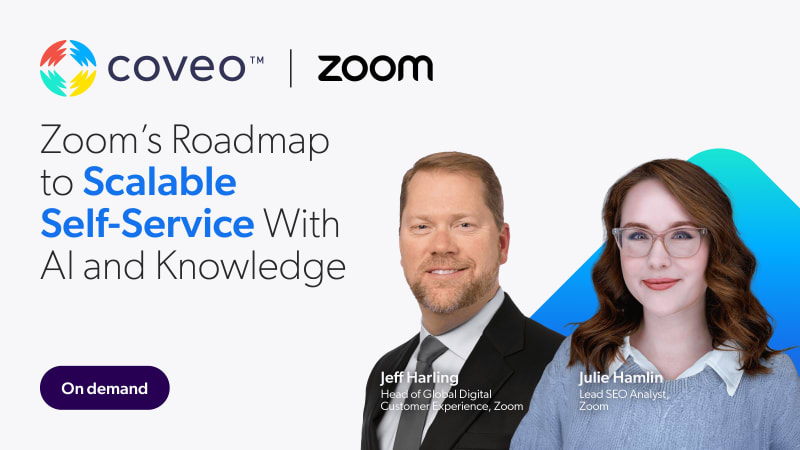

Zoom’s Roadmap to Scalable Self-Service with AI & Knowledge
AI alone doesn’t transform customer support—processes, knowledge, and execution do.
Zoom’s world-class, AI-powered self-service experience didn’t happen overnight. So how did they do it? What were the bold strategies, key decisions, and smart investments that fueled their rapid scale and delivered real business impact?
In this 45-minute session, experts from Zoom, TSIA, and Coveo will unpack how Zoom built and scaled its AI-powered self-service experience—from foundational knowledge management to advanced automation and generative AI.
What you’ll learn:
- How Zoom scaled from knowledge management to AI-driven automation & generative experiences
- The three key AI moves that boosted case deflection & improved customer experience
- TSIA’s latest research on AI’s role in knowledge maturity & support transformation
- Your AI roadmap for building a scalable, high-impact support model
Whether you're building your AI strategy or looking to elevate your current support experience, this session delivers practical insights, proven approaches, and research-backed guidance to help you get there.


Make every experience relevant with Coveo