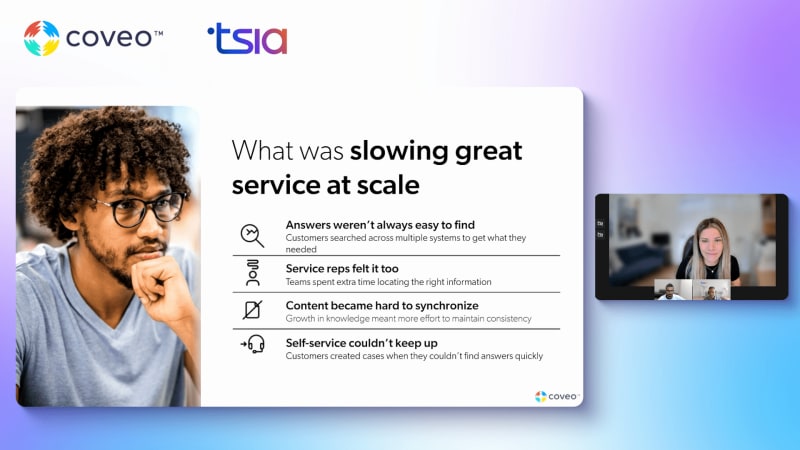
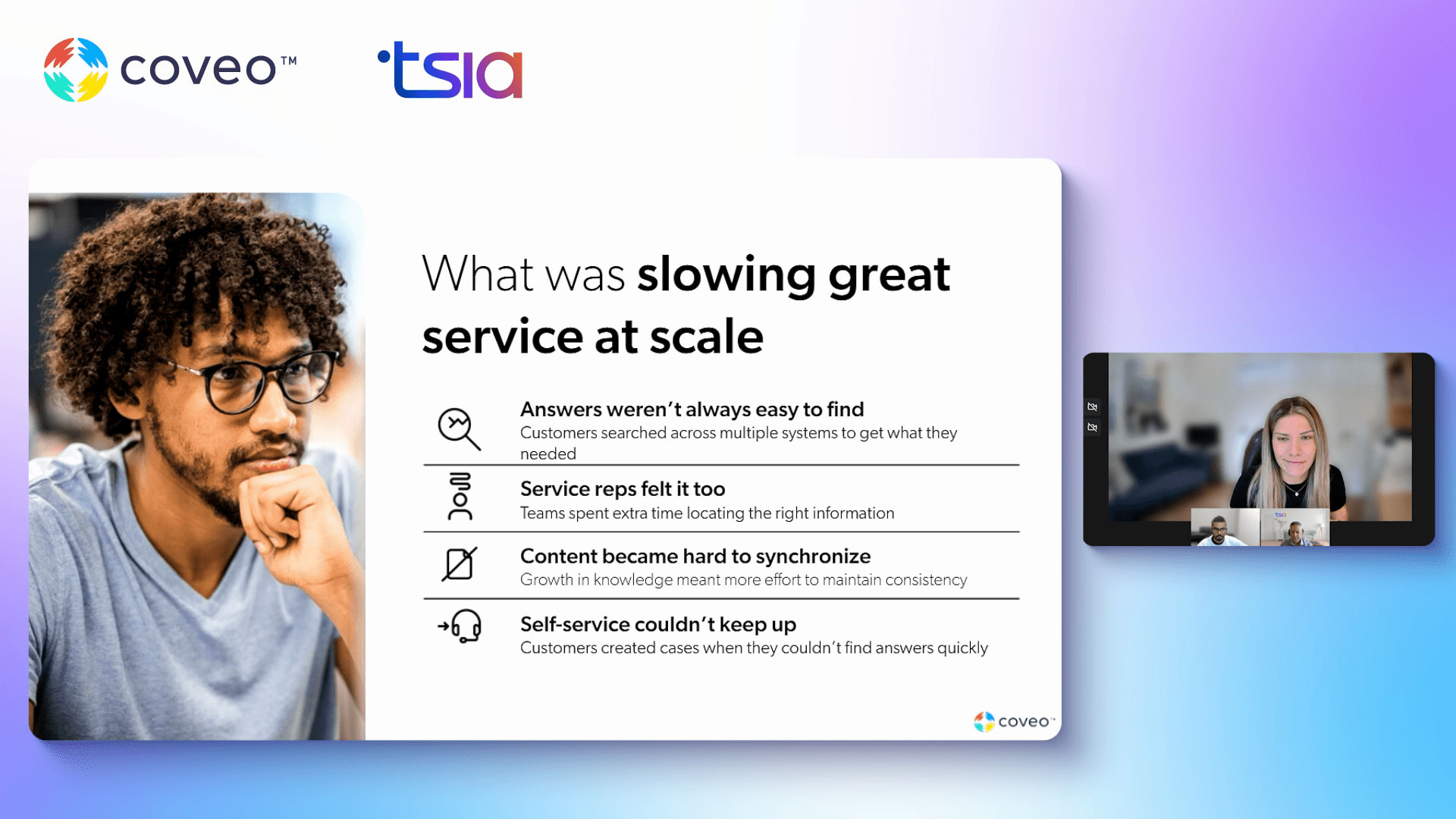
Hello, everyone. Welcome to today's webinar from AI Search to AI Agents, How UKG Transform Self-service. Brought to you by TSIA and sponsored by Coveo. I would now like to introduce our speakers for today. Dave Barca, director of support services and field services research for TSIA. Daniel Rajan, lead product marketing manager for Coveo, and Carrie Rogers, principal customer experience analyst for UKG. As with all of our TSA webinars, we do have a lot of exciting content to cover in the next forty five minutes. So let's jump right in and get started. Dave, over to you. Thanks, Vanessa. It's always great to be able to present and to work with our longtime tech partner at Coveo. So, Daniel, welcome. Good to see you again. And it's especially wonderful to co present with one of our TSIA partners. So, Carrie, welcome aboard. Great to have you, as part of our presentation team today. So the, the the topic that we're gonna delve into here, AI search to AI agents, you know, how UKJG transformed self-service is especially vital and especially important to the support industry as a whole. During the last research journey that I had the pleasure of conducting with our TSIA members, The research stemming from a global TSIA channel preference survey that queried B2B users across the globe, various primary geographies, across all demographics from an age perspective reveals that there is an ongoing and fundamentally reversible shift. We've always known that self-service was a principal importance to all support organizations, drive scalability, efficiency, but from a customer perspective, it has gone through its own unique journey, and so we now see that from a B2B technology user preference, self-service along with AI powered solutions are truly the initial point of contact for support issues. Not only do they want the questions answered seamlessly, effortlessly, They want them answered not only just from a low complexity perspective, but the complexity level that customers are expecting from their self-service and AI powered solutions is continuing to increase as well. What we see from the B2B channel preference survey and that digital first research is that the rise of self-service in AI continues to progress. The adoption of AI applications is notably high. We see that eighty seven percent of B2B customers actively utilize AI tools before contacting their support partners with the technologies that they've purchased. We also see that there is a high close alignment between both ChatGPT and Google Gemini from a usage rate perspective. This stems from both quick poll data as well as channel preference surveys. We also see that fortunately for our support organizations who have invested a ton of money and resources in self-service portals, that the self-service portals continue to drive a high regular usage of B2B technology users. But we are seeing that from a Google search perspective, a lot of our customers are using them to a very high extent. As we look at that digital first transition, the self-service powered, AI powered use case from an intentional first touchpoint perspective, there are a lot of different touchpoints and areas that support organizations need to focus on in order to ensure that the digital customer experience that they're providing in enhancing that self-service journey with AI is continuing to mature. So if we take a look at it from just an AI optimized knowledge based perspective, the ability that we have to train and to drive learning from an LLM perspective around AI is so uniquely different now than it was even just a couple years ago. That's driving a ton of additional consumption, both internally for our support agents but also for our customers. They're benefiting from that as well. When we take a look at from a proactive AI suggestions perspective, obviously the best question is the question that no longer has to be answered because your self-service and your proactive capabilities are answering those questions predictively, proactively, so that your customers don't even have to ask those questions in the first place, but we know that that is still very much a maturing space within our technology membership, so the importance of driving those proactive AI suggestions continues to be mature, and so we're seeing that slowly and meticulously entering into the universe of experience from a self-service perspective. We also know that the easier and the more elegantly you can deliver your self-service solutions through the portal design, that's going to provide an intuitive or a very comprehensive way for your customers to consume your self-service knowledge. Ensuring that you have great design, not only from a self-service perspective, but also from a customer service portal, CSP perspective, of vital importance. We've seen the progression of AI chatbots from the question answer pairs of just a few years ago to now true Agentic AI conversational capabilities. So as those AI capabilities deepen, as technology companies are able to deepen the technology vernacular in the LLMs that are protected within their safe and secure private spaces, we're seeing that the ability for AI chatbots to deliver a more human conversational interaction and experience is growing. But still, there's that stop point, right? Where you have to make the decision around, okay, are we going to continue to perpetuate this conversation or is my AI chatbot gonna be strong enough and smart enough to recognize when it's at the end of its line and then to ensure that the information that it's compiled in that interactive conversation back and forth with the customer gets portrayed and positioned and transferred over to the live agent who's receiving that escalation from self-service to that live agent channel. So that's important from persistence, from a perpetual perspective in driving that right customer experience. Then lastly, there's so much that can be done with monitoring the AI conversations, just as we do with the Live Agent interactions with AI sentiment analysis, utilizing that sentiment analysis channel and capability to truly understand the interactions that your digital chatbots are having with your customers to really gain insights around usage, design, product issues that are of great value if your product teams can take those and latch onto those and really improve the overall experience for your customers. We take a look at the business outcomes that are driven here. The importance of driving customer satisfaction is eternally important to support organizations because there's a high correlation between customer satisfaction from a transactional perspective to the revenue generation for support attached add on support services. The higher your self-service implicit case deflection can be, and this is really interesting because this is connecting that self-service non human interaction to the actual transactional customer satisfaction that you get whenever the issue gets transitioned and transferred to your customers. There's a high correlation there. That drives a really high business outcome. Really important to measure self-service implicit deflection with the self-service success as a precursor to that implicit deflection. Then also, that self-service explicit deflection where you're measuring it when customers are actually gone, they've either skipped over or they've gone through your self-service process, and now it's time to actually get a live agent to help them assist with their question and their issue of resolution. The higher you can drive that explicit case deflection, it's interesting that there's a strong correlation of lower support employee attrition. That indicates that the higher the deflection, in other words, the fewer how to questions that your support engineers are having to answer, they actually have a higher employee satisfaction rate, and that then drives that lower employee attrition rate. Great business outcomes by investing in solutions like Coveo that UKG has invested in and that we recommend as best practice for all of our support members. Just briefly, we see from the channel preference survey a strong and continued shift towards online and self-service channels in the B2B support space. A couple years ago, we wouldn't have even seen in private help for guidance hit the peg of preferences, and I'm really pleased to see that the online communities are also now on the scoreboard. But what do we see? We see Google search still being the primary online self-service predecessor to even coming to your self-service portal. It really does beg the challenge to drive the highest quality of channel response and quality to your self-service portal and not to divorce yourself and give that over to Google as the end all be all Gen AI solution for troubleshooting for your products. Then lastly, we see that knowledge management, which continues to be the underpinning of support service success and AI maturity and AI return on investment, continues to have a profound impact on the world of AI. A couple years ago, we would generally just see that maturity evolving just from an enhancing search capabilities, but now we're seeing knowledge management being used to generate a very high percentage of precision and accuracy for first generation of knowledge based articles, the ability to collaborate and share knowledge both internally and externally with your customers, providing a much higher level of personalization around the knowledge resources that you're able to provide to customers, and then lastly, improving both internal and external decision making around AI decisions. We're seeing this especially with the rise of Agentic AIs and your ability to drive cognitive decision making that are independent of humans, but also do require that human partnership. So with that, that gives us, I think, a good foundation and stage for moving into the actual crux of the presentation today. And so with that, I'll turn it over to my colleague, Daniel, over at Coveo. Daniel, over to you. Thank you, Dave. Hey, everybody. This is I'm so glad that I'm here participating in this webinar with TSIA and one of our customers, UKG. I lead our knowledge and service line of business as a product marketer in Coveo. And just to give some context before we talk about how UKG is applying some of the things that Dave spoke about, self-service and knowledge management and AI solutions. I want to first give context on who Coveo is really quickly so that could set the stage in for what Coveo is about to share. So Coveo, for those of you who are not familiar, is an AI search company powering generative search and agentic experiences across different touch points for your enterprise. Everything from commerce to service to websites to workplace. And we do this by using our AI relevance platform in delivering these business outcomes, especially for service, the ones that Dave spoke about, the explicit case deflection, implicit case deflection, increasing self-service success, achieving ROI. So all of these are outcomes that we have been delivering for amazing enterprises like UKG that we're gonna go a little more in-depth. And we've been doing this for over a decade. We've been in the game in AI search for enterprises for over fifteen years. And we we are hundred percent focused on helping large scale global brands such as UKG in improving their digital touchpoint experiences. And over the years, we have received a lot of love and acknowledgment from from analysts such as Gartner and IDC, and this has happened over the years, year after year. And our platform has deep integrations with tech ecosystems like Salesforce, SAP, AWS, and Shopify. And so we have been doing this for over a decade, like I mentioned. And this is a slide that is something that we are always proud of, and we are humbled by the slide every time we share this at a stage such as this. These are all brands that you are familiar with. Most of these are brands that you know and love. And we Coveo has been delivering relevance and these outcomes to to all of these brands across these different verticals. And so what's interesting is, like, all of these customer logos are have their own pains and challenges and goals. But what commonalities that we are now seeing is everybody is wanting to adopt AI in order to solve the real world problems that affect their business. And so they're using AI driven solutions, depending on Coveo, help deliver more personal, more relevant interactions with their end consumers and even with their internal employees. And while it's really easy to get fixated on the scale at which Coveo operates, the one fundamental principle that we always tell our customers is it's not about AI. Yes. We are an AI first company, but it's really about the customer because people don't forget how you make them feel. So this is really our mantra as in, yes, we are AI first, but it's really important to fix our eyes about the customer and helping them achieve what they want to achieve for their goals and outcomes. And when I was speaking with Carrie on their success and their journey in delivering some of these outcomes, Carrie told me something really, really interesting. And in fact, this is a quote that I probably might just put on a t shirt. She said, customers don't care if it's AI or not. They just want their questions answered faster. And so I'd love love to bring Carrie into the conversation. Carrie, why don't you introduce yourself? Tell us who you are and kind of expand on what did you mean by this quote. Hi, Danny. Hi, everyone. Yes. Sure. So principal customer experience analyst at UKG. I worked with UKG for about ten years. And if you are not familiar with UKG, we're a leading HR workforce management technology company. We serve tens of thousands of customers globally, and we're really just committed to making sure that we're providing great experiences throughout their journey with us. So, of course, Coveo is a piece of that puzzle, serving up some of our AI service experiences. So Danny, going back to the quote, that's what it's about. So of course, we've watched the evolution of AI for years. And just in the past, I would say, three years now, AI has been the hot topic. And at the end of the day, for us as a technology company wanting to do as much as we can, as quick as we can, AI is a key factor. But to the customer, it's like, I just want to get my answer as fast as possible and move on with my day. Yeah. And can you expand a little bit more on UKG and its mandate? Where do you sit in the organization? Can you tell us a little more about about your role at UKG? Sure. So I sit on our customer experience team. So customer experience at UKG crosses over implementation, support, community, education, and also into knowledge management, which is really relevant for this conversation. So my role sits in the middle of all of that, so really crosses through customer experience. Content, and a with some elements of product and program management. Spent a lot of my time figuring out where customers need better access to knowledge and defining the capabilities to improve their experience in doing so. So working closely, again, cross functionally with product support technology to bring some of those improvements to life. Yeah. So what you just said was pretty interesting. You sit at the intersection of search and community and knowledge and AI. I'm curious, does that vantage point provide any particular advantage in terms of learning about the customer need? It absolutely does. Yes. So I would say the what we see with our customers through both so through search and now the questions that they're they're asking our AI agents and our human agents, through that data, that's that's, like, the clearest indicator of what it is that they need, what's not front and center for them, what it is that they're looking for. So that's really a big piece of driving our customer experience strategy. Fair. What does this UX the CX mandate at UKG, you meant you talked about it. How does it translate into some of your KPIs as a leader in the CX organization? So what what are you tracking against? Yeah. So for CX in general, so our goal is to make sure that our customers have all the right expertise, all the right resources, all the right guidance at every step in their journey. For me specifically, I'm really focused on those on the self-service measures that I know Dave mentioned earlier. So focused on self-service success, case deflection, and then then sees that with those experiences. Got it. So are you able to speak to to about, like, those metrics specifically? Like, is it, like, increasing self serve success, case deflection? Am I am I right in reading that's what you're tracking against? Yep. Exactly. So all of the above. We want Yeah. Ideally, you know, ideally, we would be at a hundred percent on all of them. We're we're doing really well, but yeah. So improving self-service success, improving case selection, and, again, the the satisfaction with those experiences that our customers have. Got it. So I wanna, you know, dig a little deeper into you have this great CX mandate at UKG. Right? That that's the benchmark that you're all rallying rallying towards. What was slowing, you know, what great service looked like for you and operating that at scale? Yeah. So at UKG, we always have this really rich knowledge ecosystem, tons of resources available to our customers. And over time, that ecosystem just continued to grow. So we had multiple systems, each serving their own unique purpose. So our customers could find the information that they needed, but sometimes they may need to navigate to multiple places to find that information. And we heard the same thing from our internal teams. So our internal teams were also struggling to find the information they needed quickly. It's there. They know it's there, but finding it was more of a challenge. So I'll say I know that the problems weren't unique to UKG. I think it's a natural outcome of having this really large, mature knowledge ecosystem. But as we continue to grow that ecosystem and expand, there was just this clear potential to create a more intuitive journey for everyone. And did you as you were analyzing, you know, what were these blockers in in slowing down great service at scale, can you speak about, you know, identifying the root causes behind some of these obstacles? Sure. So behind the scenes, we were, as I already mentioned, working with a significant amount of knowledge. So specifically, just talking about our product documentation and knowledge documentation, we had over seventy thousand items, seventy thousand assets, and these were across eleven different systems. So again, each one of those systems had a purpose and a ton of important content managed by the experts. So it wasn't a situation where it made sense for us to be merging those core systems, where we need to keep these core systems. But there was also no unified search layer. So whether you're a customer, whether you're an internal, you would need to go to those different systems to search, which created some inconsistent experiences. Of course, it was timely for people to be searching and looking for the information that they needed. But that also meant that there was no consistent update process. So the content was getting updated at different times, so the experiences could vary slightly as those different updates took place. And I got all to say, I don't think this is unusual, so I'm sure many large organizations face the same challenges as they grow. But for us, it was just this opportunity, this really clear opportunity to modernize and unify all of our content. So it it sounds like even before you're ready to to bring in AI into the picture to deliver these great experiences, you kind of had to go back and work on the foundation, which is fixing your knowledge layer. So I often believe that working on the foundation, be it like if you're working on a hobby, like learning guitar, like learning your skills or is really boredom. It's not sexy, but it's when you fix the foundation is when you're gonna start achieving these outcomes, and that easily translates to the whole AI narrative. Everybody's fixated on AI. Oftentimes, that's just peer pressure. Another company is doing it, and so you wanna do it as well. And when you deploy AI without fixing the knowledge and the search retrieval layer, your it's no wonder you don't achieve these ROI and these outcomes that you expected to do. So can you talk about, like, okay. You've identified these blockers. You've identified the root causes. How did you use, like, a partner like Coveo to work and fix these foundations? So can you give us paint a picture on what that architecture looks like? Yeah. So first of all, I'm going to say I'm so happy that we started working through these challenges seven or eight years ago. So we started partnering with Coveo about seven or eight years ago to bring together that unified index, because it really did, and I know we're going to get into all this, but it really did set up for success in the even more fast paced times that we're all working in now. So again, going back seven or eight years where we had our content in multiple systems, we knew we wanted to bring that together. We knew we needed the UniByte Index. So we partnered with Coveo, and really the first step of that was creating that unified search layer. So if I mentioned, people had to go Again, if you think seven or years ago, we were used to Googling. We wanted to search for things. So we needed to first create those unified search experiences. And in doing that, we needed to bring our content together, align metadata, align the structure to it to serve it up nicely and a clean experience where customers' internals could find it and access it from one centralized place. Yeah. And once you did that, talk us through self-service versus assisted service and how you are able to ground these experiences on top of this unified index. What does that look like? And even transition into where you're going with AI agent, kind of talking about your current state or where you're going towards tomorrow as well. So talk us through that journey. Yeah. So it all it all started with first, setting up the index. So plugging into our content again across the different repositories. Coveo had the the amazing out of the box connectors. So a lot of that was kind of plug and play. And then there were some of it that was more custom. But once we built that, then we, of course, went through the requirements gathering exercises to understand what we needed as far as assisted service goes, what what an internal experience looks like. Maybe they need different facets and filters and different metadata on the content they're viewing than a customer. So we built all that out. And then, which we'll talk through here in a minute, I think just the progression. So we built out the search experiences. Again, so happy we did that seven or eight years ago because we were able to really solidify those before generative AI entered the picture. I think one of the big differentiators with us, with going with Coveo, was the AI that already existed. So we're talking AI machine learning prior to the generative AI boom of twenty twenty two. So Coveo was able to give us these models that would help serve up relevant content to our users based on who they were. So we know our customer. We know what products they own, what industry they're in, the recent questions that they've asked. And Coveo has models to help dynamic dynamically serve up the most relevant content to them without us having to be manually configuring that on the back end. I wanna follow-up with a couple of things, couple of questions. One is talk about these sources. Are you able to give what those sources are? Tell our audience. I think it's like Salesforce. And what what else are you indexing? Where are you indexing all these different pieces of knowledge? Yeah. So so Salesforce is a big one. We have a lot of our, of course, our our knowledge base that's primarily managed by our support teams lives in Salesforce. We have all of our customer cases in Salesforce. We have our our community is built on Salesforce experience. So there's a bunch of community discussions we index with Coveo. Then we have our CMS, which is our content management system where our professional technical writers create all their product documentation, all the official product documentation. And we do have a few homegrown, like, help sites that we are connected to that are also contain product documentation. Got it. Are you also able to speak about security? I imagine a huge enterprise like UKG will have restrictions in terms of access, who can see what. And because you are using this one common unified index to power self-service to your end users, also to your internal employees, Talk us through what how important is security and if if Coveo was able to help, yeah, help with indexing knowledge security. Of course. Yes. So yes to everything you said. So security is super important, especially when we're serving content up in our in our community. We have customers, partners in there, and we have users with different levels of access. So what was great about plugging into Coveo was that Coveo is managing all of the security and permissions for us. So again, not something maybe just in manually setup. It's indexing the native permissions of the system so it knows who you are, what permissions you have in Salesforce, what cases you should see, what community discussions you can see, which articles you can see. And what was great, again, setting this up several years ago, is that those security and permissions have flowed through with the other items and the other functionality we've built on top of Coveo. So that's been really powerful for us and really enabled us to move quickly with some other projects we've implemented. Got it. Got it. So you when you started the journey seven, eight years ago, you fixed the foundational knowledge retrieval layer, search powered on top of it, powering your self-service experiences, and then your assisted service experiences. You then implemented generative answering because that was everything three years ago, and now it's like table stakes already. And now we are transitioning into your vision of using this AI agent concierge bot that will oversee all of these interactions and really be that front door, that first touch point for your end users and probably even your internal employees. Am I reading that right? That's that's your vision? Yeah. I'm back. Awesome. So, you know, this evolution, kind of this what you're seeing over here with this diagram, you know, paints a picture of an AI maturity curve. And this is something that we are seeing with customers like UKG and everybody else that we speak to at Coveo, prospect or customer that we speak to falls somewhere within this journey. They're either in at the start of their AI maturity by fixing the foundation and implementing AI search. And like Dave mentioned earlier, that self-service search experience is really that front door and that first touch point. Once they do that, they graduate into generative AI experiences just like Carrie shared. And now we are set up to successfully graduate into more innovative experiences like conversational AI and agentic AI. And really the beauty of of the Coveo platform is regardless of where you are, where you find yourself in this AI maturity curve, we are able to deliver these outcomes for you because it's all grounded in your trusted enterprise knowledge. And so, like, today, before I kind of show in the some of the visuals of what this journey looks like for UKG by graduating from AI search and generative AI, conversational AI, and Agentic, it's important to really, you know, fix that foundational layer and that AI search retrieval layer is really, really gonna be crucial for achieving great experiences and great outcomes. So with that, I would love for Carrie to you know, for you to talk about, you know, some of these visual representations of these stages in your evolution. Sure. So what what are we seeing over here? All right, thanks. This is, you're looking at the UKG community. So the community is the place where our customers would come for everything they need outside of our products. So seeing all of their, again, product documentation, their training, to collaborate with other customers, and to reach out to support if they need it. So they're coming to the UKGPT community for everything. So we created this unified search experience, which, as you mentioned, is now table stakes. Right? So you would expect to come to a community, be able to go to a global search bar, and access all of the resources that are there for you. Again, as mentioned in the background, there was a lot going on here. A lot of these resources live in different systems. So bringing that all together was super powerful. We rolled out, again, the unified search experience about seven years ago, and we've been improving it since then. So we've had that time to continue to add resources, tweak how things show up, collect customer feedback, and and make it great. What you're looking at here is the generative answering. So we rolled out the Coveo AI generated answering late last year, so about one year ago. Was, believe it or not, one year ago, this was all very new and AI generated Answers was the big thing. So what was really cool for us was that we knew this would be helpful for those self-service experiences, but we were really surprised at, again, how quick and easy it was to turn on having that foundational knowledge layer. So as you mentioned, we already had all the security and permissions set up because we had everything plugged into Coveo. We already have the content there. The content refresh was there, so we know that every time a knowledge article gets updated, it's gonna be updated in the index within ten minutes. So these answers remain relevant wherever customers are accessing them. So this specific screenshot is within our case creation experience. So we wrote out the AI generated answers in a number of places. First, internally to get internal feedback, and then we pushed them out in our customer community. When we added them to our case creation process so the idea is customer comes in, tells us they go to a case creation form, enter the subject and description information about the question they have or the issue they're having. And we're now sending them to this interim page where we say, Hey, before you submit your case, check out a few recommended solutions. And we serve up the AI generated answer and some recommended documentation. Of course, it's if available. We don't have a document. It's not gonna show up here. But we've seen amazing success with this solution. So really excited to have this in place, and we've just gotten awesome feedback from customers too that they love having the Answer on the Spot. Because we do have users who really are not self-service savvy, so they don't wanna go and search and look. They wanna they wanna reach out. So this answer, again, like, in their workflow is is a delight. And so this is really, really amazing where you're going into, which is more of a conversational agentic state. I'd love for you to quickly cover this before we wrap things up and maybe have some time for some questions in the end. Yes. So I'm actually very excited to share some of this today. It's so relevant to what Dave was talking about earlier. So we are piloting and soon rolling this out GA for all of our customers, this UKG Community Assistant. So it helps with the case intake and self-service. Essentially, it provides the opportunity for our customers to have that conversational, that chat back and forth with the AI agent. What we've seen is that there's just really great retrieval. Again, so this agent is plugged into our Coveo index. So all of those content permissions are there. All of that content refresh is there. But all what I will say is, again, having that unified index in place helped us move so much more quickly with these agents and focus on probably the more important piece, which is tweaking the prompts and making sure that agent experience is on point. We didn't have to, again, worry about the content on the back end. So is it getting the right stuff? Is this stuff updated? It it was really plug and play as far as the content goes. Yeah. And this is also super exciting into going to voice experiences, but also leveraging again this the the secret sauce of Coveo, which is the retrieval and the relevance layer. So really, really exciting to see how customers, large enterprises like UKG are utilizing these Coveo functionalities in delivering some of these really, really cool wow experiences for their users. So I want to, you know, kind of ask you to summarize, you know, what was the change? What was the before state? I know it has been a long journey, seven to eight years. But in the seven to eight year journey, what were those different before and after states that you could speak about? Yeah. So really what changed was, again, like, having the framework to unify our ecosystem in a meaningful way. So we were, again, didn't know it when we started, but really laying the groundwork for where we're going today with, again, these AI tools, the Generative Answering, and the agents which we're getting ready to go live with. But as, again, Dave mentioned earlier, that's what customers expect. We're using AI in our everyday life. We expect when we're partnered with the company that they're gonna have those same tools available to us to get our questions answered instantly. So essentially, just partnering with Coveo helped us lay the groundwork to be ready for all of this this essential technical revolution that's happening right now. Yeah. Technical revolution it is. So to take us home, you know, if you were to if you were asked like, hey. How what are some of the things that I need to do? And I'm sure you kind of spoke about this throughout the presentation. But to sum it up, like, can you talk us through some of these guiding principles that you told me? I'd love for you to share it with the world today. Yeah. So I know we wanna have a little bit of time with questions, so I'll I'll hit my favorite ones from this list. So number one is number one for a reason. So start with the customer, not technology. So we know so much about our customers. They give us tons of feedback. There's tons of feedback in the data that we see. So we really wanna focus on real needs and outcomes, just not the hype of whatever the new thing is. Right now, it's the AI hype, but there will be something new tomorrow. But we really want to focus on solving the problem, not implementing technology for the sake of implementing technology. The other piece for us that has felt really relevant is to build the experiences that differentiate us and buy what's already out there that someone else has already perfected. So in this example, we could have spent a lot of time building our own unified index to centralize our content at UKG, but we're doing a lot with AI, aside from just these self-service experiences. So we're going to focus on those experiences that differentiate us and let Coveo do the heavy lifting when it comes to centralizing our content. Yeah. I'm so glad you brought up this point on build versus buy, and I imagine there's a lot of customer service leaders, customer experience leaders out there who are kind of wrestling with that whole build. Should we build? Should we just buy? I'm so glad that you brought up this point as we wrap up this amazing presentation. And honestly, I could ask you ten more questions to understand and learn more about your amazing journey at UKG. But I wanna give the audience right now a chance to ask some of those questions as we have a minute left. Vanessa, over to you. We yeah. We're running really low on time. I will squeeze in just one question here. And the person asks, how did you decide where to introduce generative and agentic AI first? So I'll take that one. For us, it was in the place of need. So where do we need to have the biggest impact? So that was clearly the self-service experience. Again, our customers expect this. They wanna come. They wanna get those answers really quickly. So that our goal, our first goal, to roll this out in the customer self-service experiences. We did roll out internally first to make sure we were highly confident in the answers that got displayed and just the experience in general. So we rolled out internally to our support teams for about a month. Once we felt like that was all great, we pushed out to customers. So at this time, just thank you to Dave, Daniel, and Carrie for delivering an outstanding session, and thank you to everyone for taking the time out of your busy schedules to join us for From AI Search to AI Agents, How UKG Transform Self-service. Brought to you by TSIA and sponsored by Coveo. We look forward to seeing you at our next webinar. Take care, everyone.
From AI Search to AI Agents: How UKG Transformed Self-Service
The path to agentic AI begins with intelligent search and retrieval. Only when knowledge is unified, secure, and accessible can AI agents act with accuracy and trust.
In this TSIA webinar, Keri Rogers, Principal Customer Experience Analyst at UKG, joins Daniel Rajan, Lead Product Marketing Manager at Coveo, to reveal how UKG unified knowledge across 11 content repositories to power intelligent search and transform self-service.
But that’s just the beginning. UKG is advancing to conversational, agentic experiences by integrating Coveo’s secure knowledge index and extensible APIs—enabling accurate, AI-driven answers grounded in trusted enterprise knowledge.
Join this session to learn how UKG:
- Unified scattered knowledge into a single secure index for search and retrieval
- Leveraged GenAI and AI Unified Search (RAG) within the community search and case submission workflow
- Established a scalable knowledge and infrastructure base to evolve support toward conversational AI and agentic experiences
Ready to move from AI experimentation to meaningful transformation? Discover how UKG built a strategic foundation for intelligent self-service and paved the way for the future of agentic customer support.


Make every experience relevant with Coveo