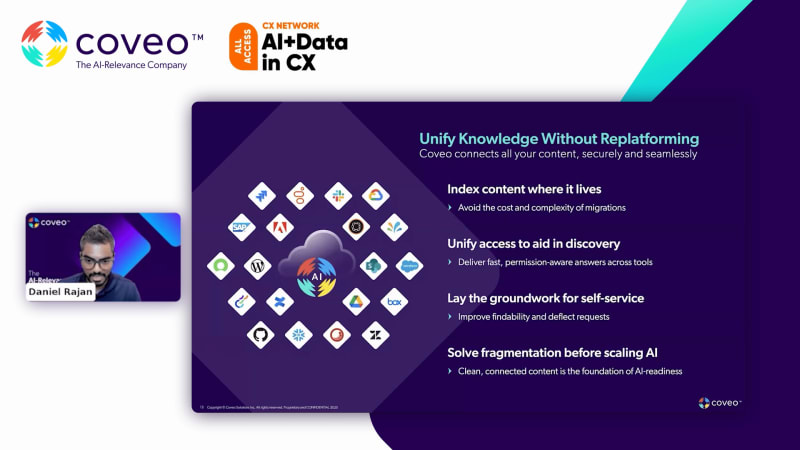
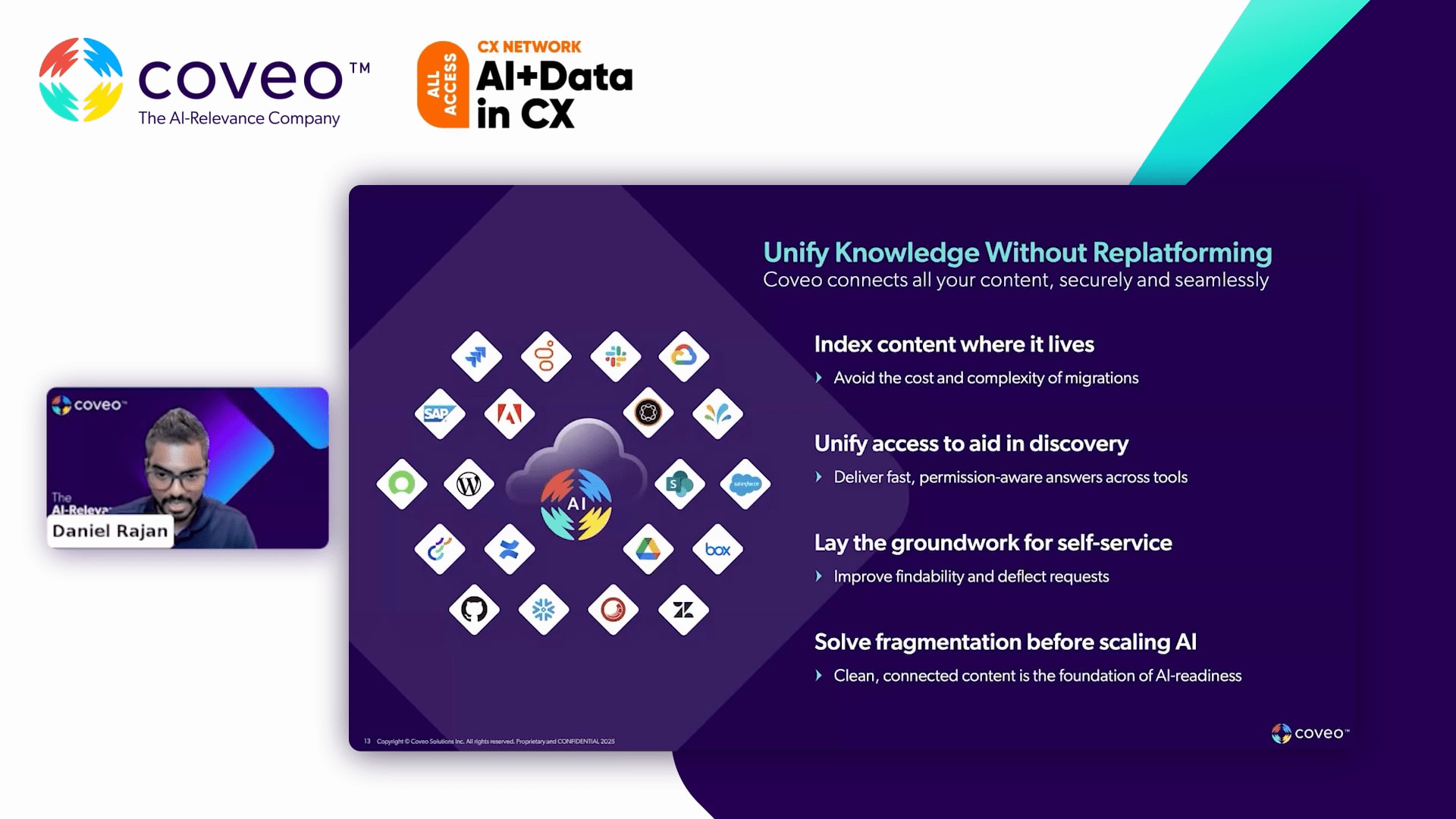
We do have, plenty more going on today, so please make sure to stay on the line. Our next session is going to be brought to you by our partners over at Covio, and will be presented by Daniel Ragen. So just, while I wait for Daniel to join me, I'll give you guys a bit of background knowledge on him. At Covio, he's been helping organizations to understand how to drive those key and measurable business outcomes, with AI First Tech. So he's got over a decade of experience, in customer service roles, working for Freshworks, Sprinkler, Gladly. And he's he's really been kind of crafting go to market strategies, throughout those ten years. So we're in really good hands. Before I do hand over to Daniel, just some housekeeping to remind you guys of. So, again, just remember everything's being recorded. You'll be able to, see these sessions on demand. Also, all of our sessions are interactive. Been really great seeing some of the questions that have come through so far. So please go ahead and carry on asking those, and we'll get to as many as we can towards the end of each session. Thirdly, we do have our resources box. So go ahead and check that out. There's some content in there from Covio at the moment. And finally, remember our post event virtual roundtable, about what's holding AI back from full scale CX adoption. That's happening at the end of the sessions today, and you can access it via the lobby. Okay. Thank you very much, and thank you so much, Daniel, for joining us. Thank you, Chloe. Thank you, Chloe, for the for that kind introduction. Hey, everybody. Welcome to today's session. I'm Daniel Rajan. AI the lead product marketing manager at Coveo for our service and knowledge line of business. Today, Today, we're talking about achieving AI success in twenty twenty five, a practical road map to fix disconnected CX. And if that sounds like a mouthful, it is, but that's because fixing disconnected customer experiences isn't simple. We're at at the moment where it feels like everyone's doing something with AI. And if your organization isn't, someone probably thinks you're doing it wrong. So let's be honest. Just because AI is in the room doesn't mean it's actually helping your customer experience. We're gonna cut through the hype and focus on real actionable steps, you can take to making AI work for your organization. I'm excited to even share how Coveo helped, an enterprise like Zoom achieve AI success. So before we dive in, I'm curious, where are all of you in your AI adopting journey? I'm curious to know what are some of your biggest barriers to achieving AI success. So let's do a quick poll. Is it disconnected knowledge sources, poor search experience, fear of hallucination, limited insights analytics, or is there a lack of budget? We will be covering some of these topics and how how to scale these barriers, so I'm curious to know where you are. Let's give it a few more seconds. AI really curious to know this answer. Chloe, do we wanna, show the results? Are they all? Yeah. Yeah. Disconnected knowledge source is number one. And that's actually gonna be our primary focus, and I'm gonna show you how to fix that. So that's really that's really interesting. A lot of you are experiencing the same problems that we've been speaking to customers, and they've been sharing similar stories. But before we get to that, I wanna level set and ask the question, why is customer experience important now more than ever? Why take action now? According to this Qualtrics study, the impact of negative customer experiences equates to three point eight trillion dollars of revenue. That that is at risk globally. So let me say that again. It's three point eight trillion dollars, and that's a lot of revenue. So the reality is that this money is is not necessarily lost. It's just that customers will go and spend it elsewhere. They will take their business to brands that offer the experiences they expect. So with that level of revenue at risk, it's no surprise that enterprises are racing to adopt AI. We are seeing AI everywhere from generated answers on search pages to custom gen AI apps, powering content and workflows, to even agentic AI. On the surface, this all looks like incredible progress, but here's the critical question. Are customers actually getting the answers they need? Because even the most impressive piece of AI technology, it can fall flat if it's pulling from incomplete, outdated, or siloed information. And that's the disconnect we are here to talk about today, and that's the disconnect that you shared right now in the in the poll. So the problem isn't a lack of AI. It's a lack of connected, trusted knowledge that AI can work with. And without fixing that, your AI initiatives are likely to deliver more frustration than value. To really understand why AI isn't delivering on its promise yet, we need to step back and look at how customer experiences were originally designed. Over AI, as new digital touch points emerge, websites, your portals, communities, we kept layering them into the experience. And each one, each channel solved a specific problem or filled a gap in the journey. But the truth is they were often built in silos with little thought given to how customers actually move across them. And if we're really honest, self-service wasn't originally created to to delight customers. I know that sounds a little controversial to say it out loud, but self-service was really created as a cost saving strategy. The goal was to deflect cases. So while it might look like we've designed a cohesive end to end experience, what we really have here is a series of disconnected channels. So the expectation was that the customer would start on the website, then they try in product help, then the portal may be community. And only after exhausting every one of those options would they finally be routed to customer service. This kind of experience might have made sense a few years ago, but in today's AI first world, it's exactly what's holding us back. So these customers don't act as designed. When when they have an issue, they embark on a path to resolution, and the truth is they will follow the path of least resistance. If you think back to your own customer experiences, how much time, were you willing to put into resolving issues on your own before you contact support or your customer service. Self-service needs to be easy or else customers will not want to self serve. The the reality is that customers have the choice of how they engage with you, And each channel they decide to leverage, whether it's, like, digital or assisted, and you have no control over which channel they choose, has all of these channels are available to them. They will they will choose whichever path feels easiest in the moment. So to look at what the actual path to resolution looks like today, it's it's kind of messy. It's not linear. It's it's more like this multi exit highway where your customers are like drivers. They can take an take any exit at any time based on what's most convenient to them. But we all know how frustrating it is how to when we take a wrong exit. You have to double back, loop around, and then try try again, which is frustrating. And that's AI of, like, what's happening in today's customer journey. Each stop, whether it's your in product help, the website, or documentation, it it's those stops are isolated. If it doesn't deliver what they need, they have to start all over again. And with every false stop, it increases frustration and the chance that they will abandon the journey altogether. And that's why unification is critical. Customers should get a consistent, complete experience no matter which channel they enter through. And if they escalate to an agent, that customer service rep should have full visibility to what the customer already tried, what content that they engaged with, where the gaps are. And that's how we can remove these stop signs and guide them to resolution without taking a detour or reaching a dead end. So why is it difficult to actually unify all of these channels across the customer journey? The reality of today's enterprise is that knowledge is everywhere, and it's rarely connected. Each channel that you see on the screen is typically owned by a different team. So there are different systems. Each team has different goals and how they track metrics. And, of course, there's a different search experience with within these each channel within these channels and different knowledge tech stacks on top of it. So this fragmentation on top of fragmentation, that that reality makes it really difficult to deliver a consistent experience. And as we move forward, each of these channels will likely get its own AI assistant or AI agent. But here's the catch. If each AI agent is only as smart as the silo it's sitting on, we're just recreating the same disconnected experience with a more expensive piece of technology. And that's why unification needs to happen at a deeper level. You need a single intelligent AI search layer that connects all of these knowledge sources and experiences, one that understands relevance, intent, and context across the across the entire journey. And to know what a unified AI search and retrieval layer looks like, we must first look at what traditional search is. A user typically enters a query, and in return, they get a list of links and documents. They then have to open each one, they scan for relevant information, and stitch together their own answer. Sometimes that meant running multiple searches or jumping to another channel entirely. In this model, the user carries the burden of resolution. It's slow, it's inefficient, and it's no longer acceptable in a world that expects AI powered answers. In comparison with generative and agentic experiences, this gets completely flipped on its head. The technology has to understand the user's intent and then provide the solution. It needs to search through all of the available content, identify the most relevant passages, and generate the answer the user expects. This is what sets modern AI experiences apart. Without a unified AI search and relevance layer, it'll be almost impossible to render an experience that is tailored to the user, including a generated answer, providing citations and recommendations, and even follow-up questions. So how do we implement AI AI search at a practical level? I wanna get into the the details. And at Coveo, we we see the most success with teams that follow this crawl, walk, run approach. And this is a road map we've developed having worked closely with customers. In the crawl phase first, it's about indexing knowledge and data what you already have. You don't have to migrate content. You simply need to connect it so it can be discovered across the customer journey. From there in the walk phase, you start applying analytics and ML models to understand how users behave. What are they searching for? What can't they find? Those are the sort of insights to improve your content discoverability and then to personalize those experiences. And only in the run phase do you introduce generative AI. And when you do this, you can do it confidently because at that point, you will know that knowledge grounding your AI is accurate and centralized and ready to support your business outcomes. So let's dive a bit deeper into each of these phases. In the first phase, the the most impactful move is making your existing knowledge useful. For most organizations, knowledge is scattered across the enterprise. While the content itself is valuable, it's often siloed, duplicated, or just hard to find when it's needed the most. So instead of migrating everything into one system, which is costly, it can be time consuming, and migrating everything into one system, it rarely gets buy in from stakeholders. The smarter the smarter part instead is to index content wherever it resides with out of the box connectors, but then you can unify access to knowledge across your ecosystem without have without having to replatform any content source. This means your CRM data stays in your CRM, your website content will continue to live in your CMS, and your support content will live in your knowledge portal of choice. But everyone from service reps to customers, they get fast permission aware access to answers through a single AI search experience. It's a major win for efficiency and cost. And critic and, critically, it lays the foundation for AI readiness without needing to deploy AI just yet. Using this, you can solve fragmentation, improve findability, and kick start your self-service journey, all before introducing your first AI model. From there, once your knowledge is unified and accessible, you are ready to move into the walk phase. And this is where experience really starts to improve. Now it's about using machine learning to better understand what users actually want, not just not just what they type. The the system learns from behavior, what people search for, what are they clicking on, what they can't find, and how successful those interactions really are. Over time, the system gets smarter, servicing more relevant results, predicting intent, and even personalizing content based on things like the the user's role, their location, language, or even permission settings. And it's not about just improving relevance. These kind of insights also show you where users are getting stuck, where searches fail, or where content is missing. That becomes a road map for your content teams. You can also start layering contextual recommendations AI related articles or next best actions tailored to what users are doing and who they are. It's this combination of smarter search, personalization, and content insight that reduces friction, deflects cases, and boosts satisfaction long before you even touch generative AI. So once you have optimized your search search experience with relevance tuning and analytics, the next big step is layering generative AI. But here's the thing. Generative AI is only as good as the content behind it. If it doesn't have clean, connected, trustworthy information to work with, it it it is gonna hallucinate. That's where RAG or retrieval augmented generation comes into play. So instead of relying on a model's training on on an LLM's model training alone, RAG pulls in real time content from your enterprise approved knowledge, whether it's support docs or your HR policies, internal articles, community posts, you name it. So when an answer is generated, it's it's grounded in fact, not on guesswork. And this way, you reinforce your knowledge ecosystem because every time generative AI references an article, it encourages teams to keep that content fresh. So if you're serious about scaling Gen AI safely and effectively, the retrieval layer isn't optional. It's it's the foundation. So once your knowledge is clean, connected, and unified, you are then ready to scale impactful AI experiences. What you're seeing over here is what's possible when you layer generative answering on top of an already optimized search experience. We call this AI AI relevance. It starts with the one intent box at the top that brings everything together, generative answers, search results, follow-up questions, recommendations, and traditional search all in one flow. All of this works because it's grounded on the same unified content foundation we've been talking about. That's what drives consistency, accuracy, and trust. This is the future of self-service in customer experience. It's not about just finding answers, but really orchestrating personalized contextual experiences that guides users. It reduces effort and drives resolution at scale. From there, you can really expand into more customized use cases. You can integrate your generative AI into your chatbot or case form workflows. You can feed knowledge into agentic systems AI your Agentic, Microsoft Copilot through accurate high performance retrieval. And the best part is it all runs off the same unified index, the same clean, secure, permission aware knowledge layer you've already built. That means every experience, whether it's for your employees, your service reps, your customers, or even AI, it's all retrieving knowledge from a single index that drives consistency and scalability across your organization. So I'm excited to show all all how all of this came into life, and how Zoom applied this exact same model to transform their customer experience. So when Zoom's growth really accelerated dramatically in twenty twenty in the height of the pandemic, they were really overwhelmed. Their content was scattered across multiple disconnected sources, each operating on different platforms with their own strategies. Their knowledge was siloed, and their teams were and their users were struggling to find answers. They were scaling fast when they were not ready to scale yet. So that that's when they partnered with Coveo by indexing what they already had, the content across their support portals, documentation, community, and internal systems without forcing each of these teams to replatform their content. That allowed them to establish a single search and retrieval layer so users could find accurate permission aware answers from anywhere in the ecosystem. From there, they applied machine learning to improve relevancy, automatically tuning search results based on user behavior. They also reviewed an analytics regularly to to keep track of their top queries, content performance, and AI identifying high impact content gaps. One powerful insight was around language disconnect. Users were searching differently than how content was actually being written. So Zoom adjusted terminology, the language used in their content, titles, metadata. They were really applying this SEO mindset to align content to actual user behavior. This dramatically improved click throughs and findability, ultimately increasing self-service success. So it wasn't until they fixed the bottom two layers of the pyramid, which is addressing content quality and search relevancy, did they actually begin implementing generative AI? So once they had the solid search foundation in place, that's when they introduced generative AI, starting with a fully managed generative AI product with Coveo and then expanding into case deflection with generative AI in their case form, providing generated answers besides the form as users fill it out. Cru crucially, they grounded all generative AI output output in real trusted knowledge using retrieval augmented generation. Each answer was citable, traceable, and aligned with their KCS practices. That helped them maintain control, governance, and trust as they scale. So today today, they continue to expand their AI capabilities with confidence because they are building on clean, structured, and measurable foundation. And Zoom didn't get there overnight, but they did follow the same search first AI road map we've AI, and the results speak for themselves. Because Zoom isn't the only one seeing success with generative answering. Coveo has now helped over thirty organizations go live with full production deployments that are secure, scalable, and fully managed. These include major brands across industries AI financial services, health care, tech, manufacturing, and others. So this isn't just experimentation. We are actually seeing real sustained adoption. With that adoption, we are seeing mesh meaningful business impact. Customers are improving self-service, deflecting more cases, and significantly reducing support costs with the likes of SAP Concur that saved eight million euros in a year. These outcomes prove that generative answering isn't just AI, it's actually impactful. So I'll leave you with this. First, don't try to boil the ocean. You don't need to index everything you have. The most successful teams start by indexing and activating the twenty percent of content that drives eighty percent of user demand. Think about high impact topics and content that's relevant to your business. Maybe it's regarding pricing or troubleshooting a new product line or feature. From there, let data guide you. Use analytics to spot gaps, optimize what's working, and prioritize what's what to improve next. So once you get your foundation right with great search, only then add generative AI when your content is strong enough to support it. And AI, treat this as a program, not a project. Success comes from continuous learning, tuning, and improving. So whether you're supporting customers, employees, or your AI agents, the goal is the same, is to deliver relevant trusted answers at scale and making it easier for people and AI to help themselves. So if you love to learn more, check out coveo dot com slash customers. Or if you're ready to explore what this could look like for your team, reach out. We love to have that conversation. With that, we come to the end of our session today, and I'm happy to take any questions. Thank you so much, Daniel. That was a really interesting session, and we've been getting some great comments in the chat, of people saying how much they agree with you. We also have one, from Manisha, which I think I think Manisha might just be reiterating what you've said, which is connected knowledge leads to connected process, which leads to unified customer experience. Couldn't have said Absolutely. Better myself. Yeah. So we've got some questions here, Daniel. So the first one is from Marcus, and this is, how can we measure ROI from AI search and generative AI? Thanks, Marcus. So it that's a great question. Measuring ROI, it it usually depends on where you are in your maturity. So in the early stages, really look at metrics like click through rates. It could be as simple as that. But, ultimately, you wanna start looking at metrics that affect your business outcomes, like case deflection rates, your time to resolution, your agent productivity. And once you implement generative AI, your ROI metrics then starts to really expand. You then look at user ratings of generative AI summaries or answers. You can also implicitly look at your CSAT and your employee satisfaction. That could really help, you measure your ROI from AI search and generative answering. Thank you very much. And, yeah, we do have a couple of minutes left. If anyone else has questions, we've got another one just come in here. Thank you. So what were the most surprising or unexpected outcomes that you've seen after implementing relevant, generative answering? At Zoom? AI guessing this question was asking what was the most surprising outcomes after implementing Agentic at Zoom. Sure. I think they Zoom was pretty much surprised on how effectively it pulled from existing sources to create helpful answers. The other things that they they spoke about in as we were doing our case study interview was really using Coveo's usage analytics to help them identify content gaps. It kind of really gave them this x-ray vision all of a sudden, which showed them opportunities to improve in terms of content. It also unexpectedly supported, like, newer use cases, like using generative AI for training their internal employees and inter internal customer service reps. So those were some of the surprising unexpected outcomes for Zoom with Coveo. Thank you for sharing. So, Daniel, that does bring us just about to the end of our session. But I really appreciate you joining us, and sharing the presentation. We've had nothing but positive commentary, in the chat since you came on. So really appreciate that, and thanks so much to everyone who asked questions as well. Awesome. Thanks for having me, Chloe. Thanks, everybody. Thank you.
Achieve AI Success in 2025: Roadmap to Fix Disconnected CX
AI is everywhere — but are your customers actually getting the answers they need?
As AI adoption accelerates across customer service and support, many organizations are still grappling with a familiar set of challenges: fragmented knowledge, inconsistent digital experiences, and underwhelming ROI from their AI investments.
In this practical session, we’ll cut through the hype and focus on what it really takes to deliver seamless, AI-customer experiences. You’ll learn how to identify and overcome the hidden obstacles standing between your organization and true CX transformation.
We’ll spotlight Zoom Communications, a global leader that successfully reimagined its self-service strategy—starting with a unified knowledge foundation, and scaling with intelligent search, recommendations, and generative answering. You’ll hear what worked and what steps your team can take to follow a similar path.
In this session, you’ll learn:
- Why disconnected CX remains one of the biggest barriers to AI success
- How to fix the knowledge layer without replatforming
- What it takes to scale GenAI safely and effectively across support operations
- The real-world impact Zoom achieved—and how you can get there too

Make every experience relevant with Coveo