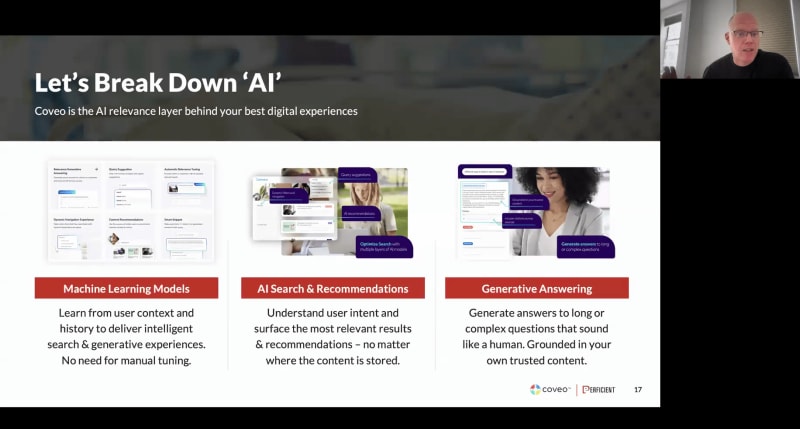
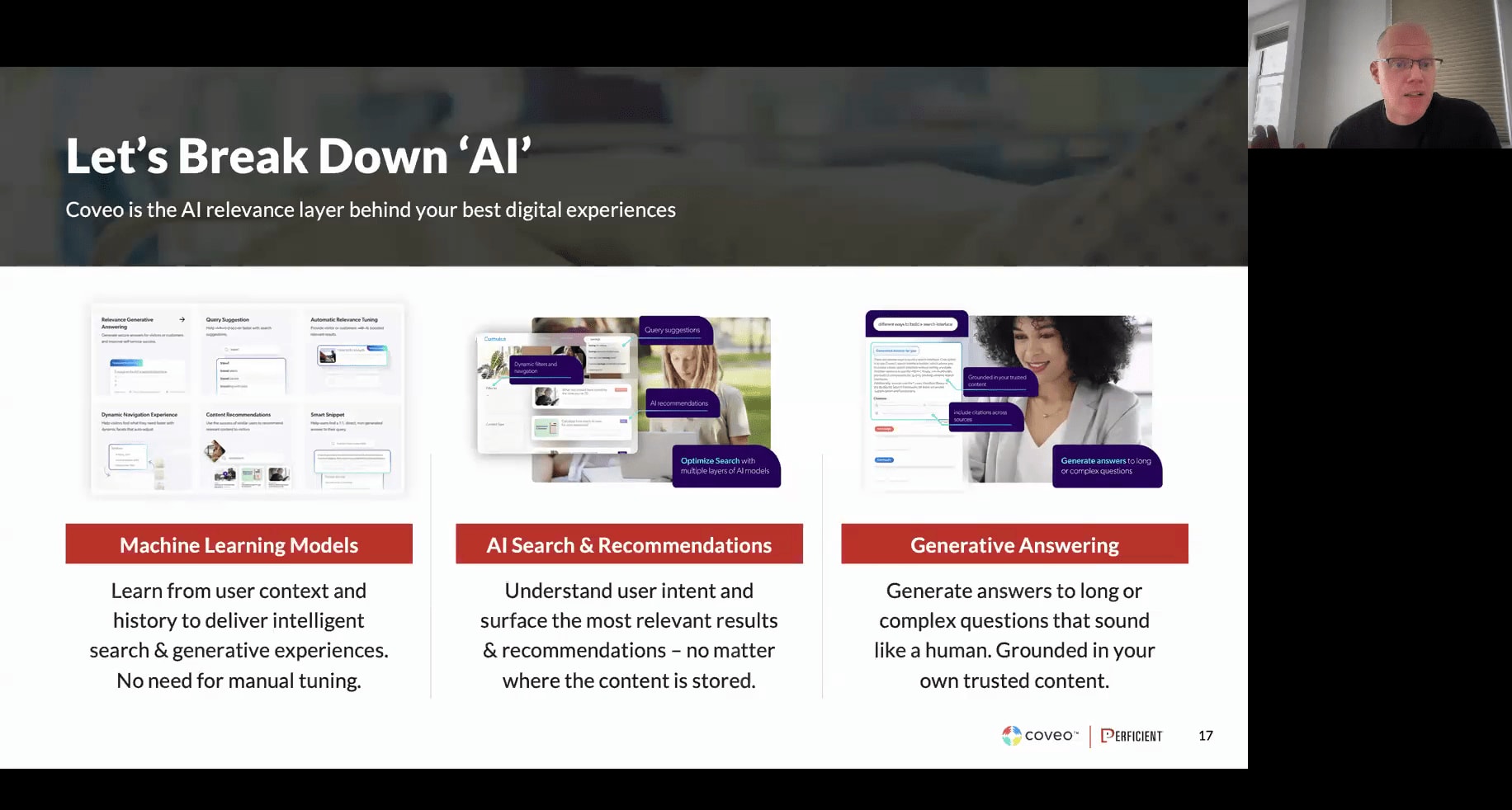
Welcome, everyone. Thank you for joining us on today's session, reimagining fine care, how AI is powering the modern health care journey. It's this today's session is brought to you by Coveo and Perficient. Choosing a provider is one of the most critical and personal decisions in health care. But when digital tools make that process difficult, patients walk away. Think about your own experiences. This may have happened to you or someone in your family. So today, we're gonna share with you how health care leaders AI St. Luke's health system in St. Louis uses a unique solution, to bring, more modern AI care experiences to their patients with AI powered search recommendations and personalization. We're gonna be hosting this webinar live today. So if you have questions, please ask them in the flow of discussion, and we'll do our best to answer your questions or, you know, incorporate, you know, your our responses into the talk track. If you have a question that we don't get answered or if you wanna have a further discussion with, someone from Coveo Proficient, we're happy to do that after the session. What's more, everyone, on the call today will get our copy of the recording as soon as it's available. But let's get started. We've got a great agenda for you today. We'll kick off with some introductions in a moment. We'll get into, why health care looks like commerce and what that means for us as health care leaders and as as digital leaders. We'll explore the AI care solution that Perficient developed, in partnership with with Coveo and others. We'll talk about St. Luke's experience using that solution, and then we'll talk about how you can get started and, of course, answer any questions. AI name is Mike Graley. I am the SVP of marketing at Coveo. I've been with the business for about fourteen years from start up till, you know, where we are now. I'm based in New York City. If you're not familiar with Coveo, we pitch Coveo as the AI relevance company. We believe that every digital journey really is unique, and that's why Coveo offers a platform that enables what we call generative AI search for enterprises. It's the only way we believe that digital leaders can solve that complex problem of creating a relevant digital experience at scale to meet the unique needs of every person, especially when you're you have millions and or thousands or millions of of potential customers and super large volumes of content and products. So, with that, I'd like to introduce you to my co presenter today, Tara Becker, who's a health care expert, who will be, leading us through the beginning of the session. Tara? Awesome. Thanks so much, AI, and and welcome everybody. We're delighted to have you here today. I'm Tara Becker. I'm a principal at Perficient. I am a health care strategist and consumer expect consumer experience leader, here at Perficient, particularly within our healthcare practice. I spent the last decade of my career working with health systems, payer organizations and life sciences organizations. And prior to that, I worked at Mass General Hospital in Boston for fifteen years, doing service line planning, strategy, digital transformation. So I've had a really robust experience of what it's like to be on the consulting side as well as what it's like to be in house. When I was at Mass General leading the AI a doctor and find care experience, although different back then, was part of my charge at Mass General. So this is a very important topic to me, very near and dear to my heart. I'm passionate about the patient experience. I'm passionate about, patient access, and find care is, the gateway to getting patients into your health care systems. And so we're really excited to talk about that today. So health care is looking more and more like commerce. So so what do we mean by that? Why are large health care systems investing in AI care experiences? Well, it's it's pretty simple. The find care experience is the closest to the commerce enablement piece of your digital experience that hospitals and health systems have. It's direct access to, patients, enabling them to get into your system. It drives revenue. It builds trust if it's a smooth and frictionless experience, and ultimately builds loyalty within your health care system. It's really the funnel to digital access for your patients. And so that's why it's really important to make sure that you get this right. You make this as smooth and seamless as possible. We'll talk a lot about, why this matters in the coming slides here. So here at Perficient, we conduct research all the time and and most recently, over the last couple of months, have conducted first party research with consumers who are searching for care. And what our findings, showed us is that forty five percent of consumers aged eighteen to sixty four, shared that they've chosen Digital First Healthcare in lieu of visiting their physician in person. They had a preference for Digital First Healthcare, and that number went up to fifty four percent when we're talking about caregivers in that same age group. Thirty percent of consumers indicated that they moved to a new provider if there was friction in their health care journey. So not just the digital experience, but their whole journey. And twenty three percent of respondents in our first party research indicated that they felt as though friction in their scheduling experience led to adverse health outcomes. And there's one more stat that I want to share that forty one percent of consumers have indicated that they will change providers altogether if the digital experience doesn't meet their expectation, and that comes from third party research. So this really matters not only to delivering a great consumer experience, but it really matters to the bottom line of health care systems. And the good news is that not only is this important to patients, but it's important to caregivers too. Health care systems, want to be delivering that same frictionless experience. They know that they need to be discoverable. They need to be easily findable because it improves health outcomes. It reduces the cost to acquire, patients, and it helps them grow their service lines. And patients wanna be able to just easily book an appointment. They wanna find what they're looking for quickly. They wanna get it in the way that they want it. They might wanna search by location, or they might wanna search by gender of of provider. They might wanna search by, service line, or they might wanna search by, languages spoken. They wanna do it the way they want to, find people, and they wanna do it seamlessly, as simple as, like, a Google search. Convenience is important both to patients and, provider organizations as well. They want to be able to have very simple things like appointment reminders. They want the same kind of experience they would get from, like, a DoorDash, or an Airbnb or an Expedia. They want appointment reminders, and they also want the easy ability to change appointments digitally if their plans change. And we know that patients that are involved in their care, show up more. They feel invested, in their care, and and they're not going to, just skip an appointment if they've actually been able to book it or change that appointment online. And from the provider perspective, they want to make it convenient as possible. They want conversion rates to go up. They wanna reduce no shows and ease appointment rescheduling, so that they don't have no shows showing up. They wanna make sure their patient panels are full. And both sides of the, of the patient and provider relationship want speed. Patients, of course, when they're not feeling well or their family members are not feeling well, feel a sense of urgency. They don't have time to wait on the phone for hours. Sometimes they don't even have the ability to call a health care organization during the business hours. And so they need to book appointments digitally, and they want this to be seamless. And providers want to enhance the quality of care. They want their patients to be healthy. They want their patients to be seen quickly. They wanna increase ROI and lifetime value of a patient and also make sure that patients are having a great experience so that not only are they receiving the care that they need and having the the health outcomes that are positive, but they're also delivering strong satisfaction scores. So the good news is that both patients and health care organizations are aligned in their expectations, around access to care. One of the things, we all know, those of us who spent a long time in health care is that the health care consumer is burdened with managing their own care, and they feel like this is tremendously complex. Whether they're trying to, book a virtual visit appointment or they're just trying to pay a bill AI, they're trying to find a doctor, they're maybe trying to find test results. It's very complicated. They're dealing with these matrix organizations that are very difficult to navigate, and they often feel very overwhelmed by this process, and they feel very confused and and very burdened by it. And so one of the, things we're trying to do with the AI powered AI care experience is take all the friction out of this journey, make this as seamless as possible so that health care consumers can really feel an ease. You know, a lot of times when they're dealing with health care systems, they're at the highest levels of stress of their lives. And we want to reduce that stress in their, in their life and we want to make this process as frictionless as possible. That does a number of things. Not only does it get them into your system as quickly as possible, but it also starts building trust. And we the way we think about, interacting with health care organizations is every interaction is an ability to build trust or build distrust. And we really wanna start solidifying those trusting relationships so that we can be building long term loyalty with our engagements with health care consumers. So this is what the AI care experience is intended to do. It's really the door to the patient journey. So if you think about all of those circles that were on the previous slide, whether it's finding a doctor, booking an appointment, whether it's, trying to find a test result or figure out whether I should go to urgent care or the emergency room or just wait a couple of days and see my primary care physician. The AI care solution is smoothing out that experience, creating, a system that acts as a guide for patients to enable them to get in quickly into the right door within the health care organization. So outcomes. Let's talk about outcomes in patient centricity for a second. Seventy two percent of patients and sixty percent of health care professionals say online appointment booking platforms not only encourage, patients to book those appointments that they might be hesitant to book, but also keep the appointments. And that has real impact for health care organizations. From a revenue perspective, increased appointment completions, generates revenue for the organization, making sure that appointments are full and that patient schedules are full and, no shows, are not, regular. That also, drives revenue and also enables health care organizations to off optimize their staffing. If they know that their patient panels aren't gonna be full two weeks from now, they can change their staffing, which will reduce cost as well. From an operational efficiency standpoint, the AI care experience enables, health care organizations to be more efficient, to be more AI in their operations. By enabling things like self-service, it takes the burden off of administration, takes the burden off of staff who are already overwhelmed and and overworked and have too many, too many things to do in the day. It cuts operational cost. It offsets call volume to the call center, and this is a really important, component. We're not just trying to offset call volume to the call Agentic, completely. We wanna make sure the right calls are getting into the call center. The calls that need high touch white glove service are getting into the call center, and the more routine, health care needs and health care appointments are getting enabled through digital self serve champ self-service channels. And we wanna simplify the appointment booking process. It should not be super complex with twelve different steps. We wanna make it very simple, one or two clicks, and we can have that appointment, booked as quickly as possible. And of course, at the end of the day, we wanna make sure health outcomes are strong. We wanna make sure patients feel empowered with self-service tools. They feel like they're a part of their own health care journey. You know, we've talked a lot in health care industry about patients being the most underutilized resource in healthcare. Well, AI care enables patients to feel like an active participant in their care, like they have control. It enables patient satisfaction, which is key. You know, if we think about provider ratings and we think about, review and ratings, holistically in in all of our lives, whether we're, you know, looking for a restaurant or, figuring out what hotel we want to stay in as we travel. Ratings are hugely important in that. That's very much true in a health care setting as well. Of course, we've been talking about easing access to care. We want patients to get to the right doctor at the right location at the right time. That's important not only for patient outcomes, but it's important for the operations of the health care system. And we wanna make sure at the end of the day, patients are supported with better health outcomes. They're feeling well. They're getting the care they need. AI, I think I think this slide sort of says it all. There are tremendous benefits to having an excellent AI care experience. Convenience really does drive action. It it allows you to, you know, as Tara shared, fill your slots. Empty slots are not generating revenue. It lets you reduce the burden on your staff, and more important, it empowers your, you know, self-service experience, empowers the patient experience. It lets you take control of your own care more. I can speak for myself. You know, being able to book, reschedule, cancel appointments easily just makes me, you know, much more involved. So why don't we do this everywhere? Well, Coveo did a study actually across multiple industries and and found this was in twenty twenty four, so recent study and found that most websites, most digital experiences are missing the mark. A high percentage of visitors to most websites, health care provider, payer, you know, ecommerce, etcetera, are are having a hard time when they go online. And what what's happening, essentially, these sites don't offer great navigation. They don't offer great search. They may not be mobile friendly. There's irrelevant recommendations, which for a time was okay. But now with the advent of answer engines like ChatGPT and Google Gemini, etcetera, visitors aren't even making it to your site. Many brands across, you know, across the world are losing traffic to those answering engines. I've heard actually yesterday is that one of our our customers has lost thirty five percent of their traffic to answer engines. So that creates a real need for your website to do a much better job delivering on the experience that your your patients or your visitors are coming to expect. What's more, health care is deeply personal as Tara shared with us. When we're looking for care, we're vulnerable for ourselves, for others. We're looking for conditions that we certainly don't wanna have. And it's an opportunity, we think, for health care leaders to improve the relevance of their sites, of their digital experiences to begin that care experience online. It really makes me think, well, you know, what if that care experience did begin online? So as Tara mentioned earlier, finding care is becoming more like commerce. That means your provider directory and your appointments are are sort of your products if you think of it that way. Most people when they're visiting provider pages or listing pages are not there to casually browse. They're there with intent, intent to seek care, intent to, you know, potentially find a provider that's gonna make sense for them. So it's your opportunity on those pages to show your patients that you understand their needs. You know, some of the things that you can see here are, you know, do do you need an appointment today or tomorrow? Are you looking for highly specialized care? Are you looking for a generalist? Do you need a location that offers the fastest access? Are you looking for a new patient or a provider who's accepting new patients? Are you looking to discover related content potentially to a condition or a medicine that you are, you know, being prescribed? You look for somebody who takes a a specific insurance provider, which matters a lot to many of us. So this is an opportunity to take advantage of all the data that you have about your providers and your business and make that all available to your your patients so they can discover what's right for them. However, we, of course, need to balance this amazing patient experience with, you know, in patient convenience you wanna offer with your goals. This, you know, Tara's talking about, essentially AI we do this. It's for you know, to generate revenue for our organizations. So this is an opportunity for you to think through how you can essentially fill as many appointments as possible, you know, with with the digital experience you create. So we recommend establishing goals and measurements so you can watch that journey along the way and and learn how you can improve that digital experience just like an ecommerce merchandiser might. So, Tara, do you wanna share a little bit more about the AI care solution? Yeah. Absolutely. So, if you think about the marketing funnel, it really starts at the top with with awareness, and and, ultimately, the end goal is to get to conversion at the bottom. The same is true for our fine care experience. We are at the top, you're thinking holistically about fine care. At the top, we're thinking about awareness, omnichannel promotion. So this is email. This could be digital advertising. This could be social. This could be any number of things, direct mail. How are we creating awareness of your health care system at the top of the funnel so that when patients do need care, you're the first organization they're thinking of, for their care needs. Some patients are already involved in a health care system. They've got all their care at one particular system, but that's not true. We know through research that some patients will go wherever they can get in most quickly. So awareness is is the first piece of the puzzle here. The second piece here is really the AI care engagement. How do you get patients quickly from that stage of awareness into the AI care engagement? And so we don't wanna bury fine care within your website. We wanna make it very prominent, easy to get to. So there will be some cohorts of patients who are really looking to do some exploration. They they've got a diagnosis and they wanna learn more about their, their diagnosis. They want to know more about their options and and what is the latest research on it. But there are a lot of patients who want to get quickly into AI have a diagnosis or I have an ailment, I have an issue and I need to find a doctor quickly. So how do we get them very quickly into the AI care engagement part of your web experience? From there, we wanna match them quickly as we've talked about here to their, provider how they wanna be matched. So whether that is, looking at, a virtual visit, whether that's looking at a specific location that's closer to their home, or maybe they're a highly complex patient with a very complex AI. And so they wanna look and see what their options are. Regardless of how they're searching and how they wanna engage with AI care, we wanna serve it up to them in a way that's relevant and has meaning, and drives them into booking an appointment. That booking an appointment channel is really important. This is where we're really thinking about things like mobile and mobile, experiences here because we know a lot of patients are searching. When they're searching, they're searching on their mobile device, and they wanna book that appointment seamlessly through their phones or their mobile device. We're also looking at we'll talk about this when we talk about the St. Luke's case study, guided experiences. So a patient might think, I I know I need this very specific appointment. I've gotten my, diagnosis. I need a referral into this specific, service line or physician, or others might be a little bit more apprehensive. They might need a little bit more guidance. And so we have created a, guided experience for the AI care. And like I said, we'll talk about that in a little bit. But at the end of the day, we wanna get that appointment booked quickly and seamlessly. And then most importantly, we want that visit attended. So we're gonna provide nudge reminders. We're gonna provide things like directions, where to park, transportation options, local amenities, visit specific content, and make sure that the whole fine care experience is not just getting patients to book the appointment. It's everything through the whole conversion funnel from awareness all the way through, through the, visit attended and all of the information that people could need through that whole experience. We want it to feel very benevolent, and we want it to be easy. So in terms of how we get started with actually building out these fine care experiences, We start, as Mike was talking about, a couple of slides ago, we start with goals and KPIs. What is the North Star strategy for our fine care experience? And we align that with the organizational strategy. So some organizations are aligned from a strategic standpoint around the revenue generating service AI. So cardiac, cancer, orthopedics, GI, neuro, and those are their priority businesses. Those are the businesses where it's really important to, get those, patient panels full. Other organizations have different priorities. They might have priorities around, pediatrics, or they might have priorities around women's health, men's health. And regardless of where those priorities lie, we wanna know those priorities. We wanna make sure that the strategy is aligned to drive those, key business results. We wanna look at platforms and make sure that your platform's AI, and we'll talk about platforms in just a minute. But, from a DXP perspective, it doesn't matter which digital experience platform you're on, whether you're on Adobe or Sitecore, Acquia, Optimizely, WordPress. The AI care experience works on any platform, which is really key here. But we wanna make sure that we have the right platforms, underneath the hood. We're aligning to things like Cerner and Epic and, making sure that all of the technology behind the scenes that are is powering the AI care experience that we're looking to drive. Most importantly, we wanna make sure we're defining the user experience. So who are your priority audiences and what are their needs? A cancer patient is gonna have very different needs than our primary care patient. A primary care patient is gonna wanna get in as quickly as possible. A cancer patient's gonna wanna find the right combination of care team to enable their care journey. So we wanna make sure that we're defining those journeys and making sure the journeys are aligned with the expectations of consumers, whichever door they're coming in. We wanna make sure we're looking at the content. We're auditing the content that's being served up in the AI care experience. That might be the physician profile. That might be the surrounding content in the fine care experience. AI make sure it's relevant. It's updated. Physician profiles are robust and start building a sense of relationship and connection with patients. And then we wanna make sure that the data strategy behind the scenes is serving up the right information and driving consumers to the right experience, throughout their journey here. From I was just gonna go to the development build, section. In some cases, our clients need to acquire new licenses to set up the system. In some cases, we just need to modernize the system. We wanna look at creating the site framework, integrating all of the systems, and we'll talk about the systems, in a couple of slides. And we wanna make sure that, as as Mike said, we think about this not only as a set it and forget it experience, but we think about it as a product strategy. Make sure we once it goes live, make sure we're measuring. Are we driving the outcomes we're intending to drive from a business standpoint? Are we doing user testing to make sure that patients are having the seamless experience? Where are their friction points? Where do we need to ease the journey? And it's a continuous cycle of improving the product here. Now we can move to the next slide. So if we think about the strategy, at the end of the day, what we're trying to build is a capabilities, a capabilities matrix here. At the top here, we're looking at all of the consumer experience pieces of the experience. We're looking at find a provider services. We're looking at appointments, patient referrals, location finder maps, the unified search experience, virtual assistance, and guided journeys, personalized campaigns, and how it links into MyChart. And when we think about AI care, you know, historically, we've thought a lot about the find a provider. It's a directory, find a provider, but find care is much more sophisticated than that. It's taking into account all of the aspects of the digital experience and streamlining it for the patient to find care as quickly as possible. Moving down a level here, it's not only taking into account the back end technology, but considering what is that front end experience? How is that being powered by intelligent search? How does this align with my marketing automation program so that we're driving the right kinds of consumers into this fine care experience that are ultimately showing up for appointments and getting the care they need? What is the content surrounding all of not only the AI care experience, but surrounding my whole digital infrastructure and my whole digital strategy? And what are the analytics? How am I measuring this to make sure that we're driving the right kind of, goals throughout in the right kind of revenue generation? And then if we think about the whole lifetime value of the the patient or the health care consumer, how are we thinking about them as they move throughout our organization, not just in this moment of care, but throughout their whole care experience with our organization as it relates to things like CRM and Salesforce and AI and and integration of the lifetime value of the customer. Makes sense. And we'll talk in the case study to show how the intelligent search box is more than just a box on on this slide, and it it it importantly connects not only what your patients and your site visitors are looking for, with what they need, but it also integrates content, across, you know, the entire spectrum. So provider data, content from your CMS, could be appointment data, location data, etcetera. So Coveo or intelligent search, I should say, unifies all of that information and brings it to people in their moment of need based upon what we can understand about their needs. So this this is a you know, this slide, I think, gives you a sense of, you know, why this is so hard because it takes the coordination and work to create those, those effortless easy experiences online. When we talk about intelligent search now or AI search as we're as as the category is becoming called, we're seeing digital leaders across, you know, multiple industries, including health care, are adopting this approach to, essentially, you know, use an existing framework that that we all know well, and this we call the intent box. So we go to most AI. We go to most browsers and type in what we're looking for. So it starts with a search, a query or question or an AI suggestion, all drives the the experience. We believe you know, we're saying here that this is the the universal DX content engagement paradigm, but, basically, it's how we we know how to interact. Then the first results that could come from an intelligent search platform could be generated answer coming from the trusted content that you, have chosen to feed the, feed the search engine with, including AI sources and citations for credibility and trust so you know where the the answers are coming from and only there to prevent against hallucinations, which we'll show an example in a minute how that works. Shows ranked and relevant search results. You know, basically, the core results that you're used to seeing and have been seeing for the past twenty years from, you know, providers like Google. Dynamic navigation facets so you can filter and really drill into what you're looking for, and then some additional features which you, you know, are possible. You can add relevant paragraphs. So if you're looking for a very, very specific thing, why not just provide the answer right there in the in the flow of the journey? Next best questions or follow ups, and additionally, you might also like. So this is a very, very familiar experience that most of us, are interacting with every day. It's possible to add that to your own digital experiences. But we talk about AI, and I'm I'm I'm I think we should take just a moment to break down what this means. So we're not adding AI in in at least in the context of intelligent search to health care. What we're adding AI is to the content and the journey, of the digital experience your patients will have using only your own trusted content. So in terms of machine learning models, this speaks to a capability of the platform that learns from user context and history to deliver intelligent search and experiences based upon what has made other people like you successful in the past. We'll show some examples of this, but this eliminates the need for manual tuning. You can tune, these tools, add, you know, for example, a custom thesaurus, etcetera, but you don't need to. The system will learn over time that, let's say, AI care means family doctor. You know? They can make that association over time on its own. AI search and recommendations speak to capabilities that surface the most relevant results and recommendations on the slide that I just showed you earlier. No matter where the content's stored, you don't need to search into multiple locations or systems that all that indexing was done upfront so that all the user needs to do is is just interact and then find whatever they need. We like to say that if the information exists but can't be found when a person need it needs it, the value of that information drops to zero. And if you think about the millions that you're likely your many health care organizations are spending on patient acquisition, so billboards, advertising on TV, campaigns, SEO, etcetera, to get a person to your site and then not deliver something that should be available to them, that's a difficult situation to be in. So it really improves relevance by adding AI search and recommendations. And then generative answering, this is generating answers to sort of longer complex questions, but based upon your own trusted content. Patients likely are, I can speak for myself, using CHET GPT to ask questions. What does this mean? You know? What does this condition mean? I've done it before. I'm sure others are. But wouldn't it be better if they're asking the question of your of your site using your own trusted content, grounding in the data, putting guardrails around the answer and how that that answer should be interpreted? These are all possible with technologies like Coveo. Tara, I'm curious. What would you add here? I was just gonna say, what I would add here is, this is really, hammering home the importance of a strong content strategy. And in a lot of health care organizations, put a lot of effort around their content strategy. But there are many, many health care organizations who have just layered on content over time. It happens everywhere. Content just gets added for a variety of reasons. Sometimes it's political. Sometimes it's, you know, we didn't know where else to put this. It's really important particularly with, AI that content strategies get really scrubbed, and you're really making sure you have relevant content. You're sunsetting the old content that's no longer relevant because the way that these, these experiences work is really making sure we're serving up and and we keep using that word relevant. If the feedback coming back to users is not relevant, that's eroding trust, and they're gonna start thinking, well, if I can't even do a Google search or I can't even do a search on this hospital website, how am I gonna trust them to provide me the best care possible when I'm at the most vulnerable in my life? This stuff really matters. And so I think, the the plug I would make here is that your content strategy really matters. And taking a look at, taking a look at the content, making sure that all of your content is relevant, all of it is aligned to the strategy that you're trying to drive, all of it is aligned to your service line priorities is is really critical here. Yeah. Indeed. I I think maybe we could take a look at an example possibly outside of health care to to ground, you know, this and, you know, and and bring it to life for folks. I I've got an example from a a brand that we all likely know well. It regulated industry, so this is United Airlines. They have taken the decision to let their customers ask questions about upcoming flights. This is an unauthenticated experience. If you log in through their mileage press program, you get one that's a little bit more contextual to you. But in this case here, you know, we're asking a the person asked a a simple question. Can I fly with my pet? So there's, consequences of giving a bad answer to questions as you know. But in this case, the United has a content strategy that that gives trusted content to Coveo and the LLM to provide an answer here, which says, yes. You can fly with your pet on United and United Express flights as long as your destination allows pets. Okay. That's a good answer, but it's not the complete answer because I'm going to Guam. So can I go? If you scroll further down the page on that that paradigm like I showed you earlier, you could see that indeed, yes, I can fly with my pet to Guam. And I can bring my my pet on flights to Guam, from Guam to Tokyo, which is great, and I cannot, and there's more additional details there. I didn't need to ask further questions, but by providing both the generated answer and then this rich text answer here, I'm able to see more data plus additional follow on information. People also ask additional, you know, travel requirements for, you know, for my animals and, you know, some interesting questions. Is there anywhere I can't fly with my service dog? So people are asking all sorts of questions. This is the type of paradigm, that that makes it easy for people to interact with your content. But, again, it goes back to what Tara was saying. You need to have you know, this is an opportunity to have a strong content strategy to answer all these questions that people may have. What's more, what happens if you get a weird question? So in this case, the question, can I fly with my kids in a checked bag? Legitimate question, you can go to United's website and ask it. United has taken a decision not to directly answer the question, but they're protecting against, hallucinations and weird questions. So they're saying here AI try asking a a question instead to get a quick answer. That's the that's how they're handling it. But, it's possible to put guardrails around this type of technology to be sure that you do not give a give a wrong answer, which I think is important. So if United is able to do this, we're seeing more and more industries adopt this exact type of technology in this approach. And I think that's really important in health care. I know there's, there's a lot of sensitivity around health care and and health care information that shared with with, consumers and and making sure that, it's it's the right kind of information. So I think those guardrails are critically important, particularly when we're thinking about health care. Exactly. So so with a platform like Coveo, essentially, think of it as, like, the the digital relevance layer that connects what your your people need with the information that you have and then understanding how it works with analytics. It unifies your content, your product listing pages, your provider listing pages, shows visitors that you understand them and and is it is the more they interact with the site, the better it will get. You'll get value from day one because those out of the box machine learning models are in place and have been tuned over decades with, you know, large enterprises. The platform itself is HIPAA compliant, which allows you to not only have confidence that, you know, health care data is being treated well, but also additional, security controls to make sure that, you know, you have enterprise grade security across any use case even if it is just on the the pub the public site. And it's backed, by hundreds of customers and, you know, has been endorsed by organizations like Gartner and Forrester. So this is the type of platform that, that really makes a difference. And I think it's some of these capabilities or why Perficient has included Coveo in the, the solution. So let's let's talk a little bit about the St. Luke's, St. Louis case study. So, Tara, pass it back to you. Sure. So, we've worked with St. Luke's for a number of years now, and and, they engage proficient, really because their digital experience was, quite out of date. They were losing, patients through leakage because patients could just could not get into their system. Their content strategy was very convoluted. It was very difficult to figure out how they wanted to, display their information, where patients could get care, how they could access the health care system. It was just very complex and, very, kind of, very outdated. So we worked with St. Luke's to do kind of a five part strategy. We wanted to deliver a consistent digital brand experience. So St. Luke's had, opened a number of, urgent care facilities, had acquired a couple of hospitals, but the branding was was kind of all over the place. So we really wanted to create a consistent digital brand experience so patients knew whichever door they're entering St. Luke's, they were indeed at the St. Luke's they're intending to be at. We wanted to make sure that the digital experience exceptional care experience. So if you if you talk to St. Luke's patients about their digital experience, they'd say it was terrible. It was a disaster. But if you talk to them about their care experience, they would say it's it's it's the best. Our caregivers are just absolutely wonderful and so caring, and I feel very much, like I get a strong sense of compassionate care. So we had these AI of two disparate experiences. Number two, we wanted to enhance patient access and drive acquisition via digital channels. Coming out of COVID, I know we're we're several years out of COVID, but health care systems are still feeling, the strain of AI being overburdened, of health systems not having the staff that they need, the call centers being overwhelmed. And and so they were really looking to drive, some amount of the the patient volume through digital channels, and and we'll talk about a bit about that. They wanted to modernize the technology stack, so, they wound up going with, Adobe as their DXP. And as we looked holistically at their their complete technology stack, we also recommended Kaveo as their their search appliance, not only behind FindCare, but behind their whole website. And we can talk about that in a little bit. Ultimately, they wanted to reach and engage a more broad, cohort of of health care consumers. They wanted to expand their reach, and they wanted to expand their market share and be the preferred hospital within their, their region. And in order to do all of this, they knew that they needed to unify their data, in order to streamline their patient journey, but but not just their patient journey, be able to streamline the insights they could deliver back to the organization to show ROI. So just to give you a context of kind of how our fine care, fine care experience evolved, we we started with this strategy with them. And in every every client looks a little bit different, but this is where we started with St. Luke's. So if you look on the right here, this was the experience that St. Luke's had, right up until about three months ago. It was very dated as you can see. This was a snapshot of of their home page. And, you know, so if you can imagine being a patient, if if you come to a home page that looks like this, you think, oh, boy. What kind of care am I receiving at this organization? So they had a very disjointed and confusing, physician AI physician finder experience. You could not schedule an appointment online. They had kind of a separate scheduling experience, which was even more confusing than not having one at all. They had a very, out of date content. Their search appliance didn't work. The filters that they had on their find a doctor search were were far too restricting, generated, very irrelevant results. Their mobile experience was, not, was was not up to par. It, it was not responsive to their website. It was a a separate mobile experience that had to be managed separately, and and there were no clear calls to action throughout the site. So you can imagine they were starting from a very, precarious position, and, there was a lot of opportunity to to improve them from a digital strategy perspective. Amazing. And they're on a journey. So, Tara, you said they've been live for just a few months now. Let's take a look at the the site that they launched. Oh, actually, before we get there, let's we'll talk about the strategy first. Sure. Yeah. Yeah. So just to give you a little bit more context, the previous slide is where they started. The strategy we put in place for them, we started with, what we call ideation and planning, started with a visioning workshop to really set a North Star strategy. We want to align on the organizational, goals and, really kind of set a, a maturity standard for where they were today and then where they want to be in twenty four, thirty six months. And and so we established a a North Star strategy for them looking at, their whole consumer experience, AI care, being a very important part of it, aligning the the business challenges they had with the technical challenges, operational, which is a really key part of the whole fine care experience. It's not just about setting the technology and the experience in place. You need to make sure that the operations can drive that experience. And and for St. Luke's, it was a cultural change for them to to go through this journey as well. We did a deep dive on, consumer and competitive insights with St. Luke's. We did a lot of journey science with their priority audiences to understand how consumers were interacting with their organization, what their friction points were, how they wanted to interact with their organization. We gained a lot of insights. That's really where we gained the insights that, patients felt like they had amazing in person experience, but a terrible digital experience. We really need to align those things. From a AI standpoint, we, visualize the reimagined AI care experience, through wireframing and and prototypes, in a very kind of agile fashion. So we weren't designing everything soup to nuts day one. We really wanted to have an agile process here that we were able to use our test, and make sure that we're driving the right kind of experience. We looked at target state target state and reference architecture. So what are the technologies behind the scenes that need to power the digital experience? We tailored our recommendations. So they had a couple of, custom apps that they had developed that we needed to incorporate into the target architecture. Cerner was their EHR. We really wanna make sure that all of these different technologies were aligned. And then from there, built a strategic road map. So day one, the site went live. A lot of what they they wanted to do, was launched day one, but they have a long term road map. They're not gonna be able to do it all day one, and I think that's a really important takeaway. You don't need to do everything at once, in order to improve your experience, but you do need to take that first step. And then, most importantly, we establish an outcomes dashboard for them. So prior to their recent launch, they were tracking things like, you know, impressions and and the the typical kind of historical metrics for a website, but we really put in place a much more, business focused outcomes dashboard and road map that enables them to report back up to the c suite to say, look. We're not just a cost center. We're actually driving revenue for your for the organization. So I think this is a really important part of it. You you can, shift to the next slide, but that that's a really important takeaway. You can plug in whatever technology you work, but if you want, but if you don't have the strategy that's powering that technology, you're gonna be really inhibited. As part of our AI care experience, we built the architecture with Kaveo's AI search, to enable a unified view, and to be able to access information from all these disparate systems. And I I think that's really kind of the differentiator here and and the key takeaway here is that Coveo can access information from all of these systems to be able to serve up the right information. Again, like Mike said, putting those, those, parameters that we wanna put in in those guardrails in place, but having access to all the disparate systems, health care systems have tons of disparate systems, and and making sure that we can, connect them all through AI powered searches was a key part of, the engagement with St. Luke's. Amazing. So now we can take a look at it. So if you remember the the before picture, which certainly had a a, you know, some areas to improve to now the the new site, which has been live for a couple of months now, will will focus mostly on the engagement layer just to give some examples of what this looks like. On this homepage, there are many opportunities for a a visitor or patient to find ways to get care. They can, you know, schedule an appointment, visit a primary care doctor, find urgent care, search the AI, and etcetera, and then there's additional calls to action up top. You really can there's many, many, many ways that people in this front door can find, care. And it's really reinforcing easy access. Remember, convenience drives action. So let's let's take a look at some of these examples. And the first example, I'm looking for a family doctor. I didn't even finish writing that in here, and, this the, AI has started to suggest, essentially queries that might meet my needs, family medicine, primary care, etcetera. This is based upon, you know, relevant queries from others' prior successes. This improves over time. This is one of the machine learning models that we talked about earlier. Now if I am looking for primary care while I in this case, I've I've switched my query to primary care. I'm looking for a provider. I'm able to tab across the top like you might be able to like you might expect. But I'm looking for primary care AI, and I'm looking for you can't see this here, but soonest available. So I'm looking for an an a AI who's gonna meet me soon. This was a dated screenshot, but you get the idea, where I can click here and set the appointment. Additionally, I have the ability to, filter to show only those providers accepting new patients, online scheduling that are part of the medical group. If they have a video introduction, maybe that's gonna help me get to know them a little bit better. This is completely customizable to your own content strategy. So as you build content, you'll be able to understand how well these guides actually help people to meet their, you know, meet their needs of finding a provider online, and and more. So I can also find I should call out, you know, my location. Find me the the provider that's closest to me. As a business, you have the ability also with some of these filters to boost things that matter to you. So for instance, you have, some new providers or providers that are starting to accept new patients, offering to show only those things that meet the needs of your business, those that are offer online scheduling only, etcetera, you can have essentially the the site, you know, boost or bias, those results in the the search page, which allows you to balance both the needs of personalized results and the the outcomes of your business. You can redirect patients. So in this example, you know, I'm still looking for family medicine, but I'm looking for soonest available. In this case, the soonest available actually is the urgent care center. So I'm being recommended to go to urgent care rather than to book appointment with a specific provider. You can boost other you have full control over what gets boosted and and buried just like a merchandiser might of their ecommerce experience. So, you know, depending upon the needs of your business, for for example, seasonality, if it's flu shot season, you can have a persistent, boost of, you know, get a flu shot, here are some up open appointments, etcetera, Whatever makes the most sense for your business at the time. And then AI, you know, I wanna show how the dynamic navigation works. In this case, I'm gonna show you two queries here. I'm searching for an annual physical. And in this case, you know, family care providers, in this case, accepting new patients are are boosted, though I didn't have to select that. And you can see in the additional filters below AI care comes up, and there are eighty providers from which I can select. So then I'm able to to drill down further on those. Again, I'm I've selected soonest available here. What's more, if I search for obstetrics, it brings up a different set of providers entirely. It sorts them again by soonest available. But if I wanna drill down into the into the, forty or so other riders available, I have the ability to do that. So, essentially, the site tunes itself based upon your need and allows essentially the patient to guide the navigation itself. We talked about location, same same, opportunity here to allow you to sort on locations, you know, to so patients can find, you know, the locations that are near to them, etcetera. Of course, Google Maps allows this, but if you're in the context of the of the flow, you wanna know which locations offer which services, and you can see, from there. What's more, and we won't go into a ton of detail on this today, but Cabello offers analytics that allows you to understand, you know, like Tara was talking about the North Star metrics, but even some detailed metrics, so you can understand how people are interacting with the search, interacting with, the capabilities that you have. Are they finding what they need essentially? So we talk about this in terms of usage trends. There's another area called content gaps. What are people searching for but then not finding? Where are they searching for something, getting either no or limited results, and then bouncing? You have the ability to really understand that, which can help you guide your forward looking content strategy based upon the real needs of your actual patients and visitors. And then you could look at other analytics AI clicks on requested appointment buttons that don't manifest into an a a confirmed appointment, hovering over provider emails or numbers, which may indicate some intent to call or email or use another channel to reach those folks. All of that data is available to you, through Coveo. So let's talk about Oh, yeah. Yeah. Go ahead, Mike. You can No. No. You you can get started. Sorry. So when we think about, best practices here, as you think about, your fine care experiences, I would say, you know, there's there's three things to really, there's there's a lot of things to focus on, but three things to really hone in on. Focus on your data, your data integrity, and your data management. You can think about this as, your content strategy as the data feeds coming into this experience and make sure that that is really sound. The experience is only as good as the data, that's flowing back out to your health care consumers. Plan for a rigorous design process. And and by rigorous, I don't mean long. Rigorous can mean can mean long, but I mean really, kind of an agile design process. You wanna make sure that, the experience that we're displaying out to health care consumers is indeed meeting their expectations. So, be flexible, be agile, be willing to make changes in the design process to be able to, drive conversion and and to drive the experience that you're looking to AI. And carefully consider the connection points, and and this is really a critical piece. And and I think, really the power of of using Coveo as your your AI tool here. But it's connecting the DXP with Kaveo with all of the APIs we know that, are required in a health care setting, making sure it's connected into things like, your EHR or your CRM and and really making sure that you have a really sound reference architecture as as you're thinking about your AI care, in in your digital experiences here. And make sure that, I would say, I would add one more, best practice here, and that's make sure that you're reporting back to the c suite. Make sure that you're really positioning, this piece of, of your digital experience as the revenue driver, as the access driver for your organization. It really is critical. So oh, go ahead. You go. Yeah. You go for it. I was gonna say so for St. Luke's, I I mentioned they're, they're on a journey, and and so we launched their site, a couple of months ago. They're having great success. The next thing that they're they're building into their experience is more of an agentic, experience, more of a guided journey, where if patients are, very sure of what they want, they can quickly get there. But if they're not sure of what they want and they wanna have more of, you know, like a conversation without calling into the call center, they can have this conversational, experience through a guided journey, through a digital, AI powered journey here that really is powered by the Kaveo platform. Like, I don't know if there's anything you would add here. No. Exactly. So it just shows the flexibility of the UI. Again, so Coveo brings the UI but takes information from wherever it is, bringing it to people in in the most personalized way possible. So this this conversation is is an an example of that. So in the this center here, it's my situation is urgent, recommends urgent care. This one is looking for, you know, best location. It's it's the same information, just a different way to access that. I think the, the thing that comes up for me is the there's a lot of potential, but, like, we don't have to do everything all at once. Tara, could you talk about how, you know, Perficient and and St. Luke's work together to break this into chunks over time? Yeah. Absolutely. And AI think, you know, if there are two key takeaways from from this whole talk is, make sure you invest in your fine care experiences. It matters to your patients. It matters to your bottom line. That that's number one. Number two is you don't have to have your entire act together to do it. Just make the first step. And it is a journey. You don't have to do everything day one. Really start. We talked about the strategy a a couple of slides ago. Start with that AI care strategy. What is your North Star? What are your priority businesses? Who are the users of those priority businesses, and what are their needs? And and build out not only the, the journeys for those, those priority audiences, but also what is the technology infrastructure needed for that. That that's really the first step. Then think about unified search. You think about find a doctor, find a location, services relevant, relevancy, personalization, making sure all of that is aligned to drive the kind of, the kind of experience that your your users are looking for. And more importantly, the kind of experience that's gonna drive them into your system and is gonna start building trust, start building loyalty, and at the end of the day, improve their health outcomes. You know, a lot of health care organizations are hesitant for a lot of reasons, and I understand AI worked, in the health care side of the business. I was at Mass General for fifteen years. I understand the complexity of displaying, in enabling patients to book online. I understand some physicians don't like to open up their schedule, but this is becoming stable table stakes. There is no longer kind of an exception for health care organizations. Other health care organizations, they don't have to deliver the same kind of experiences as I would get from Airbnb or Expedia. That that's no longer acceptable. So I would say really push your organizations to open up schedules, enable, where appropriate. There's some service lines that's not appropriate. It's not always appropriate for a cancer service line to book appointments online because it's highly complex. But where it is appropriate, like find, primary care, family medicine, the more kind of transactional pieces, open up those appointments and let people book online. Look at things like virtual agents and and really continue down the journey. I'll just go quickly here. Think about AI guided search. Think about, AI based relevancy and personalization and then, you know, things like generative AI and and how that can ultimately, power your user experience over time. I know we're running short on time here. So Amazing. Yeah. No. It's it's it's such great content, and thanks everyone for for your interest. So in in terms of the solution, Perficient and Coveo have been working together, on this solution. And you could see some of the example, you know, AI organizations, that, are using both of these technologies now. And and that you know, as as Tara mentioned earlier, you can use any DXP. Really, Adobe, Acquia, AI, Sitecore. I I know St. Luke selected Adobe, AEM for for their platform, but, essentially, the the solution works, anywhere. Is there anything you'd add, Tara, to this? No. I I would just say, make the make the step to do this. If you if you think about, your Perficient team, we're highly skilled health care strategist. The health care practice at Perficient is, comprised of people who have spent decades of their career within health care systems, payer organizations, life sciences organizations. So make sure that you're bringing in people who know health care, because it really matters when you think about not only the experience you're delivering, but you think about things like security and compliance and, connecting into things like the electronic medical record and, all of the different API connections that need to happen from a health care, perspective. If you think about Coveo, it really is a powerful tool. The AI relevance is is critical in in building trust with your health care consumers and building those experiences. And, from a DXP perspective, it can work on anything. It's really the the caveo and and strategy piece that that drives the outcomes. Amazing. So, I think we have just a few moments to to to wrap up, Tara. Before we do, I wanted to see if we can get to one question, if you don't mind. Of course. Go back up here. I should have had it at the ready. Could you talk a little bit about the the content strategy that, St. Luke's had? Sure. So where we started with St. Luke's is, they had kind of a hodgepodge of content over time that have been built over time. We started with a content audit, looking at all of the content on their site. And we evaluated their content from a performance standpoint. We evaluated it from a a relevant standpoint. Is it meeting the expectations of the personas in in their user journeys? And is it AI to conversion? Do people know what step they need to take next in their journey? And so we evaluated all of their content from that perspective. St. Luke's had a number of key priority service lines, and and we started with those key priority service lines to make sure that that content was, not only tuned to be relevant, but also had very clear calls to action. I think that's something that often gets missed in in particularly in health care because you have a lot of really smart scientists who wanna get their, their information out there, but it's not always relevant to health care consumers. So really streamlining the content to make sure it's relevant, and driving to conversion for for the health care consumer. That that's where we spend a lot of time with St. Luke's, making sure that, their priority businesses had a very sound content strategy. And then that's where we started. And from there, building out to the other pieces of the organization so that at the end of the day, they're gonna have a holistic content strategy that's that's fine tuned and relevant. But, start with the priority businesses. Amazing. Start with the AI, and and I think, you know, bring in, partners that can help you that understand the space and have experience that can guide you through it so you don't have to learn learn on your own, I think, is a is a takeaway. We're just at AI. So I'm curious, Tara, what what final guidance, would you have for for folks today? The final guidance I would have is is really just summarizing a lot of, lot of what we we've talked about throughout here. Make sure your experiences make make sure you're thinking about AI care as the commerce enablement part of your health care systems, digital experience. Ground it in strategy. Make sure you have a really sound strategy. Don't just try to plug in technology and expect it to work. Make sure you have a blueprint for, how you wanna move forward. Where are you today? What level of maturity are you at? And where do you wanna be twelve, twenty four, thirty six months from now? And build that road map and that blueprint. And really make sure you think about it from a product standpoint, from a product minded standpoint. Don't set and forget. Make sure you think about it. You're fine tuning it all the time. You're looking at the analytics. You're looking at the user experience. These things don't have to be expensive, particularly with tools like Caveo. Just make sure that you're, really paying fine attention to your your commerce, section of your website. That's really what's driving trust and what's driving revenue into your organization. Amazing. Well, Tara, thanks so much for, for your guidance and your expertise in sharing the the story with us today. Thanks to all of you for for joining us. In terms of next steps, the recording will be made available shortly if you're watching this recording on demand. You know, you'll also have the opportunity to reach out to, Cobayo or, Perficient Professional if you'd like to learn a little bit more AI the strategy, where you can get started, if you'd like to see a demo of, Coveo that's tailored to your organization, you know, please speak with, one of our professionals. But with that, we'll, we'll wrap for today. Thanks again for, for everything. And, Tara, thanks again for a great presentation. My pleasure. Thanks thanks for having me. Bye bye. Bye.
Reimagining Find Care: How AI is Powering the Modern Healthcare Journey
Choosing a provider is one of the most critical — and personal — decisions in healthcare. But when digital tools make that process difficult, patients walk away. 1 in 5 consumers abandon providers due to poor digital experiences and 41% are willing to switch for something better.
Join Coveo and Perficient to learn how healthcare leaders like St. Luke’s Health System use AI-powered search, recommendations, and personalization to enhance patient experiences, drive engagement, and accelerate growth.
We’ll also explore how to:
- Create intuitive digital pathways to the right provider or service
- Surface relevant answers and content based on real-time intent
- Boost patient acquisition, satisfaction, and trust through intelligent digital touchpoints
Hear directly from digital healthcare experts on what it takes to compete — and win — in a patient-first digital era.
Whether you’re tackling patient leakage, search abandonment, or low portal engagement, you’ll leave this session with an understanding that outcomes-driven Find Care is grounded in strategy. It’s more than technology.

By completing this form, you agree that we may share your information with Perficient and that Perficient may send you industry insights and other marketing content. For more information, visit Perficient's privacy policy


Make every experience relevant with Coveo