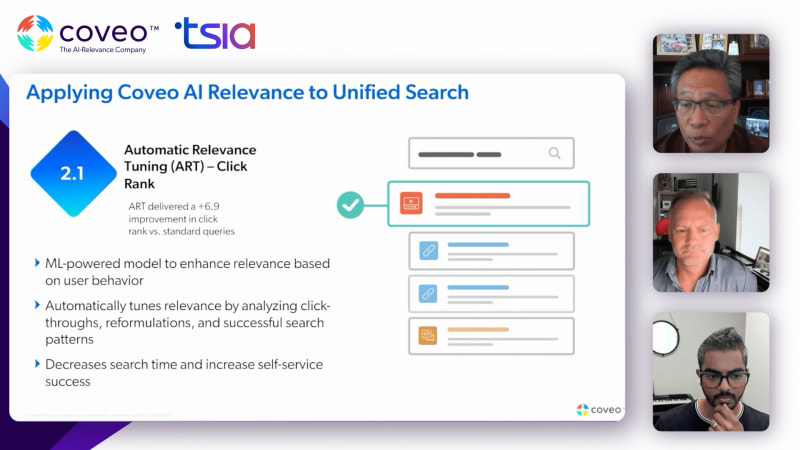
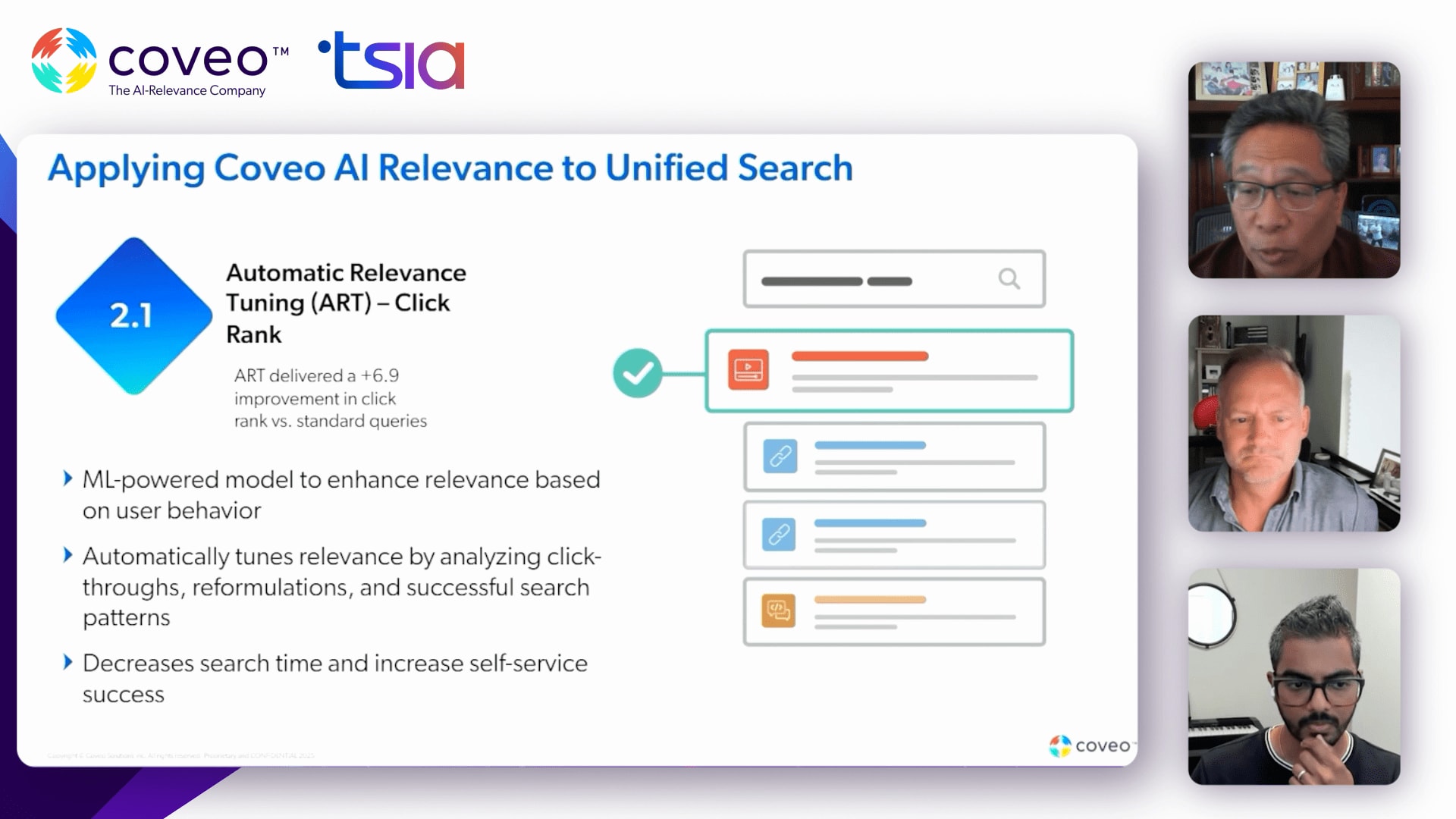
Hello, everyone, and welcome to today's webinar, how PLEX cut costs and scaled self-service with unified search. I would now like to introduce our presenters, George Humphrey, distinguished vice president and managing director of research for TSIA. Daniel Rajan, lead product marketing manager for Kaveo. And Jeff Buga Gion, global delivery leader, Rockwell Automation. As with all of our TSIA webinars, we do have a lot of exciting content to cover in the next forty five minutes. So let's jump right in and get started. George, over to you. Well, thank you, Vanessa. Jeff and Danny, thank you both for joining as well. I'm pretty excited to talk about this topic today. I've been doing some research myself recently on intelligent or cognitive search. I'll explain that here in a minute. But I just wanted to get in and and set the stage for why this topic is so important. At TSIA, we focus on these pillars for support services. All of them are critical. They're foundational to the success of a support services organization. But if you take a look at the center one here, what we're finding in our latest research, especially in these data driven and AI centric worlds that we live in, is that this self-service and knowledge management are really at the heart of most of the transformation that we see happening right now. It's really been quite a dramatic evolution over the past decade where just ten years ago, about thirty percent of the organizations that we benchmarked were employing intelligent search. It's now more than doubled. And right on the heels of that, it's this AI driven transformation where more than half of the companies that we benchmark are already employing AI in their support services search capabilities, and they're seeing some impressive results. I'm curious for you guys, for Danny and for Jeff, are you seeing the same sort of evolution, or is it a revolution in support search with regard to AI? Well, I'm seeing it as it it it sounded like a revolution a couple years ago, but it seems like an evolution today. Whether we have direct projects that we are doing with AI or they're just seeping in, you know, through the, you know, through the periphery, but it is it is just part of our lives now. Yeah. Yeah. Likewise, we are talking to customers every day at Coveo, and we are seeing a huge way of wave of AI adoption. I think the question in the market right now is, are customers getting the answers that they need? That's the biggest question. Yes. There's a wave of AI, but is AI effective? And that's that's the million dollar question right now with everybody. And we're seeing how unified search or cognitive search is really the foundation to unlocking AI and making it effective. Yeah. Yeah. I love that. We're seeing along those lines, everybody is running towards this. There's not one company that we work with that isn't talking about AI. Are they actually employing it? Are they employing it with productive results? Is there an ROI on that investment? That remains to be seen, I think, for a lot of organizations or like you said, they're getting really, like, really putting it simple. Are they getting the search results that they're looking for? And there are all these headwinds, these challenges that are facing these organizations. I won't go through this whole list, but this one in the center really jumps out at me. And I've been involved for a few decades now in building techno ecosystems for services organizations. And there is this curse, for so many organizations as they think they have to build their own. It's got to be invented here if we're going to use it if it's going to be effective. And in this AI driven world, we're we're seeing that's absolutely not the case. It is very much a partnering opportunity and finding the right partner is really, really key for companies going forward. And so there's all this conversation about intelligent search. That's really the future of search. And we were talking the other day, there's a paper that we're going to drop here within the next week or two that is the simple framework of cognitive search. It's going beyond intelligent search and putting this cognitive thought process into these search architectures. Again, won't go into this in detail, but really the reason why we're having this conversation today is there are success stories out there. There are these great examples. We are constantly searching for them at TSIA so that we can bring them to the community and say, this is what we're talking about. Here is what good looks like. And so I want to hand it over to you guys to drive us through the rest of the slides and really talk about the Plex Koveo story and how you guys found your way to a successful path. Awesome. Thanks, George. So before we get started with the story, I wanna, before I introduce Jeff, and talk about his journey with Coveo, Wanna take a moment to explain to everybody about Coveo for those who are not familiar. Coveo is the leading AI search platform, and what we do is we bring what we call as AI relevance to every digital touch point for enterprises from ecommerce to websites to customer service and even your workplace. Now all of these different touch points have become kind of like table stakes. They are everywhere. But what's missing in these digital touch points is the concept of relevance. And that's why over seven hundred enterprises, including Plex by Rockwell Automations, they trust Coveo to bring relevance to their customer and employee experiences, but they do that by delivering superior business outcomes. Just like the story the hero of the story is really how Plex achieved over five hundred thousand dollars in customer support savings in three years. So we're really excited to share more about that and how they went about achieving it. Coveo is a publicly traded company, and we've been recognized by analysts consistently in the last recent years. And Koveo has been innovating in AI search and relevance for over fifteen years with extensive partnerships with tech partners like Salesforce, SAP, AWS. And in the case of Plex, we will talk about how they implemented Coveo seamlessly into their Salesforce experiences like Salesforce Experience Cloud and Service Cloud. And they did all of that by following enterprise grade security requirements. Coveo's value and strengths are most recognized by enterprises, and you'll see all these amazing logos, but really wanna talk about Plex and happy to put the spotlight on Plex and share their success in using the Coveo platform. So this is where I'd love for I'd love to bring Jeff to the conversation. Jeff, talk us through your experience, even give us a quick background about Plex. All right. Thank you, Danny. So Plex is a native SaaS ERP platform for manufacturers. So what that means is we were born in the cloud back in two thousand and one, you know, before Amazon Web Service or even an Azure cloud was there. So we've been doing it for a very long time and we're made for the manufacturing industry, so our sweet spot is in the manufacturing execution systems. Now the thing about being a SaaS ERP system is that it is very highly configurable. And with that, being a leader in support, becomes very difficult to support our clients as they come up with issues since no two customer issues are the same. And so we have a team that represents all of our clients globally, but our team only consists of about fifty people. I want to touch on something that you just said, like, it's a highly configurable platform, and no two customers are the same. So that's really what I want to kind of double click on because, like, today, customer expectations are sky high. Each customer has unique needs, especially at the enterprise level. And this is something that I'm sure all of our audience can relate with. People want instant personalization. That means they expect every digital touch point to feel like it was designed just for them. They don't want to sift through pages of irrelevant results. What they want instead is they want fast, efficient, relevant answers. And all of this needs to be delivered in the form of trusted advice that really actually, like, helps them get things done. So they're all they're also expecting the seamless journey whether they are on your website, your help center, or talking to a customer service rep. So all of this really needs to feel connected. But the problem today is, like most of these digital experiences in customer service, they're just not meeting the mark. In fact, eighty four percent of people say they have to put a moderate or even a lot of effort to find information or to get help. So when people struggle to find the answers that they need, they get frustrated, and it really snowballs into employees even losing focus. So really, the stakes couldn't be higher, that each service organization really has a mandate to meet and exceed these customer expectations. And so in response, a lot of enterprises are trying their best to fix these digital experiences, like, because they know it's broken. But what's really holding them back is that their content and the data is scattered all over the place, especially for enterprises. It lives in these siloed systems within the organization, and most often the case is that each team owns a different part of customer journey. So it really all ends up being fragmented. So even when customers want to create these great experiences, like, the journey for the customer is really disconnected because the foundation isn't isn't really there. So at that same time, we just discussed about this huge rush to adopt AI, like, with generative AI and even agentic AI. It makes sense because AI has so much potential to trans transform how we work and we serve customers. Right? But the thing is AI without relevance is risky, And that's a thing we spoke about earlier as well. Are your customers getting the answers that they need through AI? Because if your AI can't understand context, if it can't pull from the right sources of knowledge and deliver the right answer at the right time, what you end up getting is is is a is a bad answer. At that point, AI becomes a liability instead of an asset. So that's why at Kovio, we work with enterprises like Plex, and we tell them that two things are really foundational. Unification of your knowledge and your data that powers a great search experience, but not just unification of data. How do we make that data and knowledge relevant? And so when I was having this conversation with Jeff, really, before this call, understanding his role and their journey with Kobeo and their success story, What he told me was really interesting. He told me knowledge could live anywhere, but we need it to search everywhere. So, Jeff, I'd love for you to expand on that. What did you mean, and can you put that in context with Plexus objectives and your mission for implementing a unified search experience? Sure. Thank you, Danny. And we can even shorten that sentence of knowledge can live anywhere, but we need to search everywhere. Our our mantra became one stop shop Because before we approached Coveo, a a couple of years before even, we had we realized we had a problem. We had so many sources of knowledge in our company from our product documentation, from training documentation, as well as as well as our knowledge base that we created and and and support cases, and they were all under different umbrellas, different logins, and and so people would have to go to multiple places to be able to find an answer. And that was tedious, not only for our customers, but internally as well. So what we realized was that, look, we're not gonna figure out one tool to put everything because every department picked a a a tool to put their knowledge for a reason, but we needed to be able to to search across everything, you know, where everything lived in their own in their own silos, but we should be able to find this stuff. So that was one of our our major things, and we we call this our one stop shop. And so everything that we've been doing, was all around that that mantra of a one stop shop because we wanted to deliver an intuitive experience because we realized, you know, within our organization, why do we have to go all over the place to find an answer when when you go to Google? So, you know, a b a b to c type of experience, you just go to Google and find so many things from all over the place, and we wanted to to do that, you know, at our company. So, we figured if we if we were able to do that, we could increase case deflection, so people not having to open up a support case because they found the answer they need. And also, even if they do open up a support case, our own people can use this process to get a to get an answer quicker for our customers. So it actually decrease our time to resolution. It's awesome. I also want to give everybody a visual illustration of what just what Jeff just explained. I think there are two fundamental challenges over here, and that's what you're seeing on the screen. So at the bottom, you have this data layer, which is your where your enterprise data and your content and your context is everywhere. And at the top, have the engagement layer where there are multiple search engines typically. Right? There are different sources of truth for your customers and even your employees to discover all of your enterprise knowledge. And so the challenge is how do we connect the scattered data and then make it discoverable and relevant at these different touch points at the top, at the engagement layer. And so with Coveo's out of the box secure connectors, you're able to bring in all of your data without migration or duplication. And and the way that Coveo does this is through the Koveo AI relevance platform. And so Koveo unifies all of this knowledge. It normalizes the formats. It chunks the data, vectorizes it, and stores it in what we call as a unified hybrid index. And from there, we apply AI relevance. What that really means is it we understand the intent behind the customer's question, and then we apply machine learning models such as learning from lexical matching, the semantic intent of the query, learning from the user's behavior and their past history of their interactions with with with your brand, and then also fine tuning those models based on your business outcomes, ranking the results and answers that really drive business outcomes for you, and using all of your AI relevance to surface the most relevant answers and results that's consistent across these different touch points. And so what I just explained was what happens under the hood. What you're seeing over here is a visual illustration of what this AI relevance actually means from an end user perspective. This slide really breaks down the anatomy of what we call as AI relevance, where we start by what we call as the intent box. Really, the evolution intent box is really the evolution of the the traditional search box where Coveo understands the intent behind the user's queries and then makes relevant suggestions, retrieves the most relevant results through generative AI, and provides citations that builds trust, followed then followed by personalized AI recommendations and product recommendations, and then ranks these search results that are tuned by ML models based on user behavior or even tuned to rank results based on what's most important for business outcomes. So now that we've given a background of the Coveo platform, I want to bring Jeff back into the conversation. So, Jeff, how do you unify how do you view unified search at Plex, and why do you believe fixing search was really mission critical to your service organization? Alright. Yeah. Thank you, Danny. So what we really, really wanted was to be able to have somebody log in the in one place. So we have our so we we use Salesforce, and we have an experience cloud or what we call our community. And we wanted that to be the place where everybody can can go log in one time and be able to to just search at a top search bar. And they wanted we wanted to be able to search every source of knowledge that we have available to our customers from there, so they didn't have to log in to multiple places, right, more than more than one time. And so what that did is is it allowed our customers to self serve a lot easier. It allowed them to not have to go all over the place to find the best answer. And when you go all over the place, well, you don't know which is the best answer out of all the sources. Right? Only through each source. So that was really key for us is to unify all of the different sources of knowledge to be able to find out what's the best answer across all of those knowledge silos. So, that was really one of our our biggest thing, and that didn't even that even touch yet on the machine learning, you know, part of of the search, which I'll be talking about in in these next slides. But what what I mean with all of this is we have we have two things. So our experience cloud, as you'll see on the left, is our what we call our community portal where all of our customers get to log in, and they get to do searches, they get to browse, you know, have you, but it'll go through all of our sources of knowledge. And this is where we get a lot of our our case deflections and our you know, where people can just self serve. Now even when they when they need to open up a support case with us on the right side of the service cloud, when our agent handles a case, we too get, you know, all the different sources of knowledge plus a whole bunch of internal knowledge that may not even be open for the customer. So so we get that wealth of knowledge along with our the machine learning language because, each one of our, we have groups of tech support representatives that have different specialized skills. And each person in a specific skill set as they continue to search in that general area all the time, the machine learning part of it makes it makes their answers more and more relevant. So so that's how we were able to get our time to resolution numbers down significantly. So the way our our support model works is because of the complexity of of of the things we do, the high the high configuration, that we have in our SaaS product, we actually train what we call a Plex champion. So for every customer that, implements our software, we train somebody at the site, a customer, an employee at the site to to learn everything they can about our product, and they become the first line of support. So if anybody on their plant floor has a problem, they usually go to that level zero person first. And if that person cannot figure out a solution, you know, through our online community or or, you know, through their own knowledge, that's when they open up a ticket with us. So that's my team is the level one team. And so we do case swarming. We basically are are that single tier of support to to handle all of the break fix scenarios that come in. Now sometimes we might figure out that, hey, this might be a bug or product limitation, and that's when we engage our development team. So this that's where, they get the assistance. But, you know, at least through all of level zero and level one, both customers as well as my support representatives have access to this unified search and and through the machine learning. So it helps in every step that we have. So when we talk about the, AI relevant, you know, unified search, and what you'll see on the right are you'll see different icons for each of these bubbles, which is really cool because when we do a search, it basically will tell us whether the answer that we find is coming from a knowledge article or if it's coming from a support case or a community blog or, you know, a training documentation. So we'll be able to see where that silo of information came from, but we're all seeing it all in the same place. And so that part, has really brought down our time to, you know, to resolution because, again, one stop shop. It it's just one place that we look to find all the answers we need. Right? And the fine tuning part, the same thing that we we wanted out of Google, right, where, you know, the more you use that search engine, the more it knows you, and the more it knows what you're really looking for and what you're trying to ask. Well, that's the same experience now that both my tech support engineers as well as our customers are now are now having. Jeff, I wanna really ask you something quick. Terms of configuration, when we talk about applying these machine learning models that influences discoverability and making it easier for customers to self-service. It kind of sounds complicated, but I wanna ask you in terms of a customer who's done this and is doing this every day, in terms of implementation and ease of use, any comments that you wanna provide? Yeah. It was it was easier than we thought in terms of the implementation. So, I mean, the hardest part was figuring out which sources of knowledge to tap into, right, which silos of information to be able to open up. And, you know, Coveo has been been been great with the security models, you know, and and all of that. And it it was a pretty seamless implementation for all of this. Now as it comes to usability, it was you know, our our customers, the only thing they realized was they're able to find more things, and and they're able to find more more relevant stuff. So that part was surprising, you know, pleasantly surprising. But, the thing that really helped us out was that Coveo every I think it was, like, six months or so, would check-in, and we would do an analysis on how well the machine learning is doing. And we would be able to and which we have been for the past three years, fine tuning. Alright? So, using the the analytics on the back end to see click throughs and the things that the customers find and where they relevant or not, we're able to kind of fine tune and we're constantly getting better. Awesome. Yeah. I also had another question as you were talking about the role of actually unifying knowledge was kind of really the first step. Right? Right. What what what were some of the sources that you unified at your enterprise? Where was knowledge scattered is what I'm asking. Okay. So product documentation. So that that was one, and that usually you have to be inside your application in order to get that documentation. The other was our training docs. So that was a completely different portal that people would have to log in to get. And then we had our knowledge base. Now our knowledge articles were were native to Salesforce, So that part was good because we already had that. But we also have support cases. So customers will be able when they search to not only search all of that information, but they would also be able to search their own, you know, cases that have been opened previously. So if they come across an issue that we solved for them two years ago, right, they'd be able to see the answer to that problem, you know, right away. And then finally, we have things like blogs and other things that that people in our community had posted. And then we also have access to a developer portal. So those we have some customers that have access to do some custom things. And when they have access to developer portal, that too is being searched. Awesome. Yeah. Thanks. And I think that really segues really well into what you're about to share in terms of KCS practices. So I'm curious to hear your your learnings and your takeaways. Right. So before we even started talking about doing a unified search and, you know, and and the machine learning and all of this, we wanted to make sure that we are capturing, curating, and reusing knowledge properly. So more than about five years before we even approached Coveo, about, you know, unifying and and machine learning, we wanted to make sure that that knowledge was being captured properly because you've all heard the saying for many years, garbage in, garbage out. Right? And the more relevant your your data is, the the better experience you'll have as we start putting things in, like, machine learning, you know, AI, as well as generative AI. And so what we did is using the KCS consortium, we basically, created practices around our knowledge management, and that wasn't just the technical articles that we created in support. We actually had to get multiple departments in our organization convinced about this knowledge map and about how we capture and reuse knowledge. So we even got people in training. We got the departments for our product docs. We got them all involved in a it was like a week long workshop to ensure that we were doing the best practices. So as far as support goes, we've been using KCS for for the past ten years, and, and and that only helps us to to ensure that as the machine learning is now taking into effect and as we are unifying all the different sources of knowledge, we're all, you know, all the different departments that create the knowledge, we we actually are speaking the same language and doing the same things. Got it. I'm also curious on when you said you had to really build these practices in among teams that were not used to this sort of met methodology? And what were some of these objections or questions that came up in adopting KCS, like, across your organization? Well, it's not that they really had objections as as to the point of not everybody was versed in KCS. Right? So everybody agreed that we had to create knowledge. Right? But but not everyone understood how to properly curate and how to properly reuse, you know, update, archive, etcetera, you know, to such that we have the right practices. And so that's the part that we, and and everybody, they had an open mind toward it. And we started with the CFO, right, to convince them that we needed knowledge management, and we kinda moved our way down into the, into the multiple departments. And that's what led to having a third party dual workshop with us just so that it wasn't just one of us trying to tell everybody what should be done, but we wanted to make sure that there was a third party who understood what global standards are like, and they can help teach us how how it would be done. So and our journey isn't over. You know, we're not even perfect with KCS yet, and we're we're always finding ways to improve. Got it. That's that's really helpful, that background. Yeah. So here's some hard numbers of of what we found. Because of the fact that we've been measuring things like incoming case volume, time to resolution, and all of those things Before we brought Kobeo in, it was really easy to see some some real some real gains that we had. And over the last three years, we've been averaging at least a five percent. This is this is actually pretty conservative, a five percent case deflection rate, which comes out to about a thousand cases per year that didn't open. So we've noticed that when we compare, compared the three years before Coveo and then the three years that we've been working with Coveo and with a a previously calculated through TSIA benchmark that it it cost us about a hundred ninety dollars per case. That came out to a five hundred thousand dollar savings. Now what this chart isn't telling you is that the thousand cases that were saved year over year is only for the direct deflections. And what we mean by that is, a customer has to actually go into the case submission form, before they decide to click on a knowledge article or click on, you know, one of the other sources of knowledge that we have with our unified search and to and not open up a case. But we also achieved a lot of savings in people who never even had to go open up a case because our overall number that that has changed since we implemented Coveo is on the order of three thousand cases a year. So we have been we have been consistently down at least three thousand cases a year over what we used to get previous to to a COVID implementation. That's that's amazing. I want to follow-up with a question. When you say case submission form, and can you talk us through, just for the benefit of the audience? What does that mean when I as a customer, I'm looking to submit a case? Where does that knowledge appear and what's the intention behind knowledge surfacing at that point in the workflow? Okay. Great question. And so we we view logging into our community as this this big giant funnel. Right? So when they somebody first logs into the community, they have a search bar, plus they can browse whatever they want. And if they can't find what they're searching for using, you know, the browsing or what they want, they have the ability our Plex champions have the ability to say, open up a support ticket. And when they do, there's a form that comes in where they type in the subject, the description, and then they can put in you know, fill out the form. But while they're doing that, we have what we call, I believe, it's an insight panel. And what that is is off to the right of the window are a bunch of as they're typing the subject and description, a bunch of sources of knowledge. Right? Knowledge articles, blogs, cases, that show up that and with a little title that says, hey. Have you seen these? Could this help? Right? So if they click on one of those and find their answer and they do not go on to submit a case, we get to measure that as the case deflection. And so that's that's how we measured our five percent, and that's the normal process the customer would go through. Got it. Would you mind sharing in terms of that TSIA benchmark that you shared, are you able to share what were those factors that contributed to calculating that hundred and ninety dollars cost per case? Oh, yeah. It's funny because, you know, when we first got that benchmark, we had asked a lot of questions of, you know, I don't get what that means. Right? So, first of all, we had to, we had to figure out, well, what's our annual operating expense for all of the support organization. Right? So, and then the the top part of the equation is, well, how many what is considered a case? Right? And so by TSIA's definition, it wasn't simply the cases that were created, right, or the support organization. It was also all the answers that were that were out in our in our community as well. Right? So when we because of the fact that part of our operating expense is a subscription for our community, it was also, you know, any tools that we use to enhance it like Coveo. Right? So we would take the number of answered questions that are out there divided by our annual operating expense, and that's where we got a hundred and ninety dollars per case. Got it. This is this is amazing. And one of the obviously, this slide speaks louder than everything else because it has these hard numbers, and that's amazing that you have been able to deliver this. But in today's economy, in today's market, five hundred thousand dollars over three years, I would take it any any time. So this is really, really amazing, Jeff. So Yeah. You say, gentlemen, could I add a just a quick data point on there? Because you're you're right, Danny, when you just said that slide right there, really, it tells a huge story. So eighty percent of our members that are investing in AI, only twenty percent of them are getting an ROI, which means they probably have very art project y implementations and a lack of intelligent design behind what they're doing. So clearly to see these kinds of numbers, Jeff and and team worked with Coveo to identify explicitly the problems you were trying to solve and knew the use cases specifically where to apply these technologies to deliver those kinds of results. And so there's obviously a lot of intelligent design that went into your success story. Yeah. And all of this was done without adopting generative AI, which is what I wanna come to next. Like, if you look at this slide, this kind of gives everybody an understanding of the journey that Plex took with Kobeo. They first fixed fragmented knowledge silos, which is so crucial. I think everybody starts to adopt AI without fixing the foundation, and then they figure out they can't figure out why AI isn't working for them. So you you did, like, all the groundwork by first fixing the fragmented knowledge of all of your silos, and then you brought in unified search with Koveo. And then you applied these AI models and to fine tune these results that match your business outcomes that, you know, then helps customers to find results faster. Next step, do you offer you you optimize your operations with your customer service teams to offer faster resolutions. You empowered your agents to discover knowledge and then implemented these KCS practices that you just shared. So what's next after achieving five hundred thousand dollars over three years? What's your next big milestone? So so, you know, the five hundred thousand dollars savings over three years allowed us to to scale without necessarily having to grow our team. Right? So as our revenue continued to move up, our team, we we did not have to keep on growing our team. So that's the kind of savings that, you know, that we were able to to do. Now, you know, just because we did that didn't mean that that's where we were ending. And so last year, I believe August is when Coveo showed us their their Gen AI solution. Now the cool thing about doing having all of this other stuff in place that Danny just mentioned was that doing a proof of concept was just simply a matter of showing us a a hyperlink to go, just to go test the Gen AI. And, because everything else, you know, with the machine learning and the unified search was already in place. And it was it was able to show us a a really great, and by the way, I was very hesitant speaking, you know, how good does our data really have to be to actually get some good generative answers. So we, in our proof of concept, we had our our subject matter experts join in on this proof of concept, and the the results were a lot more impressive than than I expected it to be. So today, we are in implementation of this Gen AI, and we're probably within about three weeks of launching it internally. And so once we launch that internally, we're again, you know, we now have the baseline metrics with our current, you know, search capabilities. But we're gonna see what that will do internally for us, you know, along with all the analytics that Coveo provides for us to see what our actual, you know, return is. We already had an estimate of what it will be, and we'll see if it can it can meet or even exceed our estimates. And once we do that and we find out how well it's working internally, about a month to two months after we launch it internally, we're going to put it out in our community so that our customers also take advantage of, you know, the generative answers. So the the whole thing of doing it internally first is, you know, like Danny says a few slides ago, we're, you know, we want to ensure that the answers that Gen AI is giving our customers are good answers. Yeah. We are super excited for you, Jeff, and the whole team at Plex. We can't wait for you guys to implement, and hopefully, we'll come back again and then share another success story of using generative AI to further your excellence in delivering customer service for your customers. And this has been a really exciting conversation. George, anything from your end before we get ready to answer some questions from our audience? Yeah. I believe it was a fascinating conversation. I I love listening to it. I love being part of it. I'm struck by this slide here, and and we did not plan this, but the framework that I put, on on the table up front of the presentation is directly aligned with this presentation. What we try to do is help our members see around the corner, help them see what's coming in the future, not just how am I great today, but how am I going to stay great. And so already you could see Coveo is out ahead and thinking about what the future of intelligent and cognitive search looks like. And I and I just love this Plex story. I too want to come back and be part of that cognitive generative AI conversation. So I appreciate the time and I'm excited to hear what kind of questions you got. Awesome. Okay. So with that, thank you all for a great session. We have a couple minutes left. We already have quite a few questions in queue. However, if you do have a question for any of our speakers, please go ahead and pop it in the ask a question box in the top left corner of the webinar player. I'm gonna jump right in, and this first question here is from Shelly. And they say, for organizations like mine that struggle to unify all their content in one system, is there any advice to implement unified search? I'll take that. And in Kovio's point of view, really, there should not be any problems in unifying knowledge because we offer these out of the box high end connectors that indexes all of your content no matter where it sits in your organization, no matter who is owning it. You don't have to duplicate or migrate that data into the index. Coveo is really removing every obstacle from helping you do just that, helping you unify index. So, really, security is covered. Your connectivity sources all of your content sources are covered, so it should not be a problem. So Covio is really helping you get that job done much faster and easier. Okay. I'm gonna squeeze in one last question even though I know we're almost at the end. It's Eric, and they say, how do you align stakeholders implementing unified search, and how can I convince the rest of the team about the value of search? Yeah. I can take that one. So the way we had to do it is, first, we had to find out what we all agreed on. And so we absolutely need multiple multiple stakeholders in different departments, you know, in order for this thing to work. And so the first thing we agreed on was that knowledge was walking out the door with every tenured person who left the company. They were taking their knowledge with them. So we all agreed that we needed a way to capture that knowledge, but also not to touch the individual silos. And that's when we all agreed on, we need we need a one stop shop for ease of use. So with that in mind, that's when we actually took it up to our c level executives. In this case, it was our chief financial officer that we basically took this information. We had to show how doing all of this would make allow us to scale as we grew. It would decrease our time to resolution, and and just that in itself would increase our customer satisfaction. We did have metrics to support all of that. So if if you don't have something like this now, just make sure that your KPIs right? You have some, really good, KPIs that tell the story. Right? And our KPIs at the time were telling the story of the longer it takes to solve the case, the worse the customer satisfaction score would be. Okay. Well, we have unfortunately come to the conclusion of today's event. I know there are questions in queue we weren't able to get to, but don't worry, we will follow-up with you. We have all of your information. And with that, I'd like to simply take this time to thank our presenters, George, Daniel, and Jeff, for delivering an outstanding session. And thank you to everyone for taking the time out of your busy schedules.
How Plex Cut Costs, Scaled Self-Service With Unified Search
What does it take to manufacture a truly exceptional customer service—one that boosts self-service, reduces resolution time, and elevates CSAT? For Plex, a Rockwell Automation company and a leading provider of ERP and MES solutions for the manufacturing industry, the journey began with a critical investment: Search.
In this exclusive TSIA webinar, learn how Plex transformed its support operations in Salesforce Experience Cloud and Service Cloud by partnering with Coveo — leveraging unified search and AI-powered relevance to drive efficiency and save over $500,000 in just three years.
Join Jeff Bugayong, Global Delivery Leader at Rockwell Automation, and Daniel Rajan, Lead Product Marketing Manager at Coveo, as they walk through how the team:
- Broke down silos to unify knowledge bases, documentation, and community content
- Delivered faster, more relevant answers to both customers and support reps
- Scaled self-service with AI—while proving measurable ROI
- Leveraged search analytics to continuously improve content and outcomes
Whether you're looking to reduce support costs, empower your agents, or deliver a smarter, more connected intelligent service experience, this session offers a practical, proven blueprint for success.



Make every experience relevant with Coveo