Welcome to today's webinar. Super excited for all of you to be here. By a quick introduction, my name is Michelle. I work on the marketing team here at Coveo, and I'm gonna be your moderator and host for today's fireside chat titled Talking About Generative Search, Rethinking Financial Services in the AI Era. So as we know, financial institutions are under more pressure than ever to modernize, to deliver AI powered experiences, and ultimately to show results for these experiences. And I will pass it to Carine Hamel just for a quick introduction. Good afternoon, everybody. Corinne Hamel. I am senior vice president of finance here at Coveo, being part of the finance, but also purchasing and procurement cycles as well as system decisions. So really happy to be here with you today. Kevin, you wanna go next? Yeah. Hi, everyone. My name is Kevin Daniel, senior account executive here at Coveo. Been with the organization for over five years, over overseeing multiple of our enterprise customers and accounts. Was asked to to participate to to provide some perspective. Over the last few years, I've executed probably hundreds of POCs and implementations. I've seen a lot of variations of generative and agentic deployments. So happy to share my perspective. I wanted to add as well, I feel I feel bad for buyers today given the amount of noise in the market. Every company is an AI company. Every company is an agentic company. So I was hoping if there's one person from this webinar that takes something away and is able to unstuck or or gain gain some success, I'll I'll consider this a success. So glad to be here. And, Carrie, I'll I'll let you introduce yourself. Awesome. Thanks, Kevin. So my name is Carrie Ann Beach. I'm a senior product marketing manager here at Coveo for the website line of business, and I'm super excited to get into today's discussion. Awesome. Thanks, team. So just a few housekeeping items before we go. I just wanna run over the agenda with everyone. So in today's chat, we'll be talking about why search is one of the most achievable and low barrier entries into the AI world. We'll chat about how we can set up your organization for success when it comes to AI search and generative answering. We'll also chat about the biggest buzzword that we're hearing today, Agentic, and what that means for the financial services industry. And lastly, how you can speak to your finance and internal teams at your organization and how to go about the chat of introducing a new digital transformation and AI project. So before we get into the questions, I just wanted to address those technical difficulties, so we should be all good to go. But just for going forward, you are on listen mode right now. But if you do have any questions, we do want to hear from you. So please feel free to write in the chat at any time if you have some comments, some questions. But at the end, we will have some time for some Q and A. I'll make sure we make up some time from those technical difficulties. And you will also receive a recorded copy of this webinar just under twenty four hours after we have completed. So once again, thank you for joining, and let's go ahead and get started. So, Carrie Anne, my first question is for you. We know that customer expectations are shifting and changing very dramatically in today's market, and that's especially since ChatGPT has exploded. So how has that impacted financial services and customer expectations in general? Yeah. Definitely. So it's probably a very big understatement to say that ChatGPT has really just raised the bar for what modern digital experiences can and should look like. And it's almost put a spotlight on websites that for one reason or another missed the mark. Maybe they're outdated. It's been you know, thinking that it's just been good enough for now. They're not personalized. Maybe they're not conversational. I think people are starting to look at that a lot more critically because customers just aren't going to be okay with that anymore because they've seen what really great experiences look like. And it's just completely revolutionized the self-service landscape. Right? So people are not needing to go into, say, a banking branch to have that financial education. They can get it online or at least they expect it to. And when they're looking, they expect to have answers that are gonna be gonna be contextual and relevant to them just as much as if they were talking to someone in person at a at a bank branch. So, it's safe to say that this putting a lot of pressure on financial services because it's so rooted in trust in in getting those good answers. So everyone's feeling like they just need to modernize super quickly and kind of unsure on how to do that. So I'd say the pressure is on. I would have to agree. And I think, Karim, you'd have to agree as well as our SVP of finance. You're probably feeling the pressure, I'm sure a lot of your peers are feeling the pressure. So what are you hearing from, you know, leaders like yourself and some of your peers when it comes to the pressure to modernize within the organization? Yeah. If I can share a little bit here. For my peers, when I sit on boards, what I see here at Coveo as well, constant themes around mandate to modernize, like board, c suite, or expected companies to embrace AI to modernize. But then it becomes, like, where, what, and how. And I have to admit that we've seen a bit of decision fatigue over time. Like, everybody's claiming they're doing AIs. We've seen projects that investments were made, but, you know, not yielding to excellent results. So leadership teams will are now, I think, starting to make some, you know, assessment about, hey. Stacking priorities. Where do we wanna spend money? As much as there is a strong interest in investing in AI and everyone seems to be wanting to do it, do feel that the hype is now pacing a little bit down and coming up is like, okay. Where are we putting this? What are we doing? Where are we seeing tangible results? As leaders in various departments, we're gonna see, like, you're gonna hit some procurement challenges. You're gonna have to sell your use case. You're gonna have to make sure your system team and your finance team will be supportive of your what you're trying to achieve. So this is going to be more and more important per what I see to justify what you're trying to do. Like, what is the ROI that is expected and so on? So all of that to say that it's exciting. There's a lot of interest and a lot of hype still around that. However, we're seeing a little shift around thoughtfulness around where money is spent, across AI. Yeah. Absolutely. I think a lot of people who are listening on this call can definitely relate and resonate that kind of push and pull struggle between wanting to innovate quickly, but also needing to prove ROI quickly. And sometimes that can be of difficult when you have a big lens on you to to prove that ROI. So, Kevin, I'm curious to know you're speaking with organizations every single day about these kinds of big projects. So what are you seeing on the ground? Yeah. And to allude to my my opening statement and to Karen's comments, every executive is putting the pressure on their directors and their VPs to go and implement AI. And, again, I feel bad for the buyers. What I'm seeing generally, especially when ChatGPT, you know, became table talk, right, for for individuals, it was a bit of a scramble, not just again in financial services, but everywhere. A scramble to go figure out, alright, what works and what doesn't, and I get it. But there was all these individual little siloed POCs that were happening across organizations. And, you know, large language models are fantastic technologies. I think I was reading a report yesterday. There's, like, a hundred and eighty five different large language models today, and probably in the next two to three years, we're gonna see a thousand of them. So, a bit of a commodity in my experience, but it was it was a mad rush. Figure something out, do these tiny little POCs. But the challenge from that was then trying to scale them across an enterprise, and we're gonna get into it a little bit later about the complexity of an enterprise, especially from a security perspective, but how to mitigate hallucinations, how to prepare yourself in order to scale and add use cases very quickly. So even as someone in the industry who lives, eats, sleeps, breathes generative, I still find it a bit of a challenge to stay up to date. It's like every week, there's a new functionality or new feature. So, again, sympathizing with with the buyers. But my number one takeaway from all of this for everyone is you need to establish a foundation. If you don't, you're gonna end up chasing the market consistently, and you're not gonna be able to adapt quickly. So we'll cover a little bit what I mean by that. But and before I hand it off, for a segue, I just wanted to expand everybody's thought process. Like, I know we say search. Coveo has been doing search for twenty years, but I I want you to also think about contextual retrieval. What I mean by that, any generative, any agentic solution that you're gonna look to deploy or whatever's coming next needs to be grounded and tailored in specific content that's relevant to the individual user. So search or contextual retrieval is just being able to identify the best content to then generate an answer from or action an agent from, And that is the challenge in itself. So we'll dive into it, but, yeah, I'll I'll hand it over to you, Michelle. Yeah. I really like what you said about feeling bad for buyers because it's not something I've heard pretty frequently, but you're right. There is a lot of choice out there. There's a lot of noise. It's it's hard to sift through it all. But going back to your point about search and retrieval, we definitely have to include retrieval when we're saying search, being an important foundation in an organization's AI journey. Carrie Anne, I wanna ask you, why is search and retrieval such a strong foundation and a good place for organizations to start their their digital transformation journey? Yeah. Well, so we're just talking about this. AI is such a big bucket to to figure out where it is you're even gonna start, how you're gonna implement it. There's so many different variations. Search and generative experiences that retrieval everything we're saying is a really great kind of low risk entry point into the world of AI, but it's also a really strategic decision. And that's because, you know, your website in any form, your dot com, your support, any part of your site that people are gonna be interacting with is your digital front door to your business. But beyond that, it's also the foundation of your website from which all of these other features that we're talking about, generative, agentic, they're all gonna be based and built off of that initial search experience. So if already your search experience is poor and they're getting irrelevant results or getting no results, then you're just going to stack everything on top of that. It's also a really great opportunity because it's the voice of the customer. It's your search box is actually your customers telling you in their own words what it is that they're looking for. And then if you're paying attention and you're looking at the trends, you can also see, like, their needs change, and you can start to shift to that and adapt and create new content so that you're not missing opportunities that you're not really aware of. There's also a piece that I really like to talk about, which is just credibility and trust, and I think that's just really important in this industry. When people are searching, they're kinda putting their trust in you. They're saying, hey. This is what I need. Do you understand who I am, and do you understand what I'm looking for? So this is your opportunity to show them and kinda prove that you do understand them and you can gain their trust by delivering the results that are accurate and relevant to them, and they're not just getting the same answer that everyone else has gotten. And then I don't feel, you know, special. So that's kind of an important piece to it. And then I think the third thing that I just wanted to say is the complexity of financial organization that, Kevin, you kinda alluded to, is what makes it such a great use case for AI search and generative answering because you have these complex, data ecosystems. You have diverse personas and user journeys that you need to scale across. You have so many little industry specific terminology, like, compliance considerations. It's a lot for any one person to have to do on their own, and that is generally why you'd look for a trusted partner or platform that can kind of manage that complexity for you. I'd like to just piggyback on that, and I don't know if we've got the automatic notetaker that we've all come accustomed to for for all the attendees here. So I'm gonna make it easy on everyone. If you are taking notes, this is one that I would put a number one next to is and I start every conversation with a new company. What's your business objective? When ChatGPT came out, like I said, there was a mad dash, And I started being very frank with that because I would ask, is this what are we trying to accomplish, or is this a bell and a whistle? Right? AI just for the sake of AI. Right? So start with the business objective, whether that's internal facing with your employees, customer facing. Right? What's the ROI that you're trying to achieve? So that's step number one. And I was sitting across from several CIOs at an event a few weeks ago, and they love that because they didn't they just deployed their teams to go and find something, look at AI, and then see how we can just shove it into our infrastructure and and see how it'll work. So start with the business objective. From there, what is the use case? What's the most simplest way that you can get up and running quickly with high ROI? So that's the second. And the third would be, and I'm gonna repeat this many times, benchmark, benchmark, benchmark. I do not go live with my customers unless we've established a current state. Because at the end of the day, an organization like Coveo or, you know, any AI company, we are paid to deliver results, and I need that you know, where we started today in six months, in twelve months, in eighteen months, I need to be able to look at you and your the executive team in the eye and say we delivered x amount of value for you. And if you don't have the benchmark, then everyone's just guessing. So that's always my starting point. And then from that, we'll dive into where I would go next. But, I don't wanna take the whole conversation up. Michelle, I know you're the orchestrator here. I'll pass it back to you. Thanks, Kevin. I actually want to hear a little bit from our audience. Just if you wanna write in the chat, I this can be a little mid mid webinar wake up. What are you being told or what are you hearing from leaders, from outside voices, from media, everywhere? What are you hearing in terms of we need to do AI? What's the what's the business objective that you're working on or that you're hearing that you're getting pressure about right now. So if you wanna write a little bit in the chat, I'd be curious to hear about it. But, otherwise, just to go back to, Carrie, and your point about all the opportunity that surrounds financial services and and AI and how they're such a great use case for AI search. I just wanna ask you, what are users struggling with the most when you see them starting to begin these these, AI journeys? Yeah. So when we speak to customers and prospects in the industry, a lot of the times, their primary struggle is, you know, poor search. It it truly is it can be as simple as that. The users aren't able to find what they need. They're telling them that. They're looking at the data, they're seeing it. But this is often a symptom of something else, which is that the content is being created and stored in all of these siloed systems. Right? Because there's so many different departments who are creating their own content that's gonna be helpful for the users at some point in their journey. But if you can't search across all of it, then it's gonna get siloed, and that's how you get these no results where you have to bounce around different different sites. They can have generic or, you know, just static search solutions that aren't adapting to user intents and just giving everyone the same thing. And then there's the lack of visibility is a really big one as well, like we're saying, because you need to be able to tap into the opportunity of knowing what people are searching for. So they're they're looking at all of these things, but something that we've actually noticed is when, someone goes to approve a search vendor selection, they have a search project, they're still kind of looking at the search experience in silos depending on who it is that owns that part of the website. Because this you know, the end to end CX is owned by so many different teams. Maybe you're looking at search specifically on your dot com, maybe and then someone else is looking at it from support and not kinda tying those two things together. And that's where the opportunity is, right, to have the seamless experience across the entire user journey regardless of who owns which part of the site because your users ultimately don't care who owns which part of the site or where the content is stored. They wanna be able to access it. So I think those are some of the the struggles and maybe opportunities that are there. Yeah. Absolutely. And, Kevin, you were formerly an account manager here at Coveo. So you've spoken to a lot of our customers. You've gotten to know them pretty well, but you're also speaking to prospective customers as well. So I feel like you have a great understanding of both sides of the coin. So I just wanna know when you are speaking to these customers, prospective customers, what really separates successful projects from maybe ones that don't always get off the ground or, I don't wanna say the word, failure, but, maybe ones that, you know, don't reach that level of success that was originally planned. Yeah. And it's a great question, and I know we're gonna get into the solution. This isn't meant to be a Coveo pitch, but by leaving Coveo out of it, I I think we'll still draw a a good conclusion or at least a a starting point for individuals. To just first piggyback on on Carrie Anne and what you had said, the siloed systems, think of any customer journey across the financial industry right now. How many digital touch points do they have? Right? If you're on a website and then you authenticate, maybe there's a chatbot. Is there a ticketing system? Is there you know, there's insurance products. There's, you know, wealth management products. So the user journey is not one to one. But a lot of the times, the POCs that I've mentioned previously are one to one. Like, they're not communicating to one another. As an end user, if I start my journey on a chatbot and then I navigate to a ticketing system, my expectation is that you know where I started and where I came from. In that experience, the content that is retrieved should represent that all the way to talking to somebody at the contact center. How do you you should be able to infer based on pre because everyone, myself included, whenever I have an issue, I go w w w dot, right, website dot com. And how do I do this or how do I fix that? But oftentimes, especially with financial services, I end up picking them up picking up the phone or starting in the virtual chat. Right? And you're always kinda restarting. So I'm saying this to piggyback on Carrie Anne is there needs to be a longer term vision for these organizations to be able to connect the dots. And if you continue to silo your inputs, you're gonna continue to silo your outputs, and you won't be able to scale, and you won't be able to take advantage of what's coming next. So desiloing your infrastructure, and we're gonna explain how to do that securely in a minute. So that's step number that's number one. The second big I don't wanna say failure, but hurdle, I should say, is around building out RAG or retrieval technology. So for context, Coveo, as I mentioned, we've been in business for twenty years. All we do is focus on retrieval and search and personalization. That's all we do. So I've encountered customers who, with a team of three people, think they're gonna build an enterprise grade, secure, grounded retrievals tech stack that's gonna be able to scale to an entire enterprise and innovate at the pace of the market. I've seen customers waste millions of dollars over a period of half a year trying to figure it out. There's some things that are meant you can build, and there's some things that you shouldn't. I don't understand the the mentality. So to take a note from our CEO, I've seen a lot of FrankenSearch type of deployments. So that would be the second. And the final third, I think an overlooked component of it, is the administration and the analytics piece. So even if you were to build out some type of retrieval model that could scale and you you layer generative or agentic on top of, there's a whole component of how do you administer it. Is it one person? Is it ten people? How do you, get visibility? Any successful AI deployment comes down to two things in my opinion, control and visibility. You need to have those two. If you don't, you're basically closing your eyes and throwing a dart at the board. So just those three things alone are major components that are sometimes overlooked. Yeah. And I think should be heavily considered when trying to go down that road. So, yeah, that that's in terms of what fails. I don't know, Michelle. Again, I don't I get carried away sometimes with I get very No. We appreciate it. We we welcome all the insights. But what we've what we've talked about is the foundation, how to set the foundation, what works. Carrie, you talked about it. Kevin, sometimes what doesn't work to build a foundation for search. But let's take it a step further because while we have AI search, we also have generative search here at Coveo that a lot of our customers have taken on and are using. So a little bit about generative search. Carrie Anne, what should organizations look at in a generative search solution? Well, it's funny that so that you say generative search, and I think this is kind of just the evolution of of search. At first, what we're seeing is when companies decide that they're gonna have a search project, even if generative in our case, we're talking about generative answering. So there's a lot of different types of, you know, in Gen AI. Even if it's not part of phase one, it's almost always a really crucial part of what's going to decide, you know, who they end up going with because they know that this is the direction that things are going. Right? So it's very rare that we're that you see just search being implemented. It's really search and then eventually knowing that it's going to Generative. You know, now to make it even more complicated, we're gonna add Agentic that we'll talk about, in a little bit. But when we started to talk to, you know, some of our customers, what we saw really quickly was actually a lot are not AI or machine learning experts, right, when that that makes sense. And a lot of them may only be learning about this, like, when they start to actually do a search vendor kind of evaluation. And I think as we're getting from this conversation, there's a lot to consider that might not be, you know, evident right from the get go. You really kinda have to dig under the hood, and it's about so much more than just having fast search, or even just generative. There's so many things that you have to think about in terms of accuracy, personalization, scalability. And some of the things that Kevin was talking about is really thinking about that foundation. Right? And thinking about where you are now and where you wanna grow in the future. So first part is, can you handle a high volume of content that you know that you have, especially in this industry across various different personas? Is it easy to manage? Like you like, Kevin, you were saying, are you having to manually tune for hours and hours in order to maintain relevance? This can often be a hidden cost that you don't really realize until you're in it. So that's really something you that you have to look at. And then the other thing too is machine learning models could be thrown around, but you really wanna look at the depth and breadth of those models and how much they're able to adapt to intent and user context and change depending on who they are, where they've been. So there's a lot a lot of pieces that I think you wanna consider that I know, Kevin, I'm sure you're very eager to kinda dive into double click. Yeah. I am. And I think, Michelle, I did I'm a visual person. You sure were. I think the audience, as much as they enjoy looking at our faces, they probably need a bit of a break. So there's two slides here that I think will help just explain a few things. One, if you're looking at the modern day tech stack, there's several layers, but there's one that's very or was heavily overlooked. So starting at the bottom at the compute level, NVIDIA, AMD, Intel, obviously, that's not the layer I'm referring to, but shameless plug, those, you know, are Coveo customers. They have the largest market caps in the world and still rely on a, company out of Quebec City, Canada to power their generative and agentic experiences. Then you got the hyperscalers. I think we're all familiar with those. Then if you were to go up a level, you've got the large language model, tier. So for clarity, Coveo is not an LLM nor do we have aspirations to be an LLM. As I've mentioned, that's a very, congested market. We've tested all of them in our lab. Now by nature, any large language model is binary in the sense that they are programmed to give you an answer. And although that answer sounds great, they need to be grounded in truth. And the tricky part in all of this is not generating an answer, and that's sometimes overlooked. So any of the listeners out there, if you're talking to a company and they tell you we have a hundred percent response rate, that is a significant red flag. So generating an answer when there's a high degree of certainty, mitigating hallucinations, that is the hard part. Just generating an answer that sounds good, Pick an LLM. I don't care. You know, it doesn't really matter. Now if we go to the top layer, that's the UI. So pick a flavor. Right? Salesforce. Right? They've got Agentforce. You've got SAP with Jewel. Adobe has their flavor. Coveo, where we kinda sit, we're trying to remain agnostic. So we make Agentforce more powerful. We make Jewel more powerful because we'll get into it in a minute. How to identify Kevin specific content that is secure and grounded to then power Agentforce to either make a decision or generate a response. So we integrate to any UI, almost any system. We, can index any content, any any information. I'll get into that in a minute. But where we reside, and perhaps unbeknownst to us, what we've been developing for the last two decades is the plumbing required in order to make these solutions scalable and trusted and secured and grounded. So the applied AI layer is where Coveo sits. And, Michelle, if you wanna skip ahead, we can get into the nuts and bolts of it. Being able to understand contextual relevance around the user and surface top content for the LLM or the agent to then leverage in their response. Yeah. Michelle, if you can go to the next slide. So I'm very simply, there's kind of three main layers that I'm going to kind of go over. The first layer, if you wanna click through, is the content layer. So for anyone listening, think of any piece of information or content or data internally within your organization that could be useful to an end user, whether it's an employee or a customer. Right? I'm just gonna use the term user, but we can apply it to both. Coveo, what we've done forever and what we're the best in class at is first creating a unified index. So what that means is we can connect to all of the content and all of the information across your enterprise at scale, and that can be done tomorrow. Perhaps a bit of an exaggeration, but forty plus native connectors. In my five years here, there's never been anything we can't connect to. We thrive in high complexity environments. So when we index your content, you don't migrate it. You don't duplicate it. You don't need to change it. Leave it where it is. So time to value is extremely fast. Here's an asterisk point for all those people taking notes, and this is extremely important when it comes to generative and agentic. When we index your content, we are also indexing document level permissions at scale. That not only helps with retrieval and, you know, eventually hallucinations and latency of a response, but it enables you to deploy something at scale with being grounded in security. So in theory, if and when I, as an individual, search or ask a question, I will never be presented a document that I don't have access to. And in relation to generative or Agentic, that document will never be leveraged in the generation of that answer. That piece right there is where you put an asterisk because that is what a ton of customers struggle with. Now the top layer that Michelle had clicked towards, that's the UI layer at the top. So going back to my comments before, the digital journey is not in one UI. My expectation as an end user is whether I'm on your website or a chatbot or self-service community or on the phone, doesn't really matter. My expectation is that I should get consistent results across the platform. What I've seen with multiple customers is they're doing these siloed POCs, building out or attempting to build out their own retrieval solution. Oftentimes, what's being sent to the LLM is not boiled down. So where Coveo sits is very much in the middle to give a final click, and I will stop bothering you after this. There we go. Think of Coveo as the the spinal core or the central brain that is able to sit on the back end of your financial ecosystem or your your your infrastructure and is able to understand a few things. So Kevin, as a user, holds a lot of context. So who am I? What products do I have? What geographic location am I located in? Perhaps what have I searched for in the past? People similar to me. So individual context is a very, very valuable component. The second piece is where am I within your your infrastructure or your ecosystem? Am I on an insurance page? Am I on a banking page? Am I on a chatbot? Right? Where have I been before? That is contextual relevance also that needs to be considered within a prompt. So Coveo does this at scale. It understands who is Kevin, where is he, what does he have access to, what is he asking for. All of that is wrapped and presented. You know, we have an out of the box solution where we use our own LLM, but we can use any third party LLM. It doesn't really matter to us. I don't care. But when we send, we we can go from ten million documents to three very small paragraphs or pieces of information extremely quickly. That's what we are the best in the market at doing. When we wrap all of that context and pass it to the LLM, that answer is highly valid. And, again, to reiterate, it's easy to generate an answer. It's hard to not generate an answer. So even before that response is presented to the end user, it must meet a very strict threshold of certainty. Where in the case if it doesn't meet it and no answer is presented, the user will still have AI powered search to resort to, which they're gonna click on documents, they're gonna read, they're gonna navigate, which that brain on the back end, which is Coveo, is gonna continuously learn. So that is a oversimplified version of the complexity involved. But if you don't have that unified index that can be used to deploy several use cases at scale and very quickly, you're gonna constantly trying to catch up. So I said a lot, but I hope But you made a lot of great points. That's there was a lot said, but you made a lot of great powerful points. One of them being the importance of context, importance of personalization because I think at the end of the day, we just all wanna be understood, and we wanna be known, and we wanna be recognized because we can easily switch to, you know, maybe another bank. And, you know, there's a lot of options out there. We're going back to the topic of options. So personalization, it's key, and we're seeing that in these generative experiences. So, Carrie, I wanted to ask you, how are you finding that the financial services industry is using Generative Answering and search in a way that is helping both the customers and the business? Because we need to help both. It's obviously very important. For sure. So I think the the number one use case that you usually think of Gen AI is kind of for case deflection. Right? So helping enhance the self-service experience so customers can come in and find answers on their own, and then you don't have to to have that escalate to support for at least easier questions that they can find on their own. So that's obviously a really great one. But I think one that I also wanna talk about specifically because I'm in marketing, So it's a exciting one is for knowledge discovery because I think that's thought about a little bit less. And this is really about maximizing the value of your content, making your team more efficient. Where I think this could be a really cool opportunity in financial services is other than questions that are more kind of along FAQs or maybe product oriented, you're also putting out a ton of content, like, maybe in the forms of a blog that's for financial education. Right? And just all this content that you're putting out there to help users make informed decisions. And maybe when someone's asking a question, your answer is not within one document, but you actually have a really great answer spread across multiple documents. And if you just put those together, it would be a really, really good answer. But instead of having to make content for every query that could ever possibly exist, Gen AI is able to take the most relevant sections across sources to create that answer that's hyper personalized. So then they're getting a really good experience, and then you're also maximizing the the value of your content. So I think those are pretty pretty exciting ways that generative answering is being used. Yeah. I would agree. And I think with that excitement, I think when we're talking about AI, there's excitement, but there's also hesitancy. There's a feeling of caution, of a little bit of worry. So, Kevin, I wanted to know when you're talking to prospective customers, especially in the financial services industry, how are they approaching this new era of AI of generative? You know what? I I'd mentioned this previously. I don't think financial actually, similar to, like, health care, I think the financial organizations have tiptoed a little bit slowly, and I don't blame them, to be honest. I think it's it's a smart approach. There's a couple different ways. First, I wanted to address Carrie, you'd said something right at the end around content and knowledge, and it relates to safeguards. There's an underlying value of, you know, being able to see, you know, out of the box analytics, you know, combined with others. But what are your customers asking for, and what are they finding? That's very, very important, and I think everyone would agree with that. The more important and highly valuable piece is what are they searching for and not finding? That kind of forks into two pieces of value. One, very clear north star for your content and knowledge team to fill those content gaps and address issues at your customers so they can self serve. They don't pick up the phone and go nine one one. I need help. That's obviously one piece. But the second piece of it is sorry. I lost my train of thought. Content gaps, but also the the granularity of looking at what pieces of information specifically, sorry. I'm coming back here. There's so much going on in my head. It's product insights. So I've had some customers, one in particular that pops to mind that I can't mention, that they did such a great job at reviewing their content gaps every two weeks, and they would fill those. But what they started to notice is there was trends in their analytics that people were asking for specific products or items that they didn't offer. So now that gives insight to their product team, whether it's a line of business or a specific insurance offering that they need to address. So I, again, overlooked value. And then that comes back to control and visibility, which is part of the guardrails that I'd mentioned before. But, also, you don't need to go live when you're talking about generative or agentic with everything. And that's the beauty about, again, shameless plug, Coveo is if you have ten million documents in your index that you deem to be useful that you want to be searchable by the end user, that's fine. My professional opinion is that probably five percent of that would be useful for generative and agentic. We haven't been designing content and information for the past thirty, forty, fifty years to be digested and ingested. So although Coveo can pull back the document, it's not always the most valuable. Right? Prioritizing over date and most views, etcetera, etcetera. That's table stakes. But it's the ability to we're gonna index ten million documents, but then only maybe select fifty thousand for generative. And that's your foundation. That's your starting point. And then as you you develop your content and and knowledge practice and reviewing the analytics, you can very clearly see, okay. We're gonna add this content to generative, this content to generative. So that same customer I was thinking of before, they increased their answer rate by twenty percent over a year just by doing that. So, again, control and visibility, grounded in security, and being able to see what what your users are asking for and finding and, again, what they're asking for and not finding. Can we get an idea of who that customer is? Little. No. I know we can't. But just know it's it's a good customer. No. We don't wanna we don't wanna name drop too hard on here. But, Karin, I just wanna ask you, going back to the topic of being cautious and having the guardrails up. So a lot of leaders within these organizations, they know that they need AI to have a competitive advantage, but a lot of them are worrying about the ROI, the risk. And I wanted to ask you, how can these leaders or anyone on this call today, how can they approach their internal teams and make a convincing use case for the finance and and procurement teams when talking about launching a a huge AI project like like the ones we've been chatting about. Yeah. What I have in mind here, and I think my goal today is if if I can be useful on one thing, to equip you when you go back internally, make sure you can sell your project. Right? Because I'm sure you're gonna find out some ideas out there on how you can make successful use of AI, but you might hit some, you know, hurdle internally. So that's what I'm trying to help you figure. So a couple of ideas here. Think about starting small. Like, smaller project with a lot of flexibility in terms of, you know, usage, in terms of length, in terms of quick wins, and so on, let's make sure you derisk your project as much as possible. I I know that financial institution can be risk adverse to some extent for valid reasons, and it's absolutely right to do so. So let's make sure the project is de risked as much as possible. Don't forget to think about the governance around AI, about security, and so on. We've seen a lot of prospects, customer. I see a lot of peers trying to go through with some creative, use case of AI, but then they hit internal committee around decisions about around security, which they are there for all good purpose. I'm not here to say, like, we shouldn't be there. In fact, I do highly believe that, you know, governance around that is important from, you know, an organizational standpoint. So make sure you understand that dynamic around your own organization, and you can navigate efficiently through this. I I I will never say it enough. Like, you have to spend money in something that's gonna give some return on that investment. I'm super accountant and finance driven when I say that, but I say it with, like, a lot of a a lot of conviction. Nobody no organizations want to spend money on stuff that will not yield to results. And I don't think, like, know a lot of organization that will be happy to spend money with, like, infinite budget or what have you. So there will be capital allocation decisions. There will be limited resource, not just money resource, but also people resource, like people implementing those platforms, those solution. There will be resource, bandwidth limits, with your procurement team and so on. So you gotta be super thoughtful around convincing others that by not implementing your idea ASAP, you're losing something. So speech to your executive around, like, cost efficiencies, around improvement of revenue, around, you know, return on investments that you truly believe, you will bring with your project. So this is very dear to my mind, and, you gotta not leave left sorry. You're gonna you have to make sure your finance team and other admin team will not stop you, trying to be twenty twenty five excited and soon twenty twenty six, actually. Yes. Absolutely. And we're almost at the hour mark. I know we're gonna just do a quick demo just to show everyone what we've been chatting about the last hour. But, Karin, I know you have a hard stop at two. So I just wanted to ask you if there's any final takeaways that you have from this conversation, from everything in general, just to kind of wrap it up on your end because you do offer a very unique perspective. And I think what you just said about, you know, having those those value points, showing the money, showing the ROI, it's it's incredibly important to something like this. So just wanted to give you the floor in case you had anything to wrap up. Thanks, Michelle. Just repeat it. Like, don't let your admin team, your finance team stop you trying to exceed achieve excellent excellent success. So make sure you're ready to convince them about your project. Great advice. Amazing. Alright. So like I mentioned, we're just cutting a bit close on time, so I wanna make sure that we're able to show everyone here, the amazing things that some of our Coveo customers are doing with Coveo Relevance Generative Answering. So, Kevin, I'll hand the controls to you if you wanna give us a quick walk through of, one of our customers. I I do need to mention because I did have a a friend ask me to talk about Agentic today, so I have to mention it. The same principles and concept applies for everything I've mentioned before, whether you're providing a generated answer or actioning an agent, essentially, to make an autonomous decision on your behalf. That agent needs to have the same access to content and data and information as would an individual person. Because, again, if you silo your inputs, you're siloing your outputs. So same concept applies. But in full transparency, I feel like the rush for Gen AI, people still haven't mastered that. I have customers coming back. It seems almost weekly to ask me to help with specific deployments, and the same is happening for Agentic. If you don't get the foundation right, you're not gonna be able to take advantage of the technologies that are coming out. So, I do know we're at time, and I wanna respect, I wanna throw it out. If anyone has questions and wants to have a discussion after this, I am happy. I love this stuff, so happy to talk through any problems that someone might have. First and foremost, this is a demo environment, but I think it just kinda gives the the the visual of of what we're trying to do. I have a lot of customers when I was on the account management side who started with one use case, and today they're at five, six, seven implementations. And it was very quick given that they already had that index done. So anyone will come to a digital property really for four main reasons, to either find something, to buy something, to fix something, or to learn something. We can put gaming aside for the sake of enterprise experiences. But in this case, right, you can pretend I'm coming to your website. I'm looking to find information on an ETF or a specific asset management form, or I can't log in to my account. Right? So I'm come I'm asking a question. In this particular case, I'm getting an answer because it's grounded in the content that will always be cited. Whoops. Apologies. Didn't mean to click on it. Always be cited, and it met that threshold of certainty. So Coveo identified, yes. We can answer this question. Here's the answer. Everything on this page is AI driven from recommendations to the filters and facets being reordered. Now if you think about the customer journey, whether I decide to interact with a chatbot or maybe I'm a lazy customer and I just wanna contact support because I don't wanna solve my own issues. Right? So I'm coming to a virtual ticket. Because the second you wanna keep your customer in a funnel at all times, a digital funnel. And what I mean is if they pick up the phone and go, you know, nine one one, I need help, you've lost them. You can no longer deflect that case unless there's some voice over IP that can be indexed. That's a whole other thing. But now I'm coming it under Coveo's understanding, where did I start? Where am I now? I'm adding additional context to my issue, which Coveo is ingesting. It's another more valid input. We're going to classify the case so we know where within your massive contact center we're gonna send this issue because Kevin does not like being rerouted four times in order for somebody to to finally answer my question. And then what we've done and this UI and flow is completely customizable, by the way. This was just something I used for one of my own customers because we found that their customers were paying for enterprise level support. They never tried to self serve. So they go straight to the case creation page. They'd create a ticket. And what we tried to do then is intercept them within that funnel. So we use the additional context to now try and intercept them and resolve their issue. This, on average, I think we're seeing it about conservatively twenty percent case deflection just on this page alone. I think it might be a little bit higher now, but significant results here. But the reality is you're never gonna have all the content to answer every question. So if I do need to send that request and this comes into the contact center, now if I'm an agent or a support staff at your organization, This is in Salesforce, but it could be integrations with ServiceNow or Genesys or Amazon or whatever technology you desire. Again, I don't care. What we're doing is we're using all the case information. We're gonna try and automatically generate a response for the agent because the agent has a higher degree of access to content than the customer might have. The agent can also see everything the customer did prior to submitting that case. So now it becomes a little bit more white glove. Right? And I'm not having to repeat myself. But all of the information across your enterprise is now accessible to, the agent. Now there are alternatives to this. Nobody from a retrieval perspective in the industry can meet Coveo. It's all about surfacing, going from ten million documents to three small paragraphs very, very quickly. That's the value of Coveo. Can we see that quick, Kevin, just on your other tab that we have open there, and then we'll wrap it up? Or Yep. Yes. My apologies. Show a really no. No. You're good. Just wanna show a really great example of one of our amazing customers. I'm sure all of you here know or have used United are you on United? No. Sorry. Where are you? This is NVIDIA. Okay. So highly complex. I'm not an NVIDIA customer, but I have no idea really what I'm asking. So I'm using the query suggestions that have been provided. Right? All these answers are grounded in truth and in fact. So NVIDIA, has seen significant results. Same with United. I don't know. Can I fly with my pet? A popular question. Popular question. Again, UI, UX is completely up to you, but the answer grounded in facts with all the citations involved. So this is a very simplistic use case, but extremely powerful because it's the top of the funnel with any service organization. Absolutely. And a very not similar industry, but a lot of information, a lot of need for personalization, for context. So I'm sorry we have to cut it there. But, of course, like Kevin said, if you wanted to see more examples, definitely please reach out. I'm, again, very apologetic about the the time issue here. But for any questions, we will follow-up with you directly. That way, we can give you a nice long answer and not have to rush through it today. But just as we wrap up, Kevin, Carrie, just wanted to see if you had any final quick thoughts for our group. Yeah. Sure. So I think it's clear. It's just start. Right? Start with search, search, and scale up. If you wanna look at generative, there's so much that's out there, and it's easy to kinda just feel overwhelmed with it. Or, you know, like Kevin was saying around JennyI, I think some maybe there's just misunderstandings around what guard rails might be in place. So I definitely urge you to kinda look under the hood. If you need to find a partner to help you do that, I'm sure you're you know, you can reach out. Happy to talk to you, but definitely just kind of really look at what it is that you're getting, what it is that you need today, and in the future, how it's gonna grow with you. And don't look at it in a silo even if it's beyond your own team. You know, it's even better if you can convince IT that you're gonna go for a platform that's gonna be able to scale across different use cases, and then I think everybody wins. I would agree. I think everyone's heard heard me speak enough. But Never. Start what are you trying to achieve? What is the goal? What is the objective? Identify a use case from there, but also look further in terms of how are we gonna scale this and not get stuck in the individual POC every single time. So happy like I said, if anyone wants to have a discussion and review what they're doing, it'd be my absolute pleasure, but appreciate the invite, Michelle. Anytime. Yeah. Anytime. Forward to the next one. Absolutely. So like I said, everyone will receive a recording, and the questions that were asked will definitely follow-up with you within the next day or so. But just wanted to thank you again, everyone, for being here, for attending. It's really appreciated. We wish you all the best on your AI journey, and you'll get a survey afterwards when you close the Zoom app. So if you don't mind just answering that, it'll give us a little bit more context as to who you are and what your organization is doing. So with that, I wish you all a wonderful day, and thank you so much for attending. Thank you. You.
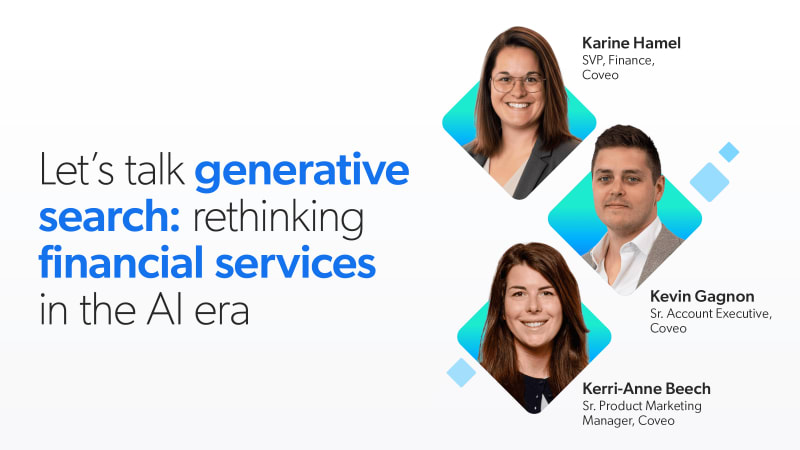
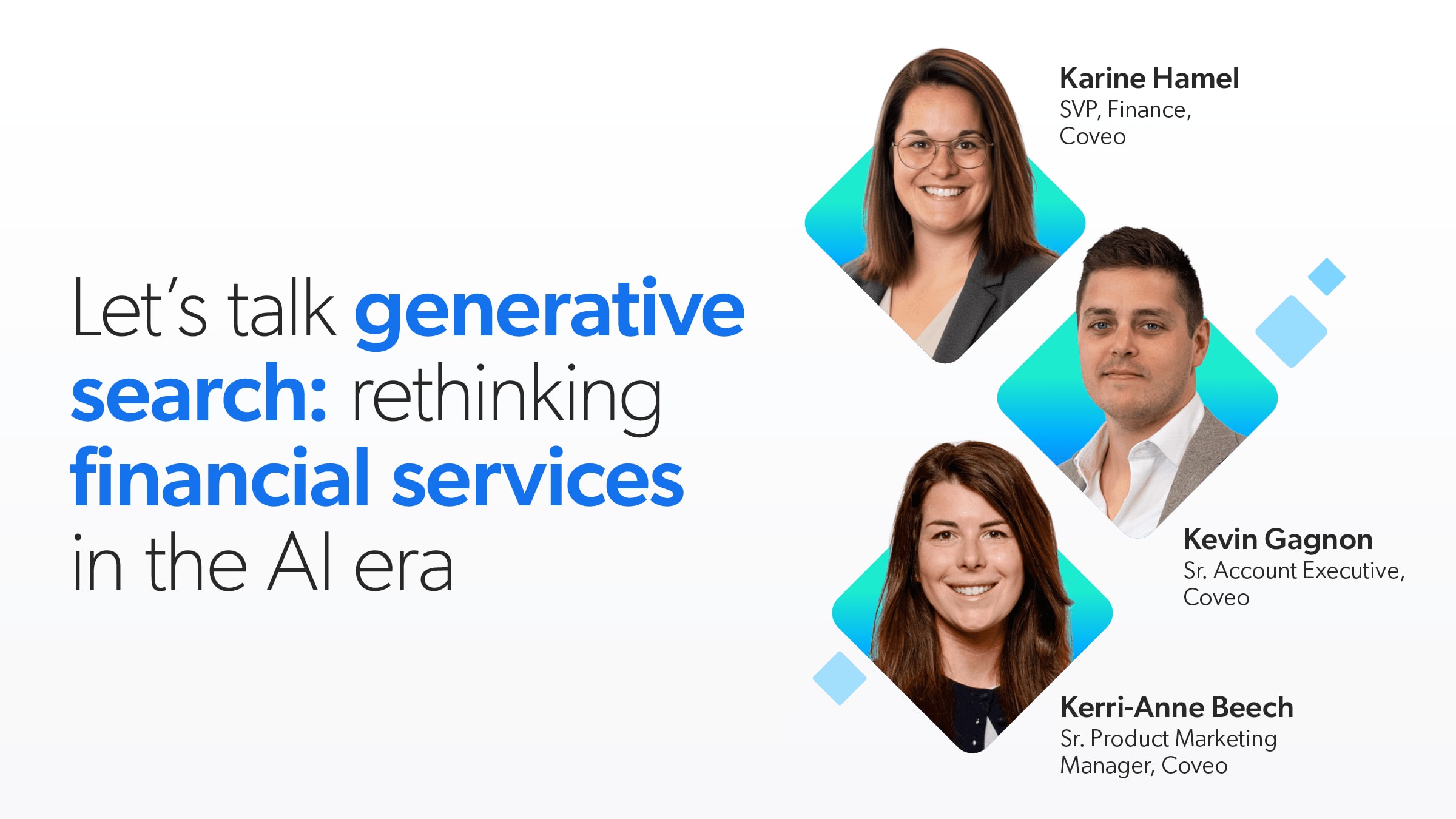
Let’s Talk Generative Search: Rethinking Financial Services in the AI Era
Banking on Better Search: The Real Cost of Bad Answers—And How AI Fixes It Fast.
Cut through the hype and tackle what’s actually holding financial institutions back. As AI-powered search and Generative AI promise to transform the customer and employee experience, banks and financial services organizations are under pressure to modernize—without compromising compliance, trust, or performance.
Join Karine Hamel, VP of Finance at Coveo, alongside Kerri-Anne Beech, Senior Product Marketing Manager, and Kevin Gagnon, Enterprise Account Executive, for an engaging fireside chat–style webinar. Together, they’ll dive into how financial leaders can move past the buzz and build AI search experiences that truly deliver measurable value.
What you’ll walk away with:
- A view of the road ahead – See how banks, lenders, and wealth managers use AI search to cut costs, raise CSAT, and boost advisor and agent efficiency.
- A breakdown of the blockers – From legacy systems to fragmented knowledge and compliance risk, uncover the real challenges AI must solve in financial services.
- A trust-first strategy – Learn how to prevent hallucinations, ensure accuracy, and control sensitive content with enterprise-ready AI search.
- Success stories to model – Explore how leaders like Vanguard and Manulife drive measurable value with Coveo AI search—faster answers, smarter agents, better outcomes.
- Steps to get started – Leave with a practical framework to implement or optimize AI search—and finally eliminate the cost of bad answers.