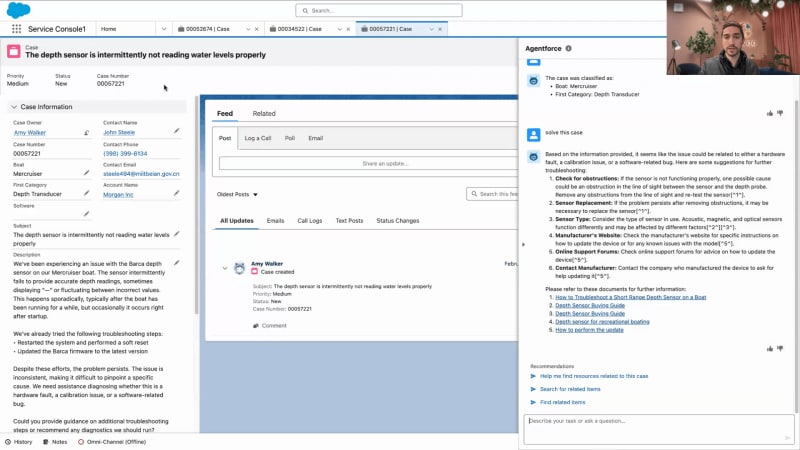
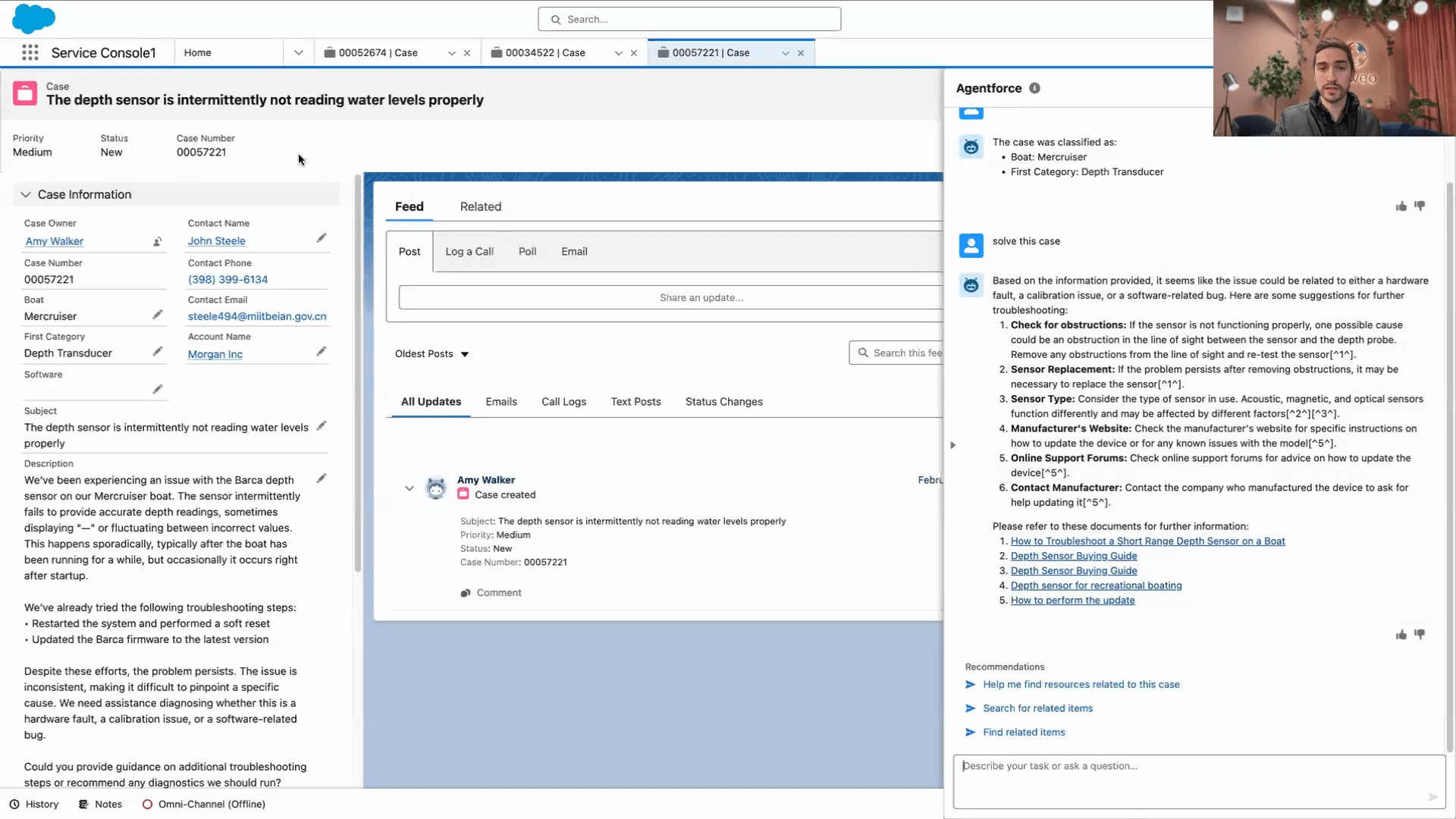
Hello, everyone. Welcome to our webinar today. My name is Mike Raley. I'm the SVP of marketing at Coveo, and I'm excited to introduce you to my colleague, Matthew Lavois Suburban, who's a product manager of Coveo for Salesforce. The two of us are so excited, for all of you to be among the first in the world to see Coveo for Agent Force in our presentation that we're calling how relevant knowledge powers Agent Force today. One quick, comment before we move on. Koei is a publicly traded company. This, disclaimer advises you to check out our most recent earnings and our annual, report for more information about the business. We will be making forward looking statements during the presentation and advise you to to make your decisions about Coveo products based upon what's currently available in the market. Today, we're gonna talk a little bit about how AI search and generative experiences, create, you know, great better better experiences in general, why Coveo for Agent Force is created, and, we're gonna do a demo and some discussion. Matthew, what would you add? No. It was actually gonna be a live demo as well, so quite excited to show everyone, what we have in store. It's gonna it's gonna be great. So we're we're excited for all y'all to to see that today. You're here, for the same reason we are. The race for Genentech AI is on. You are hearing big players making noise in the market, including Salesforce about the importance of Adentech AI, how much this is gonna change quite a lot of the way that we work, both how, people work with AI and what AI can do on its own. But I believe you're here in big part because you know that you need results. Companies like you and leaders like you have been racing for the past two years to build AI applications. These are just some of the applications that many of our customers are building, starting with search pages, generating answers on them, which Coveo is is supporting with many of our customers. We'll talk about that a little bit later. Custom gen Gen AI apps, you know, email, article generation, and marketing, a lot of content creation, etcetera, and then frankly, agents. So upping the game of what chatbots promise but couldn't deliver to really give better answers, but also take action to make people better. But because we're so early in the, adoption curve, we're curious, for where you are in your journey. We have three quick poll questions that we like all y'all to answer starting with this first one. Is your company using Agent Force today? Take a moment and let us know if you're among the first to deploy agent force, if you're planning now, you're curious or if you have no plans. Curious where where you stand on that. Yeah. Quite curious to see also there's some use cases that are slowly getting in prod. Right? I think we all know that this is a fairly new product, and it's evolving very quickly. We're getting news, or we're seeing new features appear every few weeks now. So quite curious to see what the results of this first question will be. It'll be very interesting. The next question, asks you where are you prioritizing, your, or what might you prioritize, for your first or early agent force actions. You can select as many as are relevant here. If you visit Salesforce's website, there are frankly, dozens of potential use cases, and I believe that there's you know, the sky is the limit for what will be possible with agent force in the future. Curious to see where you land and, you know, if you're starting more on an external use case or or an internal use case, where where are you where Where's everybody landing on that? We'll take a look at the results after we get through these questions. Interestingly, here we had to specify human agent assistance, right, since we're talking about AI agents. And, interestingly enough, I'm not as sure, if you noticed, Michael, we do have quite a lot of use cases for sales at Cavill. We're historically done a lot of commerce as well as service, self-service, agent assistance. But we're seeing a few of our clients also use Cavill and search for agents to or or sales agents. I'm sorry. Salespeople that actually help them be be more efficient. So we're curious to see the results of this one too. Me too. And then our third question is, if you're using Agent Force, till now, what what have been, if any, your top challenges? Speed, answer speed, answer or data quality, maybe resource constraints in inside your organization. My favorite one, potentially getting the right strategy in place, knowing where to start. You know, I'm curious what's coming up for for everyone. And we are doing a live demo letter. So, hopefully, those challenges are not part of the demo we'll be showing. We hope we hope indeed. So let's take a look at the results just to, you know, see where everyone stands in this in this poll, and then we'll get right back into the content and then to the, to the demo itself. So, looks like most folks, fifty six percent are, not there yet, but are very curious. Well, we're excited for your curiosity, and we hope to add some value to you today. Let's see if it's possible to switch to the next question. And which use case are being prioritized first? So customer self-service, fifty percent here. And then, Matthew, to your point, human agent assistance and augmentation. In our demo, I think you're gonna start actually with that use case showing how Covala for agent force can augment people. Absolutely. Yeah. And then let's see the third question. Interesting. You know? Hopefully, I didn't lead us down that that path too much, but getting the right strategy in place certainly, you know, is is, you know, coming up straight to the top. Well, thank you for, taking part in our our little informal poll. I think that helps us all ground us on where we are. And if you're interested in the survey results, after this, please let us know. We're happy to share. So given all the noise about Nogentic AI and AI and all of us at our own homes and lives seeing how AI is impacting how we operate, I'll I'll tell you my four year old son and we read, bedtime stories to him in the evening. So AI has changed everything. But on the, you know, on the customer service side, customers know businesses can do better, and they're expecting faster, better self and smarter self-service than really ever before. They're looking for quick answers, not science projects trying to discover the answer in your your knowledge base and your system. They want their complex problems, especially in the enterprise where time matters, solves quickly, and they want the answers tailored to them. Gartner, recently announced that eighty five percent of customer service leaders worldwide are exploring or piloting conversational AI or or a, agentic AI use case this year to respond to that demand and take advantage of the opportunity. But our position at Coveo is that these AI experiences will fail if they're not powered entirely by your enterprise knowledge. The reality, which, you know, potentially stating the obvious to many of you is that knowledge is everywhere inside an organization, and these are just some examples of the types of systems that contain content that could be potentially relevant to helping your customer solve their own case. And, frankly, part of the challenge that Coveo has been solving for the past fifteen years is the fact that this this knowledge is disjointed. It's possible to go to one channel, get an answer to a question that's different from the answer you might get in another channel, and that that adds up, and and we believe that it doesn't make sense. Knowledge is everywhere so much so that TSIA's most recent state of knowledge management report in the age of AI says that, you know, support teams rely on seventeen different knowledge repositories to complete a day's work. So knowledge is truly everywhere. You know that, but it's important when we think about empowering an agentic AI solution with knowledge. So our our position is that when that knowledge is disconnected, the experiences break. Last evening, I asked agent force which trailhead or specifically here, what trailhead should I take to learn agent force? And agent force, gave me some information here, which you can see here, three bullets of some FAQs, including one about how I could build, my agent force on field service, which was out of context completely, and then some links to, learning articles, but it didn't answer my fundamental question, which Trailhead, which is a Salesforce's branded name of training, should I take? So the answer I would say is partial here, but, you know, falls into the category of poor inter quality. I have to keep asking the system to get me training. I'm not sure that it can yet. Not to mention slow performance. This took less than a minute as you can see, but still took some time for me when I was asking the question. And there was what we call incomplete coverage and no fallback. There's nowhere no other place for me to go in this in this experience. I couldn't I would have to ask again. And sometimes the the, you know, the experience is not there. I'm sure you have experiences like this with agent force on your own, that that kind of leave you wanting a little bit more. Salesforce has another support experience, so it's easy to compare and contrast what they're able to do. But when you offer those fallbacks in your experience and and connect knowledge, you get a better answer. I asked the same question. What trial should I take to learn agent force on help dot salesforce dot com? Einstein generated an answer for me, which told me the top three modules to take, which is exactly what I wanted to know. Very obvious, you know, the the quick look, which is perfect for my need here given what I what I off expressed. But then further down below, you could see search results that are powered by Coveo that allow me to tab onto the learning section and see the courses to take with the first one ideally for my need get started with Trail Head. So I'm a smart person. I'm able to, you know, discern what makes the most sense. I know also a little bit about Salesforce's products, but this made it easier for me to move faster. And, what I hope you're seeing here is that unifying all this information and bringing relevance to people makes it much easier to, kind of get what I need done. It's our position that. Oh, so go for it, Matthew. Well, regardless of the medium, right, whether it's an agent or whether it's search, the thing here is the accuracy. Right? The accuracy in retrieval is really what's necessary to drive better experiences, whether it's a standard search or whether it's a snappier and smarter agents that can do more. That's right. So our position is unified AI relevance. This is how we we call it powers those, you know, remarkable experiences that we all expect, seeing the information that we need, that we ask for in one go without having to dig or investigate or become forensic analysts. And it is the new bar for digital experiences. People understand how to interact with a chatbot or with a search. We our our position is having a intent box and sort of upgrading the the search box, to engage with and then get not only the generated answers like you saw on the prior screen, but also more information that helps you explore deeper in in context. So relevant paragraphs, what people what other people like me have have looked at, what are follow-up questions or potentially next best actions that could be taken based upon that content. Other relevant results or you might also like. You've seen retail platforms, that you likely buy from offer a very, very similar experience and and we're trained and to to understand on how to use this, and we get a much better way of answering this, with that. But unifying all of this content and relevance is challenging. It's tough when you're a large enterprise and you have diversified audiences that are that really need hyper personalization. You have a ton of content or a large variety of unstructured content. The points of interaction like we talked about earlier are not unified. You have a chatbot. You have a help page. You have potentially a learning site. They're not unified. How do you deliver a great experience across all of them? And, specifically, not everyone knows where they are in your digital journey. So how do you make sure that those journeys are consistent no matter where someone is coming at at you for it? And we believe that relevance is a real science, which is why, Coveo exists. We've been in business for for, well over a decade, and our position is we are there to deliver superior relevance at every point of experience. We've talked a lot about service, relevant in commerce across your entire workplace on any website to give your business as what we say superior outcomes for for each of those experiences. The the company itself, is based in Canada. We're headquartered in Montreal. We have, a dedicated focus on the enterprise, over, you know, twelve years in AI working on this exact problem. Major enterprise alliances notably with Salesforce, but there are other platforms, especially they will to offer agentic AI solutions, and we have a massive network of, global, systems integrator partners. Fifteen years of building this this relevance platform. So this is, you know, tried, true, and tested, and, you know, proven. As a leader, we have all the security requirements that large enterprise needs and, you know, Gartner, Forrester, IDC all rank Coveo as a leader in our space. So both knowledge search and product discovery. It's an exciting time to be at Coveo, but, you know, we'll talk a little bit now about the platform itself. So in order to deliver, you know, find relevance across all those touch points, we've built a platform that really unifies all of your content in context data and then makes it available in any of the experiences that you may have. So website commerce, service, and across the workplace, including, AgenTek AI. So this is a maybe a great point where you can pass it to Matthew who will show us some examples of how customers are using Coveo across all of those digital experiences before we get into the demo. Absolutely. Thanks, Mike. And, yes, this powerful platform that you just showed is really what allows us is with this platform being agnostic to deliver accurate, relevant, and secured answers at every touch point, right, using all of your enterprise knowledge. So some of these touch points that we've seen our Salesforce clients specifically adopt are things like in app support, for example, to keep users engaged within your SaaS based product, providing secured relevant contextual answers in self-service portals to increase self-service success in conversational interface, which of course, is the topic of the hour. We'll be touching on that with our demo in a few minutes, and case submission forms where GenAI can help make the case submission form into a case resolution form, bringing significant value and increasing case deflection, And then, of course, for assisted support, which is where actually our demo will be today, to help agents in service apps to be more efficient, but in this case, using an AI agent to assist them. So what we've seen really is that for those conversational species specifically and, for agent force as well is that agent force will only be as effective as the knowledge you feed it. And, you know, Coveo ties into this ecosystem, and I think Sean from Salesforce, you know, said it very eloquently, is that precise answers and service interactions help reduce cost and improve customer satisfaction and that our extensive connectivity to content sources and our capability to add relevance to this content is really key enabler for enterprises, customers with complex search requirements within service. So we're quite happy to announce that with the capabilities we have and the need to ground agent force in solid, accurate, and, relevant knowledge, we're pleased to announce Coveo for agent force, which will allow us Sentient to power agent force with secured accurate relevant knowledge from a unified index, with our hybrid retrieval capabilities. What we're essentially doing with that integration is we're bringing our connectivity and our content and data layer that contains structured and unstructured data. Bringing this into the Coveo platform, which some of our clients and some of you here on the call might already be using the Coveo platform and have content in our index with automatic indexing or unified hybrid index, secured connectivity where we automatically replicate the security models of the sources we index, ML platform to train and use large language models in different applications, or relevancy that's hybrid in nature, uses a state of the art, system of lexical semantic with machine learning models and behavioral signals to improve relevance and accuracy, and then analytics to provide a feedback loop and help clients who are using Kavio understand the value that they're gaining out of this. And what we're essentially doing is taking that that infrastructure, that platform, and making it available to agent force to retrieve relevant passages, relevant items, case classification through different large language models. We haven't even a resolution to a case, essentially enhancing the Agent Force, ecosystem with those capabilities to provide, again, more accurate, better answers, and make those agents with agent force more efficient. So let's go ahead and see it in action. I have a a demo screen here open. I hope everyone can see, now that I'm in the Kavio admin console. And I wanted to start here just to show really where the magic happens. Right? This is where everything starts, and it starts with the index. It starts with having all the right content. And as Mike put it earlier, enterprises have on average about seventeen different sources of content that they'll need to provide accurate and relevant experiences. So we have at Coveo the capability to index content from multiple repositories, whether it'd be with native sources like Salesforce, SAP, SharePoint, and other out of the box connectors that we have, or with our universal connectors like REST API, Push API, Graph API, to bring all those different types of content sources, whether it'd be a website, repository of documents, repository of knowledge, complex technical notes, and bringing all of this unstructured content to your unified index, apply normalization so that this content can be accessible from a single point. Also normalizing things like categories, product names, and things as such to bring it all together, replicating, of course, the security knowledge from those sources into a unified security knowledge to finally have a hybrid index that you can tap into for any experiences of your choosing to deliver relevance at scale. Going now into, Salesforce in the service console. So then what we have is a company called Barca. Barca is essentially a company that sells boat hardware, boat software, boat accessories. So things like sonars, GPS, any of the accessories or any software you might need to take your boat and go across the Saint Lawrence River, for example, navigate, anywhere else in the world. This is what Barca offers. But Barca having a software can still get, with all those complex hardware and software, talking to each other, some cases that are open. Right? So in this scenario here, I'm a support agent in the Salesforce service console with a case where the depth sensor is intermittently not reading water levels properly. So I have this case that's it's seemingly from a cruiser boat. It's an electrical issue, and this is the details of the case. So I wanna ensure first and foremost before I start working on this case that it's classified properly. So I'll go and actually ask, agent force here to classify this case. Right? And what this will do to start, it was actually tap into our index. Because we have this wealth of knowledge and we have past cases indexed in Coveo, we can use large language models to compare the case that's being worked on here, compare that to past cases that were solved before to get a proper classification so we can ensure that once we do ask our AI agent that will be our next step to help us solve this case, we have, of course, the right information. So I wanna go and update the electrical category to devtranucer. We could also, for example, use native, agent force, actions such as, like, change the record to apply this automatically. But for sake of time, and since it's only one of the categorization was wrong, I did this manually. And then the logical next step, now that I have my case properly classified, is to help me solve this case. So I'll go and ask to solve this case. Alright? And what we'll be doing here is tapping into Kavio's unified index as well as our top state of the art retrieval accuracy. So what Cavill is doing in this situation is we're reading and understanding the details from the case, the subject, the description, as well as the categories, and using all of that to properly retrieve from a unified index of multiple sources the most accurate bits and pieces of content to help the AI agent here cater a response that will be an end to end step by step solution to the case that's being worked on. So we're just gonna let it finish up here. We should have this, this answer shortly. And there we go. So we have here a step by step solution that was fetched from multiple content repository for multiple sources, multiple pieces of content that were accurately targeted and found to be the most accurate and the best way to solve the issue without even having to specify or to do a query with the name of the issue. We're able to read that, understand it, and do the proper retrieval, then providing that back to the AI agent here to provide a step by step resolution to the agent. And then we could from here, for example, change the prompt or use native agent force capabilities to ask to reward this as an email, for example, or write a KB from this. Right? The possibilities from here are endless. The key element here is that to provide this tailored, accurate answer, the retrieval layer is really the key. And this is where Qubio is operating. And then from here, perhaps as an agent, I'd like to provide more resources to my client to help them self serve more in the future. So I could go, for example, and search for or find related resources. So with this action, we'll be doing a more standard search. Right? So we'll go to Coveo. Instead of calling for specific passages to help the LLM provide a a solution, we'll actually find, you know, just relevant content relevant resources that as a support agent, I can then share with my client so that my client can self serve and do more on their own next time they have an issue with their depth sensor. So with that step done, I wanna show a fourth action here. We'll actually be going in the back end. Some of you all might be familiar with this, but this is the agent builder. And show a fourth action, which would essentially be just ask a generic question. Right? So I want here to ask how to the depth not reading. Oops. A few typos here. I should have copy pasted this, perhaps. So with the depth sensor not reading water levels properly, we'll just have a generic question, which is the equivalent to the question we had in the case, but this time around, we'll actually just go and ask the question directly. Right? We can allow support agents, human agents, and it seems like my agent fell asleep on me. So let's go ahead and try that again as the builder here tends to often fall asleep if we leave it open for too long. Alright. Seems that it has figured out what it has to do this time. So what it's doing here is just to show you what's happening behind the scenes. This is the same action or the same API that we've used to deliver a solution just earlier. But this time, we'll just ask a question directly because agents might have questions sometimes that are not directly written in the case, and they wanna may wanna formulate it differently. So in this scenario, again, we can see that it identified that this was a generic question. I called our API, which actually just took three seconds for us to retrieve the most relevant passages from our large index of multiple sources, deliver those back to the agent with a prompt that instructs the agent to essentially provide those as a end to end solution as well as the citation that were used so we know that the answer is grounded in truth and an actual content. So this was, in a nutshell, what we have so far. Now those actions can be edited. Right? And today, essentially, with Agent Force, we're packaging the, the APIs and the different resources that you can get from Coveo, but there's still a lot of flexibility about how you wanna use the prompt. So one could choose to modify those actions and using the same passages and citations from Coveo to use those to write, an email or to write content, for example, or to summarize content that already exists in your index, enhancing and growing the number of use cases that can be done with, tapping into that unified index and this accurate retrieval layer. So with that shown, I'm gonna go back to the slide and just kind of do a bit of a recap or explain essentially why when or should you consider Coveo, right, for these use cases. And these are the needs that we're seeing essentially large enterprises, or that we're helping large enterprises solve to achieve value. With the first one being, we have a rich knowledge base. Right? So that's very common across the clients we work with. You have a significant amount of relevant content that you wanna unify and retrieve. That's That's typically where Coveo is able to help. You have content across multiple sources with different types of connectors. This is also something that we help, and we're able to bring that into your unified index. If you have diverse and global audiences, we provide a lot of control around how you can deliver more tailored experiences to users in different countries, in different use cases, in different experiences. We're also very strong when it comes to access control. So with Coveo, you don't need to replicate or to manually build a permission model. We'll automatically replicate the permission model from the repositories we're indexing to have a unified secured model of permissions within Coveo so that only the only the items that a user is allowed to see are gonna be made accessible to that user whenever you wanna retrieve content, classifications, or passages. Whenever you need real time updates, again, whether you knew or updated content should be immediately retrievable. Kavio is able to refresh multiple times per day if need be to make sure that we're keeping the latest and greatest content that you have available to your AI agents. Whenever you need to optimize support. Right? If you'd like to improve self-service, improve resolution time, reduce escalations, and rerouting, this is also something Coveo can can help you with. And finally, KCS adoption. We're a big KCS software sales here at Coveo. And if you follow or want to implement knowledge and services practices in your organization to reduce known issues, Coveo can be a a a strong lever for you to have access to all this content, improve this content over time, normalize it, and make it accessible in different use cases. So once again, these are the needs that we're seeing large enterprises that use Coveo solve with their technology, which in turn is helping them reduce cost to serve, significantly increase operational efficiency. So the question now is, what if you could do this? Right? What if you could deliver relevant knowledge to your customers at scale anywhere? Right? How much an impact would this have on your business? What do you think, Mike? What have we seen with, as an answer to this question from our clients? Yeah. Well, let let's take a look at it at an example, of this, and we'll show some some stats from other customers that have been using Koveo. This is, Xero is a a software company based in, New Zealand that, high growth software company. I think they've got about four thousand employees worldwide. They've been using Coveo for essentially knowledge based search, and, you know, question answering case deflection for a number of years. They, I think, became a customer five plus years ago. And in their first implementation of Koeo, found that they were able to reduce the cost to serve by about thirty five percent by merely bringing the right information at the right time in the support portal or in the product when the customer had a need. They took advantage of our relevance generative answering capabilities and and, within I think it was six weeks alone, saw a further twenty one percent improvement in case case reduction. So, basically, bringing relevant information to, the customer and allowing them to to discern what they need really has a material impact on, what cases make into the contact center in their CSAT. Recently, and this is a case study from Salesforce and our partner, Sloane. They the Xero team built on the Coveo index to, you know, create a first agent force use case. The in particular, this case was around extending self-service to social media. So they they had a question answering capability on Facebook Messenger, and they were using Coveo Gen AI capabilities that they had invested in to essentially answer through Facebook using, a Salesforce agent, which is amazing. The the yield was really, felt in, you know, helping people find information faster and reducing the load on the people. Eighty percent decrease in time spent human person time spent monitoring the Facebook Messenger channel because the answers were so great and strong. Seventy five percent of the messages were handled by this this, by the spot, and it really cut down, the amount of issues that required a human specialist to work on. So customer wins because they got the answer that they needed. Company wins because they're able to spend, less time on, known issues and and spend their time where where it really matters most on the the new issues and the more challenging areas. So this is an example of where our current customer Xero extended their their use with an agent force capability, but they relies on that underlying index of relevant knowledge from everywhere. And then it, you know, allowed the, you know, in this case, Facebook Messenger to be the the, the system of interaction or system of engagement. Zero is not alone. They're one of, you know, hundreds of current Coveo customers that have achieved what we call here achievable, impressive, and repeatable results. Zero, we we talked about already. F five networks was on stage at Salesforce Dreamforce most recently talking about how they, with Coveo generative answering, improved, their case deflection by a further eleven percent, in this case, saving them a significant amount of money. Forcepoint doing something very similar, improving case deflection. Salesforce themselves, spoke at a webinar with us, I think October, November last year talking about how with, with COVID, they're avoiding, twenty thousand cases a year. A material amount of, of, self-service success and and our our friends at SAP concur, another customer that's using Salesforce, announced that they're saving eight point six million dollars a year with this type of an approach. Not all of these customers are using, AgenTic AR. Agent four zero is the first one, that we're excited to be able to talk about, but they're all using these principles of bringing content into context so people could do more on their own, with less effort. Matthew, is there anything you'd add to those? No. I think you you said it very eloquently. You know? We're we're always very happy to see those success stories. And when we see that our technology is bringing significant to our eyes to those companies, this is really what keeps us awake and and, you know, keeps us, keeps the drive going for us to continue delivering those wonderful experiences. So it's always great to see that. So we're, we have we've got an a a great amount of time right now for q and a, and there's been some excellent questions in the, q and A panel. If you have a question you'd like to like us to answer live, please take this moment now to, share that question. If we won't get to everybody, we will make sure that we follow-up with you, one on one. We'll start with one that's just top of mind for me. It's Matthew, maybe I'll ask it of you. Can I attach or pair a generated answer generated answer to a case? Well, yes. You know, obviously, the, Agent Force UI is not built right now to have, like, those buttons and things to, like, copy paste, for example. But it's very easy to essentially ask the agent to reword or or change the answer and make it into an email or make it into something that could be, copied. We always ask your class clients on the list to use caution. Right? Because LLMs still can interpret information differently. Right? But, of course, having the right content behind the answer usually helps avoid those issues and avoids those those hallucinations. So we've seen our clients do this often with our generated answers and since she copied them and used them to clients with agent four specific. You can just ask for different formulation, and we'll give it to you. And you can then use that to write an email, send a chatter, or anything like that. That makes sense. There's another another question here. It's it's a little bit related. It goes back to, you know, what is a Genetec AI? But here, wouldn't let me make sure the question moved. Wouldn't it wouldn't true Genetec AI AI just automatically solve the case and attach the answer? Matthew, can you comment on that? Well, yeah. I mean, it it depends how you wanna set it up. Right? So we've seen clients over the last years have a bit of a of a, you know, slow approach to adopting generative answering because of the need for accuracy. Right? And this is what we help clients get and and bring forth in twenty twenty three and twenty twenty fourth when we were the first to market with our generative answering solution to deliver accurate answers that our clients can trust and use and even deploy this on self-service portals. So today with agent Forrest, you could technically have the answer and have the agent and add a few extra actions to automatically apply the answer, send it automatically to the client, and call the case done and essentially change the status to closed. Right? So these are some of the out of the box actions that Salesforce has to update the record, right, where we come into play is really delivering the answer, delivering the accuracy for this agent to be smarter and to know what to answer and what to do in those situations. But then how you decide to use that and how you decide to tailor your agent to do more and take more actions, that's really up to you. And, obviously, we'll be happy to work at making sure that our technology is tailored to fit into those different use cases where the agent you might want the agent to do more. Right? The example I had here for was for a human to actually work with the agent and use that to solve the answer. But, you know, tier one level support cases, for example, we can definitely see those in the near future being handled completely by an AI agent, especially if there are issues that are known and that are properly documented and we're able to deliver an accurate answer right out the gate. Excellent. We'll move on to the next question. This is a good one. Maybe both of us can take a shot at answering it. How does Coveo complement, overlap, or completely replace data cloud data cloud's capability to ingest and index unstructured data to power agent force? And I'll take a a first stop at that and be curious, Matthew, for your your take. I'll start with what Matthew's talked about earlier. The GM of Salesforce Service Cloud announced that it's his recommendation that and those enterprises that have content complexity or audience diversity to rely on Coveo, to power, search, experiences or, you know, answering experiences like what we're seeing here. It's our understanding that data cloud, you know, does have a capability. However, for those, to do this big picture, but the the needs of large enterprise, suggest that, Coveo might be a better option or one to look into for a couple of reasons, limited connectivity. So Coveo has an extensive set of of of connectors with rapid refresh rates, the ability to move, you know, knowledge in real time, a little bit more, you know, faster, you know, response time. Some enterprises will will have that need. They need to move quickly and make sure knowledge is updated fast. Security. Large enterprises have, oftentimes requirements of security where, you know, document level security is is very, very important. It's our understanding that data cloud does not respect, security where system security models is the same level that Coveo has done. We've been in business for for fifteen plus years doing exactly this, so Coveo is a bit more advanced. And then, ultimately, it it does come down to a cost equation. There's a cost effectiveness, that we believe are that Coveo may make more sense for certain use cases. And the way to find out is to to talk with us and and and and learn if Coveo will meet the specific needs of your use case. But the idea is Coveo is additive, endorsed by Salesforce to do this, and and could come could help you speed up the relevance, frankly, of your agent force deployment. Matthew, what what would you add? Or or Yeah. I I would add really in the size of the index as well in the complexity. Right? So there's competitive experiences, any tailored experiences and customization. That's really also where we give additional control, additional accuracy in our retrieval layer to cater to those experiences and also when it comes to the size of the index. Right? So if you have, for example, a hundred thousand documents and you were to use Cavill, it'd be like putting a Ferrari engine on a bicycle. Right? The types of clients we work with typically will have, you know, a million and upwards, documents across, you know, fifteen, twenty different sources with high complexity, high need for normalization, high need for, you know, speedy refresh, high need for security and and respecting, those models. But we have clients even with upwards of, like, a hundred million documents that work with us and even more. We've been experimenting with, like, a a farmer to school company recently that we're talking about billions of documents. So these are the types of enterprises that we're typically able to help. And where there's a need for, you know, increased accuracy of the the chunks and passages that are returned to help a model, increased flexibility, increased control, increased connectivity, increased, you know, security and unification of that in a in a index. This is where Coveo is is, you know, where we differentiate from data cloud. So if you had just, again, a hundred thousand documents, well, perhaps Coveo is not the right solution for you. But when you have complex and large indexes and complex needs and you want the experiences for the users to be optimal and personalized across any touch point, this is where really Caveo can come in and and drive, you know, significant value. Matthew, thank you for that. Just got I think we've got time for one more question. There happens to be one more in the the queue, which we'll comment on now. Would this Coveo solution work with Einstein Bot's Salesforce's, website chatbot? Yes. So because today we're we're packaging, essentially agnostic Apex classes that allow to call our APIs and add additional instructions, and these can be built into, like, prompt templates or an action or a topic. We've also seen some of our clients use those APIs and user retrieval later in more program programmed Einstein bots, which are not as flexible and as, conversational as an Einstein agent, but can also deliver great question answering experiences for self-service use cases. So that's for Einstein bot. But with AI agents, with AgentForce, with, messaging in app and web, you can also take an AI agent and have it be applied in a self-service portal, for example, or in a case a resolution use case that's outward facing. So our actions are tailored, to essentially be deployed in any of those. Right? So, yes, the answer would be yes to make it short. That's great. So, now, I I think it might be a nice time to, to announce how, folks can take the next steps to learn more about Coveo for agent force and get access to it. Could you talk a little bit about that, Matthew? Yeah. Well, our listing just went live, two days ago, actually, actually, on Tuesday. So we're quite pleased to, you know, make this available to the world. It is evolving very quickly. We're at, like, our first or second version of this package now. We're obviously gonna make some very fast increments and add more of the capabilities to agent force. So if you'd like to learn more, feel free to reach out to your customer success manager, your account manager, your account executive so we can guide you at getting started and trying out Coveo, for yourself. Amazing. Thank you. There's some other, ways to get to know, Coveo and Coveo for Agent Force. As a a follow-up to this session, certainly, both Matthew and I are available to have discussions with you. We also would invite you, if you're interested, to get a personalized and deep dive demo for your team. We could repeat this demo with your with your with your team members, tailor it a little bit more to your needs. It's an offer that, you know, everyone on this call, could take advantage of. If you wanna get down one more level, deeper, we invite you to work with one of our solution engineers to really discuss if Coveo is right for you. Does does it make sense, and would it make sense for for you to adopt Coveo in this in this way? You've also got two opportunities to meet Coveo, in person. Both Matthew and I will be in San Francisco at Salesforce TDX, March fifth and sixth. So please come see us. Bring your friends, bring, you know, teammates, bring your questions. We'll be on stage with the demo jam showing, Coveo for Agent Force. So please do come and, be part of the audience for that. And if you'll be at the, Consortium for Service Innovations annual member summit in March, we have teammates that'll be there as well. So we're we're happy to sponsor that organization and, be a partner with them. So please, please come see us. But, you'll get our contact information after this, but we're we're here to help. We wanna have conversations with you and, you know, at where meet you where you are if you're at the strategy level, etcetera. But the idea is Coveo is here to help you, get the most out of all your digital experiences. Finally, we have a great event coming up on March sixth. Also, the same, timing as TDX if you're not gonna be there. We have relevance three sixty, which is Coveo's, twice annual essentially keynote event where we talk about the most important things that are happening in AI, GenAI, in in terms of, bringing relevance to every experience. And I'm excited to say we've got a customer from Zoom who's gonna be speaking about how they are using Coveo to improve the service experience. And John Ragsdale, who is a thought leader and, research analyst for the TSIA, is gonna be coming and talking about his point of view on the the overall market. We'll be bringing case studies, thought leadership, and continuing discussion on the the importance of relevance, bringing relevant content and knowledge into into the flow of every experience. So with that, I'll say thank you all for your attention. We hope, you learned something and got some good value out of today, and I look forward to, continuing the discussion with all y'all. Thanks very much. Likewise. Thanks, everyone. Thank you.
Coveo for Salesforce Demo Webinar: How Relevant Knowledge Powers Agentforce
That’s where Coveo comes in.
While Salesforce Data Cloud plays a key role in unifying customer data, it isn’t designed to surface the most relevant content for customer support. Coveo extends the power of Agentforce by ensuring it retrieves and delivers only the most accurate, secure, and trusted knowledge—so every interaction is truly intelligent and drives real business impact.
Watch our demo webinar to see how Coveo brings AI-relevance to Agentforce and Salesforce experiences, helping you:
- Securely retrieve the right knowledge across your enterprise
- Deliver fast, relevant answers—grounded in your trusted content
- Unlock Agentforce’s full potential without the high costs and effort
For over a decade, Salesforce customers have trusted Coveo to bring relevance to their service experiences. Find out why and how this latest offering continues that track-record of search and relevance innovation.
Get your Agentforce deployment right from the start. Be among the first to use Coveo for Agentforce to make every AI conversation more relevant and successful.


Make every experience relevant with Coveo