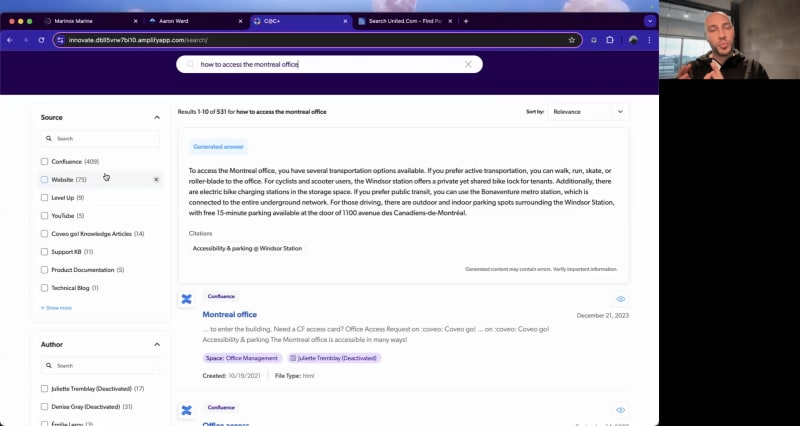
Hello, and thank you for joining today's webinar. My name is Michael Jepsen, and I'm the SVP of sales here at Coveo. I'm joined by my colleague, Vincent Bernard, who is the director of research and development here at Coveo. So before we get going, we have a couple of housekeeping items to cover off quickly. First, everyone is in listen only mode. However, we do wanna hear from you during today's presentation. We'll be answering any questions at the end of the session. So please feel free to send those along using the q and a section on your screen. Today's webinar is being recorded, and you'll receive the presentation within twenty four hours of the conclusion of the event. Okay. Without with the housekeeping items out of the way, let's go ahead and get going. Let's talk about generative AI and a recent offering we have announced, GenAI essentials. It's an offering designed to enable companies to provide not only AI powered search results, but also generated answers for their employees and their customers, all for ninety seven thousand dollars a year. So why did we announce GenAI essentials? Our thesis is this, two to three years from now, all websites, all intranets will not only have great search results, but they'll have generated answers for their employees and their customers. Most do not have either today. Most websites we see, and we see a lot of them, have pretty mediocre search experience for their for their customers. And our our belief is based on our conversations with our customers that their Internet experience is pretty much the same for their employees. They get mediocre search results, no answers like they get on the Internet, and all all that we believe is gonna change over the course of the next two or three years. So GenAI essentials for ninety seven thousand dollars a year will enable all companies to upgrade the experience for their employees and their their, customers by providing not only great search results, but generated answers. So this may all sound good, but you're probably wondering, is it secure? Is it scalable, proven? And is it gonna be improved over time? And the answers to all those, yes, it's secure. Yes, it's scalable. Yes, it's proven. And, yes, Coveo has a commitment to innovation. So let's let's make sure everyone knows who Coveo is in case you don't know. Coveo is a decades old company. We specialize in search, personalization at scale. We we specialize in generated answering, recommendations, and all this is driven by artificial intelligence and machine learning. We're really well reviewed by the likes of Gartner, Forrester, and IDC. All of them consider us a a leader. We are indeed secure. We're ISO twenty seven zero zero one. For those clients who deal with personal health information, we are HIPAA compliant. And we have seven hundred customers in production today, all of whom are subscribed to the Coveo offerings, and all of whom get constant improvements and enhancements to our to our service. So you know what GenAI essentials is. It's a an offering designed to upgrade your experience for your employees and your customers. You know what it costs. It's ninety seven thousand dollars a year. You know why we brought it to Barca? Because we believe all all companies will want to provide answers for their employees and their and their customers. It is secure, it's scalable, and it's proven, and, indeed, it, will be improved over time. So why don't we show you, via a few demonstrations here, what we typically see as a search experience for most websites and then what we think will be the search experience over the next two to three years going forward. So with that, I'll turn it over to Vincent Bernard. Thanks, Mike. I've been working at Cavio for almost ten years now, and my first job was solution architect in the website line of business. So I really did a lot of audits on websites, saw a lot of architecture, a lot of CMS. And, we kinda build that that expertise regarding UX and also relevance. And the the most flabbergasting thing you see out there is that it first off, it's hard to build search. Mike, you said it's search experience are usually subpar. I agree, but it's because it's hard. It's costly. It's hard. And having irrelevant search experience requires a lot of of knowledge. So we'll show you here on this Merinox website what we see most often even, on the intranets or on on normal websites. So you may recognize yourself. I hope not. But, there we go. Let's go. And, first off, first thing you see here, the search box is hidden. So that's mostly a a UX problem, I'd say. But the first error you see here and we're not we're far from generative experience here. But then even the search box is is shy. It's hidden. It's in the corner. But if you click on it, you're gonna have a noninviting search box. If you start typing stuff in there, you have no guidance at all. No query suggestion, no typos, no idea of what's gonna come back. So that's one of the first knowledge you need to to be aware of. Guiding users, having suggestions, or or direction will help them actually focus their search. So let's say I still proceed here. I'll go for GPS positioning. I'll fire away. You'll enter a very, I'd say, under par search experience. This is usually what we see most of the time. So, first off, the connection between the search box and the search page was not done properly. State management is not done. So the keyword you entered just failed. So you have to redo it again. At this point, you're gonna have a mixed result set under the surprise bag here. You have sometimes, excerpt here. So kind of a description of a part of the document. So you can see here that GPS positioning is there. But most of them is just a title. So as a user, I have no idea why or what is those. You're missing kind of a lot of feature. You have no idea what it is. You have no idea regarding is it is it a fresh page or not? Who authored it? Have no metadata available? So this is the kind of experience you see most of the time. Like, it yeah. It's fast, but it's not very relevant. You're also missing filtering options, so you cannot slice and dice the information or just scope on a specific topic. Also, some common mistakes we see is that there is no query, correction or or even did you mean functionality, and no even error messages if you if you missed it. Highlighting is missing as well. So if you're doing things like stemming or these kinds of technology, you won't see that position is mapped with positioning. And, yeah, that's the kind of experience we see often either in large SharePoint environments within internets or on on public websites. Mike, anything else you wanna add on this, based on your experience on the field? This is typical in our experiences based on our conversations with customers that this is typically what they see. The the biggest thing that's missing here biggest things that are missing here. You cannot fast it. You cannot filter. You can sort by relevance. And there are most notably no answers, on this this site right here. And this is our ours our thesis again is that all this is gonna change in the next two or three years. And the reason is employees and customers are simply going to expect a better experience because they get it out on the Internet today, and that's what they're gonna expect in, from their from their suppliers, their their providers, and their employers. That's for sure. And back in the day when I mean, it's kinda I'm gonna hint a little bit of my age here, but when Internet started, I mean, we didn't have search and website didn't have it. And then when Google started to provide that amazing feature, every wide website had to provide search because that's the expectation. Now that we have GPT and all these cool experiences, the same thing, you need to react because now the the out there, that's what's the that's the expectation. So let's take the same query, and then compare it to a full fledged experience and the kind of experience you can build with the platform. So, let's go here in Barca. The, another brand, same industry, but a different brand at this time. This website is built on, Adobe, by the way. So the CMS cloud here. If you enter here the search box, first off, I clicked on it, not a single keystroke either on my mobile phone or here on my desktop. Not a single keystroke. I already have suggestions. Those suggestions are based on popularity and trends, so they change every date based on how people are interacting with the content. So making it very, very dynamic. And then if I start typing something, you'll see a bunch of suggestions. It already give me a hint of, oh, this is an intelligent website because the questions that are suggested are kinda complex. You know? They're long. They're in English. It's not just keyword search. It's full sentences. But just to compare, I'll use exactly the same thing as what I had, here, the, how GPS positioning. So here, you're gonna have a very, very different experience. First off, the thing that is that is very obvious here, we have a generated experience here. So this is the feature that Coveo is promoting with the package. The generative experience will take the best results and and will combine them if there is information in many of these documents to give you a tailor made answer to your question. So here, for instance, I only have one citation. You'll see later that we can combine a bunch of documents from a bunch of different sources. But the goal here is that this is not just content that I have. It's content that I have that is adapted to the way I've queried it as a user. In terms of feature, we talked about earlier the those filters here. So you're gonna have a ton of information regarding the type of the type of, article, where is it coming from, the content type. In each one of these results, you're gonna find these badges that can help you as well filter the results. You have, like, very beautiful images, cool result templates. This is easy to do with Cavill because we have all the front end features to to help your developers really make this experience, easier to build than having to build it manually. Sorting options, really a ton of content here. Let's go here and click on, one facet. So you'll see that for the same query here, at this point, I change the filter. I get a reduced set of result. It's blazing fast. But also, the answer changed quite drastically now including variables and GPS, NMEA sentences. So depending on how you filter or what type of content is returned by the index, you're gonna have a very different, responses from the generative answering, module. It's also important to notice that this will only generate based on content you're entitled to see. So here, it's a public website, but you'll see when I'm going in an Internet that I'm gonna have result tailor made to my accesses in either in SharePoint, Google Drive, or whatever, and this will be used for generation. So Mike is an SVP. I'm a director. We don't have the same level of access in Coveo. So, obviously, we're gonna have for the same question. We're gonna have different results, which is very interesting. The last thing I wanna highlight here on this website is the fact that if you click on the quick view, you can even enter these documents and see with the highlights why are they, relevant to my question. Interestingly, my question was GPS positioning. You can see the stemming in action here with position instead of positioning and the word GPS highlighted in that document. This here is the body of the document. This is the chunks that we're gonna feed the LLM for the generative approach that we're gonna speak a little bit more about later. Mike, before I jump on the listing pages and recs, anything to add here on the search experience? Just one comment, and you you mentioned it. It has a lot to do with the permissioning and security. We have a lot of we have a lot of clients who have attempted to build their own search experience, and that's tough enough as as Vincent explained and and generated answers. It is really the hard the really hard part is not not producing search results. Anyone can produce keyword search results. The really difficult spot part is to make sure that what Vincent can see, Vincent can see through his search. And what Mike Jepsen can see Mike Jepsen can see, and all the permissions and security are honored in the search, not just as they are in the source system. So that's where a lot of lot of clients who try to build their own get caught up. It's in the security and permissioning and the indexing process that we do quite well. When you start this, journey of having a generative experience, you're gonna go hit GPT or Claude or Gemini or any kind of LLM, and you gotta have a prototype that's gonna work. Because, obviously, you ask question, you get an answer. But then when you start scaling it to a lot of subject matter experts or or clientele out there, you'll see how easy it is to get it wrong. So grounding the information on secured content that is adapted to your role and permission is a mouthful of a sentence, but also very a key feature here that we have. That's the way to to to actually make these experience scalable in the enterprise world. Since you get access to all the APIs, all the machine learning models, and also all the UI feature with the package, I'll also take the time to show you other use cases. So on this website here, we're using also kind of a people finder, approach. So this is a listing page. There is no search box. It just lets you see the information, slice and dice it. And then if you click on these listings, you're gonna also have, for instance, recommendation, which is another algorithm we have. Like, based on views and based on other patterns of the traffic, you're gonna be able to recommend things. So here, it's a a a related query article from this author, but you can also have people also viewed or this type of algorithm that we have that are available. So this is for the website part of it. Now I'm gonna jump in the Internet part of things because I think this is where, it gets a little bit more, interesting. So this is the same company Barca here, and we're looking at the Internet. If I clear a completely search, you'll see that we are looking at a hefty fifty thousand, results. You can go up to millions of documents. That's not a problem. And then here at this point, we'll, start doing queries like how to access the Montreal office. So you'll see here the citation is extremely fast, and that's another thing. The way we're using our RAG architecture and the LLM behind the scene, we're able to really have a snappy experience, which is unusual, I'd say, in these days. You have often eight to ten seconds delay. So here, we're gonna see and showcase a ton of different connection issues, connection, capabilities. So you're gonna have site map. You're gonna have Confluence connector to YouTube. We have Salesforce content. We have pushed content from custom file systems here. All these content are are, respecting the roles and permissions. And not just one time. All these connectors are updated, as we go live with all the permission systems that are changing within your, within your enterprise. So here, for instance, if I go for how to grant a bonus to an employee in Workday, this is the kind of content you cannot see if you're an employee. You can only grant bonuses if you're a manager, for instance. So this specific article that is compensation change is locked. I mean, it has it has specific rights. You need to be a specific place in the hierarchy. So if you look here at Victor Bouchard, you'll see that the guy has is the director, has a few employees behind the scenes, so he he's entitled to see, this kind of document. However, if you're logged in as someone else, you may not have at all an answer, for this question. So here, a little bit different, but what's interesting in the workplace environment is that you're gonna have more documents and you're gonna have longer question because people are really clueless regarding where is the document or does it exist. On a website, at least you're looking for something like a GPS or something. In a workplace, you have a question. Like, I just got twins. How do I take paternity leave? Is it longer? You know? Funny funny fact. But then you need to you need to ask these questions that the system usually never got before. So the the the capability here to transform bonus into compensation change or even, one time payment, These links between these words, the semantic capability takes a lot of place here in the Internet. Mike, any words for the workplace side of things? No. But everything you were showing, in my view, will be what employees expect from their employers in the next few years. Just give me the answers. It increases my productivity. The search results today, mostly most companies have a findability problem. They don't even great great search results, but we can we can do the, improve both your search results and provide answers using Gen AI essentials. Last thing I wanna share here before jumping, back on the PowerPoint to show a little bit more architecture is, some examples here, some real life examples. So united airlines dot com, one of the locksmiths. You need us we need to share again. Oh, sorry. There we go. You should see now. So United You're not. Still don't see it. What the sure. Is it working? It is not. Well, we can invite folks to go to united dot com. I I see the united dot com site. Okay. I'm not. But go ahead. Yes. Okay. So, yeah, United dot com, one of the largest brand in the United States. They were just they decided to trust us with that feature. And and, basically, what happened when you get the platform is that you can build multiple use cases out of it. So the first thing that they got is their public website, which is great. But then they got also the Internet and other use cases and the intelligence and content from all these use cases yet combined to have a really powerful experience content from all these use cases get combined to have a really powerful experience here. So what you can see how to get on standby, this is the kind of question you get. The more people interacting with the search engine having better answer, the better it will become. So this is a self learning system. Even if our query suggestion algorithm has been there for years and it's something machine learning driven, the fact that we use generative at the end of the pipe will just make the whole thing better by having better queries, better suggestion at the end. So how to get on standby? Very interesting question. You see that we get the generative approach here. So it's gonna instead of having me to go on a web page with a big title and headers and and then pictures, and it's it's kind of a long journey to get my answer. You just get the answer right away. Short answer isn't concise, which is based on their configuration. When you get the VORGE, you can get longer answers or small you can decide to go step by step. You have full, configuration possibility regarding how do you wanna get it. Here, the tone is very informative and very short. So that's the important part. So they get you, the right answer, but if you scroll down, you'll see a ton of different features. So first off here, it's also a what we call a smart snippet. So instead of a generative approach, it's gonna be an extraction of the website that is accurate. So this is the source of truth that is used as a citation. You're gonna also have the top documents. And you see earlier, we were talking about stemming and and these characters that are highlighted, which is very cool. They also get the people also ask feature. So you you have a really Google like experience here. That that that is basically what people are expecting. So United decided to use Coveo and tested it. Imagine the number of questions they got from end users and the testing required to go live with this. You you can ask very, very specific questions. Gonna have a good answer. Let's try another one here. What kind of delicious food is offered on your plane? So even if you're asking with with all sorts of tone, and you'll see that it's gonna answer and answer me back kind of with a wink. You know? United Airlines, you're gonna have a variety of delicious foods such as barbecue chicken, etcetera. So it adapts to your tone. It respect the content. Do not hallucinate or very, very little, because it's grounded on the real content. So based on that, I'll go back here to my PowerPoint, and I'll show you how this is built just before my last words on United. Nope. Very happy customer. We're getting great results. So why don't you go ahead and go back to the slideware? Alright. So here, this is what's in the box. When you get the deal and you are, buying the platform, first off, we're for this specific offer, we're limiting it to two use cases, website and workplace. Be aware that the same platform can power many different other experiences. They are different SKUs. You need to have more features in your cloud platform, but they're all accessible. And and the more use cases you have, the more intelligent it becomes. So the journey starts at the bottom here with the content and data layer. We have been in the enterprise search for years, and what we have developed is a healthy chain of connectors that are very robust that will grab all your documents and your permission for your users with little to no configuration. So it it is a admin driven. You go on the administration console. You select it, enter your keys, and then there you go. We're gonna grab that content and bring it in the platform. The same content can be used across multiple use cases. So here at Coveo, we have our technical documentation. It's used in the Internet search. It's used on the public search on coveo dot com. It's used on the docs dot coveo dot com property. So the same content piece can be used across many different channels. Then the first thing we're gonna do here, is to showcase a few things. When we get that content in, we're gonna have what we call a security cache, which is where we can have very, very fast refresh rate of the identity. So let's say, something unfortunate happened and we have to let someone go. We don't need to delete all the documents or whatsoever. We're gonna just change the security cache to update the specific profile. So it is very it's updated extremely quickly as the security cache is a separate system from the permissions directly on the index. You're gonna also have pipeline extensions to transform your content when it reaches the index, index enrichment. So those are all features that I'd say are are more than a simple index. It's actually platform capabilities, from Coveo. We're also adding to these documents some some new things that you may have heard or may play with product vectors, passages, extractions, so chunks, and also content vectors. So instead of having a vector database and an index, we decided to merge both concepts and have the vectors directly with your content. Then you're gonna have a suite of machine learning models. So what you see on the left is the behavioral machine learning models. This is what we've been building on the last ten years. So query suggestion, relevance tuning, navigation experience, automatic, content recommendation, products, and and margin optimization for commerce. And we also have what we call deep learning model, which is, intent aware predictive query suggestion, and those are mostly commerce specific. And in the last years, I'd say we got this new LLM and generative approach that came in. So everything that is generating, solutions or, generating some some text or also suggesting the right, pieces of content. You're gonna add on top of that some, analytics so you can see in reports how people are using these use cases. And imagine if you use this platform for Internet, one website, and another website in another country, you wanna see what's happening. You wanna see who's searching for what, what's the usage. So having, analytics is obviously something very, very, useful. And then just to close the loop, you're gonna have some UI framework for your developers. We're talking about, headless UI components that can be used across a variety of TypeScript application. Atomic out of the box component, if you really wanna have drag and drop experience. Hosted search page, if you wanna have one click configuration and pull a search page as a whole. In product experience, which is a widget you can put in your own platform, and then you're gonna have the APIs as well. Well. And if you are one of the many that are using some large, integration like Salesforce, SAP, ServiceNow, Sitecore, Adobe, Zendesk, Contentful, name it, we have integration for all these platform as well. So it is easier to pull the content and also bring a UI in these platform. That's it for the big tour of the platform. Since the license we're offering today is an enterprise license, you get everything that is in the box. Box, website and workplace focus, but everything. So you can build multiple use cases with the platform. It's not just for your website. You can do your Internet. You can do other properties. It's all in the box. So back to you, Mike. Yes. You can do as many websites as you want and and as many, sites on your, your Internet as you you want to. So if we wanna just go ahead and summarize, the, the offering itself is GenAI essentials. Again, it is designed to upgrade your experience for your employees and your customers. Generally, our experiences, it can be deployed in something like four to six weeks. We'll provide great search results. We'll provide great generated answers for your employees and your customers. And if you wanna learn more, we'll go to one more slide that has a QR code where if you scan that, you will, be able to see it'll take you to a landing page where you can learn an awful lot more about Gen AI essentials. You will get a, again, a a copy of this recording I sent to you. And, Vincent, we did get a few well, I couldn't see your screen for some of this. We did I did see some questions come in. And I think mostly, you're probably best to address these, and I think you already did on a couple of these. One of the questions was, do you support Optimizely? And I think you said yes. Yes. We do. So, and we're we're partnership we have a strong partnership with Optimizely right now. The main, I'd say, the main, integration we have right now is through their GraphQL endpoint to get the content. So we have a strong GraphQL recipe to grab their content and exit as fast as possible. We're also able to leverage behind Optimizely. There is a there is a strong personalization platform. So we're able also to use the personalization that is the outcome of that platform to influence our learning and influence search results. And since it's a modern platform headless driven, you can use all the Coveo headless component for a quick dev experience. So, yes, UI compatible, indexing compatible, and also personalization compatible with Optimizely. Good. Right. One question. I think, again, your best to address. When you index, do you make a copy of my content? So we're we're not copying content over, and luckily, otherwise, it would have been very heavy, and you would have one more copy to manage. So the way we do it is we we we only index it by reference. So we're taking all the metadata. We're also downloading the binary data within that file just to parse it and index all these words and making sure that we're able to get the concepts out of it. Also able to embed them and chunk them. But then it's just it's not the document copied. It's an index document, which is a little bit different. So at this point, you have all these connectors that will connect to your content, download the metadata, and all these content in the COVID index. And more importantly, the connector stays connected to the source. So if you delete it in your system, it deletes over here. These are always live and updated. You don't need to rebuild your index. It's just always live. If you add something or delete something on your side, it's gonna be reflected in our platform instantly. So not copy, indexed. Deep. And lucky you, one more question. Again, you're probably best to address. By using an LLM, will my data be out on the Internet? So short and certain, no. It goes obviously, we're gonna use the HTTP protocol to communicate with, in our case, we're using Azure OpenAI models. But we specifically asked Azure, and it's the case with more more and more, large enterprise, situation, but we asked to to have a no retention policy. So it is your data is gonna be sent in transit. And what I mean the data, the customer question with the chunks of information to respond to that question. This is the payload that we're sending to, to Azure OpenAI. And then at this point, on on their end, we specifically have some settings to avoid any learning, any persistency. It's only in transit, goes off. We turned off everything else monitoring on their end. So everything is done by Coville, monitoring, resiliency, etcetera. And the only thing they do is get that information in transit without any persistence. So very safe for your data. Yep. Stateless indeed. Good. I think that's all the questions I see. So with that, appreciate you joining. If you share our point of view that, the next couple years, companies will will need to provide answers, not just search results, but answers to their employees and their customers. Consider GenAI essentials from Coveo. It's for ninety seven thousand dollars a year, you get quite a bit, all secure, all scalable, all in production today, and our commitment to innovation. So if you wanna learn more, use the QR code on your screen. You will indeed get a copy of the recording, and we hope to see you again real soon. Thank you all for joining. Take care. Thanks, Mike.

Demo Showcase: Unlock the Power of GenAI
Lessons you won’t want to miss:
- See Real Use Cases: Learn how AI & GenAI helps users and employees find what they need - across your sites and employee portals!
- Achieve Proven Results: Experience practical Generative Answering examples and proven ROI
- Scale with AI: Learn how to personalize experiences at scale with a suite of out-of-the-box AI models!
- See it for yourself: Understand how it works, how fast you can see results, and how seamlessly you can implement it within your current ecosystem.


Make every experience relevant with Coveo