2026 State of B2B eCommerce Report
Most B2B ecommerce teams think they’re behind on AI. In reality, many are still figuring out what actually works.
The 2026 State of B2B eCommerce report shows you why digital buying experiences still feel harder than they should. See where leading organizations are investing, and what top-performing teams are doing differently to improve product discovery, self-service, and ecommerce growth.
See what’s actually holding B2B ecommerce back
See what’s actually holding B2B ecommerce back
- Why companies investing the most in AI still struggle with digital adoption
- The uncomfortable reason many ecommerce teams can’t prove ROI
- Why digital buying still feels harder than it should
- What happens when AI strategies collide with bad product data
- Why many companies feel behind on AI — even when they’re not
Watch our clip from the MasterB2B webinar to:
Watch our clip from the MasterB2B webinar to:
- Learn why most B2B companies aren't as far behind on AI as they think
- See what's really preventing digital adoption and ecommerce growth
- Discover why bad data is holding back AI and personalization
- Understand why proving ecommerce ROI remains a top challenge
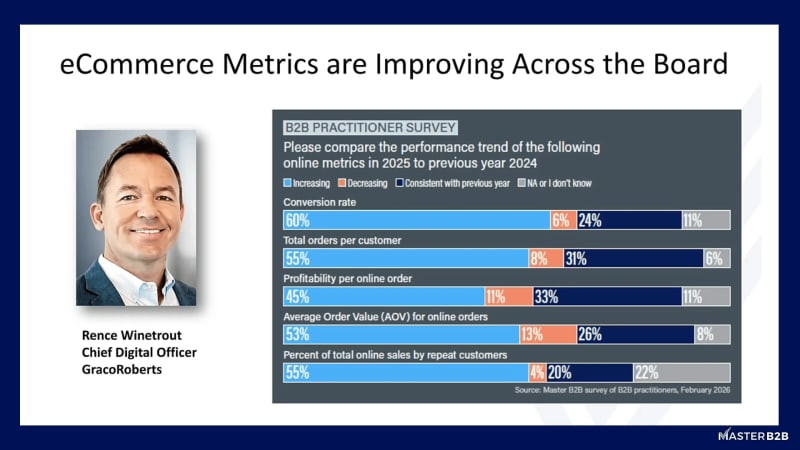
Welcome everyone to the state of B2B ecommerce twenty twenty six with Master B2B. My name is Brian Beck. I'm here with Andy *****, my partner in our thought leadership series and community of e commerce executives. And today, we're going to be speaking about the current state of B2B e commerce this year based on some research we did. We'll get into that in a minute. Andy, welcome. We got an exciting session today. Yeah. You know what? We do this every year, but I I have to believe there's not been a more important year in e commerce than the current one. And not for all the obvious reasons, for more, but we'll talk about that here today. Absolutely. Well, Andy's my partner in this thought leadership series. We've got some great folks also joining us today. But before we get into that, folks, everyone who has become a part of or is listening here to the webcast will be able to receive a copy, a full copy of our state of B2B e commerce twenty twenty six. But for those of you maybe watching later or need to download it, here's a place you can go to download this. You can scan the QR code here. It will also be available on our website. This is brought to you in partnership with Coveo and SAP. We will have some folks from those fine companies on with us today. But exciting times, Andy. And for those of you who, by the way, want to share this, you can share it out through your friends to your friends, etcetera. You'll get a copy of this recording as well in your email box and it'll be available on our website on demand. By the way, folks, you can ask questions and just do that through the Q and A box here on Zoom. Get to as many of those as we can. And we've got some great companies, Andy, joining us for this webcast today. I see here Stacy at Sure Works is here, Soventum, Zorro is here, Uline three ms. So I see Steven Gavord Schneider. Hey, Steven, I was just talking to you. Essity Grasshoppers here, Relevance Nord, McKesson, Samsung, Jim from Performance Foodservice. Yeah, what a great group we have joining us to learn more about what we found. So excited to get into this. We also have some great panelists that are going to be participating in our session. Here's a quick preview of who those panelists are. If you go to the next slide, the folks that are going to be coming in to comment on some of our, not predictions, I want to keep saying predictions Andy, Yes, thank you, for twenty twenty six. So getting into that in just a minute, but go ahead and frame it up a little bit, Andy. We have eight insights that we'll be sharing about what's happening. We ask a lot of questions in this and try to understand the pulse, right? So we're fortunate at Master B2B that we've developed a close group of thousands of people that we can tap into to ask questions. These are practitioners at manufacturers and distributors across industry segments to find out what they're seeing in different areas and what they're prioritizing in their businesses. So we went out and if you go to the next slide here on our approach to this, we did this through a survey, right? So back in January, we issued a survey that we had quite a few responses on from folks like I was just describing to you. We also have our roundtables, our summit and other things where in person events, where we collect information from our practitioners about what they're seeing in these different areas. And these are principally manufacturers and distributors in the United States and Canada. So it's mostly a North American based study. Anything else, anything you want to add there? Well, I was also worth noting that we live in this world, and so we're talking to people constantly. And so when we have our meetings to discuss what we're gonna publish for the stated B2B Commerce Report, you know, we spend hours talking through, you know, what have we observed? What have we what have noticed? What are people talking about? What are the struggles? What are the opportunities? So, yes, it's a snapshot in time, but it's based on just ongoing dialogue, which for you and I is almost twenty four seven, three sixty five. That's absolutely right. And, know, we're, you know, to frame this up a bit, Andy, you know, we've been talking about digital transformation. If you go to the next slide, you know, for years, right? We've been talking about this for twenty, thirty years, and we're really at an inflection point in what's happening in the world of digital and e commerce and B2B. Andy, you want to speak to that a little bit and what do you kind of think we're seeing here? Well, you and I have talked about this many times in that we both hate the phrase digital transformation because I think it's essentially meaningless. And so it really and especially with the technologies that are emerging right now and the business process change that's taking place. I don't think digital transformation was ever the appropriate phrase. The appropriate phrase is actually business transformation because Right. These technologies and these capabilities are actually enabling companies to reinvent themselves. I know we laugh about this in the age of digital. That is a real thing. We could quote chapter and verse of companies that are changing fundamental processes. You know, you mentioned I wrote a book about this. I mean, my thesis is that there are these middle miles between the first mile and the last mile in the commerce journey that people overlook or ignore. And that to me is where a lot of this AI is taking place right now and will have its biggest impact going forward. So, you know, I think we're starting to see change within manufacturing and distribution. We're seeing change on the solution provider side where I think we're seeing insurgents that are challenging incumbents. We're seeing AI native companies all over the place that are are re upending a lot of what's happening right now. So and I also I'm I'm a big believer, by the way, that, you know, a new technology times an old process equals an old result. I I just don't believe that new technologies on their own change a whole lot of anything. If you don't change how you think about and use these technologies, then you're effectively gonna find not much difference. And that's the big challenge. That is the big challenge right now is companies thinking in a different way in order to use these new technologies. And I gotta tell you, the scorecard so far is not great. I think we're seeing a lot of companies try things then either have success or failure and declare it over. If they have a failure, they say, oh, it was the technology that screwed up. No, the technology is not the problem. That's not the problem. It's probably the way you're using that technology, which is the big challenge. And that's really, you know, it's been the story of B2B for years too. And it's fascinating that what's happening here, you know, AI has crept our, has crept into all the different elements we analyzed in the state of B2B e commerce because it is really a transformational piece. I know we don't love that word, but I mean, this really is a serious change in underlying process and technology and things. So let's go ahead and highlight those, what are the eight areas that we got into here. So what we dove into are different aspects of how B2B companies are dealing with digital and e commerce. So here's kind of a high punch list and we're going to get into each of these in terms of what we found. Just to read through these briefly, migrating to digital is getting more complex. Digital leadership skills persist, the gaps persist. AI has moved now from aspiration to action. We were just alluding to that. E com metrics are improving across the board and that's encouraging. We'll get into why that's the case with one of our special guests. E commerce budgets are growing, which is also encouraging. AI is now the number one investment where those budgets are going. Bad data though is preventing growth and that ties into of course AI. And then finally proving ROI remains the hardest internal cell. So we going to dive into each of these based on the results we found. And the first one we are going to talk about Andy is migrating to digital becoming more complex. So we found in our first here is that, and this is really fascinating. The three most significant challenges, we asked this question, what are the three most significant challenges you face in your B2B e commerce role? Number one, far and away at fifty six percent, migrating the business from analog to digital centric. This is still, I mean, we're still dealing with internal silos here, Andy, traditional thinking, and the product data is kind of follows this, right? And if you look at number forty six percent is reflective of the same thing, right? Difficulty in overcoming some of those legacy processes you were just alluding to. But what's your take on this first of our findings? Well, it's a little scary here is that they're migrating from the number one priority or challenges from, analog to digital. Well, that that's like fighting the last war. That war already ended. Honestly, we're into a new battlefield now. And Right. And quite literally, like, what we're seeing in warfare today, like, everything is drone centric. That's the equivalent of saying, hey. You know, we have, you know, stealth fighters. It's like, well, stealth fighters have been there for a long time. I mean, if you're going from tanks to stealth fighters, the world's into drones now. So Right. This really is about AI. So if you're struggling still from analog to digital, you're falling farther and farther behind. And I hope this isn't legion in this in this space. I have a bad feeling some of it still is. The companies are still trying to convince themselves that there's something here beyond just analog and the old way of doing things. I mean, I did see an article this morning actually about how companies are now hiring digital AI AI leadership. That was the it was in distribution strategy group. And they said there, some of the compensation is approaching three hundred thousand dollars for mid level AI leaders, like AI enablement leaders, which Wow. Wow. Know, that's great, but I hope we don't fall on the same track where people say, remember this whole thing about digital? We'll hire somebody to run digital. Right. And are they gonna now hire somebody to run AI? I mean, that's just as kind of silly because AI, just like digital, is embedded across the entire organization. So this I can't say this enough. This is an opportunity for companies to reinvent how they do business, and it literally is that sweeping. And I just don't think companies are moving quickly enough. And when I hear answers from companies like, well, we've we're gonna we're testing. So we're gonna take a year to understand AI. I'm like, do you realize that one year of AI is four models of, like, Quad, OpenAI, Gemini. And the fourth model completely obviates the first model as if it was like a baby crawling on the ground versus being in the space shuttle. That's how different the fourth model is from the first model. When you take that amount of time to study something, I'm not saying rush into it or race into it, but it's gotta be just this constant process of experimentation and and thinking about, hey. Can we do this in a more efficient way? Because and this is the this is the most important thing. Other companies will do this. Right. If you don't do it, your competitors will. And that's not just an idle phrase because we know there are PE firms lurking out there that are are looking for underperforming assets. They're the ones who are gonna figure this one out, and they're gonna make sure your competitors are actually using a lot of these technologies. And this is all tied Andy, I think to number two, which is that we still have a digital skills gap in the leadership. If you go to the next slide, the skills gap persists. I mean, at this between, we asked the question, what level of digital experience does a senior most leader in your organization have, President and CEO? Thirty eight percent said little or none. Thirty eight percent, okay, little or none. So why are we lagging in some of these areas? I'm giving the industry and I don't know what grade you want to give, Mandy, but we're still at an F here, guys. Mean, this is between this and the last one, and I think this is why the last one is showing what it is. Fifty six percent saying, just getting the business from analog to digital, this has to come from the top and we're still at an F here, guys. The good news is though, for companies that do act, as Andy was just saying, there's real opportunity to create competitive advantage, don't you think? This is digital. This isn't even AI. Arguably, you know I know. Right. If we had asked the question, what's the AI leadership skill? Think we'd see even bigger gap. One of the interesting notions here that kinda gets forgotten is that, and we've seen this in the last ten to fifteen years, CEOs have gotten older. Part of it was the pandemic. Part of it is just the kind of constant change. Companies are healing to this idea that we want more gray hair in these leader and this has been studied. This is just a fact that the age of these CEOs has gotten older. And I think that's great, except that that just means the same people who didn't understand digital are still not understanding AI, and they're just getting older. They may have been very reassuring to Wall Street because they watch the numbers really well, but in an you know, it's like peacetime generals, all my war analogies. It's like peacetime generals and wartime generals, and they're different people. I would liken this to more of kind of wartime scenario where you need a a different mentality where you attack the problem and think about, hey, what happens if we don't have a website in three years? I mean, are CEOs contemplating that notion? They should be. Right. Because it may happen, right? With Agentic Commerce and everything you document in your book, Andy, you know, how does this manifest? Well, I hear stories of digital teams having the business case things to death, again, again, because the digital, the senior team doesn't understand these concepts and that you have to move quickly on some of these things. Well, let's let you know, but there is hope here folks. So let's move to our prediction number. I keep saying prediction or finding number three. AI has moved from inspiration to action. We have a special guest is going to be joining us, Daniel McIntyre, Senior Product Marketing Manager at Coveo. Daniel, let me read the stats here and then we can get into what you do. Look at this, eighty two percent said AI and machine learning for digital customer experience are the most significant impact. Fascinating. Well, Daniel, why don't you introduce yourself first, and then tell us what Coveo does? Sure thing. Thanks for having me. So Coveo, I'm Daniel McIntyre. I work as a product marketer at Coveo. So a big part of my job is actually understanding what matters to the market that we're actually serving. And Coveo is an AI search and conversational discovery platform. So for all the use cases that people care about, I'm thinking B2B and B2C commerce service website, There's also a workplace component that we're able to actually serve. The idea is to bring all of the data that you've got together so that you can find exactly what you need fast and actually use it. So yeah. So you mentioned what Coveo does. Tell us a little bit about your reaction to that notion that, you know, AI machine learning for the digital experience is the most significant trend in B2B e commerce over the next three to five years. How are you advising clients to think about that? I think it's pretty spot on. I think it's top of mind for everybody. I think there's a notion of, as you were saying earlier, digital transformation is, you know, top of mind. But to us, it's really like that is actually ten years ago, you have to be really thinking critically about how you're adopting AI because this is just the way technology is developing and it's going and it's how we are going to be connecting everything in the future. Just because you think you're behind doesn't mean it's a great reason to delay actually implementing or working with AI tooling, and I think there's a bit of a rival fallacy there. So the other component is AI adoption is very vague. So what do you do about it? To me, it's always better to think practical. So what do we actually want out of our AI tooling? Is it better CX? Is it extending your field team, the sales team that's actually serving your customers? Is it making your catalog actually findable as issue number one? So start with kind of the problem that you're solving, and then realizing that you can start to see the actual value while you transform. So AI actually helps a ton with this, for example, findability ability in a search engine, figuring out what your buyer patterns are, finding the content gaps that you've actually got and prioritizing closing those or actually pulling information together. And then while you work on something like taxonomy or updating your PIM, which is these are massive projects, you can still actually move your metrics and see the revenue as you're working on that at the same time. It really is use case specific, isn't it? Yeah. So I had a question. In Andy's book, Daniel, he posits that the world is moving towards an Agentic commerce world where front end experiences, there'll be less, in some cases less relevant, right? And we think about everyone's focused on digital customer experience, you guys obviously have a search and relevancy solution, market leading. What happens in the world three or four years from now when agents are the ones looking for the products, not humans? Have you guys been thinking about that? I'm curious. We have. I am not a full subscriber to it's gonna be all agent to agent. I do think there's gonna be some use cases that are inevitable. I think that's gonna be more common in B2B, by the way. I think in reality, the people that buy are going to continue to be humans because of the way also a lot of different industries, especially within distribution and manufacturing, actually operate. So to me, I do think there's an agentic component that you cannot ignore. The way that we're actually approaching that is to make sure it's folded into our actual product roadmap. So when we say conversational, we are actually talking about an agentic experience that's orchestrated, but the user experience is very clean. You can throw anything you want at that search bar, but the agents underneath should be able to adapt to that intent and then have a very clean and organized actual user experience that gets you to what you want fast. Dana, that is the big change that you've seen in search, isn't it? That it's no longer just about keywords. It's about people typing whole sentences out or soliloquies and Yeah. You know, you parsing through. I mean, I've heard people just say things like, you know, upload a a design spec and say, you know, tear through this thing and tell me what I need in order to create a bill of materials response to this. I mean, nobody would have thought of that as traditional search, right? Yeah, but I think that's where everything is going. Think with, you've got the actual AI platforms like ChatGPT and Claude, and they're completely in a silo, but now people are buying on there, they're starting their commerce search there. So you have to be able to surface to service those needs within your site with your search bar. That search experience should be adapted to intent, it should be driving search adoption, it should be able to handle stuff like pricing and entitlements at the query time. And then from actually building a search experience that's intent led, it means that, you know, search adoption is going to increase, therefore search conversion is gonna increase, you're gonna see your revenue from e commerce increasing. All of those are the down the line impacts that you can do. We've had a couple customers that have been able to also fold in the really important problem of content into their search, for example. So like Dow, ABB come to mind. So you've got a bunch of chemical products that you're selling, they've got a lot of technical data associated with them, and your buyers need to be able to access that at search time in the same search. And then same thing for ABB. You're buying a robot arm, you need to know all of the technical capabilities it's got. And you've got to do all of that research before you commit to buying something that expensive. And then the sales team needs to be able to pick that up wherever the user is, and finish that sale with the user. So it's both extension of your existing team, but then also drive some more self serve too. Well said, Daniel McIntyre, had to leave it there for now. You're moving AI from aspiration to action. We love that. Thanks for your good work and appreciate you joining us today. Let's go on to our next finding, which is all about, and it was more hope, Andy, for humanity here. Online metrics are improving across the board. Hope for our e commerce community here, Rince Weintraub. Oh my god, sorry, Rince. Chief Digital Officer at Graco Roberts. Rince, thank you for joining us. Tell us what Graco Roberts does and what your role is there. Yeah. Good afternoon. Yeah. Thanks for having me, Brian. Yeah. Graco Roberts, it's a PE backed company. We're in the aerospace chemicals industry, and we operate globally. And I get I get to oversee a whole portfolio of companies. So there's pretty much three main websites that make up, you know, majority of our sales. But, yeah, it's an interesting space as a distributor. You know, we we provide a lot of products for airlines as well as, you the military and defense as well as space programs, the e vehicle industry. It's quite interesting. Awesome. Well, we're seeing here that e commerce metrics are improving. This is our survey results. And Andy, know you have a couple questions here you wanna ask, but I love seeing this, guys. I mean, even think about conversion rate in B2B. Five years ago, most B2B companies didn't even know what conversion rate is or was, right? Now we're talking about it, measuring it and reacting to it. This is exciting. Know, Relevance, I wanna get your reactions. But, Andy, go ahead. Yeah. I mean, Relevance, you said when we talked earlier that traffic conversion rate, AOE AOV sales, those are the top sort of four that you watch. Which is the most important for what you're observing on a daily basis? What do you need to tell the I mean, you're the chief digital officer. Yeah. But what you have to tell the chief executive officer? Well, okay, it's hard for me to pick one. I'll but I'll I'll tell you in priority. Okay? Okay. Number one is sales. Okay? You gotta you you need to be talking about sales all the time. When we have sales little sales spikes and it and it shows that we're gonna beat our forecast for the month, yeah, I always shoot a little note to our CEO saying, hey. We're you know, looks like we're gonna be, like, fifteen percent above target. Right? So that just that just sort of clears the way for your whole whole whole week, right, when you when you do things like that. But kinda to your point, like, getting more tactical, Andy, I'm in charge of both our all of our paid media, you know, and driving traffic as well as the the website and and, you know, how that's performing. So I really if I'm looking at two, it's of course, it's traffic that's going on there. We spent quite a bit of money on paid traffic, so that's a that's an important lever. And I'm always looking at the return on investment on the paid channel. There's a whole you know, we could do a deep dive just on that, But the other one is conversion rate. And that's where that's where I do a lot of double clicking on that conversion rate and really try to unpack it and see see what's driving that, you know, not not just at a site level, you know, but really at a category and a SKU level and other dimensions as well. Rents, I have a question on that because and sorry, Andy, to interrupt your question, but I'm always curious about this. I lived in the B2C world as a VP of e com for quite a number of years, Rents. And so right. And so, you know, when we thought about conversion back in the day, it's always about website conversion. That was pretty much it. Maybe we drove some traffic to stores. I mean, we're talking about ten, fifteen years ago. How are you thinking how do you think what is a conversion to you? Is it is it just online ordering or is it something else? Well, the first thing I do look at is is is conversion, but I'm less interested in the overall site conversion at this point. I mean, I do I do roll that up. I mean, that's kinda what because, you know, there's a really convenient, there's convenient math with looking at traffic conversion rate AOB. You multiply all those three and it's sales, right? And that's a framework that the, you you go back to your earlier slide about a lot of the ELT and CEOs just not really getting digital. This just kind of gives the group, the broader group, as well as our board, you know, something they can kind of go, okay, I get it, you know, and, you know, we can manage it. But but where I'm really focused on is conversion rate, even giving Brian, getting down to the SKU level. And in the in the distribution space, when you think about the role of a distributor, you know, they're they're aggregating products, from all sorts of suppliers. It's kind of our main role. It's like, we gotta have the product. We need to have the product in stock, ready to buy and priced right. And then you pair that with the traffic coming in. So if you really figure out how to how to tap into demand, optimize your campaigns, of course, there's the long play of SEO and all your great email campaigns and triggered emails and that kind of stuff. Get traffic to the site, but you gotta make sure it's in stock. And that is where we typically see our conversion rate drop is when we're we're not keeping up with with the demand. So one of the things I'll just kind of I'll I'll share this because I I it's such a breakthrough for me right now is we are shifting, and I've I've led this effort. We're shifting from a sales history based purchasing forecast, which is pretty standard in the industry. Right? You're like, okay. What did we sell in the past? Right? The purchasing teams feel confident. Alright. We sold this many units last month or this quarter, so we'll restock. And there's all these considerations about lead time for getting the right products. But what that doesn't capture is how much traffic did we get when the product was out of stock. This is a good AI use case. We recently built some tools using Cloud, so custom applications that are now gonna start getting new data that can track what's conversion rate on that SKU when it was in stock, get that metric, capture how many views we had when it was out of stock, and now we can start shifting to what's called a demand based forecast as opposed to a sales history forecast. And that's gonna be a huge way that we drive our conversion rate. Awesome. Perfect. I mean That's one one of many things, but that's, like, been really important for us. Yeah. And so I'm happy to announce, hopefully, I can say this, friends, that you're gonna be speaking to that later this year, hopefully, at our Shop Talk Fall event, which we will be talking about shortly. But you and I have gone deep into this, and it's a fascinating new approach and a great example where you've leveraged a new technology to do things in a different way. Right? In a better way. So, let's talk about budgets. So, I think you said something really fascinating, when you and I sort of exchanged emails about this. You said because ecommerce is now impacting so many different parts of the business, the budgets for in ecommerce have actually gone up because they're touching so many other parts of the business. Can you talk a little bit more about that? Yeah. Yeah. So in traditional B2B businesses that I've been a part of, both as an operator and as a consultant looking in, helping, they're so often, especially in this country, we see these decades, hundred year old businesses that for really the lifetime of that company, ninety, ninety five percent was built offline. And I think, you know, the the digital investment is always kinda seen as like, well, how how is that gonna improve our traditional business model? And so that's where you get into those infinite business cases, Brian, because it's kind of like and then got a lot of stakeholders in the company still that are the rainmakers that aren't digital, and they're like, well, we don't know if we really want to do that. It doesn't really make sense. Is it actually helping this side of the business better? But I think what's finally happening is because of the need to always grow, there there is there has been this this pivot where I think at the board level now, you have at the board level, they're saying, we need to be online first. And it's kind of getting pushed down from the top. And I think some CEOs too are waking up to that. I think all these decades, you know, yourself, Andy, you know, I I you know, we go way back, you know, when you were an evangelist at Forrester talking about, you know, the death of the salesman, right? That it's all shifting online, right? And I think I think finally, from the top top, know, it's getting pushed down. And so what that means is online first, then people start looking at the business differently, like you said. So people start thinking about, well, if we're gonna improve even our offline sales, what does that look like? Something that I've been able to shed light on at my organization is a new way to think about customers and sales and that we need to need to move away from counting counting sales in offline and online because it's the same customer. And so what we're starting to look at, which is so this is where the sweet spot is, and this is where the magic is starting to happen, is omnichannel or however we want to call it. But B2B customers are moving seamlessly between online and offline with the same company. That's really what you want. Right? You want if there's a if there's a high touch consultative sale, make sure you got the right customer service account team to do that. But that should only be happening, like, once a month, once every two months. The rest of the time, they should just those same customers should be buying online. And so it's really about the synergies of the two. I think it's it's things like that, like, really understanding the customer journey and and then all the interconnected parts of the company from, like, operations, supply chain, IT, you know, business intelligence systems, I mean, everything. You know, it's about having the the the the people that control the money. Yep. Yep. You know, realize that and realize how interconnected it all is. And so, you I'm fortunate enough to be in an organization where we are online first. And that was one of the primary reasons I joined the organization. But it's been great because we are all hands on deck. Our biggest initiatives in the company are all about online. Customers have been channelless for years. Companies have always been channel first, and they've always had, well, we have to how's this gonna benefit our offline you know, environment? Or what are our salespeople gonna think about this? And customers are like, I never met a customer who woke up that morning and said, I'm gonna buy in the online channel today. They don't care. They're buying from Graco Roberts. It might mean online for the research, offline for the buy, through the customer call center for repurchasing. Who knows? Right? But we've talked about this omnichannel thing for years. I just think that customers are way ahead of companies, and it's good to hear a company like yours that seems to be catching up with it. But on that note, we have to let you go, Ren. Absolutely. Gotta keep going here. So thank you so much for joining us. And, Brian, why don't we bring in our next victim? Yes. Yes. Thank you, Ren, so much. That was fantastic. Alright. So now we're gonna talk about investment priorities, And we're going to bring out a special guest Megan New York, Global Head of Product Marketing, SAP CX, our partner in bringing this research to market. Megan, hello. And why don't you tell us a little bit about you and your role and what what the heck SAP is for someone who's been living under a rock. Yeah, hi, thank you guys for having me. I'm Megan York. I lead product marketing for actually our commerce products, which live in the sea in the customer experience line of business at SAP. Awesome. So we asked our community, Megan, what are your technology investment priorities for twenty six? And what's fascinating, of course, and maybe not surprising is that AI came out on top here. Other AI tools and technologies, fifty five percent was number one. And maybe not surprising at the expense of some other things, but my question, and Megan, I want to get your reaction to that. And also my reaction to it is a bit of, hey, are we leaving some other foundational things off the list just to focus on AI because it's the shiny object and the thing that CEO and the board are talking about. What's your reaction to that finding here? Yeah. When I read through the report, wasn't shocked to see it at the top of the list. We see a lot of our customers are at the point where they're really moving from AI pilots to more mass adoption within their organizations, intrinsically then I think means higher needs for budgets. The thing that did shock me really was the disparity between AI investments and then data hygiene or data health investments. I think that they were three or four away from each other. And in my mind, those two things are so tightly coupled because the success or the results of the AI, what they can do for you are highly dependent and predicated on the health of that data. So that was one interesting point of which I think my next speaker probably has something to say as well. One of the things also that was brought up in the report was the investments in the e commerce platforms are going down maybe like you said Brian at the expense of AI and this is already mentioned a little bit but I couldn't help but think that that probably because this market notion of agentic commerce that the front end is going be taken on by agents, it won't be needed anymore. Someone alluded to this already but we really don't agree with that perspective at all. Know that the discovery on the LLM is going to be so important, but we also see the agentic work on the vendor side is going to be just as important in creating that customer trust and loyalty and all of those things that ultimately drive profitable growth. You'll have agents that give better customer experiences. You'll have agents that are more executing, making sure that orders are getting where they are on time and there are issues in the order fulfillment process that are being flagged or even taken care of by agents. Then those optimization agents that are learning at all times and seeing how processes can be optimized and feeding those insights back into it. Those were just kind of some things that were top of mind for me when I saw where people's investment priorities You know, it's fascinating to me. I mean, it's almost, Megan, that should we even be thinking about AI as its own bucket, right? I mean, it's, go invest in AI. Well, what the heck does that mean? I mean, AI can be so many different things. You know, at SAP, you're baking AI into all aspects of what you're bringing to market, right? I mean, not really, if you're investing in SAP, you're investing in AI, right? Absolutely, yeah, absolutely. You know, at Sapphire this year, we introduced the idea of an autonomous enterprise where, know, the applications become kind of that infrastructure layer of your business. Then at SAP especially we're bringing together all of the data from across the business so you know that's one of the things where we see is a real strategic advantage not just for us but for our customers who are using our products is AI is not just working on the data that lives in one little silo of the business. It's really able to look at that across. Rince was talking about the importance of having things in stock and how that important that is to his forecast. Also so important things like the customer experience. You don't want to keep marketing products to your customers that they can't ultimately come back to your site and buy. And that's where that intersection becomes between all of the agents kind of driving the personalization on the customer experience angle, but how important is the data in the back end communicating with that. Ultimately that personalization can occur with the biggest data possible. Yeah, that's fascinating. I think we're gonna bring you back in just a minute, Megan. So hang tight there, don't go anywhere. We want to talk about our next one and then we're going to circle back to get your reaction there. Our next is all about data quality and exactly what Megan was just alluding to underneath all this stuff. We found that bad data is the biggest barrier to growth. Thirty percent, as people said, personalized product experiences can contribute up to thirty percent of e commerce revenue and lift conversions. But if we don't have good data underneath this stuff, it's not going to work. Rudy Abbott Ball, B2B e commerce operator, human after all, longtime practitioner, B2B or Master B2B Nexus Expert Advisor. Rudy, welcome. Tell us what you do in your world and let's get your reactions to this. Go ahead. Yeah. Thanks, Brian. So as you mentioned, I run Human After All, which is my consulting practice based in Miami and Montreal, and I work mainly with B2B distributors, manufacturers, and really I work with them on product, data, payment, e commerce, and increasingly, we keep mentioning it on GEO. Buyers already asking about the products on ChatGPT and the others, and that's where I'm here to help. So I know that there's a lot of conversation about agencies and the way to operate, but most consultants deploy the system. Tend to have been the one who's been operating it for now eighteen years, including five at Sunnapar. That's right. You're Sunnapar. That's right. And then AMG Medical and some other places. And LUMID. Yeah. LUMID is Sunnapar for Quebec. There you go. So, Rudy, I have a question for you. You know, we we talked about this in the past. I wanna hear your thoughts on it about I have a theory that people don't ascribe independent value to product data. They still don't. They think it can be it's data that will be interpreted by, in many cases, in B2B, a sales rep. But when it's out there in the wild wild west competing on its own for attention, it has to have independent value. Right? Because we continue to hear from companies about data is really important, but they don't see the investment dollars line up with the relative priority. What what do you tell clients, and what are you hearing about that? Most of the time, even the report mentions it, is that they kind of know that the data is bad, but everyone kind of above within the miracle of AI, well, AI can can fix it quickly and kind of resolve all of my problems. So what most of the time is that they don't understand what kind of problem it is. And for decades, B2B companies really never believed that data had independent value. So it was always kind of the human in the loop, a sales rep or customer service pointing to the problem or explaining to the customer the difference. And right now, there was always someone bridging the gap. And what changes that I got treated kind of two ways and both are wrong. So, the cost center where you kind of spend reluctantly, And at the same time, you have looking at it as a project with a start date and an end date, you fix it once and that's it. But as you said before, like a new technology times and you have the old process that equals an old result and companies are buying more and more AI on top of the same broken data process. So there's not going to be much, much difference right there. So the consequences, bad data is the number one barrier to growth, But at the same time, bad data hygiene is the foreign investment priority. See, kind of the difference is that at fifty five percent, data hygiene is thirty five percent. So that surprised me a bit. And that's not a knowledge gap for me. It's more the mental model problem. And what we're doing pretty much is buying the engine before the fuel. Well, until it becomes the priority, we're going to keep talking about this. We've been talking about this for decades. It's crazy. So Rudy, you walk into a new company. You've been an operator. You know what it looks like at the other side of this to have clean data. Where do you start? I mean, think to a lot of people, feels like an overwhelming problem, something that never goes away. I mean, what's your one piece of advice to practitioners here that said this is a priority, I need to solve it. What do they do first? Well, the number one is I tell them to stop treating it as a project. Okay? It's really data. It's an operation. It's part of everything. So again, made the point before is that one year of AI, it's kind of four model generation and the fourth obsolete, the first, etcetera. And the thing is, durable investment, not only on that AI model, but really on the data layer, making sure that making sure that you integrate kind of the DNA of the company within your AI models in your improvement for the data. But more importantly, is that concept of garbage in and leverage out. If AI is a commodity today, and you keep using it as every other competitor, well, your outcome will be pretty much the same. So you need to go back one step and say, well, how can I infuse properly the DNA of the company? All the knowledge that I've made our company successful for years, can I bring it into my data and share really my expertise so that AI tools that I've been growing can interpret and show my company on more results and get that recommendation needed? Awesome. Awesome. That's good stuff. Well, you know, this has real business results. If we go to the impacts, if we go to the next slide here, know, there's there's an Andy, you studied this in your, you know, in your book, poor data maturity can erode up to twenty percent of revenue through mispricing and efficiencies and lost opportunities. You found that Andy and bought to bought. Companies don't get this. They know in vague terms, but to see an actual number I mean, it Ren's referred to it. Rudy's referred to it. Right. You know, Megan's touched on this. If your data isn't good, it's a stopping point. Right? If you're Yep. If you're stocked out of something, you can't sell it. So Right. But people don't I think they've just assumed that reality. This is one of those mental model shifts that they just assume stock outs. They assume breakage. They assume all this other stuff. But imagine for a moment if that wasn't necessarily the default condition. Right. Then you look at numbers like this where you're losing perhaps twenty percent of your revenue through this stuff. Yeah. I think people prioritize something. If twenty percent of your revenue is being stolen because people are breaking into your work, you think you'd put in a security system, right? Right, right, exactly. Well, Rudy, thank you for time sake. We've got to move on to our final funding but Rudy, thank you. You've been fantastic. Andy, I think this does tie back to our final point here. This also comes back to the ROI question and tech purchasing and proving ROI we found in our study remains the hardest internal cell. We're going to bring Megan back in on this to get her reaction. Thirty six percent, Megan, of B2B companies said the biggest challenge to using Gen AI in their business is that data is different, different systems, etc. So the proving AI of that, proving AI of the data challenge we just found, that we just reported on, that Rudy was commenting on. What are your thoughts on this? Is ROI hampering, proving ROI hampering all these investments still? Why are we still talking about this if digital is so important now? Well, I think maybe Brian you or Andy alluded to a little bit earlier but I think we're having the wrong conversation especially when it comes to AI. I mean the conversation shouldn't ever be about the technology, the conversation should be about the business problem that's being tried and the company is trying to solve and how can technology help solve that business problem versus let's go pull the newest shiniest object off the shelf and see what we can do with it and hope it impacts our business somehow. I've been lucky here recently to work with customers like Trek bikes and Relevance Sports and Ericsson who have both B2B and B2C sides of their business and I think it's really interesting across all three of those companies they all run these sort of tiger teams that include people from the business side and also people from the technology side. They have executive buy in and investment in the structure of these teams. They are raising up to those executives what they feel are the biggest problems in the business at any moment. And then they're looking at how technology and most specifically AI, but not only AI can help solve those problems. And so the metrics, the success measures, all of that are really decided in the beginning. And then the technology matches up to that rather than starting with a technology conversation. I think that's especially in AI. We saw a lot of AI pilots fail because they were sort of just using AI for AI's sake and weren't necessarily lining up to business problems that could be solved. So I think we just have to reengineer the conversations we're having in our organizations, making sure there are people from the business and the technology teams all out there at the table, making sure that executive investment is in there for the beginning and then doing the solution and measuring how successful we were. Yeah, I point some out. That thirty six percent number that came from study that we did with you about two years ago. Yeah, that's to the data point that we keep talking about. I mean, that's the single biggest, for as long as I have been doing customer experience, is longer than I care to admit, data has been the single barrier to customer experience success since the beginning of time. And so I think the AI initiatives are sort of pushing that conversation within the organizations of how do we bring that data together. And again, as part of all of those conversations that are being had around business problems, I think that's also important to define is what is the data that has to come together for us to be able to make an impact in this area of the business and even looking at data projects or you know that way, know again not just doing it for the sake of oh we'll have better AI but saying you know we can close the gap in time we have from the initial conversation to when that customer gets a quote if we bring these data sources together and we layer these AI models over the top of that data. That's a very different conversation than trying to work across aisles to bring data together just so we can have this kind of pie in the sky idea of what AI can do or even what customer experience can do for a business. So Megan, you offered a solution earlier in what you said, I think to the next, if you go to the next slide here, to the number one challenge that companies have in gaining or proving ROI, we asked the question, what are the biggest challenges your organization faces in making commerce tech purchasing decisions? Number one was aligning business priorities with technology capabilities. It seems that maybe you said AI for AI's sake, technology for technology's sake. Is that what's happening here? I mean, was surprising that this is still something that is an issue here. I mean, you think tech and business were can get along these days and align. What's your reaction to that? Well, at the basis of all of our companies are people and no amount of technology or people investment are going to change cultural issues that might be happening or things like that. I think that organizational structure and culture is always a question when it comes to alignment across the company. But like I said, citing those three customer examples, I mean, I just can't drive home more that across all of these customers, that's what we're seeing is that the technology people, the business people, they're coming together to like I said solve that business problem that is almost department agnostic at the highest level of the company are saying this is the impact we can make if we came together and brought the needs of the business with the possible technology needs. So I think first you got to bring the people together and create a culture where that's sort of the expectation and then put the process and then the technology behind that for those things to come together. So Megan, you're taking us all the way back to our first findings here that we talked about in our state of B2B e commerce, which is the skills gap closing that. So you're offering us hope that that's closing, which is great. You. It's working lots of places. Yes, it is. That's wonderful. Thank you highlighting our last finding here and leaving us in a positive note. So thank you, Megan, very much. Great comments. Thank you, I'll leave it there for time sake. But thank you. Awesome. Andy, a couple quick announcements before we wrap up for our findings on the state of B2B e commerce for this year. Number one, I want to remind folks about our Master B2B Nexus program. Is go to our website, this is your personal digital lifeline. You can find out more at masterb2b dot com. We are offering both placement of expert consultants, on demand consultant or advice to you based on a panel of wonderful master B2B experts, including Rudy, who was on the call earlier today. He's one of our master B2B experts and can help you with data and other things. Anyhow, take a look, it is a paid service for practitioners and you can find out more on our site. Also folks, we have a wonderful forum that if you're not a member of, if you go to the next slide, you can find folks like this who attend our events and go to our forum as well. It's free for practitioners, practitioner only. And here you see rents there at the bottom of the row. Excellent. And also I want to remind folks, we have a weekly podcast called Friday fifteen and we talk about issues like the ones we've been covering here every single week. Andy and I talk and we try to do it fifteen minutes. Obviously, we go to twenty, as many of you know, with some frequency, twenty five sometimes. But anyway, we cover these hot topics you are dealing with, and we have that recorded every week. You can listen on your favorite podcast service and please give us reviews for those things. I want to remind everyone this webinar will be available to you in a recorded format after, and we'll send you a link to that. Andy, any final words before we wrap up our state of B2B ecommerce twenty twenty six? Yeah. You know, we're gonna put a slide on screen here to close out where people can download the report. But, you know, I do really think you used the word the phrase inflection point. After writing the book, I've become more convinced that we're gonna start to see greater bifurcation between high and low performers, just like we're gonna see in the organizations where people embrace AI and use it properly, not not just to replace them. I'm not suggesting that, but to turbocharge with their capabilities, to put them on a make go from average to extraordinary. We're gonna see the same thing with companies. And so, know, I just like you put a turbocharger on a car, it's gonna go significantly faster than the car that doesn't have a turbocharger. And so if you are a company out there that thinks you can rest on your laurels or take your time or, you know, work it into your existing processes, keep this in mind. Your processes might be the biggest impediment here. Right. And so people fall back into, we've been doing this this way for years. We've been successful doing it this way for years. Maybe so, But I think it's high time to take a broad look at all of your processes, your culture, your behavior, because ultimately, none of that stuff matters. It's all means to the end of selling products to customers. And if those customers decide that they found a better way to do this, or you're too slow, or you're you lack information, or somebody just better at it than you are, loyalty and five dollars will get you a cup of coffee in the age of As I say in the first chapter of my book from five years ago now, Andy, your time is now. That's the title of my first chapter. And I know you have a great book, it's now available on Amazon. So check out Andy's book, Bot to Bot. My book is Billion Dollar B2B Ecommerce. Guys, thank you everyone for listening. Thank you to our panelists. It's been an exciting session and we will see you hopefully on our next Friday fifteen at an event around the corner from you. Thanks everyone. We'll talk to you soon.
Produced by Master B2B in partnership with Coveo and SAP