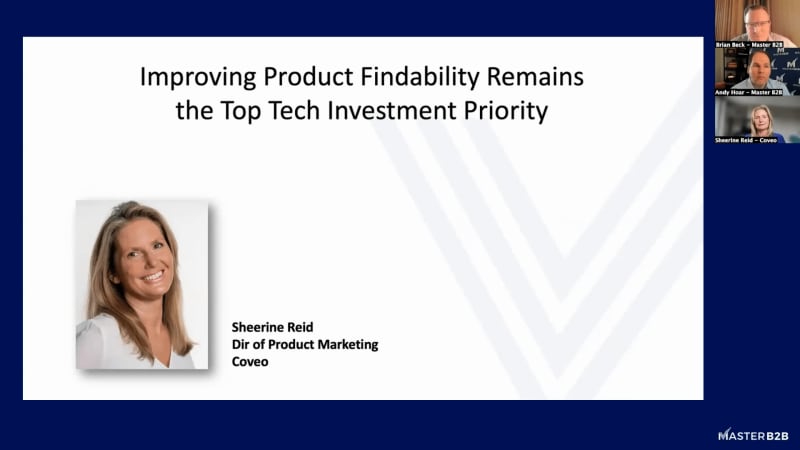
What's fascinating is when we ask the question in the survey, what are the top investment technology investment priorities that companies have? People didn't say AI. Right? They said other things. In fact, I could tease up our next topic here. What was the answer to that question? What's the top investment priority? Well, it is improving product findability. And that that was interesting because this has been a topic we've had on this on this, you know, this this state of b two b ecommerce for years and even before that. Pleased to welcome Shereen Reed, director of product marketing, Coveo, a leading search engine, search solution provider. Shereen, tell us what Coveo does, and and then let's get into some of the things you're seeing. Yeah. Sure. So Coveo is, like you said, an AI search and generative experience platform. For all the use cases that people care about, I like to say, so things like commerce, b to b, b to c, both of them, AI, service and support, and even internal workplace use cases where you think of all all of the data information that you have and being able to find the information that you need when you need it. Yeah. No. That's that's that's interesting, and, thank you for that. And, you know, Shereen, that our statistics or our survey also showed I'm gonna read a stat here. Fifty five percent of practitioners are prioritizing an Amazon like fast relevant search, as fast and relevant search results. Another stat, forty three percent of respondents said they're investing in improving how customers find products. Shireen, why is this remain such a challenge? I mean, it's you know, it feels in some ways like table stakes. Right? And what's holding us back? Is it data? What's what are some of the things that, you know, are are, you know, preventing us from getting there? Yeah. Absolutely. I'm not surprised at all. Actually, that site search is a top investment priority for b two b companies. Typically, they've just recently gone through a digital transformation, so they have an ecommerce platform. But that platform might not might have some just basic components that enable people to find products and you don't want to leave money at on the table at the end of the day, right? So search recommendations directly impact, you know, those important KPIs like conversion rate, average order value, revenue per visit. But at the other end of the spectrum, too, it's also one of the biggest friction points that customers frequently complain about. Right? And it can affect adoption rates, which are important when you're looking to lower your cost to serve. You don't want people to still be calling into your sales rep. You wanna be able to facilitate driving more of those repeat or simply simpler purchases, to your online channel. So when you fix it, the payoff can be quite significant. So I I understand why people want to invest in it. And in fact, a good amount of if you have any kind of, good amount of volume or online transactions going through online, even a small improvements in your search performance can add up to millions in terms of revenue. And I don't say that lightly. We see it time and time again. A good example of this, we had one of our customers that recently made an internal business case, for for investing in search, obviously had to map out the ROI and did a very kind of back, you know, conservative calculation, projected first year three million dollars in incremental revenue. Wow. Yeah. And then that that first year is not up yet, and they've already surpassed that by three x. Wow. Really? Done by switching out their search and improving adoption of search and the related conversions. That's so fast. AI remember remember my days as a VP of ecommerce, Shereen, we used to we used to say that search visitors, and we saw this in the data, would convert it almost five times the non site search you know, people didn't use search on the site. And so, I mean, to your point and you you raised a point about conversion rate. What's fascinating, Andy, too, if you recall from our research, we have a lot of folks that, you know, in our community, if I asked everyone, do you know what your conversion rate is? A lot of folks don't don't know what that is. So there's a disconnect here in terms of maybe that's part of what's holding it back, Shereen. Right? But, you know, when we used to work on v you know, I was the VP of ecom. We used to we used to think about things like, you know, keyword matching and, you know, identifying misspellings and a lot we used to have search AI was what we'd call them, and these are people that would sit in the in the roles, and they would, all day long, just merchandise search. They'd figure out what was getting searched, not found, and things like that. What is the state today? And if you think about AI, I mean, is that stuff still happening now, or is it is it much different in terms of Well, it is in a sense. There's a lot of people still, you know, on solar based search, which is keyword based. But I think it's important to highlight that if you're going to deploy search now, if you're looking to upgrade it, it it needs to be powered by AI. So if your search is not, you know, AI driven based on understanding of semantics, how people say things, not just how they're kind of described in your product catalog. It needs to make those connections. What is the behavior of people on the AI? Understanding that the intent and constantly learning, then you're missing that huge opportunity. And that's where that incremental conversion comes from. And that's where the frustration also goes away. And on the flip side, your team's not always trying to play constant catch up, AI, with the manual rules, the synonym creation. It's time consuming, and it's a it's a it's a never ending game. It's like a little hamster wheel where you never win. It's a big resource drain on the team, especially where you have huge catalogs. No question. Yeah. And and just big distributors, for example. And I just I remember how much, we focused on this, and and I we had several full time employees, and some of my companies focused on search AI. What, where are we going, Shereen? Where where is search gonna be in three or five years? I mean, we talk about AI and, you know, data being one of the elements that needs needs to be normalized before I mean, where are we? Or where we go? That's a really interesting question. AI think the next few years is gonna be really interesting in terms of where it's going because, you know, AI can absolutely fix or help offset some of the effects of messy messy product data, but only to a certain point. Right? So I think the next iteration is you're gonna have to invest in enriching your product data and making sure you have high quality content. Also, that's essential because here's the thing. If buyers are already frustrated with clunky search experiences, it's really gonna get tough because think of all the conversational interfaces and how they're going mainstream now. Everyone basically has used chat GPT. We all see those Google AI overviews coming up. So expectations are shifting fast and soon. I don't think it's gonna be enough to just return, let's say, a list of products. You'll need the data, the content infrastructure to support that deeper discovery. So you wanna help buyers, you know, compare options, understand compatibility, make more confident decisions. So it's not like here's a list of fifty valves based on the search term that you put in. But it's in helping them understand, look, these are the three valves compatible maybe with the system that you have. These are the options based on, you know, pressure rating, lead time. So it's gonna be more like talking to a sales rep, but available, you know, twenty four seven and probably a lot faster response. So that's where we're going, and I I think that's where people need to invest if you wanna be able to compete, going forward. That's that's awesome, Shireen. We have to leave it there for time, but thank you so much. It's fascinating to see, you know, what's gonna happen on-site. Thanks for joining us today. No problem. It was my pleasure.