Precisely’s Path
to
80% Case
Deflection
With Coveo AI

When Growth Outpaces Scalability


Precisely is the trusted leader in data integrity, with decades of deep domain expertise that spans software, data, and data strategy services. Serving 12,000 customers, globally, the company has experienced significant growth over the last few years, more than doubling in size—but their support model hadn’t evolved to match.
“Support wasn’t scalable,” explained Gerard Cafaro, Senior Director of Customer Support at Precisely. “As the company grew, customers seeking answers rose along with it.” Traditionally, Precisely had leaned on email and phone as support channels, but this didn’t meet the modern digital expectations of its customer base.
“SaaS customers don’t want to call in and wait in a queue to get their answers,” Cafaro said. “They want to be able to get their questions answered online. That’s been the primary focus.”
But Precisely’s infrastructure presented multiple challenges: an accessibility paradox that forced customers to contact support just to access support, ~150K documents containing answers scattered across multiple sources, zero visibility into content gaps, and a small team managing a massive product portfolio.
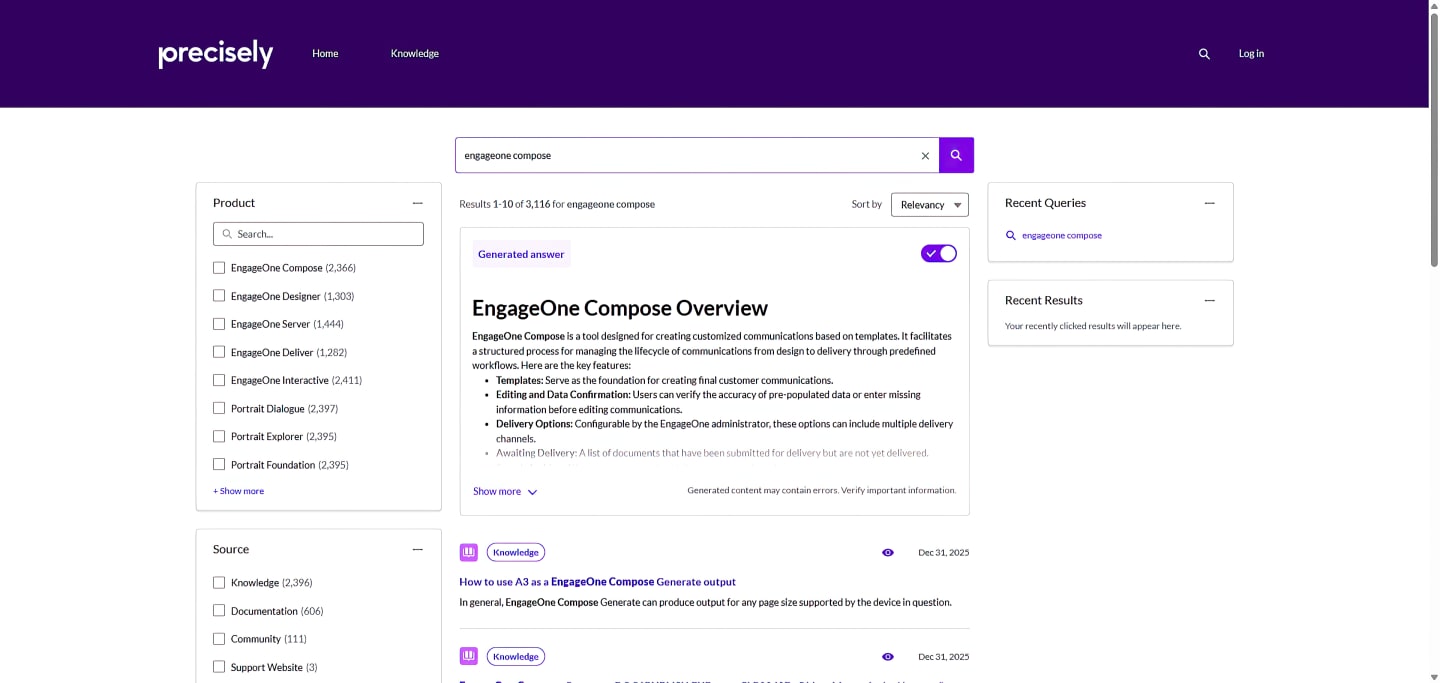
These challenges pointed to a clear need: unified search. One place where customers and partners could search for anything, regardless of where that information was stored.
Solutions & Machine Learning (ML) Models Used
Query Suggestions, Automatic Relevance Tuning, Generative Answering, Semantic Encoder, Dynamic Navigation Experience
From Fragmented Content to Frictionless Access
As a small team servicing a large multi-product portfolio, Precisely’s support operations team faced a common yet costly enterprise problem: content fragmentation. With critical knowledge scattered across multiple websites, forums, community platforms, status pages, and internal systems, there was no unified way for customers to self-serve
“Everything was behind a login. You couldn’t get access unless you contacted support, but you couldn’t contact support because it was behind a login,” Cafaro recalled. “So basically, we were teaching customers that the only way to get support was to call or email. It wasn’t scalable.”
This is more than a UX problem; it’s a scalability crisis. But rather than restructure ownership or force a full-scale content migration, Precisely took a more sustainable path: they deployed Coveo’s AI-search platform to unify access without disrupting existing systems.
Coveo’s unified index gave them a centralized search layer over distributed content: enforcing document-level permissions from each source system while respecting content ownership across IT and business teams. No duplication. No mass migration
The impact? The support team retained full autonomy over the experience. They could launch A/B tests, iterate weekly, and push changes without logging IT tickets or waiting on development sprints
“For us, that control was critical,” said Cafaro. “We got to control our own destiny.”
This model not only preserved operational boundaries, it accelerated innovation. By layering intelligence over fragmentation, Precisely built a highimpact support experience without introducing more systems to maintain

When 80% Don’t Need to Submit a Ticket
Precisely’s support team isn’t just solving cases faster; they’re preventing thousands from happening in the first place. In the last year alone, case volume dropped by 10%, despite keeping traditional email and phone support fully operational. That’s not an accident. It’s the result of a strategically orchestrated shift toward predictive, personalized self-service
With Coveo’s AI-search platform—powered by machine learning models like Automatic Relevance Tuning and Query Suggestions—users now find what they need before ever reaching for support. The proof? After conducting a search, 81.5% of users no longer proceed to the case form
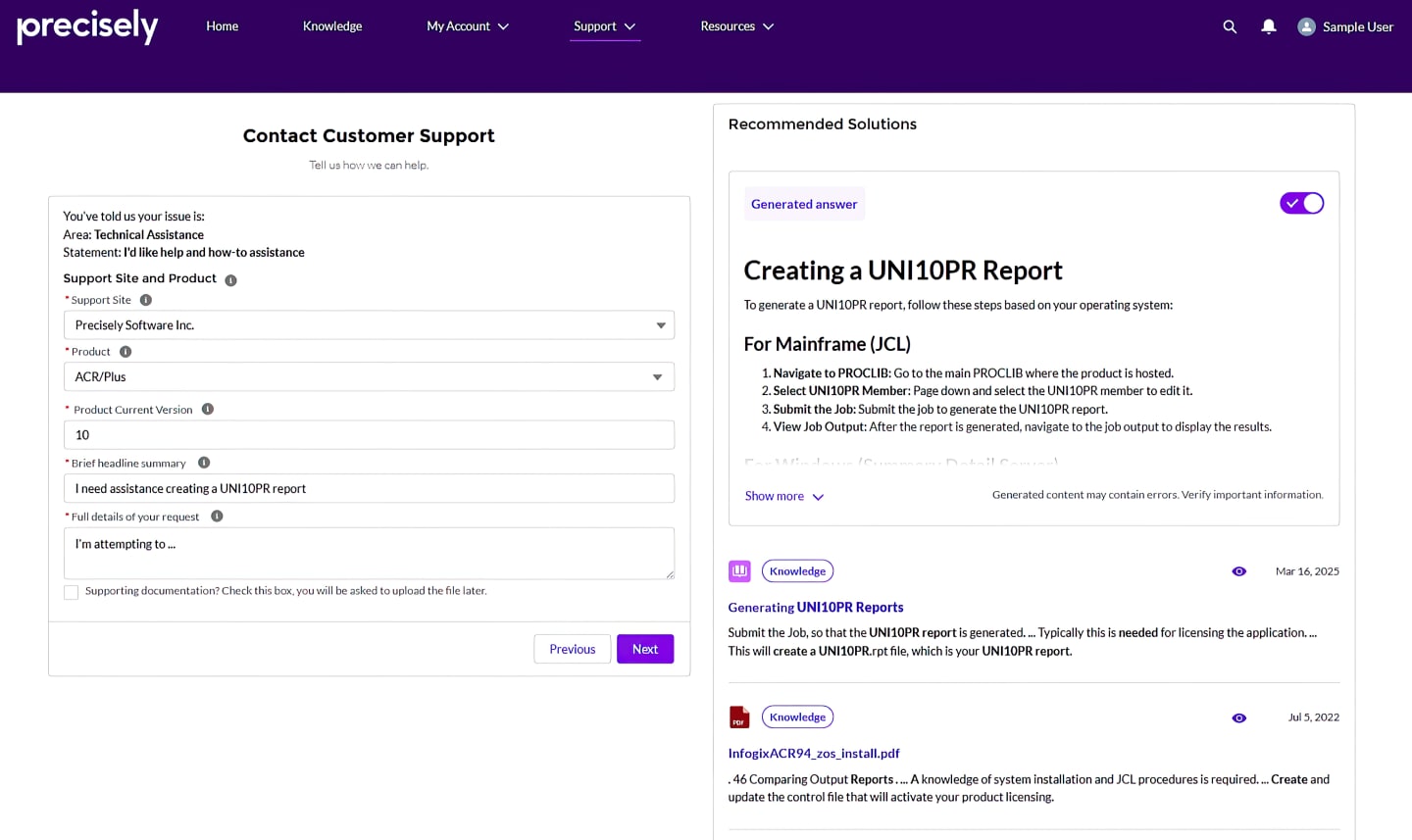
For those who do? Precisely doesn’t stop there. Contextual content recommendations embedded in the case form are deflecting another 45% of those submissions—turning “abandonment” into resolution. And with the recent rollout of Coveo Relevance Generative Answering, in less than three months, they’re already seeing an additional 13.3% in case deflection by delivering direct, citation-backed answers at scale.
The business impact is clear. “We’re deflecting about 425 more cases per month than we were before, which has resulted in significant cost savings,” reports Precisely’s support lead, Cafaro. When benchmarked against industry peers through TSIA, self-service is their standout differentiator.
For IT leaders seeking ROI, scalability, and a way to shift from reactive to proactive support models, Precisely’s approach offers a compelling blueprint: less load on engineering, faster resolution for customers, and measurable savings that fund further innovation

Operationalizing Self-Service Optimization
What Precisely’s support team can do today fundamentally redefines how decisions get made. With Coveo’s AI-search platform and robust analytics, they’ve moved from static support operations to a dynamic, test-and-learn environment. Every change is measurable, reversible, and tied to outcomes
“We don’t debate whether something might work; we test it, and we measure the impact,” said Cafaro. “Because of Coveo, we’ve saved time, avoided bad changes, and validated good ones with confidence.”

This culture of data-driven optimization is more than just experimentation. It’s how Precisely tunes machine learning models, refines ranking logic, prioritizes fresh over historical content, and even optimizes UX elements like submenu behavior on the support form. Every change is A/B tested against a control, and every outcome is tracked across core KPIs: search click-through, visit engagement, case deflection, and even the accuracy of generative responses.
This approach offers two clear advantages:
- Lower risk innovation: test without disruption.
- High-velocity iteration: guided by real-world data, not internal assumptions.
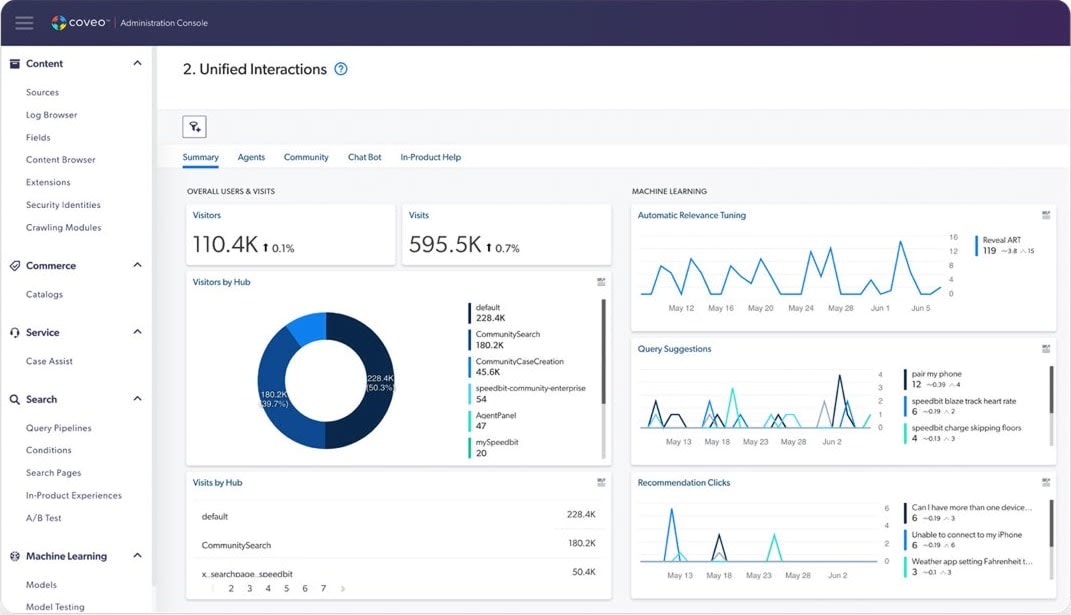
This continuous optimization approach—enabled by Coveo’s metrics dashboard tracking search click-through rates, visit click-through rates, case deflection, and generative answer relevancy scores—ensures the team never stops improving.
Ditching Email for Personalized Self-Service
The measurable impact has changed what’s possible for Precisely’s support operations.
“With our small support operations team, we’re able to showcase the impact of these changes,” said Cafaro. “We’re able to make a business case to expand the size of our team.” Three new team members will focus solely on knowledge management and self-service; a strategic investment justified entirely by the demonstrated ROI of the work to date
Precisely’s view of knowledge management isn’t just about maintaining a database of thousands of articles. It’s about operationalizing that knowledge: how it’s served to customers, used by agents, and optimized through data. Everything that sits atop the content layer, from intelligent surfacing to case‑resolution workflows, falls under their expanding remit.

The Lesson for Customer Experience Leaders

Tie every initiative back to measurable business impact.
“Updating a search experience might not get stakeholder attention,” Cafaro noted. “Until you show how it drives deflection, saves cost, and shifts your team from reactive to strategic work.”
That mindset has created a virtuous cycle: better customer experience drives real savings, which justifies further investment, which improves operations again. It’s a modern support architecture built on relevance, driven by insight, and architected for scale.
And it proves something crucial for customer experience leaders navigating legacy systems and entrenched behaviors. Transformation is possible: not by ripping and replacing, but by building smarter on top of what you already have.
Precisely’s Path to 80% Case Deflection With Coveo AI

Achieve customer self-service excellence with Automatic Relevancy Tuning (ART)

Precisely’s Path to 80% Case Deflection With Coveo AI

Hey 👋! Any questions? I can have a teammate jump in on chat right now!