Metcash | Customer Story

Wholesale Change: The ROI of Getting Search Right

How Metcash turned product discovery into measurable revenue, with 2030 already in sight
2
0
X+
conversion rate
+
27
0
%
increase in revenue per visit
+
14
0
%
increase in average order value

About Metcash

Cost
$2.8B in annual revenue
6,500 bannered retail stores
105,000+ B2B customers
95% of Australians reached
48,000+ weekly marketplace transactions

Metcash is Australia’s leading wholesaler, operating across three divisions: food (supermarkets and foodservice & convenience), liquor, and hardware, and supporting more than 105,000 independent businesses.

For almost 100 years, its purpose has been simple: winning with independents, helping local, family-owned businesses become the best store in their town.

These are businesses that play a vital role in local communities and often operate with limited time, resources, and margin for inefficiency.

As more customers moved to purchasing online, Metcash saw an opportunity to make digital buying easier, faster, and more valuable. Sorted, its B2B marketplace, became a key part of that vision.

But improving the digital experience meant more than simply moving ordering online. Metcash needed to reduce friction, help customers find the right products faster, and create a platform that could support better decisions, stronger commercial performance, and future growth.
Making It Easier to Do Business

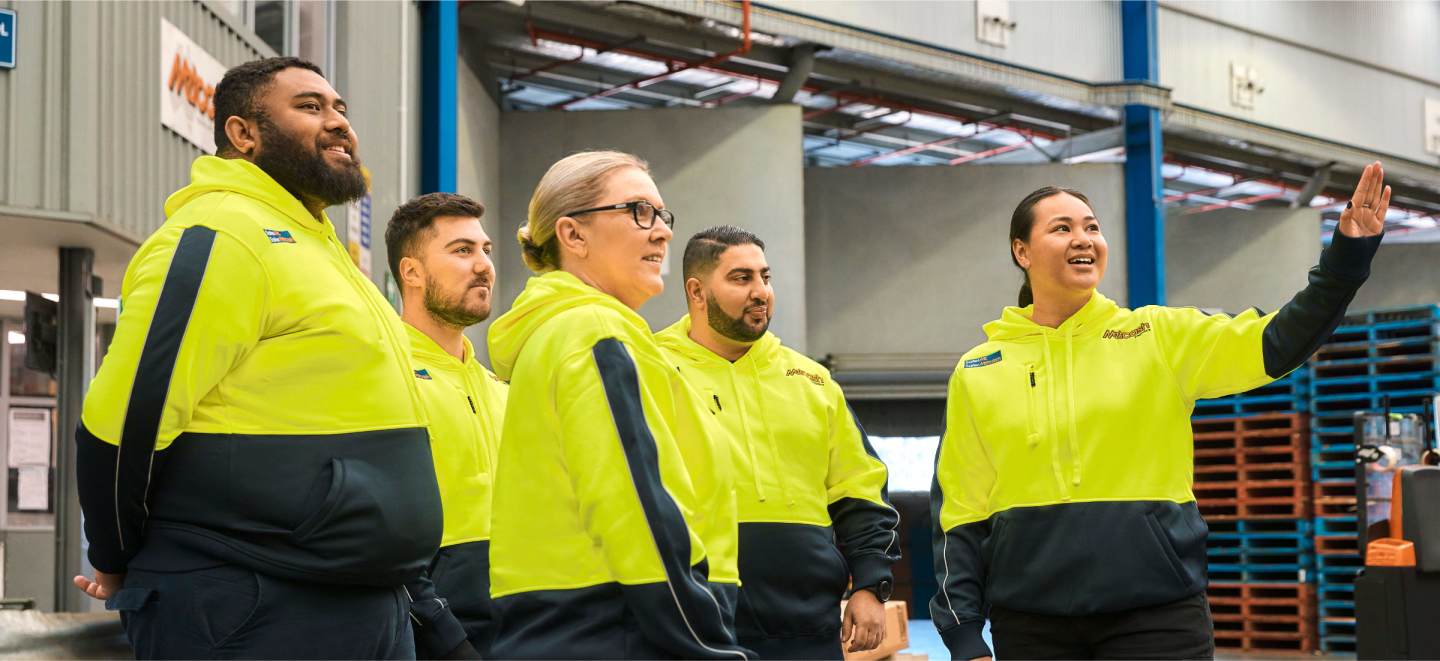
Independent businesses are woven into the fabric of Australia. Simon Williams, General Manager, B2B Digital at Metcash, points out that 97% of Australian businesses employ fewer than 20 people, and 91% turn over less than $2 million. Many of Metcash’s customers are owner-operators, running the business with a small team and a long list of responsibilities.

As Williams explains, ”We know our customers wear many hats, from CEO and CFO to CMO and COO, while also being the face of their businesses. For these hard-working Australians, time is a precious commodity. This is where Sorted can add real value.”

Ordering the products they need to run their business shouldn’t be a search or a hunt. It should be a simple, easy experience.

That’s why Metcash created Sorted, its B2B marketplace connecting independent retailers with Metcash and thousands of suppliers through a simpler digital buying experience built on SAP Commerce Cloud.

As more of Metcash’s business moved through Sorted with the marketplace now covering just over 30% of Metcash’s group turnover, product discovery became a critical part of the experience. Every unnecessary search or click created friction for customers who were already time-poor.

The goal was clear: help customers find what they need faster, make ordering easier, and ultimately give them more time to focus on their own businesses. If Sorted wasn’t easy to use, retailers would simply order less through it.

Prefer a shareable version?

The Challenges

Finding Products Took Too Long

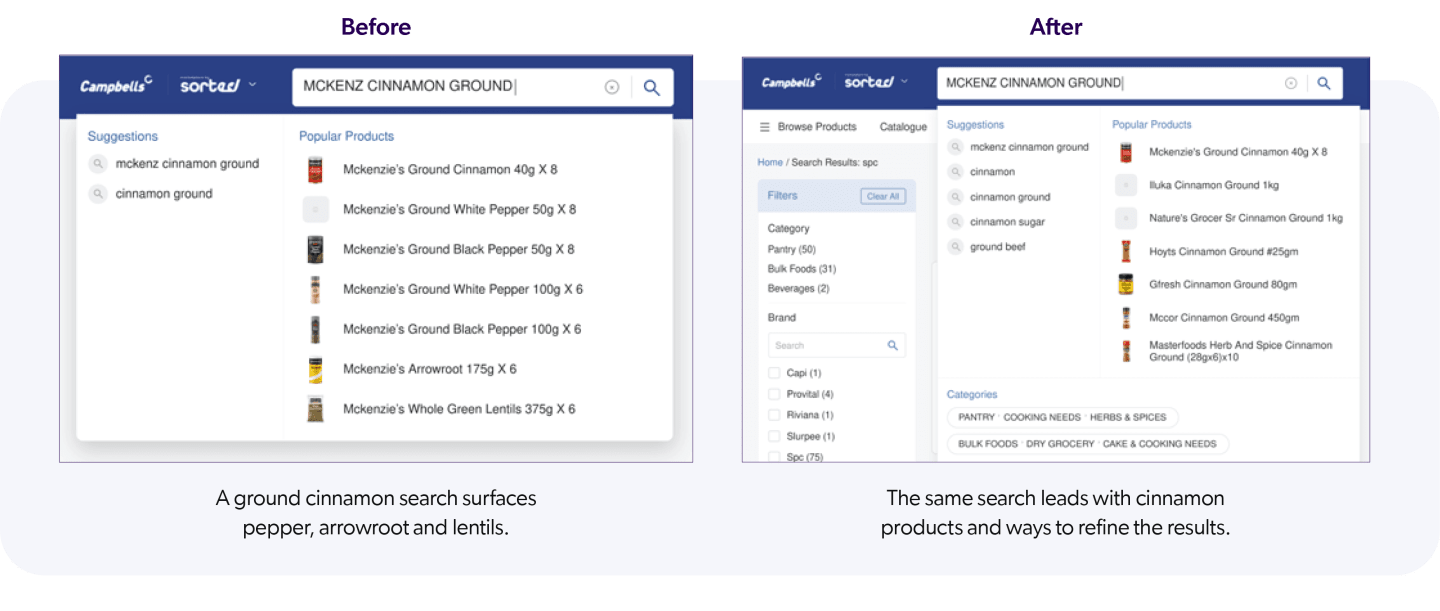
Sorted’s existing Solr-based search relied heavily on keyword matching and wasn’t consistently delivering the relevant results customers needed. Customers could work through 20 to 25 products before finding the right one. At one industry trade show, a retailer summed it up: “I know you guys sell kombucha, but I can’t find it.” A small moment that captured a much bigger problem.

One Marketplace, Very Different Buyers

Sorted serves a diverse base of 6,500 bannered retail stores, from supermarkets stocking thousands of SKUs to a single-site café ordering the products they need to run their business a few times a week. Each has different product needs and buying journeys, making it critical for Metcash to deliver relevance that adapts across very different types of customers.

Search Wasn’t Driving Growth

Search was a base function of the buying experience, rather than a lever that drove revenue. Metcash wanted proof: a way to connect product discovery to conversion, basket value, and measurable return, along with customer insights that could strengthen merchandising and product assortment decisions.

From Missed Intent to Relevant Results

Business cases are built on dollars. We needed to know what we were investing and what return we were going to deliver. With Coveo, we started to see that value very quickly.”

Simon Williams, General Manager, B2B Digital for Metcash

Just Five Months to a Faster, Easier Buying Experience

Working with Coveo, Metcash moved from project kickoff to launch in under five months, ramping up from October and going live in March 2026. As Williams explains, "We needed to create a really frictionless way of supporting our customers in running their businesses."

Search That Understands Intent

Search previously relied on keyword matching and could return irrelevant results. Coveo’s semantic search understands relationships between terms and products, helping customers get to the products they actually need faster.

Navigation That Adapts

Coveo’s dynamic navigation uses customer behavior to surface and reorder the filters most relevant to each query, instead of showing the same static list that may not apply. That makes it easier for retailers to narrow down a large catalog without having to know exactly how products are categorized.

Personalized Discovery at Scale

Across these numerous and unique buying journeys, Coveo leverages customer context and in-session behavior to tailor rankings and recommendations to make discovery more relevant for each buyer.

Ranking That Learns from Customer Behavior

Even when the underlying catalog isn’t perfect, Coveo can improve what customers see. For example, Sorted’s taxonomy placed insecticides within Kitchenware & Food Storage. Coveo uses behavioral signals such as clicks, conversions and engagement to dynamically reorder listings, bringing more expected products like food storage and garbage bags to the top.

Built to Keep Improving

Continuous optimization is built into how the platform runs. Metcash and Coveo teams meet weekly to review results and trends and refine performance. As Williams puts it, “This was never a set-and-forget for us.”

Nine Weeks to Measurable Return

Just nine weeks after launching Coveo, the return was measurable. Metcash saw improvements across conversion, revenue, order value, and customer experience, proof that better product discovery pays off for customers and the business alike.

2X+

Conversion: More Orders, Higher Conversion

  • Conversion rose from approximately 8-10% to 20%, as customers found products more easily and completed purchases with greater confidence.

+14%

Average Order Value: More Valuable Baskets

  • Average order value grew as retailers discovered additional relevant products and increased the value of every order. Order frequency held steady rather than increasing, suggesting that customers are finding what they need more efficiently and buying more in each visit.

+27%

Revenue Per Visit: Revenue That Scales

  • Revenue per visit is turning product discovery into a measurable driver of commercial performance, not simply a functional capability.

+31%

Customer Experience: A Better Customer Experience

  • Customer experience scores rose from 3.2 to 4.2 out of 5, and recurring complaints about poor search and difficulty finding products have largely disappeared.
Prefer a shareable version?

Search Data Is Becoming a Growth Signal

Wholesale merchandising has traditionally focused on the physical store: what goes on the shelf, where it’s positioned, how promotions are presented. Search data is adding a new layer to those decisions.

As Williams explains, “We’re using the search data to understand what customers are asking for, giving our merchants a much clearer view of where demand is going and where we should be expanding the range.”

These insights can reveal products customers are repeatedly searching for but aren’t currently stocked, surfacing new opportunities for ranging and category expansion. The data has also surfaced concrete experience gaps, including missing product images, helping Metcash prioritize fixes that could improve product discovery.

Better search is also changing what customers buy, not just what they find. Coveo’s ability to classify and understand long-tail products — not just the high-volume staples like chips, soft drinks, and chocolate — means those items can now surface right alongside the bestsellers. As Williams puts it, “Now, because of better search, they’re getting much deeper into our catalog.”

Metcash’s foodservice and convenience teams are now increasingly talking in terms of conversion, average order value, and ecommerce performance, using customer behavior to inform decisions.

For Metcash, the value of search extends well beyond helping a customer complete an order. What customers search for online can help shape what the business sells, how it merchandises products, and where it sees its next opportunities for growth.

We’re only a few months into using Coveo, and we’re already seeing the impact. The exciting part is we’re just getting started.”

Simon Williams, General Manager, B2B Digital for Metcash

Building on Early Success

For Metcash, launching Coveo is just the beginning of a continuous optimization journey.

Rather than relying on manual rules and constant tuning, Coveo’s AI continuously learns from how retailers search, browse, and purchase, improving relevance over time. At the same time, Metcash’s digital team is working closely with Coveo to identify new opportunities to improve the customer experience and create more value.

As Williams shares, “This wasn’t just about buying a license and walking away. We challenge Coveo, they challenge us, and that’s what’s making the difference.”

This iterative approach has helped turn an initial proof point on Sorted into a foundation for a broader enterprise strategy. Coveo is now being extended across B2B and B2C commerce, multiple technology platforms, and new knowledge and GenAI experiences, including Metcash’s hardware business, Total Tools, and askROSS, its AI-powered support tool for retailers. The results were compelling enough that Metcash’s hardware business, mid-negotiation with another vendor, switched course and brought Coveo in instead.

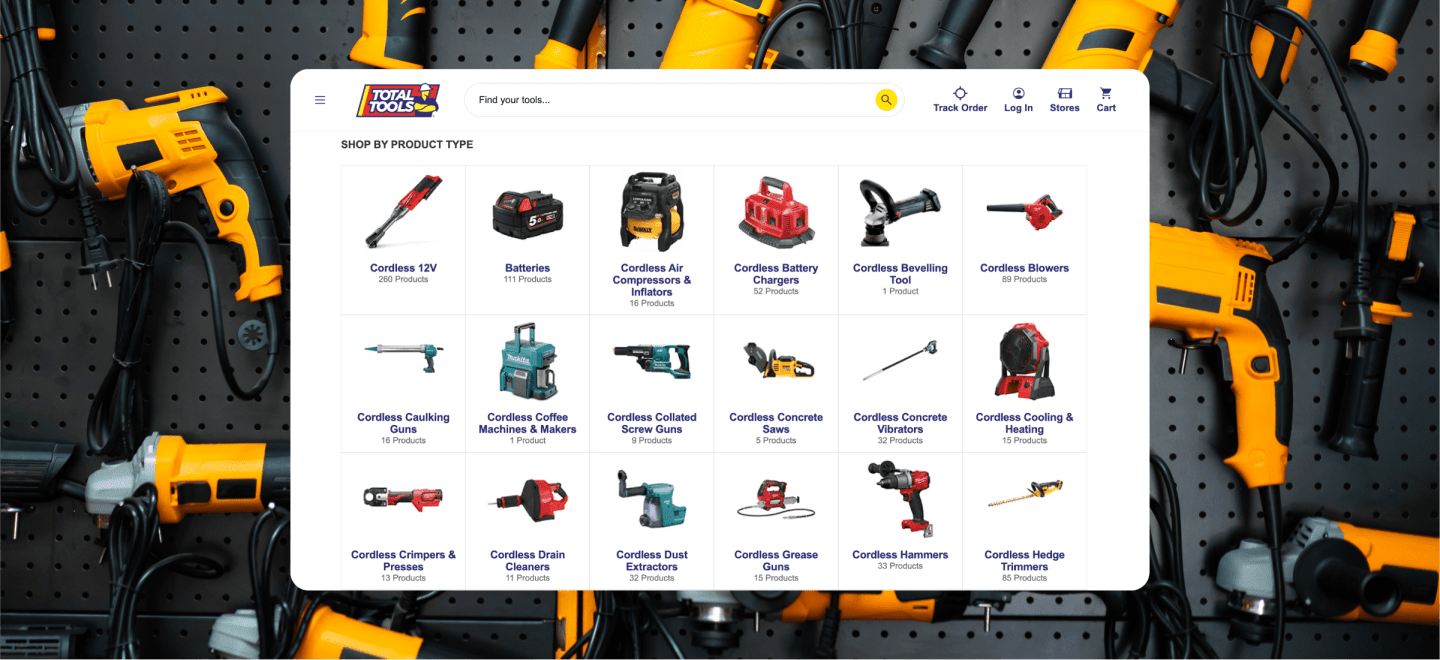
The same momentum is now appearing elsewhere in the group. At Total Tools, Coveo went live in 45 days and add-to-cart rate rose 200% in the first month. And soon, Coveo will power search for Metcash’s liquor business, Australia’s second-largest liquor wholesaler, putting more than $5.2 billion in trade through the platform.

The early results are proving that better discovery works and giving Metcash the confidence to build on what works, apply it in new parts of the business, and create a foundation for what’s next.

Building for How Customers Will Buy in 2030

For Metcash, better product discovery is just one part of a broader vision to make it easier for independent retailers to do business.

That vision is already extending beyond commerce. Through askROSS, Metcash is exploring how AI can help supermarket retailers find operational information and support more easily, bringing the principles of relevance and discovery into new parts of the customer experience.

Metcash has built a digital marketplace with real depth and breadth with teams focused on value creation for all. At the same time, Simon is challenging his team to look beyond today’s problems and imagine how Metcash will trade in 2030.

That means thinking about conversational product discovery, AI agents, agentic commerce and the data foundations needed to support new ways of buying. Getting the fundamentals right matters too. Williams points to product data quality and supplier information as ongoing priorities, so that customers have what they need to make good buying decisions as the platform gets smarter. Williams is clear that Metcash doesn’t have all the answers yet. “We’re figuring this stuff out together, rather than us trying to figure it out alone,” he says. The focus is on building technology that can evolve as customer expectations and the market change.

What began as a way to help customers find products faster is becoming the foundation Metcash is building for how they will buy in 2030.

Prefer a shareable version?