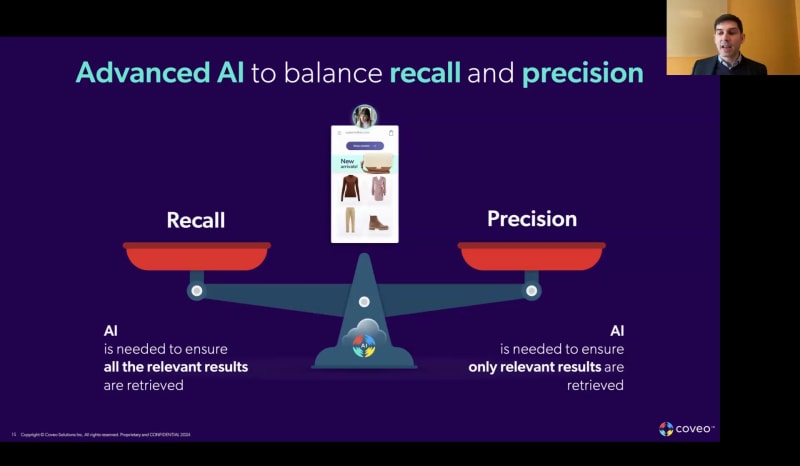
Hello, everyone. Thank you very much for joining our webinar here today. As you all know, this is only gonna be twenty minutes. So we're gonna kick off, nice and quickly. We're gonna take you through how you future proof your commerce with twelve AI models that will transform your customer experience. Just, by way of introduction, my name is Sergio. I'm the senior director of e commerce marketing at Coveo, and I'm joined today by Andrea. And Andrea's our senior e commerce product marketing manager. I'm gonna give Andrea a bit of an intro because I know normally he wouldn't wanna toot his own horn. So I'm gonna do it on his behalf. Prior to joining Coveo, he was part of a startup based in Italy, but focused on NLP and Symantic Search, and they got acquired by Coveo in twenty nineteen. So Andrea joined from that acquisition He has a PhD from the University of Edinburgh, and he's a widely cited author. He's published fifteen, and or more research articles, on the various topics of AB testing, personalization, and around big data and predictive capabilities as well. So he's he's our expert on commerce, customer experience, and all things to do with online shopping and retail. And he makes sure that he brings his academic rigor to, anything that he presents in any data that he brings to to anything such as today. So it's gonna be an exciting conversation. I'm just the host, and Andrea's gonna gonna take over, in a second, what he's gonna be discussing are the three key pillars to help, transform your customer experience with AI. Just a few housekeeping parts of the cover quickly. Everyone will be on listen only mode. You can pop your questions in the q and a, and we will review those at the end of the at the end of the session. And the session is also being recorded, and we will send that the presentation and everything and the recording out within about twenty four hours of of the event, concluding. So welcome, everyone, anyone that's joined in the last few minutes, We're about to kick off and I'll hand over to Andrea to take us through the agenda for our twenty minute session. Yeah. Well, thank you so much. So we're going to star with a very brief introduction to Coveo. And, after that, we are going to look at some key considerations that really, really matter when it comes choosing the right AI. And then we are gonna try to unpack really these considerations and really see what, AI models you need to, to leverage in order to elevate the customer experience across all of the random touch points. Also, we are going to look at what AI models are really important when it comes to drive good business across multiple objectives. And finally, we're going to focus on innovation because AI, an innovation, are not stopping. So, innovative AI models are really critical because, digital leaders want to be part of the change. So, we're going to explore what the latest trends are and what innovative models you need to be able to leverage. Such I think that you, are going to, give us a bit of an introduction to, to Cavell. Yeah. Of course. So, Coveo is is a is an AI platform. And for just over a decade, we've been building that platform, with the help of the amazing people we get to work with, and those are the forward thinking global enterprises that Coveo works with, across across every different aspect of our business. So what we our aim is to make sure that everyone is able to gain a trusted AI experience message. So we work with about seven hundred brands, to do this. Within the business, we have over seven hundred AI experts, and what we effectively do is we're one single AI platform that helps power capabilities across websites commerce, which is specifically what we're talking about today, service and support, and workplace. And then within those, we you know, we have various models and some of which, obviously, Andrea is gonna go through today in this session where we help power semantic search, AI recommendations, generative answering, and unified personalization across across channels. So I'll hand back over to Andrea he's gonna take us through the specifics. Thank you so much. I just said, alright. Let's get started. So I'm going to start by, you know, highlighting how since the early days of e commerce, The ways in which shoppers search for and find products have changed and have changed quite dramatically. Consider Amazon back in two thousand and four you can see it here. You know, the search box was fairly small. It could only accommodate a maximum of two words. It wasn't really critical to driving business for, for Domino, and it wasn't powered by AI. Now fast forward to today and Amazon search box is much bigger, as you can see here, and prominently placed at the forefront. Customers generally trust it and when they use it, they usually receive relevant results. So to significant extent, the centrality of search, you know, the the centrality that search has gained today is really due to the injection of powerful AI capabilities. So as we're saying here, AI really has ignited a new era for a search and product discovery. And, in turn, I mean, as a result, customer expectation have changed as well. Now now ninety percent of choppers, according to research from Forrester, rely on on the search function, on a retailer or brand website to find the product they intend to buy. So getting it right is really, really important. But the critical role of search, because even beyond the call, So findings from our latest research show that forty seven percent of shoppers rely on search on app or website to find products even when to when they intend to buy in a physical store. And of course, it's not just search. Now McKinsey reported a sixty seven percent of customers consider it highly important to be offered personalized product commendations. So again, you know, injecting AI to drive a relevant search and product discovery is key because your customers expected or better demanded. And, I'm pretty sure I'm pretty sure you've heard it before. Nothing but, you know, adopting AI is no longer optional. If you don't adopt it, most likely your competitors will But still, how can you win when not all AI is created equal? So today we'll look at three key areas the really separate leaders from laggards in the use and in the adoption of AI. So first, you know, we we find that leaders don't just apply AI isolated parts of the search and discovery process, but really ensure consistent relevant experiences across all touch points. Second leaders also ensure that they apply AI to drive good business because, you know, and and this really requires the ability to to effectively manage multiple goals and priorities that are inherent in the search and discovery process. And third, leaders know that, again, innovation never stops. So they are constantly looking for new ways, new tools based on cutting edge mode, models and methods and they really apply them to the most relevant use cases. So, let's get started. So, we say AI should be everywhere with AI models that are specific to the context of the customer and their journey. But what does that mean really? Well, yeah, AI must power relevance everywhere because customer joins are becoming increasingly complex. With a growing number of touch points. So there are so many possible discovery moment You can see here that from query suggestions and filters to category listings and product recommendations. There is such a wide range of touch points that you need to consider. And your customers really expect highly relevant and consistent experiences and experiences across all of these touch points. Now, I think it's important to say that there are some things you shouldn't do. One thing you shouldn't do is just pick and choose one or a few discovery touch points to focus on. Your customers actually come to your website with the goal of finding or discovering products. But their tactics and their behavior can really vary even widely. And here in this slide, what we want to provide is an illustration update. So meet Anthony who knows exactly what he wants and enters the query in LG's Marty OLED, expecting your search engine understand what he's looking for and to show exactly that. Now meet Jane who would instead like to receive some assistance through her search. I mean, she knows what she wants. I mean, she she wants a smart TV, but she also expects you to help her refine her search. And since she's using her mobile device, she prefers to receive assistance from you in the form of query suggestions rather than filters. So she's going to start by ping smart TV and she expects you to help her construct a meaningful query. And finally consider John who is still interested in receiving some assistance, but is instead searching from his desktop and would rather use Mark filters instead of, you know, I mean, to narrow down the result set instead of query suggestion. So he will enter the generic query smart TV, and we'll use filter instead to navigate your catalog. So what you can see is that there is not a single linear journey that every customer will take. In fact, these journeys are quite different and yet they all demand relevance. And, really, data backs the claim that every customer is unique with everyone doing quite different things. Maybe your customer is part of, you know, the fifty four percent of shoppers that search from mobile. And if they are, you know, there may be among those that really demand query suggestions when searching for products on an e commerce website. Maybe they're part of the fifty seven percent of customers who use filters to narrow down the result sites. Or if they aren't, actually, they might instead be part of that huge segments of shoppers that tend to reformulate queries. And what that means is just adding, changing, or really removing some words from the original query after some search results are shown. Finally, you know, there may be part of the fifty percent of shoppers that tend to use product recommendations during the product, the the product discovery journey. What you can see is that all of these touch points are important. So you cannot or you should not neglect any of them. And deliver support experiences. So there are so many discovery moments, possible journeys, you know, that your customer can really you know, be anywhere. And so AI has to be everywhere powering relevance. But what does really, you know, reality look Well, unfortunately, many touch points are often neglected with experiences that are fairly underwhelming that are being offered by many brands and retailers for example, the BayMar Institute has conducted plenty of solid research, you know, on the topic, and they mentioned that query suggestions are provided by eighty percent of e commerce websites, but only ninety percent of them get it right. And also they show that thirty four percent of websites offers subpar filtering experiences. And then it was actually confirmed also by our research at Cavell, you know, as part of our relevance report twenty twenty four, which shows that actually thirty five percent of shoppers report problems with filtering when shopping online. So there seems to be a sort of delivery expectation gap with customers that are expecting relevant experiences across multiple touch points and brands and retailers that are failing to deliver them. And now bringing the perspective of Coveo, we definitely believe that AI must power relevance everywhere. That's why we offer twelve AI models because we really want to inject relevance on each and every touch point. So for example, if you visit the website of LCBO, which is a, you know, a large distributor and retailer of alcoholic beverages in Canada. What you will see is that even if your customer enters a query with a typo like Guinness here, Coveo will leverage AI to provide intelligent helpful query suggestions along with, you know, suggested categories that prove popular among customers. But there is more as well. Because you can see relevant products and inspiring content that is also being serviced and recommended. So you see, you know, the customer has to do very little and they can get quite a lot. But, another example comes from Black which is instead Australia's largest supplier of industrial and safety products. As you can see, it doesn't really matter how broad or generic the search query is. In this case, globes. Customers will be provided not only with relevant and optimized result set. But also with dynamic intelligent filters powered by AI to help seamlessly navigate the catalog. So just to recap, AI has to be everywhere at once because your customers can interact with you anywhere and will demand consistent experience. And at Covea, we apply AI throughout the whole process ensuring relevance across the journey for each and every customer. And, second, AI must drive good business, we say. And what that means is that you have to leverage multiple models to balance multiple relevant goals, all the goals that you will find in e commerce search and discovery. And of course, starting from precision and recall. So when we talk about search, and more generally, the field of information retrieval, as many of you may already know, recall and precision are the two critical factors and metrics. So just a quick refresher, for all of you. Recall is how many of the total number of relevant options in e commerce products on your website are returned by a search. So this is really equivalent to the idea of force negative, so how many items, you know, might be relevant, but are not surfaced in the search results. So an example, if someone is searching for black trainers and you have hundred available, but only in return ten, Well, you've got a serious problem with recall. Precision is on the other hand about ensuring that only relevant products are presented. Eliminating irrelevant results. So, again, looking at that example, if someone is searching for black trainers and half of the products you return are in black or are in trainers, then the precision seems to be an issue. But balancing these two elements, procedure, and recall, really is crucial because if you have poor recall, that really means that your shoppers won't find what they're looking for, which means they cannot, we I mean, we which means they cannot bite. And they'll probably go, you know, somewhere else to some of your competitors' websites, maybe Amazon. On the other hand, if you have low precision, you will clatter results with irrelevant products, which is frustrating for your customers. And again, possibly pushing them away. So really achieving the right balance between precision and recall is critical and requires multiple approaches, multiple techniques, and tools. Again, disappointing news, unfortunately, most websites are doing it wrong. For example, the Paymer Institute found that seventy percent of search engines failed to effectively handle synonyms, which is a clear problem with recall, Google research, shows instead a seventy nine percent of consumers encounter issues with irrelevant search items in the result set. Again, suggesting in this case problems with precision as well, But, then there are kinds of challenges and layers of complexity that are quite specific to e commerce. So in e commerce, there are multiple stakeholders to keep in mind. And the interest might be aligned, but it might also, but really have to be balanced, effectively. Of course, you have brands, retailers, manufacturers, anyone really selling online who wants their customers to be able to find products to find products that are relevant, and tailored to their intent. But if you're a business selling online, you most likely have interest other than just ensuring customer satisfaction and presenting the most relevant products to, to customers when they search. For you, search experiences might also be informed by business priorities with results that are, you know, geared, towards generating profit clearing, expanding inventory, and satisfying supplier relationships as well. So these are all critical business priorities for you. You can see plenty of articles discussing related pains. So that really means that if there are two products that are equally relevant and status find, you know, the the customer search equally well. Why wouldn't he want to prioritize products that that are you know, say more profitable to you. Or this sounds nice and easy, but the truth is that achieving this balance is actually quite difficult and it requires advanced AI. So, otherwise, you're really risk compromising your customer's experience and achieve the opposite, of the intended improvement in terms of business outcomes. So, again, bringing a perspective of Coveo, the way we address this challenges and trade offs is by employing what we call a multi layered approach to relevance with multiple models across different layers of retrieval and rank So our approach starts with, but, you know, balancing procedure on recall, how do we do it? Well, for instance, by leveraging semantic understanding, which means you know, we can, it doesn't really matter. Looking at the example here, whether the word winter in winter jackets is contained in the product metadata. Coveo really understands what the relevant products are and returns all of them. But then again, Cabela's AI models are also fine tuned based on successful outcomes and wisdom of the crowd, ensuring that result sets are attractive to shop is because your shot your customer experience demands that. And we also go beyond that to drive outstanding customer experience with what we call intent away product ranking, which adds a layer, powerful layer of one to one personalization. And then as we said, we don't neglect business outcome optimization. This is critical. So we use AI to also align customer experiences with business optimization, ensuring a balance that promotes KPIs without compromising the customer experience. So again, not only has the same because relevance in e commerce is multilayer and, an AI strategy that relies on a narrow set of models and tools will be unable to effectively balance all of these goals and objectives. So quickly, third point, innovation doesn't stop. It's critical to be part of the change. Why? Well, because if you're not incorporating the latest techniques, you are missing out on opportunities to elevate your customer experience and to drive business results even further. Meanwhile, your competitors might be leveraging these innovations gaining a competitive edge by tapping new benefits. And just a reminder, you know, when we say AI, this is actually a diverse landscape of technologies. For example, machine learning is a subset of AI. And deep learning is in turn a subset of machine learning. And most recently, JNAI, e, has attracted a lot of a lot of attention fueled by the power of deep learning. Now these two new tools and techniques are not necessarily meant to replace existing ones They won't have their value in place, but what's important to highlight is that newer tools and additions can really help you tackle more use cases in search and price recovery and more precise as we will see. So just quickly, new tools and technologies are constantly being introduced. So much is happening in AI. Just a few a few figures, a few statistics here. You know, planning to be fast followers cannot be enough. We frequently hear that AI is eating the war and to be sure the amount of money being invested, the outstanding growth in computational power and in complexity of AI models are impressive. Impressive are also the continuous improvements in performance that we are seeing across many domains. The success of AI has moved from task like image classification to highly complex one like clinical diagnosis. Of course, you might ask what about e commerce? Well, it surveys that actually, in e commerce, we also see that AI and deep learning more precisely can be used to tackle very important use cases such as one to one personalization, You can see this technology in action on many of our customers' websites. Again, bus pro shop is a nice example. You know, if you visit the website, you will see that from previous suggestions to search results and recommendation, you'll experience this sort of magic of real time personalization with experiences that are adjusted based on your actions during any conversations, in on any conversations. So This is really a compelling example of how progress in AI can really provide tools to address key use case. So in this specific example, you see that we are able to read shopper's minds, and if they are typing GR in the search box, you know, they will get different quest different query suggestions depending on whether, say they they've shown some interest in items for counting compared to say, fishing. And, of course, when we're talking about new breeds of AI, you're probably wondering about gen AI for sure. It's the talk of the town. We know it. You you can see here that, you know, in in Ghana's latest hype cycle, it's at the peak of inflated expectation. So it's a it's safe to expect that innovations in and around Janai will dominate and have a transformative impact in e commerce as well. We know that Ghana suggests that by twenty twenty seven, ninety percent of tier one retailers will successfully execute at least one business transforming GenAI use case. And again, I want to bring the Coveo perspective because we definitely believe that there is plenty of value in Genai in e commerce and retail So at Coveo, we released last year's relevance, generative answering, which in the context of e commerce really helps us close one of the biggest gaps between the online shopping and the experience of buying in a physical store. It's really quite exciting because we finally had the opportunity to help e commerce players answer complex questions about products by generating answers. So brands and retailers, can really showcase their expertise and make the product discovery process dynamic, intuitive, and conversational. Of course, we also know the gen AI, you know, in gen AI, the most difficult part these days is not necessarily the, generation of context, you know, large language models can unleash plenty of creativity, but the problem is, you know, to make sure that their their answers are also accurate. So it's be it becomes really critical to retrieve and feed the eye model with only relevant information so that it generates factually accurate, factually correct answers. So it's it's not easy. It's a complex engineering feat, but precisely because it's challenging. We're so excited to be the the first product discovery vendor that went live with gen AI capability. So this is very important. A use case that is conducive to ROI and also one that avoids pit Force of introducing a brand new chat interface, you know, because JNAI is really, in our case, injecting into the traditional search interface, which customers are very familiar with. So drop up, certainly not all AI is created equal and the tools you use how you use them and where it's critical to driving business results and elevating your customer experience. That was all, and I hope it was useful, but I also know Sergio that we have a few resources, a few assets that we can recommend to our audience today, in case they want to continue, you know, learning about the role of AI in certain product discovery. So the floor is yours. Thank you very much. Thank you, Andrea. I I know that's that's a lot to pack in to, to a very short period of time. I'm sure everyone learned a lot from from that. And if If this is something that you're really interested in, you're doing a lot of research on at the moment and you haven't read our AI guide for search and product discovery, there's a lot more of what Andrea just spoke about, there's a lot more of where that came from inside that guide. So, we have the QR code up on the screen at the you can easily scan that with your phone if you wish and the links are being put in the chat as well. So that's a really good place to start you've got some research you wanna do and just learn a bit more about the space and what it means for your business. If you're a bit further down the line and you're looking to kind of select a search or product, discovery vendor, then we have an RFP template, to help you kind of choose and put out your the right questions when it goes to coming to market. So have a look at that. Download that as well. Same q r different q r code is there. Same process. If you are further down the line and you are more interested to see how AI can really change your search than you have today, then Coveo has something called the AI experience pilot, which enables you to very simply see the way in which Cabeo could power the search on your actual e commerce store. It also give you a flavor if you have good amounts of content to see what GenAI could do for your business as well. So there's the option there to to fill in a form and request a pilot, and one of my members of team will get back to you. But Andrea, thank you very much for all of that. Really appreciate it. We have sort of run out of time, but I'm just gonna bump us up to the to the half an hour slot because we have a couple of questions here that have come in. The first one here is, the person has said, I'm working to spin up a search project internally. Be useful to know what sort of value can a business expect from a search engine like this? That's that's a very great question. So the most obvious, you know, tangible results are, of course, some uplift in, you know, critical KPIs. So we have customers like Polaris the departing company of many recognizable brands like Alan Edmonds, Thomas Foodworths, and others that have experienced really, double digit uplift in conversion rates. In other cases, you have, we have customers like free prime, a big distributor of you know, track parts in North America. They chose Cabelle for an ambitious, more transformative digital transformation journey, and, they really boosted the role of digital channels for them, and it's not just about increasing traffic, driving more business and automating tasks. You know, they really are also cementing the relationship with, customers through a great customer experience. So again, it depends but there are plenty of ways in which we can really help you, drive success then. Nice. Thank you, Andrea. Got another question here. So assuming that a website isn't powered by Cavell, what elements do you look at to know if it's truly powered by AI? With an a number of ways. I think that a very interesting test is the sort by price. So if you sort by price, low to high, it's not by relevance, and you're going to see whether the results set, the products that were, you know, shown to you. Were actually, a messy set of results, but if it or if there is hygiene. So, again, there are a number of ways again, we have plenty of blog posts. And in the guide that you mentioned earlier, we we talk about some of the text that you can use to spot some of the of the problems. Again, I I I think that, again, in e commerce, ranking is not everything. So bringing a very, you know, a a a set of relevant results is critical and many, many websites are struggling to do that. So that's also why you see many assets and, you know, filters being irrelevant because the result set is quite messy to begin with. Yep. That's a good point. I think also what's interesting to look at is if you do browse on that site, you know, show, you know, do it on purpose, but show intent towards a particular category. If you then go back, does it change and personalize to you without just showing relevant products? I'm sorry, recent products. You know, I think that's a way in which people sometimes try and get around it, and there's there's no AI required for that. Last question I'm gonna summarize it, and I'll also answer it, I think, as well, Andrea, if you don't mind. But, effectively, the answer is, that's right. The question is, know, on your comment around AI is eating the world, you know, AI is being used a lot, but there's a lot of computational power and therefore energy required to use to to run all of that, is it being overused, because people are effectively worried about missing out, so they're just trying too much and it's being over applied. I would argue that probably yes, that is the case. I'm definitely not saying that AI shouldn't be used. But, to to Andrea's point earlier around, like, the types of AI that are used, they also require different amounts of computational power And there isn't sometimes there's not good reason to apply, for instance, the latest gen AI to every single problem. And so that would be overuse in in my opinion. There are simpler ways in which you can achieve good outcomes that don't require you to use significant amounts of computational power. Which cost more as well as the the cost in terms of energy. So, great questions. Thank you very much, everyone for listening, Andrea. Thank you very much for taking us through that. And, hopefully, we'll speak to you all soon.

Future-proof your commerce: 12 AI models to transform your CX
- Best practices for AI deployment in commerce, and what models are the best match for each use case.
- A detailed breakdown of how Coveo’s AI models interact across the customer journey, to ensure a frictionless and differentiated experience.
- Critical insights to evaluate and choose the best AI Search and Product Discovery solution to fulfill your business and customer needs.
Make every experience relevant with Coveo