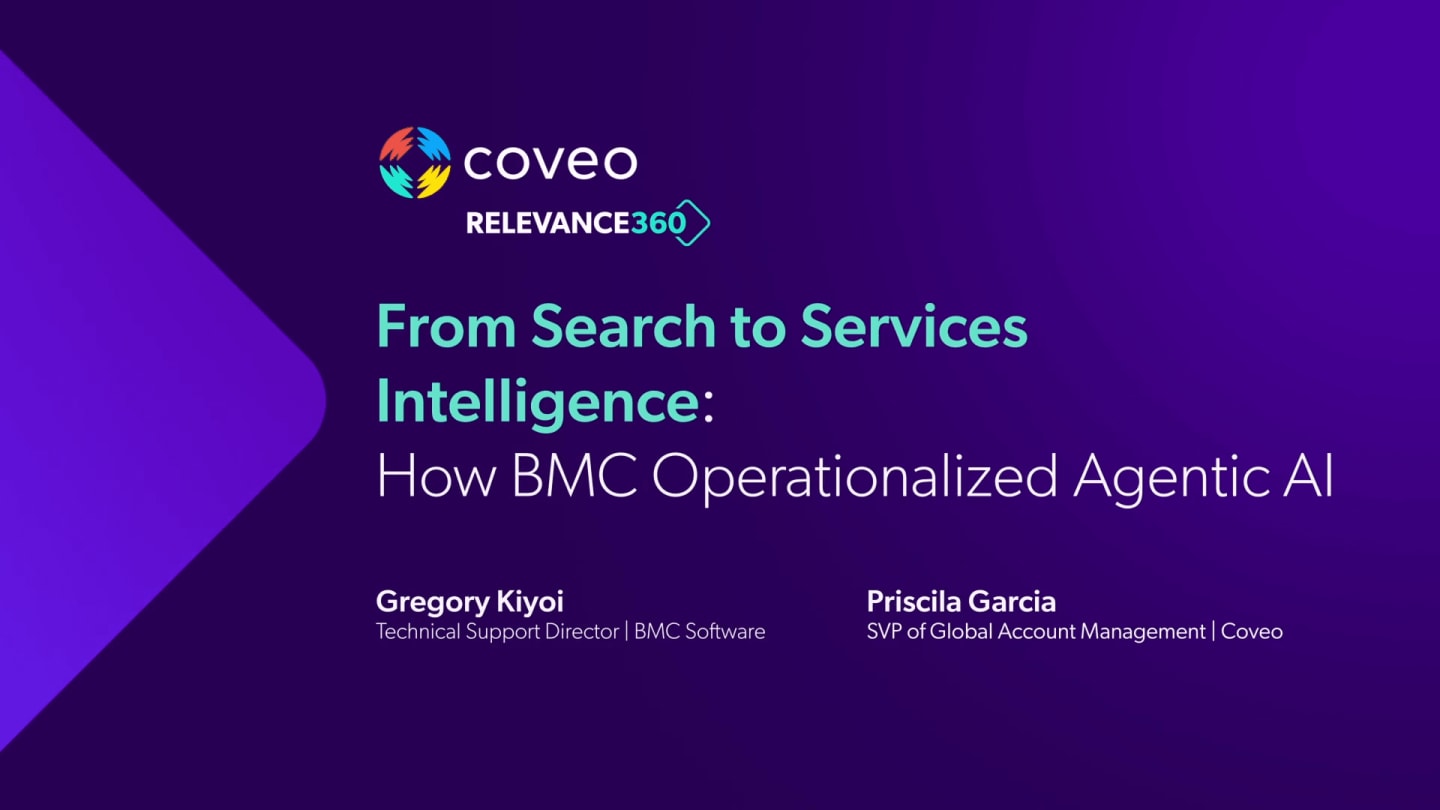
Welcome, Gregory. It's great to have you join us on Relevance three sixty. I'm very excited to hear, what you have to tell us about BMC. I know your team is dealing with highly complex enterprise software environments. So why don't you explain who you are, your role, your team, and the scale and complexity that you manage every day. Okay. Great. Thank you for having me, Priscilla. I'm a technical support director here at BMC, and my team is responsible for the next generation support tools as well as KCS, which is a critical component to support we deliver. Gosh. This includes all the AI agents, all the new fanfare that everybody's after, as well as providing these to not only our agents, but our external customers as well. These may include search capabilities as well as language translation. Obviously, finding solutions to their problems, but it's used in many different ways. But my team is responsible for these aspects within BMC support. And our support people is our main customer that we work with, and these support agents deliver support. They handle hundreds of cases per day, helping our customers with the BMC solutions. They can help with one of the products is workload automation. It may not be kind of a name like Pepsi or Coke that you're used to, but whenever you fly, before that airplane door can be closed, workload automation is the application that confirms to TSA that everything is good, all the passengers safe, everything's in order for it to depart. So really exciting product, and it's used in many different ways within many businesses we use professionally as well as just in our daily lives. Amazing. Thank you for sharing that. I think now everybody can picture what you do. And at the core of BMC's story is that this isn't just AI experimentation. Right? You've embedded AI directly across teams responsible for your customer success, including support, professional services, their customer success organization, as well as r and d. So let's start at the beginning and, you know, what problem were you trying to solve? No. That's a that's a great question. And, really, as we know from both of our perspective businesses, customers buy solutions. They are not, you know, there to spend all day opening cases, trying to get the solutions to work. They're there to run their business, and our applications and services that we sell are there to help them accomplish that. And so it's extremely important to understand as they create a support case, usually, they've spent one to seven days prior to opening that case to research, to understand, to try to self solve. So, you know, as we get a case that we may solve in, you know, an hour, we're feeling great. Hey. We solved it an hour, but their journey or their expect experiences, they've spent one to seven days before they even log that case. And so this aspect of self solve is very important, us being able to provide tools and capabilities for them to spend time running their business versus debugging, you know, our application. And so one of the important things is providing a good portal for them to accomplish this. And so this year, we did launch a portal that it it was originally the old portal was based on Coveo search, and so they had a rich experience of providing, you know, good quality results in that list. But it we've decided to elevate this to include Coveo, generative answer. And so the advantage or benefit that it has, not only can they do their search and get an answer, they can get a generative answer that now takes them to the, you know, step one, step two, step three to solve it along with the citations that that came from. So if they have any, you know, details that they need, they wanna see the source it came from, this is available to them. And this helps them, you know, cut off time instead of double clicking into each knowledge article or a document. Now they can get a really rich generative answer to kinda get back to what their day job is. And so this has been a really, really, you know, important problem to solve not only for customers, but as well as BMC. You know, case deflection is key. Every case that we take costs money, takes people's time. And, also, this isn't just a customer portal. This is something that we initially launched for our own support analysts, so they were able to leverage this. And, you know, it's kind of an interesting thing as they went on this journey. You know, we're all creatures of habit. They're used to doing keyword search, looking for an error code, looking for, you know, maybe a defect number or something. And, really, the journey has been for them to understand this keyword search isn't it. It's really ask a question, speak in a natural language to be able to get a better result, of a generated answer. So it's a journey we're on, and it is something that they're all learning because we always kind of fall back to things we're comfortable with. And so Yeah. This is a journey we're on. It only gets better, but it's something that that feedback, that experience from our TSAs helped us enable this portal for our external customers to be successful. And that journey now is taking you also in another direction. Instead of building a separate AI knowledge repository, you leverage Coveo's existing unified index that you are, you know, talking about today and connect it to Microsoft Copilot Studio using MCP. And this it's a very strategic decision. And compared to buying a new tool or building a standalone generative stack, why was leveraging Coveo as your existing AI platform the best path for, VMC? No. That's a wonderful question. And I'm gonna kinda step back. We were in a QBR, and I was presenting about some of the agents that we had within the support, you know, tool set. One was case summarization, language translation, as well as, you know, generating more and new knowledge content. And, initially, the PS organization pulled me aside after the presentation say, hey. You know, we wanna do that as well. Once I got into the meeting, it really wasn't case summarization they needed, but really, they were looking after that rich Coveo indexed, set of knowledge, documentation, all of our information. And so the conversation pivoted to, you know, how are we able to expand this not only from support, but to these other areas? And opportunistically, Coveo MCP was in beta. And so we work with our CSM. We were able to get into that program, and then almost immediately, they were able to, as you said, connect their Copilot, Azure agents directly using Coveo MCP. And now they were able to pull the same information that was available to our customers, our support people, and get that rich set of information to help them as well for their use cases. But it's not just accessing it. What it allowed us to do or what it helped with is instead of having multiple repositories of agents that index this information, so the cost of, you know, storage compute power, we're able to, you know, leverage Coveo to do this because we're already doing it. Right? So our investment was preserved. It also provided a consistency aspect. Instead of each of these different areas indexing their own, having different levels of, you know, I should say, versions of the documents or articles, they were able to have a consistent book of record. So then whether we use the customer success agent, the professional service agent, even in r and d that I'll talk to in a second, but support, the same experience was had. So this then provides trust with our customers as they use these as well as our internal personas. Because now it's always good to get the same answer when you ask multiple people or sources. And in this case, it's agents. Right? They're a part of our team as well. Brilliant. So let's talk about outcomes because you've given us already a lot of information. But, you know, you moved from a proof of concept to, you know, production usage very quickly. How has this changed the way that your teams show up for your customers? You know, how does that show up as a metric that you and the leadership team looks at every day? Yeah. There's many different aspects to this depending what organization we're talking. I'll cover a few, and then if we need to double click, let me know. But from a support aspect, it's really you know, the key is how fast can we solve a case, median days to resolve. And so it's really identifying the problem, solving it, and then getting the customer on their way. And so those aspects of how Generative Answer helps our TSAs reflects in some of the case KPIs, median days to resolve. We also median days to service restoration for our SaaS environment because, again, if it's cloud hosted, they can't do something. This is impactful to their business. So those are a few KPIs that are used within our CS side of the house. They develop success plans. What education is needed for a customer? These are things that would take hours to develop, understanding, analyzing cases, looking for knowledge, looking at this, and then building up a plan that the customer can, you know, consume, figure out what is the right path forward for, you know, maybe it's training, maybe it's consulting as needed. And so this really reduced this down. You know, I'm not gonna say hours to minutes, but it's something that now this agent's able to ask a few well defined questions and provide a, you know, acceleration plan just as output that they can action straight away. Within and I I didn't talk about a little earlier, but our r and d group. One of our r and d groups is enablement. As new resources come in, they need to get ramped up. They need to be productive faster than, you know, years or months. It needs to be, you know, days and weeks. And so what this has provided to them is they were able to again, Coveo's great at indexing information. We pointed it at all their enablement training information. And so now they're able to figure out what the math I'm sorry, what the best path forward is. And so all those available enablement curriculums are now available to these new resources, and they can find these and go down that path. So that leads to a faster enablement time. So faster path to productivity is really what that would enable. So within three different pillars of the business, there's a lot of fundamental, you know, bottom line impacts that this has as far as productivity to the customer as well as to, the internal resources, doing more with less. Right? Wow. And you and it's fascinating. I know we could be talking here for hours, and you have so many use cases. So but looking ahead, where do you see this evolving? What are you the most excited about? What's next with the partnership that we have? Gosh. You know, one of the items, you know, really a focus of the whole industry is Agentic. Right? It's great to have tools that are very, you know, purpose built for efficiencies, but the other is getting them out to the customers. And so some of the areas that we're kind of really in the middle of is, you know, one is very common request is, hey. We need a debug log to figure out what's going on to help you with that problem. And so we are developing agents that are able to analyze those files, look for patterns. Based on those patterns, then we're able to look in the indexed information, find matching knowledge. Maybe it's solved as part of a patch, and really aligning those two things together to not just help the TSA, but eventually the TSA I'm sorry. The customer would be able to self solve. Right? This is something they can upload a log file. The Agentic agent analyzes it and said, you know what? You need this latest patch. It solves this problem. And if it is a SaaS offering from ours, this Agentic agent then may just say, you know what? I've scheduled this patch to be deployed in your SaaS environment, and there's nobody human wise in BMC that was involved. It's just now the customer is able to get what they need, get an action by their new team member, a Agentic agent within BMC. Yes. So finally, if you could share one piece of advice for those that are listening to us starting or scaling their AI transformation today, what would it be? Oh, gosh. You know, it's it's really kind of a interesting thing. It's not only just, leveraging our investment within Coveo, but it's also this is a way for us to build customer trust regardless of the agent, regardless of the information that it serves. That customer getting the trust is what makes them use it. Right? Makes them invest their time to trust it, use it, and expand that use of it. And I think that's a probably a challenge that all companies have. Right? It's building agents is easy. It's getting the customer to trust what they provide and then using them. That's really what it will be the success. But I think the last thing to just talk about is is talk to your other stakeholders, your peers, and other business units and areas and pillars because I think there's a lot that can come from, you know, working together. Maybe you're on the same path of doing the same things. It's just a little different instead of support cases at success plans. So that has really helped a lot to have like minded, resources in our organization to work with and, you know, expand this. Excellent, Gregory, and excellent and great people to work with at BMC as well. But what BMC has done is a blueprint for modern service innovation if we had to call it something, and I think is is fascinating. Thank you for sharing your journey with us and for being here with us today. Thank you, Gregory. Awesome. Thank you for your time, and I appreciate the opportunity to speak with you.