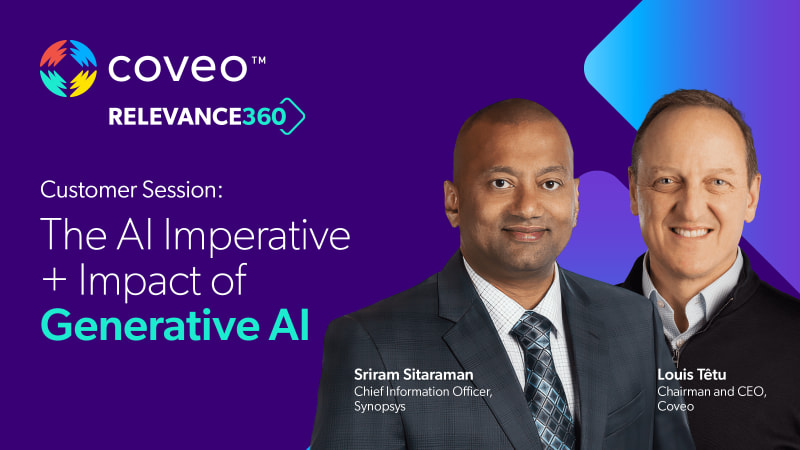
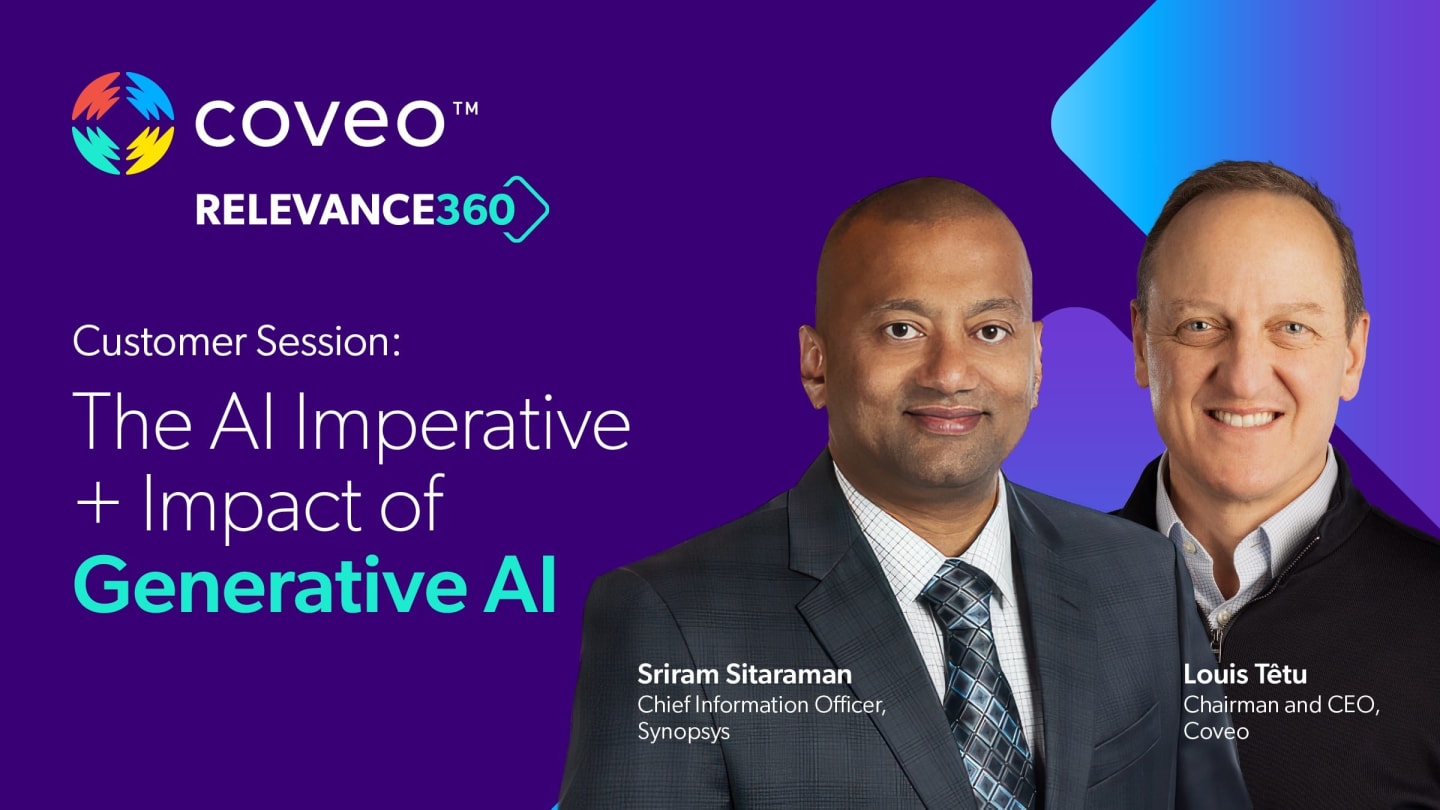
So now the next session, I have the pleasure of, talking with, Sriram Sitiram, the chief information officer of synopsis. Sriram, thanks so much for spending time with us and with our audience, today. Morning, Louis. Thank you for having me here. Sriram, first, for the audience here, synopsis is such an important, company in the technology and software landscape. Can you explain, the what the company does and, and the scale of, synopsis? Of course. Of course. So synopsis is the leading provider of EDA electronic design automation software. Semiconductor IP and a a lot of different security solutions. So if you're not familiar with this market, what that means is, you know, all the leading semiconductor companies in the world, you know, the big chip manufacturers, the big IP manufacturers, people who make smart devices, you know, the the phones, the TVs, and everything else. They use our technology to build, develop, the advanced chips that go into the smart everything's of their product line. So we essentially create software that help our customers innovate the next generation silicon chips. And we are in many different industries. Automotive internet of thing AI cloud, you know, just wherever you see it, a little bit of intelligence coming in through the electronics, we we play a a big hand on it. We also have teams that are focused on developing secure high quality software. So We have a security arm that goes out and helps organizations optimize security and quality in the desk tech ops work. So as you can imagine, creating chips is a complex process. It's a multi year, multi quarter process, and synopsis helps bring that, a lot more concise and secure. That's that's what Synopsis does. That's amazing. And, obviously, a a very leading edge, technology and software company. Sriram, so much is happening in, in AI these days. Everyone talks about it. You're a CIO of one of the import and technology companies. You know, tell us tell us about, AI and how you think about AI in the context of, of synopsis and, employee experiences and customer experiences, customer value. Oh, yeah. Yeah. You know, AI has been around for a very long time. In fact, that was one of our premises to get in touch with Coveo, right, the the whole search platform using AI. You can see AI and pretty much a lot of your interactions on the web on the, you know, in your enterprise software, things that predict things that, you know, analyze things that generate reports. They're all based off of some form of AI. We've we've relied on AI to help us get better at forecasting, predicting, analyzing, and making decisions. We relate on AI, to help us automate, manage a a large number of the, widgets that we own. So synopsis as a software company, we have, you know, several thousand widgets around the world, laptops, servers, network devices, cloud instances, software application. So AI based a very important role in connecting all up then from a from where I stand, a service point of view where my customers stand accessibility point of view. And and then the from a productivity perspective, it it helps connect all of them in an optimal way. For us, AI has been part of our core strategy in our software development world, our IT services world, finance, go to market, and several others. Now What's happened in the recent month is the GenAI. Right? So so far, we had the ability to look at and analyze data. Now we are dealing with technology that can synthesize information. Right? It looks at it looks at data, historical or not. Not only can analyze, but it can now synthesize. So we see a huge advantage from a CIO perspective I I'll give you the simplest example. So as technologies mature in the IT world, we are stuck updating documentation. Right? Go, you know, simplest things, operating systems go from version one through two through three, and you have the new feature, functionalities changed. Having having a generic component allows me to say, you know, look at all of this existing documentation And instead of pointing out a solution in an existing document, stitch all of the information from within these documents, and generate a solution. Generate a solution in the context of the user who's asking this question, not based on what information is available in the documentation. So, as you as you are showing here, we are looking at it from a employee experience and a customer experience. Now, from an employee experience, we wanna make our internal employees a lot more productive. Right? Take out the churn that they have in terms of understanding new services, new functionality that we've rolled out. Take out the churn of having to analyze, you know, thirty page documents that, we get from market research or from the product documentation. How how quickly can we say, you know, ask a question, get a summary. Maybe then start engaging with that summary to get the information that you need that is important for your job. So the employee experience, and, obviously, this is the most common use today for the generative AI is knowledge management, the lossless proprietary, we are consuming information, and then the the the AI tool generates appropriate either a summary or information or a solution. So from an employee experience, that's awesome. It's also helping us with, code development. Right? You heard of, the co pilot. Yeah. And and they actually help complete, not just complete. They review not just review and the generate unit test. Let me imagine doing all of that in a fraction of what would take an engineer, probably a day to do it. That's good. Now you still need the engineer to review, make sure it's it's consistent, it's compliant, but a lot of that could also be programmed into the GNA icon. So employee experience, it's all about taking the churn out of their daily activities and helping them, from a velocity per perspective helping augmenting them, are you really? Right. Right. From a customer perspective, very similar things. Right? So you buy three different tools. Now they come with three different documentation. How do you put them together in a flow? Now the NII could say, hey, look, if you're using the following three tools, here's how you could use them together, in a flow, and somebody is training the AI with, you know, documentation, and the AI is presenting it with context to what the customer has. Right? Maybe the customer has three other tools that are common in the industry. So stitching together all of that information is really Really cool. And finally, you know, from a core technology perspective, there's a lot of work being done at synopsis in implementing AI, gen AI, and, new technologies into our core core features. So I think that's how we look at it. It's more assistive, and then we take the same, expand with the customer, and then try to pull it into our core core functionality. Yeah. It's really it's really augmentation, and I know. I mean, you know, the big reason why why we're talking today is you guys have been such a cursor and an early adopter of AI. Now generative AI, you know, comes comes to the pick comes into the picture. You know, what are some of the I know we're doing some things together, obviously, but what are some of the how how do you think about the Jenny? What Jenny I ask? Adds to the AI capabilities and the use cases at synopsis. Great. We talked about it a little bit in my in the previous conversation, but know, the way we are looking at it is, how do we use JNAI at synopsis? Because we also realized, you know, when JNAI was introduced several months ago, clearly there was probably a decades what caused research put into it. It was not like, no, here's a new platform. Let's use it. Now that also means that there are a lot of technology partners who had access and be then they put in the appropriate effort to make specific solutions available. Right? So the way we look at it, at synopsis is configure, customize, develop. Where we wanna use configure is there's a lot of commercially available solution out of the box, implement start taking advantage, get that accelerated deployment schedule. Right? Coveo is a great example. The opening, BD is a great example. You you've essentially done the work for us on the platform that we are using. We configure and we make it available for our consumers. Customize is a little bit more work because, you know, we have some domain specific requirements. So we take the existing technology, and then we have to train it We have to augment it with maybe some ecosystem partners to say, look, while the platform's maybe sixty percent there, we need to do certain things to get it to eighty percent. And then over the next maybe year, two years, whatever it'll, it'll get to where we need it to be. So good examples are, you know, the existing Open AI does really well because it was trained on the permissible get a quote. A large books, not that it's Python, Java, JavaScript, stuff like that, but for a company like Synopsis, that our core functionality is c c plus plus Linux. It's it's a process. Right? It's not as it's not as, interesting as it for a Python code developer. So that's where we are trying to customize. We're taking it in, putting it into our existing workflows, So it doesn't it's not like a standalone system. It needs to work with an, a CICD workflow, for example. And then finally, from a developer perspective, the EDA tools are extremely domain specific, right, where you're in your whether that's verification, synthesis, mask, there's a lot of different functions that companies and industries specialize in. So we are trying to take these existing libraries incorporated into our products to help with our customers' requirements. So, again, our our process here, our thinking model is, you know, use what's available. Let's get accelerated. Get let's get that early adopted advantage. Let's build on that knowledge, customize, start including it in other parts of it while we learn how to deploy for our customers. Yeah. And and, and we know you, you, you, you're you've been an an an incredible already adopter, obviously, including, you know, working working together. As a CIO, we talked earlier in in the session in in my session earlier about this, you know, the the the CIO headaches and, and so on, you know, as a CIO, governing data, ensuring that, you know, your your your brand is is a trusted brand and, that you deliver this in an, you know, in a cost effective way and so on. Can you can you comment on on on sort of the constraints and the opportunities. And how are you dealing with all this? That's a that's an interesting question because How are you dealing changes on a monthly basis? Because, you know, the technology is changing on a monthly basis. But everything you've shown here are real concerns. Right? So experience, we talked about the configure develop configured customized, developed concept, and experience is very important because or else the consumption varies if the experience is good, the consumption is good. And so the output is generally good as opposed to how we deploy it. Again, this is so new. We don't have a really good blueprint of how to deploy it successfully and maintain the cost aspect of it, maintain the security aspect of it, maintain how content is managed what content is good, what content is bad. I I also don't want my content to leave my company. Right? So there's not a lot of clarity around what happens when the system learns. Is it going to use that information elsewhere? Because we are engaging with it today, sort of as a black box. Right? We trust the vendors to provide the security architecture Eventually, I think a lot of this will get a lot more transparent. We'll understand the inner workings. We'll get better. Accuracy comes up fairly often as well because, you know, the problem with synthesizing content is You could synthesize whatever you want. You need someone to overlook and say, yep, this may extend or This doesn't make sense. Sort of like a thumbs up, thumbs down that you see in the various GPD features. Right? That that still means that there's always going to be that doubt saying, is this accurate? Should I pull this information into my development stream? Because nine months down a development stream, you don't wanna know that a decision that you made nine months ago has an impact. But, you know, this is also true with the human way of doing things. So I think we'll learn and get better, but these are very genuine consult. Yeah. Obviously. And, and and, you know, the the accuracy, you know, That's why that's why we talk so much about relevance in in conjunction with, generative answering and so on. So those are all key considerations that, all CIOs face. Certainly, admire, your, early adopter mentality and, and and and really, the fact that, synopsis with your leadership in particular is, is really ahead, of of, of most organizations in terms of, as as you very well said, we'll we'll figure it out essentially as long as you can deploy this in the guardrails of, that that that matter, basically, that you can govern data that you don't breach security, that that, you can deliver a great experience. Sriram, as always, your your such a thought leader, on behalf of all of us at Coveo and the audience. We wanna thank you, today for spending time and, with us and, and sharing, you know, what is what is today at at synopsis, more than thought process. It's it's you're making it the reality. And an example to follow. So thank you on behalf of all the audience for spending time with us. Thank you, Louis. And I wish you success on the eleventh three sixty.